Self-Reconfigurable Wireless Mesh Network based on
Fuzzy Logic
Vijaykumar Naik Pawar
Asst Prof, RIT Goa, India
Ashwini Shahapurkar
Asst Prof, RIT Goa, India
Rajesh Gauns
Asst Prof, RIT Goa, India
ABSTRACT
Wireless Mesh Networks (WMNs) is a heterogeneous network consisting of different types of nodes and links (such as Bluetooth, wifietc). A WMN can be configured as self-Reconfigurable network where each node in the network automatically sets and maintains link connectivity among each other in the mesh network.Obtaining an optimal path in a mesh network and then maintaining QoS is always a challenging problem in multiradio WMN.In Self Reconfigurable Wireless Mesh network system the router (Access point) can take the switching decision autonomously based on the cost parameter.Therefore objective of the system is to design cost based high throughput multi radio based network. MAC estimated link bandwidth and delay in the network can together gives a good measurement of the network state in general and route state in particular. This enables the network to choose the path with high throughput.
However when the behaviour of the network is dependent on multiple parameters, resolving them is real difficult. Thus we propose a fuzzy based system to resolve the quality of the path.The objective is to combine the state of the network with routing decision as well as seamless connectivity management by integrating QoS driven service with that of handoff management.The ARS with fuzzy logic results in improved packet delivery ratio and control overhead.
Keywords
Wireless mesh networks, Self-Reconfiguration, Multiradio wireless, IEEE 802.11,fuzzy logic.
1.
INTRODUCTION
Wireless Mesh Networks (WMNs), heterogeneous networks of mesh routers and mesh clients. In mesh network routers are the key elements and has minimum movement whereas client can be either immobile or might have mobility. Therefore WMN expands the capacity of ad-hoc networks. WMN’s are not built on fixed infrastructure, which makes them different from traditional wireless networks. Here each node relies on others to keep the connection. There are two possible ways of getting connecting to the WMN's, one is by using nodes wireless network interface cards(NICs) these nodes are called conventional clients, second option is getting connected to WMN directly through mesh routers for e.g Ethernet. Therefore any type of node can get connected to WMN's, which in turn helps users to get connected to internet anytime or from anywhere. They provide network access for both mesh and conventional clients. In WMN each node operates not only as a host, but also as a router, forwarding packets on behalf of other nodes that may not be within the scope of direct wireless transmission of the destinations.[1]
A WMN can be configured as self-Reconfigurable network where each node in the network automatically sets and maintains link connectivity among each other in the mesh network. There are two aspects in this, first when multiple path to internet is available for any node it should select the best available path and secondly if there is any problem in path for eg node goes down or gateway itself goes down, it should try to find the alternative path automatically through other node so that connection is always active. Automated configuration provides many benefits to WMN, such as low installation cost, less maintenance cost, and better service coverage. WMN also provides several benefits to users such as discovering new routes automatically, zero wiring cost, simple installation etc. This makes WMN preferable in fast and easy deployment of technology.
Once the paths are obtained, source can select the path with the best cost and feasibility in terms of fuzzy cost and transmit through that path. Nodes keep on monitoring all the available access channels and quantify the quality of the link with the access points of that channel. Finally it can dynamically request a base station with better bandwidth through handoff process even while transmitting through a route. The goal is to demonstrate that admission control combined with multi metric fuzzy based bandwidth management can guarantee better QoS in mesh network. The proposed solution also helps in designing robust seamless system where route management is done at the MAC layer through handoff and over a cross layer framework where the information and channel condition gathered by MAC can be utilized by the routing layer for the routing and the routes obtained by the network layer can be used by MAC layer to determine the nodes with possibility of handoff which results in auto reconfiguration.[4]
The rest of the paper is organised as follows. Section 2 describes the related work, section 3 describes ARS architecture, section 4 describes system implementation and experimentation and section 5 concludes the paper.
2.
RELATED WORK
2.1
Link Recovery Techniques in Wireless
Mesh Network
for changes to the network reconfiguration by changing only the faulty links.
The paper “Distributed quality-of-service routing in ad hoc networks, by S. Chen and K. Nahrstedt has stated about fault tolerant routing protocol- Multipath routing, which can be adopted to avoid faulty links”. This technique depends upon a duplicate transmission path which will need more amount of resources.
“Blacklist-aided forwarding in static multihop wireless networks, by S. Nelakuditi, S. Lee, Y. Yu, J. Wang, Z. Zhong, G. Lu, and Z. Zhang” the authors proposes one more technique of recovery from link failures in wireless mesh networks that is "local rerouting". Whenever a link failure occurs the routing protocol can route the packet via a different link.
“Self Reconfigurable wireless mesh network by kyu-hankim and Kang shin ” [3] in this paper authors have proposed a automated reconfigurable system for wireless mesh networks This provides the reconfiguration plan automatically, to have real time recovery from link failure. ARS allows multi-radio WMN to automatically change the local network configuration settings such as change in radio or change in pathalignment without human intervention, so that it can quickly recover from the local link failures and return to normal operation. The main module of ARS algorithm is the scheduling algorithm that identifies local configuration to be changed for link recovery, thus bringing network back to a healthy state. In another words, system initially finds the local reconfiguration plans that are available around a defective area and then searches for a feasible local configuration based on current channel and radio associations.
Our contribution two aspects: Firstly we propose a unique admission control based routing which is a variant of DSDV protocol where a router participates in routing only if it has sufficient bandwidth to meet the demand. Secondly we offer a unique fuzzy based solution by incorporating bandwidth and delay metrics to resolve the best available connection for a node and update the route on the fly by changing the connected access point/ base station through appropriate handoff which results in auto reconfiguration. This mechanism is called automated reconfiguration.
2.2
Need for Self Reconfiguration
• Recovering from link-quality degradation:Link quality is defined as the communication quality between two nodes. Communication quality can be given by several factors such as Bandwidth, Delay, and Power. Several wireless networks such as Wifi, Bluetooth might be operating on the same radio or nearby radio, due to this severe interference it leads to link quality degradation between the nodes in WMN's. This problem can be solved using the concept of "channel switch".
• Satisfying dynamic QoS demands:Links around places, such as conference rooms may not be able to accommodate increased demands for quality of service to end users. Another example is if we are watching YouTube videos it is not possible to see it without jitter on a 2G connection because requirement of bandwidth is higher. In order to provide large amounts of data in real time the concept of radio switched can be used. This is accomplished by reallocating highly loaded radio to less loaded radiusradios.
• Coping with heterogeneous channel availability:A channel is basically characterized by delay, data rate and bit rate. We can declare a heterogeneous channel where links between nodes could vary for example it can include ethernet
line or a 3G connection or a 2G connection. A mesh network supports this heterogeneous type of connection.
2.3
Bandwidth calculation
In this work as an parameter MAC bandwidth. However a detailed overview of the entire bandwidth estimation model is presented bellow starting with proposed bandwidth.
If a node transmits N bytes per second to another node, the physical bandwidth between them is said to be N Bps. It is also termed as the data rate in a link. The Physical bandwidth is dependent on the type of channel and the channel capacity to be very precise. It is said to be constant at any given instance of time. Because of its invariant nature it is said to be a bandwidth of least significance to a homogeneous network. Theoretically Bandwidth can be defined as the number of packets a given link can handle.
Bmacα 1/Td (1)
Where Bmac is the Sensed bandwidth by the MAC ,Td is the transmission delay in the link.
Td=Tc+Tideal (2)
Where Tc is the Delay due to congestion or presence of other packets.Tideal is the delay, which is estimated as bellow
Tidealα i/Dl (3)
Where Dl is the distance between two nodes in a link.The delay measurement is elaborated in the subsequent segments.
Bresidual=Bactual-Bused (4)
Simplifying (4) with (1) and (2) we get
Bmac =Bresidual(5)
In the system there are two possible ways of calculating delay. First option is called the Average delay; in this method each node sends the "Hello" packet to the neighboring node. When the "Hello" packet is received by the neighbor, delay can be directly calculated by subtracting the packet delivery time from the packet arrival time.
2.4
Mutliradio WMN
Wireless network is where there is more than one access point. There are multiple nodes, multiple access point can communicate with each other and then get connected to the gateway. The advantage of this architecture is if any node goes down, it can select another node as is neighbor on the path to the destination. Whereas in a single radio
configuration there are several nodes and one access point and the access point is connected to the gateway. Mostly channel related link failures are due to the lack of bandwidth, lack of energy drainage of nodes or due to lack of very high power
3.
ARS ARCHITECTURE
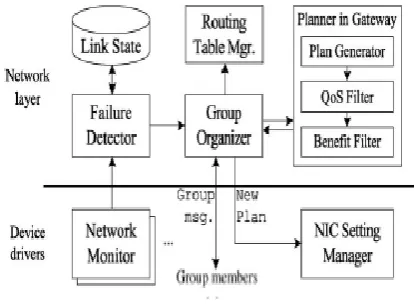
[image:3.595.66.274.136.290.2]Automated reconfiguration enabled wireless mesh network is a distributed system that is easily deployable in IEEE 802.11-based mr-WMNs. Running in each mesh node; ARS supports self-reconfigurability. [3]
Fig. 2. ARS Architecure
Initially system keeps on monitoring the state of the network using the network monitor module. The routing table has entries of the paths available in the network. All the entries saved in the routing table should satisfy the required QoS. The failure detector detects any of the link failures and when there is a link failure automatically it changes the route. And then these plan's are distributed to all the group members. In the proposed work, planning is QoS aware, based on the Bandwidth and the delay parameters, it selects the best plan among the available multiple plans. Along the route if any of the nodes fails to satisfy the demands, it selects the next best available option. The benefit filter is the fuzzy logic used in the system, and based on the fuzzy bandwidth and delay values a decision is made.
3.1
Algorithm
1. calculate Etx at each node with the of probing hello packets.
2. Generate RREQ packet. Append needed bandwidth
3. Nodes receiving RREQ forwards the request only if it’s available BW> demand bandwidth.
4. Before forwarding node appends it’s bandwidth in RREQ packet.
5. At destination average BW is calculated. Packet delay is calculated from Receive time-Sending Time.
The best route is selected based on RouteQuality. Quality=FuzzyOut(BW,Delay).
6. Destination node replies by transmittig RREP packet. While transmission some nodes may overhear this packet that is not intended for it. This accounts to interference and the overheared packet is dropped.
7. Multiple paths are obatined and the path with high cost (Quality)is selected .
8. Data is transmitted over the selected path
9. When the nodes move, mobility model sends message to physic layer.
10. Physic layer initiates channel quality assessment by looping through the signal from all the access point.
11. Physic layer finds the access point with base station and request for a handoff which results in auto reconfiguration.
12. Once the access point is switched, path is changed locally through new access point.
13. For routing, flood control technique is adopted by restricting the route hops bellow 5.
14. This mechanism is compared with present DSDV based system where only admission control is employed for QoS.
The proposed system initially looks for a viable network configuration changes locally in case of a link failure around the faulty area, depending on the current radio. Then the system generates number of reconfiguration plans to automatically recover from this link failure. The main advantage of this system is that it does minimum amount of changes in the network configuration of the surrounding healthy network. Next Automated Reconfiguration system also has a monitoring module that continuously monitors the state of the network. The planning algorithm uses this link quality information to determine the network changes to be done, in-order to meet the required QoS demands. Suppose we are watching a YouTube video on laptop, there are might multiple interface's to internet available such as modem, Bluetooth, wifi etc. whenever one of the currently used internet connection goes down, so in this case it has to automatically select the other available connection and keep the connection active without any of the human intervention.
4.
SYSTEM IMPLEMENTATION &
EXPERIMENTATION
We have implemented ARS using Omnetpp3.3p2 network stimulator. OMNeT++ is an object oriented, modular discrete network simulator. Developed in 1998, it is still new product. It is an open source package. This simulation package built based on C++ language foundation, it offers class library, GUI support (animation of network environment and graphical network editing). This kind of simulator can be used for modelling queuing networks, validating hardware architectures, traffic modelling and to measure evaluation performance of complex systems. OMNET has got a Network definition window(NED), within NED we can create network architecture and place the nodes and make network connections between these nodes. Any network in OMNET is named as a module. Any node such as computer, mobile or gateway will be a part of module and will be known as a simple module or a submodule. Path which connects these two sub modules are called connections. In order to work with OMNET first we create the network definition and then attach the required functionality through C/C++ file.
4.1
Implementation Details
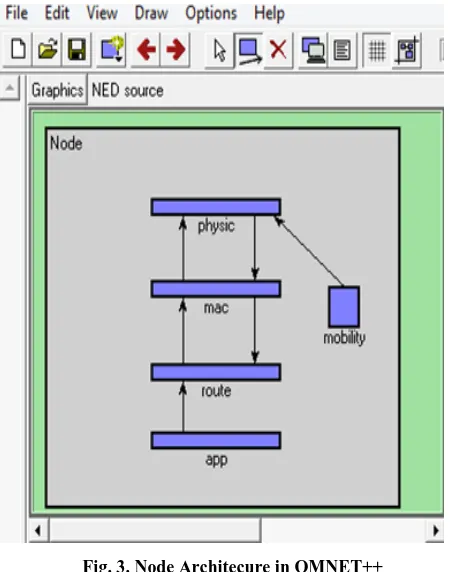
Fig. 3. Node Architecure in OMNET++
4.2
Fuzzy Based Systems
[image:4.595.314.544.334.703.2]When the system generates the route reply packets, the paths on which these packets would be send will depend on the fuzzy rule set. the block diagram of the fuzzy system is as shown in the figure 3. The first step is the fuzzification where the numeric values (ie of bandwidth and delay) are converted into fuzzy values and then each nodes checks for bandwidth and delay values with the reference values. Then bandwidth and delay will be classified as low, medium or high. The fuzzy rule set table is created based on the fuzzy values and it generates a output which is used in the decision system.[5].
Fig. 4. Fuzzy System
4.3
Experimentation Details
To evaluate our implementation, we have first constructed a heterogeneous multi hop wireless mesh network. There are a total of 35 nodes over an area of 950*950. One of the nodes is assumed to be a internet node. Objective of all the other nodes is to get connected with the internet. The source node will be transmitting data from the application layer, which will go routing layer(all routing table activities such as RREQ, RREP, RERR, hello packets) are done over here. And that would go to MAC layer and then move to physical layer. The Mobility to any node will be done by the mobility layer, which changes the X and Y location of the nodes.
4.4
Experimentation Details
We evaluated the improvements achieved by ARS using fuzzy logic, including throughput and packet delivery ratio, latency and control overhead.
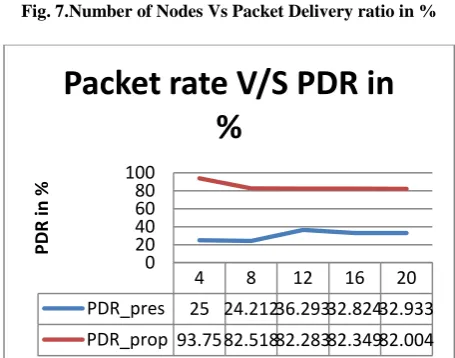
1. Packet Deliver Ratio: Throughput is the ratio of data delivered and data send. We also set the bandwidth requirement of every link to 20 Mb/s and delay of 12 ms.The graph shown in the figure 4, number of nodes in the WMN is compared with packet delivery ratio. Packet delivery ratio of proposed work is higher than present system. The graph shown in the figure 5, Packet Rate in the WMN is compared with packet delivery ratio. Even when the packet rate is varied the packet delivery ratio is higher in ARS with fuzzy logic.PDR_pres represents packet delivery gains without fuzzy logic whereas PDR_pros represents packet delivery gain with fuzzy logic.
2. Control Overhead. Avoid Control Overhead is defined as the ratio of Data delivered and control packets send. Where control packet sent id the summation of all packets sent during transmission.The graph shown in fig 6 shows comparison between number of nodes and Control Overhead (CO).According to analysis CO for proposed system is much better compared to present system.
Fig. 5.Number of Nodes Vs Control Overhead
Fig. 6.Packet Rate Vs Control Overhead 70 65 60 55 50 45 40 35 30 25 CO pres 1.1 1.5 0.9 0.6 0.9 2.3 0.9 0.8 3.6 1.9 CO_prop 2.1 2.2 2.6 2.1 2.4 2.2 2.1 2.1 2.1 2.1
0 1 2 3 4
Co
n
tr
o
l Ov
e
rh
e
ad
No of Node V/S
Control Overhead
4 8 12 16 20
CO pres 2.2558 0.5222 0.2964 0.3498 0.3088 CO_prop 2.2 1.2318 1.324 1.1695 1.2393
0 1 2 3
Co
n
tr
o
l Ov
e
rh
e
ad
[image:4.595.57.274.500.635.2]Fig. 7.Number of Nodes Vs Packet Delivery ratio in %
Fig. 8.Packet Rate Vs Packet Delivery ratio in %
5. CONCLUSION
Wireless mesh networks are generally used to provide seamless internet connection within low to medium topology changes. Generally such a network is conceived as more reliable due to fixed access points. However if the nodes are mobile, then their QoS and link quality of Access points keeps
varying. Thus routing must be suitable enough to guarantee that there is no failure or minimum failure. In this system as cost based multipath routing is used, the QOS parameters lifetime, latency can be improved. We also offered automatic changing of paths, topology by handoff and by selecting alternative routes. This is called reconfiguration. Therefore QoS driven routing, automated reconfiguration and best path transmission ensures better network performance. By combining intelligent fuzzy based system we achieve better PDR in comparison to pure admission control system.
6. FUTURE SCOPE
Internet traffic is steadily growing due to increaing service demands and number of users. therefore power consumption might play a vital role for its futher growth.The system can be further improved by incorporating parameters like Energy of the nodes and link strength in the fuzzy decision system.
7. REFERENCES
[1] I. Akyildiz, X. Wang, and W. Wang, “Wireless mesh
networks: A survey,” Comput. Netw., vol. 47, no. 4, pp. 445–487, Mar. 2005.
[2] M. Alicherry, R. Bhatia, and L. Li, “Joint channel
assignment and routing for throughput optimization in multi-radio wireless mesh networks,” in Proc. ACM MobiCom, Cologne, Germany, Aug. 2005, pp. 58–72.
[3] yu-Han Kim and Kang G. Shin, IEEE/ACM TRANSACTIONS ON NETWORKING, “Self-Reconfigurable Wireless Mesh Networks ”, APRIL 2011
[4] Mehajabeen Fatima, Roopam Gupta,R.Venkatesh , T.K. Bandhopadhyay .“ Route Discovery by Cross Layer Approach for MANET“International Journal of ComputerApplications , January 2012.
[5] Len Malinin " On Application of Fuzzy Logic to Decisions Making in Solving Inventive Problems"“International Journal of Computer and Information technology
[6] R. Draves, J. Padhye, and B. Zill, “Routing in multi-radio, multi-hop wireless mesh networks,” in Proc. ACM MobiCom, Philadelphia, PA, Sep. 2004, pp. 114–128.
70 65 60 55 50 45 40 35 30 25 PDR_pres 33 25 56 50 45 25 78 67 57 58 PDR_prop 100 97 100 100 100 94 100 100 97 97
0 50 100 150
PD
R
No of Nodes V/S PDR
in %
4 8 12 16 20
PDR_pres 25 24.212 36.293 32.824 32.933
PDR_prop 93.75 82.518 82.283 82.349 82.004 0
20 40 60 80 100
PD
R
in
%
[image:5.595.52.280.234.413.2]