
© 2019, IRJET | Impact Factor value: 7.34 | ISO 9001:2008 Certified Journal
| Page 948
STUDY OF SQUARE CONCRETE COLUMN BEHAVIOR CONFINED WITH
CFRP SHEETS
V Hema Sumana Sri
1, P Hanuma
2M.Tech, Structural Engineering
1, Assistant Professor
21,2
Sri Sunflower College of Engineering and Technology, Lankapalli, Andhra Pradesh
---***---
Abstract:- In this report study is carried out in
determining the axial shortening and Axial loading for these test total of 30 columns specimen were casted. It includes plain control column 6 no’s, reinforced column with a minimum steel 0.8% of cross section of 6 no’s and 18 no’s plain strengthen column with different layers of CFRP one, two and three in transverse direction for different grades of concrete M 20, M 30 and M 40. The use of externally bonded fiber reinforced polymer (FRP) composites has become increasingly popular for the repair and retrofitting of concrete structures. The popularity of FRP composites is due to their well-known advantages, including a high strength-to-weight ratio and excellent corrosion resistance. One important application of FRP composites is as a confining material for the retrofitting of existing reinforced concrete (RC) columns with FRP jackets. The carbon fiber used in this study is readily available in the market under the trade name “Nitowrap”. The fibers are wrapped around the column with the help of the epoxy adhesive. Results of the experimental works shows that rounded sharp increases load carrying capacity efficiently increases up to the two layers of wrapping of CFRP in the transverse direction, whereas ductility increases up to the three layers of wrapping as compared to control. Toughness index of the strengthened column increases with increase in grade of concrete, increases with increasing the number of CFRP sheet layers.
Keywords: CFRP, FRP, RC columns
I.
INTRODUCTION
Concrete is one of the vital materials for infrastructure development due to its versatile application, globally its usage is second to water. Concrete is one of the most widely used construction material. Since the day of its advent, concrete has been undergoing changes as a material and technology. Due to the growing needs of performance and durability of concrete there has been a continuous search for upgrading the properties of concrete. Concrete being the most versatile construction material and is used in a wide range of civil engineering structures and structural elements all over the world. Concrete is the most widely used engineering material due to number of reasons.
First, concrete possesses excellent resistance to water. The durability of concrete to some aggressive waters is responsible for the fact that its use has been
extended to many hostile industrial and natural environments. The second reason for the widespread use of concrete is the case with which structural concrete elements can be formed into a variety of shapes and sizes. This is because freshly made concrete is of a plastic consistency, which permits the material to flow into prefabricated formwork. The third reason for the popularity of concrete with engineers is that it is usually the cheapest and most readily available material on the job. The principal ingredients for making concrete are Portland cement and aggregates that are relatively inexpensive and are more commonly available in most areas of the world.
II. MATERIALPROPERTIES
A. Cement:
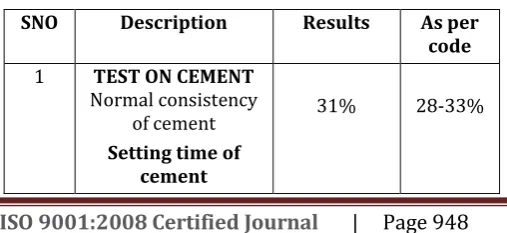
For the experimental work ordinary Portland JSW 43-grade cement was used. It was tested as per IS: 4031-1988 recommendations for hydraulic cement. The results are tabulated in Table-1.
B. Fine Aggregate:
Fine aggregate is defined as the aggregate which can pass through 4.75 mm IS sieve according to provisions of IS: 383—1970. It is also known as sand size aggregate. The locally available river sand has been used as fine aggregate. The properties of fine aggregate are tabulated in Table-1.
C. Coarse Aggregate:
[image:1.595.307.561.676.792.2]20 mm down size crushed granite aggregates are used in the present work. The tests are conducted on coarse aggregates to determine the specific gravity and fineness modulus. The test results obtained are tabulated in Table-1.
Table 1: Physical Properties Of Materials
SNO Description Results As per
code
1 TEST ON CEMENT
Normal consistency of cement
Setting time of cement
© 2019, IRJET | Impact Factor value: 7.34 | ISO 9001:2008 Certified Journal
| Page 949
Specific gravity offine aggregate 2.6
3 TEST ON COARSE
AGGREGATE
Fineness modulus of coarse aggregate Water absorption of
coarse aggregate Specific gravity of
coarse aggregate
2.56 %
0.5 %
2.7
D. Water:
Water used in concrete shall be free from sewage, oil, acid, strong alkalis or vegetable matter, and also shall be free from clay and loam. The water used is potable, and is satisfactory to use in concrete. Tap water supplied in the Sri sunflower college of Engineering and Technology is used for casting and curing of concrete specimen used in the experimental work.
E. Reinforcing Steel:
Mild steel bars of yield stress 415 MPa have been used for longitudinal and transverse reinforcement in case of reinforced columns.
F. CARBON FIBERS And EPOXY Adhesive:
[image:2.595.36.292.61.397.2]The carbon fiber used in this study is readily available in the market under the trade name “Nitowrap”.
Table 2: Properties of Nitowrap Carbon Fiber
S NO PROPERTY VALUE
1 Fiber orientation Unidirectional 2 Weight of fiber 200 g/m2 3 Fiber thickness 0.11mm 4 Ultimate elongation 1.5%
5 Tensile strength 4900 N/mm2 6 Tensile modulus 285x103N/mm2
available ordinary Portland Cement (OPC), crushed granite jelly (20 mm down) and river sand and Glenium B233 are used in the present investigation. Mix designs of these three grades of concrete are based on the guide lines of IS 10262-2009. Standard cubes (150mmX150mmX150mm) were used to determine the compressive strength of the concrete. Based on the test results with number of trial mixes the mix proportions are finalized.
Table 3: Details of Concrete Mix Proportions
S NO Mix Desig natio n
propor
tion Ratio W/B Super Plasti cizer % by wt of ceme nt Comp .stren gth @28 days( N/m
m2)
Slump (mm)
1 M20 1:1.82:
3.36 0.5 0.2 28.66 75
2 M30 1:1.66:
3.06 0.45 0.2 38.25 70
3 M40 1:1.48:
2.75 0.4 0.2 46.69 68
IV. TESTSANDRESULTS
In this report, study has been done to know the effect of axial load carrying capacity by wrapping CFRP sheets to the concrete column for different grades of concrete are discussed.
Axial Load and Axial Shortening Curve of Column:
Axial Load and Axial Shortening for Plain
[image:2.595.308.562.377.566.2]© 2019, IRJET | Impact Factor value: 7.34 | ISO 9001:2008 Certified Journal
| Page 950
[image:3.595.48.273.264.476.2]Graph 1: Axial Load v/s Axial Shortening for Unconfined Column
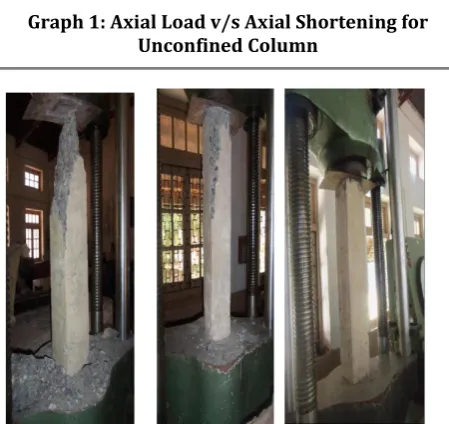
Figure 1: Failure Pattern of Unconfined Different Grades of Concrete Columns
Axial Load and Axial Shortening for Reinforced
Column
Graph 2: Axial Load v/s Axial Shortening for Reinforced Column
[image:3.595.307.558.318.486.2]M20RC
M30RC
M40RC
Figure 2: Failure Pattern of RC Column with Different Grade
Axial Load and Axial Shortening for Single
Layer Strengthened Column
Graph 3: Axial Load v/s Axial Shortening for One Layer CFRP Confined Column
Axial Load and Axial Shortening for Two
Layers CFRP Strengthened Column
© 2019, IRJET | Impact Factor value: 7.34 | ISO 9001:2008 Certified Journal
| Page 951
[image:4.595.44.281.322.521.2]Graph 5: Axial Load v/s Axial Shortening for Three Layers CFRP Confined Column
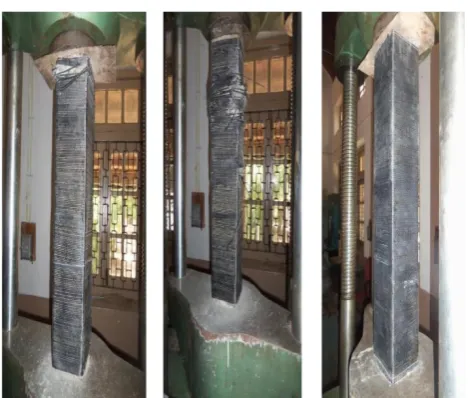
Figure 3: Failure Pattern of CFRP Strengthened Column with Different Layers
Axial Load Carrying Capacity of Column
Specimen Ultimate Axial
Load(KN) at Ultimate Axial Axial Shortening
Load(mm)
M20 M30 M40 M20 M30 M40
PCC 225.6 307.8 447.8 6.0 7.0 7.0
RCC 341.2 434.6 522.5 5.5 7.0 6.5
CF-I
LAYER 556.2 582.4 690.4 8.0 7.0 6.5
CF-2
LAYER 655.3 678.2 749.0 5.5 6.0 6.0
CF-3
LAYER 566.7 617.6 710.2 6.5 6.0 6.5
Graph 6: Ductility Indices of Column for Different Grades of Concrete and Layers of Wrapping
Toughness Index
Graph 7: Toughness Index of M20 column
© 2019, IRJET | Impact Factor value: 7.34 | ISO 9001:2008 Certified Journal
| Page 952
Graph 9: Toughness Index of M40 column
Stiffness
Graph 10: Stiffness of plain column
Graph 11: Stiffness of RC column
Graph 12: Stiffness of 1L strengthened column
Graph 13: Stiffness of 2L strengthened column
© 2019, IRJET | Impact Factor value: 7.34 | ISO 9001:2008 Certified Journal
| Page 953
combination of delamination and rupture of CFRPjacket and three layered strengthened columns failed by the mere delamination of CFRP jacket.
The increase in load carrying capacity for RC column is 36.37% as compared to plain column.
The increase in load carrying capacity for one, two and three layers strengthened columns are 96.64%, 126.02% and 103.49% as compared to plain column.
The increase in load carrying capacity for one, two and three layers strengthened columns are 43.04%, 63.82% and 48.04% as compared to RC column.
Toughness index of the carbon fiber wrapped columns, increases with increase in grade of concrete and increases with increase in the number of CFRP sheet layers.
Proposed analytical models (Theriult and Neale. 2005) predict reasonable axial load capacities of wrapped column.
9. Plain column wrapped with one layer carbon fibers shows 43.04% more axial capacity than R.C column. Hence wrapped plain column can replace R.CC column.
The stiffness is found to be maximum for wrapping with two and three layers specimen as compared the one layer wrapping specimen, RC and plain column.
Two layers of plain column with M40 grade concrete shows better performance in all respects.
SCOPE OF FURTHER WORK:
The present experimental investigation deals with
the axial compressive strength of concrete columns of different grade strengthened with one, two and three layers CFRP in the transverse direction
The present study can be extended by using the reinforced concrete instead of plain concrete strengthened with the CFRP to see the effect on load carrying capacity and ductility of column. The study can be extended to behavior of plain and
reinforced column strengthened with the CFRP
concrete confined by carbon fiber composite jackets”, journal of material in civil Engineering, Vol 12, pp 139-146.
King Hwee Tan (2002)., “ Strength enhancement of rectangular reinforced concrete columns using fiber reinforced polymer”, journal of composite for construction, Vol 6, pp 175-183.
M. Reza Esfahani, M. Reza Kianoush(2005)., “Axial compressive strength of reinforced concrete columns wrapped with fibre reinforced polymers”, Vol. 18, No. 1-11
Lei Ming Wang, Yu Fei Wu (2007)., “Effect of corner radius on the performance of CFRP confined square concrete columns”, Engineering structures, Vol. 30, pp 493-505.
A.R.Rahai, P. Sadeghian, M.R. Ehsani (2008)., “Experimental behavior of concrete cylinders confined with CFRP composites”, 14th world conference on earthquake Engineering.
Carlos Chastre, Manuel A.G. Silva (2010)., “Monotonic axial behavior and modeling of RC circular columns confined with CFRP”, Engineering structures, Vol. 32, pp 22682277.
Manuel A.G. Silva (2011)., “Behavior of square and circular columns strengthened with aramidic or carbon fibers”, Construction and building materials, Vol. 25, pp 3222-3228.
T. Trapko, M. Musial (2011)., “The effectiveness of CFRP materials strengthening of eccentrically compressed reinforced concrete columns”, Archives of civil and mechanical Engineering, Vol. 11, No. 1, pp 250-262.
N. Chikh, M. Gahmous, R. Benzaid (2012)., “Structural Performance of High Strength Concrete Columns Confined with CFRP Sheets”, Proceedings of the World Congress on Engineering, Vol. 3.
Bentur. A and Mindess. S. (2007)., “Fibre reinforced cementitious composites.” 2nd ed., Taylor & Francis, Oxon.
© 2019, IRJET | Impact Factor value: 7.34 | ISO 9001:2008 Certified Journal
| Page 954
Hegde, R. R Dahiya, Kamath, M.G.(2004)., “Carbon fibers”
Pierre Rochette and Pierre Labossiere (2000)., “Axial testing of rectangular Column models confined with composites”, Journal for composites for construction, vol.4, No.3.
ACI 440.2R-02 “Guide for the design and construction of externally bonded FRP systems for strengthening concrete structures”.
IS: 10262-2009 recommended guidelines for concrete mix design.
IS: 456-2000 Plain concrete and reinforced concrete code of practice.
IS: 383-1970 specification for coarse and fine aggregate from natural sources for concrete.

![1 Ethyl 2 tosyl 4,4,6 trimethyl 2,3,3a,4 tetrahydro 1H pyrrolo[3,4 c]pyrano[6,5 b]quinoline 11(6H) one monohydrate](data:image/gif;base64,R0lGODlhAQABAIAAAP///wAAACH5BAEAAAAALAAAAAABAAEAAAICRAEAOw==)