Segment-Level Neural Conditional Random Fields
for Named Entity Recognition
Motoki Sato1,2 Hiroyuki Shindo1,2 Ikuya Yamada3 Yuji Matsumoto1,2 1 Nara Institute of Science and Technology
2 RIKEN Center for Advanced Intelligence Project (AIP) 3 Studio Ousia
{sato.motoki.sa7, shindo, matsu }@is.naist.jp,[email protected]
Abstract
We present Segment-level Neural CRF, which combines neural networks with a linear chain CRF for segment-level se-quence modeling tasks such as named entity recognition (NER) and syntactic chunking. Our segment-level CRF can consider higher-order label dependencies compared with conventional word-level CRF. Since it is difficult to consider all possible variable length segments, our method uses segment lattice constructed from the word-level tagging model to re-duce the search space. Performing exper-iments on NER and chunking, we demon-strate that our method outperforms con-ventional word-level CRF with neural net-works.
1 Introduction
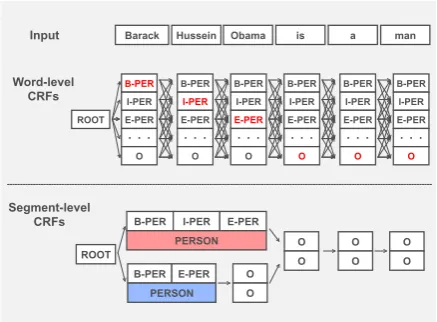
Named entity recognition (NER) and syntactic chunking are segment-level sequence modeling tasks, which require to recognize a segmentfrom a sequence of words. A segment means a se-quence of words that may compose an expres-sion as shown in Figure 1. Current high per-formance NER systems use the word-level lin-ear chain Conditional Random Fields (CRF) ( Laf-ferty et al., 2001) with neural networks. Espe-cially, it has been shown that the combination of LSTMs (Hochreiter and Schmidhuber, 1997;
Gers et al., 2000), convolutional neural networks (CNNs) (LeCun et al.,1989), and word-level CRF achieves the state-of-the-art performance (Ma and Hovy,2016). Figure1shows an overview of the word-level CRF for NER.
However, the word-level neural CRF has two main limitations: (1) it captures only first-order word label dependencies thus it cannot capture
Barack Hussein Obama is a man
Word-level
Figure 1: The difference between word-level CRF and segment-level CRF. The segment-level CRF can consider higher-order label dependencies.
segment-level information; (2) it is not easy to in-corporate dictionary features directly into a word-level model since named entities and syntactic chunks consist of multiple words rather than a sin-gle word. To overcome the limitation of first-order label dependencies, previous work propose the higher-order CRF, which outperforms first-order CRF on NER task (Sarawagi and Cohen, 2005) and morphological tagging task (Mueller et al.,
2013).
In this paper, we extend a neural CRF from word-level to segment-level and propose Segment-level Neural CRF. Our method has two main advantages: (1) segment-level linear chain CRF can consider higher-order word label dependen-cies (e.g., the relations between named entities and the other words); (2) it is easy to incorporate tionary features into the model directly since a dic-tionary entry and a segment (e.g., a named entity) are in one-to-one correspondence.
Our experiments on chunking and NER demon-strate that our method outperforms conventional word-level neural CRF.
2 Word-level Neural CRF
As a baseline method, we use word-level neu-ral CRF proposed by (Ma and Hovy,2016) since their method achieves state-of-the-art performance on NER. Specifically, they propose Bi-directional LSTM-CNN CRF (BLSTM-CNN-CRF) for se-quential tagging. Here, we briefly review their BLSTM-CNN-CRF model.
Let wt be the t-th word in an input sentence andCt =c(1)t , . . . , c(tk)be the character sequence of wt. BLSTM-CNN-CRF uses both word-level embeddingwt ∈ Rdword and character-level em-bedding ct ∈ Rdchar. Given a word sequence
X=w1, . . . , wn, the model outputs a score vector
otas follows.
ct = CNNchar(Ct),
xt = wt⊕ct,
ht = Bi-LSTM(xt,ht−1,ht+1) (1)
= LSTMf(xt,ht−1)⊕LSTMb(xt,ht+1),
ot = softmax(WT Ght+bT G),
where CNNchar is the character-level CNN func-tion, ⊕ is the concatenation of two vectors, LSTMf is the forward LSTM function, LSTMb is the backward LSTM function, Bi-LSTM is the Bi-LSTM function, respectively. Then, WT G ∈
R|T |×dhidden is the weight matrix to learn,bT G ∈ R|T | is the bias vector to learn,|T | is the size of
tag setT,dhiddenis the size of hidden layer of Bi-LSTM, andot∈R|T |is the score vector in which each element is the probability of a possible tag.
In BLSTM-CNN-CRF, CRF is applied to the output layer. The conditional probability of CRF is defined as follows:
ϕ(yi−1, yi, o(iyi)) = exp(o(iyi)+Ayi−1,yi),
p(y|o;A) =
n
∏
i=1
ϕ(yi−1, yi, o(iyi))
∑
y′∈Y n
∏
i=1
ϕ(yi′−1, yi′, o(yi′)
i )
,
whereϕ(yi−1, yi, o(iyi))is the potential function1,
yi ∈ {0, . . . ,|T |−1}is the index of tag,o(ij)is the
j-th element of the vectoroi. Then,A∈R|T |×|T | is a transition score matrix,Ayi−1,yi is a transition
1While (Ma and Hovy, 2016) defineϕ(yi
−1, yi, oi) = exp(Wyi−1,yioi+Ayi−1,yi)as the potential function where
Wis the weight vector corresponding to label pair(yi−1, yi), we use the simple potential function here.
score for jumping from tagyi−1toyi, andY indi-cates all possible paths.
At test time, the predicted sequence is obtained by finding the highest score in a all possible paths using Viterbi algorithm as follows:
˜
y = argmax
y∈Y p(y|oi;A). 3 Segment-level Neural CRF
In this section, we describe our proposed method. Our segment-level neural CRF consists of the fol-lowing two steps:
(i) A segment lattice is constructed from a se-quence of words by pruning unlikely BIO tags to reduce a search space. This is because it is difficult to consider all possible variable length segments in practice.
(ii) We use a linear chain CRF to find the highest score path on the segment lattice.
3.1 Constructing Segment Lattice
Asegment latticeis a graph structure where each path corresponds to a candidate segmentation path as shown in the lower part of Figure 1. The segment lattice is a kind of semi-Markov model (Sarawagi and Cohen, 2005). To construct the segment lattice, we firstly give an input sentence to the word-level tagging model, then obtain the score vectorotfor each word that gives the prob-abilities of possible BIO tags. Then, we generate the candidate BIO tags whose scores are greater than the thresholdT. After that, we construct the segment lattice by generating admissible segments from the candidate BIO tags. For example, we generate thePERSONsegment from the candidate BIO tags{B-PER,I-PER,E-PER}.
The threshold T is a hyper-parameter for our model. We describe how to choose the threshold
T in Section 4.3. While it has been shown that the CRF layer is required to achieve the state-of-the-art performance inMa and Hovy (2016), we observe that the CRF has no significant effect on the final performance for the lattice construction. Therefore, we use BLSTM-CNN (without CRF) as the word-level tagging model in this paper.
3.2 Segment-level Vector Representation
Segment-level CRFs
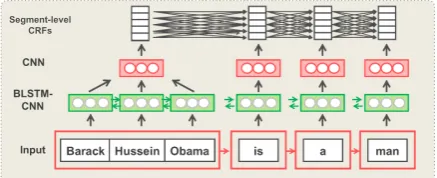
Figure 2: Details of the Segment-level Neural CRF model.
segment-level vector representation for neural net-works.
Figure2shows the details of the segment-level neural CRF model. Letui =wb, wb+1, . . . , webe thei-th segment in a segment lattice,bis the start-ing word index, andeis the ending word index. To obtain the fixed-dimensional vectorui ∈ Rdnode for the segmentui, we apply a CNN to the hidden vector sequence hb:e = hb,hb+1, . . . ,he by Eq. (1), and compute the score vectorzias follows:
ri = CNNnode(hb:e),
zi = softmax(WLSri+bLS),
where CNNnode is the CNN function for the seg-ment vector, WLS ∈ R|N |×dnode is the weight matrix to learn, bLS ∈ Rdnode is the bias vector to learn, |N |is the size of named entity type set
N, dnode is the size of the segment vector, and
zi ∈ R|N | is the score vector in which each ele-ment is the probability of a possible NE type.
Finally, we apply a linear chain CRF to find the highest score path in the segment lattice as we de-scribe in Section2.
3.3 Dictionary Features for NER
In this subsection, we describe the use of two addi-tional dictionary features for NER. Since an entry of named entity dictionary and the segment in our model are in one-to-one correspondence, it is easy to directly incorporate the dictionary features into our model. We use following two dictionary fea-tures on NER task.
Binary feature The binary featureei ∈ Rddict indicates whether thei-th segment (e.g., a named entity) exists in the dictionary or not. We use the embedding matrixWdict ∈R2×ddict, whereddict is the size of the feature embedding. e∈ {0,1}is the binary index which indicates whether the seg-ment exists in the dictionary or not. Using the in-dex e, we extract the column vector ei ∈ Rddict
from Wdict and concatenate the segment vector
ri and ei. The concatenated segment vector r′i is defined as r′
i = ri ⊕ ei. Wdict is a ran-domly initialized matrix and updated in the train-ing time. To incorporate the popularity of the Wikipedia entity into our method, we also con-catenate one-dimensional vector constructed from the page view count for one month period intoei. The page view count is normalized by the number of candidate segments in the segment lattice. The Wikipedia dictionary is constructed by extracting the titles of all Wikipedia pages and the titles of all redirect pages from the Wikipedia Dump Data2.
Wikipedia embedding feature Another addi-tional feature is the Wikipedia embeddings pro-posed by Yamada et al. (2016). Their method maps words and entities (i.e., Wikipedia entities) into the same continuous vector space using the skip-gram model (Mikolov et al.,2013). We use only the 300 dimensional entity embeddings in this paper. Please refer to Yamada et al. (2016) for more detail.
4 Experiments 4.1 Datasets
We evaluate our method on two segment-level se-quence tagging tasks: NER and text chunking3.
For NER, we use CoNLL 2003 English NER shared task (Tjong Kim Sang and De Meulder,
2003). Following previous work (Ma and Hovy,
2016), we use BIOES tagging scheme in the word-level tagging model.
For text chunking, we use the CoNLL 2000 En-glish text chunking shared task (Tjong Kim Sang and Buchholz, 2000). Following previous work (Søgaard and Goldberg,2016), the section 19 of WSJ corpus is used as the development set. We use BIOES tagging scheme in the word-level tag-ging model and measure performance using F1 score in all experiments.
4.2 Model Settings
To generate a segment lattice, we train word-level BLSTM-CNN with the same hyper-parameters used inMa and Hovy (2016): one layer 200 di-mentional Bi-directional LSTMs for each direc-tion, 30 filters with window size 3 in
character-2The dump data of Wikipedia is available in Wikimedia http://dumps.wikimedia.org/. We use the dump data at 2016-09-20.
Oracle
Threshold Train Dev Test
T=0.05 99.93 99.71 99.27
T=0.0005 99.99 99.96 99.71
T=0.00005 100.0 99.98 99.83 Table 1: ThresholdT and Oracle score on NER.
Test
Prec. Recall F1
BLSTM-CNN 89.04 90.40 89.72
BLSTM-CNN-CRF3 90.82 91.11 90.96
Our method 91.07 91.50 91.28
+ Binary Dict 91.05 91.69 91.37
+ WikiEmb Dict 91.29 91.58 91.44
+ Binary + WikiEmb 91.47 91.62 91.55 Ma and Hovy(2016) 91.35 91.06 91.21
Table 2: Result of CoNLL 2003 English NER.
level CNN, and 100 dimentional pre-trained word embedding of GloVe (Pennington et al.,2014). At input layer and output layer, we apply dropout (Srivastava et al., 2014) with rate at 0.5. In our model, we set 400 filters with window size 3 in CNN for segment vector. To optimize our model, we use AdaDelta (Zeiler,2012) with batch size 10 and gradient clipping 5. We use early stopping (Caruana et al., 2001) based on performance on development sets.
4.3 How to choose threshold
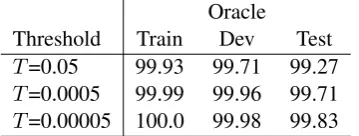
The threshold T is a hyper-parameter for our model. We choose the thresholdT based on how a segment lattice maintains the gold segments in the training and development sets. The threshold
T and the oracle score are shown in Table 1. In our experiment, theT = 0.00005 is used in NER task andT = 0.0005 is used in chunking task.
4.4 Results and Discussions
The results of CoNLL 2003 NER is shown in Ta-ble 2. By adding a CRF layer to BLSTM-CNN, it improves the F1 score from 89.72 to 90.96. This result is consistent with the result of (Ma and Hovy,2016). By using segment-level CRF, it fur-ther improves the F1 score from 90.96 to 91.28. Furthermore, by using the binary dictionary fea-ture, it improves the F1 score from 91.28 to 91.37 and by using the Wikipedia embedding feature, it
3This is same method in (Ma and Hovy,2016) and this
F-1 score is the result of our implementation.
Test
Prec. Recall F1
BLSTM-CNN 90.85 91.92 91.38
BLSTM-CNN-CRF 94.67 94.43 94.55
Our method 94.55 95.12 94.84
Table 3: Result of CoNLL 2000 Chunking.
improves the F1 score from 91.28 to 91.44. Even-tually, we achieve the F1 score 91.55 with two dic-tionary features.
The results of CoNLL 2000 Chunking is shown in Table 3. Similar to NER task, by adding a CRF layer to BLSTM-CNN, it improves the F1 score from 91.38 to 94.55. Furthermore, by using segment-level CRF, it improves the F1 score from 94.55 to 94.84.
In both experiments, it improves the F1 score by using segment-level CRF. On the NER experi-ment, the additional dictionary features help to ob-tain further improvement.
5 Related Work
Several different neural network methods have been proven to be effective for NER (Collobert et al., 2011; Chiu and Nichols, 2016; Lample et al.,2016;Ma and Hovy,2016). Ma and Hovy
(2016) demonstrate that combining LSTM, CNN and CRF achieves the state-of-the-art performance on NER and chunking tasks.
Mueller et al. (2013) show that higher-order CRF outperforms first-order CRF. Our work dif-fers from their work in that it can handle segments of variable lengths and thus it is easy to incorpo-rate dictionary features directly.
Zhuo et al. (2016) propose Gated Recursive Semi-CRF, which models a sequence of segments and automatically learns features. They combine Semi-CRF (Sarawagi and Cohen,2005) and neu-ral networks. However they report the F1 score 89.44% on NER and 94.734 on Chunking which
are lower than the scores of our method.
Kong et al.(2016) propose segmental recurrent neural networks (SRNNs). SRNNs are based on Bi-LSTM feature extractor and uses dynamic pro-gramming algorithm to reduce search space.
6 Conclusion
In this paper, we propose the segment-level se-quential modeling method based on a segment
lat-4This is under the setting without external resource. They
tice structure. Our experimental results show that our method outperforms conventional word-level neural CRF. Furthermore, two additional dictio-nary features help to obtain further improvement on NER task.
Acknowledgments
Part of this work was supported by JST CREST Grant Number JPMJCR1513, Japan.
References
Rich Caruana, Steve Lawrence, and C. Lee Giles. 2001. Overfitting in neural nets: Backpropagation, conju-gate gradient, and early stopping. In T. K. Leen, T. G. Dietterich, and V. Tresp, editors, Advances in Neural Information Processing Systems 13, MIT Press, pages 402–408.
Jason Chiu and Eric Nichols. 2016. Named entity recognition with bidirectional lstm-cnns. Transac-tions of the Association for Computational Linguis-tics4:357–370.
Ronan Collobert, Jason Weston, L´eon Bottou, Michael Karlen, Koray Kavukcuoglu, and Pavel Kuksa. 2011. Natural language processing (almost) from scratch. J. Mach. Learn. Res.12:2493–2537.
Felix A Gers, J¨urgen Schmidhuber, and Fred Cummins. 2000. Learning to forget: Continual prediction with lstm. Neural Computation12(10):2451–2471. Sepp Hochreiter and J¨urgen Schmidhuber. 1997.
Long short-term memory. Neural computation
9(8):1735–1780.
Lingpeng Kong, Chris Dyer, and Noah A Smith. 2016. Segmental recurrent neural networks. In Proceed-ings of the International Conference on Learning Representations (ICLR).
John D. Lafferty, Andrew McCallum, and Fernando C. N. Pereira. 2001. Conditional random fields: Probabilistic models for segmenting and labeling se-quence data. InProceedings of the Eighteenth In-ternational Conference on Machine Learning. Mor-gan Kaufmann Publishers Inc., San Francisco, CA, USA, ICML ’01, pages 282–289.
Guillaume Lample, Miguel Ballesteros, Sandeep Sub-ramanian, Kazuya Kawakami, and Chris Dyer. 2016. Neural architectures for named entity recognition. InProceedings of the 2016 Conference of the North American Chapter of the Association for Compu-tational Linguistics: Human Language Technolo-gies. Association for Computational Linguistics, San Diego, California, pages 260–270.
Yann LeCun, Bernhard Boser, John S Denker, Don-nie Henderson, Richard E Howard, Wayne Hubbard,
and Lawrence D Jackel. 1989. Backpropagation ap-plied to handwritten zip code recognition. Neural computation1(4):541–551.
Xuezhe Ma and Eduard Hovy. 2016. End-to-end se-quence labeling via bi-directional lstm-cnns-crf. In
Proceedings of the 54th Annual Meeting of the As-sociation for Computational Linguistics (Volume 1: Long Papers). Association for Computational Lin-guistics, Berlin, Germany, pages 1064–1074. Tomas Mikolov, Ilya Sutskever, Kai Chen, Greg S
Cor-rado, and Jeff Dean. 2013. Distributed representa-tions of words and phrases and their compositional-ity. InAdvances in neural information processing systems. pages 3111–3119.
Thomas Mueller, Helmut Schmid, and Hinrich Sch¨utze. 2013. Efficient higher-order CRFs for mor-phological tagging. InProceedings of the 2013 Con-ference on Empirical Methods in Natural Language Processing. Association for Computational Linguis-tics, Seattle, Washington, USA, pages 322–332. Jeffrey Pennington, Richard Socher, and Christopher
Manning. 2014. Glove: Global vectors for word representation. In Proceedings of the 2014 Con-ference on Empirical Methods in Natural Language Processing (EMNLP). Association for Computa-tional Linguistics, Doha, Qatar, pages 1532–1543. Sunita Sarawagi and William W Cohen. 2005.
Semi-markov conditional random fields for information extraction. In L. K. Saul, Y. Weiss, and L. Bottou, editors,Advances in Neural Information Processing Systems 17, MIT Press, pages 1185–1192.
Anders Søgaard and Yoav Goldberg. 2016. Deep multi-task learning with low level tasks supervised at lower layers. InProceedings of the 54th Annual Meeting of the Association for Computational Lin-guistics. Association for Computational Linguistics, volume 2, pages 231–235.
Nitish Srivastava, Geoffrey Hinton, Alex Krizhevsky, Ilya Sutskever, and Ruslan Salakhutdinov. 2014. Dropout: A simple way to prevent neural networks from overfitting. Journal of Machine Learning Re-search15:1929–1958.
Erik F Tjong Kim Sang and Sabine Buchholz. 2000. Introduction to the conll-2000 shared task: Chunk-ing. InProceedings of the 2nd workshop on Learn-ing language in logic and the 4th conference on Computational natural language learning-Volume 7. Association for Computational Linguistics, pages 127–132.
Erik F Tjong Kim Sang and Fien De Meulder. 2003. Introduction to the conll-2003 shared task: Language-independent named entity recognition. In
Ikuya Yamada, Hiroyuki Shindo, Hideaki Takeda, and Yoshiyasu Takefuji. 2016. Joint learning of the em-bedding of words and entities for named entity dis-ambiguation. InProceedings of The 20th SIGNLL Conference on Computational Natural Language Learning. Association for Computational Linguis-tics, Berlin, Germany, pages 250–259.
Matthew D Zeiler. 2012. Adadelta: an adaptive learn-ing rate method.arXiv preprint arXiv:1212.5701. Jingwei Zhuo, Yong Cao, Jun Zhu, Bo Zhang, and