Munich Personal RePEc Archive
Identifying the determinants and spatial
nexus of provincial carbon intensity in
China: A dynamic spatial panel approach
Zheng, Xinye and Yu, Yihua and Wang, Jing and Deng,
Huihui
Renmin University of China, Renmin University of China,
Chongqing Technology and Business University, University of
International Business and Economics
2013
Identifying the determinants and spatial nexus of provincial carbon
intensity in China: A dynamic spatial panel approach
Xinye Zheng School of Economics Renmin University of China
Beijing 100872, China [email protected]
Yihua Yu ()
School of Economics Renmin University of China
Beijing 100872, China [email protected]
Jing Wang School of Economics
Chongqing Technology and Business University Chongqing, 400067, China
Huihui Deng
Institute of International Economy
University of International Business and Economics Beijing 100029, China
Abstract Is emission intensity of carbon dioxide (CO2) spatially correlated? What determines the CO2
intensity at a provincial level? More importantly, what climate and economic policy decisions should
the China’s central and local governments make to reduce the CO2 intensity and prevent the
environmental pollution given that China has been the largest emitter of CO2? We aim to address
these questions in this study by applying a dynamic spatial system-GMM (generalized method of
moment) technique. Our analysis suggests that provinces are influenced by their neighbours. In
addition, CO2 intensities are relatively higher in the western and middle areas, and that the spatial
agglomeration effect of the provincial CO2 intensity is obvious. Our analysis also shows that CO2
intensity is nonlinearly related to GDP (gross domestic product), positively associated with
secondary-sector share and FDI (foreign direct investment), and negatively associated with population size.
Important policy implications are drawn on reducing carbon intensity.
1 Introduction
Economists, ecologists, private industries and government decision-makers have long been interested
in the relationship between economic growth and environmental quality (Burnett and Bergstrom,
2010). China has experienced a consistent and rapid economic growth since the economic reforms
started in 1978. However, the pressure from energy constraints and environmental pollution has been
increasingly serious over the same time period. In recent years, scholars have extended the study of
pollutants from the regular pollutants (say, sulphur dioxide (SO2), nitrogen dioxide (NO2), carbon
monoxide (CO), and particulate matters) to carbon dioxide (CO2), which has become the main driving
force of global climate changes. Especially, the increased demand for energy in China has generated
concomitant increase of carbon emissions, mainly measured by CO2 emissions in this study, which
poses an unprecedented challenge to China’s, and even global, environment and sustainable
development (Liu et al., 2010). China has been one of bigger contributors to the rapid growth of global
CO2 emissions, accounting for 44% of the increase in global CO2 emissions in 1990-2004 (Kahrl and
David, 2006). In 2007, the CO2 emissions ratio in China (defined as the total CO2 emissions of China
to that of the world) hit the historical highest level of 21.01% and simultaneously, China surpassed
the United States for the first time to become the largest CO2 emitter in the world with total CO2
emissions of 6.28 billion metric tons (Zheng et al., 2011). The Intergovernmental Panel on Climate
Change (IPCC) (2007) report indicates the fact that the most important environmental problem of
our ages is global warming. The predicted effects of global warming include melting of the polar ice
caps, flooding of coastlines, severe storms, changes in precipitation patterns, and widespread changes
in the existing ecological balance (Lindsay, 2001). The ever increasing amount of CO2 emissions seems
to be intensifying this problem (Soytas and Sari, 2009; Narayan and Narayan, 2010).
To resolve the contradictions between economic development and the above mentioned energy
consumption and environmental pollution problems, the 18th National Congress’ report includes three
important development concepts: the green development, the circular development, and the
low-carbon development.1 One effective way to achieve the goal of low-carbon development in China is
to reduce the industrial CO2 intensity (CO2 emissions per unit of gross domestic product (GDP). This
raises the following question: what factors determine the CO2 emission and its change? After reviewing
a bunch of literature, Liu et al. (2010) concluded that China’s economic growth and energy intensity are two important factors to affect the change of China’s carbon emissions or carbon intensity.
1 The National Congress of the Communist Party of China, which is held once every five years, is the highest body within
Besides, average labour productivity in the industrial sectors (Wu et al., 2005), economic scale (Wu et
al., 2006), fuel mix (Wang et al., 2005; Wu et al., 2006), renewable energy penetration (Wang et al.,
2005), final-energy-mix, and industry structure (Fan et al., 2007) are also important contributors to
CO2 emissions and CO2 intensity.
Existing studies on CO2 intensity are mainly based on the environmental Kuznets curve (EKC)
model, which focuses the relationship between pollutant emissions and income/GDP (Grossman and
Krueger, 1991; Panayotou, 1993; Schmalensee et al., 1998; Friedl and Getzner, 2003; Cai, 2008; Lin
and Jiang, 2009). Roberts and Grimes (1997) and Costantini and Martini (2006) modified the EKC
model and analysed the evolution and determinants of CO2 intensity across countries with different
income levels. However, the classic EKC model has been criticized because of the following
drawbacks: first, it does not consider the impacts of factors other than the economic growth on the
pollutant emissions, so it fails to explain the CO2 intensity comprehensively. Dasgupta et al. (2002),
Dinda (2004), and Stern (2004) pointed out that more explanatory variables and policies should be
included when studying how to reduce CO2 emissions. Thus, the aforementioned studies in the first
paragraph have considered quite a few other determinants besides the economic growth. Second, the
hypothesis of the EKC model ignores the spatial-temporal characteristics within the data. By ignoring
the temporal aspect, spurious results or misleading conclusions (misspecified t and F statistics) could
be generated. By ignoring the spatial aspects, biased or inconsistent estimators could be generated
because the existence of transboundary CO2 emissions between neighbours (Burnett and Bergstrom,
2010).
Studies on China CO2 intensity at national, regional, or sector level are few. At sector level, Chen
(2011) decomposed the CO2 intensity changes using 2-digit industry data in China and found that first,
the main and direct reason for the downward fluctuation of CO2 intensity is the reduction in energy
intensity or the improvement in energy productivity and second, energy structure and industrial
composition have positive effects on CO2 intensity reduction. At provincial level, Zeng and Pang
(2009) found that the ranking of the provinces in terms of total CO2 emissions did not change much
between 2000 and 2007. They pointed out that the provinces whose economic transition starts
relatively earlier attain better effects from CO2 emission reduction, and that CO2 emissions in some
provinces have a low total amount whilst with a rising trend. By estimating the CO2 emissions from
fossil energy consumption in 30 provincial units in China between 1997 and 2007, Du et al. (2010)
found that 29 provinces, except Beijing, show an increasing trend in per capita CO2 intensity. Yue et
between 1995 and 2007 and found that CO2 intensity in the middle and western areas is far higher
than that in the eastern areas. Yu et al. (2011) studied the determinants of CO2 intensity in China using
a panel data set of 29 provincial units from 1995 to 2007. Using a feasible generalized least squares
(FGLS) method, they find that there exists a nonlinear, inverted N relationship between CO2 emission
and GDP. However, their model contains only two explanatory variables: economic scale (i.e., per
capita GDP) and economic structure (i.e., added value of secondary industry to GDP ratio).
At regional level, Liu and Zhao (2012) pointed out that the regional distribution of CO2 intensity
is obviously unbalanced and the regional differences in CO2 intensity have been increasing slightly
overtime. Fan and Liu (2012) analysed the regional distribution of CO2 intensity between 1997 and
2008. They found that CO2 intensity is directly related to the degree of industrialization and the
adjustment in industrial composition in each province, and that the CO2 intensity in east developed
areas is much lower than that in other areas. Applying the Theil index and the spatial autocorrelation
method, Zhao et al. (2011) found that the CO2 intensity in eight comprehensive economic zones from
1999 to 2007 can be classified into three clusters: eastern and southern areas have the lowest level of
CO2 intensity; north-eastern areas, the middle reach of the Yellow River, and north-western areas have
the highest level of carbon intensity; and the CO2 intensity of the middle reach of the Yangtze River
and the south-western areas is in the middle level.2 The aforementioned studies analyse the issue of
CO2 emissions in terms of provincial level, but they fail to take into account the potential spatial
dependence, i.e., neighbouring areas’ CO2 intensity could impact on the local CO2 intensity.
Spatial dependence may occur in CO2 intensities for at least three reasons. First, almost all spatial
data have the characteristic of spatial dependence (Anselin, 1991), so do the provincial CO2 emission
intensity data. Second, in normal temperature and pressure, the mobility nature of CO2 (as one kind
of gas) makes it spread through the atmosphere, especially in the wind seasons, which determines the
spatial dependence of CO2 intensity. Third, as China has been speeding up the regional integration
process, which promotes the communication and cooperation between regions. Driving by the
catch-up effect and attracting by the lower cost, provinces get to learn from advanced provinces, especially
those from their neighbouring area. As a result, the industrial structures across regions that are
geographically proximate to each other get greater similar and the technologies attainable to them tend
to be the same. The environmental quality, specifically the CO2 intensity, has largely depended on the
2 The eight comprehensive economic zones (CEZ) are, North-west CEZ, Middle Reach of Yellow River CEZ, North-east
proportion of industrial products in the gross provincial products and the technology levels applied
in industrial production. Thus, if the spatial nexus is ignored, the coefficient estimates of the EKC
model can be biased and inconsistent due to omitted variable bias.
The objective of this paper is to empirically examine the spatial nexus of provincial CO2 intensity
in China and the driving forces of it when the spatial nexus effect is controlled, using a panel data set
of 30 provincial units from 1998 to 2010. Our primary interest lies in addressing the following
questions: (1) Is the provincial CO2 intensity spatially correlated? (2) What are the determinants of
CO2 intensity when the spatial dependence is taken into account? These questions are important for
China’s policy makers to understand better about the characteristics of provincial carbon emissions as
well as CO2 intensity, but the more important question is (3) what climate and economic policy
decisions should the central and local governments draw up to reduce the CO2 intensity and prevent
the environmental pollution?
This study contributes to the existing literature in two respects. First, different from most of the
existing studies which focus on CO2 density (i.e., per capita CO2 emissions), total emissions, or
ambient levels of CO2, we study the association between CO2 emissions and economic development
in China from the perspective of CO2 intensity (CO2 emissions per gross domestic product (GDP)).
Tisdell (2001) pointed out that total emissions can still increase even when emissions per unit of GDP
deceases, indicating that the scale effect of economic growth outweighs the composition effect and
the technological effect due to higher productive efficiency (Panayotou, 2000). It is well recognised
that the reduction in total CO2 emissions or per capita CO2 emissions is an important environmental
indicator. However, China is a developing country in the period of high-speed industrialization
development. Although China has engaged in adjusting industrial composition and transiting to the
tertiarisation production, such fact cannot be ignored. As most developed economies has suffered,
developing countries in this stage have to face a dilemma whether to maintain a high-speed economic
growth and endure a certain degree of environmental degradation or to slow down economic
development and concentrate on environmental pollution. There is no standard correct answer to this
problem. It is necessary to protect the environment, but development and employment are also tasks
of top priority in current China. Thus, considering the special stage where China stays, we propose
that governments should pay more attention to the CO2 emissions per unit of GDP besides the
reduction of total CO2 emissions or per capita CO2 emissions. Moreover, China’s central government
targets the reduction of CO2 intensity as the medium-term environmental protection mission. It
compared to that in 2005. However, the relationship between economic growth and CO2 intensity (a
particular important indicator in China) has rarely been analysed by previous studies.3 This paper aims
at filling in this gap. Second, to the best of our knowledge, this is the first study attempts to examine
the driving forces and spatial nexus of CO2 intensity using the dynamic spatial panel data model, which
differs from the traditional static or dynamic panel data model by taking into account both the dynamic
and spatial effects of CO2 intensity. Elhorst (2012) pointed out that either the dynamic but non-spatial
or spatial but non-dynamic panel data models produce biased estimates.
The paper is organized as follows. Section 2 presents some stylized facts about the regional
distribution of CO2 emissions in China; Section 3 specifies a dynamic spatial econometric model of
CO2 intensity where some potential key explanatory variables, such as economic development,
industrial composition, and technology, are identified. In addition, diagnostic tests and estimation
strategies that help to choose the most appropriate model are introduced; Section 4 describes the data
sources; Section 5 reports the empirical results; Finally, the last section summarizes the main findings
and draws policy implications.
2 Some Stylized Facts
As a participant in the Copenhagen Accord, China announced a binding target in 2009 to reduce its
carbon intensity by 40–45% by the end of 2020 compared to that in 2005. To achieve this goal, all
provinces in China should dedicate to saving energy and reducing CO2 emissions. However, natural
resources are distributed unevenly across provinces. Various resource endowments together with
regional variations in social-economic conditions and unbalanced regional economic development
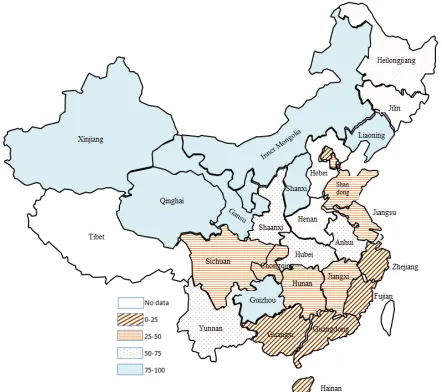
lead to different levels of CO2 intensity across provinces. Descriptive statistics show that the regional
distribution of CO2 intensity in China is dramatically uneven. Generally speaking, from 1998 to 2010,
CO2 intensity increases sharply from the eastern coastal areas to the middle and western areas (Figure
1). In detail, six provinces with the lowest CO2 intensities were Guangdong (0.111 tons/billion yuan),
Hainan (0.115 tons/billion yuan), Fujian (0.116 tons/billion yuan), Beijing (0.134 tons/billion yuan),
Guangxi (0.153 tons/billion yuan), and Zhejiang (0.158 tons/billion yuan); whereas six provinces with
the highest CO2 intensities were Gansu (0.533 tons/billion yuan), Qinghai (0.536 tons/billion yuan),
Inner Mongolia (0.565 tons/billion yuan), Ningxia (0.664 tons/billion yuan), Guizhou (0.706
3 Roberts and Grimes (1997) is the only work we know that studies the connection of carbon intensity and economic
tons/billion yuan), and Shanxi (1.034 tons/billion yuan).4 Hence, examining the provincial variations
of CO2 intensity and identifying its driving forces are necessary to make and implement effective and
[image:8.612.195.416.133.329.2]appropriate CO2 reduction policies.
Fig. 1 The distribution of provincial average CO2 intensities in China between 1998 and 2010
Note: The CO2 intensity data are compiled from the database of Energy Economic
Center at Renmin University of China (http://rucee.ruc.edu.cn)
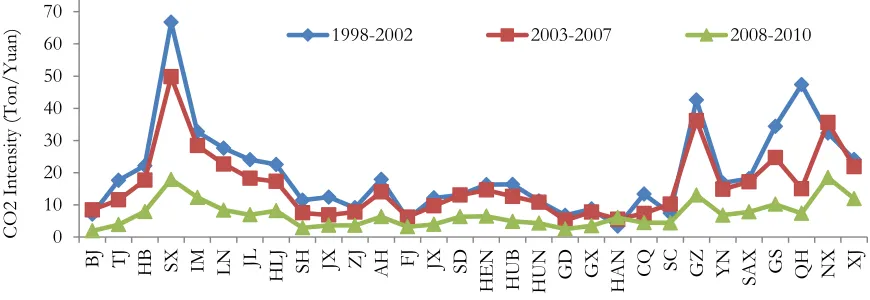
Observing Figure 2 that shows the changes in provincial CO2 intensities in China during the same
time period from 1998 to 2010, five patterns can be summarized. First, the CO2 intensity was unevenly
distributed across regions. It was relatively higher in the western and middle areas than in the eastern
areas, partly because most of the high energy-intensive industries were located in the western and
middle areas.
Second, the CO2 intensity evolved over time. It went down slightly during the period of 1995–
2002 compared to the period of 2003–2007 and dropped further in the period of 2008-2010. The
overall declining trend of CO2 intensity may imply that the CO2 emission reduction policies and
measures implemented in recent decades were effective and China may enter the low-carbon
industrialization process.
Third, CO2 intensity was diversified across provinces and the diversification was relatively greater
in the periods of 1995-2002 and 2003-2007 than in the period of 2008-2010. Taking the phase of
1998-2002 as an example, we can see that provinces like Sichuan, Hainan, Fujian, Guangdong,
Zhejiang, and Guangxi have relatively lower CO2 intensities, while provinces like Yunnan,
Heilongjiang, Jilin, Liaoning, Inner Mongolia, and Gansu have relatively higher CO2 intensities. Other
provinces, like Jiangsu, Shanghai, Beijing, Jiangxi, Hunan, Shandong, Henan, Hubei, Anhui, Tianjin,
Chongqing, Shanxi, Xinjiang, Ningxia, and Hebei, have middle-level CO2 intensities.
Fourth, CO2 intensity was spatially agglomerated. It can be seen that the differences in CO2
intensity across the eastern provinces were shrinking, indicating a pattern of agglomeration of low
energy-intensive industries there. There being far more highly energy-intensive industries
agglomerated in the middle/western regions than in the eastern region, thus the middle/western
regions have a much higher level of CO2 intensity than the eastern region.
Last, although the differences in CO2 intensities across the western provinces were still large in
general, the CO2 intensity in some western provinces, which are geographically close to the eastern
areas, has been approaching that of nearby eastern provinces, while this trend was not apparent in the
western provinces that are far away from the eastern provinces. This finding confirms our hypothesis
[image:9.612.79.514.373.523.2]of spatial dependence.
Fig. 2 The provincial distribution of CO2 intensity between 1998 and 2010
Note: BJ = Beijing; TJ=Tianjin; HB =Hebei; SX = Shanxi; IM = Inner Mongolia; LN = Liaoning; JL = Jilin; HLJ = Heilongjiang; SH = Shanghai; JX = Jiangxi; ZJ = Zhejiang; AH = Anhui; FJ = Fujian; JX = Jiangxi; SD = Shandong; HEN = Henan; HUB = Hubei; HUN = Hunan; GD = Guangdong; GX = Guangxi; HAN =Hainan; CQ = Chongqing; SC = Sichuan; GZ = Guizhou; YN = Yunnan; SAX = Shaanxi; GS = Gansu; QH = Qinghai; NX = Ningxia; XJ = Xinjiang.
3 Model Specification
This study uses the dynamic spatial panel data model, which differs from the traditional panel data
model by taking into account both dynamic and spatial effects of provincial CO2 intensity. This model
has become popular in the last decade since it combines time series econometrics, spatial
0 10 20 30 40 50 60 70
BJ TJ HB SX IM LN JL
HL
J
SH JX ZJ AH FJ JX SD
HE
N
HUB HUN GD GX HA
N
CQ SC GZ YN SAX GS QH NX XJ
CO2 In te n sit y (To n / Y ua n
econometrics, and panel econometrics. Elhorst (2012) points out that methods developed either for
dynamic but non-spatial or for spatial but non-dynamic panel data models all produced biased
estimates.
The dynamic spatial lag panel data model is traditionally specified as follows (Elhorst, 2010; Lee
and Yu, 2010; Zheng et al., 2013),
yit = α + θyi,t-1 + ρ∑j=1Wyjt + ∑kxit(k)βk + μi + υt + εit, i= 1,…, N; t = 1,…,T (3)
where yit is the dependent variable representing CO2 emissions intensity in province i at time t. W is a
non-stochastic, predetermined, contiguity-based binary matrix in which each element wij is set to be
one if provinces i and j (i ≠ j) share a common border, and zero otherwise. In addition, the matrix W
is commonly row-standardized such that the elements of each row sum to one. xit is a k × 1 vector of
independent variables. θ reflects the dynamic effects of CO2 intensity. ρ is the main concern of this
study and represents the spatial lag parameter that characterizes the strength of contemporaneous
spatial correlation between one province and other geographically proximate provinces. μi is the
provincial fixed effect, υt is the fixed temporal effect, and εit is the idiosyncratic disturbance term
assumed to be standard normal, independent of each other and everything else. When ρ = 0, Equation
(3) reduces to the traditional dynamic panel setting, while θ = 0 will reduce the model to the static
spatial econometric model.
In terms of econometric estimation, the most parsimonious panel model, or the static panel data
model which has neither dynamic effects nor spatial effects, can be estimated by the least-squares
dummy variables (LSDV) estimator if the spatial-specific effects can be considered as fixed effects, or
by the generalized lest-squares (GLS) estimator if the spatial-specific effects can be considered as
random effects (Hsiao 2003; Baltagi 2008). Extension of the static panel data model with a dependent
variable lagged in time (Yt-1) formulates a dynamic panel data model. The LSDV and GLS estimators
to estimate the dynamic panel data model become inconsistent if T is fixed, regardless of the size of
N (Arellano 2003; Baltagi 2008), which is because the lagged dependent term Yt-1 is correlated with
the spatial-specific effect.
The most popular approach to remove this inconsistency is generalized method of moments
(GMM). By creating a set of estimating equations for the parameters by making sample moments
match the population moments, one derives the estimators from the moment conditions, and also a
set exogenous variables (i.e., correlated with Yt-1 but uncorrelated with the errors) that can be used to
instrument Yt-1. The Anderson-Hsiao (1982) or Arellano and Bond (1991) difference GMM rests on
beyond (Y1, …, Yt-2, t ≥ 3) are used as instrumental variables for the differenced lagged dependent
variable (∆Yt-1). While the difference GMM approach can correct for the dynamic panel bias or
Nickell’s bias (1981) caused by the least squares regression that includes spatial-specific effects or the least squares dummy variable (LSDV) model, it may suffer from finite sample bias and precision
problems when the data series are persistent or are close to a random walk (Blundell and Bond, 1998),
as the instruments (i.e., Y1, …, Yt-2) are weak predictors of the endogenous changes (i.e., ∆Yt-1).
To overcome the drawbacks of the difference GMM approach, a closely related but improved
GMM dynamic panel approach, named system GMM, was proposed by Arellano and Bover (1995)
and later developed by Blundell and Bond (1998), which uses extra moment conditions that rely on
certain stationarity conditions of the initial observation. In other words, the system GMM approach
also uses lagged first differences for the equation in levels (i.e., the system GMM estimator also
instrument Yt-1 by the variables ∆Y1,…, ∆Yt-2, ∆X1,…, ∆Xt-1). Blundell and Bond (1998) argue that the
system GMM estimator performs better than the difference GMM estimator because of the following
properties: 1) increased efficiency; 2) less finite sample bias; 3) the instruments used in the level
equation model remain good predictors for the endogenous variables even when the series are very
persistent. Because of the good performance of the system GMM estimator compared with the
difference GMM estimator, it has become more popularly used in the panel data settings.
Ten years after the paper of Blundell and Bond (1998), several studies such as Kukenova and
Monteiro (2009) and Jacobs et al. (2009) extended the system GMM estimator of Blundell and Bond
(1998) to account for the spatial effects. The spatial system GMM is known to have the advantage on
avoiding the bias problem (especially with respect to the spatial autoregressive parameter, ρ) from the
spatial difference GMM estimator (Kukenova and Monteiro, 2009; Jacobs et al., 2009; Elhorst, 2010),
and over traditional spatial maximum likelihood estimation (MLE) in that the system GMM estimators
can also be used to instrument endogenous explanatory variables (other than Yt-1 and WYt). For this
reason, we will use the latter approach in this empirical study.
A few remarks are needed to better understand the spatial system-GMM estimator. First, the
number of sample observations is relatively large and the time span of interest is relatively short, as a
long time span would easily cause the over-identification problem of instrumental variables. The
sample in this study covers 30 provincial units from 1998 to 2010, so the first prerequisite could be
satisfied.5
5 It should be mentioned that dynamic panel is designed for micro-level panel data large N and small T. The available
Second, the consistency of the system GMM estimator (and difference GMM estimator as well)
rests on the assumption that there is no first-order serial autocorrelation (i.e., AR(1) ≠ 0) in the error
terms of the level equation, or equivalently, there is no second-order serial autocorrelation (i.e., AR(2)
= 0) in the first-differenced errors. The Arellano and Bond (1991) test is used in this empirical work.
If the above assumption is violated, the instrumental variables can be highly correlated to the
endogenous variables and the model might not be specified correctly. One way to tackle this issue is
to add dependent variables of more than one lag in the model.
Third, the instrumental variables have to be relevant and valid, which implies that the following
two requirements have to be satisfied: 1) instrument relevance, under which the chosen instruments
have to be highly correlated with the endogenous regressors even after controlling for the exogenous
regressors. This requirement can be empirically tested in the first stage regression using a joint F test
of whether all excluded instruments are statistically significant, and 2) instrument exogeneity, which
can be tested using the Sargan (1958) or Hansen (1982) over-identification test in case there are more
excluded instruments than the number of endogenous variables.
Fourth, before implementing the spatial dynamic Blundell–Bond-type system-GMM regression,
it is necessary to test for the spatial interaction effects. In a cross-sectional setting, Anselin et al. (1996)
developed two Lagrange multiplier (LM) tests for spatially lagged dependent variables and for spatial
error correlation, and two robust counterparts of these two LM tests. For panel data setup, the first
two LM tests are: LM-LAG = [e′(IT W)Y/ 2]2/J, and LM-ERROR = [e′(IT W)e/ 2]2/(TTW),
where the symbol denotes the Kronecker product, I denotes the identity matrix, T is the order of
the matrix, and e denotes the estimated residual from the non-spatial dynamic panel model. J and TW
are defined as follows: J = [((IT W)X )′(INT−X(X′X)-1X′)(IT W)X + TTW 2]/ 2, and TW =
trace(WW + W′W). The two robust LM tests are defined as follows: Robust LM-LAG = [e′(IT
W)Y/ 2−e′(I
T W)e/ 2]2/(J−TTW), and Robust LM-ERROR = [e′(IT W)e/ 2−TTW/J × e′(IT
W)Y/ 2]2/[TT
W(1 −TTW/J)]. Detailed derivations of these tests for a spatial panel data model with
spatial fixed effects can be found in Debarsy and Ertur (2010). Under the null hypothesis, these tests
follow a chi-squared distribution with one degree of freedom.
4 Data Source
ˆ ˆ
ˆ ˆ ˆ ˆ
ˆ
ˆ ˆ
ˆ
We used a panel data set of 30 provincial units (22 provinces, 4 municipalities, and 4 autonomous
regions) from 1998 to 2010.6 The dependent variable is the CO
2 intensity, which is defined as the
provincial CO2 emissions divided by provincial GDP. Data on the provincial CO2 emissions during
the sample period are available from the Energy Economic Center at Renmin University of China
(http://rucee.ruc.edu.cn), where the CO2 emissions are calculated based on the method offered by
the Intergovernmental Panel on Climate Change (IPCC), and on other information, such as total
consumption of various energies, the heat content, the carbon content, and the carbon oxidation rate
of each energy, and so on.
The potential independent variables are identified as follows. GDP is an important factor that
affects CO2 intensity. Some empirical studies found that there exists a non-linear relationship between
GDP and the CO2 intensity. For instance, Roberts and Grimes (1997) found that the CO2 intensity
and per-capita GDP have an inverted U-shaped relationship, which indicates that CO2 intensity would
fall eventually as the economy develops even without any external reduction policies. Other studies
also found that the relationship can be N-shaped (Moomaw and Unruh, 1997; Friedl and Getzner;
2003; Millimet et al., 2003; Galeotti and Lanza, 2005; Yu et al., 2011). POP, indicating population size,
is another important factor that affects CO2 intensity. The larger the population size, the more direct
and indirect is energy consumption, and the greater the CO2 emissions. Historical data show that the
population and CO2 intensity are positively related. FDI measures foreign direct investment. The
relation between FDI and the CO2 intensity is ambiguous. On the one side, inward FDI takes into
account not only capitals but also advanced technologies, equipment, and management experience
invested in China. These investments help to improve the efficiency of energy consumption and
reduce pollution. Hence, FDI, to some extent, contributes to the decline of CO2 intensity in China.
On the other hand, the rise in exports due to FDI leads to the growth in implicit energy consumption
and hence CO2 emissions. Moreover, a large amount of FDI went into pollution-intensive industries,
which would result in an increase in CO2 intensity. Therefore, the relationship between FDI and CO2
intensity is not clear and deserves further empirical analysis.
SEC is measured as the ratio of value-added from the secondary industries to the total industry
value-added. Currently, the ratio of the primary, secondary, and tertiary industries in China is 1:5:4
(Yu et al., 2011) and the growth in the economy is heavily dependent on the secondary industries,
especially on the industries with high-energy consumption and high pollution. The CO2 emissions of
the secondary industries are much more than those of the primary and tertiary industries. Therefore,
we expect the coefficient of this variable to be negative. RD is defined as the ratio of research and
development (R&D) expenditure to GDP. R&D inputs can affect CO2 intensity in two respects. On
the one side, based on the endogenous growth theory, the advancement of technology (say,
low-carbon technology) improves the utilization of natural resources, so the resources could be saved and
recycled. From this point of view, science and technology innovation has a positive effect on the
reduction in CO2 intensity. On the other side, R&D expenditure might increase CO2 emissions
because the main concern of science and technology innovation is to increase output rather than to
reduce CO2 emissions. Therefore, the relationship between R&D and CO2 intensity is also
ambiguous.7
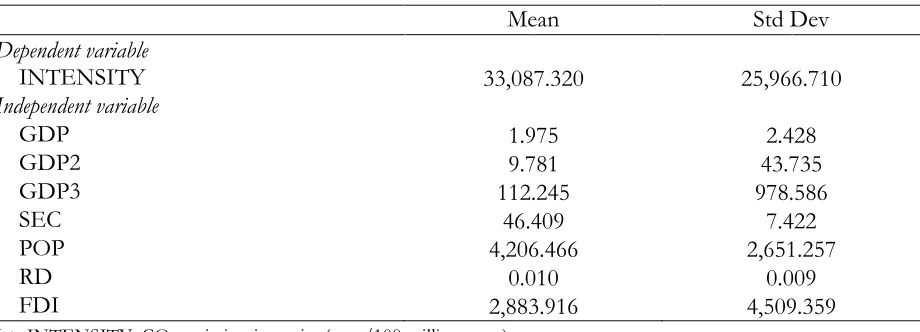
The data on the aforementioned variables, including GDP, POP, and SEC, are obtained from the
China Statistical Yearbook which is compiled by China Statistical Press. The FDI data come from the
CEIC Database.8 The R&D expenditure data are taken from China Statistical Yearbook on Science and
Technology. The variables used in the empirical model and their summary statistics are presented in
[image:14.612.80.540.414.580.2]Table 1.
Table 1 Description and Statistics of Variables
Mean Std Dev
Dependent variable
INTENSITY 33,087.320 25,966.710
Independent variable
GDP 1.975 2.428
GDP2 9.781 43.735
GDP3 112.245 978.586
SEC 46.409 7.422
POP 4,206.466 2,651.257
RD 0.010 0.009
FDI 2,883.916 4,509.359
Note: INTENSITY: CO2 emission intensity (tons/100 million yuan)
GDP: per capita GDP (10 thousand yuan/person)
GDP2: GDP squared GDP3: GDP cubed
SEC: ratio of value-added from the secondary industry to total industry value-added (%) POP: population size (10 thousand persons)
7 It is worth mentioning though that R&D’s scale is rather small compared with the product process, which implies that
even though R&D has positive or negative effect on carbon intensity, the effect may be true only in terms of statistical significance instead of economic significance.
8 CEIC is an euromoney institutional investor company (http://www.ceicdata.com/). CEIC Data provides the most
RD: ratio of R&D expenditure to GDP (%) FDI: foreign direct investment (US $)
5 Empirical Findings
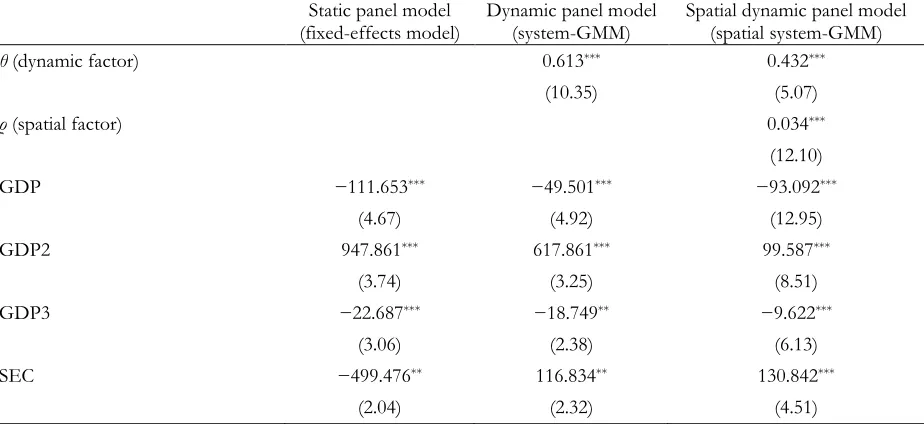
The base empirical results are shown in Table 2. Beginning with the static panel regressions in Table
2,9 the Hausman test statistics (21.38, p = 0.000) indicates that fixed effects model (FEM) is preferred
to the random effects model. The coefficient regression results show that the coefficients of GDP,
GDP squared (GDP2), and GDP cubed (GDP3) are, respectively, negative, positive, and negative.
Besides, all estimates are statistically significant at the level of 1%. This result suggests that CO2
emission intensity and GDP are nonlinearly related, which is expected. Specifically, they have an
inverted N-shaped relationship rather than an inverted U-shaped relationship or a linear relationship.
Yet, population size and R&D are found to have neither positive nor negative effects on CO2 emission
intensity. Besides, a higher share of the secondary industry is negatively associated with CO2 emission
intensity. Certainly, this conflicts with theory. This is because the FEM model does not take into
account the endogeneity and dynamic attributes of the data.
Turning attention to the dynamic panel model (i.e., the system-GMM model) in Table 2, the
system GMM model accounts for endogeneity, but ignores spatial interactions across jurisdictional
CO2 emission intensities. The system GMM results are generally more plausible than those from FEM,
as evidenced by diagnostic tests for autocorrelation and Hansen test for over-identification.
Furthermore, the lagged parameter of CO2 emission intensity is positive and statistically significant,
suggesting evidence of dynamic nature of CO2 emission. GDP terms now have smaller (in absolute
value) relationship with CO2 emission intensity than was suggested by the FEM estimates. In addition,
share of the secondary industry is positively associated with emission intensity, R&D is negatively
related to emission intensity. These results are expected, while the negative and statistically significant
coefficient estimate for population size seems unexpected. Yet, like the FEM model, the system-GMM
model has problems of model specification. Particularly, the system-GMM estimates suffer from
omitted variable bias due to ignorance of spatial spillovers effect (or spatially lagged dependent
variable), as evidenced by Moran’s I and robust LM tests for spatial autocorrelation (Table 2).
9 We conducted the panel unit root tests (Levin, Lin and Chu (LLC, 2002), Im Pesaran and Shin (IPS, 2003), and Phillips
and Perron (PP, 1988)) for the explanatory variables in this study. We found in general that GDP and FDI are I(1)
processes, while SEC and RD are I(0) processes. So eventually we assumed all variables are generated by a stationary
The last column of Table 2 shows the fully-specified spatial system-GMM results.10 The error
term’s first-order serial correlation test, second-order serial correlation test, and Hansen over-identification test indicate that the system-GMM does not have the misspecification problem and that
the instrumental variables selected are indeed exogenous.11 The coefficient estimates for the CO 2
emission intensity equation now reflect some major changes from non-spatial system-GMM and some
main results are summarized as follows.
First, the spatial lagged coefficient ρ is positive and statistically significant at the 1% level, which
indicates that the CO2intensities in the neighbouring provinces have a positive impact on one’s own
province’s CO2 intensity. Specifically, as the CO2 intensity in the neighbouring provinces rises on
(spatial) average by 1%, ceteris paribus, the CO2 intensity in the province of interest would rise by 0.03%.
Second, the inverted N-shaped relationship remains valid between CO2 intensity and GDP. Such
finding is not in line with the EKC literature, but is consistent with Moomaw and Unruh (1997), Du
et al. (2007), and Yu et al. (2011). Yet, a noteworthy change from the non-spatial model (FEM, or
system GMM) to the spatial system-GMM model is that GDP terms now have smaller (in absolute
value) relationships with CO2 emission intensity than was suggested by the FEM or system GMM
estimates.
Third, like the system-GMM estimate, a higher share of the secondary industry is positively
associated with CO2 emission intensity. This finding is predicted by theory as China’s economy is
heavily dependent on secondary industries, such as steel and iron, aluminium smelting, cement,
chemicals, and transportation industries, and these industries are also the ones that emit the most CO2.
Fourth, R&D remains to be statistically insignificant at the 10% level, implying that technological
innovation has no obvious effect on provincial CO2 intensities. This result is beyond our expectation.
The potential reasons can be three-fold: first, all levels of government are the leading forces of R&D
investment in China, some so-called ‘science and technology achievements’ fail to be converted into
production; second, the ratio of R&D expenditure to GDP may not be a good measurement of
technological innovations; and third, in the extensive economic growth stage, R&D expenditure in
China increased the CO2 emissions because the main concern of science and technology innovation
10 Analyses are done using STATA 12.0, a data analysis and statistical software, and some of the STATA modules to
implement the diagnostic tests and spatial regressions are made by Emad Shehata (http://emadstat.110mb.com/ stata.htm).
11 Economic theory rarely gives us information about the lag length (Y
t-1, Yt-2), which is usually determined empirically.
is to increase output rather than to reduce CO2 emissions. Hence, these factors combined make the
overall effect of R&D on provincial CO2 intensities insignificant.
Fourth, population size remains to be negative and statistically significant at 1% level. The
negative effect of population size, which seems puzzling at a first glance since it is usually believed
that more population leads to more energy consumption direct or indirectly and hence more CO2
emission (intensity), could imply that population size is associated with some agglomeration force that
could improve the production efficiency which leads to a reduction in emission intensity of carbon
dioxide. However, another noteworthy change is that the coefficient on population size from the
spatial system-GMM estimation decreases by almost three fold (from −3.54 to −1.28), suggesting that
system GMM without accounting for spatial dependence overestimates the population effect.
Last, most notably, FDI is now inversely related to CO2 intensity. As mentioned, the effect of
FDI on CO2 intensity is theoretically ambiguous, as, on the one side, FDI may reduce local CO2
intensity by introducing advanced technologies which help to improve the efficiency of energy
consumption; whereas, on the other side, FDI transfers some overseas high energy consumption
industries to China, which increases the overall consumption of energy and raises CO2 intensity. The
empirical findings show that the latter effect of FDI on CO2 intensity dominates the former. This
result is consistent with Yu (2012).
The striking changes from the FEM and system-GMM to the spatial system-GMM model point
to the adequacy of accounting for dynamic factor, endogeneity, spatial autocorrelation, and spatial
[image:17.612.78.540.505.717.2]heterogeneity jointly.
Table 2 Determinants of Provincial CO2Emissions Intensity in China
Static panel model (fixed-effects model)
Dynamic panel model (system-GMM)
Spatial dynamic panel model (spatial system-GMM)
θ (dynamic factor) 0.613*** 0.432***
(10.35) (5.07)
ρ (spatial factor) 0.034***
(12.10)
GDP −111.653*** −49.501*** −93.092***
(4.67) (4.92) (12.95)
GDP2 947.861*** 617.861*** 99.587***
(3.74) (3.25) (8.51)
GDP3 −22.687*** −18.749** −9.622***
(3.06) (2.38) (6.13)
SEC −499.476** 116.834** 130.842***
POP −2.439 −3.543** −1.283***
(0.97) (2.03) (6.71)
RD −141,487.115 172,590.853 −38,387.180
(0.33) (0.73) (0.62)
FDI 0.804* 1.009 0.226*
(1.85) (1.57) (1.78)
Constant 80,965.100*** 29,313.953*** 17,234.700***
(5.58) (3.05) (10.76)
Province dummy Y Y Y
R squares 0.341
Obs. 390 390 390
No. of provinces 30 30 30
Hausman test of fixed vs. random 21.38 [0.000] 8.97 [0.000]
Spatial Panel Autoregression Test
LM-Error Panel Test [0.111]
Robust LM-Error Panel Test [0.125]
LM-Lag Panel Test [0.023]
Robust LM-Lag Panel Test [0.057]
System GMM Test
AR(1) Test [0.007] [0.068]
AR(2) Test [0.403] [0.279]
Hansen Over-identification Test [0.998] [0.999]
Note: (i) ***, **, and * stand for the statistical significance at the level of 1%, 5%, and 10%, respectively; (ii) absolute t-values are in parentheses; (iii) p -values are in square brackets; (iii) spatial fixed or random effects are compared using Hausman’s specification test that is developed by Lee and Yu (2010).
6 Conclusions
Using a panel data set of 30 provincial units from 1998 to 2010, this study examined the determinants
and spatial nexus of the provincial CO2 intensities in China by estimating a spatial dynamic panel
(system-GMM) model. The dynamic factor, spatial dependence, and spatial heterogeneity of the
provincial CO2 intensities are rarely examined together in the existing literature. In this paper, we
found that provincial CO2 intensities are spatially dependent, CO2 intensity is increasing from the
eastern regions to the western regions, and the spatial agglomeration effects are obvious. In particular,
we found that CO2 intensities are spatially correlated across provinces, and the correlation tends to
increase over time. The Moran’s scatterplot shows that most provinces appeared in the first (HH) and
the third (LL) quadrants, which also reveals the spatial dependence, as it can be seen that provinces in
Yangtze River Delta region, provinces in the Pearl River Delta region, and Gansu, Ningxia, Inner
Mongolia, and Xinjiang provinces).
China’s CO2 intensity target that reducing the carbon emission by 40-45% in 2020 compared to
2005 is a big step in the right direction and it provides the right incentives for future improvements
in reducing emissions. Several policy suggestions on reducing CO2 intensity can be drawn based on
our empirical results. First, imposing a pollutant tax. Although energy or carbon tax is suggested by
numerous literatures, it can be a two-edged sword. On one hand, it contributes to reducing the demand
of coal and other energies that helps to cut down the CO2 emissions. On the other hand, it has negative
impact on energy-intensive industries as well as the macro-economy. Wei and Glomsrod (2002)
pointed out that if the government levy USD5 per ton of carbon as tax, the CO2 emission would be
reduced by 0.21 billion; meanwhile, the GDP would drop by 29 billion Chinese yuan in 2020. In other
words, the cost of reducing one ton of carbon emission is about 496 Chinese yuan (USD82.67) which
is much higher than USD5’s tax. Our finding of inverted N-shaped relationship between CO2
intensity and GDP shows that the environment can actually benefit from the growth of GDP. Thus,
it is preferable to levy tax based on pollutant directly, which is more efficient and relatively less harmful
to the economy. Also, we consider a progressive tax rate increment with a low initial tax rate will
mitigate the negative effects of tax on the economy. Furthermore, to compensate for the loss in GDP
resulted from pollutant tax, we suggest the central and local governments recycle the tax revenue by
cutting down energy-intensive industry’s production tax. In this case, pollutant tax brings a “double dividend” (improvement both in environment and economic efficiency).
Second, the spatial dependence found within in study implies that transboundary pollution
associated with CO2 emissions is potentially a real issue. This regional pollution problem is further
complicated by the fact that the coal consumed in some provinces is imported from other provinces.
The regional plans to reduce emissions then must inevitably involve energy trading. It is possible that
neighbouring provinces may develop cooperative initiatives to reduce emissions. Taking the CO2
emission quota as an example, central government should allocate the quota across provinces based
on the provincial factor endowments and allow for quota transactions among provinces. The
western/middle provinces have relatively larger CO2 emissions because most of the energy-intensive
industries are located there, so those provinces should have more of the quotas. Local governments
should make good use of their comparative advantages to improve energy utilization, which can not
Third, optimizing the industrial composition by enhancing the development of green industries
and constraining the development of high-carbon consumption industries. Meanwhile, positively
developing the environmental friendly alternative energy sources, such as solar energy, wind energy,
and hydro energy.
Fourth, enlarging the R&D investment aiming at recycling CO2 emissions besides improving
energy efficiency and reducing CO2 emission. We suggest governments of all levels earmark the
pollutant tax revenue as the R&D fund that is used exclusively for CO2 emission recycling and
reduction. We also recommend that governments should facilitate the cooperation between
energy-intensive industry and local universities as well as other research agencies to make a fully use of their
comparative advantage in research. Besides, governments should set up a supervision division to
guarantee the transfer of the research achievements into productivity.
Last but not least, fostering enterprises’ low-carbon production and creation consciousness.
Using proper policies to guide the enterprises to make correct choice between the low-carbon
technique and traditional business, as well as between the short-run profits and long-run development.
Moreover, encouraging the citizens to engage in energy-saving and emission-reduction activities and
constructing an intensive, economical, and ecological development trajectory. The bottom line is that
these policies, regulations or initiatives need to start being developed soon. Nonetheless, China’s
carbon intensity target still leaves room for even more ambitious action.
References
Anderson T, Hsiao C (1982) Formulation and estimation of dynamic models using panel data. J Econom 18: 47–82.
Anselin L (1991) Handbook of regional and urban economics: Peter Nijkamp, ed., Volume 1: Regional Economics
(North-Holland, Amsterdam, 1986). Reg Sci and Urban Econ 21(1): 143–156
Anselin L (1995) Local indicators of spatial association – LISA. Geogr Analy 27: 93–115
Anselin L, Bera A, Florax R, Yoon M (1996) Simple diagnostic tests for spatial dependence. Reg Sci and Urban Econ 26:
77–104
Arellano M (2003) Panel data econometrics. Oxford University Press.
Arellano M, Bond S (1991) Some tests of specification for panel data: Monte Carlo evidence and an application to
employment equations. Rev of Econ Stud 58: 277–297
Arellano M, Bover O (1995) Another look at the instrumental variable estimation of error-components models J of
Econom 68: 29–51
Baltagi B(2008) Econometric analysis of panel data. 4th edn., Chichester: John Wiley
Blundell R, Bond S (1998) Initial conditions and moment restrictions in dynamic panel data models. J Econom 87(1): 115–
143
Burnett J, Bergstrom J (2010) U.S. state-level carbon dioxide emissions: A spatial-temporal econometric approach of the environmental Kuznets curve. Faulty Series #96031 from Department of Agricultural and Applied Economics, University of Georgia
Cai F (2008) Lewis turning point: A coming new stage of China’s economic development. Social Sciences Academic Press
(China)
Chen S (2011) The carbon intensity’s downward fluctuation mode and economic explanations in China. World Econ 4:
Costantini V, Martini C (2006) A modified environmental Kuznets curve for sustainable development assessment using panel data. Working Papers 2006.148, Fondazione Eni Enrico Mattei
Dasgupta S, Laplante B, Wang H, Wheeler D (2002) Confronting the environmental Kuznets curve. J Econom Perspect
16(1): 147–168
Debarsy N, Ertur C (2010) Testing for spatial autocorrelation in a fixed effects panel data model. Reg Sci and Urban Econ
40: 453–470
Dinda S (2004) Environmental Kuznets curve hypothesis: A survey. Ecol Econ 49(4): 431–455
Du G, Cai Y, Li S (2010) The changing trend analysis of provincial carbon intensity from fossil energy in China between
1997 and 2007. Geogr and Geogr Inf Sci 5: 76–81 (in Chinese)
Du T, Mao F, Luo R (2007) An analysis of economic growth and CO2emission evolution. Chinese J Pop, Resour and Env
2: 94–99 (in Chinese)
Elhorst P (2010) Dynamic panels with endogenous interaction effects when T is small. Reg Sci and Urban Econ 40(5):
272–282
Elhorst P (2012) Dynamic spatial panels: models, methods, and inferences J Geogr Sys 14: 5–28
Fan D, Liu H (2012) The distribution characteristics and changes of provincial carbon intensity in China. J Xi'an Inst of
Finan and Econ 3: 4–10 (in Chinese)
Fan Y, Liu L, Wu G, Tsai H, Wei Y (2007) Changes in carbon intensity in China: Empirical findings from 1980 to 2003.
Ecol Econ 62(3-4): 683–691
Friedl B, Getzner M (2003) Determinants of CO2 emissions in a small open economy. Ecol Econ 45(1): 133–148
Galeotti M, Lanza A (2005) Desperately seeking environmental Kuznets. Environ Model and Soft 20(11): 1379–1388
Grossman G, Krueger A (1991) Environmental impacts of a North-American free trade agreement. NBER Working Paper 3914
Hansen L (1982) Large sample properties of generalized method of moments estimators. Econom 50: 1029–1054
Hsiao, C. (2003) Analysis of panel data. Cambridge University Press: Cambridge
Im S, Pesaran M, Shin Y (2003) Testing for unit roots in heterogeneous panels. J Econom 115: 53–74
Intergovernmental Panel on Climate Change (IPCC) (2007) IPCC fourth assessment report: climate change 2007. Cambridge University Press: Cambridge
Jacobs J, Ligthart J, Vrijburg H (2009) Dynamic panel data models featuring endogenous interaction and spatially correlated errors. International Center for Public Policy (formerly the International Studies Program) Working Paper Series 0915, Andrew Young School of Policy Studies, Georgia State University
Kahrl F, Roland-Holst D (2006) China’s carbon challenge: Insights from the electric power sector (available at
http://areweb.berkeley.edu/~dwrh/Docs/CCC_110106.pdf, accessed on March 14, 2013)
Kukenova M, Monteiro J (2009) Spatial dynamic panel model and system GMM: A Monte Carlo investigation IRENE Working Papers 09-01, Irene Institute of Economic Research
Lee L-F, Yu J (2010) Estimation of spatial autoregressive models with fixed effects, J of Econom 154: 165–185.
Levin A, Lin CF, Chu CSJ (2002) Unit roots tests in panel data: asymptotic and finite sample properties. J Econom 108:
1–24
Lin B, Jiang Z (2009) EKC forecasting and driving forces of China’s CO2. Manag Sci 4: 27–36
Lindsay H (2001) Global warming and the Kyoto Protocol. Environ Pol Iss (available at
http://www.csa.com/discoveryguides/ern/01jul/overview.php, accessed on March 14, 2013.
Liu L, Wang J, Wu G, Wei Y (2010) China’s regional carbon emissions change over 1997-2007. Inter J of Energy and Env
1: 161–176
Liu H, Zhao H (2012) The regional differences of CO2 intensity in China. Stat Res 6: 46–50 (in Chinese)
Millimet D, List J, Stengos T (2003) The environmental Kuznets curve: Real progress or misspecified models? Rev of
Econ and Stat 85(4): 1038–1047
Moomaw W, Unruh G (1997) Are environmental Kuznets curves misleading us? The case of CO2 emission. Environ Dev
Econ 4: 451–463
Moran, P (1950) Notes on continuous stochastic phenomena. Biometrika 37(1): 17–23
Narayan P, Narayan S (2010) Carbon dioxide emissions and economic growth: Panel data evidence from developing
countries. Energy Policy 38: 661–666
Nickell S (1981) Biases in dynamic models with fixed effects. Econometrica 49: 1417–1425
Panayotou T (1993) Empirical tests and policy analysis of environmental degradation at different stages of economic development World Employment Programme Research Working Paper WEP2-22/WP 238
Panayotou T (2000) Economic growth and the environment. CID Working Paper 56, Harvard
Phillips P, Perron P (1988) Testing for a unit root in time series regression. Biometrika 75, 335–346.
Roberts J, Grimes P (1997) Carbon intensity and economic development 1962-91: A brief exploration of the
SarganJ (1958)The estimation of economic relationship using instrumental variables. Econom 26: 393–415
Schmalensee R, Stoker T, Judson R (1998) World carbon dioxide emissions: 1950-2050. Rev Econ and Stat 80: 15–27
Soytas U, Sari R (2009) Energy consumption, economic growth, and carbon emissions: Challenges faced by an EU
candidate member. Ecol Econ 68: 1667–1875
Stern D (2004) The rise and fall of the environmental Kuznets curve. World Dev 32: 1419–1439
Tisdell C (2001) Globalisation and sustainability: Environmental Kuznets curve and the WTO. Ecol Eon 39: 185–196
Wang C, Chen J, Zou J (2005) Decomposition of energy-related CO2 emission in China: 1957-2000. Energy 30: 73–83
Wei T, Glomsrod S (2002) The impacts of carbon tax on Chinese economy and CO2 emission. World Econ and Polit 8:
47–49
Wu L, Kaneko S, Matsuoka S (2005) Driving forces behind the stagnancy of China’s energy-related CO2 emissions,
intensity change and scale change. Energy Policy 33: 319–335
____ (2006) Dynamics of energy-related CO2 emissions in China during 1980 to 2002: The relative importance of energy
supply-side and demand-side effects. Energy Policy 34: 3549–3572
Yu H (2012) The determinants and spatial nexus of provincial energy consumption intensity in China. Resour Sci 7: 1353–
1365 (in Chinese)
Yu Y, Zheng X, Zhang L (2011) Economic development, industrial composition, and CO2 intensity – A provincial panel
data analysis in China. Econ Theory and Bus Manage 3: 72–81(in Chinese)
Yue C, Hu X, He C, Zhu J, Wang S, Fang, J (2010) An analysis of provincial carbon emissions and carbon intensity in
China from 1995-2007 J of Peking Univ 46: 510–516 (in Chinese)
Zeng X, Pang H (2009) The CO2 emissions, trends, and emission reduction measures of Chinese provinces. China Soft
Sci (The Supplementary Issue) 8: 64–70 (in Chinese)
Zhao Y, Huang X, Zhong T (2011) The spatial evolution characteristics of CO2 intensity from energy consumption in
China from 1999 to 2007. Env Sci 11: 3145–3152 (in Chinese)
Zheng X, Zhang L, Yu Y, Lin S (2011) On the nexus of SO2 and CO2 emissions in China: the ancillary benefits of CO2
emission reductions. Reg Environ Change 11: 883–891
Zheng X, Li F, Song S, Yu Y (2013) Central government’s infrastructure investment across Chinese regions: A dynamic