USING MACHINE LEARNING TO SELECT AND
OPTIMISE MULTIPLE OBJECTIVES IN MEDIA
COMPRESSION
Oleksandr Murashko
A Thesis Submitted for the Degree of PhD
at the
University of St Andrews
2018
Full metadata for this item is available in
St Andrews Research Repository
at:
http://research-repository.st-andrews.ac.uk/
Please use this identifier to cite or link to this item:
http://hdl.handle.net/10023/15657
Using Machine Learning to Select
and Optimise Multiple Objectives
in Media Compression
Oleksandr Murashko
This thesis is submitted in partial fulfilment for the degree
of PhD at the University of St Andrews
Abstract
The growing complexity of emerging image and video compression standards means additional demands on computational time and energy resources in a variety
of environments. Additionally, the steady increase in sensor resolution, display
resolution, and the demand for increasingly high-quality media in consumer and professional applications also mean that there is an increasing quantity of media being compressed.
This work focuses on a methodology for improving and understanding the qual-ity of media compression algorithms using an empirical approach. Consequently, the outcomes of this research can be deployed on existing standard compression algo-rithms, but are also likely to be applicable to future standards without substantial redevelopment, increasing productivity and decreasing time-to-market.
Using machine learning techniques, this thesis proposes a means of using past information about how images and videos are compressed in terms of content, and leveraging this information to guide and improve industry standard media compres-sors in order to achieve the desired outcome in a time and energy efficient way.
Declaration
Candidate’s declarations:
I, Oleksandr Murashko, hereby certify that this thesis, which is approximately 47 000 words in length, has been written by me, and that it is the record of work carried out by me, or principally by myself in collaboration with others as acknowl-edged, and that it has not been submitted in any previous application for a higher degree.
I was admitted as a research student in October 2013 and as a candidate for the degree of PhD in October 2013; the higher study for which this is a record was carried out in the University of St Andrews between 2013 and 2017.
Date April 25, 2018 signature of candidate ...
Supervisor’s declaration:
I hereby certify that the candidate has fulfilled the conditions of the Resolution and Regulations appropriate for the degree of PhD in the University of St Andrews and that the candidate is qualified to submit this thesis in application for that degree.
Permission for Publication
In submitting this thesis to the University of St Andrews I understand that I am giving permission for it to be made available for use in accordance with the regulations of the University Library for the time being in force, subject to any copyright vested in the work not being affected thereby. I also understand that the title and the abstract will be published, and that a copy of the work may be made and supplied to any bona fide library or research worker, that my thesis will be electronically accessible for personal or research use unless exempt by award of an embargo as requested below, and that the library has the right to migrate my thesis into new electronic forms as required to ensure continued access to the thesis. I have obtained any third-party copyright permissions that may be required in order to allow such access and migration, or have requested the appropriate embargo below.
The following is an agreed request by candidate and supervisor regarding the publication of this thesis:
•PRINTED COPY: No embargo on print copy;
•ELECTRONIC COPY: No embargo on electronic copy.
Date April 25, 2018 signature of candidate ...
Acknowledgements
First of all, I would like to thank my supervisor Dr John Thomson, who gave me an opportunity to experience and participate in the world of cutting edge science and research. John did an excellent job guiding me through the course of my study from the first day till submission over the last four years. I greatly appreciate his effort and exceptional personal contributions to the research project. In particular, I acknowledge his assistance in expressing complex technical concepts and ideas in simple yet understandable language.
I also would like to thank all my advisers from the School of Computer Science in the University of St Andrews: Dr Graham Kirby, Dr Alexander Konovalov, Dr Mark-Jan Nederhof, Dr Kasim Terzic, Dr Susmit Sarkar, as well as Dr Hugh Leather from the School of Informatics in the University of Edinburgh.
I also want to express my gratitude to all my previous supervisors, whom I worked with over the course of my academic career: Mr John Davies, Prof Volodymyr Kazymyr, Dr Olga Sherba and especially Dr Oleksandr Narovlyansky, who instilled my interest to math and research.
Acronyms
ACACIA – Advanced content-adaptive compressor of images
API – Application programming interface
AVX – Advanced vector extensions (set of CPU instructions)
BPG – Better portable graphics (name of a relatively new image format)
CNN – Convolutional neural network
CRF – Constant rate factor (parameter in x264 and x265 video codecs)
DCT – Discrete cosine transform
DWT – Discrete wavelet transform
GA – Genetic algorithm
HC – Hill climbing algorithm
JPEG – Joint Photographic Experts Group (also name of a popular image format)
JPEG 2000 – Name of an image format that was designed as a JPEG alternative
LMSSIM – Logarithmised mean structure similarity index
LSTM – Long short-term memory
MLP – Multilayer perceptron (type of a feed-forward artificial neural network)
MB – Megabyte; 106 bytes
MP – Megapixel; 106 pixels
MSSIM – Mean SSIM; mean structure similarity index
PNG – Portable network graphics (name of a popular image format)
PSNR – Peak signal-to-noise ratio
PSNR-HVS – Peak signal-to-noise ratio based on the human visual system
RMSE – Root-mean-squared error
RMSRCoP – Root-mean-squared relative correction of prediction
SIMD – Single instruction, multiple data
SSIM – Structure similarity index
VP9 – Name of a popular video format developed by Google
WebP – Name of an image format developed by Google
WHT – Walsh-Hadamard transform
YUV – A colour space consisting of one luminance (Y) and
List of Figures
1.1 Two ordinary photographs resized to 600×400 pixel and then compressed
into WebP format with the same minimum possible quality. . . 3
1.2 Frame quality in the mean SSIM metric for an ordinary 1080p video and
its 720p version, both uncompressed and encoded with x265. . . 5
2.1 Level of detail comparison between a resampled and an unmodified image
blocks of 32×32 pixels. . . 25
3.1 Sketch of the proposed method for compressing images with the desired
outcome. . . 33
3.2 Size/quality trends for an image compressed with JPEG and WebP codecs
using a range of quality factors (photo of the road from figure 1.1a was used as an example for this graph). . . 35
3.3 Differences between pixels and blocks for calculating features: (a)f1 and
f4, (b) f2 and f5, (c) f3 and f6; and convolutions for features (d) f7,
(e) f8, (f)f9. . . 37
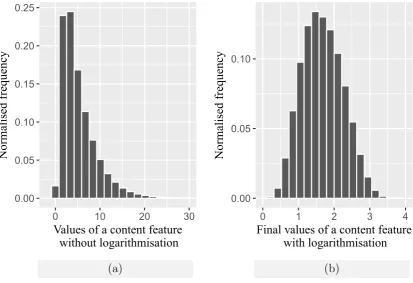
3.4 Histograms demonstrating how logarithmising influences content feature
values distribution (using feature f1 as an example). . . 38
3.5 Relative cost of arithmetical operations between eight integers in the
256-bit vector. . . 39
3.6 Horizontal and vertical pixel differences in two related vectors that can
be quickly calculated with AVX instructions. . . 39
3.7 Group of 100 different images is formed by randomly resampling 20 large
images into 5 smaller versions each. . . 41
3.8 Resampling 8×8 pixels image into 3×3. . . 42
3.9 Number of images in training, validation and testing sets. . . 50
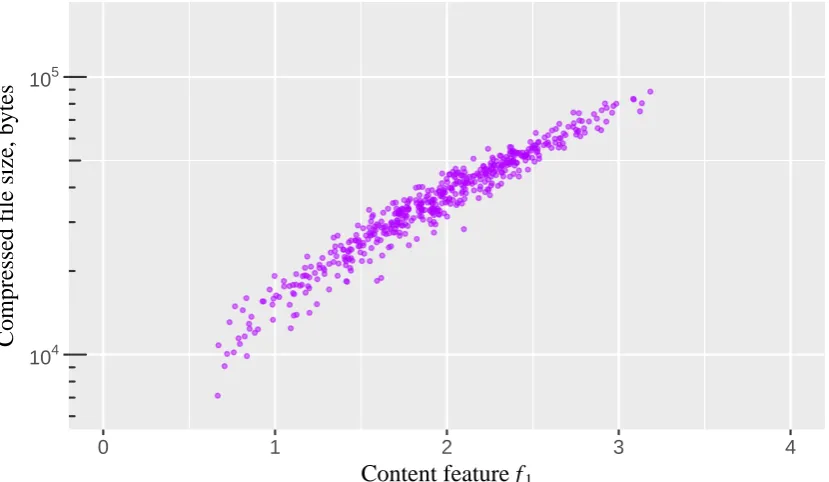
3.10 Correlation between first content feature f1 and the default JPEG size
for 500 training images 600×400 pixels. . . 51
3.11 Correlation between quality factor and file size of JPEG images for 500
training images 600×400 pixels. . . 51
3.13 Comparison of the proposed machine learning method with JPEG
transcod-ing through average errors between target and actual objectives. . . 58
3.14 Distributions of the file size percentage errors for transcoding method and proposed machine learning approach . . . 59
3.15 Distributions of quality deviations in MSSIM metric for transcoding method and proposed machine learning approach . . . 60
3.16 Average file size deviation upon compressing into JPEG with target size (using the proposed methodology). Each of 100 points is a mean error for 4000 images of a particular resolution. . . 62
3.17 Average MSSIM deviation upon compressing into JPEG with given level of quality. . . 62
3.18 Sketch of quality distributions for 16 MP images compressed with a con-stant quality factor and with the proposed method while keeping the same minimal quality for 95% of images. . . 64
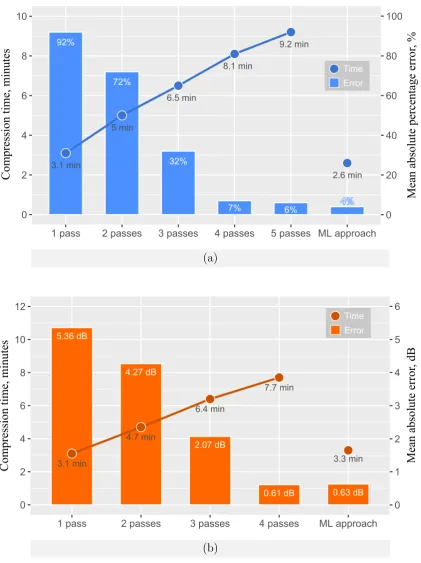
3.19 Comparison of the average file size percentage errors (a), PSNR quality deviations (b) and the total compression time for multipass WebP en-coding versus the proposed machine learning method using 4000 small test images of 0.24 MP. . . 66
3.20 Distributions of the file size percentage errors for multipass WebP en-coding and proposed machine learning approach. . . 67
3.21 Comparison of the average file size percentage errors (a), PSNR quality deviations (b) and the total compression time for multipass WebP en-coding versus the proposed machine learning method using 4000 large test images of 24 MP. . . 69
3.22 WebP compression time distribution for 24 MP images using the machine learning method (exclusive of feature extraction). . . 70
3.23 ACACIA interface in Windows. . . 72
4.1 First frame of the test video “Bosphorus”. . . 82
4.2 Example of the trends for quality, size and compression time when en-coding a small test video with different CRF values. . . 83
4.3 Example of the compressed video characteristics when using different presets with default CRF = 28. . . 84
4.4 Trend examples of the default compressed video using preliminary resam-pling to different resolutions, and assuming that the quality is calculated with respect to the 1080p original. . . 85
4.5 Sketches of different quality balancing strategies. . . 87
4.6 Video segments extraction procedure. . . 89
4.8 Dataset structure. . . 90
4.9 Relation between RMSE and error distribution. . . 93
4.10 Example comparison between percent error and relative correction of prediction. . . 93 4.11 Example of the error trends comparison using different gradient descent
modifications. . . 95
4.12 Sketch of an MLP used to evaluate content features. . . 97
4.13 Adding content features decreases average file size prediction errors. . . . 98 4.14 Differences used in video features to detect static regions (a) and
move-ment down (b). . . 99 4.15 Example distribution of the file size errors. . . 100 4.16 Range of scales and x265 parameters used in the experiments. . . 102 4.17 Compressed frame size distribution before and after logarithmisation. . . 103 4.18 Distribution of mean SSIM quality metric values: standard (a) and
mea-sured in decibels (b). . . 103 4.19 Sketch of the best network for file size predictions. . . 105 4.20 Difference between file size error distributions for models with and
with-out compression options (calculated for development set). . . 105 4.21 Hill climbing search trends for the compressed file size and average quality
in MSSIM metric using random start and 4th test video as an example. . 109
4.22 Heatmaps of the best parameter combinations found by the GA for 3rd
test video with target quality 0.957 (a) and 0.790 (b). . . 114 4.23 Similarity in the frame quality trends between the default x265
compres-sion and per-segment encoding with the search-based dynamic resolution
targeting minimal file size (4th test video was used as an example). . . . 116
4.24 Example of choosing optimal compression parameters among several
al-ternatives by using heuristic-based ranking (assuming µ = 0.9 and σ =
0.005). . . 119
4.25 Comparison of the frame quality trends between default x265
compres-sion and per-segment encoding with dynamic resolution using 3rd test
video as an example. . . 122 4.26 Comparison of the frame quality trends between default x265
compres-sion and per-segment encoding with dynamic resolution using 4th test
video as an example. . . 123 4.27 Concept of the three sliders to specify priorities for each target objective. 124
List of Tables
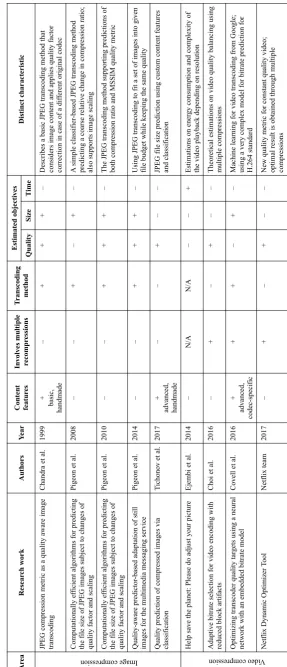
2.1 Brief summary of the recent research related to predictable image and
video compression. . . 31
3.1 Normalised weighting coefficients wi for calculating SSIM in an 11×11
pixels window. . . 44
3.2 Selecting the best model for JPEG file size prediction among several
models trained with different settings. . . 54
3.3 Test set errors for all JPEG and WebP regression models. . . 55
3.4 Typical execution time for different operations on a 24 MP image using
libjpeg-turbo and vector instructions. . . 61
4.1 Short summary of four test videos. . . 91
4.2 Selecting optimal network structure for the regression model predicting
file size. . . 106
4.3 Selecting optimal network structure for the quality and compression time
models. . . 107
4.4 Comparison summary of applying a search-based dynamic resolution
method to four test videos. . . 111
4.5 Comparison summary of applying dynamic resolution method with
heuristic-based quality balancing to four test videos. . . 120
4.6 Comparison of the compression results obtained with different priority
combinations using 4th test video as an example. . . 125
Table of Contents
Abstract ii
Declaration ii
Permission for Publication iii
Acknowledgements iv
Acronyms v
List of Figures vi
List of Tables x
Table of Contents xi
1 Introduction 1
1.1 Problem Examples . . . 2
1.2 General Idea . . . 6
1.3 Contributions . . . 8
1.4 Thesis Structure . . . 9
2 Related Work 10 2.1 Modern Image and Video Codecs . . . 10
2.1.1 Image compression standards . . . 10
2.1.2 Video compression standards . . . 11
2.2 DCT Quantizer as a Main Codec Parameter . . . 12
2.3 Predicting Image Compression . . . 13
2.4 Video Compression Optimisation . . . 16
2.5 Objective Quality Metrics . . . 20
2.6 Machine Learning in Image Compression . . . 23
3 Predicting and Optimising Image Compression 32
3.1 Methodology . . . 32
3.2 Content Features Description . . . 34
3.3 Feature Extraction Program . . . 38
3.4 Image Dataset . . . 40
3.5 Image Resampling Program . . . 42
3.6 Image Quality Measuring Program . . . 43
3.7 External Tools . . . 44
3.7.1 JPEG compressors . . . 45
3.7.2 WebP compressor . . . 46
3.8 Experimental Setup . . . 47
3.9 Gathering Image Compression Statistics . . . 47
3.10 Regression Models . . . 49
3.11 Results for JPEG . . . 56
3.11.1 Comparison with JPEG transcoding . . . 56
3.11.2 Comparison with a constant quality factor . . . 63
3.12 Results for WebP . . . 64
3.13 Discussion . . . 71
3.14 ACACIA image compression tool . . . 71
3.15 Summary . . . 73
3.16 List of Contributions . . . 74
4 Dynamic Resolution and Video Compression with Target Quality 75 4.1 Levels of Quality Balancing . . . 76
4.2 Video Quality Measuring Program . . . 77
4.3 External Tools . . . 79
4.3.1 FFmpeg and FFprobe tools . . . 80
4.3.2 Introduction to x265 . . . 81
4.4 Problem Formulation . . . 86
4.5 Dataset of Video Segments . . . 88
4.6 Error Metrics . . . 91
4.6.1 RMSE . . . 92
4.6.2 Relative correction of prediction . . . 93
4.7 Gradient Descent Techniques . . . 95
4.8 Experimental Setup . . . 96
4.9 Video Segment Features . . . 96
4.11 Experimental Results . . . 107
4.11.1 Targeting average frame quality . . . 107
4.11.2 Targeting constant frame quality . . . 117
4.12 Discussion . . . 125
4.13 Summary . . . 126
4.14 List of Contributions . . . 127
5 Conclusions 128 5.1 Summary of Results . . . 128
5.2 Relation to Other Work . . . 132
5.3 Theoretical and Practical Significance . . . 133
5.4 Limitations of the Considered Techniques . . . 134
5.5 Future Work . . . 135
5.6 Closing Thoughts . . . 137
Appendix A Alternative approaches to numerical regression 138
Appendix B Tool for training feed-forward neural networks 141
Appendix C Fitness bias in the genetic algorithm 143
Chapter 1
Introduction
Improving the efficacy of image and video compression algorithms has been an ongoing area of research for many decades. The challenges associated with image and video compression remain important today due to the steady increase in sensor resolution, display resolution, and the demand for increasingly high quality media in consumer and professional applications. However, introducing a new compression standard to meet these demands is difficult in practice, even with an improved quality to size ratio, because modern infrastructure has been optimised specifically for current standards. As a result, employing image and video codecs currently in use is often thought preferable to making radical changes.
This work focuses on a methodology for improving and understanding the qual-ity of media compression algorithms using an empirical approach. Consequently, the outcomes of this research can be deployed on existing standard compression algorithms, but are also likely to be applicable to future standards.
Processing modern large photographs and high-quality videos requires increased storage capacities, network bandwidth and a considerable amount of time and en-ergy. This means that the compression time associated with the use of traditional codecs with modern images and videos has become a major concern. These chal-lenges are compounded when we consider not just the increased size, quality and resolution of modern images and videos, but the ever increasing volume and sheer bulk of image data in existence.
This rapidly growing global volume of multimedia data requires new strategies for image and video compression that balance quality and file size, minimise com-pression time and have the flexibility to allow optimisation for specific use cases. For example, live steaming video can suffer from inconsistent quality because of strict limits for compression time, as highly detailed scenes generally take longer to process. The offline compression can be demanding as well. If a hypothetical medium-sized multimedia company needs to compress thousands of images or videos per day, which occupy few terabytes of disk space, that company will experience some non-trivial requirements for server equipment and energy consumption.
However, there is an alternative to increasing the number of servers for data compression. Large quantities of images and videos can actually be considered as an advantage for applying methods of statistical optimisation such as machine learning. This means that it may not be possible to decrease compression time for every singe image, but at the scale of 1000 images the difference in time will be substantial in comparison with using just built-in compressor options.
In reality, optimisation may not be possible in some cases. For example, com-pressing images into smaller file sizes with the same quality using the same codec is contradictory, unless of course, the codec has specific options that allow such scenario at the cost of increased compression time. Overcoming limitations of a particular codec will require changes in the compression algorithm.
But in many practical situations, there are alternative compression strategies which can give better results in terms of speed. It is relevant for applications that require a specific outcome of compression such as a given level of quality or fixed file size; this thesis is focused on such use cases. This research proposes a new methodology for predicting the outcome of compression allowing various prelimi-nary optimisations of encoding strategy in order to save compression time and even improve resulting quality or decrease size.
In view of the above, it is clear that compression time optimisations are impor-tant from a practical point of view, and it becomes necessary to explain why they are possible and indeed necessary. The main reason is unpredictability of modern codecs.
1.1
Problem Examples
The result of compression is determined by a particular codec, which is assumed to be a fixed choice, and the following factors:
– input resolution (and length for videos); – actual content of the image or video.
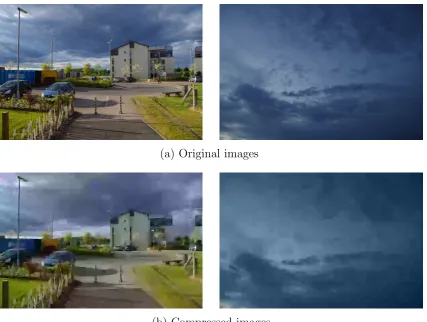
Upon compressing various images or videos with the same options, the results are different in terms of quality and size (figure 1.1). The problem is that there is no easy way to tell anything about the outcome of compression beforehand because it depends on the three above-listed factors, which influence result simultaneously in a complex manner. This creates an obstacle for use cases aiming for specific quality or file size as it is often unclear how to choose appropriate compression parameters. The simplest way to deal with this problem is to perform several recompressions with different parameters until the desired constraints are satisfied. Such approach could be very expensive in terms of compression time.
(a) Original images
[image:17.595.86.514.286.608.2](b) Compressed images
Figure 1.1: Two ordinary photographs resized to 600×400 pixels (a)
and then compressed into WebP format with the same minimum possible quality (b). The road image had size 3 kB and quality 0.7;
the sky image – 1 kB and 0.9 in the MSSIM quality metric (mean structure similarity index [2]).
content. This example case uses WebP codec to show explicit quality degradation because WebP does not make an image unrecognisable at very low quality com-pression. Image codecs are not very good at understanding content and connection between its complexity and outcome of compression. Identical encoding parameters do not imply either same quality or same size.
The need for compression time optimisations arises because modern image and video codecs do not implement functionality for estimating compression result char-acteristics such as quality and size. There are a couple of exceptions like fixed bitrate video encoding that produces constrained size by definition and JPEG 2000 lossy compression, which aims for a given file size by design. However, in a ma-jority of probable scenarios image/video codecs are still hard to predict. Although there are no theoretical obstacles to perform estimations of quality and size inside a codec based on the content of a particular image or video, it is pertinent to mention that estimating compression time does not exist in any modern encoder due to an objective reason – it may be possible only for a fixed hardware configuration.
In the case of video compression choosing optimal parameters could be even more complicated because video content can vary significantly between the first and the last frames of a single video, which makes any set of options more suitable for some parts of the video and less appropriate for the others. Although many video compressors can perform quality balancing across different segments of the video, it is often not perfect and there are scenarios, where such balancing cannot work properly.
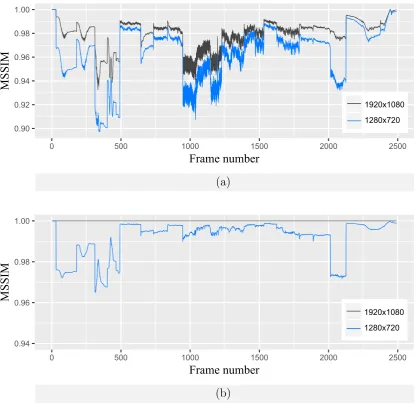
For example, downsampling an entire video into a different resolution is a widely used method of quality control in many popular video streaming services including YouTube and Twitch. Figure 1.2a shows distribution of quality in a particular video
compressed in two resolutions: 1920×1080 and 1280×720 assuming that the display
resolution is Full HD, so 720p version is upscaled to 1080p upon playback.
0.90 0.92 0.94 0.96 0.98 1.00
0 500 1000 1500 2000 2500
Frame number
MSSIM
1920x1080 1280x720
(a)
0.94 0.96 0.98 1.00
0 500 1000 1500 2000 2500
Frame number
MSSIM
1920x1080 1280x720
[image:19.595.90.508.87.491.2](b)
Figure 1.2: Frame quality in the mean SSIM metric for an ordinary 1080p video and its 720p version encoded with x265 (a) and without
any compression (b) at the 1920×1080 display resolution.
1.2
General Idea
This research proposes a universal method that helps to deal with the problem of unpredictable compression. It is based on a simple idea – knowing the outcome of compression without actual compression allows a saving in total computational time. Considering the fact that conducting several recompressions will eventually lead to a desired solution, it is possible to notice that such a procedure is redundant in terms of the amount of produced information. Actual compressed files are discarded, only their characteristics like quality and size are recorded for comparison. This fact inspired the idea that the compression result can be estimated without performing any compression but using statistical models.
The main factor that brings uncertainty into the problem of estimating a com-pression outcome is how the content of various images and videos interacts with different codec parameters to produce various compression results. However, it is reasonable to assume that gathering enough statistics will help to identify some trends and regularities, which in turn can facilitate prediction of the outcome char-acteristics.
This concept should be applicable to a range of existing image and video com-pressors due to the fact that they operate by the same basic principle – eliminating redundancy in the low entropy data, which enforces correlations between the out-comes of different codecs.
Based on the possibility of improvements with the statistical approach, it is
possible to put forward the Predictable Compression Hypothesis:
Regardless of a particular codec the desired compression result can be obtained in a single encoding operation thus avoiding the need for several recompressions and extra processing time.
The main problem on a path towards obtaining a desired compression result is lack of functionality for estimating the compression outcome characteristics much faster than doing actual compression. One of the key ideas of this research is to build machine learning models that can predict such objectives as compressed file size, resulting quality and encoding time for images and videos.
investigates a general scenario without any format constraints and demonstrates superior accuracy in comparison with the transcoding method.
As for the video compression, the existing research does not address the prob-lem of predicting compression results and barely considers optimisations, which are external to the codec. Despite some indication of the growing interest in this area, in particular by Netflix, no comparable research projects have been found. In this research we do not just build a predictor for the x265 video codec, but also propose a novel concept of the dynamic resolution video, which permits to surpass standard codec capabilities and decrease total compression time in some use cases. The main idea of the dynamic resolution is to use variable size for different segments of the video according to their complexity.
So, the main goals of this work are:
– to investigate the connection between image/video content and the outcome of compression with different parameters;
– to propose optimisation strategies for bypassing multiple recompressions. The methodological basis of this research is an experiment-driven investigation, which uses the following methods: gathering statistical data, modelling through regression analysis, statistical comparison and heuristic-based decisions.
The scope of the research consists of investigating lossy compression for image and video formats, which are suitable for photographical (natural) scenes. The considered problems are related to processing only graphical information (pixel data) in the images and videos. The metadata and audio streams were not studied. This work does not propose new compression algorithms or any modifications to the existing ones. Instead it introduces methods for obtaining a desired compression result faster and in a predictable way using only real image and video codecs.
The investigation commences with the case of image compression and proceeds into scenarios for video compression. Such approach allows a gradual increase the problem complexity because images represent a fundamentally simpler data type in comparison with videos. The problem of predicting image compression was tested on a wide range of resolutions up to 24 megapixels.
objective quality metrics are used in this thesis with the main focus on the mean structure similarity index (MSSIM) by Wang et al. [2]. It is a popular and flexible quality metric independent from picture size and video length. Although it is not a perfect metric, this research considers any quality estimation algorithm as a “black box” proposing a universal methodology applicable to various quality metrics.
1.3
Contributions
The research contains the following contributions:
• A concept of content features for representing entropy of an image or video. The content features presented in this work were designed specifically with an in-tention to provide a computationally cheap metric for image and video complexity. They were engineered manually based on the factors influencing compression result as well as on the author’s own experience in image compression. This research uses the most adequate set of features for the prediction problem in comparison with related work, where the choices were barely explained. An extra effort was made to tweak the features to be suitable for implementation with Intel AVX (advanced vector extensions) instructions.
• A universal method for predicting outcome of compression. The method is based on employing the machine learning models that use content features and val-ues of compression parameters as input vectors for explicit predictions of quality, size or computational time for images and videos before compression.
• The problem of predicting image compression was solved with reasonable ac-curacy. The image compression with size and quality constraints was tested on a range of resolutions including large photographs and has shown a relatively small average error of 3% for the file size and 0.01 for quality in the MSSIM metric. Such accuracy is sufficient for applying the proposed methodology in various practical use cases. The necessity to analyse image content before compression increases to-tal computational time for approximately 20–30% using the JPEG codec and 1–2% for WebP in comparison with a single default compression.
•The problem of video compression with a given level of quality was solved with a sufficient accuracy for practical use. Although the errors of the prediction models for video compression were relatively high, in particular the average error of the file size prediction model was about 30%, it was still possible to use such models for compressing long videos with a given level of quality.
in various resolutions according to their content complexity and the desired quality. The video is then resampled to the display resolution upon playback. This approach results in a decreased compression time and sometimes even smaller file size, while the quality is maintained at approximately the same level. This thesis investigates the efficacy of dynamic resolution video and its interaction with other compression parameters.
1.4
Thesis Structure
The thesis includes a literature review (chapter 2) and two technical chapters dedicated to image and video compression respectively:
–Predicting and optimising image compression (chapter 3), which describes the methodology and demonstrates its universality by applying it to JPEG and WebP image formats;
– Dynamic resolution and video compression with target quality (chapter 4) introduces a concept of video compression with variable resolution across different segments using x265 codec.
The main results from the third chapter “Predicting and Optimizing Image Compression” were presented in the paper of the same title [4] at the ACM Multi-media conference in 2016.
Chapter 2
Related Work
This chapter provides a summary of existing image and video compression stan-dards, explains how classic compression algorithms require user-generated input pa-rameters, like the quantizer factor, and gives a brief overview of the related research that attempts to deal with this problem.
2.1
Modern Image and Video Codecs
There are few image and video formats widely used in practice, in particular, on the Web. Existing implementations of media compression standards tend to demonstrate a similar efficiency in terms of quality-to-size ratio, and it is difficult to identify an universally best compressor.
2.1.1
Image compression standards
JPEG is one of the oldest image compression formats. The JPEG File
Inter-change Format (JFIF) specification was proposed in 1991. It is the most widely used still image format, which became the de-facto standard for photographic images and Internet graphics.
Today, JPEG is defined by the reference implementation from the Independent JPEG Group [5], although a number of other implementations are more popularly
used, like libjpeg-turbo [6], which is optimised with CPU vector instructions.
Google’sWebP format [8] was proposed in 2010 as an alternative to JPEG and PNG (Portable Network Graphics) formats for Web applications. It relies mostly on a discrete cosine transform, similar to JPEG, but also uses prediction techniques and arithmetic compression.
WebP codec has more compression parameters than a typical JPEG encoder. However, the main parameter is still quality factor in the same range [0; 100]. There are a couple of options, which are of particular interest because they allow a user to compress images into given file size or quality in PSNR (peak signal-to-noise ratio) metric using multiple recompressions and a binary search. The availability of these options has allowed a more direct comparison between the method proposed in this thesis and the built-in functionality of the WebP codec.
JPEG 2000was proposed as an alternative standard for replacing JPEG. It is based on the discrete wavelet transform (DWT) instead of DCT. It was originally designed to compress images into a given file size without multiple recompressions, which is related to the problem investigated in this research. Such functionality was implemented through progressive encoding from low- to high-frequency components of the discrete wavelet spectrum, so that the redundant information, which does not fit into specified file budget, is discarded. The details of the standard implementation can be found in [9].
The JPEG 2000 codec was not considered in this thesis as the format is not widely used today, and is generally not considered successful in comparison with JPEG. It has been criticised, in particular, for blurring the smooth colour areas in the image [10], which affects its applicability in practice.
2.1.2
Video compression standards
H.264 is a widespread video compression standard used by many streaming services and supported by all popular browsers. It was first proposed in 2003 and resulted in many software and hardware implementations. One of the well known and efficient implementations is the x264 video codec.
in this thesis. Currently, it has considerably fewer options and general functionality than x265. The latter is used as the reference implementation for research in this thesis due to its real-world use and emphasis on performance. Multiple comparisons demonstrate the efficiency of the H.265 standard and x265 video codec in particular [13, 14, 15].
VP9 video compression format was developed by Google as an alternative to
H.265 (supposedly due to the licensing issues). This standard is used by the YouTube online video service along with H.264.
Thor video codec by Cisco is positioned as a free alternative to the licensed
standards. It is defined with its reference implementation [16] and openly published description [17], which is relatively simple and easy to understand. For example, it explicitly shows the role of the discrete cosine transform in regulating the quality by compressing individual frames [17, fig. 1].
Daalais a relatively new codec [18], which is still under development sponsored by Mozilla. It is presented as a potentially more efficient alternative to the existing VP9 and H.265 formats based on more sophisticated techniques than a standard DCT. The codec is in the experimental stage, not properly optimised and does not use parallel processing.
2.2
DCT Quantizer as a Main Codec Parameter
The discrete cosine transform (DCT) is the most widely used method for audio-visual data compression. Many popular image and video codecs employ it in order to change the representation of the pixel data into a spectral form more suitable for subsequent entropy encoding.
Due to the fact that all popular image and video codecs are based on spectral transformations, the quantizer plays a major role in regulating the level of compres-sion and resulting quality of the image or video.
Most image and video codecs ask user to specify the value of quantizer or conceptually similar parameter before compression. The problem is that although such options can be considered and used as a measure of quality degradation, it does not correspond to the subjectively perceived level of quality or objective quality metrics like PSNR and SSIM. The situation with the compressed size is even worse – it cannot be estimated based on the quantizer value.
As image and video codecs become more complicated, other compression options are added in order to further tweak the compression process. This only complicated the problem of getting a desired outcome without trying multiple combinations. Modern video codecs operate with dozens of parameters, and it is very difficult for a user to understand the implications of each of these parameters on a compression process. This is why this research investigates the connection between compression parameters and the resulting characteristics using statistical methods.
2.3
Predicting Image Compression
Chandra and Ellis (1999)
The problem of predicting image compression outcome and optimal codec pa-rameters has already been discussed in few papers. Various authors consider only the JPEG transcoding scenario – i.e. recompressing JPEG image into lower quality. Probably the oldest paper that addresses the problem is the work of Chandra et al. in [20], which explicitly states that predicting compressed JPEG file size is impossible without taking into account the image content. The paper proposed an approach to classify a transcoding operation according to the potential improvement in file size. The idea of predicting explicit image characteristics was not developed. The research of Chandra et al. is based on a simple fact that the value of JPEG quality factor, which is used to scale quantization tables, correlates with the compression ratio of the image. Therefore, having enough statistics it is possible to estimate the compression ratio for another quantizer value. A considerable attention was paid to the problem when the original JPEG image was compressed using dif-ferent software with custom DCT quantization tables, and consequently its original compression ratio may not correspond to the quantizer used in the test codec.
they used some image characteristics as parameters for classification. They obtain a couple of values from manipulating DCT coefficients of the compressed image, for example, by calculating the percentage of high-amplitude DCT components. The idea of using coefficients of image spectral transformations as a measure of entropy has influenced design of the few image content features in this thesis.
Pigeon and Coulombe (2008 – 2014)
Another approach for transcoding JPEG images, which was extensively used
by Steven Pigeon and St´ephane Coulombe in several papers [3, 21, 22, 23, 24, 25,
26], consists of constructing a classifier for estimating only a relative change in the compressed file size and quality in comparison with the input JPEG image. Such an approach is similar to the work of Chandra and Ellis [20] but does not use any features describing the image content.
For example, in [3] Pigeon et al. aim to predict the JPEG file size for transcoding operations prior to recompression. They consider two compression options: qual-ity factor and scale. The main parameter controlling the aggressiveness of JPEG compression is the quality factor, which is used in the JPEG algorithm to scale quantization tables. In addition, an external parameter is introduced – the scaling factor for changing the output image resolution. Both quality factor and scale are taken into account when predicting transcoding outcome.
Pigeon et al. use a dataset of 70 300 images for gathering statistics. Firstly, they cluster original images with K-means algorithms considering original resolution (width and height) and original quality factor as independent variables. Then for each cluster they create a statistical table of 100 cells corresponding to all combi-nations of the quality factors (10, 20, ..., 100) and ten scales (10%, 20%, ..., 100%). Each cell represents an average relative change in the file size upon recompressing with particular quality factor and resolution.
A new image that needs to be recompressed is mapped to one of the clusters and subsequently to one of the cells in the corresponding table that represents a desired change in the compressed file size. This allows to identify optimal quality factor and target resolution for recompressing the image.
Although the JPEG transcoding method does not explicitly rely on the image content, it has such advantages as instant feature extraction and a possibility of a partial recompression. These benefits may not be applicable to other image formats like WebP. Moreover, Pigeon et al. did not consider cases if the original JPEG image was compressed using different options (e.g. Huffman code optimisation) or quantization tables (despite the fact it was previously done by Chandra et al. [20]), which is likely to decrease accuracy of the classifier.
In [21] Pigeon and Coulombe added the MSSIM quality metric as a second ob-jective to be predicted for JPEG transcoding. Using the same approach as in the previous work [3] they show that it is possible to transcode images with a given qual-ity relative to the original image. They also propose to apply multiple recompres-sions in cases where a single transcoding did not fit the target objective. However, they do not compare computational expenses between the multiple recompressions with and without prediction as an extra a priori information. In addition, calculat-ing quality metric relative to an already compressed JPEG image is not suitable for scenarios where original image is not in the JPEG format – e.g. a raw data from the camera sensor or an edited photo.
In their last paper [26] Pigeon et al. adopted the problem to transcoding mul-tiple images and positioned it as an optimisation for the Multimedia Messaging Service (MMS). Considering a set of images, the aim is to recompress them into the same level of quality. A reasonable objective function is proposed – the product of quality metric values for all images in the group, which encourages the uniform quality distribution for multiple images. It is based on the fact that a product value is maximum when its factors are identical. The paper is focused mostly on solving this optimisation problem by maximising the product with dynamic programming. Although the proposed method can be used in practice, the role of the MMS service in particular looks secondary and artificially attached to the topic.
The work of Pigeon and Coulombe can be summarised into two different use cases: recompressing (transcoding) one JPEG image with constraints and recom-pressing a group of images with constraints. They use up to three main target objectives: desired quality, compression ratio and resolution.
These papers discuss similar practical cases with methodologies which only differ slightly, or iteratively. Although the work by Pigeon et al. only considers compressed images and not uncompressed images, it is the most closely related to the problems
considered in this thesis. For this reason their core methods and experimental
Tichonov et al. (2017)
The recent work by Tichonov et al. [27] is dedicated to the problem of pre-dicting image quality when compressing images into JPEG format. In the paper a classification approach is proposed, which is conceptually similar to the works of Pigeon and Coulombe. The major difference is in the fact that Tichonov et al. use a feature vector of several parameters, which are the colour depth and eight colour features – statistical characteristics of an image after applying an edge filter to the red, green and blue colour channels. Unfortunately, this choice has not been ex-plained, but it can still be considered as the only explicitly formulated idea of the image content features in the research literature.
Due to the fact that this thesis also proposes a different set of content features specifically designed to predict compression outcome, it would be interesting to com-pare them with those proposed by Tichonov et al. However, it was impractical due to the fact that when Tichonov et al. published their paper after the work on im-age compression for this thesis had been completed and published in 2016 [4]. This circumstance made it inefficient to return to image compression experiments to repli-cate and test another method. The intention behind this was to save time and disk space in order to get more interesting results from video compression experiments, because the latter was assumed the more perspective research direction.
Nevertheless, it is possible to make some general conclusions. For example, considering how the features in [27] are calculated, it is clear that they were not designed to capture local spacial complexity of the image relief. Instead, the statis-tical calculations are applied to an image as a whole. Presumably, such an approach is not an efficient mean of representing the diversity of image content especially for large images. As a consequence, it should reduce the accuracy of a machine learning model for predicting quality.
Tichonov et al. did not experiment with predicting compressed file size. The reason given for this is that they considered file size more difficult to predict than quality. This question of relative difficulty is discussed in the thesis in Chapter 3.
2.4
Video Compression Optimisation
Choi et al. (2016)
in the video encoded with a fixed bitrate have variable amount of block artefacts. Due to the fact that increasing the bitrate for the whole video may be too expensive, they propose to deal specifically with the problematic frames.
For the experiments in [28] the reference implementation of the H.264 standard was chosen. Six standard short test videos from the xiph.org database were used as a dataset. The optimisation starts with recompressing a test video into multiple target bitrates and recording the amount of blocking artefacts for all frames in every scenario with a specially designed method.
Then using an optimisation procedure, based on the collected data, Choi et al. choose which bitrate should be targeted for each particular frame so that the amount of blockiness is minimal. Finally, they claim that the test video can be compressed with the optimal bitrate for each frame. The problem is that they do not explain how to perform this compression in practice. It appears to be impossible to achieve this through standard encoding procedure without modifying the codec. The reference codec manual [29] shows that the user can specify bitrate for the whole video, but not for individual frames.
Although the research of Choi et al. discusses some similar issues, the context in which the work is done is very different – it demonstrates what result can be obtained theoretically using their proposed balancing technique, but not in a way which can be put into practice in under current standards. Consequently, this research is not directly comparable with the methods presented in the current thesis, which are bound by the real world constraints of real formats.
Nevertheless, Choi et al. [28] proposed an interesting and original idea, which demonstrates an example of how multiple recompression can be useful for quality balancing inside a video. This thesis, conversely, investigates practical scenarios that help to avoid compressing a video more than once in order to save time and energy.
YouTube machine learning for video transcoding (2016)
Covell et al. proposed to predict an optimal compression parameter value that leads to the desired quality level. The main idea was to extract general video fea-tures like resolution, frame rate, original bitrate, as well as hundreds of more specific ones like various motion compensation vectors. In order to get this information they perform a preliminary compression pass with a relatively low quality to get a ref-erence compression ratio. Then they calculate several hundred features (depending on the approach modification) and use a neural network trained with the data from 9250 5-second video segments to predict the optimal CRF (constant rate factor) parameter values in the x264 video codec.
Covell et al. did not estimate the computational complexity or potential time savings upon using their method [30]. It would be an interesting question to inves-tigate because using a video precompression stage requires a considerable amount of time as well as calculating lots of features from the compressed file. It is also unclear if the hundreds of features used, which depend on a particular video codec, might be transferable to other codecs, making this approach much less general. Due to the fact that the proposed system for predicting a single compression parameter is quite complicated, it should add a substantial time overhead, thus reducing the potential compression time benefits in comparison with multipass encoding.
Unfortunately, the original paper is relatively short and does not provide enough information to replicate the proposed method to a reasonable extent for comparison purposes. The general description of the method was also published in the YouTube developers blog [31] but it also does not contain technical details.
Netflix Dynamic Optimizer (2017)
The video streaming companyNetflix recently announced the development of a
tool called “Dynamic Optimizer” [32], which is expected to help with the problem of video bufferization when using slow connections. It should improve the compressed video quality or reduce bitrate in comparison with a typical scenario of the constant bitrate encoding.
Although no specific technical details have been reported except the fact that they use machine learning to balance the quality of all frames in the video, this topic is still related to the thesis.
objective quality metrics in order to approximate the mean subjective score of the frame quality degradation.
Although the news about Dynamic Optimizer look more like marketing claims to advertise the company services, it is possible to put forward an educated guess about how it might be implemented based on the preceding research published in the Netflix blog.
Firstly, it is reasonable to assume that one of the target objectives is the same level of quality for all frames in the video. The visual quality perception for each frame should be verified using VMAF tool considering the amount of work they invested into it. Another aim of the Dynamic Optimizer should be the quality to size ratio for each particular video. Considering the fact that compressed video is viewed many times, the encoding time factor is less important than minimising file size or improving the quality. Therefore, they can afford multiple recompressions of every frame to obtain a specific level of quality.
Consequently, it is likely that the developers modified a video codec by replac-ing the default heuristic for choosreplac-ing quantizer at every frame with an exhaustive search for an optimal quantizer value that yields a chosen level of quality for each particular frame depending on its complexity. Despite the fact that there could be problems with taking into account the motion compensation part of the algorithm, such idea of per-frame quality balancing makes sense in terms of practically con-stant perceived quality across the entire video. This is speculation, but there is no scientific publication to refer to.
This thesis also considers the problem of targeting constant quality, although at a different level. Instead of dealing with individual frames, the optimisation is performed for video segments corresponding to separate scenes in a long video.
Ejembi and Bhatti (2014)
Video compression optimisations may be related not just to the obvious charac-teristics like resulting quality, file size and compression time, but also to the decoding complexity and its energy demands.
2.5
Objective Quality Metrics
The purpose of using an objective quality metric is to have a quick, deterministic and reliable way to measure quality degradation of the compressed image or video in comparison with the original.
Depending on the practical purpose of compressing an image or video, it can be targeted for a subsequent algorithmic processing or for the human vision. Con-sequently, the quality metrics used to estimate the amount of introduced noise may be different. In the case if the image/video is a subject to further machine analy-sis, the standard mean squared error is often considered sufficient. However, if the compressed material will be viewed by people, there is no solid consensus on which metric should be used as a replacement for subjective quality perception. Many quality metric investigations like [36] suggest that it is still an open question.
There are two kinds of objective quality metrics. One is calculated by com-paring the compressed image with the original. Another – referenceless metrics – estimate the image quality without reference to any other source. Referenceless metrics are usually aimed at detecting explicit compression artefacts like blur or blockiness. For example, Tong et al. [37] propose to measure the amount of blur using spectrum coefficients of the discrete Haar wavelet transform, while Chen et al. [38] use conceptually similar method based on calculating the gradient at different image resolutions. To detect blockinness Gunawan et al. [39] propose to use a Sobel operator while taking into account the entropy of the image area. There seem to be no established standards among the referenceless metrics.
This research uses only metrics calculated with respect to original image or video
(full-reference metrics). Probably the most popular quality estimation methods
today are PSNR (peak signal-to-noise ratio) and SSIM (structure similarity index).
The PSNR metric is a simplest one based on the mean squared error. It uses
a logarithmic scale in decibels to facilitate interpretation of the values. For two
images (discrete signals)x and y the PSNR metric is calculated as:
P SN R= 10·log10
L2
1
N ·
N X
i=1
(xi−yi)
2
,
whereN is a number of discrete samples (pixels in the image); L= 255 is a dynamic
range of the brightness levels or maximum possible pixel value;xi and yi are values
Although PSNR is still widely used today, it has been criticised for insufficient correlation with the human vision system. For example, Huynh-Thu et al. [40] empirically established that PSNR can reliably indicate quality levels only for a single image or video. In case of different images and videos, the same values of this metric do not correspond to the equal amount of the visible quality degradation.
The SSIM metric and, more importantly, its window version – MSSIM (mean
structure similarity) were designed from scratch by Wang et al. [2] based on several basic assumptions about specifics and sensitivity of human vision. The MSSIM was proposed as a more sophisticated alternative to a widely used PSNR. The authors’ aim was to improve the approximation of the human quality perception.
Between two images MSSIM is calculated as an average of the SSIM metric
values in all positions of 11×11 sliding window. According to Wang et al., this
approach is usually more reliable than simply calculating SSIM for the entire image because of higher attention to the details in each window.
The SSIM in 11×11 pixels window is calculated as follows:
SSIM = (2µxµy +C1)(2σxy+C2)
(µ2
x+µ2y+C1)(σx2+σy2+C2)
µx = N X
i=1
wixi
σx = v u u t
N X
i=1
wi(xi−yi)2
σxy = N X
i=1
wi(xi−µx)(yi−µy),
where N = 121 is the number of pixels in the window; C1 = (0.01· L)2; C2 =
(0.03·L)2; L = 255 is a maximum luminance; x
i and yi are corresponding pixel
values;wirepresents a value from the 11×11 matrix of samples from the 2D Gaussian
with σ= 1.5 in the range [–5; +5].
The range of theoretically possible values of the SSIM metric is [–1; +1], where 1.0 means identical images. However, in practice the metric values do not drop below zero.
PSNR and SSIM metrics for compressed videos and experimentally established that SSIM is considerably more adequate than PSNR for measuring quality degradation in video sequences. Kotevski et al. also note that SSIM is not a perfect metric and has some issues too, mainly due to reduced sensitivity to changes in brightness and contrast.
Butteraugliis a new image quality metric proposed by Google. It is defined by its reference implementation [43] and unfortunately lacks a comprehensive explana-tion of its mechanisms and basic principles. According to the informaexplana-tion available, the Butteraugli project aims to reach a sufficient approximation of the way the hu-man visual system reacts to minor quality differences. It is a full-reference metric that uses information from all colour channels to calculate a difference value. The PSNR and SSIM metrics are typically calculated only for image luminance. The ref-erence implementation of Butteraugli is relatively slow. It takes approximately 10 seconds for a Full HD frame in comparison with about 1 second for MSSIM metric and only few milliseconds for PSNR.
The most reliable method to estimate quality degradation in images and videos
is to ask real people to rank them and calculate themean opinion score (MOS).
However, this approach is not feasible in many research projects, including this thesis. In the case of calculating quality of the compressed material as one of the final stages of an experiment, obtaining MOS is a demonstration of a solid result. However, if multiple quality measurements need to be conducted in real time to make certain decisions, using an objective quality metric is the only practical choice.
Despite the fact that new alternative quality metrics are introduced, only PSNR and SSIM/MSSIM remain widely used by multimedia research community. The problem seems to be in the balance between the metric complexity and its corre-lation with the human perception. When another more complex quality metric is introduced, it becomes necessary to understand how reliable it is in the different use cases. Even assuming that the new metric demonstrates better correlation with mean subjective opinion than SSIM, it may not be the case in the alternative sce-nario. For example, considering Butteraugli, its authors admit that it may not be a reliable measure of significant image distortions.
Consequently, the researchers often prefer slightly less efficient metrics with relatively simple and transparent implementations than more complicated ones with lower reliability for general use.
Almost all quality measurements for compressed images and videos in this
the-sis were done in the MSSIM metric. One of the advantages is that due to its
resolution as well as length of the video.
It is important to emphasise that MSSIM is not an ideal quality metric. However this thesis proposes methods which are independent from any particular metric by design. The logic behind this decision is that although the results may slightly differ upon using a different metric, the methodology remains the same.
2.6
Machine Learning in Image Compression
Although making compression algorithms or comparing their efficiency in terms of quality to size ratio is not the focus of this research, it is important to know how machine learning had been used for improving compression algorithms.
Hinton et al. (2006)
In recent years the idea of utilising the approximation capabilities of artificial neural networks for image compression has been gaining popularity. In particular,
this relates to autoencoders – a type of multilayer network that replicates input
signals on the output using a relatively small number of neurons in the middle of the network. The smaller transverse diameter in one of the central layers forces generalisation of the input data upon transferring it through the network.
Hinton and Salakhutdinov [44] pointed out that this property of autoencoders can be used for dimensionality reduction of the graphic and text data. Using au-toencoder is conceptually similar to the principal component analysis (PCA) but in a non-linear space. Lossy image compression is a suitable use case for such method-ology.
Hinton et al. only presented a concept in an explicit form but did not conduct an efficiency comparison with the existing image compression techniques. This makes the paper interesting conceptually, but does not provide an evaluation that would suggest it is better than existing implementations.
Toderici et al. (2016)
One of the recent interpretations of the way autoencoders can be used for im-age compression was presented by Toderici et al. [45] from a research group in
Google. They proposed an efficient method to compress tiny images of 32×32 pixels
memory unit is a type of a neural network component with recurrent connections that facilitates the vanishing gradient problem).
Toderici et al. use a single neural network, which works as both compressor and decompressor, so the network structure was not considered as a part of the compressed data. This means that such network had to be trained as a universal encoder for any image content. It was achieved by using a dataset of more than 200 million images. Considering a small image size the raw data occupied approximately 600 GB.
One of the key features of this work is that Toderici et al. also addressed an important problem related to autoencoders – a fixed compression ratio, which
is usually impossible to adjust without retraining the model. They proposed a
relatively simple idea of progressive encoding. Thus compression process consists of several iterations that reduce input pixel data to a fixed number of bits. The input for the first iteration is the original image, but each subsequent iteration compresses a difference (error) between original and decoded image. Using this approach allows to gradually reduce error over multiple encoding iterations whilst increasing the number of compressed bits.
The proposed compression method [45] was compared with the existing image formats like JPEG, JPEG 2000 and WebP. The results demonstrated a noticeable superiority in image quality over all tested codecs at various compression levels.
Although the work by Toderici et al. proposes a relatively new approach to the problem of image compression with autoencoders and demonstrates good results, it has certain limitations. Besides an obvious one related to the tiny size of images, the computational complexity of the proposed method has not been compared with the existing codecs even approximately. Moreover, training the model on such a large dataset would require some high-end equipment and a considerable amount of time, which was not described in the paper.
Nevertheless, taking into account a considerably better performance of the de-scribed autoencoder-based method over existing image formats, it is reasonable to ask how it can be adopted to larger images. This can be done in two ways: simply
by increasing image resolution or by splitting a big image onto 32×32 blocks
Toderici et al. (2017)
Considering a relative success of the autoencoder-based method described in [45] the research was apparently continued in pursuit of better quality to size ratio for bigger images. In their latest paper [46] Toderici, Vincent and others investigated
the idea of compressing a relatively large image (1280×720 pixels in particular) block
by block using similar approach.
However, the problem of compressing images block by block is not straightfor-ward. There are couple of reasons why it is a considerably more complicated task than compressing a single block.
Firstly, Toderici et al. note that the amount of details inside a small sample taken from a large image is different from the case when it was obtained by resam-pling a bigger image like it was done in [45]. Small versions of large images tend to be more detailed. Indeed, consider an example of a road photo from figure 1.1. Its
resized version of 32×32 pixels is shown on figure 2.1 along with a random sample
of equal size copied from the same image. The content of the resampled original has noticeably higher detaili. So, the training process had to be adopted to a wider range of internal segment entropy.
(a) (b)
Figure 2.1: Level of detail comparison between an image resampled
to 32×32 pixels (a) and an unmodified random block from the
original image (b).
Secondly, a considerable amount of entropy in a large image is contained be-tween the blocks, i.e. in the diversity of their content. A method that compresses them individually cannot discover possible correlations or similarities for any group of blocks. Toderici et al. deal with this problem by introducing an additional lossy entropy encoding step similar to existing image codecs. Due to using the iterative compression principle from the previous paper [45], the entropy coder keeps the context between iterations.
visual system [47]) quality metrics. On average their method performs marginally better than JPEG on a range of compression ratios up to 2 bits per pixel, which can be considered a relative success. They admitted that no comparison with the WebP codec had been conducted, although stated that it is in the plans after they adopt the system to a variable block size method similar to the one used in WebP.
The results of this research were presented in Google blog [48], where engineers pointed out a noticeable blur in the compressed images. This type of compression artefacts is also present in the JPEG 2000 format, therefore, it would be natural to compare the proposed system with a JPEG 2000 codec. However, the comparison with JPEG 2000 appears to have been dropped between the two papers [45, 46].
Spectrum-based algorithms vs LSTM autoencoders
The papers from Google mentioned above [45, 46], propose a reasonable idea – to use specifically recurrent neural networks for image compression.
One of the common features of the DCT- and DWT-based image compression algorithms is that they perform lossy compression through quantizing the spectrum, i.e. deliberately throwing out a part of information from the image. In particular, the compression algorithms focus on removing relatively small details because deleting or smoothing any large enough elements on the image relief will immediately cause obvious distortions.
The problem is that there is a limited number of small details that can be removed without making image unrecognisable. In the discrete spectral representa-tion this means that there is a finite number of high-frequency spectrum components that can be removed without destroying the image. The remaining low-frequency components are always compressed with a lossless entropy coder. Any entropy coder has a theoretical limit according to the Shannon theorem, unless a regular pattern is compressed, which is not the case for natural images. Consequently, it is possible to assume that compression algorithms based on the discrete spectral transformations have a certain limit to the compression ratio that can be achieved in practice while keeping image in a recognizable state.
Assuming that a better image compression algorithm exists, but it is difficult to discover or design manually, it is reasonable to employ machine learning for this problem. In this light the idea of using recurrent neural networks looks promising because Siegelmann and Sontag [50] proved that such network can implement a Turing complete system. It is hard to imagine if a highly efficient image compression algorithm can be learned from scratch in practice, but it seems a worthwhile direction for future research.
Unfortunately, Toderici et al. did not discuss this advantage or give an expla-nation to their choice of recurrent networks, which leads to an assumption that they did not consider this fact and proposed to use LSTM for some other reason.
Romano et al. (2016)
Instead of developing an efficient encoder, it is possible to focus the efforts at improving image quality upon decompression. One of the recent research works by Romano et al. [51] proposes a new method – RAISR (Rapid and Accurate Image Super-Resolution) for increasing image resolution in 2, 3 or 4 times.
Image upscaling (or interpolation) is one of the important areas in computer graphics. The problem is that without any additional a priori information about a set of discrete samples (pixel brightness levels), in a general case it is not possi-ble to recover the intermediate signal values. In some cases, for example, knowing frequency characteristics of the original signal it is possible to reconstruct it with cer-tain accuracy according to the Nyquist-Shannon sampling theorem. However, when dealing with images in practice, the main assumption is a smooth colour transition between pixels in the image. Therefore, one of the widely used resampling
tech-niques is a bicubic interpolation, which represents any 4×4 area as a superposition
of cubic parabolas.
Romano et al. propose to store a priori information in the form of a table with optimal filters for different types of image fragments. It seems to be the most important feature of this work that differs it from the more complex alternatives based on convolutional networks.
When image is upscaled with an ordinary algorithm like bilinear or bicubic interpolation, the obtained result is different from the original high-resolution ver-sion (which may not exist in real world scenario, but always present in tests for comparison).