EFFECTIVENESS OF COMMON RISK FACTOR APPROACH BASED HEALTH EDUCATION MODULE:
A QUASI
1, *
Dr. Nupur Sharma,
1
Department of Dentistry, Government Medical College
2
Department of Public Health Dentistry,
Bangalore:560078, Karnataka, India
3Department of Public Health Dentis
Mysore Road, Kumbalgodu, Bengaluru
ARTICLE INFO ABSTRACT
Background:
communicable diseases. India is no exception in witnessing a rising incidence of non diseases (NCDs). Moreover NCDs have their common risk factors which could b minimum cost but maximum output utilising a setting based Common Risk Factor Approach for health promotion. Schools, an important setting with its essential stakeholder’s teachers, have the policy mandate to support action to promot
opportunity (and often the capacity) to do so. Therefore this study was conducted to evaluate the effectiveness of common risk factor approach based health education module in higher primary schoo teachers in Bangalore city, India.
Method:
undertaken with a sample of 151 school teachers in Bengaluru. Frequencies and percentages were used to describe the respondents
after the completion of the CRFA based health education program in knowledge, attitude & self perceived behaviour
Results:
significantly increased from 15.66±3.59 to 18.48±2.77, 35.77±3.01 to 41.17±3.34 & 4.91±1.63 to 6.46±1.75
Conclusion:
towards CRFA among a sample of school teachers compared with the base line results emphasises the need for training teachers in health education.
Copyright © 2018, Nupur Sharma et al. This is an open use, distribution, and reproduction in any medium, provided
INTRODUCTION
Non-Communicable Diseases (NCDs) is one of the major threats for development in the 21st century and tackling this global burden, a great challenge. Taking into account the future burden of NCDs and the current health care system of a developing nation like India we should emphasize the prioritize the prevention and control of NCDs.
complex picture of associated risk factors, causes, and causes of the causes in social contexts that are highly varied and complicated to understand. They present the kind of patterning that the field of health promotion has long recognized, understood, and tried to address with limited funding, limited
*Corresponding author: Dr. Nupur Sharma,
Department of Dentistry, Government Medical College and Hospital, Balangir-767002, Odisha, India
ISSN: 0975-833X
Article History:
Received 14th February, 2018
Received in revised form 10th March, 2018
Accepted 09th April, 2018
Published online 31st May, 2018
Citation: Dr. Nupur Sharma, Dr. Harikiran A.G. and Dr. Shweta Y.S. module: A Quasi-experimental study”, International Journal of Current Research
Key words:
Common risk factor, School teachers, Health education.
RESEARCH ARTICLE
EFFECTIVENESS OF COMMON RISK FACTOR APPROACH BASED HEALTH EDUCATION MODULE:
A QUASI-EXPERIMENTAL STUDY
Dr. Nupur Sharma,
2Dr. Harikiran A.G. and
3Dr. Shweta
Dentistry, Government Medical College and Hospital, Balangir-767002, Odisha, India
Department of Public Health Dentistry, DAPM RV Dental College, J.P Nagar 1st Phase, 24th Main,
Bangalore:560078, Karnataka, India
Department of Public Health Dentistry, Raja Rajeswari Dental College, No.14, Ramohalli Cross,
d, Kumbalgodu, Bengaluru-560074, Karnataka, India
ABSTRACT
Background: Globally there is a shift of the disease burden from communicable diseases to non communicable diseases. India is no exception in witnessing a rising incidence of non
diseases (NCDs). Moreover NCDs have their common risk factors which could b minimum cost but maximum output utilising a setting based Common Risk Factor Approach for health promotion. Schools, an important setting with its essential stakeholder’s teachers, have the policy mandate to support action to promote the health of young people and importantly, they have the opportunity (and often the capacity) to do so. Therefore this study was conducted to evaluate the effectiveness of common risk factor approach based health education module in higher primary schoo teachers in Bangalore city, India.
Method: A Quasi experimental study employing one group pre and post intervention design was undertaken with a sample of 151 school teachers in Bengaluru. Frequencies and percentages were used to describe the respondents’ socio-demographic characteristics. Changes in scores before and after the completion of the CRFA based health education program in knowledge, attitude & self perceived behaviour (KAB) was measured using Paired student’s t test.
Results: The mean ± SD total knowledge, attitude & self -perceived behaviour score of respondents significantly increased from 15.66±3.59 to 18.48±2.77, 35.77±3.01 to 41.17±3.34 & 4.91±1.63 to 6.46±1.75 (n=151, P<0.05) after the intervention respectively.
Conclusion: The significant improvement in the knowledge, attitude and self
towards CRFA among a sample of school teachers compared with the base line results emphasises the need for training teachers in health education.
open access article distributed under the Creative Commons Attribution provided the original work is properly cited.
is one of the major threats for development in the 21st century and tackling this global burden, a great challenge. Taking into account the future burden of NCDs and the current health care system of a developing nation like India we should emphasize the need to prioritize the prevention and control of NCDs. NCDs present a complex picture of associated risk factors, causes, and causes of the causes in social contexts that are highly varied and complicated to understand. They present the kind of patterning that the field of health promotion has long recognized, understood, and tried to address with limited funding, limited
Department of Dentistry, Government Medical College and Hospital,
capacity, and little support from governmental and international agencies across the globe
number of chronic diseases such as heart disease, cancer, strokes, injuries and oral diseases share common risk factors and many risk factors are applicable to more than one chronic disease. Such risk factor oriented strategies are more coherent than those directed at specific diseases.
underlying the integrated common risk promoting general health by con
factors may have a major impact on a large number of diseases at a lower cost, greater efficiency and effectiveness than disease specific approaches
Health promotion strategies, with a strong foc
prevention, are the need of the hour to empower people to take necessary action both individually and collectively to prevent NCDs and their risks. One such strategy is utilising a setting
International Journal of Current Research Vol. 10, Issue, 05, pp.69868-69873, May, 2018
A.G. and Dr. Shweta Y.S. 2018. “Effectiveness of Common risk factor approach based health education
International Journal of Current Research, 10, (5), 69868-69873.
EFFECTIVENESS OF COMMON RISK FACTOR APPROACH BASED HEALTH EDUCATION MODULE:
Dr. Shweta Y.S.
767002, Odisha, India
J.P Nagar 1st Phase, 24th Main, CA#37,
No.14, Ramohalli Cross,
, India
Globally there is a shift of the disease burden from communicable diseases to non-communicable diseases. India is no exception in witnessing a rising incidence of non-non-communicable diseases (NCDs). Moreover NCDs have their common risk factors which could be addressed with minimum cost but maximum output utilising a setting based Common Risk Factor Approach (CRFA) for health promotion. Schools, an important setting with its essential stakeholder’s teachers, have the e the health of young people and importantly, they have the opportunity (and often the capacity) to do so. Therefore this study was conducted to evaluate the effectiveness of common risk factor approach based health education module in higher primary school
A Quasi experimental study employing one group pre and post intervention design was undertaken with a sample of 151 school teachers in Bengaluru. Frequencies and percentages were demographic characteristics. Changes in scores before and after the completion of the CRFA based health education program in knowledge, attitude & self
-was measured using Paired student’s t test.
perceived behaviour score of respondents significantly increased from 15.66±3.59 to 18.48±2.77, 35.77±3.01 to 41.17±3.34 & 4.91±1.63 to
t improvement in the knowledge, attitude and self- perceived behaviour towards CRFA among a sample of school teachers compared with the base line results emphasises the
ribution License, which permits unrestricted
capacity, and little support from governmental and
international agencies across the globe (Sheiham, 2000). A
diseases such as heart disease, cancer, strokes, injuries and oral diseases share common risk factors factors are applicable to more than one chronic disease. Such risk factor oriented strategies are more coherent than those directed at specific diseases. The key concept common risk approach is that by controlling a small number of risk factors may have a major impact on a large number of diseases at a lower cost, greater efficiency and effectiveness than (Glasrud and Frazier, 1988). Health promotion strategies, with a strong focus on disease prevention, are the need of the hour to empower people to take necessary action both individually and collectively to prevent NCDs and their risks. One such strategy is utilising a setting
INTERNATIONAL JOURNAL OF CURRENT RESEARCH
based approach. It involves a holistic and multi-disciplinary method which integrates action across risk factors. Schools along with its important stakeholders, the teachers, are one of the settings which can be utilised for health promotion, offering an efficient and effective way to reach over one billion children worldwide and, through them, families and community members. In interest of improving community health using school as a setting and teachers as health educators, a Common Risk Factor Approach (CRFA) module seems to be appropriate. Limited information is available about specific CRFA training module or health education programs using teachers. So we seek to develop and evaluate the effectiveness of a common risk factor approach based health education module on higher primary school teachers in Bengaluru which can be utilised by school teachers to impart health education.
MATERIALS AND METHODS
A quasi experimental study with one group pre-test post-test design was conducted from May 2012toNovember 2014
among higher primary school teachers, teaching 5th –7th class
students in Bengaluru.
Sample size: 200 participants (Matched Pairs)
For sample size calculation, we assumed that the knowledge should be about 50% in our population of school teachers. This has been tested by pilot test and also assumed from literature. Knowledge=50%, P=0.5, Q=1-P=0.5
N = Zα2xPxQ/(M.E)2
Where:
Zα =1.96 from normal table, two tailed P= Population proportion
M.E = Margin of error
Now, N = (1.96)2 x (0.5) x (0.5)/(0.05)2= 384
Non response correction = 5%
Total Sample size with provision for drop outs from the study= 384 + 5% of 384 = 403
Matched- pairs concerns the comparison of the same group of individuals being measured twice, before and after an 'intervention'. Using this methodology the respondents or their matched 'partners' function as their own control thus the total sample size (200 to be compared pre & post intervention=400)
is satisfied (Lang et al., 1989).
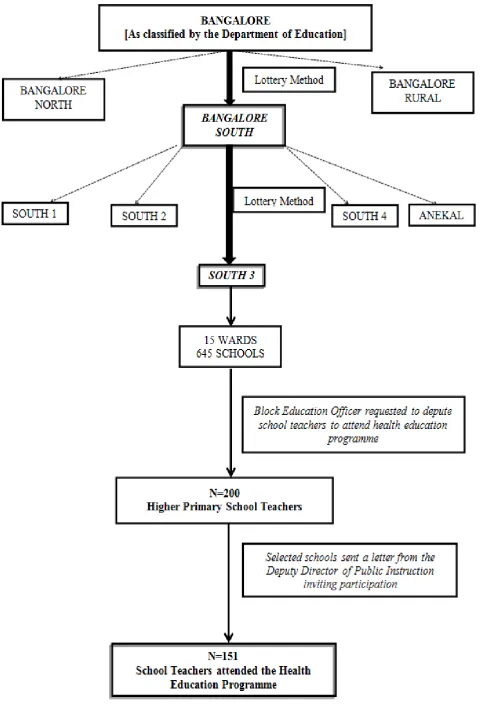
Sampling method: illustrated in Figure 1
Method of data collection (Instrument): A structured
validated self-administered Knowledge Attitude Self-Perceived Behaviour(KAB) questionnaire in English language was used in the current study to collect baseline data on demographic & socio-economic characteristics, knowledge, attitude & Self-Perceived Behaviour on Common Risk Factor Approach before and after exposure to the health education module.
Study Instrument Development: The main objective of the
study was to include questions based on the school teachers’ understanding of the common risk factor approach and its
utilisation for health promotion. Unfortunately literature about KAB of common risk factor approach among schoolteachers was scanty. To accomplish this goal, various health promotion models like the health belief model developed by Becker in the 1970s and Theories of reasoned action and planned behaviour developed in the 1980s by Ajzen and Fishbein and others were studied and applied emphasizing people’s intentions to change their attitudes and beliefs leading to health promotion. We emphasized the important role of school teachers in the community and their vital importance in improving community health and encouraging the utilisation of the Common Risk Factor Approach in day to day life. The questionnaire was developed after discussions and deliberations among the researchers. Inputs were also obtained from other researchers in the field. The questionnaire was pilot tested.
Pretesting of the questionnaire: The questionnaire was
pretested for readability and ease of understanding among twenty-two teachers. These teachers taught different grades like five, six and seven. Their data was not used in the study. Cronbach’s alpha was 0.76 indicating good internal consistency. There were two questionnaires prepared for collecting data i.e before the intervention (Pre-test) & after the intervention (Post-test).
Pre-test KAB Questionnaire : Consisted of a total of
42 items ,a combination of closed-ended multiple-choice questions and 5- point likert scale with 5 indicating strongly agree & 1 indicating strongly disagree. Information pertaining to Demographic
characteristics like age, gender, educational
qualification, designation etc. (n=9), Teaching
experience (n=3), Personal information & habits(n=3), Knowledge about common risk factors(n=10),Attitude about utilising common risk factor approach(n=12) & self-perceived behaviour change (n=5) was collected from the participants.
Post-test KAB questionnaire: The same KAB
questionnaire after deletion of items on demographic characteristics, personal information & teaching experiences consisting of 27 questions was used to collect data after the common risk factor approach based health education intervention. Items were
randomised differently at baseline and
post-intervention, to minimise recall bias.
Scoring System Used in the questionnaire: There
were ten items for assessing knowledge with 1 point ascribed to each correct answer & 0 to each incorrect answer with a maximum possible score of 21.There were twelve statements in total for assessing attitude comprising of items with a dichotomous response scale to note respondent’s agreement & nine statements using a Likert type scale. The scoring system used was: 5 = strongly agree with the statement, 4 = agree, 3= neutral, 2 = disagree and 1 = strongly disagree with the statement. The maximum possible score for the attitude domain was 50.There were five items in total for assessing Self perceived behaviour with a maximum possible score of 11.
Common Risk Factor Approach Based Health Education
Module: A Common risk factor approach based health
The educational module was a power-point presentation developed in consultation with experts having the following specific learning objectives:
1. To appreciate their role in improving the health of
themselves, their families & the school children.
2. To enumerate the common diseases and describe the risk
factors which can cause these diseases.
3. To possibly recognise the presence or absence of these risk
factors in themselves, their families and the school children.
4. To identify the initiatives they can implement for school
health promotion.
Content of the Health Education Module: In order to
fulfil the specific learning objectives the Health education module focussed on diseases and their common risk factors, the importance of utilising a common risk factor approach to health promotion by overcoming these risk factors and working towards making a school a health promoting school.
As an attempt for breaking monotony & demonstrating how the risk factors like stress & lack of exercise can be over-comed, two activities were planned involving the school teachers in the same named as follows:
Beat the stress!!
Let’s be active!!
The health education module developed with the above mentioned content was pilot & field tested on a group of higher primary school teachers one month prior to the actual implementation in the training programme.
The Training Programme: The school teachers were invited
to attend a one-day teachers training workshop on the developed common risk factor approach based health education module. The Health education (intervention) accompanied with open discussion with the participants was delivered to a single group of 151school teachers who turned up for the programme over a period of 3 hour session. In order to increase compliance, the participants were provided a certificate of participation along-with food & travelling allowance of Rs.50/- each after the training workshop.
Data Analysis: The data was analysed using Statistical
Package for Social Sciences (SPSS window version 18.0). The demographic details were expressed in terms of number and percentage.Changes in the knowledge, attitude & self-perceived behaviour change of the participants before & after the intervention was tested using Student Paired t-test.
Ethical Considerations: The Institutional Review Board
Clearance was obtained for the study. Necessary permission was taken from the authorities of the Department of Education concerned. Informed consent was obtained from the participants.
RESULTS
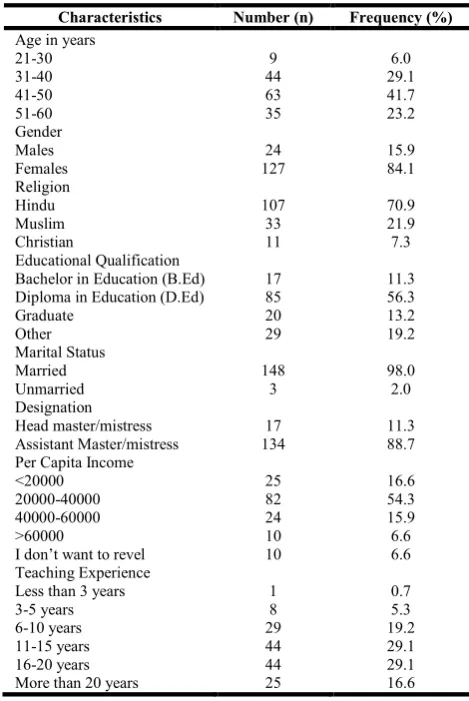
Of the 200 higher primary school teachers invited to attend the educational workshop, 151 of them agreed to participate constituting a 76 % participation rate. 15.9 % (n=24) were males & 84.1 % (n=127) were females. The mean age was
[image:4.595.314.549.104.455.2]43.8 +8.1 year. The socio-demographic characteristic is illustrated in Table 1.
Table 1. Socio-Demographic Characteristics (N=151)
Characteristics Number (n) Frequency (%)
Age in years
21-30 9 6.0
31-40 44 29.1
41-50 63 41.7
51-60 35 23.2
Gender
Males 24 15.9
Females 127 84.1
Religion
Hindu 107 70.9
Muslim 33 21.9
Christian 11 7.3
Educational Qualification
Bachelor in Education (B.Ed) 17 11.3 Diploma in Education (D.Ed) 85 56.3
Graduate 20 13.2
Other 29 19.2
Marital Status
Married 148 98.0
Unmarried 3 2.0
Designation
Head master/mistress 17 11.3
Assistant Master/mistress 134 88.7
Per Capita Income
<20000 25 16.6
20000-40000 82 54.3
40000-60000 24 15.9
>60000 10 6.6
I don’t want to revel 10 6.6
Teaching Experience
Less than 3 years 1 0.7
3-5 years 8 5.3
6-10 years 29 19.2
11-15 years 44 29.1
16-20 years 44 29.1
More than 20 years 25 16.6
Comparison of Knowledge scores before and after the
health education intervention: The knowledge of Common
Risk Factor Approach among the respondents was assessed by asking 10 multiple choice questions with more than one correct option for some. A score of 1 was given for each correct answer and 0 score for each wrong answer. The minimum & maximum possible score was 0 &21respectively.The mean ± SD total knowledge score of respondents about Common Risk Factor Approach after the intervention significantly increased from 15.66±3.59 to 18.48±2.77 (n=151, P<0.001) (Table 2).
Comparison of Attitude scores before and after the health
education intervention: The attitude domain assessed the
respondents’ perception towards the need for adopting an integrated approach like the Common Risk Factor Approach to the promotion of both oral &general health ‘which is likely to be more efficient and effective than programs targeting a
single disease or condition’. There were twelve
statements/items in total for assessing attitude with a maximum possible score for the attitude domain 50. The mean ± SD total attitude score of respondents about Common Risk Factor Approach & role of schools as well as teachers in promoting health after the intervention significantly increased from
35.77±3.01 to 41.17±3.34 (n=151,P<0.001)(Table 2).
Comparison of self- perceived behaviour scores before and
after the health education intervention: There were five
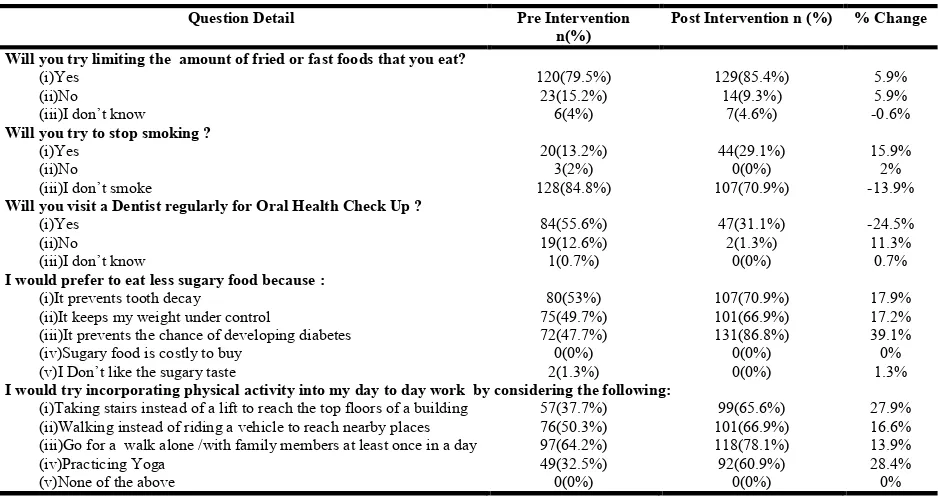
The mean ± SD total self -perceived behaviour score of respondents about adopting a Common Risk Factor Approach after the intervention significantly increased from 4.91±1.63 to 6.46±1.75 (n=151, P<0.001) (Table 2). Upon the completion of the training program, respondents who smoked (n=44, 29.1%) expressed their willingness to stop smoking compared to the pre –assessment (n=20, 13.2%) (Table 3).
DISCUSSION
India’s epidemiologic transition, is marked by multiple challenges in disease control, all of which needs to be managed concurrently. Non-communicable diseases (NCDs), primarily chronic diseases (heart disease, diabetes, cancer, and chronic respiratory disease/asthma) and injuries, and mental illness, now account for an estimated 62% of the total age-standardized burden of forgone disability adjusted life-years (DALYs) in India, with the remainder from communicable
diseases and maternal and child health issues (Engelgau et al.,
2012). NCDs, which could cause long-standing disabilities, have direct economic consequences at households and community level, both through the expenses on health care, which divert other expenditure, and also on levels of income through reduced labour productivity. The economic and social ramifications of growing NCDs are dire. The shortcomings of the highly practiced ‘Treatment Based Approach’ in reducing the disease burden and health inequity, has shed light on understanding and appreciating the importance of prevention along with health promotion strategies, appropriate policy and measures towards empowerment as well as capacity building.
The CRFA is one such collaborative approach which addresses risk factors common to many chronic conditions with minimum cost but maximum output. The potential benefits of such an approach are far greater than isolated interventions. The Health Promoting School (HPS) is a concept which has been developed over the last decade to address school health in a more comprehensive way. It represents a settings approach where different aspects of schools are taken into account in
efforts to improve the health opportunities for students. School
teachers play an integral part in health promotional education and have many opportunities to do so with school-age children through planning and implementing health promotional programmes at schools together with other partners and more widely in the community, provided they have a positive
attitude and are being prepared in a manner to adequately
understand and effectively address the health-related issues
(Jourdan et al., 2010). Surveys conducted in Minnesota and
Michigan, among schoolteachers established that health knowledge of these important populations was often
inadequate and inaccurate(Glasrud and Frazier, 1988; 3.Lang
et al., 1989). Studies in Romania, China and Saudi Arabia have
reported positive attitudes among schoolteachers towards school based health education and a willingness to be involved
in oral health promotion (Petersen et al., 1995; Petersen and
Esheng, 1998; Al-Tamami and Petersen, 1998). Tanzanian school teachers reported low levels of oral health knowledge accompanied by a poor attitude towards becoming involved in
dental health education (Nyandindi et al., 1994). These
[image:5.595.80.512.87.158.2]international data describe the significant, but not always easy, potential of incorporating school teachers in health promotion
Table 2. Effect Of The Intervention On Knowledge, Attitude & Self Perceived Behaviour Scores, Using The Paired T Test, Among Higher Primary School Teachers In Bangalore - South Zone
Pre Intervention (N=151) Post Intervention (N=151) % change t value p value Knowledge
(Total Score:21)
15.66±3.59 18.48±2.77 18.65% 8.064 <0.001**
Attitude
(Total Score:50)
35.77±3.01 41.17±3.34 15.09% 16.271 <0.001**
Perceived Behavior change
(Total Score:11)
4.91±1.63 6.46±1.75 31.57% 9.590 <0.001**
** Statistically Significant (p <0.05)
Table 3. Response Of Higher Primary School Teachers’ To Each Question That Assesses Their Self-Perceived Behaviour.(N=151)
Question Detail Pre Intervention
n(%)
Post Intervention n (%) % Change
Will you try limiting the amount of fried or fast foods that you eat?
(i)Yes 120(79.5%) 129(85.4%) 5.9%
(ii)No 23(15.2%) 14(9.3%) 5.9%
(iii)I don’t know 6(4%) 7(4.6%) -0.6%
Will you try to stop smoking ?
(i)Yes 20(13.2%) 44(29.1%) 15.9%
(ii)No 3(2%) 0(0%) 2%
(iii)I don’t smoke 128(84.8%) 107(70.9%) -13.9%
Will you visit a Dentist regularly for Oral Health Check Up ?
(i)Yes 84(55.6%) 47(31.1%) -24.5%
(ii)No 19(12.6%) 2(1.3%) 11.3%
(iii)I don’t know 1(0.7%) 0(0%) 0.7%
I would prefer to eat less sugary food because :
(i)It prevents tooth decay 80(53%) 107(70.9%) 17.9%
(ii)It keeps my weight under control 75(49.7%) 101(66.9%) 17.2%
(iii)It prevents the chance of developing diabetes 72(47.7%) 131(86.8%) 39.1%
(iv)Sugary food is costly to buy 0(0%) 0(0%) 0%
(v)I Don’t like the sugary taste 2(1.3%) 0(0%) 1.3%
I would try incorporating physical activity into my day to day work by considering the following:
(i)Taking stairs instead of a lift to reach the top floors of a building 57(37.7%) 99(65.6%) 27.9% (ii)Walking instead of riding a vehicle to reach nearby places 76(50.3%) 101(66.9%) 16.6% (iii)Go for a walk alone /with family members at least once in a day 97(64.2%) 118(78.1%) 13.9%
(iv)Practicing Yoga 49(32.5%) 92(60.9%) 28.4%
[image:5.595.64.533.198.447.2]programmes. In India the data available on knowledge attitude and practice about prevention of diseases sharing risk factors in common among school teachers is scarce and in the present study an attempt was made to assess the same. In the present study, results showed a substantial improvement in all the
considered domains (KAB), proving therefore the
effectiveness of the CRFA based health educational module in higher primary school teachers. The school teachers in this study had a good amount but incomplete & inaccurate knowledge about common risk factors and health in some instance. This result supports findings from another study
(Lang et al., 1989), which suggests that teachers’ knowledge
about oral health and current methods of prevention is incomplete and inaccurate. This could be attributed to lack of dissemination of information by health care professionals and considering health education a marginal area of teaching activity (Han and Weiss, 2005). Concepts of common risk factors must inform public health work and education (Sheiham and Watt, 2000). The teachers in our study exhibited a positive attitude towards working for a health promoting school incorporating its various components. This finding is similar to a study on school health carried out in Benin-City, where all the teachers demonstrated positive attitude (Ofovwe and Ofili, 2007). The concept of perceived self-efficacy in the context of cognitive behaviour modification is receiving increasing recognition as a predictor of health behaviour change and maintenance. The teachers who participated in this study displayed a strong perceived self-efficacy by their responses to adopt healthy lifestyles. This finding is consistent
with a study done by Ulgen et al. (2012). School teachers’ gap
in knowledge, attitude & practice for imparting health education calls for need of training teachers for strengthening the health promoting school initiative in India. This is the first study of its kind which evaluates the effectiveness of an interventional educational module based on common risk factor approach on the higher primary school teachers. Our study had certain limitations. There was the problem of obtaining convenient time slots for conducting the study from school teachers and school management out of their busy schedule. The other major limitation was that we did not have a comparison group to take into account any changes that would have occurred due to factors other than the interventional education programme. Further, longer follow-up is required to determine whether changes are sustained over the longer term, and to be able to detect changes in health-related behaviours. The data for the study relied heavily on the information received from the respondents and so may be biased by social desirability. While the study had its
limitations, the information presented allows for
recommendations for further research studies and offers a starting point for school teachers to begin dialogue regarding health promotion within the teaching profession.
CONCLUSION
The training of teachers is an investment in health as well as education. Legislation, together with appropriate incentives, must guide the structures of teacher training, both initial and in-service, using the conceptual framework of the health-promoting school. One important component of this training programme could be a CRFA based health education training which is likely to be more effective & efficient in simultaneously preventing oral and other chronic diseases. The coordinated efforts of health and education departments along with active involvement of non- governmental organizations
and local civil societies is what is required at present in most developing countries to promote health and oral health among school students by organising various training programmes for important stakeholders ,the school teachers. There is a pressing need for the promotion of health through the school system in India and other developing countries. The concept of using school teachers for frequent health education is definitely feasible as well as more effective.
Conflict of Interest: None Declared
Funding Statement: This study was supported by a grant
from the Indian Council of Medical Research
(No.3/2/2012/PG-thesis-HRD)
Abbreviations
NCDs- Non-Communicable Diseases CRFA- Common Risk Factor Approach
KAB- Knowledge Attitude Self-Perceived Behaviour SPSS- Statistical Package for Social Sciences HPS- Health Promoting School
REFERENCES
Al-Tamami S, Petersen P E. 1998. Oral health situation of schoolchildren, mothers and schoolteachers in Saudi
Arabia. Int Dent J. 48: 180-186.
Engelgau MM, Karan A, Mahal A. 2012.The Economic impact of Non-communicable Diseases on households in India. Globalization and Health, 8:9.
Glasrud P H, Frazier P J. 1988. Future elementary schoolteachers’ knowledge and opinions about oral health
and community programs.JPublicHealth Dent.,48:74-80.
Han S., Weiss B. 2005. Substainability of Teacher Implementation of School-based Mental Health Program.
Journal of Abnormal Child Psychology, 33(6):665-679.
Jourdan, D., Mannix Mc Namara, P., Simar, C., Geary, T.,
Pommier, J. 2010 Factors Influencing Staff Contribution to
Health Educationin Schools. Health Education Research,
519-530
Lang P, Woolfolk MW, Faja BW.1989. Oral health knowledge
and attitudes of elementary schoolteachers in Michigan. J
Public Health Dent., 49(1):44–50.
Nyandindi U, Palin-Palokas T, Milen A, et al. 1994. Participation, willingness and abilities of school-teachers in
oral health education in Tanzania. Community Dent Health,
11: 101-104.
Ofovwe GE, Ofili AN.2007. Knowledge, attitude and practice of school health programme among head teachers of primary schools in Egor local government area of Edo
State, Nigeria. Ann Afr Med., 6: 99–103.
Petersen P E, Danila I, Samoila A. 1995. Oral health behaviour, knowledge, and attitudes of children, mothers,
and schoolteachers in Romania in 1993. Acta Odontol
Scand, 53: 363-368.
Petersen P E, Esheng X.1998. Dental caries and oral health behaviour situation of children, mothers and schoolteachers
in Wuhan, People’s Republic of China. Irzt Dent J. 48:
210-216.
Sheiham, A. and Watt, RG. 2000. The common risk factor approach: a rational basis for promoting oral health.
Community Dent Oral Epidemiol., 28(6):399–406.
Ulgen H, Ozturk C, Armstrong M. 2012. Effect of Self-Efficacy on Turkish Children’s Perceptions of the
Advantages/Disadvantages of Smoking. Asian Pac J
Cancer Prev.,13(3):795–8.