Is the bus boring?
Mr William Clayton
PhD Research Student
University of the West of England, Bristol, UK
Abstract
Contemporary research on travel-time use challenges the notion that travel-time is wasted, but is it always a positive experience? Previous studies have suggested that engaging in activity during travel-time increases the utility of a journey, and thus regaining and maintaining control over time on-the-move is hypothesised to have a positive effect on the passenger experience through a sense that the time has gained value. The results presented here challenge this finding in the specific context of bus travel.
To explore travel-time use in relation to the bus passenger experience, this paper draws upon data from a mixed-methods approach: online Facebook discussions, focus groups, and a survey of 840 bus passengers conducted in Bristol, UK. Despite travel-time activity on the bus being an integral part of many journeys, a consistent association with improvements in journey experience and service perception is challenged. The personalisation and privatisation of travel space through activities – from reading to listening to iPods – may be purposively sought to disengage from the bus community, however, such technology use and disengagement may be symptomatic of uncomfortable experiences such as boredom and stress, as opposed to a creator of positive utility or distinct experience of enjoyment. Furthermore, disengagement can negatively impact upon the sociality of the bus space. It is suggested that wider factors are of more primary significance than travel-time activity in forming perceptions and experiences. The conclusions will consider the implications for transport policy and bus operations.
Introduction – Journey experiences on the bus
Improving journey experiences for public transport passengers is identified in government policy as an important aspect of encouraging a modal shift from the private car to public transport for some trips (see: DfT, 2011). The ways in which people use their time on-the-move can influence the journey experience, and thus the relationship between travel-time activity and journey experience is important to this goal (Lyons & Urry, 2005). Existing research into travel-time use and the value of activities conducted whilst travelling have broadly followed two perspectives on what travel-time means to the passenger. The first of these is a focus on travel-time predominantly in terms of its potential for productivity, where „time = money‟ (see: Adam, 1995), transforming the notion in transport studies that travel is a derived demand, and thus time spent travelling is „wasted‟. Such studies focus primarily on the opportunity for productive activity during a journey. The alternative perspective to this is a focus on travel-time “beyond the economic”, in which a broader experience that encompasses leisure, relaxation, and sociability is the focus of the research.
However, the results of a recent study by Ettema et al. (N/D – Article submitted for publication) which explored travel-time activities in relation to levels of subjective well-being on public transport in Sweden have challenged the underlying perspective that a good journey is connected to its positive utility. They found that productive activities such as working or studying, entertainment activities such as reading and listening to music, and the use of ICTs during the journey had no positive effect upon passengers‟ satisfaction with the journey. Thus in contrast to Lyons et al.‟s (2007) perspective of productive time use, Ettema et al. (N/D) explain thatthe fact that travel-time is „useful‟ does not necessarily have to mean that it is therefore also enjoyable, attractive, pleasant, or „fun‟. This indicates a more complex relationship between travel-time use and journey experience. Their findings demonstrate that when following such a utility-centric approach alone, it is problematic to make a distinction as to whether passengers are actually experiencing their journey positively, or simply productively. This key issue is important in evolving the discussion of the findings in this paper, and indeed, Mokhtarian and Salomon note this difficulty in drawing out different meanings of travel-time:
‘Measuring a positive affinity for travel is complex: in self-reports of attitudes towards travel, respondents are likely to confound their utility for the activities conducted at the destination, and for activities conducted while travelling, with the utility of travel itself’ (2001, p. 695).
Where Ettema et al. (N/D) contest the notion that travel-time activity is a significant factor in the creation of positive journey experiences for the individual, they note that „the relationship between travel-time activity and the experience of the journey is not straightforward. There is a great deal of contextuality and subjectivity in travel-time use, and qualitative studies have explored how travel-time is experienced by different passengers, at different times, in different contexts. This complexity is reflected in qualitative studies into the experience of travel-time. Generally, bus travel is omitted from these travel debates (with the exception of Jain, 2009), but journey experiences on the bus have been explored in several studies, and these present different perspectives on the subjective meanings of this time to passengers which assist in moving this debate forwards.
Adopting a different approach to more traditional passengers satisfaction surveys – in which passengers are usually asked to rate their levels of satisfaction with a set of pre-defined service aspects (for example: Passenger Focus1, 2011; Scottish Executive, 2005) – Stradling et al. (2007) have considered what it is that makes an „ideal‟ bus journey from a passenger‟s perspective. Using qualitative and quantitative data, they identify aspects of the bus journey experience that passengers see as particularly desirable. Stradling et al. (2007) provide an experiential account of what makes both an unsatisfactory and an „ideal‟ bus journey from a passenger‟s perspective. The conceptual framework of core affect (see: Russell, 2003) forms the basis of Stradling et al.‟s (2007) description of the ideal bus journey. A key concern identified in Stradling et al.‟s (2007) research is that the journey should be affectively pleasant – i.e. the passenger feels comfortable in their surroundings. The predominant desire amongst bus passengers is for a relaxing, switched-off, calm journey, whilst others desire a more social, activated experience (see also: Mann & Abraham, 2006; Beirão & Cabral, 2007). Thus, this pleasant experience is suggested to lie at a point on the continuum from more active to less active affective states at the pleasurable end of the circumplex model of affect (see: Russell, 2003). Both desires can be argued to provide the same positive affect within the bus (Stradling et al.; 2007), and the findings suggest a certain state of tranquillity, which is not necessarily an experience of calm/quiet, but one in which a passenger feels affectively comfortable and is not subject to negative experiences of boredom or stress. Existing research that has explored travel-time on the bus from an experiential perspective emphasises that the bus is an intensely public space in which the passenger is particularly prone to the experience of negative affects such as boredom (Jain, 2011), stress (Guiver, 2007), and social discomfort (Stradling et al., 2007). Where such studies often include examples of travel-time activity, there has been no specific
1
research into the role that activity plays in the creation of positive and negative affective experiences.
The experience of travel-time has been considered from the perspective of performative relationships in time and space, where the bus journey is conceptualised as an intersection and interplay between the passengers (actors), the bus (the stage), and the items that people carry with them and use during travel (the props) (Jain, 2009). In her analysis, Jain (2009) explains how travel-time experiences are made by the socio-material relations between passengers with and within the public spaces of the bus. She explains the experience of the bus as one of mundanity and routine. The activities of passengers and the items that they carry with them are woven into individual and collective performances of the journey, and thus the experience of travel-time. Similarly, Noble (2008) has suggested that the experience of bus travel is scored into the practices and rhythms of the communities which buses serve, and notes the „everydayness‟ of bus travel as non-glamorous and repetitive. Such descriptions of the day-to-day experience of bus travel suggest that the activities and items that passenger carry with them are a part of the mundane quotidian reality of the journey, and these studies challenge the notion that engaging in travel-time activity creates distinctly positive or enjoyable journey experiences for the passenger.
Several other studies which have explored the experience of travel-time on public transport more widely are useful too in understanding the relationship of travel-time activity and journey experience. Jain and Lyons (2008) have conceptualised travel-time as a „gift‟ to the passenger. They explain that having this time might often provide the traveller with an opportunity for „time-out‟ (i.e. time to relax and „switch off‟) during an otherwise busy routine; it might be valued as a piece of „transition time‟, in which the passenger has the opportunity to mentally shift gears between the different spaces and social spheres of departure and destination (i.e. work and home); or it might be a piece of „time-for‟, which provides the opportunity for personal tasks such as organising work and home life. Watts (2008) and Watts and Lyons (2010) have explored the relativity of individual travel-times, and explained how passengers on the train craft their experiences of duration through activity and the use of carried objects and mobile technologies on a journey. Passengers are able to compress and stretch their experiences of time by engaging in different activities, and this suggests that passengers on the bus might also be able to control their experience of travel-time in similar ways. Bissell (2009) has explored the impacts of different socialities on the train, and suggests that collective affective atmospheres that emerge in the different spaces of travel can predispose passengers to different uses of travel time. Using the example of a first class carriage on a train, Bissell (2009) explains how both the environment and the collective demeanour of the passengers might create a sociality which primes passengers for working. Bissell (2009) notes that such a sociality might be very different in a standard class carriage on a Friday evening, in which a collectively uplifted mood might prime passengers for socialising. Thus, there is a question as to what kind of sociality bus environment might engender. The bus is most often a homogenised and open space in which the passenger is afforded little by way of personal space or privacy, and Bissell‟s (2009) research suggests that this might predispose bus passengers to particular journey experiences and activities within this sociality.
Therefore there has been a wider range of perspectives from which travel-time has been considered more generally, some of which specifically focus upon the bus but none of which have explored the relationship between travel-time activity and journey experience on this mode in detail. The studies introduced above are all useful in developing the discussion in this paper, which addresses this lack of research into the specific relationship between travel-time activity and journey experience on the bus.
Methodology
qualitative data was first collected from a smaller sample of individuals to provide a corpus of journey experiences and travel-time activities on the bus. Following this, consistent themes and discourses of travel-time experience more generally were drawn out. These were then constructed into a large-scale survey of 840 bus passengers on 5 bus routes in Bristol, UK, to test their wider applicability. An outline of the three phases of data collection is presented below:
Phase 1
Primary data collection located on the online social networking site (SNS), Facebook™. Qualitative data on individuals‟ use of time whilst on the bus – including written accounts of journey experiences – were generated in an online discussion group over a period of six weeks. 28 participants took part in the discussion, with the majority being younger people aged 18 - 25. The data was subjected to a thematic analysis, and the provided preliminary working indications and themes about passengers‟ journey experiences and use of time whilst on the bus.
Phase 2
Two focus groups conducted with participants recruited from the University of the West of England (UWE) student population. The focus groups were designed around broad themes relating to the findings generated in Phase 1; and explored these themes with the two groups consisting separately of 6 car users and 8 bus users. The focus groups had the function of testing content for the survey conducted in Phase 3, providing insight into the language used and the ways in which this specific population conceptualise and discuss their experiences and use of travel-time.
Phase 3
This phase represented a large-scale survey of 840 passengers sampled on 5 routes in Bristol to explore the qualitative findings related to the use of travel-time, and how this might influence their journey experience on the bus. Phase 3 was an on-board survey in which passengers were asked to complete a questionnaire regarding their travel-time activities and their experience of the journey in-situ.
Findings and discussion - Journey experience, service perceptions, and travel-time activity
Experiences of bus travel will be different in different places, and the cultural construction of bus services will vary at local, regional, and national scales. It is recognised in this paper that that the knowledge on travel-time use and experience generated from the empirical data is relevant to the wider bus user population, whilst accepting that it is not wholly representative of it. Thus, whilst this paper holds that the findings are relevant to bus travel more generally, there will be idiosyncratic differences observed in the nature of these in different areas.
Quantitative data
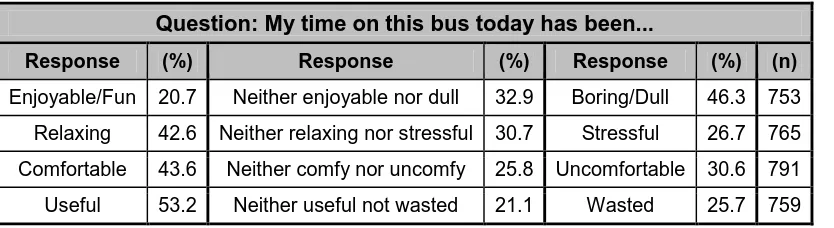
This section presents the quantitative data on passengers‟ journey experiences and service perceptions in relation to time use; passengers‟ journeys experiences, levels of travel-time activity on the bus, and statistical associations between these are discussed. In the following section qualitative discourses are presented which contextualise these findings. Table 1 and Table 2 (p. 5) present the data for passenger experience and service perception. Passengers‟ experience of their travel-time is represented by Likert scale responses2 to 4 categories, shown in the tables below
2
Question: My time on this bus today has been...
Response (%) Response (%) Response (%) (n)
Enjoyable/Fun 20.7 Neither enjoyable nor dull 32.9 Boring/Dull 46.3 753 Relaxing 42.6 Neither relaxing nor stressful 30.7 Stressful 26.7 765 Comfortable 43.6 Neither comfy nor uncomfy 25.8 Uncomfortable 30.6 791 Useful 53.2 Neither useful not wasted 21.1 Wasted 25.7 759
Table 1 - Journey experience on the bus
Question: How do you feel about riding the bus in general? (n = 826)
Response (%)
I really like it 4.6
I like it 28.1
I neither like it nor dislike it 47.7
I dislike it 15.4
[image:5.595.109.526.70.184.2]I really dislike it 4.2
Table 2 - Passenger perception of the bus
It is evident that generally, a higher proportion of participants experienced their bus journey as boring/dull than found it enjoyable, however conversely, higher proportions of participants experienced their travel-time as relaxing, comfortable, and useful than found it stressful, uncomfortable, and wasted. It is interesting to note also that high proportions of passengers were indifferent to the experience. In terms of perception of the bus, higher proportions of passengers like riding the bus than dislike it, however here the majority are indifferent. Following from these findings, Table 3 (p. 6) presents the travel-time activities in which over 10% of passengers engaged. The results show that there are a range of travel-time activities that a high proportion of passengers are engaging in on the bus, and indeed, the level and range of activity occurring is approximately equivalent to those recorded on the train – whilst the specific types of activity that are more popular in each environment are different (see: Lyons et al., 2011). Less than 10% (8.3%) of passengers had engaged in working and studying activities. The nature of the trips that participants were making – with only 6.5% of passengers travelling for the purposes of business – and also the restricted nature of the bus interior which can limit the opportunities for working (i.e. having space to use laptops and paperwork) will have impacted on this figure. It is important also to note that despite large proportions of passengers engaging in activities such as reading, listening to music, and using their mobile phones, Table 1 above has shown that almost half of the passenger surveyed had experienced a boring journey.
On the train, Lyons et al. (2007) perceive activities such as reading and listening to music as secondary, whereas on the bus they are primary activity. To further investigate the relationship between travel-time activity and journey experience an ordinal regression analysis was employed to explain the influence of independent variables upon passengers‟ perceptions and experiences of the bus. Five separate models were constructed, using the experience and perception categories presented in tables 1 and 2 as the dependent variables. All models were significant to p < 0.05 The independent variables included in the models were: travel-time activities, carried objects, social comfort3, punctuality, gender, age, car availability, time of day, and journey purpose The intent of these analyses was to ascertain the significance of the association of different independent variables to passenger perceptions and journey experiences, and the independent variables identified as significant
3
(p < 0.05) in each case are presented below. It should be noted that whilst an aim of the ordinal regression analysis was to identify predicator variables, the scope of the dataset was restrictive to the models‟ predictive capabilities. The primary function of these analyses was to further explore the relationships between the variables, as opposed to forecasting future outcomes. Ordinal regression is employed here for its explanatory function as opposed to its predictive function.
Activity (%) Activity (%)
Window-gazing/people watching 62.0 Reading for leisure (incl. „Metro‟) 48.9
Thinking/contemplating 47.1 Daydreaming 46.0
Making personal phone-calls 42.0 Listening to music 38.7 Talking to others 23.5 Accessing the internet 21.3 Accessing social network sites 16.4 Eating/drinking 11.3 Making work-related phone-calls 11.1 Table 3 - Travel-time activities on the bus
The results of the 5 ordinal regression analyses are discussed together. There is a lack of any consistent association between travel-time activities, carried objects, and passengers‟ experiences and perceptions of their bus journey; however, there are several isolated cases in which activities displayed a significant association with perception and experience. Window-gazing was found to have a significant positive association with perception of the bus (p = 0.00), and also with how useful passengers found their travel-time (p = 0.05). Listening to music had a significant positive association with experiences of relaxation (p = 0.04) and the „usefulness of travel-time‟ (p = 0.01). Finally, „caring for someone on the bus‟ was found to have a significant positive association with experiences of enjoyment (p = 0.05). Checking emails was found to have a significant association with how useful passengers found their travel-time (p = 0.05). The vast majority of travel-time activities and carried objects are notable in this analysis by their absence. No other activities or objects were found to have a significant association with experiences and perceptions.
In the models, there were several other independent variables which displayed consistent significant associations with perceptions and experiences, these are: punctuality, age, and social comfort. Passengers on buses that were punctual were more likely to report significantly better perceptions of the bus in general, and furthermore to report their travel-time as more enjoyable, more relaxing, more comfortable, and more useful than those passengers on buses that were late4. Similarly, passengers that felt more comfortable engaging with the social environment of the bus also reported significantly better perceptions of the bus, and also more enjoyable, relaxing, comfortable, and useful experiences of travel-time than those who felt social discomfort. Age is also an important factor in how participants perceive and experience the bus. Older passenger were significantly more likely than younger passengers to perceive the bus more favourably, and furthermore, older passengers were more likely to have experienced their travel-time as more enjoyable, relaxing, and useful than their younger counterparts. This issue is expanded upon in later discussion.
Therefore, the quantitative findings demonstrate that travel-time activities and carried objects have a weak statistical association with journey experience and service perception, particularly in relation to the other consistently significant factors of punctuality, social comfort, and age. These findings support Ettema et al.‟s (N/D) findings that travel-time activities are not consistently linked to positive experiences of public transport journeys, suggests that „positive utility warrants further investigation. Furthermore, these findings suggest that other factors are of more primary importance than the concept of travel-time activity when considering experiences of travel-time.
Qualitative data
Participants‟ qualitative discourses assist in the interpretation of these findings. The qualitative data demonstrate that there is a more complex relationship between activity and experience than the quantitative data show. Where the survey findings deny a consistent link between activity and experience, participants‟ discourses explain that travel-time activity is inextricably woven into the experience of the journey. Stradling et al. (2007) have explained that an „ideal‟ bus journey from an experiential perspective is one in which a person feels affectively comfortable. For some this may be a pleasantly deactivated experience, such as relaxation; for others this might be a more pleasantly activated experience such as socialising. The qualitative discourses show that travel-time activities – and the carried objects that passengers have – are important tools in their efforts to attain and maintain such an ideal affective experience. Participants discussed how travel-time activity on the bus enable them to „craft‟ their journey experience (see: Watts, 2008) primarily in one of three ways: through „time-out/time-for‟ (relaxation or personal time) activities; through activities for distraction/displacement (i.e. killing time and lessening the negative experiences of the journey – boredom, social discomfort, and stress); and through social activities.
Several participants articulated the positive benefits of periods of time-out and time-for on the bus. For participants, the bus often provides a unique piece of free time within their day in which they are able to relax:
‘I value my time on the bus either to have some time to relax before work and read or something. Or to unwind after work after being on my feet all day. Time on the bus is time when I can’t be doing uni work or anything so I can relax without feeling guilty.’ (Female participant – Online discussion)
‘The bus journey is a time to reflect, to think and to enjoy the tranquilness before or after work.’ (Female Participant – Online discussion)
Some participants suggested that they would like their journey to last a bit longer, which is consistent with findings from Redmond and Mokhtarian (2001) and Jain and Lyons (2008) who have noted that in interviews passengers suggested they would prefer a 10-15 minute commute over a shorter one:
‘For me it’s time to relax especially after a busy day at work. Sometimes I feel like the journey could last a little longer – especially when I am at a good point in my book!’ (Female participant – Online discussion)
Travel-time activities are an important part of experiences of time-out for some participants, and books, newspapers, and personal music players were often used by participants to facilitate experiences of time-out:
‘I quite enjoy that half an hour of actually switching off and just listening to music, you know, I quite enjoy that period before I get to uni, because I know it’s going to be a day of study…’ (Male participant – Online discussion)
‘For me the time on the bus is a time of relaxation before starting my day at work. I am really using it reading the newspaper or listening to music.’ (Male participant – Online discussion)
Other passengers used their bus journey as personal time in which they could organise or complete personal or tasks:
‘I usually read the Metro paper, if there are any left, or else I will get on with some Uni reading which uses the time more productively. I also often use the time to write lists of work and other bits and pieces that I need to get done.’ (Female participant – Online discussion)
Thus for several participants, travel-time on the bus was articulated as a positive experience of personal time in which they were able to relax, and often the activities they engaged in and the items they used were important in facilitating these experiences. These narratives support the concepts of time-out and time-for developed by Jain and Lyons (2008) in theorising the „gift of travel-time‟.
seen to engender:
‘I normally read on the bus, sometimes listening to music at the same time. Or I will just listen to music. If I have neither a book or my iPod I generally find someone to ring just to have something to do. I think doing things like this on the bus make the journey seem a lot quicker and more enjoyable.’ (Female participant – Online discussion)
The carried items and mobile technologies that people carry with them are often essential for participant to be able to kill time on the bus, serving as a distraction from the duration of the journey. In particular, personal music players played an integral part in many participants‟ efforts to mediate their journey experiences:
‘An iPod makes the journey go quicker. If you’re listening to something, you just sort of sit there and you’re at your stop quicker than if you’re just sitting there looking at the scenery that you see every day.’ (Female participant – Bus user focus group)
For some participants, the mobile technologies they carry with them are essential pieces of „bus kit‟, allowing them to control the experience of duration. The extracts below illustrate the negative experience that is caused if they are unavailable:
‘If I didn’t have my phone or my iPod or whatever, well then, and the journey was a bit crappy, and the weather was a bit miserable, then it’s just going to bring your whole kind of mood right down.’ (Male participant – Online discussion)
‘If my iPod runs out on the bus, it will lead to a bad journey, and I’ll just be annoyed that it’s run out.’ (Female participant – Bus user focus group)
Thus, the activities that participants engaged in and the items that they carry with them are able to mediate the flow of the journey, and mitigate the negative experiences of duration such as boredom, as Watts (2008) and Watts and Lyons (2010) have noted with rail travel. Compressing and stretching the experiences of time is shaped by (Watts & Lyons, 2010), and also occurs on the bus where boredom can be diffuse. As Jain (2011, p. 1021) has noted: ‘A comfortable journey suggests a journey where time does not lag and boredom does not overpower’.
Besides mitigating negative experiences of boredom, travel-time activity on the bus is also important to passengers in mediating their experiences of the social environment. Bissell (2009) has noted that the spaces of public transport are often intensely social, and Stradling et al. (2007) have explained that the intrusion of other passengers – particularly strangers – into one‟s own personal space is often seen as unwanted, and shatters the reverie of a tranquil affective experience. Participants discussed the creation of personal space through the use of a personal music players and books, which can shut them off to a degree from the rest of the bus and so, provides a measure of control over the environment which is perceived to be potentially disruptive. In existing research, Schivelbusch (1980) has discussed the use of books and newspapers as “shields” in the train carriage, and Bull (2005) has explained how personal music players allow people to create their own sense of private space through controlling their sensory environment. This thesis finds that participants are using technologies and carried objects in exactly the same way on the bus, and that this is often able to mitigate negative intrusions into personal space in the intensely public spaces of the bus:
‘I like to listen to my iPod so I don’t have to talk to any of the weirdoes on the bus’ (Female participant – Online discussion)
‘I use an MP3 player a lot of the time – it gives you an excuse not to interact with anyone.’ (Male participant – Bus user focus group)
‘This thing about the bus, the issue of limited control over your senses compared to other modes of transport, you can control it by putting your iPod in.’ (Female participant – Bus user focus group)
‘Because you can – if you’ve got a book or your music – then you can escape into that.’ (Female participant – Bus user focus group)
situations. Thus, many participants used travel-time activity and their carried objects to disengage from the social spaces of the bus. However, whilst for some participants the social environment was perceived as intense and intrusive, for other the bus journey provides a distinct opportunity to socialise:
‘I just chat to people. I feel more relaxed if I’m talking to someone, even if it’s just at the bus stop. Even if you just compliment someone on the bus then they feel so much better about the journey anyway.’ (Female participant – Bus user focus group)
‘Ideally I like to socialise. Often (more so with the U-Link buses and long distance journeys) I speak to the person sitting next to me. Provides a fantastic opportunity to meet new people.’ (Male participant – Online discussion)
‘I’d rather talk to someone than just sit there and listen to my iPod.’ (Female participant – Bus user focus group)
Beirão and Cabral (2007) have noted this aspect of travel-time on public transport. Thus, there is a tension on the bus between those who enjoy the opportunity for social interaction, and those who find the experience of limited personal space and the presence of strangers intrusive. This reflects the findings from the quantitative data which have explained that in the regression analyses a passenger‟s subjective sense of social comfort had a consistent significant association with journey experiences.
Discussion in this section has explained that the different forms of data generate slightly different findings. The quantitative data denies a consistent significant association between participants‟ use of time and their journey experiences and service perceptions, and places greater emphasis the wider factors of punctuality, social comfort, and age. The qualitative data explores the actual experience of travel-time activity in greater depth, and finds that at times it does play an important part in passengers‟ experiences of time-out and time-for on the bus, however many participants engage in activity primarily as a means of mitigating negative experiences of boredom, stress, and social discomfort that the bus journey is seen to engender. It is suggested that these different findings have been caused – in part – by the ways in which the data were collected. The survey asked passengers to report on their experiences in-situ, and thus their answers were influenced by all of the wider contextual aspects of that particular journey – and the results therefore show other aspects of the bus to be of more primary concern. The participants that generated the qualitative data however had more time to discuss, consider, and articulate more detailed discourses of the specific experiences of travel-time activity, and thus in these greater depth and meaning is evident in their responses.
A key issue that has emerged from this section is that of the importance of a sense of engagement and social comfort within the bus, and both the quantitative and the qualitative findings demonstrate the social aspect of travel-time is the one which can create both the most positive and the most negative experiences of this time, dependent upon the social desires of individual passengers. This issue is now explored in greater depth in relation to the differences in experiences between passengers of different ages, with age having been identified as a highly relevant factor in passengers‟ experiences of travel-time on the bus.
Concluding discussion – Age and engagement
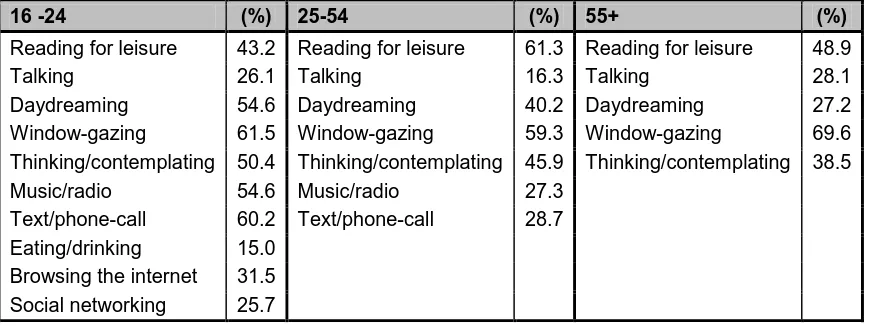
This paper finds that younger passengers are engaging in a wider range of travel-time activities than their older counterparts, and in particular are putting to use emergent mobile technologies and ICTs on the bus in high numbers (see: Table 4, p. 10). Passengers aged 55 and above spend most of their travel-time reading, talking, window-gazing, daydreaming, and thinking. Those aged 16-24 however spend this time reading, talking, daydreaming, window-gazing, thinking, listening to music, texting, making phone-calls, eating and drinking, browsing the internet, and using SNSs.
during travel, and they facilitate an increasing range of activities – for example, watching videos, checking emails, making phone-calls, accessing the internet, sending text messages, using mobile „apps‟, playing games, and many more.
16 -24 (%) 25-54 (%) 55+ (%)
Reading for leisure 43.2 Reading for leisure 61.3 Reading for leisure 48.9
Talking 26.1 Talking 16.3 Talking 28.1
Daydreaming 54.6 Daydreaming 40.2 Daydreaming 27.2
Window-gazing 61.5 Window-gazing 59.3 Window-gazing 69.6 Thinking/contemplating 50.4 Thinking/contemplating 45.9 Thinking/contemplating 38.5 Music/radio 54.6 Music/radio 27.3
Text/phone-call 60.2 Text/phone-call 28.7 Eating/drinking 15.0
[image:10.595.66.502.132.295.2]Browsing the internet 31.5 Social networking 25.7
Table 4 - Travel-time activities by age
The technology divide between old and young on the bus is reflective of people‟s activity practices in their wider lives. A several international studies have examined the use of emergent mobile technologies and finds that younger people are the significant leaders in their adoption and use (see: Axelsson, 2010; Ito & Okabe, 2005; Lenhart et al., 2005). Green (2006) notes that younger people in the UK use mobile technologies in many of the same ways as adults, however also engage with these technologies to a much greater – „hyper-coordinated‟ – degree in expressive ways (involving „social and emotional communication‟) that are „more important for teens than for other groups‟ (p. 203). Younger people are using expressive communication through mobile technologies as a part of identity formation and engagement with their social groups (Green, 2006; Ito & Okabe, 2005), and in forming a sense of relatedness through their consumption of mobile technologies (Green, 2006). Furthermore, as discussed, many young people‟s keen adoption of portable music players has allowed them to have increasing control over their mobile experiences through altering their auditory environment (Bull, 2005), and employing this as a coping resource in perceived stressful situations (Skånland, 2011) – attenuating unwanted and intrusive noise within the social environment of the bus.
The results from the survey deny consistent significant associations between the use of ICTs (and indeed most carried objects and travel-time activities) and a distinctly positive experience of the journey, and indeed the findings discussed throughout this chapter and explained in this section demonstrate that the younger passengers who account for the greatest use of ICTs and a broader range of travel-time activities on the bus are in fact reporting more negative experiences of the journey than their older counterparts that are engaging in simpler, “less active” activities during their journey. Ettema et al. (N/D) have observed a similar age disparity in their results for public transport commuters returning from work, with the younger age group reporting lower positive activation, lower positive deactivation, and lower cognitive evaluations of their journeys than their older fellow passengers.
Wilson (2011) suggests that experiences of social belonging and engagement can be formed through the experiences of physical mobility. This might be seen as particularly true in the case of the spaces of public transport, in which physical mobility is inextricably fused with the experience of being with others. This paper finds that older people are more engaged with the social spaces of the bus than younger passengers. This is shown by the fact that older passengers are significantly more comfortable talking to strangers on the bus, and are speaking to a wider range of people on the bus (friends, family, strangers, acquaintances), where younger passengers talk predominantly to their friends (p < 0.05%). In conjunction with the finding that both age and a willingness to engage in the public space of the bus are the strongest and consistently significant variables, it is evident that such a sense of engagement is an important factor in a forming more positive journey experiences.
This is relevant to Bissell‟s (2009) concept of socialities. The qualitative discourses show that younger passengers travelling on the university‟s designated U-Link service experienced a distinctly different sense of engagement within the space than they did on other public bus services in the city. Wilson (2011) suggests that buses can be sites of identity-making. Participants explained how they felt something in common with other passengers on the bus when travelling by U-Link. Other people on this service, even if unacquainted, were perceived as familiar due to their identification as a university student. Specifically on these services, the younger passengers engaged with others on the bus, and the experience is a distinctly social one; on other buses however, there was a lack of common identity with other passengers, and participants appeared less willing to engage in the social environment on these services:
‘If you’re getting the uni bus then you’re all students and you’ve all got something in common. It’s like someone said earlier about exam period when everyone chats to each other. Everyone’s got something in common with someone else on the bus. Whereas getting a First bus you get some proper weirdoes and you actually don’t want them to sit down next to you!’ (Male participant – Bus user focus group)
Therefore this paper argues that for some young people on buses in which they find little common identity with their fellow passengers, a perceived lack of engagement with the immediate social space of the vehicle leads them to disconnect from this space through their use of technology. Through the use of portable music players and mobile phones, passengers either passively disconnect themselves using music and sound (Bull, 2005), or actively re-engage through ICTs in their virtual networks within which they feel engagement and belonging (Green, 2006). Furthermore, the very act of disengagement thus serves to further reinforce disconnection from a sense of belonging and identity in the public spaces of the bus, and a fostered experience of difference from unacquainted passengers is perpetuated through the travel-time activities of many younger passengers.
The use of mobile technologies by a proportion of younger passengers is a highly normalised part of their wider socio-technical routines, and thus for some younger passengers on the bus this thesis suggests that the ubiquity of such technologies and their availability for use anywhere, anytime means that there is little that is unique about the affordance of travel-time as a period of time-out in which to conduct these activities. Thus the use of these technologies on the bus is no different for many younger passengers than their use in any other sphere of life, and their use during travel-time therefore does not have the effect of creating a positive journey experience, helping to explain the finding that younger people have worse perceptions and journey experiences despite their engagement in more travel-time activity. Indeed, younger passengers‟ disengagement from the social environment of the bus is often facilitated by a re-engagement with their virtual social networks through the use of these technologies. The bus is simply an uncomfortable and intrusive corporeal setting from which to reach out into their virtual social networks. This raises questions as to what the future of the journey experience on the bus might be in the technological age.
References
Axelsson, A.S. (2010) Perpetual and personal: Swedish young adults and their use of mobile phones. New Media & Society [online]. 12 (1), pp.35.
Beirão, G. and Cabral, J.A.S. (2007) Understanding attitudes towards public transport and the private car: A qualitative study. Transport Policy. 14 pp.478-489.
Bissell, D. (2009) Moving with Others: The sociality of the railway journey. In: Vannini, P., ed. (2009) The Cultures of Alternative Mobilities - Routes Less Travelled. Farnham, UK: Ashgate Publishing Ltd, pp.55-69.
Bull, M. (2005) No dead air! The iPod and the culture of mobile listening. Leisure Studies. 24 (4), pp.343-355.
Department for Transport (DfT), (2011) Creating Growth, Cutting Carbon - Making Sustainable Local Transport Happen. Her Majesty's Stationery Office (HMSO).
Ettema, D., Friman, M., Gärling, T., Olsson, L.E. and Fujii, S. (N/D - Article submitted for publication) How in-Vehicle Activities Affect Work Commuters’ Satisfaction with Public Transport. Unpublished. Guiver, J.W. (2007) Modal talk: Discourse analysis of how people talk about bus and car travel. Transportation Research Part A: Policy and Practice. 41 (3), pp.233-248.
Holley, D., Jain, J. and Lyons, G. (2008) Understanding Business Travel Time and Its Place in the Working Day. Time & Society [online]. 17 (27), pp.27-46.
Ito, M. and Okabe, D. (2005) Intimate connections: Contextualizing Japanese youth and mobile messaging. The Inside Text [online]. pp.127-145.
Jain, J. (2011) The classy coach commute. Journal of Transport Geography. 19 (5), pp.1017-1022. Jain, J. (2009) The making of mundane bus journeys. In: Vannini, p., ed. (2009) The Cultures of Alternative Mobilities: Routes Less Travelled. Surrey: Ashgate Publishing Ltd, pp.91-107.
Jain, J. and Lyons, G. (2008) The Gift of Travel Time. Journal of Transport Geography. 1 (16), pp.81-89.
Lenhart, A., Madden, M. and Hitlin, P., (2005) Teens and Technology - Youth are Leading the Transition to a Fully Wired and Mobile Nation. Report number: 202-419-4500.Washington, DC: Pew Internet & American Life Project.
Lyons, G., Jain, J., Susilo, Y. and Atkins, S. (2011) How do Rail Travellers use their Time? A Comparison of National (Rail) Passenger Survey Findings between 2004 and 2010. Unpublished. Lyons, G. and Urry, J. (2005) Travel Time Use in the Information Age. Transportation Research [online]. Part A (39), pp.257-276.
Lyons, G., Jain, J. and Holley, D. (2007) The use of travel time by rail passengers in Great Britain. Transportation Research Part A: Policy and Practice. 41 (1), pp.107.
Mann, E. and Abraham, C. (2006) The role of affect in UK commuters' travel mode choices: An interpretative phenomenological analysis. British Journal of Psychology. 97 (2), pp.155-176.
Mokhtarian, P.L. and Salomon, I. (2001) How derived is the demand for travel? Some conceptual and measurement considerations. Transportation Research A. 35 (8), pp.695-719.
Mokhtarian, P.L., Salomon, I. and Redmond, L.S. (2001) Understanding the demand for travel: It's not purely 'derived'. Innovation: The European Journal of Science Research. 14 (4), pp.355-380. Noble, A. (2008) Quotidian Bus Journeys: City Life Reflections on Lothian Buses. Napier University. Passenger Focus, (2011) Bus Passenger Satisfaction Survey - Quarterly Results - Quarter 4 2010-2011. Manchester: Passenger Focus.
Redmond, L.S. and Mokhtarian, P.L. (2001) The positive utility of the commute: modeling ideal commute time and relative desired commute amount. Transportation. 28 (2), pp.179-205.
Russell, J.A. (2003) Core Affect and the Psychological Construction of Emotion. Psychological Review. 110 (1), pp.145-172.
Schivelbusch, W. (1980) The Railway Journey: Trains and Travel in the 19th Century [online]. Oxford: Blackwell.
Scottish Executive, (2005) Bus Passenger Satisfaction Survey. Online publication: Scottish Executive. Skånland, M.S. (2011) Use of Mp3-Players as a Coping Resource. Music and Arts in Action [online]. 3 (2), pp.15-33.
Stradling, S., Carreno, M., Rye, T. and Noble, A. (2007) Passenger perceptions and the ideal urban bus journey experience. Transport Policy [online]. 1 (14), pp.283-292.
Watts, L. (2008) The Art and Craft of Train Travel. Social and Cultural Geography. 9 (6), pp.711-726.