Expected Sequence Similarity Maximization
Cyril Allauzen1, Shankar Kumar1, Wolfgang Macherey1, Mehryar Mohri2,1 and Michael Riley1 1Google Research, 76 Ninth Avenue, New York, NY 10011
2Courant Institute of Mathematical Sciences, 251 Mercer Street, New York, NY 10012
Abstract
This paper presents efficient algorithms for expected similarity maximization, which co-incides with minimum Bayes decoding for a similarity-based loss function. Our algorithms are designed for similarity functions that are sequence kernels in a general class of posi-tive definite symmetric kernels. We discuss both a general algorithm and a more efficient algorithm applicable in a common unambigu-ous scenario. We also describe the applica-tion of our algorithms to machine translaapplica-tion and report the results of experiments with sev-eral translation data sets which demonstrate a substantial speed-up. In particular, our results show a speed-up by two orders of magnitude with respect to the original method of Tromble et al. (2008) and by a factor of 3 or more even with respect to an approximate algorithm specifically designed for that task. These re-sults open the path for the exploration of more appropriate or optimal kernels for the specific tasks considered.
1 Introduction
The output of many complex natural language pro-cessing systems such as information extraction, speech recognition, or machine translation systems is a probabilistic automaton. Exploiting the full in-formation provided by this probabilistic automaton can lead to more accurate results than just using the one-best sequence.
Different techniques have been explored in the past to take advantage of the full lattice, some based on the use of a more complex model applied to the automaton as in rescoring, others using addi-tional data or information for reranking the hypothe-ses represented by the automaton. One method for using these probabilistic automata that has been suc-cessful in large-vocabulary speech recognition (Goel and Byrne, 2000) and machine translation (Kumar and Byrne, 2004; Tromble et al., 2008) applications
and that requires no additional data or other com-plex models is the minimum Bayes risk (MBR) de-coding technique. This returns that sequence of the automaton having the minimum expected loss with respect to all sequences accepted by the automaton (Bickel and Doksum, 2001). Often, minimizing the
loss functionLcan be equivalently viewed as
max-imizing a similarity functionK between sequences,
which corresponds to a kernel function when it is positive definite symmetric (Berg et al., 1984). The technique can then be thought of as an expected
se-quence similarity maximization.
This paper considers this expected similarity max-imization view. Since different similarity functions can be used within this framework, one may wish to select the one that is the most appropriate or relevant to the task considered. However, a crucial require-ment for this choice to be realistic is to ensure that for the family of similarity functions considered the expected similarity maximization is efficiently com-putable. Thus, we primarily focus on this algorith-mic problem in this paper, leaving it to future work to study the question of determining how to select the similarity function and report on the benefits of this choice.
A general family of sequence kernels including the sequence kernels used in computational biology, text categorization, spoken-dialog classification, and many other tasks is that of rational kernels (Cortes et al., 2004). We show how the expected similarity maximization can be efficiently computed for these kernels. In section 3, we describe more specifically the framework of expected similarity maximization in the case of rational kernels and the correspond-ing algorithmic problem. In Section 4, we describe both a general method for the computation of the ex-pected similarity maximization, and a more efficient method that can be used with a broad sub-family of rational kernels that verify a condition of non-ambiguity. This latter family includes the class of
n-gram kernels which have been previously used to
apply MBR to machine translation (Tromble et al., 2008). We examine in more detail the use and ap-plication of our algorithms to machine translation in Section 5. Section 6 reports the results of ex-periments applying our algorithms in several large data sets in machine translation. These experiments demonstrate the efficiency of our algorithm which is shown empirically to be two orders of magnitude faster than Tromble et al. (2008) and more than 3 times faster than even an approximation algorithm specifically designed for this problem (Kumar et al., 2009). We start with some preliminary definitions and algorithms related to weighted automata and transducers, following the definitions and terminol-ogy of Cortes et al. (2004).
2 Preliminaries
Weighted transducers are finite-state transducers in
which each transition carries some weight in addi-tion to the input and output labels. The weight set has the structure of a semiring.
A semiring(K,⊕,⊗,0,1)verifies all the axioms
of a ring except from the existence of a negative
el-ement −xfor each x ∈ K, which it may verify or
not. Thus, roughly speaking, a semiring is a ring that may lack negation. It is specified by a set of
values K, two binary operations⊕and⊗, and two
designated values0and1. When⊗is commutative,
the semiring is said to be commutative.
The real semiring (R+,+,×,0,1)is used when
the weights represent probabilities. The log
semiring (R ∪ {−∞,+∞},⊕log,+,∞,0) is
iso-morphic to the real semiring via the
negative-log mapping and is often used in practice
for numerical stability. The tropical semiring
(R∪,{−∞,+∞},min,+,∞,0) is derived from
the log semiring via the Viterbi approximation and is often used in shortest-path applications.
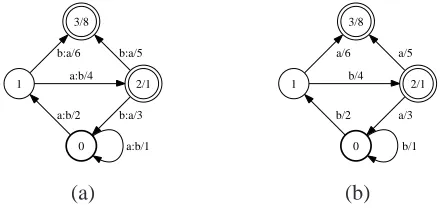
Figure 1(a) shows an example of a weighted finite-state transducer over the real semiring
(R+,+,×,0,1). In this figure, the input and
out-put labels of a transition are separated by a colon delimiter and the weight is indicated after the slash separator. A weighted transducer has a set of initial states represented in the figure by a bold circle and a set of final states, represented by double circles. A path from an initial state to a final state is an accept-ing path.
The weight of an accepting path is obtained by
first ⊗-multiplying the weights of its constituent
0 a:b/1 1
a:b/2
2/1 a:b/4
3/8
b:a/6
b:a/3 b:a/5
0 b/1 1
b/2
2/1 b/4 3/8
a/6
a/3 a/5
(a) (b)
Figure 1: (a) Example of weighted transducerT over the real semiring(R+,+,×,0,1). (b) Example of weighted
automatonA.Acan be obtained fromTby projection on the output andT(aab, bba) =A(bba) = 1×2×6×8 + 2×4×5×8.
transitions and⊗-multiplying this product on the left
by the weight of the initial state of the path (which
equals1in our work) and on the right by the weight
of the final state of the path (displayed after the slash in the figure). The weight associated by a weighted
transducerT to a pair of strings(x, y)∈Σ∗×Σ∗is
denoted byT(x, y)and is obtained by⊕-summing
the weights of all accepting paths with input labelx
and output labely.
For any transducer T, T−1 denotes its inverse,
that is the transducer obtained fromT by swapping
the input and output labels of each transition. For all
x, y∈Σ∗, we haveT−1(x, y) =T(y, x).
The composition of two weighted transducersT1
andT2with matching input and output alphabetsΣ,
is a weighted transducer denoted byT1 ◦T2 when
the semiring is commutative and the sum:
(T1◦T2)(x, y) = X
z∈Σ∗
T1(x, z)⊗T2(z, y) (1)
is well-defined and inK for all x, y (Salomaa and
Soittola, 1978).
Weighted automata can be defined as weighted
transducersAwith identical input and output labels,
for any transition. Since only pairs of the form(x, x)
can have a non-zero weight associated to them by
A, we denote the weight associated byA to(x, x)
by A(x) and call it the weight associated by A to
x. Similarly, in the graph representation of weighted
automata, the output (or input) label is omitted. Fig-ure 1(b) shows an example of a weighted
automa-ton. WhenAandB are weighted automata,A◦B
is called the intersection ofAandB. Omitting the
input labels of a weighted transducerT results in a
weighted automaton which is said to be the output
[image:2.612.318.541.61.165.2]3 General Framework
LetXbe a probabilistic automaton representing the
output of a complex model for a specific query input. The model may be for example a speech recognition system, an information extraction system, or a ma-chine translation system (which originally motivated our study). For machine translation, the sequences
accepted by X are the potential translations of the
input sentence, each with some probability given by X.
LetΣbe the alphabet for the task considered, e.g.,
words of the target language in machine translation,
and let L: Σ∗ ×Σ∗ → R denote a loss function
defined over the sequences on that alphabet. Given
a reference or hypothesis set H ⊆ Σ∗, minimum
Bayes risk (MBR) decoding consists of selecting a
hypothesisx∈Hwith minimum expected loss with
respect to the probability distributionX(Bickel and
Doksum, 2001; Tromble et al., 2008):
b
x= argmin
x∈H
E
x′∼X[L(x, x
′)]. (2)
Here, we shall consider the case, frequent in
prac-tice, where minimizing the loss L is equivalent to
maximizing a similarity measureK: Σ∗×Σ∗→R.
When K is a sequence kernel that can be
repre-sented by weighted transducers, it is a rational
ker-nel (Cortes et al., 2004). The problem is then
equiv-alent to the following expected similarity
maximiza-tion:
b
x= argmax
x∈H
E
x′∼X[K(x, x
′)]. (3)
When K is a positive definite symmetric rational
kernel, it can often be rewritten asK(x, y) = (T ◦
T−1)(x, y), where T is a weighted transducer over
the semiring(R+∪{+∞},+,×,0,1). Equation (3)
can then be rewritten as
b
x= argmax
x∈H
E
x′∼X[(T ◦T
−1)(x, x′)] (4)
= argmax
x∈H
kA(x)◦T ◦T−1◦Xk, (5)
where we denote by A(x) an automaton accepting
(only) the stringxand byk·kthe sum of the weights
of all accepted paths of a transducer.
4 Algorithms
4.1 General method
Equation (5) could suggest computing A(x)◦T ◦
T−1 ◦ X for each possible x ∈ H. Instead, we
can compute a composition based on an
automa-ton accepting all sequences inH,A(H). This leads
to a straightforward method for determining the se-quence maximizing the expected similarity having the following steps:
1. compute the composition X ◦ T, project on
the output and optimize (epsilon-remove,
de-terminize, minimize (Mohri, 2009)) and letY2
be the result;1
2. compute the compositionY1=A(H)◦T;
3. computeY1◦Y2and project on the input, letZ
be the result;2
4. determinizeZ;
5. find the maximum weight path with the label of
that path givingxb.
While this method can be efficient in various scenar-ios, in some instances the weighted determinization
yieldingZ can be both space- and time-consuming,
even though the input is acyclic. The next two sec-tions describe more efficient algorithms.
Note that in practice, for numerical stability, all of these computations are done in the log semiring
which is isomorphic to(R+∪ {+∞},+,×,0,1). In
particular, the maximum weight path in the last step is then obtained by using a standard single-source shortest-path algorithm.
4.2 Efficient method forn-gram kernels
A common family of rational kernels is the family
ofn-gram kernels. These kernels are widely use as
a similarity measure in natural language processing and computational biology applications, see (Leslie et al., 2002; Lodhi et al., 2002) for instance.
Then-gram kernelKnof ordernis defined as
Kn(x, y) =
X
|z|=n
cx(z)cy(z), (6)
where cx(z) is the number of occurrences of z in
x. Kn is a positive definite symmetric rational
ker-nel since it corresponds to the weighted transducer
Tn ◦Tn−1 where the transducer Tn is defined such
thatTn(x, z) =cx(z)for allx, z ∈Σ∗with|z|=n.
1
Equivalent to computingT−1◦X and projecting on the
input.
2Z
0 a:ε b:ε
1 a:a
b:b 2
a:a b:b
a:ε b:ε
0
1 a/0.5
2 b/0.5
3 b/1
4 b/1
5 a/1
6 a/1
7 a/0.4
8 b/0.6
b/1
9/1 b/1
a/1
(a) (b)
0
1 a
2 b
3 b
4 b
5 a
6 a
7 a
8 b
b
9 b
a
0
1 a/1
2
b/1 3/1
a/0.2
b/1.5
a/1.8
b/0.5
(c) (d)
ε
a/0 a/0
b/0 b/0
a/0.2
b/1.5
a/1.8 b/0.5
0
1 a/0
2 b/0
3 b/1.5
4 b/0.5
5 a/1.8
6 a/1.8
7 a/0.2
8 b/1.5
b/0.5
9/0 b/1.5
a/1.8
[image:4.612.76.559.63.301.2](e) (f)
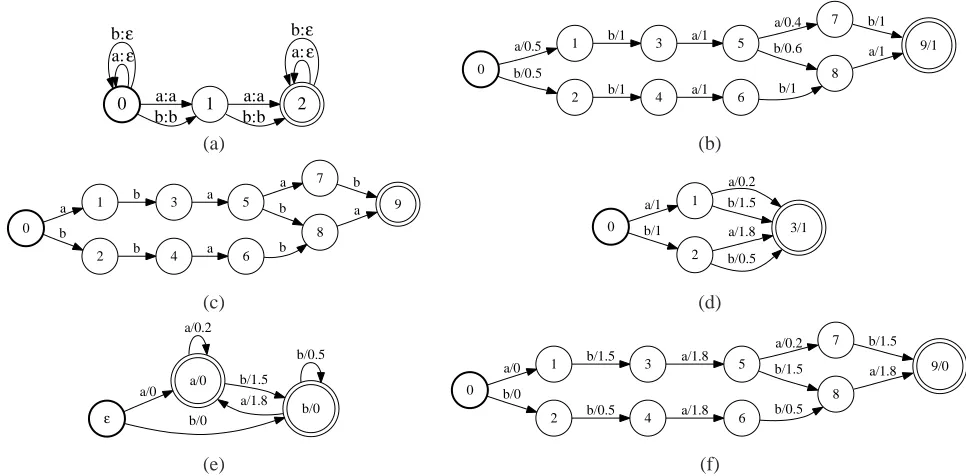
Figure 2: Efficient method for bigram kernel: (a) Counting transducerT2forΣ ={a, b}(over the real semiring). (b)
Probabilistic automatonX(over the real semiring). (c) The hypothesis automatonA(H)(unweighted). (d) Automaton
Y2representing the expected bigram counts inX(over the real semiring). (e) AutomatonY1: the context dependency
model derived fromY2(over the tropical semiring). (f) The compositionA(H)◦Y1(over the tropical semiring).
The transducerT2 forΣ = {a, b} is shown in
Fig-ure 2(a).
Taking advantage of the special structure of n
-gram kernels and of the fact that A(H) is an
un-weighted automaton, we can devise a new and
sig-nificantly more efficient method for computing bx
based on the following steps.
1. Compute the expectedn-gram counts inX: We
compute the compositionX◦T, project on
out-put and optimize (epsilon-remove, determinize,
minimize) and letY2be the result. Observe that
the weighted automatonY2is a compact
repre-sentation of the expectedn-gram counts inX,
i.e. for ann-gramw(i.e.|w|=n):
Y2(w) = X
x∈Σ∗
X(x)cx(w)
= E
x∼X[cx(w)] =cX(w).
(7)
2. Construct a context-dependency model: We
compute the weighted automaton Y1 over the
tropical semiring as follow: the set of states is
Q = {w ∈ Σ∗| |w| ≤ nandwoccurs inX},
the initial state beingǫand every state being
fi-nal; the set of transitionsE contains all 4-tuple
(origin, label, weight, destination) of the form:
• (w, a,0, wa)withwa∈Qand|w| ≤n−
2and
• (aw, b, Y2(awb), wb) with Y2(awb) 6= 0
and|w|=n−2
where a, b ∈ Σ and w ∈ Σ∗. Observe that
w ∈ Q when wa ∈ Q and thataw, wb ∈ Q
whenY2(awb)6= 0. Given a stringx, we have
Y1(x) = X
|w|=n
cX(w)cx(w). (8)
Observe thatY1 is a deterministic automaton,
henceY1(x)can be computed inO(|x|)time.
3. Compute xb: We compute the composition
A(H)◦Y1.xbis then the label of the accepting
path with the largest weight in this transducer and can be obtained by applying a shortest-path
algorithm to−A(H)◦Y1in the tropical
semir-ing.
The main computational advantage of this method
0 a/1 1 a/c1 2/1 b/c2
0 a 1
2/c1 a
3/c2 b
0 b
1 a
2/c1 a
3/c2
b
b
a b
a
0 b/0
1 a/0
2 a/0
3 b/0
2’/0
b/0 a/0
ε
/c1 3’/0
ε
/c2 b/0
a/0
[image:5.612.78.545.63.152.2](a) (b) (c) (d)
Figure 3: Illustration of the construction ofY1in the unambiguous case. (a) Weighted automatonY2 (over the real
semiring). (b) Deterministic tree automatonY′
2 accepting{aa, ab}(over the tropical semiring). (c) Result of
deter-minization ofΣ∗Y′
2(over the tropical semiring). (d) Weighted automatonY1(over the tropical semiring).
(+,×) semiring, which can sometimes be costly.
The method has also been shown empirically to be significantly faster than the one described in the pre-vious section.
The algorithm is illustrated in Figure 2. The
al-phabet is Σ = {a, b} and the counting transducer
corresponding to the bigram kernel is given in
Fig-ure 2(a). The evidence probabilistic automaton X
is given in Figure 2(b) and we use as hypothesis set the set of strings that were assigned a non-zero
probability byX; this set is represented by the
deter-ministic finite automatonA(H)given in Figure 2(c).
The result of step 1 of the algorithm is the weighted
automaton Y2 over the real semiring given in
Fig-ure 2(d). The result of step 2 is the weighted
au-tomaton Y1 over the tropical semiring is given in
Figure 2(e). Finally, the result of the composition
A(H)◦Y1 (step 3) is the weighted automaton over
the tropical semiring given in Figure 2(f). The re-sult of the expected similarity maximization is the
string bx = ababa, which is obtained by applying
a shortest-path algorithm to−A(H)◦Y1. Observe
that the stringxwith the largest probability inXis
x=bbabaand is hence different frombx=ababain this example.
4.3 Efficient method for the unambiguous case
The algorithm presented in the previous section for
n-gram kernels can be generalized to handle a wide
variety of rational kernels.
LetK be an arbitrary rational kernel defined by a
weighted transducerT. LetXT denote the regular
language of the strings output by T. We shall
as-sume thatXT is a finite language, though the results
of this section generalize to the infinite case. Let
Σdenote a new alphabet defined byΣ = {#x:x∈
XT}and consider the simple grammarGof
context-dependent batch rules:
ǫ→#x/x ǫ. (9)
Each such rule inserts the symbol#x immediately
after an occurrencexin the input string. For batch
context-dependent rules, the context of the applica-tion for all rules is determined at once before their application (Kaplan and Kay, 1994). Assume that this grammar is unambiguous for a parallel applica-tion of the rules. This condiapplica-tion means that there is a unique way of parsing an input string using the
strings of XT. The assumption holds for n-gram
sequences, for example, since the rules applicable
are uniquely determined by then-grams (making the
previous section a special case).
Given an acyclic weighted automatonY2over the
tropical semiring accepting a subset ofXT, we can
construct a deterministic weighted automatonY1for
Σ∗L(Y2)when this grammar is unambiguous. The
weight assigned byY1 to an input string is then the
sum of the weights of the substrings accepted byY2.
This can be achieved using weighted determiniza-tion.
This suggests a new method for generalizing Step 2 of the algorithm described in the previous section as follows (see illustration in Figure 3):
(i) use Y2 to construct a deterministic weighted
tree Y2′ defined on the tropical semiring
ac-cepting the same strings as Y2 with the same
weights, with the final weights equal to the
to-tal weight given by Y2 to the string ending at
that leaf;
(ii) letY1 be the weighted automaton obtained by
first adding self-loops labeled with all elements
of Σ at the initial state ofY2′ and then
Step (ii) consists of computing a deterministic
weighted automaton for Σ∗Y2′. This step
corre-sponds to the Aho-Corasick construction (Aho and Corasick, 1975) and can be done in time linear in the size ofY2′.
This approach assumes that the grammar G of
batch context-dependent rules inferred byXT is
un-ambiguous. This can be tested by constructing the
finite automaton corresponding to all rules inG. The
grammarGis unambiguous iff the resulting
automa-ton is unambiguous (which can be tested using a classical algorithm). An alternative and more ef-ficient test consists of checking the presence of a
failure or default transition to a final state during
the Aho-Corasick construction, which occurs if and only if there is ambiguity.
5 Application to Machine Translation
In machine translation, the BLEU score (Papineni et al., 2001) is typically used as an evaluation metric. In (Tromble et al., 2008), a Minimum Bayes-Risk
decoding approach for MT lattices was introduced.3
The loss function used in that approach was an ap-proximation of the log-BLEU score by a linear
func-tion ofn-gram matches and candidate length. This
loss function corresponds to the following similarity measure:
KLB(x, x′) =θ0|x′|+ X
|w|≤n
θ|w|cx(w)1x′(w).
(10)
where1x(w)is 1 ifwoccurs inxand 0 otherwise.
(Tromble et al., 2008) implements the MBR de-coder using weighted automata operations. First,
the set of n-grams is extracted from the
lat-tice. Next, the posterior probability p(w|X) of
each n-gram is computed. Starting with the
un-weighted lattice A(H), the contribution of eachn
-gram w to (10) is applied by iteratively
compos-ing with the weighted automaton correspondcompos-ing to
w(w/(θ|w|p(w|X))w)∗wherew = Σ∗\(Σ∗wΣ∗).
Finally, the MBR hypothesis is extracted as the best path in the automaton. The above steps are carried
out onen-gram at a time. For a moderately large
lat-tice, there can be several thousands ofn-grams and
the procedure becomes expensive. This leads us to investigate methods that do not require processing
then-grams one at a time in order to achieve greater
efficiency.
3
Related approaches were presented in (DeNero et al., 2009; Kumar et al., 2009; Li et al., 2009).
0
1
ε:ε
2
ε:ε
b:ε
3 a:a
[image:6.612.383.471.62.141.2]a:ε b:b a:ε b:ε
Figure 4: Transducer T1 over the real semiring for the
alphabet{a, b}.
The first idea is to approximate theKLB
similar-ity measure using a weighted sum of n-gram
ker-nels. This corresponds to approximating1x′(w) by
cx′(w)in (10). This leads us to the following
simi-larity measure:
KN G(x, x′) =θ0|x′|+ X
|w|≤n
θ|w|cx(w)cx′(w)
=θ0|x′|+ X
1≤i≤n
θiKi(x, x′)
(11)
Intuitively, the larger the length ofwthe less likely
it is thatcx(w) 6= 1x(w), which suggests
comput-ing the contribution to KLB(x, x′) of lower-order
n-grams (|w| ≤k) exactly, but using the
approxima-tion byn-gram kernels for the higher-ordern-grams
(|w|> k). This gives the following similarity mea-sure:
KN Gk (x, x′) =θ0|x′|+ X
1≤|w|≤k
θ|w|cx(w)1x′(w)
+ X
k<|w|≤n
θ|w|cx(w)cx′(w)
(12)
Observe thatK0
N G=KN G andKN Gn =KLB.
All these similarity measures can still be com-puted using the framework described in Section 4.
Indeed, there exists a transducer Tn over the real
semiring such thatTn(x, z) = 1x(z)for allx∈Σ∗
andz ∈ Σn. The transducerT
1 for Σ = {a, b}is
given by Figure 4. Let us define the similarity
mea-sureKnas:
Kn(x, x′) = (Tn◦T−
1
n )(x, x′) =
X
|w|=n
cx(w)1x′(w).
(13) Observe that the framework described in Section 4
can still be applied even thoughKnis not
zhen aren
[image:7.612.129.488.59.129.2]nist02 nist04 nist05 nist06 nist08 nist02 nist04 nist05 nist06 nist08 no mbr 38.7 39.2 38.3 33.5 26.5 64.0 51.8 57.3 45.5 43.8 exact 37.0 39.2 38.6 34.3 27.5 65.2 51.4 58.1 45.2 45.0 approx 39.0 39.9 38.6 34.4 27.4 65.2 52.5 58.1 46.2 45.0 ngram 36.6 39.1 38.1 34.4 27.7 64.3 50.1 56.7 44.1 42.8 ngram1 37.1 39.2 38.5 34.4 27.5 65.2 51.4 58.0 45.2 44.8
Table 1: BLEU score (%)
zhen aren
nist02 nist04 nist05 nist06 nist08 nist02 nist04 nist05 nist06 nist08 exact 3560 7863 5553 6313 5738 12341 23266 11152 11417 11405 approx 168 422 279 335 328 504 1296 528 619 808
ngram 28 72 34 70 43 85 368 105 63 66
ngram1 58 175 96 99 89 368 943 308 167 191
Table 2: MBR Time (in seconds)
can then be expressed as the relevant linear
combi-nation ofKiandKi.
6 Experimental Results
Lattices were generated using a phrase-based MT system similar to the alignment template system de-scribed in (Och and Ney, 2004). Given a source
sen-tence, the system produces a word latticeAthat is a
compact representation of a very largeN-best list of
translation hypotheses for that source sentence and
their likelihoods. The latticeA is converted into a
lattice X that represents a probability distribution
(i.e. the posterior probability distribution given the source sentence) following:
X(x) = P exp(αA(x))
y∈Σ∗exp(αA(y))
(14)
where the scaling factorα∈[0,∞)flattens the
dis-tribution whenα < 1and sharpens it whenα > 1.
We then applied the methods described in Section 5
to the lattice X using as hypothesis set H the
un-weighted lattice obtained fromX.
The following parameters for the n-gram factors
were used:
θ0=
−1
T andθn=
1
4T prn−1 forn≥1. (15)
Experiments were conducted on two language pairs Arabic-English (aren) and Chinese-English (zhen) and for a variety of datasets from the NIST
Open Machine Translation (OpenMT) Evaluation.4
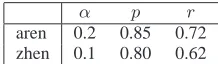
The values ofα,pandrused for each pair are given
4
http://www.nist.gov/speech/tests/mt
α p r
aren 0.2 0.85 0.72
zhen 0.1 0.80 0.62
Table 3: Parameters used for performing MBR.
in Table 3. We used the IBM implementation of the BLEU score (Papineni et al., 2001).
We implemented the following methods using the OpenFst library (Allauzen et al., 2007):
• exact: uses the similarity measureKLB based
on the linearized log-BLEU, implemented as described in (Tromble et al., 2008);
• approx: uses the approximation toKLB from
(Kumar et al., 2009) and described in the ap-pendix;
• ngram: uses the similarity measureKN G
im-plemented using the algorithm of Section 4.2;
• ngram1: uses the similarity measure K1
N G
also implemented using the algorithm of Sec-tion 4.2.
The results from Tables 1-2 show that ngram1
performs as well as exact on all datasets5 while
be-ing two orders of magnitude faster than exact and overall more than 3 times faster than approx.
7 Conclusion
We showed that for broad families of transducers
T and thus rational kernels, the expected
similar-5
[image:7.612.371.480.266.298.2]ity maximization problem can be solved efficiently. This opens up the option of seeking the most
appro-priate rational kernel or transducer T for the
spe-cific task considered. In particular, the kernel K
used in our machine translation applications might not be optimal. One may well imagine for
exam-ple that somen-grams should be further emphasized
and others de-emphasized in the definition of the similarity. This can be easily accommodated in the framework of rational kernels by modifying the
tran-sition weights of T. But, ideally, one would wish
to select those weights in an optimal fashion. As mentioned earlier, we leave this question to future work. However, we can offer a brief look at how one could tackle this question. One method for de-termining an optimal kernel for the expected sim-ilarity maximization problem consists of solving a problem similar to that of learning kernels in
classi-fication or regression. LetX1, . . . , Xmbemlattices
with Ref(X1), . . . ,Ref(Xm) the associated
refer-ences and let xb(K, Xi) be the solution of the
ex-pected similarity maximization for latticeXi when
using kernelK. Then, the kernel learning
optimiza-tion problem can be formulated as follows:
min
K∈K
1
m m
X
i=1
L(xb(K, Xi),Ref(Xi))
s. t.K =T ◦T−1∧Tr[K]≤C,
whereK is a convex family of rational kernels and
Tr[K] denotes the trace of the kernel matrix. In
particular, we could chooseKas a family of linear
combinations of base rational kernels. Techniques and ideas similar to those discussed by Cortes et al. (2008) for learning sequence kernels could be di-rectly relevant to this problem.
A Appendix
We describe here the approximation of the KLB
similarity measure from Kumar et al. (2009). We
assume in this section that the latticeXis
determin-istic in order to simplify the notations. The posterior
probability ofn-gramwin the latticeXcan be
for-mulated as:
p(w|X) = X
x∈Σ∗
1x(w)P(x|s) =
X
x∈Σ∗
1x(w)X(x)
(16)
where sdenotes the source sentence. When using
the similarity measureKLB defined Equation (10),
Equation (3) can then be reformulated as:
b
x= argmax
x′∈H
θ0|x′|+ X
w
θ|w|cx′(w)p(w|X). (17)
The key idea behind this new approximation
algo-rithm is to rewrite then-gram posterior probability
(Equation 16) as follows:
p(w|X) = X
x∈Σ∗
X
e∈EX
f(e, w, πx)X(x) (18)
where EX is the set of transitions of X, πx is
the unique accepting path labeled by x in X and
f(e, w, π)is a score assigned to transitioneon path
πcontainingn-gramw:
f(e, w, π) =
1 ifw∈e, p(e|X)> p(e′|X),
ande′precedeseonπ
0 otherwise.
(19)
In other words, for each pathπ, we count the
tran-sition that contributesn-gramwand has the highest
transition posterior probability relative to its
prede-cessors on the pathπ; there is exactly one such
tran-sition on each lattice pathπ.
We note that f(e, w, π) relies on the full path π
which means that it cannot be computed based on local statistics. We therefore approximate the quan-tityf(e, w, π)withf∗(e, w, X)that counts the
tran-sitionewithn-gramwthat has the highest arc
poste-rior probability relative to predecessors in the entire
latticeX.f∗(e, w, X)can be computed locally, and
then-gram posterior probability based onf∗can be
determined as follows:
p(w|G) = X
x∈Σ∗
X
e∈EX
f∗(e, w, X)X(x)
= X
e∈Ex
1w∈ef∗(e, w, X)
X
x∈Σ∗
1πx(e)X(x)
= X
e∈EX
1w∈ef∗(e, w, X)P(e|X),
(20)
whereP(e|X) is the posterior probability of a
lat-tice transition e ∈ EX. The algorithm to perform
Lattice MBR is given in Algorithm 1. For each state
tin the lattice, we maintain a quantity Score(w, t)
for eachn-gramwthat lies on a path from the initial
state tot. Score(w, t)is the highest posterior
prob-ability among all transitions on the paths that
termi-nate ontand containn-gramw. The forward pass
requires computing then-grams introduced by each
transition; to do this, we propagate n-grams (up to
Algorithm 1 MBR Decoding on Lattices
1: Sort the lattice states topologically.
2: Compute backward probabilities of each state. 3: Compute posterior prob. of eachn-gram: 4: for each transitionedo
5: Compute transition posterior probabilityP(e|X). 6: Computen-gram posterior probs.P(w|X): 7: for eachn-gramwintroduced byedo 8: Propagaten−1gram suffix tohe.
9: if p(e|X)>Score(w, T(e)) then 10: Update posterior probs. and scores:
p(w|X)+=p(e|X) −Score(w, T(e)). Score(w, he) =p(e|X).
11: else
12: Score(w, he) =Score(w, T(e)).
13: end if
14: end for 15: end for
16: Assign scores to transitions (given by Equation 17). 17: Find best path in the lattice (Equation 17).
References
Alfred V. Aho and Margaret J. Corasick. 1975. Efficient String Matching: An Aid to Bibliographic Search.
Communications of the ACM, 18(6):333–340.
Cyril Allauzen, Michael Riley, Johan Schalkwyk, Woj-ciech Skut, and Mehryar Mohri. 2007. OpenFst: a general and efficient weighted finite-state transducer library. In CIAA 2007, volume 4783 of LNCS, pages 11–23. Springer. http://www.openfst.org.
Christian Berg, Jens Peter Reus Christensen, and Paul Ressel. 1984. Harmonic Analysis on Semigroups.
Springer-Verlag: Berlin-New York.
Peter J. Bickel and Kjell A. Doksum. 2001.
Mathemati-cal Statistics, vol. I. Prentice Hall.
Corinna Cortes, Patrick Haffner, and Mehryar Mohri. 2004. Rational Kernels: Theory and Algorithms.
Journal of Machine Learning Research, 5:1035–1062.
Corinna Cortes, Mehryar Mohri, and Afshin Ros-tamizadeh. 2008. Learning sequence kernels. In
Pro-ceedings of MLSP 2008, October.
John DeNero, David Chiang, and Kevin Knight. 2009. Fast consensus decoding over translation forests. In
Proceedings of ACL and IJCNLP, pages 567–575.
Vaibhava Goel and William J. Byrne. 2000. Minimum Bayes-risk automatic speech recognition. Computer
Speech and Language, 14(2):115–135.
Ronald M. Kaplan and Martin Kay. 1994. Regular mod-els of phonological rule systems. Computational
Lin-guistics, 20(3).
Philipp Koehn. 2004. Statistical Significance Tests for Machine Translation Evaluation. In EMNLP, Barcelona, Spain.
Shankar Kumar and William J. Byrne. 2004. Minimum Bayes-risk decoding for statistical machine transla-tion. In HLT-NAACL, Boston, MA, USA.
Shankar Kumar, Wolfgang Macherey, Chris Dyer, and Franz Och. 2009. Efficient minimum error rate train-ing and minimum bayes-risk decodtrain-ing for translation hypergraphs and lattices. In Proceedings of the
Asso-ciation for Computational Linguistics and IJCNLP.
Christina S. Leslie, Eleazar Eskin, and William Stafford Noble. 2002. The Spectrum Kernel: A String Kernel for SVM Protein Classification. In Pacific Symposium
on Biocomputing, pages 566–575.
Zhifei Li, Jason Eisner, and Sanjeev Khudanpur. 2009. Variational decoding for statistical machine transla-tion. In Proceedings of ACL and IJCNLP, pages 593– 601.
Huma Lodhi, Craig Saunders, John Shawe-Taylor, Nello Cristianini, and Chris Watskins. 2002. Text classifica-tion using string kernels. Journal of Machine Learning
Research, 2:419–44.
Mehryar Mohri and Richard Sproat. 1996. An Efficient Compiler for Weighted Rewrite Rules. In Proceedings
of ACL ’96, Santa Cruz, California.
Mehryar Mohri. 2009. Weighted automata algorithms. In Manfred Droste, Werner Kuich, and Heiko Vogler, editors, Handbook of Weighted Automata, chapter 6, pages 213–254. Springer.
Franz J. Och and Hermann Ney. 2004. The align-ment template approach to statistical mchine transla-tion. Computational Linguistics, 30(4):417–449. Kishore Papineni, Salim Roukos, Todd Ward, and
Wei-Jing Zhu. 2001. Bleu: a Method for Automatic Evaluation of Machine Translation. Technical Report RC22176 (W0109-022), IBM Research Division. Arto Salomaa and Matti Soittola. 1978.
Automata-Theoretic Aspects of Formal Power Series. Springer.
Roy W. Tromble, Shankar Kumar, Franz J. Och, and Wolfgang Macherey. 2008. Lattice minimum Bayes-risk decoding for statistical machine translation. In
Proceedings of the 2008 Conference on Empirical Methods in Natural Language Processing, pages 620–