Phrase Representations for Multiword Expressions
Jo¨el Legrand1,2 and Ronan Collobert∗3,1 1Idiap Research Institute, Martigny, Switzerland
2Ecole Polytechnique F´ed´erale de Lausanne (EPFL), Lausanne, Switzerland 3Facebook AI Research, Menlo Park (CA), USA
Abstract
Recent works in Natural Language Pro-cessing (NLP) using neural networks have focused on learning dense word repre-sentations to perform classification tasks. When dealing with phrase prediction problems, is is common practice to use special tagging schemes to identify seg-ments boundaries. This allows these tasks to be expressed as common word tagging problems. In this paper, we propose to learn fixed-size representations for arbi-trarily sized chunks. We introduce a model that takes advantage of such representa-tions to perform phrase tagging by di-rectly identifying and classifying phrases. We evaluate our approach on the task of multiword expression (MWE) tagging and show that our model outperforms the state-of-the-art model for this task.
1 Introduction
Traditional NLP tasks such as part-of-speech (POS) tagging or semantic role labeling (SRL) consists in tagging each word in a sentence with a tag. Another class of problems such as Named En-tity Recognition (NER) or shallow parsing (chunk-ing) consists in identifying and labeling phrases (i.e. groups of words) with predefined tags. Such tasks can be expressed as word classification prob-lems by identifying the phrase boundaries instead of directly identifying the whole phrases. In prac-tice, this consists in prefixing every tag with an extra-label indicating the position of the word in-side a phrase (at the beginning (B), inin-side (I), at the end (E), single word (S) or not in a phrase (O)). Different schemes have been used in the literature, ∗All research was conducted at the Idiap Research
Insti-tute, before Ronan Collobert joined Facebook AI Research
such as the IOB2, IOE1 and IOE2 schemes (Sang and Veenstra, 1999) or IOBES scheme (Uchimoto et al., 2000) with no clear predominance.
These tasks have been tackled using various machine learning methods such as Support Vec-tor Machines (SVM) for POS tagging (Gim´enez and M`arquez, 2004) or chunking (Kudoh and Mat-sumoto, 2000), second order random fields for chunking (Sun et al., 2008) or a combination of different classifiers for NER (Radu et al., 2003). All these approaches use carefully selected hand-crafted features.
Recent studies in NLP introduced neural net-work based systems that can be trained in an end-to-end manner, using minimal prior knowl-edge. These models take advantage of continu-ous representations of words. In Collobert et al. (2011) the authors proposed a deep neural net-work, which learns the word representations (the features) and produces IOBES-prefixed tags dis-criminatively trained in an end-to-end manner. This system is trained using a conditional ran-dom field (Lafferty et al., 2001) that accounts for the structure of the sentence. This architec-ture has been applied to various NLP tasks, such as POS tagging, NER or semantic role labeling and achieves state-of-the-art performance in all of them.
In this paper, we propose to learn fixed-size con-tinuous representations of arbitrarily sized chunks by composing word embeddings. These represen-tations are used to directly classify phrases with-out using the classical IOB(ES) prefixing step. The proposed approach is evaluated on the task of multiword expression (MWE) tagging. Using the SPRML 2014 data for French MWE tagging (Seddah et al., 2013), we show that our phrase representations are able to capture enough knowl-edge to perform on par with the IOBES-based model of Collobert et al. (2011) applied to MWE
tagging. Furthermore, we show that our system outperforms the winner of the SPMRL (Syntactic Parsing of Morphologicaly Rich Language) 2013 shared task for MWE tagging (Constant et al., 2013) which is currently the best published sys-tem.
2 The model
The proposed model computes fixed-size continu-ous vectors of arbitrarily sized chunks which are then used as inputs to a classifier. Every possi-ble window of sizes from 1 to K (K being the maximum size) is projected onto a common vector space (the same for allk), using a different neural network for each sizek. The resulting represen-tations are passed on to a classifier which outputs a score for every possible tag. To ensure that a word belongs to one chunk at most, decoding is performed using structured graph decoding using the Viterbi algorithm.
2.1 Word representation
Given an input sentenceS = w1, . . . , wN, each
word is embedded into a D-dimensional vector space by applying a lookup-table operation (Ben-gio et al., 2000):
LTW(wn) =Wwn
where the matrix W ∈ RD×|W| represents the
parameters of the lookup layer. Each column Wn ∈ RD corresponds to the vector embedding
of thenthword in the dictionaryW.
Additional features, such as part-of-speech tags, can be used by using a different lookup table for each discrete feature. The input becomes the concatenation of the outputs of all these lookup-tables. For simplicity, we consider only one lookup-table in the rest of the architecture descrip-tion.
2.2 Phrase representation
We denotek-window a window of sizek∈[1, K] where K is the maximum window size. Phrase representations for all k-windows within a given sentence are produced by looking, for all sizes from 1 to K, at all successive windows of text, sliding over the sentence, from position 1 toN −
K+ 1. Formally, if we denote
xn,k =[LTW(wn−c), . . . , LTW(wn)
, ...,
, LTW(wn+k−1), . . . , LTW(wn+k−1+c)]
the concatenated word representations corre-sponding to thenthk-window (cbeing the context
from each side of the the k-window), its represen-tation is given by
rn,k =Mk1xn,k,
where M1
k ∈ R(k+2c)D×nhu is a matrix of
pa-rameters andnhuthe dimension of the phrase rep-resentations (which is the same for all k). Words outside the sentence boundaries are assigned a special ”PADDING” embedding.
2.3 Phrase scoring
We denoteT the set of tags andTkthe set of tags
for ak-window. We denotetk∈ Tkthe tagt∈ T
for ak-window. The scores for allk-windows are computed by a linear layer, using their correspond-ing representations as input. Formally, the score for thenthk-window are given by
sn,k=tanh(M2rn,k),
whereM2 ∈ Rnhu×|T |is a matrix of parameters.
We definesn,tk the score for the tagtk∈ Tk start-ing at the positionn < N−k+ 1.
2.4 Structure tag inference
The cat sat on the mat
1-NP
2-NP
..
.
Other
Figure 1: Constrained graph for structured infer-ence. Each node is assigned a score from the scor-ing layer. For instance, the first node of the line 2-NP correspond to the score for the tag NP for the phrase ”the cat”. Nodes in gray represent final nodes.
The scoring layer outputs a matrix of |Tk| ×
The next module (see Figure 1) of our system is a structured graph G constrained in order to en-sure that a word is tagged only once. Each node Gn,tk is assigned the scoresn,tk (the score of the tagtk∈ Tkstarting at the positionn < N−k+1)
from the scoring layer. Only transitions from node Gn,tk to node Gn+k,t0k0 (withn+k <= N) are possible since a word cannot be tagged twice along the same path. The Viterbi algorithm is an efficient choice to find the best path in the lattice. The score for a sentence S of size N along a path of tags [t]Nt
1 is then given by the sum of the tag scores:
s(S,[t]Nt
1 , θ) = Nt
X
n=1
sn,tk
whereθrepresents all the trainable parameter.
2.5 Training
The proposed neural network is trained by maxi-mizing the likelihood over the training data, using stochastic gradient ascent. Following Collobert et al. (2011), the scores(S,[t]Nt
1 , θ)can be
inter-preted as a conditional probability by exponenti-ating this score and normalizing it with respect to all possible path scores. Taking the log, the con-ditional probability of the true path[t]Nt
1 is given
by
logp(s(S,[t]Nt
1 , θ)) =s(S,[t]N1t, θ)
−log (X
u
s(S,[u]Nu
1 ), θ)
Following Rabiner (1990), the normalization term (second term of this equation) can be com-puted in linear time thanks to a recursion similar to the Viterbi algorithm. The whole architecture (in-cluding the input feature, phrase representations and scoring layer) is trained through the graph in order to encourage valid paths of tags during train-ing, while discouraging all other paths.
3 Experiments
3.1 Multiword expression
Multiword expressions are groups of tokens which act as single units at some level of linguistic anal-ysis. They cover a wide range of linguistic con-structions such as idioms (”kick the bucket”), noun compound (”traffic light”) or fixed phrases (”ad hoc”). As they can carry meaning that can not
be inferred directly from the meaning of individ-ual constituents (as for idioms), they are difficult to handle by automatic systems and represent a key issue for many NLP systems addressing, for instance, machine translation and text generation tasks.
3.2 Corpus
Experiments were conducted on the SPMRL french corpus provided for the Shared Task 2013 (Seddah et al., 2013). This dataset provides 14.7k sentences (443k tokens) with 22.6k identi-fied MWE. A given MWE is defined as a continu-ous sequence of terminals, plus a POS tag among the 10 possible POS tags. As presented in Table 1, a wide majority of the chunks are 2-chunks or 3-chunks (91.2%).
Chunk size 2 3 4 5 5+
#chunk 11108 10188 1702 309 250
percentage 47.2 43.2 7.2 1.3 1.1
Table 1: Number of k-sized chunks in the training corpus
3.3 Evaluation
We evaluate the performance of the proposed net-work on MWE tagging using the three metrics de-scribed in Seddah et al. (2013), reporting for each of them the recall, precision and F-score. MWE correspond to the full MWEs, in which a predicted MWE counts as correct if it has the correct span (same group as in the gold data). MWE+POS is defined in the same fashion, except that the pre-dicted MWE counts as correct if it has both correct span and correct POS tag. COMP correspond to the non-head components of MWEs: a non-head component of MWE counts as correct if it is at-tached to the head of the MWE, with the specific label indicating that it is part of an MWE.
3.4 Baseline models
are known to greatly improve MWE segmentation (Constant and Tellier, 2012).
3.5 Setup
The network is trained using stochastic gradient descent over the training data, until convergence on the validation set. Hyper-parameters are tuned on the validation set. The look-up table size for the words is 64. Word embeddings are pre-trained by performing PCA on the matrix of word co-occurrences (Lebret and Collobert, 2014) using Wikipedia data. These embeddings are fine-tuned during the training process. As additional fea-tures, we only use the part-of-speech tags obtained using the freely available tool MarMoT (Mueller et al., 2013)1. The POS-tag embedding size is 32. The context size isc = 2 The maximum size for a window is K = 7. The common embedding size for thek-window isnhu = 300. We fix the learning rate to 0.01. Following Legrand and Col-lobert (2015), to prevent units from co-adapting, we adopt a dropout regularization strategy (Srivas-tava et al., 2014) after every lookup-table, as the capacity of our network mainly lies on the input embeddings.
For the IOBES-based model, we use the follow-ing parameters: the context size is set to 2, word and tags feature sizes are 64 and 32 respectively, the hidden layer size is 300 and the learning rate is 0.001. We use the same dropout regularization strategy and the same word initialization as for the proposed model.
4 Results
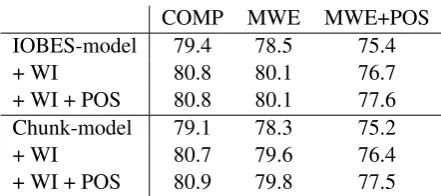
We first compare our approach with the IOBES-model from Collobert et al. (2011). Table 2 presents the results obtained for the two models. We see that, our model performs on par with the IOBES-based model. Interestingly, adding the POS features has little effect on the performance for MWE identification but helps to determine the MWE POS-tags.
In Table 3, we compare our model with the win-ner of the SPMRL 2013 shared task for MWE recognition (Constant et al., 2013). Both the IOBES and chunk based models are obtained us-ing an ensemble of 5 model and averagus-ing the ob-tained scores. We see that both our model and the
1The tags used are available here:http://cistern.
cis.lmu.de/marmot/models/CURRENT/
COMP MWE MWE+POS
IOBES-model 79.4 78.5 75.4
+ WI 80.8 80.1 76.7
+ WI + POS 80.8 80.1 77.6
Chunk-model 79.1 78.3 75.2
+ WI 80.7 79.6 76.4
[image:4.595.307.528.60.158.2]+ WI + POS 80.9 79.8 77.5
Table 2: Results on the test corpus (4043 MWEs) in terms of F-measure. WI stands for word initial-ization.
IOBES-based model outperform this state-of-the-art model.
COMP MWE MWE+POS
LIGM-Alpage 81.3 80.7 77.5
IOBES-model 81.4 80.7 78.2
Chunk-model 81.3 80.7 78.1
Table 3: Results on the test corpus (4043 MWEs) in terms of F-measure.
5 Representation analysis
As the proposed chunk-based model produces continuous phrase representations, it allows for phrase comparison. Table 4 presents some of the closest neighbors (in terms of Euclidean dis-tance) for some chosen phrases. We see that close representations correspond to semantically close phrases.
pr´esident de la r´epublique chef de l’´etat pr´esidence de la r´epublique
ministre de l’int´erieur
´evasion fiscale fraude fiscale d´etournements financiers
lib´eralisme sauvage
impˆot sur le revenu impˆot sur la fortune impˆot sur le patrimoine
impˆots sur la fortune
6 Conclusion
In this paper, we proposed a neural network model that learns fixed-size continuous representations of arbitrarily-sized chunks by composing word em-beddings. These representations are used to di-rectly identify and classify phrases. Evaluating our model on the task of multiword expression tagging, we showed that the proposed representa-tions perform on par with a baseline IOBES-based system. We also showed that it outperforms the model obtaining the best published performance for this task while not using any external lexicon and relying on few input features. As the pro-posed model computes phrase representations, it allows for comparison between phrases. In the fu-ture, the potential of this approach for higher-level tasks such as bilingual word alignment are to be explored.
References
Y. Bengio, R. Ducharme, and P. Vincent. A Neural Probabilistic Language Model. InNIPS, 2000. R. Collobert, J. Weston, L. Bottou, M. Karlen,
K. Kavukcuoglu, and P. Kuksa. Natural lan-guage processing (almost) from scratch. Jour-nal of Machine Learning Research, 2011. M. Constant, M. Candito, and D. Seddah. The
LIGM-Alpage Architecture for the SPMRL 2013 Shared Task: Multiword Expression Anal-ysis and Dependency Parsing. InFourth Work-shop on Statistical Parsing of Morphologically Rich Languages, 2013.
J. Gim´enez and L. M`arquez. Svmtool: A gen-eral pos tagger generator based on support vec-tor machines. InLREC, 2004.
T. Kudoh and Y. Matsumoto. Use of support vector learning for chunk identification. In
Proceedings of the 2Nd Workshop on Learn-ing Language in Logic and the 4th Conference on Computational Natural Language Learning - Volume 7, 2000.
J. Lafferty, A. McCallum, and F. Pereira. Condi-tional random fields: Probabilistic models for segmenting and labeling sequence data. In
Int. Conf. on Machine Learning (ICML 2001), 2001.
R. Lebret and R. Collobert. Word Embeddings through Hellinger PCA. In Proc. of EACL, 2014.
J. Legrand and R. Collobert. Joint RNN-Based Greedy Parsing and Word Composition. In Pro-ceedings of ICLR, 2015.
T. Mueller, H. Schmid, and H. Sch¨utze. Efficient higher-order CRFs for morphological tagging. InProceedings of the 2013 Conference on Em-pirical Methods in Natural Language Process-ing, 2013.
L. R. Rabiner. Readings in speech recognition. chapter A Tutorial on Hidden Markov Models and Selected Applications in Speech Recogni-tion. 1990.
F. Radu, I. Abe, J. Hongyan, and Z. Tong. Named entity recognition through classifier combina-tion. InProceedings of the Seventh Conference on Natural Language Learning at HLT-NAACL 2003 - Volume 4, 2003.
E. F. T. K. Sang and J. Veenstra. Representing text chunks. InProceedings of the Ninth Con-ference on European Chapter of the Association for Computational Linguistics, 1999.
D. Seddah, R. Tsarfaty, S. K¨ubler, M. Can-dito, J. D. Choi, R. Farkas, J. Foster, I. Goe-naga, K. Gojenola, Y. Goldberg, S. Green, N. Habash, M. Kuhlmann, W. Maier, J. Nivre, A. Przepi´orkowski, R. Roth, W. Seeker, Y. Ver-sley, V. Vincze, M. Woli´nsk, A. Wr´oblewska, and E. Villemonte De La Clergerie. Overview of the SPMRL 2013 shared task: A cross-framework evaluation of parsing morphologi-cally rich languages. InProceedings of the 4th Workshop on Statistical Parsing of Morpholog-ically Rich Languages: Shared Task, 2013. N. Srivastava, G. Hinton, A. Krizhevsky,
I. Sutskever, and R. Salakhutdinov. Dropout: A simple way to prevent neural networks from overfitting. J. Mach. Learn. Res., 2014.
X. Sun, L. Morency, D. Okanohara, and J. Tsujii. Modeling latent-dynamic in shallow parsing: A latent conditional model with improved infer-ence. InProceedings of the 22Nd International Conference on Computational Linguistics - Vol-ume 1, 2008.