Evaluating HeLI with Non-linear Mappings
Tommi Jauhiainen University of Helsinki
@helsinki.fi
Krister Lind´en University of Helsinki
@helsinki.fi
Heidi Jauhiainen University of Helsinki
@helsinki.fi
Abstract
In this paper we describe the non-linear mappings we used with the Helsinki lan-guage identification method, HeLI, in the 4thedition of the Discriminating between
Similar Languages (DSL) shared task, which was organized as part of the Var-Dial 2017 workshop. Our SUKI team par-ticipated in the closed track together with 10 other teams. Our system reached the 7th position in the track. We describe
the HeLI method and the non-linear map-pings in mathematical notation. The HeLI method uses a probabilistic model with character n-grams and word-based back-off. We also describe our trials using the non-linear mappings instead of relative frequencies and we present statistics about the back-off function of the HeLI method.
1 Introduction
The 4th edition of the Discriminating between
Similar Languages (DSL) shared task (Zampieri et al., 2017) was divided into an open and a closed track. In the closed track the participants were al-lowed to use only the training data provided by the organizers, whereas in the open track the par-ticipants could use any data source they had at their disposal. This year we did not participate in the open track, so we did not use any addi-tional sources for training and development. The creation of the earlier DSL corpora has been de-scribed by Tan et al. (2014). This year’s train-ing data consisted of 18,000 lines of text, ex-cerpts of journalistic texts, for each of the 14 languages. The corresponding development set had 2,000 lines of text for each language. The task had a language selection comparable to the 1st (Zampieri et al., 2014), 2nd (Zampieri et al.,
2015), and3rd(Malmasi et al., 2016) editions of
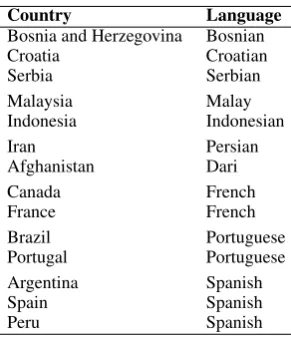
the shared task. The languages and varieties are listed in Table 1. The differences from the previ-ous year’s shared task were the inclusion of Per-sian and Dari languages, as well as replacing the Mexican Spanish variety with Peruvian Spanish.
Country Language
Bosnia and Herzegovina Bosnian
Croatia Croatian
Serbia Serbian
Malaysia Malay
Indonesia Indonesian
Iran Persian
Afghanistan Dari
Canada French
France French
Brazil Portuguese
Portugal Portuguese
Argentina Spanish
Spain Spanish
[image:1.595.343.489.313.484.2]Peru Spanish
Table 1: The languages and varieties of the 4th
edition of the Discriminating between Similar Languages (DSL) shared task.
For the4thedition, we were interested in
modi-fying the HeLI method and use the TF-IDF scores and some non-linear mappings instead of relative frequencies. We were inspired by the successful use of TF-IDF scores by Barbaresi (2016). He was able to significantly boost the accuracy of his identifier after the3rdedition of the shared task by
using the TF-IDF scores. Earlier, Brown (2014) managed to boost several language identification methods using non-linear mappings.
2 Related Work
Automatic language identification of digital text has been researched for more than 50 years. The first article on the subject was written by Musto-nen (1965), who used multiple discriminant
ysis to distinguish between Finnish, English and Swedish. For more of the history of automatic lan-guage identification the reader is suggested to take a look at the literature review chapter of Marco Lui’s doctoral thesis (Lui, 2014).
There has also been research directly involving the language groups present in this year’s shared task. Automatic identification of South-Slavic languages has been researched by Ljubeˇsic et al. (2007), Tiedemann and Ljubeˇsic (2012), Ljubeˇsic and Kranjcic (2014), and Ljubeˇsic and Kranjcic (2015). Brown (2012) presented confusion matri-ces for the languages of the former Yugoslavia (in-cluding Bosnian and Croatian) as well as for Indo-Iranian languages (including Western and Eastern Farsi). Chew et al. (2009) experimented distin-guishing between Dari and Farsi, as well as Malay and Indonesian, among others. Distinguishing between Malay and Indonesian was studied by Ranaivo-Malanc¸on (2006). Automatic identifica-tion of French dialects was studied by Zampieri et al. (2012) and Zampieri (2013). Discriminat-ing between Portuguese varieties was studied by Zampieri and Gebre (2012), whereas Zampieri et al. (2012), Zampieri (2013), Zampieri et al. (2013), and Maier and G´omez-Rodr´ıguez (2014) researched language variety identification between Spanish dialects.
The system description articles provided for the previous shared tasks are all relevant and refer-ences to them are provided by Zampieri et al. (2014), Zampieri et al. (2015), and Malmasi et al. (2016). Detailed analysis of the first two shared tasks was done by Goutte et al. (2016).
The language identification method used by the system presented in this article, HeLI, was first introduced by Jauhiainen (2010) and it was also described in the proceedings of the 2nd edition
of the DSL shared task (Jauhiainen et al., 2015). The complete description of the method was first presented in the proceedings of the 3rd VarDial
workshop (Jauhiainen et al., 2016). The language identifier tool using the HeLI method is available as open source from GitHub1. The non-linear
mappings evaluated in this article were previously tested with several language identifiers by Brown (2014).
1https://github.com/tosaja/HeLI
3 Methodology
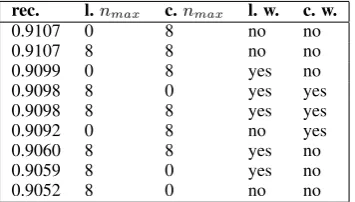
In this paper, we re-present most of the descrip-tion of the HeLI method from the last year’s sys-tem description paper (Jauhiainen et al., 2016). We leave out the mathematical description of the words as features, as they were not used in the submitted runs. We tried several combinations of words, lowercased words,n-grams, and lower-casedn-grams with the development set. The best results of these trials can be seen in Table 2. In the table, ”l. nmax” refers to the maximum
num-ber of lowercased n-grams, ”c. nmax” to the n
-grams with also capital letters, ”l. w.” to lower-cased words, and ”c. w.” to words with original capitalization. We did similar tests with different combinations of the language models when choos-ing the models to be used with the loglike-function described later.
rec. l.nmax c.nmax l. w. c. w.
0.9107 0 8 no no
0.9107 8 8 no no
0.9099 0 8 yes no
0.9098 8 0 yes yes
0.9098 8 8 yes yes
0.9092 0 8 no yes
0.9060 8 8 yes no
0.9059 8 0 yes no
[image:2.595.329.507.324.425.2]0.9052 8 0 no no
Table 2: Testing the different combinations of lan-guage models on the development set.
3.1 On Notation
A corpusCis a finite sequence,u1, ..., ul, of
indi-vidual tokensui, which may be words or
charac-ters. The total count of all individual tokensu in the corpusCis denoted bylC. A featurefis some
countable characteristic of the corpusC. When re-ferring to all featuresF in a corpusC, we useCF
and the count of all features is denoted by lCF.
The count of a feature f in the corpus C is re-ferred to asc(C, f). Ann-gram is a feature which consists of a sequence ofnindividual tokens. An
n-gram of the lengthn starting at positioni in a corpus is denotedun
i. If n = 1, u is an
individ-ual token. When referring to alln-grams of length
nin a corpus C, we useCn and the count of all
suchn-grams is denoted bylCn. The count of an
n-gram u in a corpus C is referred to as c(C, u) and is defined by Equation 1.
c(C, u) =lC +1−n X
i=1
1 , ifu=un i
The set of languages is G, and lG denotes the
number of languages. A corpusCin languagegis denoted byCg. A language modelObased onCg
is denoted byO(Cg). The features given values by
the modelO(Cg)are the domaindom(O(Cg))of
the model. In a language model, a valuevfor the featuref is denoted byvCg(f). For each potential
languagegof a corpusCin an unknown language, a resulting score Rg(C) is calculated. A corpus
in an unknown language is also referred to as a mystery text.
3.2 HeLI Method
The goal is to correctly guess the languageg ∈G
in which the monolingual mystery text M has been written, when all languages in the setGare known to the language identifier. In the method, each language g ∈ G is represented by several different language models based on character n -grams from one tonmax. Only one of the language
models is used for every wordtfound in the mys-tery text M. The model used is selected by its applicability to the word t under scrutiny. If we are unable to apply then-grams of the sizenmax,
we back off to lower ordern-grams. We continue backing off until character unigrams, if needed.
A development set is used for finding the best values for the parameters of the method. The three parameters are the maximum length of the used charactern-grams (nmax), the maximum number
of features to be included in the language mod-els (cut-offc), and the penalty value for those lan-guages where the features being used are absent (penalty p). The penalty value has a smoothing effect in that it transfers some of the probability mass to unseen features in the language models.
3.2.1 Creating the Language Models
The training data is tokenized into words using non-alphabetic and non-ideographic characters as delimiters. The relative frequencies of character
n-grams from 1 tonmax are calculated inside the
words, so that the preceding and the following space-characters are included. The n-grams are overlapping, so that for example a word with three characters includes three character trigrams.
The c most common n-grams of each length in the corpus of a language are included in the language models for that language. We estimate the probabilities using relative frequencies of the character n-grams in the language models, using only the relative frequencies of the retained
to-kens. Then we transform those frequencies into scores using 10-based logarithms.
The derived corpus containing only then-grams retained in the language models is calledC0n. The
domaindom(O(C0n))is the set of all charactern
-grams of lengthnfound in the models of all lan-guagesg ∈G. The valuesv0
C0gn(u)are calculated
similarly for all n-grams u ∈ dom(O(C0n))for
each languageg, as shown in Equation 2
vC00n
g (u) =
−log10
vCg(u) , ifc(C0n g , u)>0
p , ifc(C0n
g , u) = 0
(2)
In the first run of the shared task we used rel-ative frequencies of n-grams as values vCg(u).
They are calculated for each language g, as in Equation 3
vCg(u) =c(C
0n
g , u) lC0n
g
(3)
wherec(C0n
g , u)is the number ofn-gramsufound
in the derived corpus of the languagegandlC0n
g is
the total number of then-grams of lengthnin the derived corpus of languageg.
Brown (2014) experimented with five language identifiers using two non-linear mappings, the gamma and the loglike functions. We tested apply-ing the two non-linear mappapply-ings to the relative fre-quencies. Both functions have a variable (gamma
ortau), the value of which has to be empirically found using the development set.
The valuevCg(u)using the gamma function is
calculated as in Equation 4
vCg(u) =
c(C0n g , u) lC0n
g
γ
(4)
The value vCg(u)using the loglike function is
calculated as in Equation 5
vCg(u) =
log(1 + 10τ c(C0g ,un ) lC0gn )
log(1 + 10τ) (5)
3.2.2 ScoringN-grams in the Mystery Text
When using n-grams, the word t is split into overlappingn-grams of charactersun
i, wherei = 1, ..., lt+ 1−n, of the length n. Each of the n
-grams un
i is then scored separately for each
lan-guageg.
If then-gramun
i is found indom(O(Cg0n)), the
is not found in any of the models, it is simply dis-carded. We define the functiondg(t, n)for
count-ingn-grams intfound in a model in Equation 6.
dg(t, n) =lt +1−n X
i=1
1 , ifun
i ∈dom(O(C0n)) 0 , otherwise (6)
When all then-grams of the sizenin the word
thave been processed, the word gets the value of the average of the scoredn-gramsun
i for each
lan-guage, as in Equation 7
vg(t, n) =
( 1
dg(t,n)Plti=1+1−nvC0g0n(uni) , ifdg(t, n)>0 vg(t, n−1) , otherwise
(7) wheredg(t, n)is the number ofn-gramsuni found
in the domaindom(O(C0n
g )). If all of then-grams
of the size n were discarded, dg(t, n) = 0, the
language identifier backs off to using n-grams of the size n−1. If no values are found even for unigrams, a word gets the penalty valuepfor every language, as in Equation 8.
vg(t,0) =p (8)
3.2.3 Language Identification
The mystery text is tokenized into words using the non-alphabetic and non-ideographic characters as delimiters. After this, a scorevg(t) is calculated
for each word tin the mystery text for each lan-guage g. If the length of the word lt is at least
nmax −2, the language identifier uses character n-grams of the lengthnmax. In case the wordtis
shorter thannmax−2characters,n=lt+ 2.
The whole mystery text M gets the score
Rg(M) equal to the average of the scores of the
wordsvg(t)for each languageg, as in Equation 9
Rg(M) = PlT(M)
i=1 vg(ti)
lT(M) (9)
whereT(M)is the sequence of words andlT(M)is the number of words in the mystery textM. Since we are using negative logarithms of probabilities, the language having the lowest score is returned as the language with the maximum probability for the mystery text.
4 Experiments
In order to find the best possible parameters (nmax,c, andp), we applied a simple form of the
greedy algorithm using the development set. The best recall for the original HeLI method, 0.9105, was reached usingnmax = 8,c= 170,000, andp
of 6.6.
4.1 TF-IDF
We made a small experiment trying to adapt the HeLI method to use TF-IDF scores (product of term frequency and inverse document frequency). TF-IDF scores were successfully used to boost the performance of a Naive Bayes identifier by Bar-baresi (2016). Also Malmasi et al. (2015) used character n-grams from one to four, which were weighted with TF-IDF. There are several varia-tions of TF-IDF weighting scheme and Malmasi et al. (2015) do not specify whether they used the basic formula or not. We calculated the TF-IDF as in Equation 10
vCg(u) =c(Cg, u)log lG
df(CG, u) (10)
wheredf()is defined as in Equation 11. LetlGbe
the number of languages in a language segmented corpusCG. We define the number of languages in
which ann-gram u appears as the document fre-quencydf ofuas
df(CG, u) =XlG g=1
1 , ifc(Cg, u)>0
0 , otherwise (11)
We used the vCg(u) values from Equation 10
instead of relative frequencies in Equation 2, but we were unable to come even close to the accuracy of our original method. We did not submit a run using the TF-IDF weighting.
4.2 Gamma Function
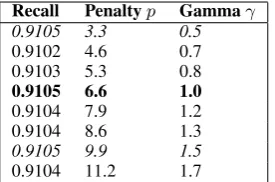
Using the gamma function in his experiments, Brown (2014) was able to reduce the error rate of his own language identifier by 83.9% with 1366 languages and 76.7% with 781 languages. We tested using the gamma function with the devel-opment set, which did not manage to improve our results. It seems that the penalty value p of the HeLI method and theγvariable have at least partly the same effect. If we fix one of the values we are able to reach almost or exactly the same re-sults by varying the other. Table 3 shows some of the results on the development set. When usingγ
of 1.0 the method is identical to the original HeLI method. As there were no improvements on the results at all, we decided not to submit a run using the gamma function.
4.3 Loglike Function
Recall Penaltyp Gammaγ 0.9105 3.3 0.5
0.9102 4.6 0.7
0.9103 5.3 0.8
0.9105 6.6 1.0
0.9104 7.9 1.2
0.9104 8.6 1.3
[image:5.595.327.501.60.174.2]0.9105 9.9 1.5 0.9104 11.2 1.7
Table 3: Testing the gamma on the development set.
8, and c = 170,000. There seemed to be a lo-cal optimum at around τ = 2.9, so we experi-mented with a bit different nmax andcaround it
as well. The best recall of 0.9109 was provided by
nmax = 7, c= 180,000, and τ = 3.0. The
log-like funtion seemed to make a tiny (about half a percent) improvement on the error rate when us-ing the development set. Usus-ing the loglike func-tion, Brown (2014) was able to reduce the errors made by his own identifier by 83.8% with 1366 languages and 76.7% with 781 languages. Even though our error reduction was far from Brown’s numbers, we still decided to submit a second run using the loglike function.
Recall Penaltyp Tauτ
0.9104 6.5 0
0.9103 5.2 2.0
0.9104 4.7 2.7
0.9107 4.6 2.8
0.9106 4.5 2.9
0.9107 4.4 3.0
0.9104 4.3 3.2
0.9101 4.1 3.5
0.9075 3.0 4.5
[image:5.595.114.252.62.153.2]0.9058 1.2 6.5
Table 4: Testing the loglike function on the devel-opment set.
5 Results
Our SUKI team submitted two runs for the closed track. For both of the runs we used all of the train-ing and the development data to create the lan-guage models. The first run was submitted us-ing the relative frequencies as in Equation 3. In the second run, we used the loglike function as in Equation 5. The results and the parameters for each run can be seen in Tables 5 and 6. We have also included the results and the name of the win-ning team CECL (Bestgen, 2017).
For the 3rd edition of the task, we used the
HeLI-method without any modifications and the
Run Accuracy F1 (macro)
CECL run1 0.9274 0.9271 SUKI run 2 0.9099 0.9097 SUKI run 1 0.9054 0.9051 Table 5: Results for the closed training.
Run nmax c p
SUKI run 1 8 170,000 6.6 SUKI run 2 7 180,000 4.7 Table 6: Parameters for the closed training.
first run of the 4th edition was run with an
iden-tical system. This year the Peruvian Spanish re-placed the Mexican Spanish. It seems that it is more easily distinguished, at least with the HeLI method, from the Argentinian or Peninsular vari-eties, as the average F1-score for the Spanish va-rieties rose from last year’s 0.80 to 0.86. Also the inclusion of the languages using the Arabic script helped to raise the overall average F1-score from 0.888 to 0.905.
6 Discussion
After this year’s shared task we also looked into the backoff function of the HeLI method and cal-culated how often each of then-gram lengths were used with the test set. These calculations can be seen in Table 7.
Number of words n
176,635 8
57,252 7
56,361 6
56,243 5
88,054 4
27,975 3
3 2
[image:5.595.340.491.139.168.2]0 1
Table 7: Number of words identified with each length ofn-gram.
Table 8 shows the number of words of each length after removing non-alphabetic characters and adding extra space before and after the word. When comparing the two tables it seems that the backoff function was used only with a small frac-tion of words.
7 Conclusions
[image:5.595.122.241.408.520.2] [image:5.595.368.467.455.548.2]Number of words length
60,108 ¿10
33,243 10
41,731 9
46,448 8
56,229 7
54,611 6
54,912 5
87,385 4
[image:6.595.123.241.59.164.2]27,856 3
Table 8: Number of words of each length.
times higher than with the development set. In the future, we will be making further experiments try-ing to introduce discriminattry-ing features into the HeLI method. As it is now, it is still a genera-tive method, not relying on finding discriminating features between languages.
Acknowledgments
We would like to thank Kimmo Koskenniemi for many valuable discussions and comments. This research was made possible by funding from the Kone Foundation Language Programme.
References
Adrien Barbaresi. 2016. An Unsupervised Morpho-logical Criterion for Discriminating Similar Lan-guages. In Proceedings of the Third Workshop on NLP for Similar Languages, Varieties and Dialects (VarDial3), pages 212–220, Osaka, Japan.
Yves Bestgen. 2017. Improving the character ngram model for the dsl task with bm25 weighting and less frequently used feature sets. InProceedings of the 4th VarDial Workshop, Valencia, Spain.
Ralf D. Brown. 2012. Finding and identifying text in 900+ languages. Digital Investigation, 9:S34–S43. Ralf D. Brown. 2014. Non-linear mapping for
improved identification of 1300+ languages. In
Proceedings of the 2014 Conference on Empirical Methods in Natural Language Processing (EMNLP 2014), pages 627–632, Doha, Qatar.
Yew Choong Chew, Yoshiki Mikami, Chandra-jith Ashuboda Marasinghe, and S. Turrance Nan-dasara. 2009. Optimizing n-gram order of an n-gram based language identification algorithm for 68 written languages. International Journal on Advances in ICT for Emerging Regions (ICTer), 2(2):21–28.
Cyril Goutte, Serge L´eger, Shervin Malmasi, and Mar-cos Zampieri. 2016. Discriminating Similar Lan-guages: Evaluations and Explorations. In Proceed-ings of the 10th International Conference on Lan-guage Resources and Evaluation (LREC 2016).
Tommi Jauhiainen, Heidi Jauhiainen, and Krister Lind´en. 2015. Discriminating similar languages with token-based backoff. In Proceedings of the Joint Workshop on Language Technology for Closely Related Languages, Varieties and Dialects (LT4VarDial), pages 44–51, Hissar, Bulgaria.
Tommi Jauhiainen, Krister Lind´en, and Heidi Jauhi-ainen. 2016. HeLI, a Word-Based Backoff Method for Language Identification. InProceedings of the Third Workshop on NLP for Similar Languages, Va-rieties and Dialects (VarDial3), pages 153–162, Os-aka, Japan.
Tommi Jauhiainen. 2010. Tekstin kielen automaatti-nen tunnistamiautomaatti-nen. Master’s thesis, University of Helsinki, Helsinki, Finland.
Nikola Ljubeˇsic and Denis Kranjcic. 2014. Discrimi-nating between very similar languages among twit-ter users. In Proceedings of the Ninth Language Technologies Conference, pages 90–94, Ljubljana, Slovenia.
Nikola Ljubeˇsic and Denis Kranjcic. 2015. Discrimi-nating between closely related languages on twitter.
Informatica, 39.
Nikola Ljubeˇsic, Nives Mikelic, and Damir Boras. 2007. Language indentification: How to distinguish similar languages? InInformation Technology In-terfaces, 2007. ITI 2007. 29th International Confer-ence on, pages 541–546, Cavtat/Dubrovnik, Croatia.
Marco Lui. 2014. Generalized language identifica-tion. Ph.D. thesis, The University of Melbourne.
Wolfgang Maier and Carlos G´omez-Rodr´ıguez. 2014. Language variety identification in spanish tweets. In Proceedings of the EMNLP’2014 Workshop: Language Technology for Closely Related Lan-guages and Language Variants (LT4CloseLang 2014), pages 25–35, Doha, Qatar.
Shervin Malmasi, Eshrag Refaee, and Mark Dras. 2015. Arabic dialect identification using a parallel multidialectal corpus. In Proceedings of the 14th Conference of the Pacific Association for Compu-tational Linguistics, PACLING’15, pages 209–217, Bali, Indonesia.
Shervin Malmasi, Marcos Zampieri, Nikola Ljubeˇsi´c, Preslav Nakov, Ahmed Ali, and J¨org Tiedemann. 2016. Discriminating between similar languages and arabic dialect identification: A report on the third dsl shared task. In Proceedings of the 3rd Workshop on Language Technology for Closely Re-lated Languages, Varieties and Dialects (VarDial), Osaka, Japan.
Bali Ranaivo-Malanc¸on. 2006. Automatic identifica-tion of close languages–case study: Malay and in-donesian. ECTI Transaction on Computer and In-formation Technology, 2(2):126–133.
Liling Tan, Marcos Zampieri, Nikola Ljubeˇsic, and J¨org Tiedemann. 2014. Merging comparable data sources for the discrimination of similar languages: The dsl corpus collection. InProceedings of the 7th Workshop on Building and Using Comparable Cor-pora, Reykjavik.
J¨org Tiedemann and Nikola Ljubeˇsic. 2012. Efficient discrimination between closely related languages. InProceedings of COLING 2012, pages 2619–2634, Mumbai.
Marcos Zampieri and Binyam Gebrekidan Gebre. 2012. Automatic identification of language vari-eties: The case of portuguese. In 11th Conference on Natural Language Processing (KONVENS) - Empirical Methods in Natural Language Processing -Proceedings of the Conference on Natural Language Processing 2012, pages 233–237, Vienna.
Marcos Zampieri, Binyam Gebrekidan Gebre, and Sascha Diwersy. 2012. Classifying pluricentric lan-guages: Extending the monolingual model. In Pro-ceedings of the Fourth Swedish Language Technlogy Conference (SLTC2012), pages 79–80, Lund. Marcos Zampieri, Binyam Gebrekidan Gebre, and
Sascha Diwersy. 2013. N-gram language models and pos distribution for the identification of spanish varieties. InActes de TALN’2013 : 20e conf´erence sur le Traitement Automatique des Langues Na-turelles, pages 580–587, Sables d’Olonne.
Marcos Zampieri, Liling Tan, Nikola Ljubeˇsi´c, and J¨org Tiedemann. 2014. A report on the dsl shared task 2014. InProceedings of the First Workshop on Applying NLP Tools to Similar Languages, Varieties and Dialects (VarDial), pages 58–67, Dublin, Ire-land.
Marcos Zampieri, Liling Tan, Nikola Ljubeˇsi´c, J¨org Tiedemann, and Preslav Nakov. 2015. Overview of the dsl shared task 2015. In Proceedings of the Joint Workshop on Language Technology for Closely Related Languages, Varieties and Dialects (LT4VarDial), pages 1–9, Hissar, Bulgaria.
Marcos Zampieri, Shervin Malmasi, Nikola Ljubeˇsi´c, Preslav Nakov, Ahmed Ali, J¨org Tiedemann, Yves Scherrer, and No¨emi Aepli. 2017. Findings of the VarDial Evaluation Campaign 2017. InProceedings of the Fourth Workshop on NLP for Similar Lan-guages, Varieties and Dialects (VarDial), Valencia, Spain.