
EFFECT OF ARTIFICIAL SWEETENERS ON LOCOMOTOR BEHAVIOUR IN
Velanganni Selvaraj
Department of Studies in Zoology, University of Mysore, Manasagangotri, Mysore
ARTICLE INFO ABSTRACT
The quality of food intake by an organism play an important role in maintenance of health and Nowadays the trend towards health, figure and fitness has increased
D. melanogaster
on locomotory activity (larval crawling and
sweetener had significantly lesser crawling activity than those larvae fed on normal and Sucrose based media. Similar trend also was found in adult climbing ability as there is increase in age
on different sugar based media. Further, it was noticed that flies fed on Sucrose had the least quantity of whole body glucose and highest quantity of lipid compared to other sugar based media. In contrast, flies fed on artificial sweetener
least quantity of lipid. Thus, this study suggests that artificial sweeteners have less calories, however, when it is consumed with the normal diet it affects the locomotor ability. Therefo
suggestive to take the artificial sweetener to maintain the fitness of an organism.
Copyright © 2015 Velanganni Selvaraj and Krishna. This
unrestricted use, distribution, and reproduction in any medium, provided the original work is properly cited.
INTRODUCTION
Energy is required for each and every activity that is taking place in an organism for survival and their reproduction. i.e, locomotory, courtship, movement, etc. Locomotion is an important activity which is required for location of food, mate, escape from predators, defense of territory and response to stress. Therefore, it forms integral components of most animal behaviour (Jordan et al., 2007). Animal obtain their energy from the food they consume, diet are classified either quantitative (food availability) or qualitative (composition). Qualitative effects are evident since animal obtain energy and other nutritional requirements from food. Therefore the balance between energy intake and expenditure is necessary for survival, locomotion, reproductive success of animals ( 1989; Sibly, 1991). The balance depends on the interplay between matter intake, digestion and allocation of acquired energy to various functions such as locomotion, growth and reproduction (Karasov, 1986). Nowadays the trend towards health, figure and fitness has increased. Energy imbalance between calories consumed on one hand and calories utilized on the other hand due to urbanization, sedentary lifestyle and excessive consumption of sugary foods along with increased fat consumptions.
*Corresponding author: Krishna, M. S.
Department of Studies in Zoology, University of Mysore, Manasagangotri, Mysore – 560006, Karnataka, India
ISSN: 0975-833X
Article History:
Received 19th March, 2015
Received in revised form 15th April, 2015
Accepted 29th May, 2015
Published online 30th June,2015
Key words:
Locomotor ability, Artificial sweeteners,
D. melanogaster.
Citation: Velanganni Selvaraj, M. and Krishna, M. S.
International Journal of Current Research, 7, (6),
RESEARCH ARTICLE
EFFECT OF ARTIFICIAL SWEETENERS ON LOCOMOTOR BEHAVIOUR IN
Velanganni Selvaraj, M. and *Krishna, M. S.
Department of Studies in Zoology, University of Mysore, Manasagangotri, Mysore –
ABSTRACT
The quality of food intake by an organism play an important role in maintenance of health and Nowadays the trend towards health, figure and fitness has increased
D. melanogaster reared on different sugar based media used to test the effect of artificial sweeteners on locomotory activity (larval crawling and adult climbing). It was noticed that larvae fed on artificial sweetener had significantly lesser crawling activity than those larvae fed on normal and Sucrose based media. Similar trend also was found in adult climbing ability as there is increase in age
on different sugar based media. Further, it was noticed that flies fed on Sucrose had the least quantity of whole body glucose and highest quantity of lipid compared to other sugar based media. In contrast, flies fed on artificial sweeteners and normal based media had a greater quantity of glucose and the least quantity of lipid. Thus, this study suggests that artificial sweeteners have less calories, however, when it is consumed with the normal diet it affects the locomotor ability. Therefo
suggestive to take the artificial sweetener to maintain the fitness of an organism.
This is an open access article distributed under the Creative Commons Att use, distribution, and reproduction in any medium, provided the original work is properly cited.
Energy is required for each and every activity that is taking place in an organism for survival and their reproduction. i.e, locomotory, courtship, movement, etc. Locomotion is an important activity which is required for location of food, mate, predators, defense of territory and response to stress. Therefore, it forms integral components of most animal Animal obtain their energy from the food they consume, diet are classified either ty) or qualitative (composition). Qualitative effects are evident since animal obtain energy and other nutritional requirements from food. Therefore the balance between energy intake and expenditure is necessary for ss of animals (Pough, 1989; Sibly, 1991). The balance depends on the interplay between matter intake, digestion and allocation of acquired energy to various functions such as locomotion, growth and Nowadays the trend towards ealth, figure and fitness has increased. Energy imbalance between calories consumed on one hand and calories utilized on the other hand due to urbanization, sedentary lifestyle and excessive consumption of sugary foods along with increased fat
Department of Studies in Zoology, University of Mysore, 560006, Karnataka, India.
Therefore the growing health awareness today has increased demand for food product that supports better
consumer side demanding a greater variety of low calorie products and they strive to make healthier food choices. A sugar substitute is a food additive that duplicates the effect of sugar in taste, but usually has less food energy. It is about times sweeter than sugar. Some sugar substitutes are natural and some are synthetic. Those that are synthetic are in general referred as artificial sweeteners (Kirtida, 2011).
The artificial sweetener consumption gained much popularity, owning to their reduced costs, lower caloric intake and perceived health benefits. However, its effect on locomotory activity and health benefits in
identified. Since Drosophila is a very good model to study human diseases because of the mechanis
metabolism are very much conserved between
human. Therefore the present study was undertaken to study the effect of artificial sweetener on locomotor behaviour of
melanogaster.
MATERIALS AND METHODS
Establishment of Stock
The experimental stock of D. melanogaster
from the progenies of 150 naturally inseminated females,
International Journal of Current Research
Vol. 7, Issue, 06, pp.17196-17202, June, 2015
Velanganni Selvaraj, M. and Krishna, M. S. 2015. “Effect of artificial sweeteners on locomotor behaviour in , 7, (6), 17196-17202.
EFFECT OF ARTIFICIAL SWEETENERS ON LOCOMOTOR BEHAVIOUR IN
D. MELANOGASTER
– 560006, Karnataka, India
The quality of food intake by an organism play an important role in maintenance of health and fitness. Nowadays the trend towards health, figure and fitness has increased. Therefore, in the present study reared on different sugar based media used to test the effect of artificial sweeteners adult climbing). It was noticed that larvae fed on artificial sweetener had significantly lesser crawling activity than those larvae fed on normal and Sucrose based media. Similar trend also was found in adult climbing ability as there is increase in age of flies of fed on different sugar based media. Further, it was noticed that flies fed on Sucrose had the least quantity of whole body glucose and highest quantity of lipid compared to other sugar based media. In contrast, s and normal based media had a greater quantity of glucose and the least quantity of lipid. Thus, this study suggests that artificial sweeteners have less calories, however, when it is consumed with the normal diet it affects the locomotor ability. Therefore, it is not suggestive to take the artificial sweetener to maintain the fitness of an organism.
is an open access article distributed under the Creative Commons Attribution License, which permits
Therefore the growing health awareness today has increased demand for food product that supports better health. The consumer side demanding a greater variety of low calorie products and they strive to make healthier food choices. A sugar substitute is a food additive that duplicates the effect of sugar in taste, but usually has less food energy. It is about 200 times sweeter than sugar. Some sugar substitutes are natural and some are synthetic. Those that are synthetic are in general referred as artificial sweeteners (Kirtida, 2011).
The artificial sweetener consumption gained much popularity, r reduced costs, lower caloric intake and perceived health benefits. However, its effect on locomotory activity and health benefits in Drosophila has not been is a very good model to study human diseases because of the mechanism involved in metabolism are very much conserved between Drosophila and human. Therefore the present study was undertaken to study the effect of artificial sweetener on locomotor behaviour of D.
MATERIALS AND METHODS
D. melanogaster was established from the progenies of 150 naturally inseminated females,
OF CURRENT RESEARCH
which were collected at Chamundi Hills, Mysore, India. In each generation flies obtained from these culture bottles were mixed together and redistributed to 20 different culture bottles containing wheat cream agar media (100g of jaggery, 100g of wheat powder, 8g of Agar was boiled in 1000ml of double distilled water and 7.5ml of Propionic acid was added). These flies were maintained at 22±1°C with a relative humidity of 70% in 12 hours dark: 12 hours light cycle. This procedure was carried out for three generations to acclimatize flies to lab condition. At fourth generation, eggs were collected using Delcour’s procedure (1969). Eggs (100) were seeded to each culture bottle containing wheat-cream agar media / Sucrose based media / Sucralose based media / Aspartame based media (6g of respective sugar was added to the 100 ml normal wheat cream agar media to make 6% Sucrose / Artificial sweeteners (Sucralose / Aspartame) based media. The flies obtained were used for the further experiments.
Quantification of Food Intake
The quantification of food intake was measured in larvae, as described previously (Lozinsky et al., 2012), by transferring ten larvae to the fresh media vial containing normal / 6% Sucrose / 6% Sucralose / 6% Aspartame media containing 2.5% (w/v) blue food dye (FD & C Blue Dye no. 1). The larvae were allowed to feed for 30 minutes. Then the larvae were transferred to Eppendorf tubes and frozen. These frozen larvae were homogenized. The absorbance was measured at 629 nm using 96 well plate reader. Larvae which were not treated with blue dye were used as the blank. The amount of food taken was measured from the standard graph made from serial dilution of a blue dye. A total of ten trials were made for each media.
Whole body Glucose estimation
The whole bodies of five flies were homogenized in 10mM PBS at a ratio 1:10. Homogenates were deproteinized by heat treatment at 70°C for 5 minutes, followed by centrifugation (16,000 RPM, 15 min, 4°C) to precipitate denatured proteins (Rovenko et al., 2014). The whole body glucose levels were measured using Liquid gold glucose test kit and following manufacturers’ instruction. Ten trials were run for each of the four media studied.
Estimation of lipid content (%)
Lipid content was determined according to the Robinson et al., (2000) method. A group of five flies each was weighed to find a wet mass, the weighed flies, dried at 60°C for 24 h. Then the flies were weighed to get a dry mass. Lipids were extracted by placing the dried flies in a glass vial containing 9 ml of diethyl ether for 24 h at room temperature with constant shaking. Then the flies were removed from the vials and again dried at 60°C for 24 h to get the dry lean mass. The difference between dry mass and dry lean mass was considered as the percentage of lipid content.
Larval Crawling assay
The third instar larvae were obtained by using Delcour procedure (1969) and placing them on the different sugars
treated media. The third instar larvae were collected by adding 50 ml of 20% Sucrose solution to the vials. The larvae were transferred to 15 cm petri dish containing 2% agarose (previously heated and allowed to become hard) over graph paper with 0.2 cm2 grid. The number of grid lines crossed per larva in a minute was counted, and the peristalsis contractions in a minute by per larva also counted. 30 larvae were used for each of the four media used.
Negative geotaxsis
The flies obtained from four different sugar based media were subjected to climbing assay from the age of 5 days to 45th day in 5 day intervals. In this assay, an assay tube is used to record climbing ability of flies, it is a long transparent hollow tube of about 25 cm. One end of the tube is closed with cap and the other end is closed with a cotton plug. The tube was marked at three different levels of height like 0-8 cm, 8-16 cm and 16-24 cm. Flies were taken in an assay tube and tapped gently to the bottom; the stop clock was started and allowed flies to climb the tube. The flies climbed different heights within 30 seconds were noted down.
Locomotor ability (speed)
In another experiment the Locomotor ability (speed) was determined using the negative geotaxis assay as described by (Coulom and Birman, 2004). For each assay 20 flies (five day old, male and female) were taken separately and placed in a vertical climbing tube which is 25 cm long and 1.5 cm in diameter. Time taken by a single fly to reach 8 cm was tested. Assays were repeated 6 times at 1 minute intervals for each of the four media.
Statistical Analysis
The data obtained were analyzed using SPSS version 14.0. Mean, standard error, one way ANOVA, two way ANOVA and Tukey’s post - hoc test was carried out for the data obtained.
RESULTS
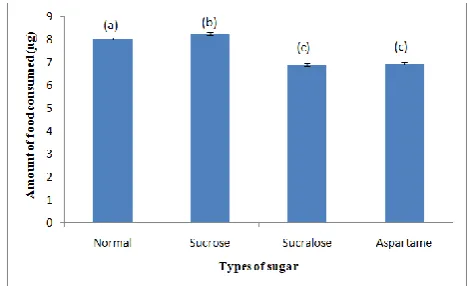
[image:2.595.316.551.576.719.2]Feeding behaviour data of D. melanogaster larvae on different types of sugar based media is provided in Fig 1.
Fig. 1. Effect of different types of sugar based media on feeding behaviour
of D. melanogaster larvae, measured by dye method. (Different letters on
Larvae fed Sucrose based media had consumed greater quantity of food than those larvae fed on normal and artificial sweeteners based media. The sequence of food intake in different sugar based media was Sucrose > Normal > Artificial sweetener. One way ANOVA followed by Tukey’s post-hoc test showed significant variation in food intake in different types of sugar based media. Tukey’s post-hoc test showed that larvae fed on Sucrose based media had consumed significantly greater quantity of food compared to larvae fed on normal and artificial sweeteners based media. Further larvae fed on normal had consumed significantly greater quantity of food than those fed on artificial sweeteners based media by Tukey’s post-hoc test (Table 1).
[image:3.595.47.559.92.274.2]The Fig 2 shows the mean and standard error of whole body glucose in different types of sugar based flies. Flies obtained from artificial sweetener (Sucralose) based media had the highest quantity of glucose compared to flies fed on normal and Sucrose based media. Data of whole body glucose in different types of sugar based media subjected to one way ANOVA followed by Tukey’s post-hoc test showed significant variation between them (Table 1).
Fig 2. Effect of different types of sugar based media on whole body glucose
concentration in D. melanogaster. (Different letters on the bar graph shows
significance at 0.05 level by Tukey’s Post Hoc test)
Flies obtained from Sucralose based media had a significantly greater quantity than those flies obtained from normal, Sucrose and Aspartame based media. However, there was no significant difference in the glucose concentration among flies obtained either from normal or artificial sweetener based media, but there was a significance difference between normal and Sucrose and also between artificial sweeteners and Sucrose.
[image:3.595.308.561.489.641.2]Data on the effect of different sugar based media on percentage of lipid content is given in Fig 3. In both males and females, the flies fed on Sucrose based media found to have a higher percentage of lipid content than flies fed on normal and artificial sweeteners based media. When the above data subjected to one way ANOVA followed by Tukey’s post-hoc test, it showed significant variation between the lipid content of flies fed on different sugar based media (Table 1).
Fig 3. Effect of different types of sugar based media on percentage of lipid
content concentration in D. melanogaster. (Different letters on the bar
graph shows significance at 0.05 level by Tukey’s post-hoc test)
[image:3.595.39.290.560.719.2]Effect of artificial sweetener on larval crawling behaviour and data related to this has been provided in Fig. 4 and 5. It was noticed that larvae obtained from Sucrose based media had shown greater crawling behaviour than larvae obtained from normal and artificial sweetener based media. Among larvae obtained from normal and artificial sweetener, larvae of normal Table 1. One way ANOVA of different parameters of flies fed on different types of sugar (Normal, Sucrose, Sucralose and Aspartame)
based media
S.No Parameter Sum of Squares Df Mean Square F Sig.
1 Food intake estimation in Larvae Between Groups 90.36302615 3 30.12100872 173.3487 0.000*
Within Groups 41.00728019 236 0.173759662
Total 131.3703063 239
2 Whole body glucose estimation Between Groups 67.1547075 3 22.3849025 12.69371 0.000*
Within Groups 63.48469 36 1.763463611
Total 130.6393975 39
3 Lipid content in Female (%) Between Groups 14.64025 3 4.880082 272.2681 0.000*
Within Groups 1.003733 56 0.017924
Total 15.64398 59
4 Lipid content in Male (%) Between Groups 19.82382 3 6.607939 25.60834 0.000*
Within Groups 14.45016 56 0.258039
Total 34.27398 59
5 Crawling assay - Contraction and relaxation Between Groups 17774.7 3 5924.9 60.70058 0.000*
Within Groups 11322.6 116 97.60862069
Total 29097.3 119
6 Crawling assay - Distance travelled(mm) Between Groups 10670.625 3 3556.875 63.16073 0.000*
Within Groups 6532.5 116 56.31465517
Total 17203.125 119
had the greater crawling ability compared to larvae of artificial sweeteners. Further, among larvae grown in artificial sweetener Sucralose had lower crawling ability than those larvae grown on Aspartame. Crawling behaviour data were subjected to one way ANOVA followed by Tukey’s post-hoc test showed significant variation (Table 1). Tukey’s post-hoc test showed larvae fed on Sucrose had significantly greater crawling ability than those larvae fed on normal and artificial sweetener based media.
Fig. 4. Effect of different types of sugar based media on number contraction and relaxation during larval crawling behaviour of
D.melanogaster. (Different letters on the bar graph indicates significance
at 0.05 level by Tukey’s post-hoc test)
Fig. 5. Effect of different types of sugar based media on the distance
travelled by a larva during larval crawling behaviour of D. melanogaster. (Different letters on the bar graph indicates significance at 0.05 level by
Tukey’s post-hoc test)
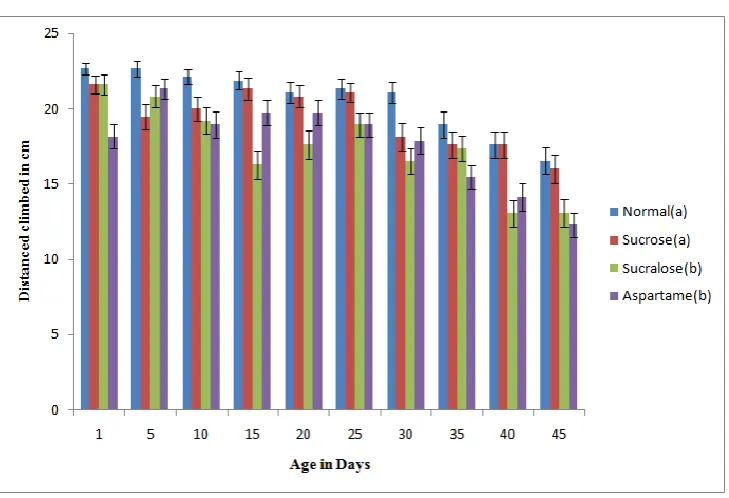
Data on the effect of different sugar based media on the climbing ability of different aged flies is provided in Fig 6. It was found that climbing ability in all sugar based media was found to be more or less same up to 25th day then it was found to decline. Among different media flies fed on normal and Sucrose based media had the greater climbing ability than flies fed on artificial sweeteners. Further flies grown on Aspartame had the lesser climbing ability than flies fed on Sucralose this showed that there is a difference even within artificial sweeteners fed flies climbing ability. The above data subjected to two way ANOVA followed by Tukey’s post-hoc test shows (Table 2) significant variation in climbing ability between different flies fed on different sugar based media between age classes and also there is an interaction between age and sugar media on adult climbing ability. Tukey’s post-hoc showed flies
[image:4.595.41.286.170.318.2]fed on normal and Sucrose had significantly greater climbing ability compared to flies fed on artificial sweeteners.
Table 2. Two way ANOVA of effect of different types of sugar (Normal, Sucrose, Sucralose and Aspartame) based media and increase in age on
climbing ability of D. melanogaster
*Significant at 0.0001 level (p < 0.0001) ** Significant at 0.001 level (p < 0.001)
[image:4.595.41.283.380.533.2]Data on the effect of different sugar based media on the climbing speed of different sex is provided in the Fig 7. It was found that climbing speed varied between different sugar based media in both males and females. However, females climb slower than males. Climbing speed found in different media in following sequence Normal > Sucrose > Sucralose >Aspartame. Two way ANOVA followed by post hoc test showed significant variation between different sugar based media and also there is interaction between different sex and different sugar based media on climbing speed.
Table 3. Two way ANOVA of effect of different types of sugar (Normal, Sucrose, Sucralose and Aspartame) based media and sex on locomotor
ability speed (time taken by a fly to reach 8cm on Day 5) of D.
melanogaster
*Significant at 0.0001 level (p < 0.0001)
DISCUSSION
D. melanogaster is one of the most popular animal models to study carbohydrate and lipid metabolism under different physiological and pathophysiological conditions (Baker and Thummel, 2007; Musselman et al., 2011; Skorupa et al., 2008; Pasco and Leopold, 2012; Morris et al., 2012; Na et al., 2013; Musselman et al., 2013; Hirabayashi et al., 2013; Teleman et al., 2012; Havula et al., 2013; Owusu-Ansah and Perrimon, 2014). To date, most Drosophila nutritional studies have been done using Sucrose containing food (Skorupa et al., 2008; Musselman et al., 2011; Pasco and Leopold, 2012; Morris et al., 2012; Na et al., 2013; Musselman et al., 2013; Hirabayashi
et al., 2013), while the beneficial effects of artificial sweeteners on locomotor ability in D. melanogaster was not tested, hence flies grown on different sugar based media(normal, Sucrose, artificial sweeteners) were subjected to experiment to determine their locomotor ability (larval crawling and adult climbing). It was noticed that flies reared on different sugar based media had a significant influence on larval feeding (Fig 1 and Table 1).
Source Type III Sum of Squares
df Mean
Square
F Sig.
Sugar 3998.293 3 1332.764 35.09738 0.000*
Age 11159.89 9 1239.988 32.65418 0.000*
sugar * age 2126.507 27 78.75951 2.074074 0.000954**
Parameter Source Type III
Sum of Squares
Df Mean
Square
F Sig.
Time taken by a
single fly to
reach 8 cm
sex 270 1 270 1593 0.000*
sugar 104.1667 3 34.72222 204.8611 0.000*
sex * sugar
[image:4.595.299.558.389.471.2]In Drosophila, it was shown that the larvae can show inhibition threshold when consuming a new or foul tasty food (Melcher et al., 2007). In this study also such an inhibition threshold was found when the larvae fed on artificial sweeteners. Hence larvae fed on artificial sweetener had taken a significantly lesser quantity of food.
It is presumed that using artificial sweeteners can reduce calorie intake and more likely to prevent obesity and diabetes etc., (Kirtida, 2011). Therefore, we determined the glucose concentration present in flies fed on different sugar based media. It was noticed from the Fig 2 that glucose concentration was found to be significantly greater in flies fed on Sucralose based media followed by flies fed on normal and Aspartame
based media. In contrast to this, flies fed on Sucrose had the least quantity of glucose (Table 1).
[image:5.595.122.487.54.303.2]In contrast to this the lipid content (Fig. 3 and Table 1) of flies fed on different sugar based media showed strikingly different results. It was found out that, lipid content was high in flies grown on Sucrose based media. This shows that the glucose content was present in the Sucrose fed flies was converted in to reserve food such as lipid in these flies as compared to the flies grown on other normal and artificial sweetener based media. So this difference in the glucose and lipid concentration among flies fed on different sugar based media suggesting that it has its implication on changes in physiological process and fitness ability of the flies.
Fig. 6. Effect of different types of sugar based media and age on the distance travelled by a fly during climbing assay of
D. melanogaster (Different letters next to the different types of sugar indicates significance at 0.05 level by Tukey’s post-hoc test)
Fig.7. Effect of different types of sugar based media on the time taken to reach 8 cm by a single fly during climbing assay of
[image:5.595.148.459.356.546.2]Hence, in the present study, we subjected larvae and flies fed on different sugar based media to locomotor assay (larval crawling and adult climbing) to study its implication on locomotor behaviour. The Fig. 4 and 5 shows that the larval crawling ability was found to be highest in Sucrose and it was found to be least in larvae fed on artificial sweetener Sucralose based media (Table 1). This is because the amount of food consumed by the Sucrose fed larvae was greater than other normal and artificial sweetener based media fed larvae hence the food consumed found to have a direct effect on the crawling ability of larvae.
In the present study adult flies locomotor ability was tested by performing climbing assay. Sucrose and normal based media fed flies had significantly greater climbing ability compared to other artificial sweetener based media fed flies till the age of the 25th day (Fig. 6 and Table 2). The greater climbing ability can be explained by the presence of a greater quantity of lipid in the flies which supports greater locomotor activity. Between age classes when climbing ability was compared flies fed on normal and Sucrose based media had a greater climbing ability till the 25th day after which the climbing ability was found to decline. This suggests that the amount of reserve food available and also aging of the flies found to be responsible for the decline in the climbing ability. We also studied the ability of the fly's speed to reach 8 cm within 30 seconds. As we know that time is reverse of speed. The flies fed on artificial sweeteners had taken more time to reach 8 cm compared to flies fed on normal and Sucrose media. Further, it was also noticed that males have greater speed in climbing than those of females. Similar results were also found in all different sugar based media (Fig. 7 and Table 3).
Thus, these studies suggest that artificial sweeteners as they do not provide calories to the organism hence the whole body glucose of flies fed on normal and artificial sweetener show no significant difference but Sucrose based food fed flies do show variation in glucose and lipid concentration.
So the artificial sweeteners treated media had the amount of calories, which were equal to the calories present in the normal media. Since there were equal calories in normal fly media as well as in artificial sweetener based media, the artificial sweetener based media fed flies suppose to have the same climbing ability and climbing speed that of normal media fed flies. But this was not seen in cases of flies fed on artificial sweeteners based media. Hence we can conclude from these studies that artificial sweeteners have less calorie content, but fed together with normal diet affect the normal locomotor behaviour in D. melanogaster. Therefore, it is not suggestive to take artificial sweeteners to maintain the fitness of an organism.
Acknowledgement
We thank the chairman, Department of studies in Zoology, Manasagangotri, Mysore, for facilities. We also thank
Drosophila stock center, Stress biology lab and Institute of Excellence, University of Mysore, Manasagangotri, Mysore for the facilities provided. One of the authors is also grateful to Prof. Maria Lazarus for financial support.
REFERENCES
Baker, K.D., Thummel, C.S. 2007. Diabetic larvae and obese flies emerging studies of metabolism in Drosophila. Cell Metab., 6 (4), 257–266.
Coulom, H., Birman, S. 2004. Chronic exposure to rotenone models sporadic Parkinson’s disease in Drosophila melanogaster. J Neurosci., 24:10993–10998.
Delcour, J. 1969. A rapid and efficient method of egg collecting. Drosophila Information Service 44:133-134. Havula, E., Teesalu, M., Hyotylainen, T., Seppala, H., Hasygar,
K., Auvinen, P., Orešič, M., Sandmann, T. and Hietakangas, V. 2013. Mondo/ChREBP-Mlx-regulated transcriptional network is essential for dietary sugar tolerance in Drosophila. PLoS Genet. 9 (4), e1003438. Jordan, K.W., Carbone, A.M., Yamamoto, A., Morgan, T. J.
and Mackay, F.C.T. 2007. Quantitative genomics of locomotor behaviour in Drosophila melanogaster. Genome Biology, 8: R172.
Karasov WH 1986. Energetics, physiology and vertebrate ecology. Trend Ecol Evol., 1: 101–104.
Keller, A. 2007. Drosophila melanogaster's history as a human commensal. Curr. Biol., 17 (3), R77–R81.
Kirtida, R.T., 2011. Sugar substitutes: Health controversy over perceived benefits. J Pharmacol Pharmacother, 2(4): 236 – 243.
Lozinsky, O., Lushchak, O., Kryshchuk, N.,Shpanska, N., Riabkina, A., Skarbek, S., Maksymiv, I., Storey, K. and Lushchak, V. 2012. S-nitrosoglutothione-induced toxicity in Drosophila melanogaster: delayed pupation and induced mild oxidative nitrosative stress in eclosed flies. Comp. Biochem.Physiol.A Mol. Integr. Physiol., 164:162-170. Melcher, C., Bader, R. and Pankratz, M. J. 2007. Amino acids,
taste circuits, and feeding behaviour in Drosophila: towards understanding the psychology of feeding in flies and man.
Journal of Endocrinology, 192(3):467-472.
Morris, S.N., Coogan, C., Chamseddin, K., Fernandez-Kim, S.O., Kolli, S., Keller, J.N. and Bauer, J.H. 2012. Development of diet-induced insulin resistance in adult
Drosophila melanogaster. Biochim.Biophys.Acta1822(8), 1230–1237.
Musselman, L.P., Fink, J.L., Narzinski, K., Ramachandran, P.V., Hathiramani, S.S., Cagan, R.L. and Baranski, T.J. 2011. A high-sugar diet produces obesity and insulin resistance in wild type Drosophila. Dis. Model Mech., 4 (6), 842–849.
Musselman, L.P., Fink, J.L., Ramachandran, P.V., Patterson, B.W., Okunade, A.L., Maier, E.Brent, M.R., Turk, J. and Baranski, T.J. 2013. Role of fat body lipogenesis in protection against the effects of caloric overload in
Drosophila. J. Biol. Chem., 288 (12), 8028–8042.
Na, J., Musselman, L.P., Pendse, J., Baranski, T.J., Bodmer, R., Ocorr, K. and Cagan, R. 2013. A Drosophila model of high sugar diet-induced cardiomyopathy. PLoS Genet. 9 (1), e1003175.
Pasco, M.Y., Leopold, P. 2012. High sugar-induced insulin resistance in Drosophila relies on the lipocalin Neural Lazarillo. PLos One 7 (5), e36583.
Robinson, S.J.W., Zwann, B., and Patridge, L. 2000. Starvation resistance and adult body composition in a latitudinal cline of Drosophila melanogaster. Evolution, 54(5), 1819-1824. Rovenko, B. M., Perkhulyn, V.N., Natalia, Gospodaryov, V.
D., Sanz, A., Lushchak, V. O. and Lushchak, I .V. 2014. High consumption of fructose rather than glucose promotes a diet-induced obese phenotype in Drosophila melanogaster. Comparative Biochemistry and Physiology, Part A 180: 75-85.
Sibly RM 1991. The life-history approach to physiological ecology. Func Ecol., 5:184–19
Sisodia S, Singh, B.N. 2012. Experimental Evidence for Nutrition Regulated Stress Resistance in Drosophila ananassae. PLoS ONE 7(10):1-9.
Skorupa, D.A., Dervisefendic, A., Zwiener, J., Pletcher, S.D. 2008. Dietary composition specifies consumption, obesity, and lifespan in Drosophila melanogaster. Aging Cell, 7 (4), 478–490.


![Tris(propionitrile κN)[1,4,7 tris(cyanomethyl) 1,4,7 triazacyclononane κ3N1,N4,N7]copper(II) bis(perchlorate) dihydrate](data:image/gif;base64,R0lGODlhAQABAIAAAP///wAAACH5BAEAAAAALAAAAAABAAEAAAICRAEAOw==)