THE IMPACT OF (PICTiL) PROGRAM DESIGNED ACCORDING TO A NEW PROPOSED MODEL
(ICTiL) ON CREATIVE THINKING AMONG
*Shaker Shafi Alharthy, Moh
School of Educational Studies, Universiti
ARTICLE INFO ABSTRACT
A proposed (ICTiL) model that
bring the two processes in one process. A new proposed training program (PICTiL) designed according to (ICTiL) model
thinking. The sample of the study consisted of (92) male gifted students of secondary school stage who were distributed equally onto control and experimental groups (46 respondents each) and were assigned randomly. Mixed
Torrance Test of creative Thinking (figural form; form B) was used as the instrument of the study. The findings revealed high size effect of (ICTiL) model represented in (PICTiL) program on respondents` creative thinki
on fluency, flexibility, originality, and elaboration of creative thinking. Suggestions and recommendations included adopting (ICTiL) model from all interested parties.
Copyright © 2016, Shaker ShafiAlharthy et al. This
unrestricted use, distribution, and reproduction in any medium, provided the original work is properly cited.
INTRODUCTION
In our world, the increase and the communication of the knowledge lead to scientific breakthroughs that make our lives better. This continuous desirable change requires creative individuals to make it happens by generating more new ideas that keep business firms competitive on the right track
& Rudd, 2006). Researchers and theorists agree that creativity involves the development of a novel product, idea, or problem solution that is of value to the individual and/or the society (Hennessey & Amabile, 2010).Creativity is good for the economy and therefore for society. It is good for individuals who are more fulfilled when creative (Craft, 2003). Benjamin (1984), confirmed that it is the responsibility of the early family to give opportunities for independent actions that encourage creative achievement and that creativity training programs in schools are more effective when teachers are involved highly. Craft (2003), stated that it is the role of the education system to include changes to the school curr to encompass creativity. Anonymous (1999), added that providing rich and varied contexts for pupils to acquire, develop and apply a broad range of knowledge, understanding and skills, the curriculum should enable pupils to think
*Corresponding author: Shaker ShafiAlharthy,
School of Educational Studies, Universiti Sains Malaysia, Penang, Malaysia.
ISSN: 0975-833X
Article History:
Received 21st December, 2015
Received in revised form 25th January, 2016
Accepted 27th February, 2016
Published online 31st March, 2016
Key words:
Creative thinking, Creativity, Learning, Gifted students.
Citation: Shaker Shafi Alharthy, Mohd Zuri Ghani and Aznan Bin Che Ahmad proposed model (ICTiL) on creative thinking among gifted students
RESEARCH ARTICLE
THE IMPACT OF (PICTiL) PROGRAM DESIGNED ACCORDING TO A NEW PROPOSED MODEL
(ICTiL) ON CREATIVE THINKING AMONG GIFTED STUDENTS
harthy, Mohd Zuri Ghani and Aznan Bin Che Ahmad
School of Educational Studies, Universiti Sains Malaysia, Penang, Malaysia
ABSTRACT
A proposed (ICTiL) model that integrates thinking creatively into learning process was presented to bring the two processes in one process. A new proposed training program (PICTiL)
ned according to (ICTiL) model-was delivered to a study sample aiming at fostering thinking. The sample of the study consisted of (92) male gifted students of secondary school stage who were distributed equally onto control and experimental groups (46 respondents each) and were assigned randomly. Mixed-method approach was used with an explanatory sequential design. Torrance Test of creative Thinking (figural form; form B) was used as the instrument of the study. The findings revealed high size effect of (ICTiL) model represented in (PICTiL) program on respondents` creative thinking; there was a significant statistical impact of (PICTiL) training program on fluency, flexibility, originality, and elaboration of creative thinking. Suggestions and recommendations included adopting (ICTiL) model from all interested parties.
This is an open access article distributed under the Creative Commons Att use, distribution, and reproduction in any medium, provided the original work is properly cited.
In our world, the increase and the communication of the knowledge lead to scientific breakthroughs that make our lives better. This continuous desirable change requires creative individuals to make it happens by generating more new ideas firms competitive on the right track (Friedel & Rudd, 2006). Researchers and theorists agree that creativity involves the development of a novel product, idea, or problem solution that is of value to the individual and/or the society 2010).Creativity is good for the economy and therefore for society. It is good for individuals who are more fulfilled when creative (Craft, 2003). Benjamin (1984), confirmed that it is the responsibility of the early endent actions that encourage creative achievement and that creativity training programs in schools are more effective when teachers are (2003), stated that it is the role of the education system to include changes to the school curriculum Anonymous (1999), added that by providing rich and varied contexts for pupils to acquire, develop and apply a broad range of knowledge, understanding and skills, the curriculum should enable pupils to think
School of Educational Studies, Universiti Sains Malaysia, Penang,
creatively and critically, to solve problems and to make a difference for the better. Pupils should be given the opportunity to be creative, innovative, enterprising, and capable of leadership to be equipped for their future lives as workers and citizens.
Many studies showed that the contents of school books concentrate on the cognitive aspects more than thinking styles and skills (Al-Rashed, 2001; A
Majeed, 2004; Al-Jabr, 2005; Al
It is noticed that the efforts of improving creative thinking has not reached a convincing accepted level yet, which reveals a necessity to design and develop educational
(Al-Uqaiyel, Al-Shayi, & Al-Jughaiman, 2014).
that, the programs of taking care of gifted students are still in their theoretical form and unapplied properly (Al
2010). The weak productivity of creative works in Saudi Arabia can be seen clearly depending on the statistics given by the World Bank which show the rank of Saudi Arabia regarding knowledge transition of the society in the fields of education and innovation (King Abdul
and Technology (KACST), 2014). (KACST (2014), showed in its report that the total score of economy knowledge was (5.96/10), the score of education was (5.65/10), and the score of innovation was (4.14/10). It was shown also that the indicator of knowledge economy shows how S
International Journal of Current Research
Vol. 8, Issue, 03, pp.28808-28815, March, 2016
INTERNATIONAL
Shaker Shafi Alharthy, Mohd Zuri Ghani and Aznan Bin Che Ahmad, 2016. “The impact of (PICTiL) program designed according to a new
proposed model (ICTiL) on creative thinking among gifted students”, International Journal of Current Research, 8, (03),
THE IMPACT OF (PICTiL) PROGRAM DESIGNED ACCORDING TO A NEW PROPOSED MODEL
GIFTED STUDENTS
Aznan Bin Che Ahmad
Sains Malaysia, Penang, Malaysia
integrates thinking creatively into learning process was presented to bring the two processes in one process. A new proposed training program (PICTiL) -which was was delivered to a study sample aiming at fostering creative thinking. The sample of the study consisted of (92) male gifted students of secondary school stage who were distributed equally onto control and experimental groups (46 respondents each) and were ith an explanatory sequential design. Torrance Test of creative Thinking (figural form; form B) was used as the instrument of the study. The findings revealed high size effect of (ICTiL) model represented in (PICTiL) program on impact of (PICTiL) training program on fluency, flexibility, originality, and elaboration of creative thinking. Suggestions and recommendations included adopting (ICTiL) model from all interested parties.
is an open access article distributed under the Creative Commons Attribution License, which permits
creatively and critically, to solve problems and to make a difference for the better. Pupils should be given the opportunity ive, enterprising, and capable of leadership to be equipped for their future lives as workers and
Many studies showed that the contents of school books concentrate on the cognitive aspects more than thinking styles Rashed, 2001; Al-Ghaiyadh, 2003;
Abdul-Jabr, 2005; Al-Shayi and Al-Uqaiyel, 2006). It is noticed that the efforts of improving creative thinking has not reached a convincing accepted level yet, which reveals a necessity to design and develop educational enriching units Jughaiman, 2014). In addition to that, the programs of taking care of gifted students are still in their theoretical form and unapplied properly (Al-Dalam, 2010). The weak productivity of creative works in Saudi Arabia can be seen clearly depending on the statistics given by the World Bank which show the rank of Saudi Arabia regarding knowledge transition of the society in the fields of education and innovation (King Abdul-Aziz City for Science CST), 2014). (KACST (2014), showed in its report that the total score of economy knowledge was (5.96/10), the score of education was (5.65/10), and the score of innovation was (4.14/10). It was shown also that the indicator of knowledge economy shows how Saudi Arabia is
INTERNATIONAL JOURNAL OF CURRENT RESEARCH
classified in the fields of education and innovation; Saudi Arabia is ranked to the world as (50) on economy knowledge, (58) on education, and (84) on innovation. Ranks and scores are shown in tables (1) and (2):
Table 1. The performance of Saudi Arabia on knowledge economy indicator
The total score of economy knowledge indicator
The score of
education The score of innovation
5.96/ 10 5.65/ 10 4.14/ 10
Source: (KACST, 2014).
Table 2. Classification of Saudi Arabia onknowledge economy indicator
The rank Rank on economy
knowledge indicator
Rank on education
Rank on innovation
To world 50 58 84
To Arab world 4 3 8
Source: (KACST, 2014).
Ranks and scores, shown in Tables (1) and (2), reflect the reality of education; which is far from the ambitions, and the reality of innovation as one level of creative thinking; which is not accepted as well, as all progress and excel requirements are provided by the government of Saudi Arabia represented in all concerned institutions including different types of training programs. Depending on all the preceding information, the researcher decided to make a step forward as a contribution to the field of creative learning and thinking by presenting a new cognitive-thinking model relying on some concepts of learning styles theory and some concepts of Islamic perspective of thinking to integrate creative thinking in learning seeking to overcome the majority of negative points carried by other programs in general, and the point that is related to acquiring and producing knowledge in particular. Consequently, the researcher designed a new program to take the model into practice in order to test it experimentally and find out whether it is effective or not.
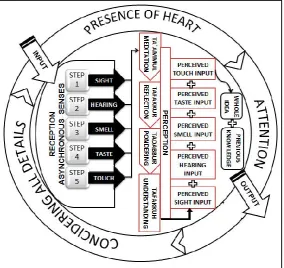
[image:2.595.158.443.515.783.2](ICTiL) model aims at integrating learning process and creative thinking. It is supposed to bring the acquisition of information and thinking creatively in the acquired information together which is supposed to overcome isolating creative thinking from learning process and overcome viewing creativity as a reaction step when facing a problem. The researcher believes that thinking creatively in fresh pieces of information at the time of acquiring them may lead to new ideas or products, as those pieces of information are still founded in perception field and can be taken to other phases. The proposed (ICTiL) model is premised on a particular concept of learning style theory and an Islamic perspective of thinking. As for the concepts of learning style theory, being visual, verbal, auditory, or kinesthetic inspired the researcher to come up with something new; which is using senses asynchronously, while the Islamic concepts were driven from some verses of the Holy Qura`an and some instructions of Sunnah. The (ICTiL) model is illustrated in Figure (1).
Depending on what is presented in figure (1), it can be seen that information, behavior, and/or skill are received by senses asynchronously; that is not to use all possible senses together, but to use one sense at a time. When a sense, sight for example, receives something, it should be sent to thinking steps that lead to perception; which are Ta`ammul (Meditation), Tafakkur
(Reflection), Tadabbur (Pondering), and Tafakkuh
(Understanding) respectively. The same steps are followed for the reception of hearing sense until perception happens. The same is followed for the rest of senses, using them one after another. When all possible senses are used and all related perceptions complete, then they are connected together to form a whole complete idea. This idea can be linked to previous knowledge and transferred to long term memory. Using senses asynchronously and the above mentioned steps of thinking should happen within three conditions; (a) presence of heart, (b) paying attention, and (c) considering all details.
The research sought answering the following questions:
1. What is the impact of the program of integrating creative
thinking in learning (PICTiL) on gifted students` creative thinking?
This question includes the following sub-questions:
a. What is the impact of PICTiL program on gifted students`
fluency?
b. What is the impact of PICTiL program on gifted students`
flexibility?
c. What is the impact of PICTiL program on gifted students`
originality?
d. What is the impact of PICTiL program on gifted students`
elaboration?
2. What has the program added to you in the way of thinking?
The research also sought accepting or rejecting the following hypothesis:
1. There is no statistically significant difference due to the
impact of (PICTiL) program at the level of (α ≤ 0.05) between the two groups` means of scores on post-test of Torrance Test of Creative Thinking (TTCT).
MATERIALS AND METHODS
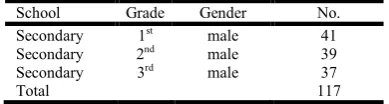
For the purpose of this study, mixed-method approach is used, the explanatory sequential design is adopted; where quantitative data collection and analysis is followed by qualitative data collection and analysis before interpretation is delivered. The population of this study is comprised of all male secondary school gifted students who passed Mawhiba`s scales of giftedness successfully in Al-Quraiyat city, Saudi Arabia for the academic year 2014-2015 A.D. Due to the nature of mixed-method approach researches, two samples were assigned; one for quantitative approach and the other one for qualitative approach. Simple random sampling technique was used to assign the sample of this study. The researcher referred to sample size determination table of Krejcie and Morgan (1970) to decide the appropriate sample size of this study. A number of (92) elements were assigned from a population that consists of (117) as shown in Tables (3) and (4).
Sample elements were divided and distributed equally on control and experimental groups (46 each). The qualitative sample elements were chosen and assigned randomly from the elements of the experimental group. A focus group of eight elements was used to explore opinions, attitudes, and feelings. In the light of the study objectives, the researcher used Torrance Test of Creative Thinking, figural form (Form B), standardized into Arabic environment by Alnafi (2008).
RESULTS
To answer the first question “What is the impact of the program of integrating creative thinking in learning (PICTiL) on gifted students` creative thinking?”, means of scores of the two groups were extracted to check if there is a difference. Table (5) shows the results:
The results shown in Table (5) indicate that there is a very slight difference between the means of the control group and the experimental group on pre-test of Torrance test of creative thinking; the means of the scores of the control group was (120.41) with a standard deviation of (4.369), and the mean of the scores of the experimental group was (120.11) with a standard deviation of (3.802). The difference between the two means was (0.3) in favor of the control group. While on post-test of Torrance post-test of creative thinking, there was a notable difference between the control group and the experimental group of (3.91) in favor of the experimental group; the control group mean was (120.70) with a standard deviation of (4.447), while the mean of the experimental group was (124.61) with a standard deviation of (3.997).
There was no big difference between the two means of scores of the control group on pre-test/post-test as it was (0.29). On the contrary, there was a notable difference between the two means of scores of the experimental group on pre-test/post-test which was (4.5).
To find out whether the difference between the means of the two groups is significant at the level (α≤0.05), independent samples t-test was used. Results are shown in table (6):
In Table (6), the significance value of Levene`s test for equality of variance was (0.583) which is higher than (0.05). This indicates that the variance between the two groups is equal, and hence the values of “Equal variances assumed” are considered. The results of the “Equal variances assumed” in table (6) show that the calculated “t” value is (-4.439) which is greater than the table “t” value at degree of freedom of (90) and a level of (0.05) which is (±1.990). The significance value is almost (0.000) which is of course less than (0.05).
In light of these values, the null hypothesis “There is no statistically significant difference due to the impact of (PICTiL) program at the level of (α ≤ 0.05) between the two groups` means of scores on post-test of Torrance Test of Creative Thinking (TTCT)”is rejected.
To find out the effect size, Cohen`s (d) was used. The means and the standard deviations of the experimental group on (TTCT) pre-test and post-test were used to calculate the effect size, the resulted output was a value of (- 1.15) which indicates that the effect size is large as it is higher than (± 0.8).
As for the four sub-questions of the first question, which are:
e. What is the impact of PICTiL program on gifted students`
fluency?
f. What is the impact of PICTiL program on gifted students`
flexibility?
g. What is the impact of PICTiL program on gifted students`
originality?
h. What is the impact of PICTiL program on gifted students`
elaboration?
The results shown in Table (7) show that the difference between the means of scores between the pre-test and the post-test on fluency is (-0.717) in favor of scoring on post-post-test, the significance value is (0.007) which is less than (0.05); thus it is statistically significant. For the second sub-question; which is flexibility, the difference between the two means of scores between the pre-test and the post-test is (-0.500) in favor of scores on post-test, the significance value is (0.040) which is less than (0.05); thus it is also statistically significant. The difference between the means of scores of originality on pre-test and post-pre-test is (-1.087) in favor of the scores on post-pre-test, the significance value is almost (0.000) which is less than
(0.05) which indicates a statistically significant difference on the third sub-question. The last sub-question of elaboration shows a difference between the scores of means on pre-test and post-test. The difference is (-2.196) in favor of post-test mean of scores with a value of significance of almost (0.000). This indicates that the difference is statistically significant. To answer the second question "What has the program added to you in the way of thinking?", a focus group elements revealed the following responses:
[image:4.595.200.395.80.132.2]“The way of thinking encourages me to search for new thoughts and to produce new ideas”.
Table 3. The distribution of the study population members
School Grade Gender No.
Secondary 1st male 41
Secondary 2nd male 39
Secondary 3rd male 37
Total 117
Table 4. The distribution of the study sample
Secondary school grade Control group Experimental group Sum
1st 15 17 32
2nd 18 17 35
3rd 13 12 25
[image:4.595.168.428.246.343.2]Total 46 46 92
Table 5. Means of scores of control and experimental groups on pre-test and post-test of creative thinking
Group Pre-test TTCT Post-test TTCT
control group Mean 120.41 120.70
N 46 46
Std. Deviation 4.369 4.447
experimental group Mean 120.11 124.61
N 46 46
Std. Deviation 3.802 3.997
Total Mean 120.26 122.65
N 92 92
[image:4.595.36.543.379.459.2]Std. Deviation 4.076 4.642
Table 6. Independent samples t-test results of (TTCT)
Levene's Test for Equality of Variances F.304 Sig. .583 Equal variances assumed Equal variances not assumed
t-test for Equality of Means t -4.439 -4.439
df 90 88.997
Sig. (2-tailed) .000 .000
Mean Difference -3.913 -3.913
Std. Error Difference .882 .882
95% Confidence Interval of the Difference
Lower -5.664 -5.665
[image:4.595.43.548.488.605.2]Upper -2.162 -2.161
Table 7. Paired samples t-test results for sub-scores of TTCT
Pair 1 Pair 2 Pair 3 Pair 4
Pre-test / Post-test fluency Pre-test / Post-test flexibility
Pre-test / Post-test originality
Pre-test / Post-test elaboration Paired
Differences
Mean -.717 -.500 -1.087 -2.196
Std. Deviation 1.721 1.602 1.644 3.908
Std. Error Mean .254 .236 .242 .576
95% Confidence
Interval of Difference
Lower -1.229 -.976 -1.575 -3.356
Upper -.206 -.024 -.599 -1.035
t -2.827 -2.117 -4.484 -3.811
df 45 45 45 45
“I feel I start to think in two opposite directions at the same time”.
“I realized that nothing is absolute, everything is possible”.
DISCUSSION
The results shown in Table (5), show that means of scores of control and experimental groups on TTCT pre-test showed that both groups have almost the same means; the control group has a mean of scores of (120.41), while the experimental has a mean value of (120.11). The difference between the two means was (0.30) which is very small value. The standard deviations of both groups show near values; the control group standard deviation was (4.369), while that of experimental group was (3.802). These approximate values of means and standard deviations may reflect that both group members have approximate creativity as their results on pre-test of Torrance test of creative thinking were nearly the same. The approximation between the two group’s means may indicate that the distribution of the respondents on both groups was good and the sample was homogeneous. The results in Table (5) also show that the difference between the means of scores of control and experimental groups on post-test of (TTCT) was (3.91) in favor of the experimental group; the control group mean was (120.70), while the experimental group mean was (124.61). This value of difference between the two means seemed to be large enough to be noticed. The two standard deviations of both groups were approximate; the control group deviation was (4.447), while the standard deviation of the experimental group was (3.997). This indicates that the noticed progress of the experimental group can be attributed to the influence of the treatment program.
The difference between the means of control group on pre-test and post-test indicates that there is a very little progress on creative thinking. The values of the means of control group according to Table (5) show mean difference of (0.29); as the mean on pre-test was (120.41), while on post-test it was (120.70). On the other hand, the difference between the two means of scores of experimental group on pre-test and post-test of (TTCT) was (4.5) which indicates that there was a notable progress on creative thinking. These values again may denote to the impact of the (PICTiL) program. Results in Table (6) show that the calculated “t” value is (-4.439) which is greater than the table “t” value at degree of freedom of (90) and a level of (0.05) which is (±1.990). The significance value is almost (0.000) which is of course less than (0.05). It was also obvious that the lower and the upper values of confidence interval do not include the (0) value; this contradicts with the notion that there is no difference between the two means due to the impact of (PICTiL) program. Depending on that, the null hypothesis was rejected; the (PICTiL) program affected the experimental group positively and increased the progress of the experimental members` creative thinking.
The statistical tests of significance show how the experimental results are different from chance expectations, whereas effect size measurements provide the relative magnitude of the experimental treatment. As Cohen stated that effect sizes of (±0.20) are small, (±0.50) are medium, and (±0.80) are large (Thalheimer and Cook, 2002), it appeared that the effect size of
(PICTiL) program was large as Cohen`s (d) result was (- 1.15) which is greater than (±0.8). This result may denote to the fact that most respondents, if not all, have been practicing what they have been learning during the sessions of the training (PICTiL) program in their daily life. The above inference goes well with the finding of the study of Forster (2012), who stated that creative thinking needs real-world application to optimize its chances in order to ensure actual achievement. Without the real-world application, an idea can remain as it is and innovation need not follow. Concepts learned in classrooms should be resolved in real life processes. Cropley (2006), recommended that learning should be deep rather than rote; this will happen by relating to real life, encouraging students to find alternatives, and providing self-paced learning as creative thinking tends to do. Moreover, Hargreaves` study (2009),
showed that improvisation affects significantly the
development of creative thinking as it promotes flexibility, originality, and syntax of music-making. In addition to that, the study of Mohr, Sell, and Lindsay (2015), demonstrated that scores on fluency, elaboration, and originality, core constructs of participants’ assessed creative ability, were systematically influenced by the visual design of the response boxes. They call for increased awareness and transparency of visual design decisions across research fields. Peters` finding in his study (2015), revealed the need to adopt instructional strategies that cultivate the students’ creative and life-long learning skills since anchored learning maximizes the probability of achieving the desired outcomes. Result on creative thinking due to PICTiL program meets the findings of the study of Karpova, Marcketti, and Barker (2011), where creativity was significantly higher for the total group of participants after training than it was before training. The analysis showed that students in four out of the five participating classes had higher creative thinking significance after the exercises were completed. The study showed that by infusing creativity exercises into the existing courses, teacherswere more able to help students develop their creative thinking. The results of the study of Im, Hokanson, and Johnson (2015), provided support for creativity training as they conducted a program to test both short-term and long-term effects of creative problem-solving training on students’ creativity scores.
The findings of the first sub-question "What is the impact of
analysis to identify what it is, and then taking the result into more deep thinking process. Vygotsky(2004), stated that imagination is the basis of all creative activities created by people, culture in the entire world results from human being`s imagination and from creation that depends on this imagination. Robert and Walker (2010), suggested representing information innon-visualforms and information can be perceived through any sensory input which can be very beneficial. Depending on that, the researcher thinks that using one sense at a time when receiving information enhances imagination and hence producing various ideas and thoughts.
As for the second sub-question "What is the impact of PICTiL
program on gifted students` flexibility?",Table (7) shows that a
difference of (-0.5) was recognized between the scores on pre-test and pre-test of the experimental group in favor of the post-test scores. This difference was found statistically significant with a value of (0.040) confirmed by the absence of (0) value as the upper confidence interval was (-0.024) and the lower confidence interval value was (-0.976). These results indicate that there was a progress in flexibility among the experimental group elements related to the impact of PICTiL program. Flexibility is defined as the ability to look at a question or topic from different angles (Shively, 2011), and it occurs when a person easily shifts his or her perspective about that topic being considered (Edgar, Faulkner, Franklin, Knobloch and Morgan, 2008). The researcher believes that the way of receiving information involved in PICTiL program in which one sense is used at a time gives a chance to the learner to improve that sense and look at the information from different perspectives as every sense has a different role and a different sensory channel. Bavelier and Dye (2010), mentioned that studies of animals and humans show that the loss of one sense is often met by an enhancement not only of the remaining senses, but farther where verbal memory skills are enhanced demonstrating that sensory loss can also lead to cognitive compensatory adjustments.
The researcher believes that using senses asynchronously resembles the loss of one or more senses in terms of the increase of attention, concentration, and practice. When information is attended by one sense, this sense is supposed to gain more and deeper details in that information as more concentration is paid to that sense. Practicing makes things grow and improve; this is what is supposed to happen to any sense when given more time to get all possible details especially when accompanied by less distraction and interference that emerges from gathering information through all senses working together synchronously.
The findings appear in table (7) of the third sub-question "What is the impact of PICTiL program on gifted students` originality?" showed a difference of(-1.087) between the means on pre-test and post-test of the experimental group on originality in favor of the scores on post-test. The difference was statistically significant as the value (0) is not included between the upper confidence interval value (-0.599) and the lower value (-1.575). These results indicated that the progress of the respondents increased due to the impact of PICTiL program. Since originality is the production of unique unusual ideas (Wu, 2013), the researcher thinks that the combination
involved in PICTiL program; which includes heart presence, mind images, and linking existing knowledge with the new perceived information can be of an important role in generating original ideas. Those mentioned elements cannot of course be separated from the remaining elements contained in PICTiL program, but they seem to be the strongest elements that contributed most to originality. According to Advanced academic Programs [AAP] (n.d), original thinking helps combining existing ideas and creates new and unusual ideas. Many ordinary ideas usually are expressed before more novel ones occur to us. It seems that visualizing things- the conscious act of forming mental images and pictures of something that is not actually present- promotes insight, enhances creativity, expands imagination, increases comprehension, helps in planning experiences before embarking on them, and strengthens problem-solving skills.
According to the results shown in table (7), the fourth sub-question "What is the impact of PICTiL program on gifted students` elaboration?" reveleda difference of (-2.196) was recognized between the scores on pre-test and post-test of the experimental group in favor of the post-test scores. This difference has the largest value among the remaining creative thinking skills. It was found that this difference was statistically significant with a value of almost (0.000) confirmed by the absence of (0) value as the upper confidence interval was (-1.035) and the lower confidence interval value was (-3.356). These results indicate that there was a respectable progress in elaboration among the experimental group elements due to the impact of PICTiL program. Shively (2011), stated that elaboration includes the addition of details, gaps filling, decorating, and completing a creative idea as it accomplishes an idea, or adds contextual details needed in order to make a
real, meaningful, and understandable thing. The researcher
believes that the way the information is received through the asynchronous senses and the way that information is perceived both contributed to the enhancement in elaboration skill. According to ICTiL model and hence PICTiL program, any information is received through all possible senses one by one under a three conditions that involve considering all details. The received information then is taken into another process of deep thinking steps that leads to perception. After that, all received pieces of information that result from different senses are supposed to be linked together. Thus, the researcher thinks that this combination seems to take the learner into a deep analysis-synthesis process based on predetermination of every single detail no matter how insignificant it is.
The results of the second question "What has the program
added to you in the way of thinking?"showed that responses to
and unconventional ideas to emergence through activating and accessing both conscious and subconscious subsystems and processes. The production as byproduct construct is characterized by two attributes: First, the act of creation imparts learning-induced change upon the creator, and second, divergent thinkers use an open-ended, often chaotic process of seeking and discovery in contrast to a closed-ended, consciously task-monitored, linear process of solving and answering”.
Depending on respondents` responses, it seems they realized that they experienced a change in their way of thinking that resulted in giving inner motives to at least try to produce new ideas and thoughts. Moreover, PICTiL program seems to enhance self-confidence to start thinking critically and not to accept any information as granted. The researcher thinks that all components involved in ICTiL model work together in harmony to produce such previously mentioned positive feelings and opinions.
Acknowledgement
The researcher thank with deep appreciation, the supervisors Dr. MohdZuri Bin Ghani and Dr. Aznan Bin Che Ahmad, for their valuable advice, patience, encouragement, assistance, and commitment. Thanks to University Sains Malaysia and all of its employees who have been very nice and very cooperative. The efforts of the Saudi Ministry of Education represented in the Saudi Cultural Attaché in Kuala Lumpur and the Gifted Center in Al-Quraiyat city are appreciated. The researcher expresses appreciation with great thanks to Sameer Abdulrazzaq, AtallahAlatawi, Mohammad Alzahrani, Faisal Alsahafi, TurkiAljebab, Adel Alzayedi, Saleh Aljuhani, and Wuqaiyan Al-Qahtani for their support wishing the best for them all.
REFERENCES
Abdul-Majeed, M. 2004. The extent to which the content of science curriculum in the intermediate stage covers the nature of science and its processes, and the students`
understanding of them. Educational Scientific Journal,
7:103-144.
Advanced Academic Programs. (n.d). Introduction to thinking skills lessons. Retrieved from: http://www.fcps.edu
Al-Dalami, M. 2010. Proposition for gifted care development program at the primary stage in Saudi Arabia, in the light of the international contemporary trends. Unpublished Ph.D Dissertation, Imam Muhammad Ben Saud Islamic University.
Al-Ghaiyadh, R. 2003. Developing the content of science curriculum in elementary stage in Saudi Arabia in light of the modern international approaches. Unpublished Ph.D thesis, sociology college, the Islamic University of Muhammad bin Saud, Riyadh.
Al-Jabr, J. 2005. An analytical study of the content of the sixth elementary grade science book in Saudi Arabia in light of standards of science teaching. A research submitted to the seventeenth scientific conference of the Egyptian foundation of curricula and teaching methods, Ain Shams University, Cairo.
Alnafi, A. 2008. Standardizing Torrance test of creative thinking (figural form) on Saudi environment. A paper submitted to the fifth management meeting, creativity and management excellence.
Al-Rashed, A. 2001. Books of science in elementary stage in Saudi Arabia from a modern educational perspective. Educational research center, Education college, King Saud University, Riyadh.
Al-Shayi, F., & Al-Uqaiyel, M. 2006. The extent to which the norms of k-4 project is achieved in (NSES) content.
Submitted paper for the 10th scientific conference of the
Egyptian scientific educational foundation, University of Ain Shams, Cairo.
Al-Uqaiyel, M., Al-Shayi, F., & Al-Jughaiman, A. 2014. The Effect of using proposed scientific enriching activities on creative thinking for elementary schools gifted students.
Scientific Journal, 15.
Anonymous. 1999. The National curriculum handbook for primary teachers in England. London, Department for Education and Employment. P. 11.
Bavelier, D. & Dye, M. 2010. Encyclopedia of perception.
Thousand Oaks: Sage Publications Inc.
Benjamin, L. 1984. Creativity and counselling. Highlights: an ERIC/CAPS factsheet, Ann Arbor, MI, School of Education, University of Michigan, USA.
Craft, A. 2003. The limits to creativity in education: dilemmas
for the educator. British Journal of Educational Studies,
51, 2.
Cropley A 2006. Creativity: A social approach. Roeper
Review,28, 3: 125–130.
Edgar, D., Faulkner, P., Franklin, E., Knobloch, N., & Morgan, A. 2008. Creative thinking: opening up a world of thought
[pdf]. Retrieved from: http://giftedtalentedlearners.
wikispaces.com
Forster, J. 2012. Creativity: The hub of real achievement.
Gifted Education International. 28, 3.
Friedel, C., & Rudd, R. 2006. Creative Thinking and Learning
Styles in Undergraduate Agriculture Students. Journal of
Agricultural Education,47, 4.
Hargreaves, D. 2009. An experimental study of the effects of improvisation on the development of children's creative
thinking in music. Psychology of Music, 37, 3.
Hennessey, B., & Amabile, T. 2010. Creativity. Retrieved from: www.annualreviews.org.
Im, H., Hokanson, B., & Johnson, K. 2015.Teaching creative
thinking skills: a longitudinal study. Clothing and Textiles
Research Journal, 33, 2.
Karpova, E., Marcketti, S. and Barker, J. 2011. The efficacy of teaching creativity: Assessment of student creative thinking
before and after exercises. Clothing and Textiles Research
Journal, 29, 1.
Kerr, B. 2009. Encyclopedia of giftedness, creativity, and talent. SAGE publication, U.K.
King Abdul-Aziz City for Science and Technology. 2014. Transition to knowledge society in Saudi Arabia [pdf]. Retrieved from: http://publications.kacst.edu.sa
Krejcie, R., & Morgan, D. 1970. Determining sample size for
research activities. Educational Psychological
Measurement, 30.
thinking in an online survey. Social Science Computer
Review, doi: 10.1177/0894439315588736.
Peters, R. 2015. Anchored learning and the development of creative, critical thinking and life-long learning skills.
Teaching Public Administration, 33, 3, 221-240.
Robert, J., & Walker, R. 2010. Using all our senses: the need for a unified theoretical approach to multi-sensory
information visualization [pdf]. Retrieved from:
https://eagereyes.org
Salkind, N. 2008. Encyclopedia of Educational Psychology. SAGE publication, U.K.
Shively, C. 2011. Grow creativity [pdf]. Retrieved from: http://files.eric.ed.gov
Thalheimer, W. and Cook, S. 2002. How to calculate effect sizes from published research articles: A simplified
methodology [pdf]. Retrieved from:
http://work-learning.com
Vygotsky, L. 2004. Imagination and creativity in childhood.
Journal of Russian and East European Psychology, 42, 1.
Wu, C. 2013. Elementary school students` creativity and perceptions in English theme-based picture books teaching.
Unpublished master thesis, Ming Chuan University,
Taiwan.