Enhancing Network Lifetime by Implementing
Energy Efficient Clustering in Wireless Sensor
Network
G. Vignesh
1, Dr. V. Kumar
*21M.E - Department of Computer Science, Knowledge Institute of Technology, Kakapalayam, Salem, Tamil Nadu, India 2M.E, Ph.D., Head of The Department, Department of Computer Science, Knowledge Institute of Technology, Kakapalayam, Salem,
Tamil Nadu, India
Abstract: Wireless sensor network is an emerging and most utilized technology for transmission of information. In general it was created for military purpose and due to its wide application it has been utilized in every field. The issue or research work takes place on reducing energy consumption and increasing network lifetime. Clustering is an efficient technique for data transaction and it minimizes energy consumption. Here clustering has been done based on two criteria energy and distance. Therefore energy consumption is reduced and it increases network lifetime. The path creation is done through AODV algorithm. In addition to this apart from active nodes, idle nodes are transformed to sleep mode. The objective of enhancing network lifetime is achieved by implementing efficient routing process and energy efficient techniques.
Keywords: AODV, sleep and a wake approach, minimize energy consumption, network lifetime and reliability.
I. INTRODUCTION
A. Wireless Sensor Network
Wireless sensor networks (WSNs) have turned into an inexorably prominent research point lately. WSNs have created promising answers for a few applications, for example, interruption discovery, target identification, mechanical computerization, ecological observing, observation and military frameworks, restorative diagnosing frameworks, and strategic frameworks. WSNs comprise of little sensor hubs scattered in a focused on territory to screen the occasions for gathering the information of intrigue. WSNs likewise experience many testing issues; including substantial vitality utilization, organize versatility, portability, inclusion, and consistency. These issues influence the lifetime of the system, increment the inactivity, and lessen the throughput. The constrained battery life and unforgiving working conditions bring on additional intricacies, which can prompt hub disappointment. Albeit noteworthy research has been directed on WSNs to keep up high correspondence measures (particularly inclusion), the issue of high power utilization stays uncertain. The radio is one of the real power-devouring segments of the sensor in WSNs that can be dealt with utilizing vitality effective medium access control (MAC) conventions.
Issues in WSN:
B. Limited Energy Capacity
Since sensor hubs are battery fueled, they have restricted vitality limit. Vitality represents a major test for system planners in unfriendly conditions. Moreover, when the vitality of a sensor achieves a specific edge, the sensor will become defective and won't most likely capacity legitimately, which will majorly affect the system execution.
C. Massive And Random Node Deployment
Sensor hub arrangement in WSNs is application subordinate what's more, can be either manual or arbitrary which at long last influences the execution of the directing convention. In many applications, sensor hubs can be dispersed haphazardly in an expected region or dropped enormously over a blocked off or threatening district.
D. Scalability
E. Node Capability
Depending on the application, a sensor hub can have an alternate job or capacities like as handing-off, detecting and conglomeration if all these capacities are performed by a similar hub the vitality of that hub would be depleted all the more quickly. An extraordinary capacity of sensor hubs raise various issues identified with information directing and makes steering more requesting.
II. LITERATURE SURVEY
Chunjuan Wei et.al (2012), presents inferable from the restricted assets of the sensor hubs, planning vitality effective steering component to drag out the general system lifetime ends up a standout amongst the most significant advancements in remote sensor systems (WSNs). As a functioning part of steering innovation, group based directing conventions have ended up being compelling in system topology the board, vitality minimization, information collection, etc. In this paper, we present a review of best in class directing strategies in WSNs. We first blueprint the bunching engineering in WSNs, and characterize the proposed methodologies dependent on their destinations and plan standards. Moreover, we feature the difficulties in grouping WSNs, including pivoting the job of bunch heads, streamlining of group size and correspondence mode, trailed by a far reaching overview of steering methods. At long last, the paper closes with conceivable future research regions.
Sithembiso Gama et.al (2015), shows the vitality investigation of another vitality proficient circulated recipient based agreeable medium access control (MAC) conspire for remote sensor systems. The agreeable MAC plot grew thus fuses collaboration, catching evasion, collector based transfer hub determination and a Markov-based channel state estimation onto the standard IEEE 802.15.4 plan. The arrangement is created dependent on a beneficiary situated methodology while choosing helpful hand-off hubs and utilizing a store and forward plan to transfer the bundles to the goal hub. This current works' primary center is in consolidating the agreeable bundle handing-off with catching shirking so as to diminish hub vitality utilization consequently upgrading the system lifetime. As the execution criteria, the vitality devoured per hub is examined against parcel entry rate and normal flag to-commotion proportion. The level of vitality expended and parcel throughput are additionally researched as the proposed MAC plot is thought about against the standard IEEE 802.15.4 MAC over the assessed channel conditions. The outcomes demonstrate that the proposed MAC plot with participation and catching evasion brought about both improved execution and improved vitality sparing examples. Georgios Y.Lazarou et.al (2006), discusses WSNs that is extensible to a huge number of heterogeneous hubs, major advances in vitality productive correspondence conventions must happen. In this paper, we initially propose a vitality effective and strong intra-bunch correspondence bit-map helped (BMA) MAC convention for huge scale group based WSNs and after that infer vitality models for BMA, regular TDMA, and vitality proficient TDMA (E-TDMA) utilizing two unique methodologies. We use recreation to approve these expository models. BMA is proposed for occasion driven detecting applications, that is, sensor hubs forward information to the group head just if huge occasions are watched. It has low multifaceted nature and uses a dynamic planning plan. Grouping is a promising circulating procedure utilized in expansive scale WSNs, and when joined with a proper MAC plot, high vitality effectiveness can be accomplished. The outcomes show that BMA can improve the execution of remote sensor organizes by diminishing vitality consumption and bundle inactivity.
C.E. Perkins and E.M. Royer (2002) describe the agreeable commitment of a gathering of versatile hubs without the required intercession of any concentrated passageway or existing framework. We present Ad-hoc On Demand Distance Vector Routing (AODV), a novel calculation for the activity of such specially appointed systems. Every portable host works as a particular switch, and courses are gotten as required (i.e., on-request) with next to zero dependence on intermittent ads. Our new steering calculation is very appropriate for a dynamic self beginning system, as required by clients wishing to use impromptu systems. AODV gives circle free courses even while fixing broken connections. Since the convention does not require worldwide intermittent steering commercials, the interest on the general transmission capacity accessible to the versatile hubs is considerably not exactly in those conventions that do require such notices. In any case we can at present keep up a large portion of the upsides of fundamental separation vector steering components.
results demonstrate that EEDUC conveys the group heads, balances the vitality utilization well among the bunch heads and builds the system lifetime.
Jyotirmoy Karjee and H.S Jamadagni (2012) presents the goal of this paper is to lessen the quantity of sensor hubs by assessing an exchange off between information exactness and vitality utilization for choosing hubs in probabilistic methodology in a conveyed system. Plan Strategy/Approach: Observed information is profoundly connected among sensor hubs in the spatial space due to sending of high thickness of sensor hubs. These sensor hubs structure non-covering conveyed groups due to high information relationship among them. We build up a probabilistic model for each conveyed group to perform information precision and vitality utilization model in the system. At long last we discover an exchange off between information precision and vitality utilization model to choose an ideal number of sensor hubs in each conveyed group. We too analyze the execution for our information exactness estimation model with data precision model for each appropriated bunch in the system. Viable Implementation: Measuring temperature in physical condition and estimating dampness content in rural field. Imaginative/Novel Idea: Optimal hub choice in probabilistic approach utilizing the exchange of between information precision and vitality utilization in a group based disseminated organizes.
A. Problem Identification
1) To increase network lifetime, by minimizing nodes energy consumption and utilizing it in efficient way. 2) Either energy or distance parameter are taken into consideration and processed for enhancing network lifetime.
3) Attaining parameters such as throughput, end to end delay and energy consumption in better performance compared to existing approaches.
4) System should not focus in enhancing network lifetime alone it should attain maximum data reliability.
III. PROPOSED SYSTEM
In this section, brief description of our proposed work has been discussed clearly. Similarly objective of our project also attained by minimizing energy consumption through implementing clustering and sleep and awake technique.
A. AD HOC On Demand Distance Vector
Ad Hoc On Demand Distance Vector Routing (AODV). AODV belongs to multihop type of reactive routing. AODV routing protocol works purely on demand basis when it is required by network, which is fulfilled by nodes within the network. Route discovery and route maintenance is also carried out on demand basis even if only two nodes need to communicate with each other [8]. AODV cuts down the need of nodes in order to always remain active and to continuously update routing information at each node. In other words, AODV maintains and discovers routes only when there is a need of communication among different nodes. AODV uses an efficient method of routing that reduces network load by broadcasting route discovery mechanism and by dynamically updating routing information at each intermediate node. Change in topology and loop free routing is maintained by using most recent routing information lying among the intermediate node by utilizing Destination Sequence Numbers of DSDV. 1) Route Discovery Process: During a route discovery process, the source node broadcasts a route query packet to its neighbors. If
any of the neighbors has a route to the destination, it replies to the query with a route reply packet; otherwise, the neighbors rebroadcast the route query packet. Finally, some query packets reach to the destination.
2) AODV Route Message Generation: The route maintenance process in AODV is very simple. When the link in the communication path between node 1 and node 10 breaks the upstream node that is affected by the break, in this case node 4 generates and broadcasts a RERR message. The RERR message eventually ends up in source node 1. After receiving the RERR message, node 1 will generate a new RREQ message.
B. Implementation Process
1) Implementation of WSN and Energy Analysis: In this module, a WSN is created. Nodes are randomly deployed in the network area. All the nodes are monitoring the network and transmit the data to the base station. BS node aggregates the data and inform to the admin. All the transmissions are carried out in the wireless link. Energy is the limited source in WSN. Due to the excess traffic in base station, the energy consumption is increased in the network which reduces the lifetime.
based on distance and residual energy. Once the CH are selected, the member nodes joins with CH. Inter and Intra clustering communication is happened between the nodes.
3) Implementation of sleep/awake Scheduling: In this module, sleep/awake scheduling is implemented across the network. All the nodes are involved in this scheduling. According to this module, all the nodes are forced to be in sleep and awake cycle. If a node is being idle for a period of time, then the node should enter into sleep state. The same node can be awakening, when there is data to send. This helps to preserve the unwanted energy consumption in the nodes.
[image:4.595.78.489.257.558.2]4) Implementation of Energy Based MAC Routing Approach: In this module, energy based mac routing approach is introduced to reduce the energy consumption between the nodes in inter and intra clustering. All the nodes energy is consider as a deciding parameter for routing. All the nodes residual energy is taken in account to calculate the eligibility of the node to be selected for data transmission. Based on this approach, the forwarder nodes are selected between CH and member nodes and between CH and base station node.
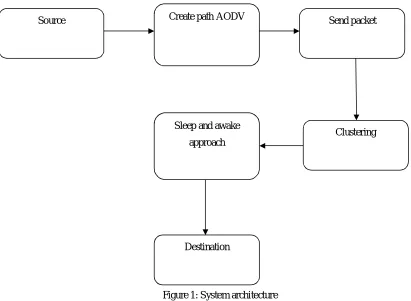
Figure 1: System architecture
System architecture describes source to destination data transaction with respect to minimum energy consumption. Initially path selection has been selected through AODV routing protocol and packet will be transmitted in the selected path. Clustering is utilizes such as inter and intra clustering is implemented for communication. Cluster head is selected based on both energy and distance parameters. While clusters are created the node which are in idle state are transformed to sleep mode hence this increases network lifetime. Packets are transmitted from source to destination without any packet loss and it attains reliability.
IV. RESULT AND DISCUSSION
The result obtained from our proposed system is discussed clearly and the parameters utilized are also described below.
A. End to End Delay
End to End Delay is the summation of Transmitting Delay (at MAC layer), Propagation Delay and queuing Time of a packet. End to End delay (ms) = (Communication end time – start time) / data received
In the graph, the right colored curves represent the delay at the network when there is no offloading in the network. Whereas the
Source Create pathAODV Send packet
Clustering Sleep and awake
approach
Figure 2: end to end delay graph obtained between existing and proposed system
B. Packet Delivery Ratio
Packet delivery ratio defines the ratio of the number of packets sent by the source node and the number of packets received by the destination node.
PDR = ( data sent/ data received)*100
In the provided graph, the red curve indicates the PDR where there is no offloading in the network. The PDR rate is low compared with offloading due to the excess load generated at the base station.
C. Packet Loss
Packet loss is the failure of one or more transmitted packets to arrive at their destination. Packet loss = [ Data sent – data received ]
[image:5.595.80.514.520.735.2]D. Energy Consumption
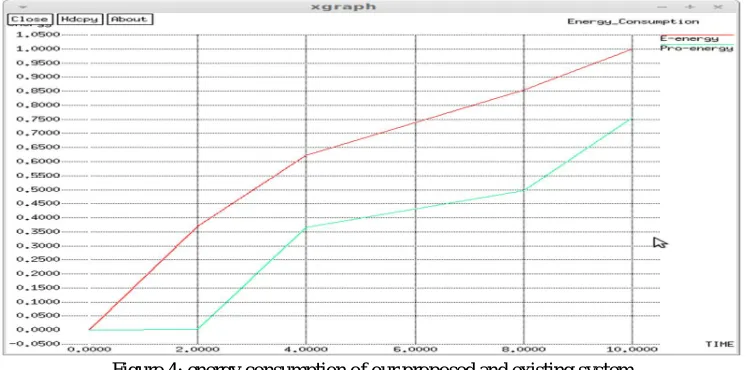
[image:6.595.112.485.163.348.2]The objective of our system is to reduce energy consumption there by increases the network lifetime. Our proposed system attains minimum energy consumption compared to existing system and it achieves maximum network lifetime. Hence it clearly shows that our proposed system attains objective of our system.
Figure 4: energy consumption of our proposed and existing system
V. CONCLUSION
To enhance network lifetime and to increase performance parameters in WSN there are many approaches has been invented and implemented. In our proposed, clustering is utilized for reducing energy consumption, however in general clustering is done based on energy or based on distance. In our proposed considering both energy and distance increases network lifetime. In addition to this to reduce energy consumption, sleep and awake approach has been deployed. The nodes which are not take participate in transaction will transformed to sleep mode. Hence node with high energy and minimum distance will be taken for transaction and it achieves data reliability and increases network lifetime.
REFERENCES
[1] Demirkol, I., Ersoy, C., Alagoz, F.: ‘MAC protocols for wireless sensor networks: a survey’, IEEE Commun. Mag., 2006, 44, pp. 115–121.
[2] Heinzelman, W.B., Chandrakasan, A.P., Balakrishnan, H.: ‘An application specific protocol architecture for wireless microsensor networks’, IEEE Trans. Wirel. Commun., 2002, 1, pp. 660–670
[3] Ibriq, J., Mahgoub, I.: ‘Cluster-based routing in wireless sensor networks: issues and challenges’. SPECTS, 2004, pp. 759–766
[4] Gama, S., Walingo, T., Takawira, F.: ‘Energy analysis for the distributed receiver based cooperative MAC for wireless sensor networks’, IET Wirel. Sensor Syst., 2015, 5, (4), pp. 193–203
[5] Pei, G., Chien, C.: ‘Low power TDMA in large wireless sensor networks’. Military Communications Conf., 2001. MILCOM 2001. Communications for Network-Centric Operations: Creating the Information Force. IEEE, 2001, pp. 347–351
[6] Lazarou, G.Y., Li, J., Picone, J.: ‘A cluster-based power-efficient MAC scheme for event-driven sensing applications’, Ad Hoc Netw., 2007, 5, pp. 1017–1030 [7] Hsu, T.-H., Yen, P.-Y.: ‘Adaptive time division multiple access-based medium access control protocol for energy conserving and data transmission in wireless
sensor networks’, IET Commun., 2011, 5, pp. 2662–2672
[8] Johnson, D.B., Maltz, D.A.: ‘Dynamic source routing in ad hoc wireless networks’, in Imielinski, T., Korth, H.F. (Eds.): ‘Mobile computing’ vol. 353 (The Kluwer International Series in Engineering and Computer Science, Boston, MA, 1996), pp. 153–181
[9] Perkins, C.E., Royer, E.M.: ‘Ad-hoc on-demand distance vector routing’. Second IEEE Workshop on Mobile Computing Systems and Applications, 1999. Proc. WMCSA'99, 1999, pp. 90–100
[10] Li, C., Ye, M., Chen, G., et al.: ‘An energy-efficient unequal clustering mechanism for wireless sensor networks’. IEEE Int. Conf. on Mobile Adhoc and Sensor Systems Conf., 2005, pp. 8–604
[11] Gong, B., Li, L., Wang, S., et al.: ‘Multihop routing protocol with unequal clustering for wireless sensor networks’. ISECS Int. Colloquium on Computing, Communication, Control, and Management, 2008. CCCM'08, 2008, pp. 552–556
[12] Tunca, C., Isik, S., Donmez, M.Y., et al.: ‘Ring routing: an energy-efficient routing protocol for wireless sensor networks with a mobile sink’, IEEE Trans. Mob. Comput., 2015, 9, pp. 1947–1960
[13] Hayes, T., Ali, F.H.: ‘Location aware sensor routing protocol for mobile wireless sensor networks’, IET Wirel. Sensor Syst., 2016, 6, (2), pp. 49–57
[14] Farooq, M.O., Kunz, T.: ‘Impact of route length on the performance of routing and flow admission control algorithms in wireless sensor networks’, IET Wirel. Sensor Syst., 2016, 6, (1), pp. 10–16