Abstract—This paper presents a first aid drug prescription software deployed for small mobile devices. The system provides a cost-efficient, multilingual, easily accessible mobile solution. A key limitation of the existing systems of drug prescription is that they do not address challenges such as inaccessibility of patients to medical Doctors or trained paramedics, digital divide, cost constraints among other challenges peculiar to rural African communities. This paper presents one of the solutions developed in our research efforts at addressing the aforementioned. The work produced a novel mobile software tool that addressed the provisioning of real-time, standardized drug prescription solution for patients in communities where access to Doctor is near zero with Multilanguage interface. Yoruba language, one of the three most widely spoken languages in Nigeria was used in the preliminary implementation of this system.
Index Terms—Drug Prescription, m-Health, Pharmacy, Rural Healthcare
I. INTRODUCTION
RUG prescription, medical advises and general basic primary and secondary health care services are delivered by Doctors in a standard system. However, self medication and prescription by quack practitioners are the order of the day in many poverty ridden societies, especially rural society of underdeveloped countries where Doctor-to-Patient ratio in the world is lowest - “in 31 African countries one Physician attends to more than 10,000 people”[1].
This attitude to medication has the tendency of causing damage to patients’ system which could result into death. The patient’s physical interaction prior to medication has not proven efficient and effective due to waiting long hours in the hospitals at health centers to meet with medical practitioners, who are dismally low to the number of patient, merely for consultation. Also, due to lack of healthcare services in the rural areas, patients travel tens of kilometers to nearest urban setting to visit qualified medical practitioners who may not be available to attend to them. This work is an attempt at providing a solution for this challenge.
Manuscript submitted on Monday, July 25, 2011. This work was supported in part by the research grants from the Mobile e-Services Research Group at Ladoke Akintola University of Technology, Ogbomoso, Nigeria.
Dr. John B. Oladosu is with the Department of Computer Science and Engineering, Ladoke Akintola University of Technology, Ogbomoso, Nigeria (corresponding author; Phone: +234-803-455-6065; e-mail:
Mrs. Oluyinka T. Adedeji is with the Department of Computer Science and Engineering, Ladoke Akintola University of Technology, Ogbomoso, Nigeria.
Mobile communication infrastructures have been deployed in a good number of rural communities investigated in this research. Deployments of these infrastructures are inevitable in these communities as many of them are used as access path from one urban setting to another. The mobile phone technology has proven affordable to most poor African dwellers compared with the personal Computer technology [2, 3]. This research leverages on this advantage to propose a primary healthcare pharmaceutical digital assistance (FAPDA). This solution proposes a standardized drug prescription system accessible through a patient’s mobile phone. The drug prescription can then be used to dispense drug for first aid treatment and primary healthcare.
This solution chose four categories of ailment (malaria, pneumonia, conjunctivitis and gastroenteritis) as candidate health problems to test the concept. The solution has the potential of saving time on the part of the patient and saving a lot of lives in the process.
II. ELECTRONIC DRUG PRESCRIPTION
It is reported in [4] that Computer-aided drug prescription has helped to “reduce medication error rates by as much as 60%.” Computer-aided drug prescription also has potential to “significantly lower primary care drug costs” [5]. It is also reported in literature that the “most common prescription error – prescription of excessive doses” can be prevented with the aid of electronic prescription [6]. However, unprofessional practice in drug prescription can have adverse effect whether by using Computer or manual means [7, 8]. A study of unlicensed and off label drugs administered to children in hospital in five European countries was conducted in [7]. Use of off label or unlicensed drugs to treat children was reported in the study as likely having negative effect on children throughout Europe.
The studies in [4], [5] and [6] support the use of electronic drug prescription while [7] and [8] are cautionary notes on the use of unprofessional means of drug prescription such as self medication, use of unlicensed and off label as well as off the self drugs. In order to address the inadequacy of medical practitioners as well as poverty level of an average African rural dweller while striving to save as many life as possible, a solution that addresses the challenges raise in [1], [2] and [3] as well as avoiding the pitfalls in [7] and [8] is necessary. The most appropriate solution is through the deployment of services accessible via mobile phones [9]. This means that electronic prescription through the personal computers is not the most appropriate solution for rural African communities [9]. This is the rationale for engaging in the development of mobile electronic solution. It is our belief that primary
FAPDA: First Aid Pharmaceutical Digital
Assistant
John B. Oladosu and Oluyinka T. Adedeji
healthcare services will be within the reach of most dwellers in the underdeveloped countries with the use of solution developed in this work.
III. RELATED WORK
The generic model of an e-prescription system is presented in [10]. The model identifies a human Doctor as a critical component of the e-prescription solution. The patient must physically visit a human Doctor for consultation before electronic prescription is sent to the Pharmacist. However, in our work, the human Doctor is replaced by an electronic Doctor. The “e-Doctor” is a Decision Support System DSS developed from and expert’s knowledge base of diagnosis for common diseases. Therefore a distinction between the model in [10] and our model (Figure 1) is the absence of a human Doctor who is scarcely available in our implementation scenario.
AuthTag™, a Mobile Authentication and Electronic Prescription system is presented in [11]. In compliance with the Two-factor authentication standard of the American Drug Enforcement Administration (DEA) [12], the solution in [11] is secure. It however, requires the use of barcode which can be read only by using high-end phone such as “iPhone, Android, Blackberry, Windows Phone, etc” which are not within the reach of an average rural dweller in underdeveloped countries. The use of such solution will be out of reach of about 70% of a continent like Africa where about two thirds of its population lives in poverty-ridden rural communities [13].
A host of other e-prescription systems are in literature such as those reported in [14], [15] and [16] among many others not reviewed in this work. A key feature in our solution which is conspicuously absent in all the system under review is an indigenous language interface which enables a patient to interact with the system in his local language (Yoruba in this case) while translation is done internally by the system. Diagnosis is done and prescription is sent to the Pharmacist in the official language (English).
IV. METHODOLOGY
The scope model of the system is shown in Figure 1. The mobile patient can consult with the expert system anywhere. The communication between the patient and the expert system is interactive. The expert system sends the diagnosis decision to the e-Prescription warehouse at the end of the consultation. The Prescription system then sends an e-Prescription to the pharmacy from where drug can be delivered to the patient or collected by the patient. The e-Reporting (see [10]) component has been removed from the model as it is not yet part of our current work.
Figure 2 shows the software technology built on three tier architecture described in [17]. The Client Tier consists of Mobile Terminals and Mobile service infrastructure. The mobile application resides on the mobile terminal using both its memory and processing power. Mobile service infrastructure is responsible for providing the General Packet Radio Service (GPRS), 3G or any related connectivity technology, which the mobile terminal uses in
Authentication and authorization, Context extraction, Message switching and transfer. This solution is part of an elaborate framework discussed in [17].
The pharmacy database is used for keeping the names of prescribed drugs from the e-prescription system and sending the prescription to the parcel delivery service for home delivery to the patient or alternatively kept with the pharmacy for patient to pick up. This pharmacy database comprised the names of prescribed drugs from the virtual doctor for the treatment of four common ailments namely: malaria, pneumonia, conjunctivitis, and gastroenteritis. The service registry is responsible for keeping the database and monitoring it. It also provides a number of other services to the upper layers.
Pharmacy for e-prescription Mobile patient
e-Prescription Data warehouse
[image:2.595.307.552.226.400.2]Expert system for medical consultation (Hospital based or national repository)
Figure 1: The Scope Model of FAPDA
[image:2.595.307.539.446.629.2]Figure 3: Structural Flowchart of the System
V. RESULTS
Figure 4 presents the screen shot that shows the list of four ailments i.e. malarial, pneumonia, conjunctivitis, and gastroenteritis, from which the patient is going to select one base on the diagnosis of virtual doctor.
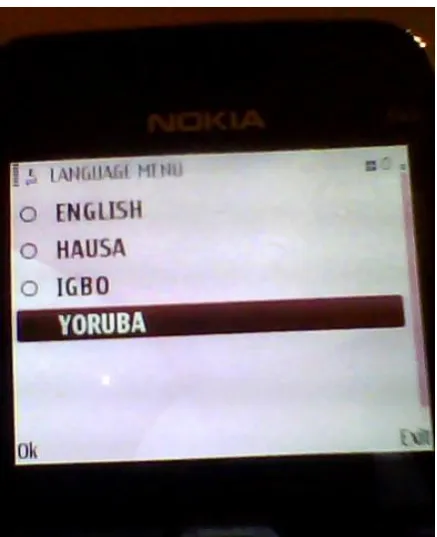
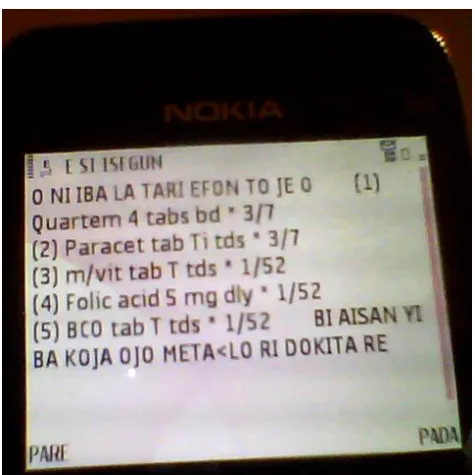
Figure 5 presents the screen shot of the page consisting of the full prescription and price of drugs all in tabular form in accordance with ailment, for instance malaria. Figures 6, 7 and 8 demonstrate the use of the system by a patient interacting with the software in Yoruba. Figure 6 shows the screen where the patient is choosing Yoruba as his preferred language of communication while figure 7 shows the final diagnosis and drug prescription in Yoruba language. Figure 8 shows a message screen where the patient is being told that his sickness cannot be diagnosed by the expert system. He is advised to visit the hospital.
[image:3.595.132.537.62.722.2]Figure 4: Sickness Option page
[image:3.595.306.462.74.258.2]Figure 5: Drug Prescription Page
[image:3.595.305.524.455.724.2]Figure 7: Prescription page for Yoruba Language user
Figure 8: A message screen for Yoruba Language user
VI. CONCLUSION AND FURTHER WORK
This work is an integral part of service oriented solution for mobile healthcare provisioning developed at our research centre. The usage of this system will help reduce long queues in hospitals, and proffer solutions to barriers such as language, distance and cost in the process of effective health care delivery. Further work will be focused on improving the scope of drug prescription that can be accommodated in the e-prescription warehouse. Work also continues on this solution to further perfect the language translation and extend it to more indigenous languages in Nigeria and other African countries. National and international government and non-governmental agency support is needed to further develop this work.
ACKNOWLEDGMENT
The researchers acknowledge the support of the mobile e-services research centre of LAUTECH, Ogbomoso, Nigeria for providing environment for conducting this research and giving stipends to research assistants who were engaged in
this work.
REFERENCES
[1] Maurice M., “Sub-Saharan Africa: Is Telemedicine A Viable Solution?” A Seminar paper presented at Nelson R Mandela School of Medicine, University of KwaZulu-Natal, South Africa, 2007.
[2] Kifle M., Mbarika V. W.A. and Tan J. A., “TeleMedicine Transfer Model for Sub-Saharan Africa.” Proceedings of the 41st Hawaii International Conference on System Sciences – 2008,
[3] WHO, “The World Health Report 2006 - Working together for health.” Accessed on 26 May, 2011 at
http://www.who.int/whr/2006/en/index.html.
[4] R E Ferner, “Commentary: Computer aided prescribing leaves holes in the safety net.” BMJ Volume 328 May 2004, pp. 1172 – 1173.
[5] S. Troy McMullin, Thomas P. Lonergan, and Charles S. Rynearson, “Twelve-Month Drug Cost Savings Related to Use of an Electronic Prescribing System With Integrated Decision Support in Primary Care,”
Journal of Managed Care Pharmacy, May 2005 Vol.
11, No. 4.
[6] H. M. Seidling, S. P. W. Schmitt, T. Bruckner, J. Kaltschmidt, M. G. Pruszydlo, C. Senger, T. Bertsche, I. Walter-Sack, and W. E. Haefeli, “Patient-specific electronic decision support reduces prescription of excessive doses.” Qual Saf Health Care 2010; 19:e15. DOI:10.1136/qshc.2009.033175
[7] Sharon Conroy, Imti Choonara, Piero Impicciatore, Angelika Mohn, Henrik Arnell, Anders Rane, Carmen Knoeppel, Hannsjoerg Seyberth, Chiara Pandolfini, Maria Pia Raffaelli, Francesca Rocchi, Maurizio Bonati, Geert`t Jong, Matthijs de Hoog and John van den Anker, “Survey of unlicensed and off label drug use in paediatric wards in European countries.” BMJ Volume 320 January 2000, pp. 79 – 82.
[8] Trisha Greenhalgh, “Drug prescription and self-medication in India: An exploratory survey,” Social Science & Medicine Volume 25, Issue 3, 1987, Pages 307-318. DOI:10.1016/0277-9536(87)90233-4. [9] Adigun M. O., “ICT Infrastructure for Electronic
Commerce and Services: A Case Study of Rural SMEs in South Africa, Department of Computer Science, University of Zululand.” A Guest Paper Presented at the Second International Conference on Application of Information Technologies to Teaching, Research and
Administration, at Obafemi Awolowo University,
Ile-Ife, Nigeria, September, 2007
[10] Stephen Chu, Electronic Prescription: Standards and Decision Support Issues,” The Journal on Information
[image:4.595.47.290.310.491.2][11] Razoron Mobile, “AuthTag™ Mobile Authentication and Electronic Prescriptions,” ©2011 Razoron Mobile. Accessed on 21 July 2011 at www.razoron.com. [12] APhA, “Drug Enforcement Administration Releases
Interim Final Rule To Permit Electronic Prescriptions for Controlled Substances.” April 7, 2010. Accessed on 21 July 2011 at http://www.pharmacist.com/ [13] Korir A. Singoei & Adam Hussein Adam, “A New
Scramble for Africa’s Remaining Collective Territories: The Trends, Tensions and Challenges.” A 2007 Work in Progress. Accessed on 21 May 2011 at www.africanbiodiversity.org/
[14] I. R. Clark, B. A. McCauley, I. M. Young, P. G. Nightingale, M. Peters, N. T. Richards and D. Adu, “Electronic Drug Prescribing and Administration - Bedside Medical Decision Making,” Lecture Notes in Computer Science, 1999, Volume 1620/1999, 143-147, DOI: 10.1007/3-540-48720-4_14.
[15] OnCallData, “Mobile Electronic Prescribing and Medication: Reconciliation Applications for Apple iPad and iPhone, Google Android, and BlackBerry,” March 11, 2011. Accessed on 21 July 2011 at http://www.businesswire.com/news/home/2011031100 5528/en/OnCallData-Launches-Mobile-Electronic-Prescribing-Medication-Reconciliation.
[16] Wikipedia, “ List of open source healthcare software,” Accessed on 21 July 2011 at http://en.wikipedia.org/ wiki/List_of_open_source_healthcare_software. [17] Oladosu J. B., Emuoyinbofarhe J. O., Ojo S. O. and
Adigun M. O., “Framework for A Context-Aware Mobile E-Health Services Discovery Infrastructure for Rural/Suburban Healthcare.” Journal of Theoretical
and Applied Information Technology, Vol. 6 No. 1,
![Figure 2: Overview of application model (Source: [17])](https://thumb-us.123doks.com/thumbv2/123dok_us/1285830.657389/2.595.307.552.226.400/figure-overview-application-model-source.webp)