ISSN(Online): 2319-8753 ISSN (Print): 2347-6710
I
nternational
J
ournal of
I
nnovative
R
esearch in
S
cience,
E
ngineering and
T
echnology
(A High Impact Factor & UGC Approved Journal)
Website: www.ijirset.com
Vol. 6, Issue 9, September 2017
Face Spoofing Detection Using Image
Distortion Features
Prashasti Raval1, R.R.Sedamkar2, Sujata Kulkarni3
P.G. Student, Department of Electronics & Telecommunication Engineering, Thakur College of Engineering &
Technology, Mumbai, Maharashtra, India1
Professor, Department of Computer Engineering, Thakur College of Engineering & Technology, Mumbai,
Maharashtra, India2
Associate Professor, Department of Electronics & Telecommunication Engineering, Thakur college of Engineering &
Technology, Mumbai, Maharashtra, India3
ABSTRACT: Accurate biometric system for authentication is the need of the hour in today’s scenario. In face spoofing attack a person tries to pretend to be a valid user by using photo or video of an authorized person and gets illegitimate access. Hence it is essential to develop a robust and authentic face spoof detection system in order to protect the privacy about the person. Centre of attraction of this paper is face spoofing detection system using Image Distortion Analysis (IDA). Analysis of distortion of an image to identify spoof attack is the principle consideration of the proposed system. This paper extracts four different IDA features-Specular Reflection, Blurriness, Chromatic Moment and Colour Diversity which are concatenated together to form IDA feature vector. IDA feature vector is further used for face spoof detection using Support Vector Machine (SVM) and Artificial Neural Network (ANN). This paper highlights the performance of accuracy of SVM and ANN using in term of True Acceptance Rate (TAR) and True Recognition Rate (TRR). The performance of classifier was tested on the data-set of public-domain face spoof databases MSU MFSD face images. It was observed that the TAR vs TRR for SVM is 94.4% while that for ANN is 88.9%. The performance of accuracy indicated that the spoof detection based on IDA using SVM is more secured than ANN.
KEYWORDS: Face spoofing attack, Feature Extraction, Image Distortion Analysis(IDA), ensemble classifiers.
I. INTRODUCTION
ISSN(Online): 2319-8753 ISSN (Print): 2347-6710
I
nternational
J
ournal of
I
nnovative
R
esearch in
S
cience,
E
ngineering and
T
echnology
(A High Impact Factor & UGC Approved Journal)
Website: www.ijirset.com
Vol. 6, Issue 9, September 2017
In this article, the state-of-the-art spoofing identification techniques for facial biometrics based on feature extraction using IDA are presented. In our project, the system first takes an image of the user, apply the proposed algorithm to that captured image and finds whether it is spoof face or genuine face. In this paper, we have implemented two face spoof detection systems using, Support Vector Machine(SVM) and Artificial Neural Network(ANN), and have compared these two algorithms on their performance. There are many publicly available databases which can be used for the purpose of training and testing, which are given as IDIAP REPLAY-ATTACK, CASIA FASD and MSU MFSD database. Clients in the database have given their permission to access it publicly. [1][2]
The whole remaining paper we have organized as follows. In Section 2 we discuss related works on face spoofing attacks and countermeasures. And our proposed approach, based on Image Distortion Analysis using SVM and ANN for face spoof detection systems are described and evaluated in Section 3&4. Extensive experiments are conducted in Section 5, it also consisting of analysis of results and comparison. A conclusion is drawn in Section 6.
II. RELATEDWORK
According to various types of information used in face spoof detection, different methods can be categorized into four groups:
Motion Based Methods: This motion based methods, designed to count printed photo attacks, has a very important information for liveliness, the natural motion of organs and muscles in a live face, such as eye blink, mouth movement and head rotation. The frequency of facial motion is limited by the human physiological pattern. Finally, it takes a comparatively long time usually greater than three second to acquire stable vitality features for face spoof detection. [3]
Texture Based Methods: To oppose the printed photo and replayed video attacks, texture based methods were suggested to remove image artefacts in spoof face image. Generalization ability of texture based methods is to be poor. The half total error rate increased dramatically under the cross-database, where the training and testing sets came from dissimilar face spoof databases. [4]
Image Quality Analysis Based Method: There is no face specific information has been measured in designing informative features for face spoof detection. On the contrary, four features are designed mainly for face feature representation in image quality analysis method, and the potency of these features for spoof face detection. The proposed approach focus is to improve the generalization ability under cross-database which has often explored in the biometric community.
Methods Based on Other Cues: Face spoof counter measure based on cues which is derived from sources which also requires additional necessities on the face recognition system such as 2D intensity image, 3D depth, IR image, spoofing context, and voice. [5]
III.PROPOSED SYSTEM
ISSN(Online): 2319-8753 ISSN (Print): 2347-6710
I
nternational
J
ournal of
I
nnovative
R
esearch in
S
cience,
E
ngineering and
T
echnology
(A High Impact Factor & UGC Approved Journal)
Website: www.ijirset.com
Vol. 6, Issue 9, September 2017
Figure 1 is the block diagram of our proposed algorithm which shows the entire flow of this paper. In this paper, proposed system uses Image Distortion Analysis (IDA) for face feature extraction. For each normalized face image, four different features (specular reflection, blurriness, chromatic moment, and colour diversity) are extracted, which are concatenated to get feature vector known as IDA feature vector. These feature vectors are individually passed through SVM classifier (Support Vector Machine Classifiers) and ANN (Artificial Neural Network) after comparing the input image with all images in the database it will detect whether it is a genuine face or spoof face. [6]
IV.METHODOLOGY&ALGORITHM
A. Feature Extraction Using LBP
LBP (Local Binary Pattern) divides the examined window into cells. (LBP looks at 9 pixels at a time). For each pixel in a cell, LBP will compare every neighbour pixel with central pixel. It follows the pixel along circle. If the central pixel’s value is greater than that of neighbour’s value LBP assigns the value 1 or else 0. This gives an 8-digit binary number. For LBP, binary pattern will remain same irrespective of illumination or change of contrast. Transitions from 0 to 1 or vice versa indicates edges. The above procedure is followed for every pixel in the block, and each of those represents different decimal numbers. [7]
Let us assume, that the co-ordinates of centre pixel are ( , ) then the co-ordinates of his P neighbour ( , ) on the edge of the circle with the Radius R can be calculated with the sinus and cosines: [7]
= + R cos (2πp/P) ……… (1)
= + R sin (2πp/p) ………... (2)
If the grey value of the centre pixel is and the grey values of his neighbours are , with p=0,…, p-1, than the
texture T in the local neighbourhood of pixel ( , ) can be defined as:
T=t( , , …., ) ……….(3)
T=(s ( - ,),…….,s( - )) ………(4)
Where,
S(x) = 0, 1, ≥< 0 0 ………. (5)
In the last step to produce the LBP for pixel ( , ) a binomial weight 2p is assigned to each sign S( - ) These
binomial weights are summed: [8]
LBPP, R ( , ) = ∑ ( − )2p ……… (6)
The Local Binary Pattern characterizes the local image texture around ( , ) [7] [8]
ISSN(Online): 2319-8753 ISSN (Print): 2347-6710
I
nternational
J
ournal of
I
nnovative
R
esearch in
S
cience,
E
ngineering and
T
echnology
(A High Impact Factor & UGC Approved Journal)
Website: www.ijirset.com
Vol. 6, Issue 9, September 2017
B. Feature Extraction Using IDA
Feature extraction is nothing but dimensionality reduction. Features often contain information relative to colour, shape, texture or content. Image Distortion is a fundamental issue in many image processing problems. Distortion varies with illumination and quality of camera. For finding image distortion in spoof face images, we will consider four features such as specular reflection, blurriness, chromaticity, and colour diversity. [6]
1. Specular Reflection
There are 2 types of reflection, specular and diffuse reflection. Specular reflection component image has been widely used for specular reflection removal and face illumination normalization. [6]
To separate the specular reflection component I_s from an input, assumption has been made that the illumination is i) from a particular source, ii) of unique colour, and iii) not over-flooded. Since most of the face images used in our database, that is MSU databases are captured indoors under relatively controlled illumination, and hence these three assumptions are reasonable. After calculating the specular reflection component image I_s, we represent the secularity intensity distribution with three dimensional features: i) specular pixel percentage r, ii) mean intensity of specular pixels µ, and iii) variance of specular pixel intensities σ. [9]
2. Blurriness
For short distance spoof attacks, spoof faces are often weakened in mobile phone cameras. The reason is that the spoofing medium (printed paper, tablet screen, and mobile phone screen) usually have limited size, and the attackers have to place them close to the camera in order to tuck away the boundaries of the attack medium. As a result, spoof faces tend to be defocused, and the image blur due to defocus can be used as a cue for anti-spoofing.
Blurriness is measured based on difference between original input image and its blurred vision. his difference decides the quantity of the blurriness in the original input image. As the difference increases, the blurriness in the original image will be less. [10]
3. Chromatic Moment
Recaptured face image tends to show an extraordinary shade distribution in comparison to colours in true face photographs. These is caused by the imperfect colour reproduction property of printing and display media. First, we convert normalized facial image from RGB space into the HSV (Hue, Saturation & value) space & then compute the mean, deviation & skewness of each channel as a chromatic feature. Since these three features are equivalent to the three statical moments in each channel, they are referred to as chromatic moment feature. [11]
4. Colour Diversity
Another important difference between genuine and spoof faces is the colour diversity. Generally, true faces tend to have abundant colours. This diversity leads to colour reproduction loss in spoof face during image/video recapture. In this paper, we follow the method used in to measure the image colour diversity. First, colour quantization is performed on the normalized face image using 32 steps in the red, green and blue channels, respectively. Two measurements are then pooled from the colour distribution: i) the histogram bin counts of the pinnacle one hundred most often acting colours, and ii) the number of distinct colours acting in the normalized face picture. [12]
Above given features such as specular reflection, blurriness, chromatic moment, and colour diversity are combined together and form IDA feature vector and then this feature vector is pass through SVM classifier and ANN classifier trained on different training samples and classify it as a genuine face or a spoof face.
C. Support Vector Machine (SVM)
ISSN(Online): 2319-8753 ISSN (Print): 2347-6710
I
nternational
J
ournal of
I
nnovative
R
esearch in
S
cience,
E
ngineering and
T
echnology
(A High Impact Factor & UGC Approved Journal)
Website: www.ijirset.com
Vol. 6, Issue 9, September 2017
The main purpose of support vector machine is to create a hyper plane in between data sets to indicate which class it belongs to. The biggest challenge of SVM is to train the machine to understand the data structure and mapping right class label. Hyperplane is selected whose distance is largest to the nearest training data points of any class. [14]
As we can see from figure 3, H3 plane does not separate the two classes while H1 plane separate the two class with a
small margin, only H2 plane gives a maximum margin between two classes, therefor it’s the right hyper plane used by
support vector machine. [15]
( ) = + x ……… (1)
Where β is known as the weight vector and β_0 as the bias. The one chosen Hyperplane among all possible
representation is given by,
| + | = 1 ……… (2)
Where, x symbolizes training examples
Distance=
‖ ‖ ………. (3)
Is the distance between a point x and a hyperplane(β ). As numerator is equal to one and distance to support vectors is
[15]
=
‖ ‖ =‖ ‖ ……… (4)
Margin M, is twice the distance to the closest examples:
= 2 ‖ ‖
The problem of maximizing M is equivalent to the problem of minimizing a function. [15]
‖ ‖
= ……….. (5)
Subject to (| + |)≫1∀ …………. (6)
Where represents each of the labels of training example.
This is a quadratic optimization problem is called Lagrangian Optimization which can be solved using Lagrange multipliers [15]
‖ ‖ 2 +
ISSN(Online): 2319-8753 ISSN (Print): 2347-6710
I
nternational
J
ournal of
I
nnovative
R
esearch in
S
cience,
E
ngineering and
T
echnology
(A High Impact Factor & UGC Approved Journal)
Website: www.ijirset.com
Vol. 6, Issue 9, September 2017
After minimization,
‖ ‖
+∑ max[ (1− [ + ])] ……… (7)
Where is Lagrange Multiplier [14] [15]
D. SVM LIB
LIBSVM has been widely used in many areas. LIBSVM is a library for Support Vector Machines (SVMs). The goal is to help users to easily apply SVM to their applications. A typical use of LIBSVM involves twos steps: first is training a data set to obtain a model and second is to use that model for information prediction of a testing data set. [15]
E. Artificial Neural Network (ANN)
Neural networks are composed of simple elements operating in parallel. These elements are inspired by biological nervous systems. Commonly neural networks are adjusted, or trained, so that a particular input leads to a specific target output. [16]
A neural network contains of an interconnected group of artificial neurons (processing element), working in unison to solve specific problems. ANNs, like people, learn by example. The neuron has two modes of operations. The training/learning mode and the using/testing mode. In most of the cases an ANN is an adjustable system that converts its structure based on external or internal information that flows through the network in the learning phase. During training phase, the network is trained, such that output pattern is trained with respect to input pattern. When
the network is used, it identifies the input pattern and tries to associate with output pattern. In this case, the network gives the output that corresponds to a trained input pattern that is least different from the given pattern. [16]
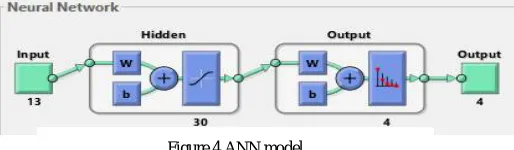
An ANN is created by combining artificial neurons into a structure containing three layers. [17] 1. The first layer consists of neurons that are responsible for a face image sample.
2. ANN performs error reduction in its second layer, i.e. hidden layer, which is necessary to achieve desired output
3. In the output layer, or final layer, neuron number is determined by the size of the set of desired outputs, with each possible output being represented by a separate neuron.
Neural networks are mainly used for pattern recognition. Pattern recognition can be implemented by using a feed-forward neural network that has been trained accordingly. During training, the network is trained output pattern according with input pattern. When the network is used, it identifies the input pattern and tries to associate with output pattern. The output of ANN network is in corresponds to a trained input pattern that has least difference from input sample. Neural network has two types of layer approaches single layer and multi-layer approach. In this paper feed forward network is used. It has multi-layer approach. Multilayer approach is mainly used in pattern recognition. [17]
F. Description of Dataset
Publicly available face spoof databases support many face spoof detection techniques which are used to detect genuine face and spoof face. Images in face spoof database are captured by different camera configuration for detecting spoof face for mobile phone and computer applications. We have collected MSU Mobile Face Spoof Database (MSU MFSD). The publicly available MSU MFSD Database for face spoof attack consists of 280 video clips of genuine and attack attempts of 35 clients.
ISSN(Online): 2319-8753 ISSN (Print): 2347-6710
I
nternational
J
ournal of
I
nnovative
R
esearch in
S
cience,
E
ngineering and
T
echnology
(A High Impact Factor & UGC Approved Journal)
Website: www.ijirset.com
Vol. 6, Issue 9, September 2017
There are three types of spoof attacks were generated, using three different spoof mediums such as high-resolution replay video attacks using an iPad (with resolution of 2048x1536), mobile phone replay video attacks using an iPhone 5S screen (with resolution of 1136x640) and printed photo attacks using an A3 paper with fully-occupied printed photo of the client’s biometry, (paper size: 11' x 17' (279mm x 432 mm), printed by a HP Color LaserJet CP6015xh printer, with printing resolution of 1200 x 600 dpi), these all replay videos and printed photos are captured by laptop camera and android camera for establishing the face spoof database. Combinedly there are 280 real-accesses and attack videos captured in one scenario of 35 different clients. [18]
V. EXPERIMENTAL RESULTS
1. Local Binary Pattern (LBP)
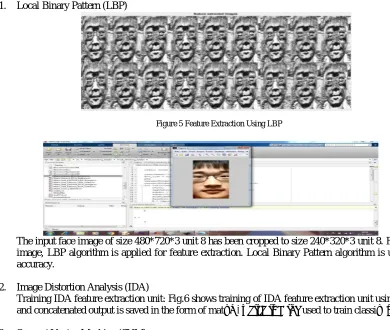
The input face image of size 480*720*3 unit 8 has been cropped to size 240*320*3 unit 8. For the cropped image, LBP algorithm is applied for feature extraction. Local Binary Pattern algorithm is used for higher accuracy.
2. Image Distortion Analysis (IDA)
Training IDA feature extraction unit: Fig.6 shows training of IDA feature extraction unit using training data and concatenated output is saved in the form of matfile, which is being used to train classifier.
3. Support Vector Machine (SVM)
Figure 5 Feature Extraction Using LBP
Figure 6 Training IDA feature Extraction Unit
ISSN(Online): 2319-8753 ISSN (Print): 2347-6710
I
nternational
J
ournal of
I
nnovative
R
esearch in
S
cience,
E
ngineering and
T
echnology
(A High Impact Factor & UGC Approved Journal)
Website: www.ijirset.com
Vol. 6, Issue 9, September 2017
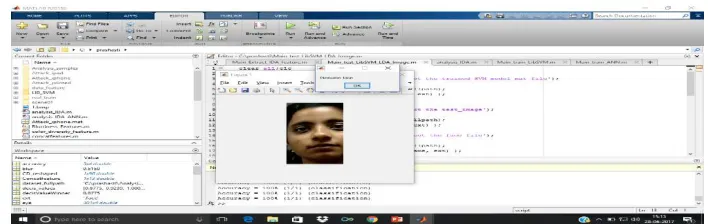
Face Spoof Detection for image using SVM: For a single image, it will select test image and its corresponding face image, extract IDA features, concatenate all the features into a single array and pass it into SVM classifier and find whether it is genuine or spoof.
4. Artificial Neural Network (ANN)
Face Spoof Detection for image using ANN: For a single image, it will select test image and its corresponding face image, extract IDA features, concatenate all the features into a single array and pass it into Neural network and find whether it is genuine or spoof.
5. Performance Analysis of SVM
To calculate the performance analysis of trained SVM model, we have considered 18 images out of which 10 are real face images and 8 are spoofed. True Positive Rate of SVM at False Acceptance rate of 0.1 is 94.4444%. Thus, total accuracy is 94.4444%.
Figure 9 Analysis of SVM
Confusion Matrix: In the below matrix,
1) The first row indicates spoof class. All the 8 spoof images have been classified as spoof image, hence its 100% accurate
2) The second row indicates real class. Out of 10 face images, 1 has been misclassified as spoof, hence its FAR is 0.1 and its accuracy is 90%
ISSN(Online): 2319-8753 ISSN (Print): 2347-6710
I
nternational
J
ournal of
I
nnovative
R
esearch in
S
cience,
E
ngineering and
T
echnology
(A High Impact Factor & UGC Approved Journal)
Website: www.ijirset.com
Vol. 6, Issue 9, September 2017
Thus, overall accuracy of SVM is 94.4444%.
6. Performance Analysis of ANN
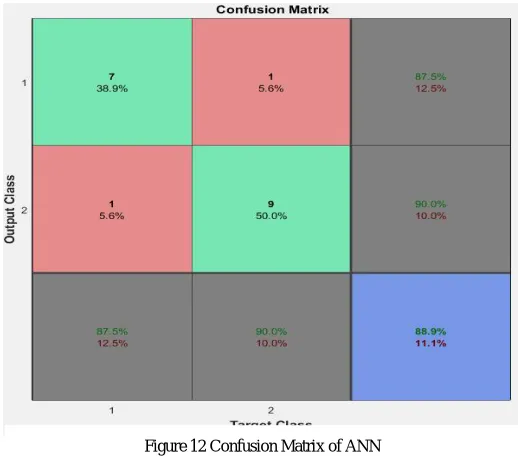
To calculate the performance analysis of ANN model, we have considered 18 images out of which 10 are real face images and 8 are spoofed. True Positive Rate of ANN at False Acceptance rate of 0.2 is 88.8889%. Thus, total accuracy is 88.8889%
Confusion Matrix: In the below matrix,
1) The first row indicates spoof class. Out of 8 face images, 1 has been misclassified as spoof, hence its FAR is 0.1 and its accuracy is 90%
2) The second row indicates real class. Out of 10 face images, 1 has been misclassified as spoof, hence its FAR is 0.1 and its accuracy is 90%
Figure 10Confusion Matrix of SVM
ISSN(Online): 2319-8753 ISSN (Print): 2347-6710
I
nternational
J
ournal of
I
nnovative
R
esearch in
S
cience,
E
ngineering and
T
echnology
(A High Impact Factor & UGC Approved Journal)
Website: www.ijirset.com
Vol. 6, Issue 9, September 2017
Thus, overall accuracy of ANN is 88.8889%.
Table 1 Accuracy of SVM vs ANN
Classifier SVM ANN
No. of Real Face images 10 10
No. of Spoof Face Images 8 8
Total images in testing 18 18
Misclassification of Real face samples 1 1
Misclassification of spoof face samples 0 1
Overall Accuracy % 94.4% 88.8%
Figure 12 Confusion Matrix of ANN
94.40%
88.80%
SVM ANN
Ac
cu
ra
cy
%
Classifier
Accuracy Percentage of Different Classifiers
ISSN(Online): 2319-8753 ISSN (Print): 2347-6710
I
nternational
J
ournal of
I
nnovative
R
esearch in
S
cience,
E
ngineering and
T
echnology
(A High Impact Factor & UGC Approved Journal)
Website: www.ijirset.com
Vol. 6, Issue 9, September 2017
VI.CONCLUSION
Current face biometric systems are very vulnerable to spoofing attacks. Photographs are probably most common source of spoofing attacks. This paper discusses about face spoof detection. Proposed approach analyses face spoof detection based on Image Distortion Analysis (IDA) rather than any other conventional methods. [2] During the analysis, four features where extracted such as Specular Reflection, Blurriness, Chromatic Movement, Colour Diversity. All these four features have been concatenated and the results are then fed to Support Vector Machine classifier and Artificial Neural Network. This system analyses the data collected and revels whether the image is genuine or spoof. As such, going further, we have used SVM and ANN on a training database to find their comparative effectiveness. After checking close to 18 images, we concluded that SVM gives much better results than ANN. SVM showed 94.4% effectiveness while ANN ended up with 88.8%. Extensive experiments are done on a publicly available database containing several real and fake faces and they showed excellent results. [16]
Evaluation of these methods suggest that they are far more accurate than the conventional methods in detecting spoofing. We believe that our approach can also be extended to detect spoofing attacks using masks or 3D models of the face because skin has a very particular texture. [5]
VII. ACKNOWLEDGMENT
I would like to acknowledge my indebtedness and sincere gratitude to my guide Dr.R.R.Sedamkar and co-guide Dr.Sujata Kulkarni for their invaluable guidance, encouragement and kind co-operation during my project and paper work. I would also like to thank anonymous reviewers of this paper for their comments and helpful suggestions. Also, we would like to thank the MSU Public Research University for sharing their face spoof database
REFERENCES
[1] S. Unnikrishnan and A. Eshack, "Face spoof detection using image distortion analysis and image quality assessment," 2016 International Conference on Emerging Technological Trends (ICETT), Kollam, 2016, pp. 1-5.
[2] K. Patel, H. Han and A. K. Jain, "Secure Face Unlock: Spoof Detection on Smartphones," in IEEE Transactions on Information Forensics and Security, vol. 11, no. 10, pp. 2268-2283, Oct. 2016.
[3] Kollreider K., Fronthaler H., Faraj, M.I.,Bigun J., “Real-Time Face Detection and Motion Analysis With Application in Liveness Assessment”, Information Forensics and Security, IEEE Transactions, Vol. 2, pp. 548 - 558, 2007.
[4] Maatta J., Hadid A., Pietikainen, M., “Face spoofing detection from single images using micro-texture analysis”, Biometrics (IJCB), 2011 International Joint Conference, pp. 1 - 7, 2011.
[5] Javier Galbally, SbastienMarcel,JulianFierrez, “Image Quality Assessment for Fake Biometric Detection: Application to Iris, Fingerprint, and Face Recognition”, Image Processing, IEEE Transactions, Vol.23, pp. 710 - 724, 2014.
[6] D. Wen, H. Han and A. K. Jain, "Face Spoof Detection With Image Distortion Analysis," in IEEE Transactions on Information Forensics and Security, vol. 10, no. 4, pp. 746-761, April 2015.
[7] T. Ahonen, A. Hadid and M. Pietikainen, "Face Description with Local Binary Patterns: Application to Face Recognition," in IEEE Transactions on Pattern Analysis and Machine Intelligence, vol. 28, no. 12, pp. 2037-2041, Dec. 2006
[8] D. Menotti et al., "Deep Representations for Iris, Face, and Fingerprint Spoofing Detection," in IEEE Transactions on Information Forensics and Security, vol. 10, no. 4, pp. 864-879, April 2015.
[9] Q. Yang, S. Wang, and N. Ahuja, “Real-time specular highlight removal using bilateral filtering,” in Proc. ECCV, 2010, pp. 87–100.
[10] F. Crete, T. Dolmiere, P. Ladret, and M. Nicolas, “The blur effect: perception and estimation with a new no-reference perceptual blur metric,” in Proc. SPIE: Human Vision and Electronic Imaging XII, 2007
[11] Y. Chen, Z. Li, M. Li, and W.-Y. Ma, “Automatic classification of photographs and graphics,” in Proc. ICME, 2006, pp. 973–976.2014
[12] A. Chetouani, A. Beghdadi and M. Deriche, "Image distortion analysis and classification scheme using a neural approach," 2010 2nd European Workshop on Visual Information Processing (EUVIP), Paris, 2010, pp. 183-186.
[13] D. C. Garcia and R. L. de Queiroz, "Face-Spoofing 2D-Detection Based on Moiré-Pattern Analysis," in IEEE Transactions on Information Forensics and Security, vol. 10, no. 4, pp. 778-786, April 2015.
[14] N. D. Patil and S. V. Kadam, "Face spoof detection techniques: IDA and PCA," 2016 Online International Conference on Green Engineering and Technologies (IC-GET), Coimbatore, 2016, pp. 1-8.
[15] Y. B. Reeba and R. Shanmugalakshmi, "Spoofing face recognition," 2015 International Conference on Advanced Computing and Communication Systems, Coimbatore, 2015, pp. 1-5.
[16] Rajath Kumar M. P., Keerthi Sravan R. and K. M. Aishwarya, "Artificial neural networks for face recognition using PCA and BPNN," TENCON 2015 - 2015 IEEE Region 10 Conference, Macao, 2015, pp. 1-6.
[17] K. Mhou, D. van der Haar and W. S. Leung, "Face spoof detection using light reflection in moderate to low lighting," 2017 2nd Asia-Pacific Conference on Intelligent Robot Systems (ACIRS), Wuhan, China, 2017, pp. 47-52.