*Corresponding author. E-mail: [email protected]
Evolutionary Questions Raised by Cellular Slime Mould Development
SONIA KAUSHIK and VIDYANAND NANJUNDIAH*
Centre for Ecological Sciences, Indian Institute of Science and Jawaharlal Nehru Centre for Advanced Scientific Research, Bangalore 560012
(Received on 9 September 2003; Accepted after revision on 15 October 2003)
The cellular slime moulds (CSMs) are amoeboid organisms whose life cycle can be viewed in two ways. Firstly, because free-living amoebae come together to build bodies, they are ideal models for studying multicellular development in terms of the properties of single cells. Secondly, coming together and partici-pating in an integrated unit implies social behaviour. Consequently differentiation (especially in the advanced CSMs) can be seen as a form of division of labour in which only some amoebae get to transmit their genes to the next generation. Viewed thus, their life cycle is ideally suited for studying the evolutionary basis of cooperation with some members of the cooperating group exhibiting altruistic behviour. The present review takes the second approach. We examine alternative explanations for social behaviour (i.e., multi-cellular development) based on individual-level and group (including kin-group) selection. Non-clonal fruiting bodies are likely to be common in nature; we show a case with at least nine genotypes. The CSMs display both individual and group-level adaptations and both levels of selection operate in their appropriate contexts. The review ends with questions for the future and indicates how studies of CSM development might help to explain the evolution of altruism in this group.
Key Words: Evolution of development, Dictyostelium, Microbial social behaviour, Altruism, Cheating
Introduction
Studies on the evolution of development tend to focuson features such as metamerism, organs of specialisation and body patterns. With some exceptions, they gloss over what has been acknowledged, ever since Weismann (1893), as the most striking feature of multicellularity, division of labour between the germ line and soma. Somatic cells contribute to building bodies and define what we think of as the phenotype. In due course they die and their genes disappear with the death of the body that they have built. The germ line does not contribute to the visible phenotype but the genes that it contains are transmitted to the next generation. Developmental biologists do not often ask why there is a germ line-soma distinction at all. The reason could be that it is so familiar; or, that it is hardly possible to conceive of how things could be otherwise. The usual approach to the difference between the germ line and soma is to look at it as a developmental problem; that is to say, as something that demands an explanation in terms of the causal pathways of gene expression and cellular
Therefore, if we want to understand the origin of somatic cells in a background of unicellular reproductives, we must take into account size increase as a preadaptation. More specifically, almost every one of his publications ranging over the past sixty years illuminates some adaptive aspect of development in the cellular slime moulds (CSMs), the system of interest to us here (Bonner 1991 contains a selection that needs to be updated). The present review touches on something akin to the germ line-soma dichotomy that is found in the asexual life cycle of the CSMs. In these social amoebae the individual genotype has a persistence possessed only by genes, or by DNA segments that form units of recombination, in sexually reproducing organisms.
The evolutionary problem posed by the germ line-soma distinction is this: How can it benefit the genes that are in one cell (a somatic cell) to help genes in another cell (a germ cell) to be transmitted to future generations? There are two reasons behind the lack
of attention paid to this problem. Firstly, development usually involves changes in size, shape and organisation within a confluent group of cells all of which are in constant and, as it were, enforced cooperation with one another. The extent of mutual dependence in the process leaves no room for cellular phenotypes to vary outside narrowly defined limits; development in the higher metazoans is ‘frozen in’. A mutation that results in a somatic cell entering the germ line or a primordial germ cell becoming part of the soma is likely to be so harmful to the body carrying it that it is subject to strong negative selection. Secondly, the problem of division of labour between the germ line and soma seems to have a facile solution. The fertilised egg develops into the embryo and the adult via a series of mitotic divisions; multicellular organisms are clones. Thus the genetic makeup of somatic cells is identical to that of the germ line and the division of labour can be viewed as a mechanism by which somatic cells make use of germ cells as vehicles for passing on their own genes to the next generation (Dawkins 1982).
Figure 1. a-i Life cycle of Dictyostelium discoideum a, Fruiting body; b, Spores; c, Amoebae; d, Loose aggregate; e, Streaming aggregate; f, Mound; g, Slug; h, Early culminants; i, Two macrocysts formed by D. gigantuem stains Scales: the mature fruiting body and slug are about 1mm; spores and amoebae are about 10 µm; and the macrocysts are about 100 µm”.
a b c d
h g f e
[image:2.558.119.446.347.650.2]These limitations do not hold in the cellular slime moulds (CSMs). The CSMsare free-living soil amoebae that grow and divide by mitosis so long as food is plentiful and enter a developmental stage without cell division when the food supply is exhausted (Bonner 1967). In one form of development amoebae form unicellular cysts; in another they construct a much larger cyst after aggregation; and in a third, they build a migratory multicellular structure known as the slug, also after aggregation (figure 1). In the species that have been well studied, the end or terminal state of differentiation, called the fruiting body, consists of an elevated column of dead cells (stalk, equivalent to somatic tissue) that supports a globular mass of live cells (spores, comparable to the germ line) on its top and thereby aids in their dispersal. In some species, well before terminal differentiation has taken place, one can identify presumptive (‘pre’) stalk and spore cells. The presumptive state remains reversible until the fruiting body is built. Pre-stalk and pre-spore cells can transdifferentiate; they can also revert to the feeding stage if food is made available. Because cellular slime mold amoebae form truly multicellular structures, they serve as paradigms for both the evolution of multicellularity and the evolution of altruism in social groups.
One might say that CSM amoebae come together by choice and not because they are born in close proximity. Such being the case, there is no reason why they should be genetically identical; aggregates can contain amoebae of more than one genotype. This raises more starkly the question of why (in an evolutionary sense) only some of the cells that join an aggregate contribute to the next generation whereas the rest die, apparently for the sake of furthering the genetic interests of the survivors. The death of the amoebae that contribute to the stalk is thus an example of behavioural altruism. To the extent that cellular behaviour, including social behaviour, has a genetic basis, the altruism would seem to demand an explanation in terms of the genes that influence cell behaviour. Our aim in this review is to (a) reiterate that in the CSMs, multicellular development and social behaviour are the same thing; and (b) set up a framework within which to discriminate between different explanations for altruistic behaviour in the CSMs such as group selection, kin selection and individual level selection.
Social behaviour and division of labour in the CSMs shows features that are common to other systems in which too a tension exists between individual and group advantage. Only a few instances can be listed here. There are microbial systems (Crespi 2001, Velicer 2003), foremost being the myxobacteria, which display an amazing extent of convergent evolution with the CSMs in that single cells aggregate and build a fruiting body (Kaiser 1986, 1993), a form of social behaviour can be exploited or lost (Velicer et al. 2000, 2002). The volvocine algae display a size-dependent evolutionary trend with a clear somatic segregation being apparent only in the larger-sized species (Kirk 1998, Michod & Nedelcu 2003, Solari et al. 2002), a trend that can also be seen in the CSMs (Bonner 2003a). In the colonial ascidian Botryllus, the fusion of two individuals can result in a competition between cell lineages for populating the germ line or soma (Stoner et al. 1999), resembling a possible competition between CSM amoebae for becoming pre-spores or pre-stalk cells (Buss 1999). The most fascinating analogy to the CSMs is to be found in the social insects, especially the primitively eusocial wasps (Gadagkar & Bonner 1994). The wasp worker is comparable to a pre-stalk amoeba and the queen to a pre-spore amoeba. The analogy extends further. Caste differentiation in Ropalidia marginata can be described in terms that are similar to those used for describing the developmental strategies adopted by starved amoebae of Dictyostelium discoideum. What has been termed ‘coin-tossing’ in the case of D. discoideum (Nanjundiah & Lokeshwar 1984, Nanjundiah & Bhogle 1995) is ‘gambling’ in R. marginata (Gadagkar 1990). The difference is that in the former case the outcome of coin-tossing biases the probability that an amoeba that has joined a group becomes a stalk cell or a spore, whereas in the latter case the gamble has to do with whether being a founder is better or worse than joining a group. The choice of differentiation pathways is influenced by pre-aggregation biases in D. discoideum (reviewed in Nanjundiah & Saran 1992), paralleling pre-imaginal caste biasing in the wasp (Gadagkar et al. 1988). Reproductive dominance of workers by the queen wasp can be compared to dominance by high-quality amoebae (Atzmony et al. 1997).
1985, DeAngelo et al. 1990, Matsuda & Harada 1990, Gadagkar & Bonner 1994, Hilson et al. 1994, Atzmony et al. 1997, Strassmann et al. 2000, Hudson et al. 2002, Queller et al. 2003). Bonner ( 2003a,b) has presented an integrated hypothesis for the evolution of development in the CSMs in which aggregate size plays a crucial role. On the whole, though, the literature on social behaviour in CSMs is richer in theoretical considerations than in empirical data, especially observations made under natural conditions. The present work reviews previous discussions about CSM life cycles as evolutionary problems; sometimes the same aspect is discussed under different heads. In particular, we address the issue of altruism during fruiting body formation with reference to the best-studied species, Dictyostelium discoideum. Unless stated otherwise, our discussions will be with reference to it. Simply because so much more is known about D. discoideum than any other species, we tend to think of it as if its properties are illustrative of CSMs in general; it must be kept in mind that this need not be true. Other CSMs may differ in essential respects from it because they occupy niches that differ in ways unknown to us. Further information can be found in books (Bonner 1967, Raper 1984, Kessin 2001).
Natural History and Phylogeny
The CSMs are a group of eukaryotic amoebae found in soils all over the world; the number of recorded species approaches 100. Oskar Brefeld discovered them in 1869 when he isolated D. mucoroides from horse dung and followed its life cycle. The most commonly used laboratory species, D. discoideum, was isolated from North Carolina (USA) forest soil by Raper in 1935. The size of a CSM amoeba varies from 10 to 15 µm. The amoebae are motile and move by means of pseudopodia. Bacteria are their natural prey but they can also live off yeasts. Reproduction is asexual and leads to an increase in cell numbers by binary fission. It is characteristic of the CSMs that growth and cell division are separated in time from development and differentiation; the latter phases follow after starvation. The conventional end of one developmental cycle and the beginning of the next, the fruiting body, is the stage of hibernation and potential dispersal. The means of dispersal may include passing soil invertebrates, flowing water and, in the case of Acrasis, wind (Bonner 1982). Soil nematodes are predators of the CSMs; but the
nematodes can digest only amoebae, not spores (Kessin et al. 1996), and one can food chain that ends with CSMs being dispersed over very long distances by birds (Suthers 1985). To cope with a range of osmotic conditions, CSM amoebae are equipped with contractile vacuoles and lysosomal enzymes help in the rapid digestion of food. They occur in nature as microcysts, spores or vegetative amoebae in the soil and on tree barks; the relative percentages of the different forms exhibit seasonal variations (Kuserk 1980). Visual evidence of CSM fruiting bodies in nature – on deer scat – has been provided recently by Velicer (2003).
of other metazoans- approximately 59% in Drosophila melanogaster, 54% in the mouse and 57% in the human genome (Campbell et al. 1999). The CSMs fall into two major groups, Acrasids and Dictyostelids (table 1). Of the two, the Acrasids have been little investigated compared to the Dictyostelids.
Acrasids
Acrasids aggregate without breaking up into secondary streams and lack a clear demarcation between spores and stalk cells. To date, no chemoattractant has been identified as being responsible for their aggregation. In the genera Acrasis and Copromyxa,sorocysts (amoebae) pile on top of each other, come above the surface and branch out. All terminally differentiated cells are viable. In Guttulinopsis, the stalk is made of dead cells (Olive 1975). Fonticula shows no division of labour in the sense that every cell differentiates into spores, which rise in the air while extruding an extracellular stalk. Coming together and sticking to each other appears to have the function of raising the mass of amoebae above the substrate level. To the extent that every amoeba participates in sporulation, all get a survival and eventual reproduction (the chances may or may not be the same for all). It may be that the Acrasids retain
relatively primitive evolutionary features and that the appearance of the Dictyostelids, with their morphologically differentiated stalk and spore cells, represents a later evolutionary step. Other than in Guttulinopsis, cell death does not seem to be part of the developmental cycle (Olive 1975, Raper 1984). The majority of Acrasid fruiting bodies consist of viable spores and viable stalk cells. The absence of reproductive division of labour in most of the Acrasids may imply that they lack an advanced communication system such as the Dictyostelids possess (Bonner 1967).
Dictyostelids
Dictyostelid amoebae aggregate in response to self-generated chemoattractants and differentiate into two distinct cell types, spore and stalk, which taken together constitute the fruiting body. The broad features of development and differentiation in Dictyostelid species such as D. mucoroides, D. purpureum, D. giganteum, D. lacteum, and P. violaceum are similar to those in D. discoideum. However, there are differences too (Raper 1984). The chemoattractant used for aggregation, the geometry of aggregation, pattern formation in the slug and fruiting body morphology can all vary. Table1 Characteristic features of Acrasids and Dictyostelids (adapted from Bonner 1967, Olive 1975 and Raper 1984).
Group Type example Characteristics
Acrasids No clear division of labour among cells, fruiting bodies about
1mm in height. No chemoattractant reported.
Guttulina Stalk cells are viable, globular mass of spores atop small stalk.
Copromyxa Stalk cells are viable; spores are borne on branched structures. Guttulinopsis Stalk cells are dead, spores are somewhat differentiated.
Fonticula Mound of cells secretes extracellular stalk tube through which cells propel themselves upward.
Acrasis All cells are alive; spores are borne on branched structures.
Dictyostelids Fruiting bodies with division of labour, size range 1-5 mm.
Aggregation with chemotaxis, can include signal delay.
Dictyostelium Chemoattractant, cAMP. No stalk during slug migration. discoideum Stalk bears single sorus on the top. Presence of basal disc.
Lemon-coloured spore mass.
D. giganteum Chemoattractant, cAMP. Slugs show stalked migration, mature stalks slender and longer than in D. discoideum.
Polysiphondylium Chemoattractant, Glorin (a dipeptide). Stalked migration of violaceum slugs, branched fruiting bodies. Violet-coloured spore mass.
In many species of Dictyostelids the spores contain refractile granules. These can be found on both extremities of spores and also in a central position and are known as polar granules (Hagiwara 1989). Traub and Hohl (1976) drew attention to a curious feature, namely that species with polar granules do not use cyclic AMP as the chemoattractant while species lacking polar granules do. One does not know how general the correlation is.
An elaborate morphogenetic process involving division of labour precedes fruiting body formation and distinguishes the Dictyostelids from the Acrasids. Acytostelium is an exception to the rule. Members of this genus are characterized by the absence of division of labour; following aggregation, all cells secrete an extracellular stalk and differentiate into viable spores (Bonner 1967, Raper 1984). An immediate advantage of coming together and sticking to each other is that a large size protects against the environment by decreasing the surface area relative to the volume. Later, because of large numbers, a mass of amoebae (differentiated or otherwise) can be raised above the substrate level, thereby helping dispersal. Though they may remain viable, in the Acrasids many amoebae end up as stalk cells and not as part of an elevated mass. Therefore on average the chances of dispersal and post-aggregation survival per amoeba that enters an aggregate may be less in the Acrasids than in the Dictyostelids. On the other hand, the fact that there is no cell death probably redresses the balance.
Survival Strategies: Development and Social Behaviour
As long as food is available, amoebae keep growing and dividing and lead a solitary existence. Starvation triggers the multicellular or social phase. During which large numbers of amoebae (typically 103 -105 in D. discoideum) signal to one other, aggregate and undergo a complex developmental cycle. The result is either a fruiting body made up of a dead stalk and a viable spore mass on top of the stalk, or a macrocyst, which may involve a sexual phase.
As in other microorganisms, sporulation or sexual reproduction are responses to the stress of starvation. But CSMs can respond to harsh conditions in one other way, which is by forming microcysts, a solitary means
of survival. Microcyst formation obviously does not involve division of labour. Macrocyst formation begins with aggregation. This is followed by similar but complementary behaviour on the part of two cells that fuse. The fused giant cell becomes a diploid and enters into meiosis, but before doing that it cannibalises the others. Therefore there is some division of labour here. The physical environment and biotic factors may influence the choice of a particular life cycle strategy by an amoeba (Raper 1984).
Microcysts
opportunity to disperse may be traded off against the benefit of allowing for a higher probability of individual survival. Overall, too little is known about the microcyst cycle for us to do more than speculate about its evolutionary connotations.
Macrocysts
Besides the asexual modes of propagation, namely via, fruiting body and microcyst formation, Dictyostelids also possess a sexual mode of reproduction. This involves what is known as the macrocyst cycle. Amoebae can undergo sexual development under conditions of high humidity and darkness when there are individuals of opposite mating types present in the same aggregate. Macrocyst formation begins with aggregation via chemotaxis and the fusion of cells of opposite mating types within the aggregate (Blaskovics & Raper 1957, O’Day 1979). The fused cell, normally binucleate, proceeds to engulf and digest the other cells and develops into an encysted structure known as the macrocyst. Bozzone and Bonner (1982) have shown that the mere presence of a small fraction of cells belonging to a different mating type can cause cells of the majority genotype to fuse. If this is common in nature, the macrocyst is an interesting way of survival but is not a sexual stage. Given appropriate conditions, the macrocyst can germinate. A diploid cell results from nuclear fusion in the binucleate cell. The diploid nucleus undergoes meiosis and gives rise to four haploid progeny, of which one survives to give rise to an amoeba (for details see Urushihara 1992, 1997). Macrocysts seem to have two functions: (i) zygote formation and recombination, and (ii) an alternative resistant stage, without any recombi-nation, probably in response to sudden flooding and especially in homothallic forms (see Bonner 1982, Bozzone & Bonner 1982).
Different mating types have been discovered in many species of cellular slime molds (Clark et al. 1973, Erdös et al. 1975). O’Day and Lewis (1975) showed that diffusible mating type factors mediate macrocyst formation. In the laboratory, D. discoideum can form macrocysts in various combinations including that of the two naturally occurring strains NC4 and V12. Getting them to germinate is generally difficult, though certain pairs of strains readily yield recombinant progeny (Francis 1998). Erdös et al. (1975) tested 42 natural
isolates of D. giganteum, 50 % of which formed macrocysts. In contrast, Clark et al. (1973) say “.. very few of the many strains of cellular slime molds that have been isolated from nature actually form macrocysts”. Evans et al. (1988) used the technique of restriction fragment-length polymorphism (RFLP) to distinguish between Dictyostelium genotypes. They found that wild isolates of D. discoideum shared a minimum of 80% of the observed restriction fragments with NC4, the commonly used laboratory strain originally isolated by Raper in 1935. Francis and Eisenberg (1993)examined D. discoideum strains from the same forest soil from which Raper had originally isolated it. Based on RFLP data, one of the strains seemed to be genetically identical to Raper’s original NC4 isolate - an unlikely outcome if recombination had been frequent in the wild. These results imply that genetic exchange is rare among D. discoideum strains in the wild and that macrocyst formation may not be a common mode of reproduction in nature in this species. Transient diploids can be generated artificially under laboratory conditions and rare mitotic crossovers can be utilized for parasexual genetic analysis (Katz & Sussman 1972). It is not known whether anything similar occurs under natural conditions. According to Kessin (2001), because (i) the multicellular mode in CSMs very likely derived from one or more unicellular ancestors, (ii) starved cells aggregate by chemotaxis before a macrocyst is formed and (iii) the fruiting body is a far more complex structure than the macrocyst, the micro-and macrocyst life cycles could have served as pre-adaptations that favoured the evolution of fruiting bodies. In this regard, Mutzel (1991) drew attention to the occurrence of predation and cannibalism in the macrocyst cycle and said that predatory behaviour might have led to sociality.
Aggregation and Fruiting Body Formation
D. discoideum, D. mucoroides and D. purpureum, come under this category. Sometimes streams break up to give rise to more than one slug. The violaceum type is similar except that streams break up frequently and secondary centres are formed. Species like P. violaceum and D. aureo-stipes display this kind of aggregation. In minutum-type aggregates, amoebae usually aggregate without streaming. This results in solitary or clustered fruiting body formation; D. minutum undergoes this kind of aggregation. The microsporum-type, exemplified by D. microsporum, is similar to the minutum-type during the early stages, but later secondary centre s are formed around the main one; the amoebae go on to form tertiary centre s around the secondary ones.
The well-known second messenger cyclic AMP is the chemoattractant that drives aggregation in D. discoideum and several other Dictyostelid species; P. violaceum (and probably P. pallidum) uses a dipeptide, glorin (Shimomura et al. 1982) and D. lacteum uses pterin (van Haastert et al. 1982). Bonner (1982) alludes to at least 8 distinct chemoattractants in the CSMs and tries to link the diversity of attractants with isolating mechanisms. In proposing that the aggregation signal was pulsatile, relayed from cell to cell and subject to rapid degradation, Shaffer (1961, 1962) anticipated the essential features of what we know today about the pathway which links cAMP signaling, its reception and directed movement by the receiving cell (Parent & Devreotes 1999). Relaying extends the influence of the original centre of signaling and increases the size of the aggregating mass. A fascinating finding is that the cAMP signal in D. discoideum is released in regular periodic bursts every 7 min or so and relayed from cell to cell (Gerisch & Wick 1975, Tomchik & Devreotes 1981); oscillatory movements, presumably driven by oscillatory signal propagation, persist through later stages (Dormann et al. 1998). One can show that given the parameters appropriate to D. discoideum, periodic signaling increases the range of the signal well beyond the range of a steady signal under comparable conditions – that is, given that both require the same expenditure of energy in the long run; other parameter values can tilt the balance in favour of steady signaling (Nanjundiah 1973). Interestingly, periodicity per se appears to be adaptive in another manner. When supplied externally for the purpose of stimulating an aggregationless mutant of D. discoideum to
differentiate, a periodic train of cAMP pulses is significantly more effective than an aperiodic train of the same strength per pulse and the same mean period (Nanjundiah 1988).
D. discoideum is characterized by the stalkless migration of slugs and a well-developed basal disc in fruiting bodies. Slugs exhibit phototaxis and thermotaxis (Bonner et al. 1950) and it has been argued that in conjunction with localized ammonia production, these abilities serve as adaptations that enable them to reach the soil surface (Bonner et al. 1988, 1989). In this species and its close relatives, pre-spore cells are positioned in the posterior of the slug and pre-stalk cells in the anterior, with the spatial pattern being the result of segregation, or sorting out, of cells with different pre-existing tendencies (Bonner 1959, reviewed in Nanjundiah & Saran 1992). Sorting out must entail a great deal of relative movement within aggregates and slugs. By making use of an elegant technique for inducing flat (two-dimensional) slugs to form, Bonner (1998) showed that the pattern of movement was seemingly uncoordinated and random in pre-stalk cells and coordinated and directed towards the anterior in pre-spore cells. His vivid description is ‘gas molecules zipping about inside a balloon’ and ‘a flock of sheep moving down a narrow street’ respectively (Bonner 2000). Internal movement persists through further development and, along with movement of the mass as a whole, is responsible for shaping the fruiting body during culmination (Dormann et al. 1996, 1998). A functional spatial segregation of cell types is achieved very late in development in other species, if achieved at all.
many are traits that have been fixed by drift, how many are side effects of selection for something else or reflect developmental constraints (Bonner 1982), is unknown.
The speed of slug movement increases with size and presumably makes dispersal more efficient, which is yet another adaptive reason for getting into an aggregate and inducing others to get in (Bonner et al. 1953). According to Raper (1984) three species besides D. discoideum have a stalkless migratory stage and one (D. sphaerocephalum) is stalkless when migrating at low temperatures; this means that the majority of known species leave a stalk behind during the migrating slug stage. Often the stalk is aerial. We do not know whether stalked migration is a primitive or an advanced feature. But we can speculate on the possible advantages and disadvantages of leaving behind a stalk during migration. It may be that the loss of the cells that form the stalk is compensated by the ability of the remaining cells to travel a greater distance than they would if all cells conserved their energy and none differentiated into a stalk during migration; Bonner (1982) mentions a fruiting body 22cm long. But this cannot be the whole story, because as said larger aggregates move faster than smaller ones (Bonner et al. 1953). It may be that under natural conditions the long stalk that is left behind means that the period of migration is lengthened and more time is had for seeking out a suitable habitat for fruiting (Bonner 1982). Stalked slugs soar above the substrate before they start culminating, so that besides aiding dispersal the stalk raises cells away from possible toxins in the soil (Gadagkar & Bonner 1994) and reduces the chances of their being eaten by soil predators such as nematodes (Kessin et al. 1996).
Fitness and the Fruiting Body
Forming a microcyst is self-evidently a means of tiding over harsh times and a macrocyst, in addition to fulfilling the same role, can promote genetic exchange, which – for a variety of reasons, not all of them fully clarified (Bell 1982) – is believed to be generally advantageous to the participants. Here we confine our attention to the fruiting body.
For the sake of definiteness let us start with a single amoeba that has just germinated from a spore. Its fitness measured over the entire life cycle has many components. To begin with, there is cell division: the efficiency with which the amoeba makes copies of
stalk cells. Therefore some of the amoebae in an aggregate are more likely to transmit the genes of the founders than the others, and one already has the beginnings of a primitive form of division of labour. An operational definition of fitness will have to incorporate the relative degrees of reproductive success achieved via the spore and stalk pathways.
CSMs without Division of Labour
Protostelium is an asocial species with the same terminal morphology as the others except that here a single cell transforms itself into a spore and extrudes a stalk (Raper 1984). This shows that the evolution of a dispersive stage that was raised above the soil may have preceded the evolution of multicellularity and division of labour.
As has been said, in most Acrasids there is no evidence for division of labour. In some, for instance Guttulina, all terminally differentiated cells are potentially capable of reproduction but it is not known whether their fitnesses are the same. Cells occupy different positions in the multicellular structure and it may be that those situated at the bottom of the fruiting body do not get to disperse as far as the ones at the top. Unfortunately there is no report of the dispersal or survival of the cells in Acrasid fruiting bodies. Acytostelium and Protostelium provide other examples of fruiting body formation without division of labour. In Acytostelium all cells sporulate and secrete an extracellular stalk, which keeps them raised above the substrate.
Purely on mechanical grounds, there are advantages to a cell that can sporulate and secrete an extracellular stalk, to do so as one of many cells (as in Fonticula) rather than by itself (as in Protostelium). The principle depends on a scaling law and is illusstrated by the fable ‘Unity in Strength’ (Aesop 1954). Imagine that a starved amoeba has a fixed amount of resource, measurable in terms of energy, to be partitioned between making a spore and secreting a stalk. It helps if the spore rests on a tall stalk. But there is an upper limit to how much of the resource can be invested in making the stalk, because spore viability drops as the fraction of the energy allocated to building the stalk goes up. A stalk of volume v is the most that a cell can manage. v is given by the formula πππππ. r2 . l where l is the height
and r the radius of the cross-section. Now, given a cylindrical stalk of length l and radius r, the
maximum load (which is to say, the maximum spore weight ) that it can carry before it becomes unstable with respect to an infinitesimal amount of random bending is given by Tmax= πππππ2 E I
2 /4 l 2.
Here I2, which equals π π π π π r4/4, stands for the moment
of inertia of the cross-section and E is the modulus of elasticity of the stalk (which we take to be a characteristic of the material of which it is made) (Landau & Lifshitz 1970, p.98). Also, r2 equals v/
πππππ l. Substituting first for I2 and next for r2, we get
Tmax= πππππE v2/16 l4. This is the relation between the
minimum viable weight of a single spore and the maximum length of stalk that it can secrete. Assume now that instead of one spore we have n spores forming one spore mass and n stalks, each of them of volume v andlength l, forming one large and approximately cylindrical bundle. The volume of this cylinder will be V = n. v and its radius will be R where πππππ. R2 . l = n. v. What is the maximum
load that can be carried by this collective cylinder before it becomes unstable? The answer, as shown by simple substitution, is n2 times, and not n times,
the maximum load that can be carried by one cylinder. In other words, a bundle of ten stalks can carry 100 times the load that a single stalk can before instability sets in. Equivalently, to be assured of the same degree of mechanical stability, each one of ten amoebae that takes part in laying down one stalk tube needs to invest just √1/10, or about 30%, in making a stalk relative to what it needs to invest when sporulating by itself. The extra 70% can be re-directed towards improving spore viability. The viability of the spore would be still higher, of course, if it did not have to use its resources in making a stalk at all but could rest on a stalk made by other amoebae.
to occur. This may be advantageous if the average duration between successive episodes of significant bacterial growth in the same patch of soil is a long one. On the other hand, the natural ecology might be such that there is a relatively short interval between bouts of bacterial growth in the same location. In that case, it might be unimportant to insure for long-term stability of the structure and a less sturdy extracellular stalk might do. Also, the secretion of stalk material must require energy. Other things being equal, then, under natural conditions Acrasid and Acytostelium spores should also be less capable of withstanding long-term starvation than Dictyostelid spores. Perhaps in nature they do not need to remain viable as long as the latter. But all these arguments remain purely speculative in the absence of a detailed knowledge of the relevant ecological conditions.
CSMs with Division of Labour
Division of labour is most clearly exhibited when a sub-set of cells within multicellular groups of Dictyostelid aggregations forms a dead stalk in the course of terminal differentiation. The amoebae that die appear to improve the chances of reproductive success of those that sporulate. When they can be recognised well in advance, as in the case of D. discoideum, they are known as presumptive stalk or pre-stalk cells. Not all CSMs contain identifiable stalk cells (Bonner 1952), but in those that do, pre-stalk cells may also exhibit traits that seem to benefit pre-spore cells, and so benefit spores. For example, in D. discoideum pre-stalk cells are predominantly the providers of the motive force for slug movement and dispersal (Inouye & Takeuchi 1980).
In those cases in which some amoebae die and form a cellular stalk, one must explicitly take into account a possible indirect role of stalk cells in enhancing fitness (at a level to be discussed below). One way to do so is to make the plausible and convenient assumption that pre-stalk and stalk cells aid in dispersal, and that the extent of the aid is a monotonic function of their number. If the whole fruiting body is one clone, a reasonable expression for the fitness of the original amoeba that gave rise to it would be the number of spore cells in the spore mass multiplied by an appropriate function of the number of stalk cells (Nanjundiah 1985, Matsuda & Harada 1990). Symbolically, let N be the total number of amoebae in an aggregate and n the number of
spores that it gives rise to. Ignoring any cells that are lost during migration, the number of stalk cells will be N-n. Given that the stalk aids in dispersal and the spores give rise to amoebae in the next generation, the fitness W will be positively correlated with both n and N-n. The simplest such correlation is expressed by the equation W = n x f(N-n). The choice of a functional form for f is not obvious, nor can we be sure that it makes sense to choose one particular form. What is important is that by representing fitness in this way we see why both stalk and spore cells are required. Too many spores reduce the efficiency of dispersal; a small number of spores make dispersal efficient (because the stalk becomes taller) but at a cost, because the number of propagules is reduced. There is a trade-off between allocating progeny to the stalk and spore pathways and the optimum solution is to direct some to both.
ecological model may in fact yield a power-law for dispersal. The limitation of our analysis is that we have assumed that an aggregate is a single clone. Matsuda and Harada (1990) showed that proportioning persists under somewhat relaxed assumptions about the dispersal function f and that the essence of the argument remains the same as the one sketched above when aggregates are multi-clonal. But before coming to that we need to examine the issue of altruism.
Altruistic Behaviour and Levels of Selection We discuss how the altruism displayed by amoebae that die and contribute to the stalk might be viewed most obviously as an adaptation displayed at the level of the group, and less obviously as an adaptation at the level of the individual amoeba. Group adaptations can be usefully sub-divided into those in which kinship plays an essential role (kin selection) and those in which kinship may exist but has a minor role (group selection).
Group Selection
One can try to account for altruistic behaviour as a group-level adaptation that overrides a tendency to selfish behaviour at the individual level even under circumstances in which the group does not consist of related individuals. We have already given two reasons why joining a group may be better for a starved amoeba than staying alone and both remain valid. Firstly, a large aggregate can migrate faster than a small one. Secondly, it is more cost-effective (in the sense of the benefit to be gained by mechanical stability relative to the resources to be invested) for many spores to rest on a combined stalk than to do so on separate stalks. The second inference was drawn with reference to the case of an extracellular stalk tube but applies just as well for a cellular stalk, though the details of the stability argument can not be the same. Bonner (1982) showed that in D. discoideum the mid-point diameter and height of the stalk are proportional to one another, unlike the conclusion we reached earlier for a secreted cylindrical stalk tube. Both extracellular and cellular stalks provide an additional advantage, that of improved dispersal, which we consider now.
Let us consider a situation in which starved amoebae are present; assume that they can form neither microcysts nor macrocysts. The amoebae aggregate, and we wish to compare two sorts of
aggregates. In one, every amoeba sporulates but remains at the ground level or at the bottom of a crevice in the soil. In another, a few amoebae die and form a stalk, in the process permitting the others, which sporulate, to rise above the ground. Post-aggregative migration might occur in both situations. Suppose that aerial spores are better situated for dispersal than those on the ground. The difference will be meaningful if dispersal is essential in order to ensure that spore germination takes place before the spore viability falls too low. In that case, putting aside the question of whether a group consists of related individuals or not, a group of amoebae that participates in division of labour and building a fruiting body can do better than a group that does not.
Kinship has not entered the picture so far; what we are looking at is the expected benefit that an amoeba (i.e., the genotype whose representative is an amoeba) obtains by taking part in building a stalked fruiting body relative to the expected benefit to it of forming spores alone. In both cases the expectations are to be averaged over many life cycles, in some of which the genotype of interest goes into a spore and in others dies and differentiates into a stalk cell. Kinship can be taken into account in one of two ways. The role of kinship could be passive: that is to say, an amoeba automatically gains additional benefit when many of its daughters participate in building a common fruiting body rather than just one of them doing so. The role of kinship could also be active. Genetic relatedness could influence the probability of sporulation vis-à-vis becoming a stalk cell; in other words, f couldvary between clones and depend on how many clones there are. Once again altruistic behaviour will be favoured in selection between groups. However, in the absence of additional reinforcement (for example, an enhancement of overall group reproduction by the presence of an altruist genotype within the group), a group selection model is inherently unstable. If a mutant that differentiates constitutively into a spore, a ‘cheater’, arises, it will spread unchecked. As we will see, kin selection, which is the name given to group selection in which the group consists of closely related individuals, has the same difficulty. The reason for this is that the success of both group and kin selection depends on a group-level adaptation, in this case the construction of a fruiting body with division of labour.
Kin Selection
Models for kin selection are usually framed in terms of the probability that two individuals in a group share a certain fraction of their genes by common descent. This framework is not so useful if what we are looking at is an asexual life cycle. Of course mutation will generate variation at a slow rate. But while building models, in the absence of genetic exchange, it is difficult to think of relatedness as a continuous variable (however easy it may be to come up with measurements of similarity between two genomes). It is more convenient to think of just two alternatives, individuals sharing all their genes -because they belong to the same clone - or not sharing all their genes.
We will now compare two situations: one in which aggregates are made up of closely related amoebae – ideally, members of a clone, and another
in which many different clones participate in building the same aggregate. In either case fitness will mean inclusive fitness, that is, it will refer to the clone or genotype as unit. In the case of reasonably-sized fruiting bodies of D. discoideum, about 20% of the cells give up their lives and in the process the remaining 80% survive (Nanjundiah & Bhogle 1995). It seems that when the entire fruiting body is built by a single clone, the cost incurred by the founder of the clone as a result of the death of some of its progeny is small relative to the benefit obtained – especially if, as we have just seen, not incurring the cost would imply a very low chance of survival overall. But what if there is more than one clone in a fruiting body?
Division of Labour as an Evolutionary Stable Strategy (ESS)
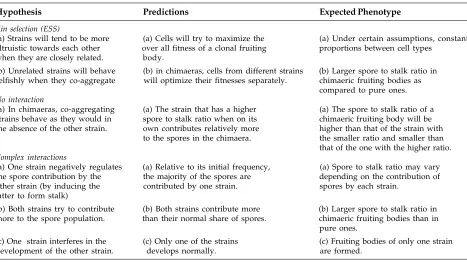
Matsuda and Harada (1990) modelled the decision made by amoebae to follow a stalk or spore pathway to see whether division of labor could be an evolutionary stable strategy (ESS) (Maynard Smith 1982). The ESS was a conditional or mixed strategy, and was dependent on the ability on the part of the amoebae to sense the total number of cells in an aggregate as well as each other’s genetic relatedness. It turns out that in order to accurately model the spore:stalk ratios measured in small fruiting bodies, one needs to assume that the cells that make up an aggregate can sense how many of them there are (Nanjundiah & Bhogle 1995). We do not know how size-sensing might work, but it is not unlikely that it exists, because it is known that amoebae of D. discoideum possess quorum-sensing mechanisms (Brock & Gomer 1999, Okuwa et al. 2001). As shown by the outcome of mixing experiments, CSM amoebae have the ability to distinguish self from non-self (reviewed in Kaushik 2002); but it is not known whether they can also distinguish between members of their clone and others, or sense how many clones there are.
the more genetically diverse that an aggregate was, the more ‘spory’ would be the fruiting body that it gave rise to. Thirdly (in effect explaining the second prediction), the relative number of cells belonging to any single genotype that was allotted to forming spores would increase with the degree of genetic heterogeneity within an aggregate: the level of altruism would fall off as a function of the number of clones in a chimaera.
Hudson et al. (2002) have carried out a comparable but more extensive analysis of the outcomes to be expected in chimaeric aggregates. They too assume that the fitness of a founder cell is proportional to the product of two factors as before. The first factor (fecundity) is the number of spores that differentiate in aggregates consisting of its descendants and the second factor (dispersibility) is an increasing function of the number of stalk cells formed by the same aggregates. On the grounds that spore masses have some expectation of non-zero dispersal by themselves, they explicitly allow for the possibility of a small but positive contribution to fitness by the second factor even in the absence of a stalk. A puzzling feature of their model is that the fecundity and dispersibility both depend on the fraction of cells that form stalk, not – as one would expect - their absolute number. However, since Hudson et al. do not explore the issue of proportioning, their qualitative predictions are similar to those of Matsuda and Harada (1990). But the two models differ with regard to what they have to say about the coexistence of altruist and cheater genotypes (see below).
To sum up, reasonable-looking fitness functions can account for the allocation of some cells to a non-reproductive pathway (those which form the stalk). With the help of subsidiary assumptions whose plausibility is unknown they can also ensure an invariant spore:stalk ratio at the ESS. The ESS is derived by maximizing the fitness of each clone subject to the constraint that every other clone’s fitness is also maximized. It is exists, the ESS is automatically stable with respect to invasion by any other genotype that also allocates amoebae to both the spore and stalk pathways. Whether it is also stable against a ‘cheater’ that differentiates constitutively into spores remains to be examined.
Individual Level Selection
The underlying hypothesis here is that entering an aggregate and participating in the formation of a
fruiting body is an adaptation at the level of the individual cell (Atzmony et al. 1997). The test of the hypothesis of individual selection is to see whether it holds good when an aggregate contains many different genotypes, perhaps as many as the number of cells in it (to take the most extreme case). Then the assertion would be that both an amoeba that sporulates and one that ends up as a stalk cell benefits as an individual amoeba by coming together with the others and building a fruiting body. For this to be true in the case of an amoeba that contributes to the stalk, the assertion can be valid only if one condition is met. Namely, it must be the case that on average, for any amoeba, not joining an aggregate is a poorer option than joining one. This condition can be justified. Firstly, a starved isolated amoeba has extremely limited powers of dispersal, and is guaranteed to die in a relatively short time (Gregg 1971). Secondly, after joining an aggregate, many factors influence the choice of what an amoeba differentiates into. The factors can be summed up as an intrinsic ‘quality’ relative to the qualities of the other amoebae (discussed in Kawli & Kaushik 2001, Kaushik 2002). It is the relative aspect that makes participation in an aggregate an act of ‘coin-tossing’, a gamble on the part of an amoeba. Gambling in the hope of differentiating into a spore is preferable to remaining solitary, because it is impossible for an amoeba to predict in advance whether the other cells in its group will tend to be of higher or lower quality than itself. For this model to work, (i) amoebae in the wild must be heterogeneous with respect to their phenotypic qualities, (ii) the amoebae in an aggregate should be capable of assessing each other’s quality by means of cell-cell signaling and (iii) after aggregation, amoebae should adopt a prestalk or a prespore fate depending on their relative quality.
Quality
groups. For example, the quality of an amoeba could be reflected in its ability to survive prolonged starvation when kept in isolation. Other correlates of quality exist; in the case of some, but not all, one can see right away that the relevant trait might have something to do with fitness.
Amoebae of D. discoideum that are grown in an axenic medium containing high levels of glucose, and are therefore nutritionally well-endowed, tend to form spores when combined with amoebae grown without glucose, which are in comparison nutritionally poorly endowed; the latter tend to form stalk cells (Leach et al. 1973). The important thing is for the two sets of amoebae to have different reserves of metabolisable sugar when they are starved (Takeuchi et al. 1986). Similarly, amoebae that are in the mid- to late G2 phase of the cell cycle when food runs out tend to form spores in mixtures with amoebae that are in late S or early G2, which show a tendency to stalk differentiation (McDonald & Durston 1984, Weijer et al. 1984). Amoebae with relatively low calcium levels at starvation are predisposed to a pre-spore pathway relative to those with higher calcium level, which are predisposed to a pre-stalk pathway (Azhar et al. 2001). It seems intuitively likely that an amoeba that has more energy reserves should be more likely to become a spore than one with relatively lower reserves of energy. However, cell size seems to act opposite to the way in which one would guess: in the beginning, pre-stalk cells can be larger than pre-spore cells (Bonner 1959, Bonner et al. 1985, Saran et al. 1994).
D. discoideum amoebae produce toxic molecules that are membrane-permeable chlorinated phenolic derivatives generically called DIF for ‘differentiation-inducing factor’; the most potent of the DIF isoforms identified, DIF-1 (MW~ 300), induces stalk cell differentiation when supplied at an appropriate concentration (Kay 1997). In the original individual selection model it was hypothesized that the capacity to make DIF-1 and the tendency to resist its effects might be indications of high quality (Atzmony et al. 1997). Both predictions have been borne out in the sense that DIF-1 seems to made by pre-spore cells and is broken down by pre-stalk cells, and nutritionally well-endowed cells are less sensitive to DIF-1 than nutritionally poorly endowed cells (Kay et al. 1993, Thompson & Kay 2000a, 2000b). However, the DIF story is more complicated because a mutant that is unable to make DIF-1 can form slugs
which contain cells that are of pre-stalk as well as pre-spore type; however, it lacks a particular subset of pre-stalk cells (pstO cells; Thompson & Kay 2000b). It may be that in the mutant background, some other molecule takes over the role normally performed by DIF-1 (the role of a coercive agent made by high-quality amoebae that induces low-high-quality amoebae to differentiate into pre-stalk cells). On the other hand, DIF-1 and related compounds may be merely one among a variety of factors used by cells to signal their qualities.
One can try to artificially flatten the quality profile by raising the quality of every member of a population. This has been done by growing amoebae in a sugar-rich medium (Leach et al. 1973), by synchronizing their growth and then starving them at G2-M boundary of the cell cycle (Azhar et al. 2001) and by lowering their calcium levels with the help of an ionophore (Baskar et al. 2000). Amoebae that have been treated in any of these fashions aggregate and form abnormally ‘spory’ fruiting bodies. The complementary experiment of lowering all qualities results in ‘stalky’ fruiting bodies. This lends strength to the supposition that quality is a reflection of a cell’s intrinsic fitness. At the same time, because more or less normal development ensues in spite of the perturbations, intercellular interactions must play an important role in determining the fate of a cell. Since pre-aggregation biases can be shown to exist even when genetically identical amoebae are raised in a uniform environment, the biases, which are indicators of quality differences, must depend on micro-heterogeneities between amoebae (Azhar et al. 2001).
As we will see now, an attractive feature of the individual-selection model is that its outcome is stable with respect to invasion by cheaters.
Cheating
The possibility of simultaneous exploitation by a clonal group of invaders is not implausible and its consequences need to be examined.) How well do the arguments that we have made for altruistic behaviour in the CSMs fare in the presence of cheaters?
A ‘cheater’ can be of many types. It could be an amoeba that (i) invariably differentiates into a spore, never to a stalk cell, and does not influence the behaviour of a co-aggregating partner, (ii) can sporulate and simultaneously manipulate, or exploit, co-aggregating partners so that they contribute more cells than usual to the stalk, or (iii) forms a spore when in a chimaeric aggregate with the wild type ‘altruist’ but, when developing on its own, can form a spore or a stalk cell - (i) and (ii) are illustrative of what might be called unsophisticated cheating and (iii) represents sophisticated cheating. As we have seen earlier, a model of fitness enables us to infer that group fitness is maximised at a certain ratio of spore cell number to stalk height (Nanjundiah 1985). In a clonal group the outcome can also be interpreted as maximising individual fitness. A cheater that differentiates constitutively into spores and invades a wild type aggregate will always have a higher fitness than the fitness of an average wild type cell. It will therefore increase its representation from one generation to another. But as the cheater genotype spreads it reduces the fitness of the group as a whole because proportioning becomes non-optimal. If it is a constitutive, spores-only cheater, it may drive the group to extinction.
One way for the wild type to hold its own is by trying to ensure that in every generation at least some aggregates are made up of wild type clones. Armstrong (1984) discussed conditions that could either favour or inhibit the evolution of cheaters (in his definition, mutant cells which joined wild type aggregates and invariably sporulated). He performed computer simulations of growth and aggregation on a rectangular grid, using very small aggregate sizes (of the order of 100 cells). The wild type could persist in the long run if, following spore dispersal, germination and feeding, amoebae that were derived from different spores were not in close proximity when starvation set in. The inference was that cheating was unlikely to be successful when aggregate sizes were small (aggregates would tend to be founded by single spores and so would consist of clones, a factor which favours division of labour)
or if amoebae migrated large distances in a random fashion while feeding (in which case, once again, clonal groups were likely to form). This line of reasoning was extended by Matapurkar and Watve (1997) who demonstrated that by juggling with the relevant parameters it was theoretically possible to have a weakly oscillatory coexistence of wild type and cheater genotypes.
How do the ESS models discussed above fare in the presence of a cheater? A sophisticated cheater may try to always allocate relatively fewer cells to the stalk than the wild type does. But, as we have seen, this strategy stops working once the pro-portion of wild type cells falls below some critical value, because then the ESS logic implies that all wild type cells differentiate into spores. In short, the wild type recovers and eventually coexists stably with the cheater (which is thus a cheater only in name). An unsophisticated, constitutive cheater will invariably increase in frequency until there are so few wild type cells that all cells in the aggregate differentiate into spores. In the long term, there can be one of three outcomes. One, the system crashes because of extinction (if spore masses without a stalk have zero fitness on account of a very low dispersibility). Two, some wild type clones form and develop into aggregates in the next generation, allowing both genotypes to co-exist (a version of the Matapurkar & Watve picture). Three, the two genotypes persist at a stable relative frequency that is affected only by drift (if a spore mass on its own has some chance of dispersal and an average fitness per spore of greater than zero). In every case, if the cheater is also a manipulator, that is, if the cheater induces the wild type to form more stalk cells than otherwise, the long-term fate of the population, assuming that it persists at all, will be biased even more in favour of the cheater.
that dispersibilty is a function of the relative proportion of cells allocated to the stalk pathway, not of the actual number of stalk cells. Secondly, the chimaeras that they consider do not consist of (for example) a single wild type cell and a number of cheaters. Rather, the chimaeras are made up of the progeny of a single wild type founder cell and the progeny of one or more cheaters. Thirdly, and most difficult to understand, it is assumed that when they form a common fruiting body, wild type and cheater spores have different dispersibilities, the latter being characteristic of a stalkless fruiting body and the former of a stalked fruiting body.
The individual selection model for altruism rests on the assumption that pre-aggregation amoebae are heterogeneous in a functional sense and that they compete for the chance of sporulating (Atzmony et al. 1997). An amoeba’s success in accomplishing this is correlated with where it falls on a scale of quality, in other words on certain aspects (perhaps a large number of aspects) of its phenotype in relation to the rest. Those who fail in the competition are coerced to die and form a stalk. If this is a reasonable picture, the very concept of a cheater loses meaning irrespective of whether there are genetic differences between amoebae or not. To be sure, if a cell arises that has, because of its genotype, a higher quality than the others, its frequency in the population will certainly increase. But, given that small differences between cells are sufficient to discriminate between them, environmental factors will ensure that the qualities of the amoebae belonging to the successful genotype will not be identical. Phenotypic selection will continue to act between the cheater individuals themselves. They too will compete with one another for sporulation and will form a fruiting body in the process. What if the cheater’s genotype imposes constitutive sporulation? Within the framework of an individual selection model such a cheater is better termed a loser; its frequency increases in the short term but declines in the long term for the reasons discussed earlier. A plethora of evidence supports the hypothesis that phenotypic heterogeneity is the fundamental cause of differentiation in D. discoideum (see later). This lends strength to the belief that there must be something to the individual selection-based analysis of why altruistic behaviour is stable. Hudson et al. (2002) use the phrase ‘anticheater adaptations’ to describe why cheating
may not pay in D. discoideum. Thereby they seem to imply something that arose after the evolution altruistic behaviour. If the individual-selection model is correct, ‘anticheater adaptations’ reflect cellular properties correlated with quality that existed prior to the evolution of sociality (and may have become refinforced later).
Experimental Evidence
Behaviour in genetic chimaeras
Genetically diverse amoebae can form chimaeric fruiting bodies in the laboratory (Bonner & Adams 1958, Filosa 1962). They can also contribute disproportionately to the spore population (Buss 1982, Strassmann et al. 2000, Kaushik 2002), raising the possibility of behavioural parasitism. Filosa (1962) studied D. mucoroides cultures obtained from a single sorus collected in the wild and maintained in the laboratory for eight years. When sub-clones were generated from them, morphologically different clones were obtained. On mixing the morphological variants, all deriving from a single strain originally, Filosa saw that cells belonging to different clones mixed to form a common slug and fruiting body. When mixed with the wild type too, the variants gave rise to a common fruiting body, this time with the wild type phenotype. In one case a variant that could form slugs but not fruit by itself did so when mixed with the wild type and preferentially formed spores. Buss (1982) obtained eleven D. mucoroides strains from natural soil within a very small distance (1mm) of each other. On sub-culturing, one strain gave rise to a normally proportioned fruiting body; another one formed just a mass of spores on the substrate. In other words, the latter was a stalkless form. When the stalkless form began in a small minority (0.1%), competition between the two strains resulted in an increase in its frequency; also, in the presence of the stalkless form, the spore contribution of the stalked form decreased by 20%. Thus ‘cheater’ strains do occur in nature and can take advantage of the ‘honest’ cell types. Interestingly, except for the one strain just discussed, other D. mucoroides strains that appeared to develop in a manner similar to the standard wild type did not mix at all with this stalkless form. This points to CSMs having defensive mechanisms to guard against invasion by cheaters.
laboratory strains of D. discoideum; the spore:stalk ratio so defined was taken to reflect the degree of selfishness exhibited by the cells taken as a whole. They concluded that a mixture of the two strains displayed more selfishness (and so a lesser extent of altruism) than either pure strain by itself. The results appeared to indicate an increased tendency to selfish behaviour in groups of unrelated individuals. This was taken as support for the simple ESS-based prediction (Matsuda & Harada 1990), at least qualitatively. But it turned out later that the results were reversed if a rich nutrient medium was used (Hilson et al. 1994). Using microsatellite DNA probes, Strassmann et al. (2000) found that when different wild genotypes of D. discoideum were forced to co-aggregate in the laboratory, sometimes their contributions to the spore population was disproportionate to their representation in the initial mix. In other words, amoebae belonging to on clone could behave more selfishly when mixed with other strains than when by themselves. Recent studies have found no link between genetic heterogeneity and selfish behaviour as reflected by an enhanced spore-forming tendency (Foster et al. 2002, Kaushik 2002). The potential for ‘cheater’-like behaviour was probed in some detail in a particular mutant-wild type chimaera involving a mutant gene (chtA) which appeared to convert mutant cells that found themselves in the company of their wild type counterparts into cheaters (Ennis et al. 2000). By itself, the mutant strain did not develop beyond the slug stage. However, when mixed with wild type cells, mutant amoebae differentiated normally and when they did, they contributed disproportionately to the spore population. At the same time, in the presence of the mutant, wild type amoebae displayed an increased tendency towards the stalk pathway. The chtA gene encodes a protein harbouring an F box and WD 40 repeats. Such proteins are known to regulate the removal of other proteins by targeting them for the ubiquitination-mediated proteolytic degradation pathway. Considering that the chtA strain is unable to differentiate by itself, it may be more appropriate to call the mutant an obligate parasite or an unsophisticated cheater.
The relevance of the findings listed above hinges on the degree of genetic similarity between slime mould populations existing in close proximity in
nature. We discuss this aspect now, and in particular look at how many distinct genotypes might contribute to building one fruiting body.
Genetic Heterogeneity in Nature
Very few studies have been carried out on the degree of genetic relatedness among cellular slime mould populations found in close proximity in the wild (Eisenberg 1976, Kaushik 2002, Fortunato et al. 2003) and, as far as we know, just one on the relatedness between members of an aggregate that forms under reasonably natural conditions (Kaushik 2002, reported below). Eisenberg (1976) found a patchy distribution of CSMs in the soil with up to four species occurring within a 6mm circle. Kaushik (2002), while confirming this finding, extended it by demonstrating that different strains of the same species could be isolated from single particles (ca 1mm) of undisturbed forest soil and moreover, could form genetically heterogeneous aggregates when mixed in the laboratory. Fortunato et al. (2003) report that different clones of D. discoideum co-exist over very small spatial scales in nature (within a soil sample weighing 0.2 gm) and can form chimaeric aggregates when brought together in the laboratory. Indirect but compelling evidence indicates that genetic heterogeneity cannot be uncommon in Dictyostelid aggregates under natural conditions (Filosa 1962, Buss 1982, Francis & Eisenberg 1993, Strassmann et al. 2000), and our own observations support this (see below). The experiments described so far show that there is a potential for conflict between coaggregating amoebae in terms of contributing to the next generation. However, direct evidence for the likelihood of conflict under natural conditions was lacking. An experiments to be described now shows that up to 9 genotypes of Dictyostelium spp. (tentatively identified as D. giganteum) can come together to form a single fruiting body under simulated natural conditions (Kaushik 2002).
experiments 50µl of Klebsiella aerogenes was gently pipetted on to the soil; this was just sufficient to moisten it. In the undisturbed situation Dictyostelium fruiting bodies appeared on plates after 2 to 3 weeks. Presumably bacteria existing in the soil provided whatever food was necessary and the moisture in the agar supplied the requited humidity. In those cases in which bacteria were added, fruiting bodies appeared within a week. Spores were isolated from single fruiting bodies, counted and diluted for cloning. Fruiting bodies were generated from individual spores and DNA was extracted from their spores. The DNA extracted was analyzed with the help of the polymerase chain reaction using 4 randomly generated primers ( opa01, opa03, opa14 and opa18 from Operon Technology, USA). The results were highly reproducible: a clone yielded the same pattern of bands with a given primer. This made it possible to establish that the genotypes present in the original fruiting body were not all the same.
A typical RAPD profile is shown in figure 2. The spores in this particular fruiting body contained at least 9 genotypes. In general, 6 to 9 genetic variants were present in samples of 10 randomly cloned spores from a single fruiting body. In none of the fruiting bodies were all the examined spores from the same clone. Also the degree of genetic relatedness between genotypes was estimated. For the case shown in figure 2, the average degree of relatedness is 0.73 ± 0.15 (using 4 RAPD primers). Interestingly, the value is comparable to the mean within-species relatedness in Dictyostelids isolated from the wild (Kaushik 2002 and unpublished observations), which makes it likely that the co-aggregating amoebae belong to the same species. However, this is only an average value. Spores with as low a level of relatedness as 0.41 (comparable to that between two Dictyostelid species) can be found in the same fruiting body. This shows that fruiting bodies obtained under quasi-natural conditions can originate from a large number of genotypes – and indirectly, that there must be a fair amount of mixing during the phase that covers spore germination, cell division and pre-aggregation movement.
Conclusions: Implications for the Evolution of Altruism
We have shown how a number of features of CSM development can be understood as adaptations. One can write down more than one plausible