Journal of Chemical and Pharmaceutical Research, 2016, 8(3):225-236
Research Article
ISSN : 0975-7384
CODEN(USA) : JCPRC5
Manipulating the stability, solubility, performance of pharmaceutical dosage
forms by controlling the crystal habit of excipients and drugs used
Sandouk Mohamad Louai and Othman Mohamad
Department of Pharmaceutical Technology, Faculty of Pharmacy, Damascus University, Syria
_____________________________________________________________________________________________
ABSTRACT
With the increasing use of poorly soluble drugs, appear problems in production different dosage forms include these substances and in its bioavailability, and therefor in its affects and efficacy, especially for oral ones, and one of the most effective factors, that determine the efficacy of the drug in the body, are the solubility extent of this drug in gastrointestinal track. There are many ways to enhance the solubility of such drugs, such as micronisation of its particles, which increases its surface, other routes are to use the drug as salt form, use co-solvents, use micelles solutions, manipulating its crystal habit, etc (4). these methods depend very much on the physical and chemical properties of the used substance, therefor we cannot assure the success of such methods, as well asthese materials show a lot of technological problems during its producing. In this study we work on different way of paracetamol crystallization, we study the produced crystals of each rotes, we determine its pharmaceutical properties, its compressibility and its different physical characteristics, and we study the tablets that produced using each type of these crystals.
Key words: Paracetamol, crystals, crystal habits, crystallization, direct compression tablets, flow ability of the crystals.
_____________________________________________________________________________________________
INTRODUCTION
effect on the temperature of the solution. Some interfere in crystallization conditions could inhibit one face of the crystal from growing, which produces needle like crystals(8).
There are several factors affect the crystal habit, most common ones: 1- Degree of supersaturation.
2- Rate of cooling and degree of solution agitation(8).
3- Through altering the solvent and co-solvent we can affect the interaction between the solvent and the solute (8). 4- Any materials that could be found in the solution of crystallization, could act as impurities and could adsorb on the crystal lattice and disturb the regular and repeating arrangements of a crystal.
The properties of crystal habit are very important in dosage form formulation and performance, they affect the flow ability and compress ability of the crystals, the symmetric crystals (such cubic ones) are easy to compress and prevent capping in the produced tablets, but the nonsymmetrical ones are not easy to be compressed(8). Successful tableting requires uniform flow from the hopper, proper packing, rearrangement, reduction in porosity, and plastic deformation of particles in the die cavity. The crystal habit affect the compressing mechanically through affecting on hardness and cohesion, which facilitate the compressing, and the crystal habit of the used excipients affect so much in the produced tablets and their properties(19).
One of the ideal ways to alter the solubility characteristic with maintaining other properties is to change the crystal habit without changing the polymorphic of the used substance(17). The determine of the crystal habit and the rout of controlling and predicting the crystal habits of the active ingredient and the excipients in the produced dosage form, is essential in improving and developing the formulation of this dosage form (16).
There are a lot of factors and disturbances that could appear during crystallization process, and could affect the resulting crystals' properties, for example, the presence of impurities affects the kinetic of crystallization (13). Using the traditional ways in crystallization is not less important and not less common than other designed methods(12).
All pharmaceutical dosage forms, regardless of its ingredients, should fulfill several conditions to guaranty their quality, efficacy, and safety, and these conditions are:
1- Dosage uniformity.
2- Capability of application on the patients.
3- Can deliver the active ingredient to the targeted tissue affectively. 4- Able to maintain their effectiveness during shelf storing.
5- Be produced through mechanism that save their performance and is economical reproducible.
It is important to recognize the benefits of the amorphous materials used in the solubility of oral dosage forms (12). The most common dosage forms are the oral solid ones (tablets), because they are the most acceptable and the easiest to used by patients. Most of the used drugs in these dosage forms do not have acceptable properties to be easily compressed or good solubility and stability characteristics, we aim in this research to study the different effects of changing the crystallization methods on Paracetamol crystals, and the changing in their physical and chemical properties and what changes in the performance of the tablets prepared from these crystals.
All kinds of tablets are prepared in a very simple principle, compressing a mixture of powders, but it is not always that easy to achieve that, the mixture should has certain characteristics to form acceptable tablets, such as good flow ability, good compressibility, fully disintegration in the gastrointestinal track, etc (1).
Tablets consist of diluents, binder agent, lubricant, disintegrating agent, coloring agent, flavoring agent, sweetening agent, and the active ingredient.
Paracetamol:
It is N-(4-hydroxyphenyl) acetamide, and used widely as OTC medicine as analgesic, antipyretic, and against inflammatory pains. It is started to be used in the medical field in 1893, and is available in many dosage forms ( tablets, capsules, gel capsules, suppository, oral solution)(7). Its classified as aniline analgesic, and some times from the NSAIDs(2) (20). It is prescribed for headaches and other minority pains. Its effect in the body starts after 11minutes from oral administration, and its half life is 1-4 hours. It shows weak effect as cyclooxygenase(cox) inhibitor, with selective effect on COX-2 (5).
It is found as Wight powder, sparingly soluble in water, freely soluble in alcohol, and very slightly soluble in ether and methelene chloride, and melts in 168-172ºC (3).
Even though it is a very low compressibility drug, it is still used very widely in the solid dosage forms. It has poor flow properties, which can be improved by granulation, which is very costing method(6).
Paracetamol's crystals have three polymorphic shapes, form I, II and III.
Form I ( monoclinic) thermodynamically stable form, that is why it is used in productions of Paracetamol tablets using wet granulating method, with proper plasticizer (11). Form II (orthorhombic) shows better flow ability and compressibility and suffers a plastic deformation during compressing (11). That is why producing tablets from this form attracted a lot of attentions, and it is important to know that this form is easily changed to form I when touching solvent. Form III is recognized in 1982 and has very low stability and is ,therefore, very hard to be isolated (14).
EXPERIMENTAL SECTION
1- Materials:
Paracetamol powder from Ibn Sina Medical company (Syria) patch number 0903494.
Phosphate mono sodium and Phosphate die sodium.
Excipients for the preparation of the tablets (starch, avicel PH102, magnesium stearate and lactose) from Amrit Medical Company (Syria).
2- Methods:
The following equipment has been used in this study: ultrasonic device, Spectrophotometer, Polarized microscope, Büchi melting point device, Pharma-test PT-DT7 for dissolution rate studies, Tapped density measuring device, Compressing machine ( Erwika), Erwika machine to measure tablets' diameter and hardness, Erwika machine to measure tablets' friability, Erwika machine to measure tablets' disintegration time, and Buker FT-IR device, DSC .
RESULTS AND DISCUSSION
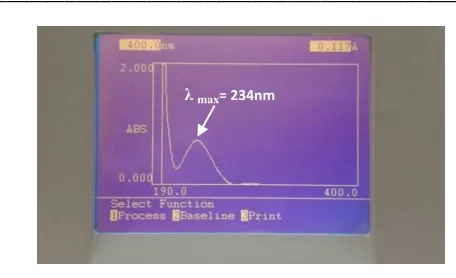
1- Determination of λmax (maximum wave length of absorption) for Paracetamol:
[image:4.595.178.406.93.232.2]
Fig 1. The determination of λmax for Paracetamol
2- Determination of the relationship between the absorption and the concentration of Paracetamol in the solution:
We dissolve 10mg of Paracetamol in the buffer and complete the volume to 100ml to make a solution with concentration C1= 100µg/ml, we take 1ml from this solution and dilute it till 5ml with the buffer to get solution C2= 20µg/ml, from which we prepare a series of concentrations as following:
Table1: standard Series of concentrations
Tube number
Volume from the solution C2 (ml)
Volume from the buffer (ml)
The new concentration µg/ml
Absorption in λmax =
234nm
1 3 0 20 1.208
2 3 1 15 0.816
3 2 2 10 0.548
4 1.5 3.5 6 0.356
5 1 4 4 0.241
6 1 6 2.856 0.174
7 0.5 4.5 2 0.108
[image:4.595.170.421.453.624.2]And figure 2 shows the linier relationship between the concentration and absorption:
Fig.2: The relationship between the concentration and absorption.
This relationship is shown in the equation:
y = 0.0578x +0.0018
And so we are able to calculate the concentration:
x = ( y – 0.0018) / 0.0578
y = 0.057x + 0.001 R² = 0.995
0 0.2 0.4 0.6 0.8 1 1.2 1.4
0 5 10 15 20 25
A b so rp ti o n a t λm a x = 2 3 4 n m Concentration µg/ml
x: the concentration µg/ml. y: absorption when λ= 234nm.
3- Preparation of the crystals and determine their extinction angle:
3-1- Slow cooling rate: We prepare a saturated solution of Paracetamol in distilled water in temperature 65°C, then we let it 24 hours in the roomtemperature25°C, then we isolate the resulted polyhedral crystal ( Fig3), its dimension is : 0.5-1 mm.
Fig3: Paracetamol's crystals, prepared by slow cooling rate
3-2- Fast cooling rate: We prepare a saturated solution of Paracetamol in distilled water in temperature 65°C, then we put it in low temperature to lowering its temperature till 3°C, to have plate like crystals (Fig4), its dimension is: 0.25-0.5 mm.
Fig4: Paracetamol's crystals, prepared by fast cooling rate
0 20 40 60 80 100 120
0 20 40 60 80
D
ru
g
d
is
so
lv
e
%
Time (min)
Fig5: Paracetamol's crystals, prepared by melting the powder
4- Determination of melting point of the crystals:
We put each kind of crystals in a capillaceous tube and put this tube in its place in the melting pint determinations device, we got the following results shown in table 2.
Table2: Melting point.
The crystal habit Melting point ( °C)
Slow cooling rate crystals 165.3ºC Fast cooling rate crystals 166.3ºC Melting crystals 165.7ºC The original powder 167.8ºC
5- Dissolution rate:
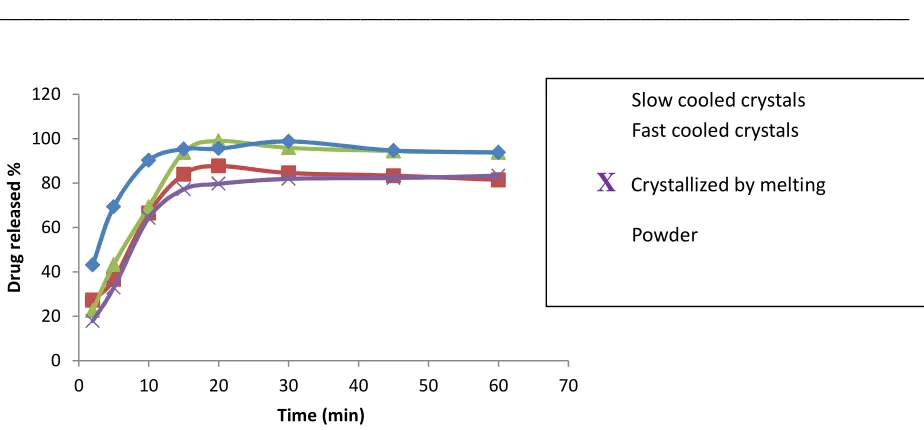
We add 3.25mg Paracetamol (each time we use one of the four forms of it) in 750 ml buffer, in the dissolution rate tester (Pharma-test PT-DT7), and we sat temperature on 37ºC with 50 round per minute, a 5ml of sample was withdrawn at 2,5,10,15,20,30,45, and 60 min intervals replacing 5ml of dissolution medium each time. Then we analysis the dissolution samples by using UV spectrophotometer, then the percentage drug dissolved was calculated by developed UV method:
x = ( y – 0.0018) / 0.0578
x: the concentration µg/ml, and y: absorption when λ= 234nm. The graph of percentage drug dissolve versus time is
shown in Figure 6.
Fig6: Dissolution profile of the four forms of Paracetamol
Slow cooled crystals
X
Fast cooled crystals Crystallized by melting
6- The physical characteristics of the four forms:
6-1- Tapped density: We put weight of the powder (W mg) which has the volume V0 ml, then we tapped it first of
all 10 times , we get V1, for the second time we tapped it 500 times and score the new volume, third time we tapped
it 1500 times, and we keep tapping 1500 times each step till the differ between volumes became less than 2ml, then we had reached the final volume Vf, , we calculate the tapped density by using this equation (18):
Density (g/ml)= W(g)/ V0(ml)
Tapped density(g/ml)= W(g)/ Vf (ml)
6-2- Hausner ratio: It is calculated from the equation:
Hausner Ratio= V0 / Vf
6-3- Compressibility (Car) Index: It can be defined by this equation (16):
Compressibility index%= ×
6-4- Angle of repose: We put the powder in a funnel, and let it flow as the end of the funnel is 2- 4cm over the head of the powder corn, then we measure the diameter of the base and the height of the corn, then calculate the tan (α) from which we find out the angle αº.
We can compare the results in the USP 34(18).
Table3: the results of the compressibility tests
The form of Paracetamol Slow cooling Fast cooling Melting Powder
Tapped density(g/ml) 0.512 0.575 0.749 0.630
Hausner ratio 1.154 1.073 1.207 1.548
Compressibility Index% 13.33 6.82 17.14 35.4
Angle of repose αº 33 29 37 49
Validation Good Excellent Fair Very poor
7-Tablets: We prepared formulation for a 200mg tablet
Paracetamol 100 mg Starch 40 mg
Mg stearate 0.25 mg Lactose 29.75 mg
Then we put the tablets under control by applying the following tests: uniformity of weight. tablet's diameter, hardness, friability, disintegration test, dissolution rate ( by following steps in the dissolution rate of the powders but with the use of tablets) . Table 7 shows the results.
Table 4: The tests on tablets
The form of used Paracetamol Slow cooling Fast cooling Melting Powder
Average weight (mg) 200.45 202.15 200.15 199.3
Average diameter(mm) 9.784 9.790 9.7935 9.787
Hardness (N) 39.17 41 32.7 35.5
Friability (%) 1.82 6.31 2.44 1.09
Disintegration time (sec) 35 20 25 20
0 20 40 60 80 100 120
0 10 20 30 40 50 60 70
D
ru
g
r
e
le
a
se
d
%
[image:8.595.71.533.84.299.2]Time (min)
Figure 7. Dissolution rate test for the four forms of Paracetamol tablets
8- FT-IR:
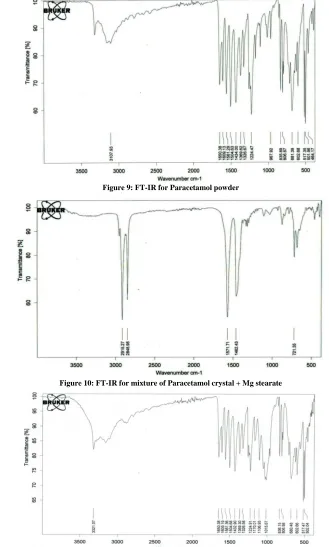
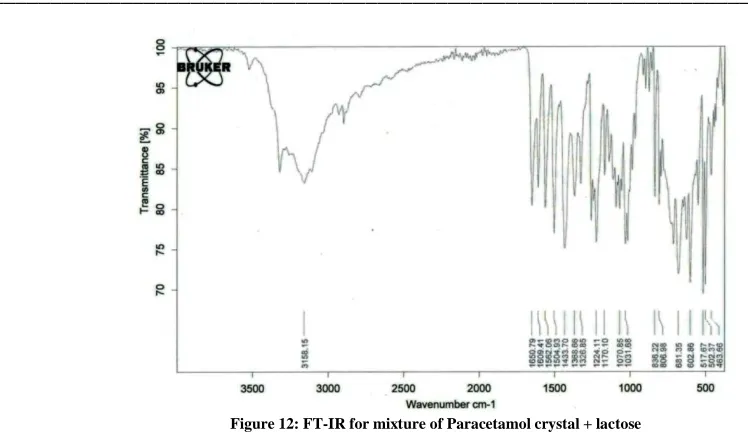
It is used to detect the identity of substances, and to study the different inter actions between its physical mixtures.
A sample of 2 g (of the pure material or a 50:50% mixture) was studied by using the Buker FT-IR, in the range of wave number: 400-4000 cm-1 .
Table 5. The functional groups of Paracetamol (10),(15).
Wave number cm-1
Functional group
1562, 1505, 836 aromatic stretching peaks
1560, 1513 C–N amide stretching peaks
1653, 1610 unsaturated bond
3324, 3162 -OH group
[image:8.595.156.442.513.651.2]The next figures show the IR diagram of crystals of Paracetamol prepared by fast cooling rate, Paracetamol powder, mixture Paracetamol crystals + Mg stearate, mixture Paracetamol crystals+ avicel, and mixture Paracetamol crystals +lactose.
Figure 8: FT-IR for crystals of Paracetamol prepared by fast cooling rate
Slow cooled crystals
Fast cooled crystals
X
Crystallized by melting
Figure 9: FT-IR for Paracetamol powder
Figure 10: FT-IR for mixture of Paracetamol crystal + Mg stearate
Figure 12: FT-IR for mixture of Paracetamol crystal + lactose
9- Deferential Scanning Calorimetry DSC:
Differential scanning calorimetry (DSC) is the most widely used method of thermal analysis within the pharmaceutical field. The approach usually involves the application of a linear heating or cooling signal to a sample and the subsequent measurement of the temperature and energy associated with a range of thermal events including melting, crystallization, glass transitions, and decomposition reactions.
The samples was put in the device and the temperature was turned up from 25ºC to 400ºC with the rate 10ºC/ min.
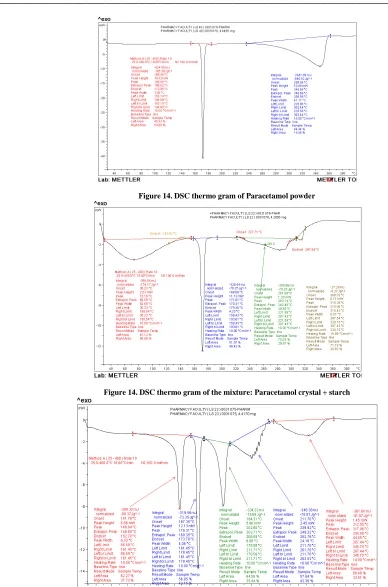
The next thermo gram shows that, both Paracetamol powder and its crystals showed approximately the same sharp characteristic endothermic peak at 168.95ºC.
[image:10.595.169.428.443.620.2]Figure 14. DSC thermo gram of Paracetamol powder
Figure 14. DSC thermo gram of the mixture: Paracetamol crystal + starch
DISCUSSION
• Powders:
It is so clear that the characteristics of Paracetamol has changed with the change of rout of crystallization, which changed in term crystal size and shape. Melting point, even though, did not differ from one crystal habit to another. On the other hand, the dissolution rate and the compressibility has changed, and the best form , which showed the most proper characteristics, was the one prepared by fast cooling rate.
• Tablets:
We noticed the same for the different kinds of tablets, whereat the tablets prepared from the crystals of fast cooling rate method were the most acceptable ones in general, but their friability was a little bit high.
The FT-IR diagram and DSC thermogram both have shown, that Paracetamol different crystals have the same polymorphic structure and the same fingerprint of the Paracetamol powder. And their physical mixture with the used excipients exhibited presence of some interactions between the functional groups of both Paracetamol and the used excipients, it can be related to formation on hydrogen bond and wandervals bonds.
The changing in the crystallization method has affected the physical and chemical properties of the Paracetamol, by changing its crystal habits. The crystals prepared with fast cooling rate route were the most acceptable ones to be used in preparation of tablets by direct compression.
Acknowledgments
The authors gratefully acknowledge the finance support of this work by Damascus university, and the pharmaceutical company Amrit.
REFERENCES
[1]Al Saalloum Issa. Pharmaceutical Thechnology(1) first edition. Tishreen Uni, Faculty of Pharmacy, Syria, 2006. [2]Behera S, Ghanty S, Ahmad F, Santra S, Banerjee S. J Anal Bioanal Tech 3:151. 2012 doi: 10.4172/2155-9872. [3]British Pharmacopoeia Commession, British Pharmacopoeia, 2013; Appendix I D. Buffer Solutions.
[4]Garti, N.; Karpuj, L.; Sarig, S. The effect of solvents and crystallization conditions on crystal habit of cholesterol. Cryst. Res. Technol. 1981.
[5]Hinz B, ChereminaO, Brune K. FASEB 2008 , J22: 383-390.
[6]J. Sebastian Kaerger, Stephen Edge, Robert Price. European Journal of Pharmaceutical Sciences 2004 , 22, 173– 179.
[7]Jadwiga Tritt-Goc, Joanna Kowalczuk. 2002 European Journal of Pharmaceutical Sciences 15, 341–346. [8]James Swarbrick: Encyclopedia of Pharmaceutical Thechnology- third edition, 820-871, New York, USA. [9]JonathanC. Burely, et al. European journal of pharmaceutical sciences 2007, 31, 271–276.
[10]N. Al-Zoubi, J.E. Koundourellis, S. Malamataris. Journal of Pharmaceutical and Biomedical Analysis 2002. 29, 459–467.
[11]N. Al-Zoubi, K. Kachrimanis, S. Malamataris. European Journal of Pharmaceutical Sciences, 2002. 17, 13–21. [12]N. Blagden, M. de Matas, P.T. Gavan, P. York. Advanced Drug Delivery Reviews 2007.59, 617–630.
[13]Nagy, Z.K.; Chew, J.W.; Fujiwara, M.; Braatz, R.D.Advances in the modeling and control of batch crystallizers.Proceedings of the IFAC Symposium on Advanced Controlof Chemical Processes, 2004.Jan 11–14. [14]Simon Gaisford, Asma B.M. Buanz, NadyaJethwa. Journal of Pharmaceutical and Biomedical Analysis 2010. 53 , 366–370.
[15]S Talegaonkar; A Yakoob Khan; R Kishan Khar; F Jalees Ahmad; Z Khan. IJPR, 2007 , Page 95-99. [16]Tiwary, A. Drug Dev. Ind. Pharm. 2001.
[17]Tiwary, A.K.; Panpalia, G.M. Indian J. Pharm. Sci. 2000, 62 (4), 267–272,
[18]United State Pharmacopeia, National Formulary 34 rev, Rockville, United States Pharmacopeial Convention; 2011, 1893.
[19]Veesler, S.; Boistelle, R.; Delacourte, A.; Guyot, J.-C.; Guyot-Herman, A.-M. DrugDev. Ind. Pharm. 1992, 18 (5), 539–560.