Generalised PP-Attachment Disambiguation
using Corpus-based Linguistic Diagnostics
Paola Merlo
Linguistics Department
University of Geneva
2 rue de Candolle
1211 Geneva 4, Switzerland
[email protected]
Abstract
We propose a new formulation of the PP attachment problem as a 4-way classification which takes into account the argument or adjunct status of the PP. Based on linguistic diagnostics, we train a 4-way classifier that reaches an average accuracy of 73.9% (baseline 66.2%). Compared to a sequence of binary classifiers, the 4-way classifier reaches better performance and individ-uates a verb's arguments more accu-rately, thus improving the acquisition of a crucial piece of information for many NLP applications.
1 Motivation
Incorrect attachment of prepositional phrases of-ten constitutes the main source of errors in current parsing systems. Correct attachment of PPs is nec-essary to construct a parse tree which will support the proper interpretation of constituents in the sen-tence. Consider the time-worn example
I saw the man with the telescope
It is important to determine if the PP with the telescope is to be attached as a sister to the noun the man, restricting its interpretation, or if it is to be attached to the verb, thereby indicating the in-strument of the main action described by the sen-tence. Based on examples of this sort, recent ap-proaches have formalised the problem of disam-biguating PP attachments as a binary choice, dis-tinguishing between attachment of a PP to a given verb or to the verb's direct object (Ratnaparkhi et al., 1994; Collins and Brooks, 1995).
This is, however, a simplification of the prob-lem, which does not take the nature of the attach-ment into account. Precisely, it does not distin-guish PP arguments from PP adjuncts. Consider the following example, which contains two PPs, both modifying the verb.
Put the block on the table in the morning The first PP is a locative PP required by the sub-categorisation frame of the verb put, while in the morning is an optional descriptor of the time at which the action was performed. Though both at-tached to the verb, the two PPs entertain different relationships with the verb — the first is an argu-ment while the latter is an adjunct. Analogous ex-amples could be built for attachments to the noun. Is it important to model not just the site but also the nature of the attachment of a PP into the tree structure? We would like to claim that it is. Distinguishing arguments from adjuncts is key to identifying the semantic kernel of a sentence. Ex-tracting the core meaning of a sentence or phrase, in turn, is necessary for automatic acquisition of important lexical knowledge, such as subcategori-sation frames and argument structures, which is used in several NLP tasks and applications, such as parsing or machine translation (Srinivas and Joshi, 1999; Don, 1997). Moreover, from a quan-titative point of view, arguments and adjuncts have different statistical properties, requiring different statistical techniques. For example, (Hindle and Rooth, 1993) clearly indicate that their lexical as-sociation technique performs much better for argu-ments than for adjuncts, whether the attachment is to the verb or to the noun.
native speakers' intuitions and requiring complex world knowledge. The usual expectation has been that this discrimination is not amenable to a corpus-based treatment. In recent work, how-ever, we succeed in distinguishing arguments from adjuncts using evidence extracted from a parsed corpus (Merlo and Leybold, 2001). Our method develops corpus-based statistical correlates for the diagnostics used in linguistics to decide whether a PP is an argument or an adjunct. A numerical vectorial representation of the notion of argument-hood is provided, which supports automatic clas-sification, reaching 86% accuracy. In the current paper, we extend this work and propose a new for-mulation of the PP attachment problem. We treat PP attachment as a 4-way classification of PPs into noun argument PPs, noun adjunct PPs, verb argu-ment PPs, and verb adjunct PPs.
We show that it is possible to build a classifier that solves this problem using corpus evidence, with good accuracy (74%). This classifier solves the classification problem directly, in one step. In-terestingly, we show that a 4-way classifier reaches better accuracy than a two-step sequence of binary classifiers, which first solve the noun-verb attach-ment problem and then refine the attachattach-ment deci-sion into argument or adjunct. This result indicates that the current formulation of the PP attachment problem cannot be considered a first step in the solution of the final 4-way discrimination task. Fi-nally, we note that the improvement is especially due to a better recognition of verbs' arguments, thus providing more accurate information to many NLP tasks and applications.
Solving this novel 4-way classification task cru-cially relies on the ability to distinguish arguments from adjuncts using corpus counts.
2 A Novel Method to Distinguish
Arguments from Adjuncts
Few attempts have been made to distinguish ar-guments from adjuncts automatically (Buchholz, 1999; Merlo and Leybold, 2001; Villavicencio, 2002; Aldezabal et al., 2002). The core difficulty in this enterprise is to define the notion of argu-ment precisely. There is a consensus in linguis-tics that arguments and adjuncts are different both with respect to their function in the sentence and in
the way they themselves are interpreted (Jackend-off, 1977; Marantz, 1984; Pollard and Sag, 1987; Grimshaw, 1990). With respect to their function, an argument fills a role in the relation described by its associated head, while an adjunct predicates a separate property of its associate head or phrase. With respect to their interpretation, a complement is an argument if its interpretation depends ex-clusively on the head with which it is associated, while it is an adjunct if its interpretation remains relatively constant when associating with different heads (Grimshaw, 1990, 108). Restricting the dis-cussion to PPs, these differences are illustrated in the following examples (PP-argument in bold), see also (Schiitze, 1995, 100).
a) Kim camps/jogs/meditates on Sunday b) Kim depended on Sandy
In example a) the PP on Sunday can be con-strued without any reference to the preceding part of the sentence, and it preserves its meaning even when combining with different heads. This is, however, not the case for b). Here, the PP can only be properly understood in connection with the rest of the sentence: Sandy is the person on whom someone depends.
These semantic distinctions surface in observ-able syntactic differences, giving rise to a set of linguistic diagnostics to determine whether a PP is an adjunct or an argument. We illustrate here those countable diagnostics that can be approximated statistically and estimated using corpus counts, thus combining linguistic insight with the robust-ness of corpus-based methods.
3 The Linguistic Diagnostics
Head Dependence Arguments depend on their lexical heads, because they form an integral part of the phrase. Adjuncts do not. Consequently, PP-arguments can only appear with the specific ver-bal or nominal head by which they are lexically selected, while PP-adjuncts can co-occur with a far greater range of different heads than arguments (Pollard and Sag, 1987, 136), as illustrated in the example sentences below (PP-argument in bold). a) a man/woman/scarecrow with gray hair b) a student/*punk/*watermelon of physics
We capture this insight by measuring the disper-sion of the distribution over the different verbs or nouns that co-occur with a given PP in a corpus. We expect adjunct PPs to have higher dispersion than argument PPs. Differently from our previ-ous simpler implementation (Merlo and Leybold, 2001), we use entropy as a measure of the disper-sion of the distribution, as indicated in (1) (h in-dicates the noun or verb head to which the PP is attached).
H(PP) = —E,p(h,)log2p(h,) (1)
Optionality In most cases of verb attachment,' PP-arguments are obligatory elements of a given sentence whose absence leads to ungrammatical-ity, while adjuncts do not contribute to the seman-tics of any particular verb, hence they are optional, as illustrated in the following examples: 2
a) John put the book in the room b) *John put the book
c) John saw/read the book in the room d) John saw/read the book
The notion of optionality can be captured by the conditional probability of a PP given a particular verbal head, P(PP1v).
'We do not compute this measure for nominal heads as PP are always optional when governed by a nominal head.
2Notice that this diagnostics can only be interpreted as a statistical tendency, and not as a strict test, because not all arguments are obligatory (but all adjuncts are indeed op-tional). The best known descriptive exceptions to the crite-rion of optionality are the class of so-called object-drop verbs (Levin, 1993) and, arguably, instrumental verbs (Schatze, 1995). While keeping these exceptions in mind, we maintain optionality as a valid diagnostic here.
Iterativity and Ordering Arguments cannot be iterated and they must be adjacent to the select-ing lexical head. Neither of these two restrictions apply to adjuncts, as illustrated in the examples below.
a) *Chris rented the gazebo to girls, to boys b) Kim met Sandy in Baltimore in the hotel lobby in a corner
Thus, the probability of a PP being an adjunct can be approximated as the probability of its oc-currence in second position in a sequence of PPs, as indicated in (2).
P(ADJ1(PP)1);----- P(PP)2 (2) Copular Paraphrase The diagnostic of copular paraphrase is specific to the distinction of NPs ar-guments and adjuncts (Schiitze, 1995, 103). NP arguments cannot be paraphrased by a copular rel-ative clause (examples b and b'), while adjuncts can (examples a and a').
a) a man from Paris
a') a man who was from Paris b) the weight of the cow
b') *the weight that was of the cow
Thus, the probability that a PP is an adjunct can be approximated by the probability of its occur-rence following a copular verb, such as be, be-come, appear, seem, remain (Quirk et al., 1985), as indicated in (3).
P(ADJ1(PP)) P(copulary < PP) (3)
Deverbal Nouns This diagnostic is based on the observation that PPs following a deverbal noun are likely to be arguments. This diagnostic can be cap-tured by a probability indicators function, that as-signs probability 1 of being an argument to PPs following a deverbal noun and 0 otherwise.
In conclusion, the different properties of argu-ments and adjuncts can be reduced to surface in-dicators, which can be estimated by appropriate corpus counts.
4 Experiments
estimation of the feature vectors used for training. We explain the details of our methodology below. 3 4.1 The Materials
Corpora We construct two corpora comprising examples of PP sequences. A PP is a preposi-tion and head noun sequence. One corpus contains data encoding information for attachment of single PPs in the form of four head words (verb, object noun, preposition and PP-internal noun) for each instance of PP attachments found in the corpus. We also create an auxiliary corpus of sequences of two PPs, where each data item consists of verb, direct object and the two following PPs. This cor-pus is only used to estimate the feature Iterativ-ity. All the data was newly extracted from the Penn Tree-bank. Our goal was to create a more comprehensive and possibly more accurate corpus than existing ones (Merlo et al., 1997; Collins and Brooks, 1995). To improve coverage, we extracted all cases of PPs following transitive, and intran-sitive verbs and following nominal phrases. We include also passive sentences and sentences con-taining a sentential object. To improve accuracy, attention was paid not to extract overlapping data, contrary to counts in previous corpora, where mul-tiple PP sequences were counted more than once, each time as part of a different structural configu-ration.
The Counts The linguistic diagnostics illus-trated in the previous section are approximated by corpus counts based on the extracted tuples.
Head dependence is approximated by the en-tropy of the distribution of the verb or noun heads for each PP, as indicated in (4).
Oki) tog C(h) (4)
H(PP) E,C(h) 2 C(h)
We implement also some more general variants, where PP-internal nouns and head nouns are re-placed by their WordNet 1.7 class (Miller et al., 1990). Polysemous nouns are disambiguated by selecting the most frequent WordNet sense.
Optionality is captured by the conditional prob-ability of a PP given a particular verbal head, as indicated in (5).
3For more detail on the features and experiments, please see (Esteve-Ferrer and Merlo, 2002).
C (v, PP) C(v)
Analogously to the measure of head depen-dence, optionality is also measured in general vari-ants that rely on verb and noun classes, based on WordNet 1.7.
Iterativity and ordering are approximated by collecting counts indicating the proportion of cases in which a given PP in first position had been found in second position in a sequence of multiple PPs over the total of PPs in second position, as in-dicated in (6).
C (PP)2
P(ADJI(PP)i) (6)
E,C(PP2
The problem of sparse data here is especially se-rious, because of the small frequencies of multiple PPs. We estimate this measure in a single variant using a backed-off estimation (Katz, 1987), where we replace lexical items by their WordNet classes. Copular paraphrase is captured by calculating the proportion of times a given PP follows a copu-lar verb over all the times it appears following any verb.
P(ADJI(PP)) C (copular, < PP) (7) EiC(vi < PP)
This measure is an approximation, since we don't know whether the copular verb is indeed in a relative clause or not. Here again, we back-off to the noun classes of the PP-internal noun, to ad-dress the problem of sparse data.
The diagnostic of deverbal nouns is imple-mented as a binary feature that simply indicates if the PP follows a deverbal noun or not. Dever-bal nouns are identified by inspecting their mor-phology (Quirk et al., 1985). The suffixes that can combine with verb bases to form deverbal nouns are -ant (inhabitant), -ee (appointee), -er, or (singer), -age (breakage), -al (refusal), -ion (ex-ploration), -sion (invasion), -ing (building), -ment (arrangement).
In conclusion, the linguistic diagnostics can be approximated by simple statistical indicators es-timated in a sufficiently large corpus. Once the counts are collected they constitute the input to an automatic classifier.
-CLR dative object if dative shift not possible(e.g.
do-nate); phrasal verbs; predication adjuncts
-DTV dative object if dative shift possible (e.g. give) -BNF benefactive (dative object offor)
-PRD non VP predicates -PUT locative complement of put -LGS logical subjects in passives -DIR direction and trajectory -LOC location
-MNR manner
-PRP purpose and reason -TMP temporal phrases
Figure 1: Grammatical function and semantic tags that involve PP constituents in the PTB
The Target Attribute Since we are planning to use a supervised learning method, we need to la-bel each example with a four-valued target at-tribute (the values are Narg, Nadj, Varg, Vadj). The Penn Treebank annotation does not explic-itly make the distinction between arguments and adjuncts. Information about this difference then must be gleaned from the semantic and function tags that have been assigned to the nodes (Bies et al., 1995). Figure 1 illustrates the tags that involve PP constituents. Based on the guidelines (Marcus et al., 1994, 4),(Bies et al., 1995, 12), inspection of the actual annotation in the Tree bank, and dis-cussions in the literature (Quirk et al. 1985, sec-tions 8.27-35, 15.22, 16-48), we mapped PPs into arguments and adjuncts as follows: Adjuncts: All PPs tagged with a semantic tag (DIR, LOC, MNR, PRP, TMP). Arguments: All untagged PPs or PPs tagged with CLR, PUT, DTV, BNF, PRD or LGS.
4.2 The Method
The Input Data Each input vector represents an instance of a PP attachment, which could be both noun or verb attached, either as an argument or as an adj unct.4 Each vector contains 20 training
fea-tures. They comprise the four lexical heads and their WordNet classes, all the different variants of the implementation of the diagnostics, and one 4-valued target feature, indicating the type of attach-ment.
4Notice however that the learning features were calculated
on all the instances described above, so in practice we use both the unambiguous cases and ambiguous cases in the esti-mation of the features of the ambiguous cases.
Experimental Settings We use the C5.0 Deci-sion Tree Induction Algorithm (Quinlan, 1992), applied to a training and testing corpus contain-ing 13906 exemplars, of which we used 90% for training and 10% for testing. The test sets were se-lected by stratified sampling. (Nine samples were created.)
% Accuracy (% Error reduction) Task Base All fts Bst+w Bst+w+c 2+2
4way 65.3 66.2
70.9(16) 72.7(19)
69.9(13) 73.9(23)
71.1(17) 73.9(23) Table 1: Percent accuracy (percent error reduc-tion) using combination of features in the two dif-ferent experimental settings
Each binary classifier reaches good or even the state of the art accuracy for these tasks. Specifi-cally, the classifier disambiguating the noun-verb attachment reaches an accuracy of 80.2% (base-line 71.6%. using only the preposition) using in-formation about argumenthood and 77.2% if the decision tree induction is performed exclusively on the basis of words and classes. The classifier that distinguishes verb arguments from verb ad-juncts performs at an accuracy of 81.1% (baseline 72.3%), while the discrimination of noun argu-ments from noun adjuncts reaches an accuracy of 89.8% (the baseline is already very high, 88.4%.)
5 Results and Discussion
Tables 1 reports the classification accuracy of the two comparative experiments performed. All re-ported numbers are averages of accuracies on 9 different data samples. The first column reports the baseline accuracy for both tasks, calculated by performing the classification using only the fea-ture preposition. The second column shows the results of an experiment where all the features de-scribed above were used for the classification. The third column reports the results in which only the lexical heads and most effective features — deter-mined experimentally — were used. The fourth col-umn reports the results in which the lexical heads and their classes together with the most effective features were used. For the two-step classification experiment, we determined the best feature for each classifier independently. We observe that the 4-way classification is better in both cases, even if the two-step method decomposes the problem in simpler tasks.
The degradation in performance of the two-step approach compared to the 4-way classification is not unexpected and is likely due to the inappro-priate underlying assumptions about the
distribu-tion of the data. A two-step approach assumes that the preferred attachment in the first step subsumes the preferred attachment in the second step. For example, it assumes that a given PP can first be classified as attached to the verb and then refined as a verb argument. Numerically, this assumption is only verified if the largest proportion of cases over the four possible attachments is a subset of the larger proportion of cases in the disambigua-tion between noun and verb attachment. In gen-eral, this assumption holds if the distribution of cases is very skewed. But in some case it does not hold. For example, consider a hypothetical am-biguous PP sequence, distributed across the four possible outcomes with the following proportions: N-arg .25; N-adj .35; V-arg .4; V-adj 0. As can be easily seen, a two-step approach relying directly on the proportion of cases in the data would clas-sify this sequence as an NP attachment at first (.25 + .35 = .6> .4), assigning it to the N-adj class in a second step. However, the most likely assignment in a 4-way classification, and the correct one, is that the PP is an argument of the verb.
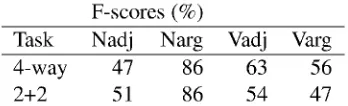
F-scores (%)
Task Nadj Narg Vadj Varg 4-way
2+2
47 51
86 86
63 54
[image:7.595.123.297.86.139.2]56 47 Table 2: Percent F-scores using best features in the two different experimental settings
as noun argument. (Relative frequencies are N-arg .47, N-adj 0, V-arg .44, V-adj .09.)
A more refined analysis of the errors of our classifiers confirms this interpretation. Table 2 shows the F-scores for a sample used in the ex-periment reported in the fourth column of Table 1. As can be seen, the 4-way classification is a little worse for noun attachments (due to worse recall of noun adjuncts) but better for the verb attach-ments. The distribution of the errors reveals that improvements can be observed in distinguishing noun arguments and verb arguments — clearly an instance in which the actual attachment site does not subsume the assigned attachment. This result confirms that it is misleading to formalise PP at-tachment as a binary problem, assuming that a dis-tinction between arguments and adjuncts can be performed later, if necessary, without loss of accu-racy.
The 4-way classification also reveals a little im-provements in the discrimination of verb argu-ments from verb adjuncts (especially fewer verb arguments misclassified as adjuncts). Improve-ments in the precision of verb arguImprove-ments is par-ticularly relevant, as this class of attachments is crucial in supporting further language processing tasks, which usually require precise knowledge of a verb's subcategorization frame.
In conclusion, these results show that good ac-curacy on a fine-grained and informative classifi-cation of PPs can be achieved using corpus counts. Moreover, classification of PPs performed with a single classifier is more accurate than sequencing binary classifiers: by tackling the 4-way discrimi-nation problem directly, the approach does not rely on any assumption on the distribution of the data, and thereby reaches better accuracy. Finally, a re-sult of particular interest is the improved discrimi-nation of verb arguments from verb adjuncts com-pared to a two-step approach, a promising result
for all the numerous NLP tasks and applications that rely on the correct identification of a verb's subcategorization frame.
6 Related Work
As far as we are aware, this is the first attempt to integrate the notion of argumenthood in a more comprehensive formulation of the problem of dis-ambiguating the attachment of PPs. Hindle and Rooth (1993) mention the interaction between the structural and the semantic factors in the disam-biguation of a PP, indicating that verb adjuncts are the most difficult. We confirm their finding that noun arguments are more easily identified, while verb complements (either arguments or adjuncts) are more difficult.
7 Conclusions
We have proposed a reformulation of the problem of PP attachment as a 4-way disambiguation prob-lem, arguing that what is needed in interpreting prepositional phrases is knowledge about both the structural attachment site - the traditional noun-verb attachment distinction - and the nature of the attachment - the distinction of arguments from ad-juncts. Practically, we have shown that a 4-way
classifier which solves the complete problem di-rectly performs better than solving a sequence of binary decisions. Future work lies in further inves-tigating the difference between arguments and ad-juncts to achieve even finer-grained classifications and to model more precisely the semantic core of a sentence.
Acknowledgments
This research was made possible by Swiss NSF grant no. 11-65328.01. I would like to thank Eva Esteve Ferrer for her collaboration.
References
Izaskun Aldezabal, Maxux Aranzabe, Koldo Gojenola, Kepa Sarasola, and Aitziber Atutxa. 2002. Learning argu-ment/adjunct dictinction for Basque. In Procs of the
SIGLEX Workshop on Unsupervised Lexical Acquisition,
pages 42-50, Philadelphia,PA, July.
Ann Bies, M. Ferguson, K.Katz, and Robert MacIntyre. 1995. Bracketing guidelines for Treebank II style. Tech-nical report, University of Pennsylvania.
Sabine Buchholz. 1999. Distinguishing complements from adjuncts using memory-based learning. ILK, Computa-tional Linguistics, Tilburg University.
Michael Collins and James Brooks. 1995. Prepositional Phrase Attachment through a Backed-Off Model. In Procs
of the Third Workshop on Very Large Corpora, pages
27-38, Cambridge, MA.
Bonnie Don. 1997. Large-scale dictionary construction for foreign language tutoring and interlingual machine trans-lation. Machine Translation, 12(4):1-55.
Eva Esteve-Ferrer and Paola Merlo. 2002. Automatic dis-tinction of PP arguments and adjuncts. Technical report, MALA Project 1, University of Geneva.
Jane Grimshaw. 1990. Argument Structure. MIT Press.
Donald Hindle and Mats Rooth. 1993. Structural ambi-guity and lexical relations. Computational Linguistics,
19(1):103-120.
Ray Jackendoff. 1977. X' Syntax: A Study of Phrase
Struc-ture. MIT Press, Cambridge, MA.
S.M. Katz. 1987. Estimation of probabilities from sparse data for the language model component of a speech recog-nizer. IEEE Transactions on Acoustic, Speech and Signal
Processing, 35(3):400-401.
Anna Korhonen. 2002. Semantically motivated subcatego-rization acquisition. In Proc.s of the SIGLEX Workshop on
Unsupervised Lexical Acquisition, pages 51-58,
Philadel-phia,PA, July.
Beth Levin. 1993. English Verb Classes and Alternations. University of Chicago Press, Chicago, IL.
A. Marantz. 1984. On the Nature of Grammatical Relations. MIT Press, Cambridge, MA.
M. Marcus, G. Kim, A. Marcinkiewicz, R.Macintyre, A. Bies, M. Ferguson, K.Katz, and B.Schasberger. 1994. The Penn Treebank: Annotating argument structure. Technical report, University of Pennsylvania.
Paola Merlo and Matthias Leybold. 2001. Automatic dis-tinction of arguments and modifiers: the case of preposi-tional phrases. In Procs of the Fifth Computapreposi-tional
Nat-ural Language Learning Workshop (C0NLL-2001 ), pages
121-128, Toulouse, France.
Paola Merlo, Matt Crocker, and Cathy Berthouzoz. 1997. Attaching multiple prepositional phrases: Generalized backed-off estimation. In Procs of the Second Conference
on Empirical Methods in Natural Language Processing,
pages 145-154, Providence, RI.
George Miller, R. Beckwith, C. Fellbaum, D. Gross, and K. Miller. 1990. Five papers on Wordnet. Technical re-port, Cognitive Science Lab, Princeton University.
Carl Pollard and Ivan Sag. 1987. An Information-based
Syn-tax and Semantics, volume 13. CSLI lecture Notes,
Stan-ford University.
J. Ross Quinlan. 1992. C4.5: Programs for Machine
Learn-ing. Series in Machine LearnLearn-ing. Morgan Kaufmann, San
Mateo, CA.
Randolph Quirk, Sidney Greenbaum, Geoffrey Leech, and Jan Svartvik. 1985. A Comprehensive Grammar of the
English Language. Longman, London.
Adwait Ratnaparkhi, Jeffrey Reynar, and Salim Roukos. 1994. A Maximum Entropy Model for Prepositional Phrase Attachment. In Procs of the ARPA Workshop on
Human Language Technology, pages 250-255.
Carson T. Schiitze. 1995. PP Attachment and Argument-hood. MIT Working Papers in Linguistics, 26:95-151.
Bangalore Srinivas and Aravind K. Joshi. 1999. Supertag-ging: An approach to almost parsing. Computational
Lin-guistics, 25(2):237-265.
Aline Villavicencio. 2002. Learning to distinguish PP argu-ments from adjuncts. In Procs of the 6th Conference on
Natural Language Learning (CoNLL-2002), pages 84-90,