Applying Sentence Simplification to the CoNLL-2008 Shared Task
David VickreyandDaphne Koller
Stanford University Stanford, CA 94305-9010
{dvickrey,koller}@cs.stanford.edu
Abstract
Our submission to the CoNLL-2008 shared task (Surdeanu et al., 2008) focused on applying a novel method for semantic role labeling to the shared task. Our system first simplifies each sentence to be labeled using a set ofhand-constructed rules; the weights of the system are trained on se-mantic role labeling data to generate sim-plifications which are as useful as possible for semantic role labeling. Our system is only a semantic role labeling system, and thus did not receive a score for Syntactic Dependencies (or, by extension, a score for the complete problem). Unlike most sys-tems in the shared task, our system took constituency parses as input. On the sub-task of semantic dependencies, our system obtained an F1 score of 76.17, the high-est in the open task. In this paper we give a high-level overview of the sentence sim-plification system, and discuss and analyze the modifications to this system required for the CoNLL-2008 shared task.
1 Sentence Simplification
The main technical interest of our method is a sen-tence simplification system. This system is de-scribed in depth in (Vickrey and Koller, 2008); for lack of space, we omit many details, including a discussion of related work, from this paper.
Current semantic role labeling systems rely pri-marily on syntactic features in order to identify and classify roles. Features derived from a syntac-tic parse of the sentence have proven parsyntac-ticularly useful (Gildea and Jurafsky, 2002). For example, the syntactic subject of “eat” is nearly always the
c
2008. Licensed under the Creative Commons
Attribution-Noncommercial-Share Alike 3.0 Unported li-cense (http://creativecommons.org/licenses/by-nc-sa/3.0/). Some rights reserved.
S
NP VP
VP
NP PP
Tom wants S
a to
eat VP
NP
NP salad
croutons with
Tom: NP S(NP) VP S VP VP T
NP1 croutons:
VP PP(with)
T salad:
[image:1.595.314.515.212.322.2]NP1 VP T
Figure 1: Constituency parse with path features for verb “eat”.
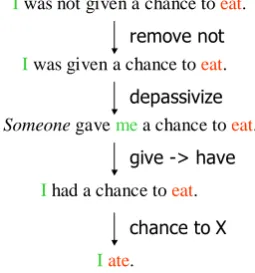
Iwas not given a chance to eat.
Someone gave mea chance to eat.
Ihad a chance to eat.
Iate.
depassivize
give -> have
chance to X Iwas given a chance to eat. remove not
Figure 2:Example simplification
ARG0. An example sentence with extracted path features is shown in Figure 1.
A major problem with this approach is that the path from a phrase to the verb can be quite com-plicated. In the sentence“He expected to receive a prize for winning,”the path from “win” to its ARG0, “he”,
involves the verbs “expect” and “receive” and the preposition “for.” The corresponding path through the parse tree likely occurs a small number of times (or not at all) in the training corpus. If the test set contained exactly the same sentence but with “pected” replaced by “did not expect” we would ex-tract a different parse path feature; therefore, as far as the classifier is concerned, the syntax of the two sentences is totally unrelated.
The idea of our method is to learn a mapping from full, complicated sentences to simplified
[image:1.595.350.478.361.498.2]NP-7
[Someone] VB-5 NP VP-4 give chance NP-2 I VB-5 NP VP-4 give chance NP-2 I S-1 S-1 NP-2 VP-3 VB*-6 VBN-5 be VP-4 Transformed Rule
Replace 3 with 4
Create new node 7 – [Someone]
Substitute 7 for 2 Add 2 after 5 Set category of 5 to VB
[image:2.595.309.531.73.321.2]S NP VP VBD VBN NP was VP given chance I Original
Figure 3: Rule for depassivizing a sentence tences. Figure 2 shows an example of a series of simplifications applied to the sentence “I was not given a chance to eat.” Our method com-bines hand-written syntactic simplification rules with machine learning, which determines which rules to prefer. We then use the output of the sim-plification system as input to an SRL system that is trained to label simplified sentences.
There are several reasons to simplify sentences before doing semantic role labeling. First, ing simplified sentences is much easier than label-ing raw sentences. Second, by mapplabel-ing all sen-tences to a common, canonical form, we can gener-alize more effectively across sentences with differ-ing syntax. Third, our model is effective at shardiffer-ing information across verbs, since most of our simpli-fication rules apply equally well regardless of the target verb. These latter two benefits are particu-larly important for verbs with few labeled training instances; using training examples efficiently can lead to considerable gains in performance.
Note that unlike most participants in the CoNLL-2008 Shared Task (Surdeanu et al., 2008), our model took as input constituency parses as generated by the Charniak parser (specifically, we used the parses provided with the CoNLL-2005 shared task distribution). This was the only labeled data used that was not available in the closed task. 1.1 Transformation Rules
At the center of our sentence simplification system is a hand-written set of transformation rules. A transformation rule takes as input a parse tree and produces as output a different, changed parse tree. Since our goal is to produce a simplified version of the sentence, the rules are designed to bring all sentences toward the same common format.
A rule (see left side of Figure 3) consists of two parts. The first is a “tree regular expression”, a tree fragment with optional constraints at each node. The rule assigns numbers to each node which are referred to in the second part of the rule. Formally, a rule node Xmatchesa parse-tree node A if: (1)
Simplified Original
# Rule Category
I ate the food. Float(The food) I
ate. 5 Floating nodes
He slept. I said he slept.
4 Sentence extraction
Food is tasty. Salt makes food
tasty. 8 “Make” rewrites
The total includes tax. Including tax, the
total… 7 Verb acting as PP/NP
John has a chance to eat. John’s chance to
eat… 7 Possessive
I will eat. Will I eat?
7 Questions
I will eat. Nor will I eat.
7 Inverted sentences
Float(The food) I ate.
The food I ate … 8
Modified nouns
I eat. I have a chance to eat.
7 Verb RC (Noun)
I eat. I am likely to eat. 6
Verb RC (ADJP/ADVP)
I eat. I want to eat.
17 Verb Raising/Control (basic)
I eat. I must eat.
14 Verb Collapsing/Rewriting
I ate. I ate and slept. 8
Conjunctions
John is a lawyer. John, a lawyer, …
20 Misc Collapsing/Rewriting
A car hit me. I was hit by a car.
5 Passive
I slept Thursday. Thursday, I slept.
24 Sentence normalization Simplified Original # Rule Category
I ate the food. Float(The food) I
ate. 5 Floating nodes
He slept. I said he slept.
4 Sentence extraction
Food is tasty. Salt makes food
tasty. 8 “Make” rewrites
The total includes tax. Including tax, the
total… 7 Verb acting as PP/NP
John has a chance to eat. John’s chance to
eat… 7 Possessive
I will eat. Will I eat?
7 Questions
I will eat. Nor will I eat.
7 Inverted sentences
Float(The food) I ate.
The food I ate … 8
Modified nouns
I eat. I have a chance to eat.
7 Verb RC (Noun)
I eat. I am likely to eat. 6
Verb RC (ADJP/ADVP)
I eat. I want to eat.
17 Verb Raising/Control (basic)
I eat. I must eat.
14 Verb Collapsing/Rewriting
I ate. I ate and slept. 8
Conjunctions
John is a lawyer. John, a lawyer, …
20 Misc Collapsing/Rewriting
A car hit me. I was hit by a car.
5 Passive
I slept Thursday. Thursday, I slept.
24 Sentence normalization
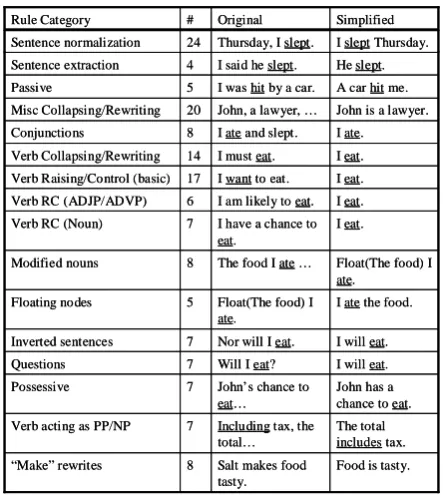
Table 1: Rule categories with sample simplifica-tions. Target verbs are underlined.
All constraints of node X (e.g., constituent cate-gory, head word, etc.) are satisfied by node A. (2) For each child node Y of X, there is a child B of A that matches Y; two children of X cannot be matched to the same child B. There are no other requirements. A can have other children besides those matched, and leaves of the rule pattern can match to internal nodes of the parse (correspond-ing to entire phrases in the original sentence). For example, the same rule is used to simplify both “I had a chance to eat,” and “I had a chance to eat a sandwich,” (into “I ate,” and “I ate a sandwich,”).
The second part of the rule is a series of simple steps that are applied to the matched nodes. For ex-ample, one type of simple step applied to the pair of nodes (X,Y) removes X from its current parent and adds it as the final child of Y. Figure 3 shows the depassivizing rule and the result of applying it to the sentence “I was given a chance.” The trans-formation steps are applied sequentially from top to bottom. Any nodes not matched are unaffected by the transformation; they remain where they are relative to their parents. For example, “chance” is not matched by the rule, and thus remains as a child of the VP headed by “give.”
1.2 Rule Set
[image:2.595.74.298.74.180.2]only one possible sentence and simplification rule from that category; many of the categories handle a variety of syntax patterns. Our rule set was devel-oped by analyzing performance and coverage on the PropBank WSJ training set; neither the devel-opment set nor (of course) the test set were used during rule creation. Please refer to (Vickrey and Koller, 2008) for more details about the rule set.
In the context of the CoNLL-2008 Shared Task, the rule set might be viewed as consisting of out-side information. Since we only submitted a sys-tem to the open task, this was not an issue.
1.3 Generating Simple Sentences
We now describe how to produce all possible sim-plified sentences for a given input sentence. We maintain a set of derived parsesSwhich is initial-ized to contain only the original, untransformed parse. One iteration of the algorithm consists of applying every possible matching transformation rule to every parse in S, and adding all resulting parses to S. With carefully designed rules, re-peated iterations are guaranteed to converge; that is, we eventually arrive at a set Sˆsuch that if we apply an iteration of rule application toSˆ, no new parses are added. Note that we simplify the whole sentence without respect to a particular verb.
We then find all parses inSˆ that have “eat” as the main verb. We call such a parse avalid simple sentence; this is exactly the canonicalized version of the sentence which our simplification rules are designed to produce.
1.4 Labeling Simple Sentences
For a particular sentence/target verb pairs, v, the output from the previous section is a set Ssv =
{tsv
i }i of valid simple sentences. From the train-ing set, we now extract a set of role patterns Gv = {gv
j}j for each verb v. For example, a common role pattern for “give” is that of “I gave him a sandwich”. We represent this pattern as ggive1 = {ARG0 = Subject NP, ARG1 = P ostverb NP2, ARG2 =P ostverb NP1}.
For each simple sentence tsv
i ∈ Ssv, we ap-ply all extracted role patternsgv
j totsvi , obtaining a set of possible role labelings. We call a sim-ple sentence/role labeling pair a simple labeling and denote the set of candidate simple labelings Csv ={csv
k }k.
1.5 Probabilistic Model
Given a (possibly large) set of candidate simple la-belingsCsv, we need to select a correct one. We
Rule = Depassivize
Pattern = {ARG0 = Subj NP, ARG1 = PV NP2, ARG2 = PV NP1} Role = ARG0, Head Word = John
[image:3.595.328.502.488.527.2]Role = ARG1, Head Word = sandwich Role = ARG2, Head Word = I Role = ARG0, Category = NP Role = ARG1, Category = NP Role = ARG2, Category = NP Role = ARG0, Position = Subject NP Role = ARG1, Position = Postverb NP2 Role = ARG2, Position = Postverb NP1
Figure 4:Features for “John gave me a sandwich.”
assign a score to each candidate based on its fea-tures: which rules were used to obtain the simple sentence, which role pattern was used, and fea-tures about the assignment of constituents to roles. The set of extracted features for the sentence “I was given a sandwich by John” with simplification “John gave me a sandwich” is shown in Figure 4.
We now define a log-linear model which as-signs a probability to each candidate simple label-ing based on its score. Specifically, the probability of a simple labelingcsv
k with respect to a weight vectorwisP(csv
k ) = e
wTfksv P
k0e wTfsv
k0 .
Unfortunately, we do not have labeled examples of correct simplifications. To get around this, we treat the correct simplification as a hidden variable. Thus, we say that the probability of a particular semantic role labeling is Pcsv
k ∈KsvP(c
sv
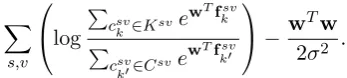
k ). This leads to our final objective,
X
s,v
log
P
csv
k ∈Ksve
wTfsv k P
csv k0∈Csve
wTfsv k0
− wTw
2σ2 .
We train our model by optimizing the objective using standard methods, specifically BFGS. Due to the summation over the hidden variable repre-senting the choice of simplification (not observed in the training data), our objective is not convex. Thus, we are not guaranteed to find a global opti-mum; in practice we have gotten good results using the initialization of setting all weights to 0.
2 Baseline Model
Both our simplification model andBaseline pro-duce labeled constituencies. Since we were re-quired to produce semantic dependency relations, we simply labeled the head word of each con-stituent with the role chosen by the model.
3 Labeling Nouns
The 2008 shared task requires systems to label the arguments of both nouns and verbs. However, our sentence simplification system was built to handle only verbs. While in principle the model can nat-urally be extended to label nouns by the addition of further syntactic simplification rules, we were not able to complete this extension in time for the contest deadline. Instead, we trained ourBaseline model to label the arguments of nouns as well as verbs. The features of this model are the same as those used to label verbs, and were not extended to handle special features of nouns.
4 Identifying Predicates
Another important subtask was to identify the predicates to be labeled. In the labeled training corpus, nouns with no labeled arguments are gen-erally skipped (i.e., not labeled as predicates at all). Thus, we made a strong simplifying assumption: if a predicate (either noun or verb) is labeled by our system as having no arguments, we should not la-bel it as being a predicate. On the development set, out of a total of 6390 labeled predicates, only 23 had no labeled arguments; thus, this assumption appears to be quite reasonable.
Our system architecture was as follows. First, we modified the training (and test) set by mark-ing as a potential predicate every word that was ei-ther: a) a verb that wasn’t “do”, “be”, or “have” or b) a noun found in the nombank index. Then, we trained our system onallpotential predicates (not just predicates that were actually labeled). Finally, after applying our classifier to the test data, we re-moved any predicate with no labeled arguments. 5 Sense-Tagging Predicates
We tried three simple heuristics for sense-labeling the predicates. All of them were applied at theend of our pipeline, and thus did not interact with the argument labeling decisions.
The simplest heuristic labeled every predicate as sense 1. A slightly more intelligent heuristic la-beled every predicate with its most common sense in the training set. Finally, we extended this heuris-tic to label each verb with its most common sense
for the subcategorization (i.e., set of roles) actu-ally produced by the labeling system. Thus, if one sense was intransitive while the other was transi-tive, we would be able to distinguish between them (assuming that our labeling system produced the correct set of arguments). For this third heuristic, we ignored all but the core arguments (ARG0 -ARG5). The final heuristic was the most effective, as discussed in the results section.
6 Results
The first stage ofBaseline, which tries to filter out constituents which are obviously not arguments, took about three hours and approximately 4Gb of memory to train1. The second stage, which per-forms the final classification of arguments, took about four hours and 3Gb of memory to train.
The sentence simplification system, which we will refer to asSimplification, works in two steps. First, it generates the set of all possible simplifi-cations for each sentence. This step took a rela-tively small amount of memory, under 1Gb, but took around 24 hours to complete. The set of sim-plifications is stored in a compact form; the total storage required for all simplifications of all sen-tences was roughly 4 times the (compressed) size of the Charniak input parses. The second step, which trains the model using the possible simplifi-cations, took around 12 hours and 3Gb of memory. We only submitted results for the semantic de-pendencies portion of the competition. The sys-tem we used was theCombinedsystem described in (Vickrey and Koller, 2008), which combines the simplification procedure with the Baseline model. The Combined model was augmented with the modifications described above. Our sys-tem achieved an official F1 score on the SRL subtask of 76.17, the highest in the open task. Our results are not strictly comparable to those in the closed task, due to the use of the Char-niak parser trained on Penn Treebank constituency parses. However, a comparison still provides in-sight into the relative strength of our system; our score would place us tied for fourth in the closed challenge for semantic dependencies.
We will now discuss the relative contributions of various components of our system. All results in this section are for TestWSJ + TestBrown.
Our Combined model provides the same ben-efit over Baseline as described in (Vickrey and
1All runs were done on a dual core 2.66Mhz Xeon
Koller, 2008) for labeling the arguments of verbs2. When applied to just verb predicates, the Com-binedmodel provides a statistically significant im-provement of 1.2 points of F1 score over Base-line. However, since the CoNLL-2008 shared task adds both labeling of noun dependencies and pred-icate identification and sense tagging, the gain due to better labeling arguments of verbs is reduced. TheBaselinemodel achieves an F1 score of 75.31 on the semantic dependencies task, .86 F1 points lower than theCombinedsystem.
Note that while most of this gain is directly due to better verb argument labeling, better verb ar-gument labeling also indirectly slightly improves predicate identification and sense-tagging since we use the predicted arguments for both of of these subtasks. We do in fact see a small increase for labeling and sense-tagging predicates, from 80.72 F1 for theBaselineto 80.81 F1 forCombined.
As mentioned, we useBaselineto label the ar-guments of nouns. Noun argument labeling ap-pears to be more difficult than verb argument la-beling, or at least requires some modification of the features.Baselineobtains an F1 score of 75.64 for verbs, but only 68.19 F1 for nouns.
On the subtask of predicate identification, Com-binedachieved an F1 of 90.65. It performed bet-ter on verbs than nouns. For predicates with part of speech VB*3 it scored 95.43 F1; for predicates with part of speech NN*, it scored 85.97 F1. Verbs without arguments are often labeled in the gold data, so the verb score could perhaps be improved by retaining verb predicates without arguments.
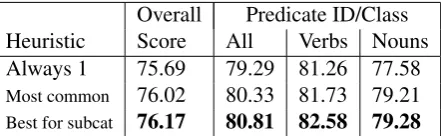
As described above, we tried three heuristics for sense-labeling predicates. Our final system used the third heuristic, which chose the most com-mon sense for the set of labeled arguments pro-duced by the system. Combinedobtained an F1 score of 80.81 on the combined predicate identifi-cation/classification task, with a score of 82.58 for verbs and 79.28 for nouns. The decrease in per-formance by adding classification is much larger for verbs than nouns; verb sense classification is apparently significantly more difficult than noun sense classification (at least for verbal nouns).
Table 2 compares the results of the Combined system using each of the three heuristics. Going
2Note that the scoring metrics are different between the
2005 and 2008 shared tasks. The CoNLL-2005 required the constituent boundaries to be labeled cor-rectly, while the CoNLL-2008 only requires identifying the head word of each argument.
3This category includes some nouns, e.g. gerunds.
Overall Predicate ID/Class
Heuristic Score All Verbs Nouns
Always 1 75.69 79.29 81.26 77.58
Most common 76.02 80.33 81.73 79.21
[image:5.595.309.530.72.140.2]Best for subcat 76.17 80.81 82.58 79.28
Table 2:Relative performance of sense-labeling heuristics
from the simplest heuristic to the third heuristic gained 1.52 points of F1 score on the subtask of predicate identification/classification, and an im-provement of .48 F1 score for the overall seman-tic dependency score. Another interesting thing to note is that all of improvement for noun predicates came from choosing the most common sense in-stead of always choosing sense 1. On the other hand, using subcategorization information is quite important for sense-tagging verbs.
7 Discussion and Future Work
The CoNLL-08 task introduces two new sub-tasks for labeling semantic dependencies: predi-cate identification and predipredi-cate classification. Our experimental results show that both are non-trivial and suggest that there is room for additional im-provement on these subtasks.
We are particularly interested in two extensions to our simplification model related to the 2008 shared task. The first is extending our simplifica-tion model to handle the arguments of nouns. As discussed above, there is a large amount of room for improvement for argument labeling of nouns. The second is incorporating uncertainty from the parser into our model. Specifically, we would like to extract a complete parse forest from the Char-niak parser and use it as input to our model. This would allow our simplification model to jointly reason about the correct parse, possible simplifica-tions of those parses, and semantic role labelings of the resulting simplified sentences.
References
Gildea, D. and D. Jurafsky. 2002. Automatic labeling of semantic roles.Computational Linguistics. Pradhan, S., K. Hacioglu, V. Krugler, W. Ward, J. H.
Martin, and D. Jurafsky. 2005. Support vector learn-ing for semantic argument classification. Machine Learning, 60(1-3):11–39.
Surdeanu, M., R. Johansson, A. Meyers, L. M`arquez, and J. Nivre. 2008. The CoNLL-2008 shared task on joint parsing of syntactic and semantic dependencies. InProceedings of CoNLL.