Accurate Supervised and Semi-Supervised Machine Reading for Long
Documents
Izzeddin Gur∗
Department of Computer Science University of California, Santa Barbara
Daniel Hewlett Google Research [email protected]
Alexandre Lacoste† Element AI
Llion Jones Google Research [email protected]
Abstract
We introduce a hierarchical architecture for machine reading capable of extract-ing precise information from long doc-uments. The model divides the docu-ment into small, overlapping windows and encodes all windows in parallel with an RNN. It then attends over these window encodings, reducing them to a single en-coding, which is decoded into an answer using a sequence decoder. This hierarchi-cal approach allows the model to shierarchi-cale to longer documents without increasing the number of sequential steps. In a super-vised setting, our model achieves state of the art accuracy of 76.8 on the WikiRead-ing dataset. We also evaluate the model in a semi-supervised setting by downsam-pling the WikiReading training set to cre-ate increasingly smaller amounts of su-pervision, while leaving the full unlabeled document corpus to train a sequence au-toencoder on document windows. We evaluate models that can reuse autoen-coder states and outputs without fine-tuning their weights, allowing for more ef-ficient training and inference.
1 Introduction
Recently, deep neural networks (DNNs) have pro-vided promising results for a variety of reading comprehension and question answering tasks ( We-ston et al.,2014;Hermann et al.,2015;Rajpurkar et al.,2016), which require extracting precise in-formation from documents conditioned on a query. While a basic sequence to sequence (seq2seq) model (Sutskever et al., 2014) can perform these
∗Work completed while interning at Google Research. †Work completed while at Google Research.
tasks by encoding a question and document se-quence and decoding an answer sese-quence (Hewlett et al.,2016), it has some disadvantages. The an-swer may be encountered early in the text and need to be stored across all the further recurrent steps, leading to forgetting or corruption; Atten-tion can be added to the decoder to solve this problem (Hermann et al., 2015). Even with at-tention, approaches based on Recurrent Neural Networks (RNNs) require a number of sequential steps proportional to the document length to en-code each document position. Hierarchical read-ing models address this problem by breakread-ing the document into sentences (Choi et al., 2017). In this paper, we introduce a simpler hierarchical model that achieves state-of-the-art performance on our benchmark task without this linguistic structure, and use it as framework to explore semi-supervised learning for reading comprehension.
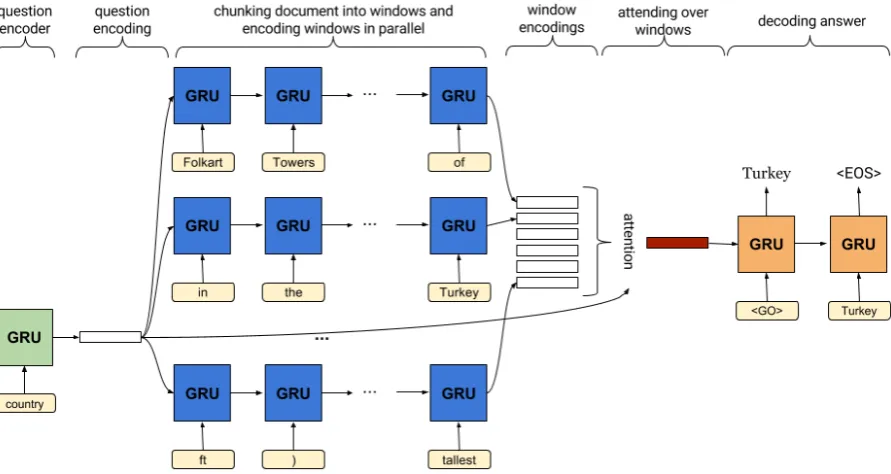
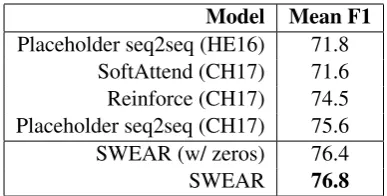
We first develop a hierarchical reader called Sliding-Window Encoder Attentive Reader (SWEAR) that circumvents the aforementioned bottlenecks of existing readers. SWEAR, illus-trated in Figure1, first encodes each question into a vector space representation. It then chunks each document into overlapping, fixed-length windows and, conditioned on the question representation, encodes each window in parallel. Inspired by recent attention mechanisms such as Hermann et al. (2015), SWEAR attends over the window representations and reduces them into a single vector for each document. Finally, the answer is decoded from this document vector. Our results show that SWEAR outperforms the previous state-of-the-art on the supervised WikiReading task (Hewlett et al.,2016), improving Mean F1 to 76.8 from the previous 75.6 (Choi et al.,2017).
While WikiReading is a large dataset with mil-lions of labeled examples, many applications of machine reading have a much smaller number
of labeled examples among a large set of unla-beled documents. To model this situation, we con-structed a semi-supervised version of WikiRead-ing by downsamplWikiRead-ing the labeled corpus into a variety of smaller subsets, while preserving the full unlabeled corpus (i.e., Wikipedia). To take advantage of the unlabeled data, we evaluated multiple methods of reusing unsupervised recur-rent autoencoders in semi-supervised versions of SWEAR. Importantly, in these models we are able to reuse all the autoencoder parameters without fine-tuning, meaning the supervised phase only has to learn to condition the answer on the doc-ument and query. This allows for more efficient training and online operation: Documents can be encoded in a single pass offline and these en-codings reused by all models, both during train-ing and when answertrain-ing queries. Our semi-supervised learning models achieve significantly better performance than supervised SWEAR on several subsets with different characteristics. The best-performing model reaches 66.5 with 1% of the WikiReading dataset, compared to the 2016 state of the art of 71.8 (with 100% of the dataset).
2 Problem Description
Following the recent progress on end-to-end su-pervised question answering (Hermann et al., 2015;Rajpurkar et al.,2016), we consider the gen-eral problem of predicting an answer A given a query-document pair(Q, D). We do not make the assumption that the answer should be present ver-batim in the document.
2.1 Supervised Version
Given a document D = {d1, d2,· · · , dND} and a query Q = {q1, q2,· · ·, qNQ} as sequences of words, our task is to generate a new sequence of words that matches the correct answer A = {a1, a2,· · · , aNA}. Because we do not assume that A is a subsequence of D, the answer may require blending information from multiple parts of the document, or may be precisely copied from a single location. Our proposed architecture sup-ports both of these use cases.
The WikiReading dataset (Hewlett et al., 2016), which includes a mix of categorization and extraction tasks, is the largest dataset match-ing this problem description. In WikiReadmatch-ing, documents are Wikipedia articles, while queries and answers are Wikidata properties and values,
respectively. Example Wikidata property-value pairs are (place of birth, Paris), (genre, Science Fiction). The dataset contains 18.58M instances divided into training, validation, and test with an 85/10/5 split. The answer is present verbatim in the document only 47.1% of the time, severely limiting models that label document spans, such as those developed for the popular SQUAD dataset (Rajpurkar et al., 2016).
2.2 Semi-Supervised Version
We also consider a semi-supervised version of the task, where an additional corpus of documents without labeled (Q, A) pairs is available. Tak-ing advantage of the large size of the WikiReadTak-ing dataset, we created a series of increasingly chal-lenging semi-supervised problems with the fol-lowing structure:
• Unsupervised: The entire document corpus (about 4M Wikipedia articles), with queries and answers removed.
• Supervised: Five smaller training sets cre-ated by sampling a random (1%,0.5%,0.1%) of the WikiReading training set, and taking (200,100) random samples from each prop-erty in the original training set.
3 Supervised Model Architecture
We now present our model, called Sliding-Window Encoder Attentive Reader (SWEAR), shown in Figure 1, and describe its operation in a fully supervised setting. Given a (Q, D) pair, the model encodesQinto a vector space represen-tation with a Recurrent Neural Network (RNN). The first layer of the model chunks the document Dinto overlapping, fixed-length windows and en-codes all windows in parallel with an RNN condi-tioned on the question representation. The second layer attends over the window representations, re-ducing them into a single vector representing the latent answer. Finally, the answer sequence Ais decoded from this vector using an RNN sequence decoder.
3.1 Preliminaries and Notation
Each wordw comes from a vocabularyV and is associated with a vectorew which constitutes the
rows of an embedding matrixE. We denote byeD,
Figure 1: SWEAR model: Boxes are RNN cells, colors indicate parameter sharing.
the document, question, and answer sequences, re-spectively. More specifically, we aim at obtaining vector representations for documents and ques-tions, then generating the words of the answer se-quence.
Our model makes extensive use of RNN en-coders to transform sequences into fixed length vectors. For our purposes, an RNN encoder con-sists of GRU units (Cho et al., 2014) defined as
ht=f(xt;ht−1;θ) (1)
wherehtis hidden state at timet.f is a nonlinear
function operating on input vector xt and
previ-ous state,ht−1 with θbeing its parameter vector. Given an input sequence, the encoder runs over the sequence of words producing the hidden vectors at each step. We refer to the last hidden state of an RNN encoder as theencodingof a sequence.
3.2 Sliding Window Recurrent Encoder The core of the model is a sequence encoder that operates over sliding windows in a manner analo-gous to a traditional convolution. Before encod-ing the document, we slide a window of length l with a step size sover the document and pro-ducen=bND−l
s cdocument windows. This yields
a sequence of sub-documents(D1, D2,· · · , Dn),
where eachDi contains a subsequence oflwords
from the original documentD. Intuitively, a pre-cise answer may be present verbatim in one or
more windows, or many windows may contain ev-idence suggestive of a more categorical answer.
Next, the model encodes each window condi-tioned on a question encoding. We first encode the question sequence once using a RNN (Enc) as
hq=Enc(eQ;θQ) (2)
wherehqis the last hidden state andθQrepresents
the parameters of the question encoder. Initialized with this question encoding, we employ another RNN to encode each document window as
hwi,0 =hq hw
i =Enc(eDi;θW) (3)
wherehw
i,0 is the initial hidden state,hwi is the last
hidden state, andθW represents the parameters of
the window encoder. θW is shared for every
win-dow and is decoupled fromθQ. As the windows
are significantly smaller than the documents, en-codings of windows will reflect the effect of ques-tion encodings better, mitigating any long-distance dependency problems.
3.3 Combining Window Encodings
SWEAR attends over the window encoder states using the question encoding to produce a single vectorhdfor the document, given by
pi ∝exp(uTRtanh(WR[hwi , hq])) (4)
hd=X
i
Model Mean F1 Placeholder seq2seq (HE16) 71.8
[image:4.595.84.278.61.159.2]SoftAttend (CH17) 71.6 Reinforce (CH17) 74.5 Placeholder seq2seq (CH17) 75.6 SWEAR (w/ zeros) 76.4 SWEAR 76.8
Table 1: Results for SWEAR compared to top published re-sults on the WikiReading test set.
HE16 Best SWEAR Categorical 88.6 88.6
Relational 56.5 63.4
[image:4.595.309.525.62.155.2]Date 73.8 82.5
Table 2: Mean F1 for SWEAR on each type of property com-pared with the best results for each type reported in Hewlett et al. (2016), which come from different models. Other pub-lications did not report these sub-scores.
where [.] is vector concatenation, and pi is the
probability windowiis relevant to answering the question.WRanduRare parameters of the
atten-tion model.
3.4 Answer Decoding
Given the document encoding hd, an RNN
de-coder (Dec) generates the answer word sequence:
ha0 =hd
hat =Dec(hat−1;ωA) (6)
P(a∗t =wj)∝exp(eTj(WAhat +bA)) (7)
a∗
t =argmaxj(P(a∗t =wj)) (8)
where ha
0 is the initial hidden state andhat is the
hidden vector at timet. A∗ = {a∗
1, a∗2,· · ·, a∗NA} is the sequence of answer words generated. WA,
bA, and ωA are the parameters of the answer
decoder. The training objective is to minimize the average cross-entropy error between the candidate sequenceA∗ and the correct answer sequenceA.
3.5 Supervised Results
Before exploring unsupervised pre-training, we present summary results for SWEAR in a fully su-pervised setting, for comparison to previous work on the WikiReading task, namely that of Hewlett et al. (2016) and Choi et al. (2017), which we re-fer to as HE16 and CH17 in tables. For further ex-periments, results, and discussion see Section5.2. Table1shows that SWEAR outperforms the best
Doc length pct seq2seq SWEAR imp [0,200) 44.6 79.7 80.7 1.2 [200,400) 19.5 76.7 77.8 1.5 [400,600) 11.0 74.5 76.3 2.3 [600,800) 6.6 72.8 74.3 2.1 [800,1000) 4.3 71.5 72.8 1.8 [1000, max) 14.0 64.8 65.9 1.7
Table 3: Comparison of Mean F1 for SWEAR and a baseline seq2seq model on the WikiReading test set across different document length ranges. pctindicates the percentage of the dataset falling in the given document length range.impis the percentage improvement of SWEAR over baseline.
results for various models reported in both pub-lications, including the hierarchical models Sof-tAttend and Reinforce presented by Choi et al. (2017).1 Interestingly, SoftAttend computes an
attention over sentence encodings, analogous to SWEAR’s attention over overlapping window en-codings, but it does so on the basis of less powerful encoders (BoW or convolution vs RNN), suggest-ing that the extra computation spent by the RNN provides a meaningful boost to performance.
To quantify the effect of initializing the window encoder with the question state, we report results for two variants of SWEAR: InSWEARthe win-dow encoder is initialized with the question en-coding, while inSWEAR w/ zeros, the window en-coder is initialized with zeros. In both cases the question encoding is used for attention over the window encodings. For SWEAR w/ zeros it is ad-ditionally concatenated with the document encod-ing and passed through a 2-layer fully connected neural network before the decoding step. Condi-tioning on the question increases Mean F1 by 0.4. Hewlett et al. (2016) grouped properties by an-swer distribution: Categorical properties have a small list of possible answers, such as countries, Relationalproperties have an open set of answers, such as spouses or places of birth, andDate prop-erties (a subset of relational propprop-erties) have date answers, such as date of birth. We reproduce this grouping in Table 2 to show that SWEAR im-proves performance for Relational and Date prop-erties, demonstrating that it is better able to extract precise information from documents.
Finally, we observe that SWEAR outperforms a baseline seq2seq model on longer documents, as
1Document lengths differ between publications: We
[image:4.595.91.272.201.258.2]shown in Table3. The baseline model is roughly equivalent to the best previously-published result, Placeholder seq2seq (CH17) in Table 1, reach-ing a Mean F1 of 75.5 on the WikiReadreach-ing test-set. SWEAR improves over the baseline in every length category, but the differences are larger for longer documents.
4 Semi-Supervised Model Architecture
We now describe semi-supervised versions of the SWEAR model, to address the semi-supervised problem setting described in Section2.2. A wide variety of approaches have been developed for semi-supervised learning with Neural Networks, with a typical scheme consisting of training an unsupervised model first, and then reusing the weights of that network as part of a supervised model. We consider each of these problems in turn, describing two types of unsupervised autoen-coder models for sequences in Section4.1 before turning to a series of strategies for incorporating the autoencoder weights into a final supervised model in Section4.3. All of these models reuse the autoencoder weights without modification, mean-ing a document can be encoded once by an of-fline process, and the resulting encodings can be used both during training and to answer multiple queries online in a more efficient manner.
4.1 Recurrent Autoencoders for Unsupervised Pre-training
Autoencoders are models that reconstruct their in-put, typically by encoding it into a latent space and then decoding it back again. Autoencoders have recently proved useful for semi-supervised learn-ing (Dai and Le,2015;Fabius and van Amersfoort, 2014). We now describe two autoencoder mod-els from the recent literature that we use for un-supervised learning. The Recurrent Autoencoder (RAE) is the natural application of the seq2seq framework (Sutskever et al.,2014) to autoencod-ing documents (Dai and Le,2015): In seq2seq, an encoder RNN already produces a latent represen-tation hN, which is used to initialize a decoder
RNN. In RAE, the output sequence is replaced with the input sequence, so learning minimizes the cross-entropy between the reconstructed input se-quence and the original input sese-quence. Encoder and decoder cells share parametersθU.
4.1.1 Variational Recurrent Autoencoder The Variational Recurrent Autoencoder (VRAE), introduced by Fabius et al. (2014), is a RAE with a variational Bayesian inference step where an un-observed latent random variable generates the se-quential data. The encoder and decoder are exactly the same as RAE, but the latent statehN is not
di-rectly passed to the decoder. Instead, it is used to estimate the parameters of a Gaussian distribution with a diagonal covariance matrix: The mean is given byµx =WµhN +bµand the covariance by
Σx = WΣhN +bΣ, whereWµ, WΣ, bµ, andbΣ are new variational step parameters. The decoder is initialized with a single vector sampled from this distribution,zx ∼ N(z|µx,Σx). For VRAE,
the Kullback-Leibler divergence between trained Normal distribution and standard normal distribu-tion, i.e., KL(N(µx,Σx)|N(0, I)), is added to
the loss.
4.1.2 Window Autoencoders
We take advantage of the SWEAR architecture by training autoencoders for text windows, as opposed to the standard document autoencoders. These autoencoders operate on the same sliding window subsequences as the supervised SWEAR model, autoencoding all subsequences indepen-dently and in parallel. This makes them easier to train as they only have to compress short se-quences of text into a fixed-length representation. As the task of autoencoding is independent from our supervised problem, we refer to the generated encodings asglobal encodings.
4.2 Baseline: Initialization with Autoencoder Embeddings
Our baseline approach to reusing an unsupervised autoencoder in SWEAR is to initialize all em-beddings with the pre-trained parameters and fix them. We call this model SWEAR-SS (for semi-supervised). The embedding matrix is fixed to the autoencoder embeddings. All other parameters are initialized randomly and trained as in the fully su-pervised version. We found that initializing the encoders and decoder with autoencoder weights hurts performance.
4.3 Reviewer Models
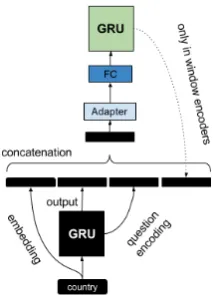
Figure 2: Multi-layer reviewer model (SWEAR-MLR), shown operating over a single window: Black boxes are RNN cells with fixed weights copied from the autoencoder, dia-monds indicate vector concatenation with adapter and FC lay-ers. For simplicity, only the cells in dashed boxes are fully illustrated (detailed in Figure3), but the same structure is re-peated for each cell.
catastrophic forgetting when initializing and fine-tuning SWEAR with pre-trained weights. This includes fixing window encoder parameters with autoencoders and only fine-tuning question coders. Second, conditioning the window en-coders on the question eliminates the possibility to train window representations offline and uti-lize them later which causes a significant overhead during testing.
Inspired by recent trends in deep learning mod-els such as Progressive Neural Networks (Rusu et al., 2016) and Reviewer Models (Yang et al., 2016), we propose multiple solutions to these problems. All of the proposed models process text input first through a fixedautoencoder layer: fixed pre-trained embeddings and fixed RNN encoder parameters, both initialized from the autoencoder weights. Above this autoencoder layer, we build layers of abstraction that learn to adapt the pre-trained models to the QA task.
[image:6.595.75.290.61.211.2]4.3.1 Multi-Layer Reviewer (SWEAR-MLR) The most straightforward extension to the baseline model is to fix the pretrained autoencoder RNN as the first layer and introduce a second, train-ablereviewer layer. To make this approach more suitable for question answering, reviewer layers utilize corresponding global encodings as well as hidden states of the pre-trained autoencoders as input (Figure 2). The aim is to review both pre-trained question and window encodings to com-pose a single vector representing the window con-ditioned on the question.
Figure 3: Detailed illustration of the dashed box in SWEAR-MLR question encoder. Black boxes are fixed parameters and encodings. The window encoder is similar, except that the output of the question reviewer layer is also added to the con-catenated input (dashed line).
Encoding questions: The question is first encoded by the autoencoder layer, h˜q =
Enc(eQ;θU) where both word embeddings (E
andeQ) and encoder (θU) are fixed and initialized
with pretrained parameters. A second, learnable RNN layer then takes the output of the autoen-coder layer and corresponding input embeddings as input and produces the final question encoding, hq = Enc(F C([eQ,˜hq,˜h
t]);θQ) whereF C is a
fully connected layer with ReLU activation func-tion, and˜htis the output of the autoencoder layer
at time stept. Figure 3 illustrates a single time-step of the question encoder.
Encoding windows: Similarly, windows are encoded first by the fixed autoencoder layer and then by a reviewer layer,˜hw
i =Enc(eDi;θU)and
hw
i = Enc(F C([eDi,˜hiw,˜hwt, hq]);θW) where
˜ hw
t is the output of the autoencoder layer at time
step t. Unlike supervised SWEAR, in SWEAR-MLR the window encoder is not initialized with the question encoder state. Instead, the question encoder state is an additional input to each unit in the reviewer layer (illustrated as the dashed line in Figure3). Intuitively, the reviewer layer should reuse the global window and question information and encode only information relevant to the cur-rent question.
[image:6.595.363.470.64.213.2]Figure 4: Progressive reviewer model (SWEAR-PR), shown operating over a single window: Black boxes are RNN cells with fixed weights copied from the autoencoder, diamonds indicate vector concatenation with adapter and FC layers. Dashed boxes contain reviewer layers. Cells within reviewer layers are decoupled as indicated by different colors.
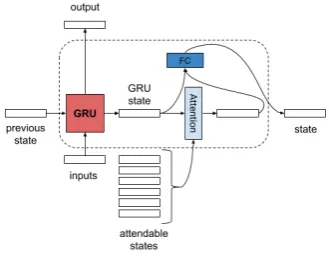
Figure 5: Illustration of attention cell: GRU state is used to attend over attendable states, then final state is computed by concatenating GRU state with context vector and passing through a fully connected neural network.
To address these issues, we now present a Progres-sive Reviewer model (SWEAR-PR) that reviews the outputs of the encoders using a separate RNN that is decoupled from the window size (Figure4). Encoding questions and windows: Similar to SWEAR-MLR, SWEAR-PR first encodes the questions and windows independently using au-toencoder layers, ˜hq = Enc(eQ;θ
U) and˜hwi =
Enc(eDi;θU). To decouple the question and win-dow encoders, however, SWEAR-PR does not have a second layer as a reviewer.
Reviewing questions and windows: SWEAR-PR employs two other RNNs to review the question and window encodings and to compose a single window representation conditioned on the question. Question reviewer takes the same pre-trained question encoding at each time step and attends over the hidden states and input embeddings of the pre-trained question encoder, hq = AttnEnc(F C(˜hq);F C([˜hq
t, eQ]);θQ)
whereAttnEncis an RNN with an attention cell
which is illustrated in Figure 5. Outputs of the fixed autoencoder layer and fixed word embed-dings,[˜hqt, eQ], are the attendable states. Window
reviewer on the other hand takes the pre-trained window encoding and reviewed question encod-ing at each time step and attends over the hidden states of pre-trained window encoder, hw
i =
AttnEnc(F C([˜hw
i , hq]);F C([˜hwt, eDi]);θW)
where outputs of the fixed autoencoder layer and fixed word embeddings, [˜hw
t , eDi], are the
attendable states. As length of the windows is smaller than length of the reviewers, SWEAR-PR has significantly smaller overhead compared to other supervised and semi-supervised SWEAR variants.
4.3.3 Shared Components
Reducing window encodings and decoding: As in the supervised case described in4, both re-viewer models attend over the window encodings using the question encoding and reduce them into a single document encoding. Identical to answer decoding described in 6, the answer is decoded using another RNN taking the document state as the initial state. The parameters of this answer de-coder are initialized randomly.
Adapter layer: As the distribution and scale of parameters may differ significantly between the autoencoder layer and the reviewer layer, we use an adapter layer similar to the adapters in Pro-gressive Neural Networks (Rusu et al., 2016) to normalize the pre-trained parameters:
Wout =a∗tanh(b∗Win) (9)
where a and b are scalar variables to be learnt andWinis a pre-trained input parameter. We put
adapter layers after every pre-trained parameter connecting to a finetuned parameter such as on the connections from pre-trained embeddings to reviewer layer. We use dropout (Srivastava et al., 2014) regularization on both inputs and outputs of the reviewer cells.
5 Experimental Evaluation
[image:7.595.98.263.278.406.2]SWEAR-Model 1% 0.5% 0.1%
SWEAR 63.5 57.6 39.5
[image:8.595.331.500.61.105.2]SWEAR-SS (RAE) 64.7 62.8 55.3 SWEAR-SS (VRAE) 65.7 64.0 60.7
Table 4: Mean F1 results for SWEAR (fully supervised) and SWEAR-SS (semi-supervised) trained on1%,0.5%, and 0.1%subsets, respectively. Variants of SWEAR-SS indicate different sources of fixed encoder weights.2
PR over various subsets of the WikiReading dataset, using SWEAR as a baseline.
5.1 Experimental Setup
Following Hewlett et al. (2016), we use theMean F1metric for WikiReading, which assigns partial credit when there are multiple valid answers. We ran hyperparameter tuning for all models and re-port the result for the configuration with the high-est Mean F1 on the validation set.
The supervised SWEAR model was trained on both the full training (results reported in Sec-tion 3.5) and on each subset of training data (re-sults reported below). Unsupervised autoencoders were trained on all documents in the WikiRead-ing trainWikiRead-ing set. We selected the autoencoder with the lowest reconstruction error for use in semi-supervised experiments. After initialization with weights from the best autoencoder, learnable parameters in the semi-supervised models were trained exactly as in the supervised model.
Training Details
We implemented all models in a shared frame-work in TensorFlow (Abadi et al.,2016). We used the Adam optimizer (Kingma and Ba,2014) for all training, periodically halving the learning rate ac-cording to a hyperparameter. Models were trained for a maximum of 4 epochs.
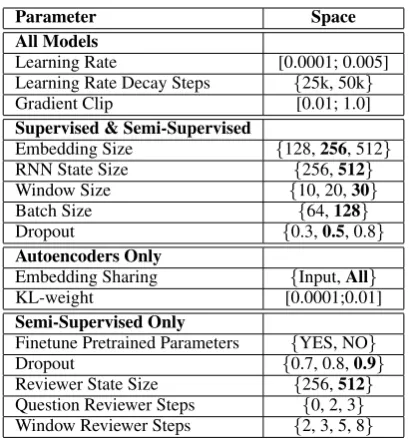
Table 7 shows which hyperparameters were tuned for each type of model, and the range of values for each hyperparameter. The parameters in the second group of the table are tuned for su-pervised SWEAR and the best setting (shown in bold) was used for other models where applicable. We fixed the batch size to 8 for autoencoders and 64 for semi-supervised models. We used a trun-cated normal distribution with a standard deviation of 0.01 for VRAE.
5.2 Results and Discussion
2Initialization with Word2Vec (Mikolov et al.,2013)
em-beddings on1%subset gives 64.0 Mean F1 score.
Model 100 200
SWEAR 25.0 33.0
[image:8.595.79.287.62.119.2]SWEAR-SS (VRAE) 39.0 45.0
Table 5: Results for SWEAR and the best SWEAR-SS initial-ization (VRAE) trained on 100- and 200- per-property sub-sets, respectively.
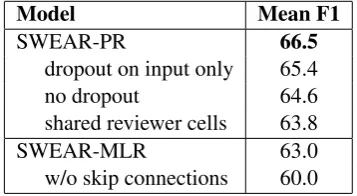
Model Mean F1
SWEAR-PR 66.5
dropout on input only 65.4 no dropout 64.6 shared reviewer cells 63.8
SWEAR-MLR 63.0
w/o skip connections 60.0
Table 6: Results for semi-supervised reviewer models trained on the1%subset of WikiReading.
Table 4 and 5 show the results of SWEAR and semi-supervised models with pretrained and fixed embeddings. Results show that SWEAR-SS al-ways improves over SWEAR at small data sizes, with the difference become dramatic as the dataset becomes very small. VRAE pretraining yields the best performance. As training and test-ing datasets have different distributions in per-property subsets, Mean F1 for supervised and semi-supervised models drops compared to uni-form sampling. However, initialization with pre-trained VRAE model leads to a substantial im-provement on both subsamples. We further exper-imented by initializing the decoder (vs. only the encoder) with pretrained autoencoder weights but this resulted in a lower Mean F1.
Table 6 shows the results of semi-supervised reviewer models. When trained on 1% of the training data, SWEAR-MLR and the supervised SWEAR model perform similarly. Without us-ing skip connections between embeddus-ing and hid-den layers, the performance drops. The SWEAR-PR model further improves Mean F1 and outper-forms the strongest SWEAR-SS model, even with-out fine-tuning the weights initialized from the au-toencoder.
[image:8.595.327.506.157.255.2]Parameter Space All Models
Learning Rate [0.0001; 0.005]
Learning Rate Decay Steps {25k, 50k}
Gradient Clip [0.01; 1.0]
Supervised & Semi-Supervised
Embedding Size {128,256, 512}
RNN State Size {256,512}
Window Size {10, 20,30}
Batch Size {64,128}
Dropout {0.3,0.5, 0.8}
Autoencoders Only
Embedding Sharing {Input,All}
KL-weight [0.0001;0.01]
Semi-Supervised Only
Finetune Pretrained Parameters {YES, NO}
Dropout {0.7, 0.8,0.9}
[image:9.595.78.283.59.279.2]Reviewer State Size {256,512} Question Reviewer Steps {0, 2, 3} Window Reviewer Steps {2, 3, 5, 8} Table 7: Hyperparameter search spaces for each model type. We use{. . .}to denote a set of discrete values and [. . . ] to denote a continuous range. Following Hewlett et al. (2016), we ran a random search over the possible configurations.
a smaller hidden vector size (128) reduced Mean F1 to62.5. Increasing the number of review steps for the question to 5 caused a decrease in Mean F1 of2.1.
6 Related Work
Our model architecture is one of many hierarchi-cal models for documents proposed in the litera-ture. The most similar is proposed by Choi et al. (2017), which uses a coarse-to-fine approach of first encoding each sentence with a cheap BoW or Conv model, then selecting the topksentences to form a mini-document which is then processed by a standard seq2seq model. While they also evalu-ate their approach on WikiReading, their emphasis is on efficiency rather than model accuracy, with the resulting model performing slightly worse than the full seq2seq model but taking much less time to execute. SWEAR also requires fewer sequential steps than the document length but still computes at least as many recurrent steps in parallel.
Our model can also be viewed as containing a Memory Network (MemNet) built from a doc-ument (Weston et al., 2014; Sukhbaatar et al., 2015), where the memories are the window encod-ings. The core MemNet operation consists of at-tention over a set of vectors (memories) based on a query encoding, and then reduction of a second set of vectors by weighted sum based on the attention weights. In particular, Miller et al. (2016)
intro-duce the Key-Value MemNet where the two sets of memories are computed from the keys and val-ues of a map, respectively: In their QA task, each memory entry consists of a potential answer (the value) and its context bag of words (the key).
Our reviewer approach is inspired by “Encode, Review, Decode” approach introduced by Yang et al. (2016), which showed the value of introducing additional computation steps between the encoder and decoder in a seq2seq model.
The basic recurrent autoencoder was first intro-duced by Dai et al. (2015), a standard seq2seq model with the same input and output. Fabius et al. (2014) expanded this model into the Varia-tional Recurrent Autoencoder (VRAE), which we describe in Section 4.1.1. VRAE is an applica-tion of the general idea of variaapplica-tional autoencod-ing, which applies variational approximation to the posterior to reconstruct the input (Kingma and Welling, 2013). While we train window autoen-coders, an alternative approach is hierarchical doc-ument autoencoders (Li et al.,2015).
The semi-supervised approach of initializing the weights of an RNN encoder with those of a recurrent autoencoder was first studied by Dai et al. (2015) in the context of document classifica-tion and further studied by Ramachandran et al. (2016) for traditional sequence-to-sequence tasks such as machine translation. Our baseline semi-supervised model can be viewed as an extension of these approaches to a reading comprehension set-ting. Dai et al. (2015) also explore initialization from a language model, but find that the recurrent autoencoder is superior, which is why we do not consider language models in this work.
7 Conclusions
References
Mart´ın Abadi, Ashish Agarwal, Paul Barham, Eugene Brevdo, Zhifeng Chen, Craig Citro, Gregory S. Cor-rado, Andy Davis, Jeffrey Dean, Matthieu Devin, Sanjay Ghemawat, Ian J. Goodfellow, Andrew Harp, Geoffrey Irving, Michael Isard, Yangqing Jia, Rafal J´ozefowicz, Lukasz Kaiser, Manjunath Kudlur, Josh Levenberg, Dan Man´e, Rajat Monga, Sherry Moore, Derek Gordon Murray, Chris Olah, Mike Schuster, Jonathon Shlens, Benoit Steiner, Ilya Sutskever, Ku-nal Talwar, Paul A. Tucker, Vincent Vanhoucke, Vi-jay Vasudevan, Fernanda B. Vi´egas, Oriol Vinyals, Pete Warden, Martin Wattenberg, Martin Wicke,
Yuan Yu, and Xiaoqiang Zheng. 2016. Tensorflow:
Large-scale machine learning on heterogeneous dis-tributed systems.CoRR, abs/1603.04467.
KyungHyun Cho, Bart van Merrienboer, Dzmitry
Bah-danau, and Yoshua Bengio. 2014. On the properties
of neural machine translation: Encoder-decoder ap-proaches. CoRR, abs/1409.1259.
Eunsol Choi, Daniel Hewlett, Alexandre Lacoste, Illia Polosukhin, Jakob Uszkoreit, and Jonathan Berant. 2017. Coarse-to-fine question answering for long
document. In Association for Computational
Lin-guistics (ACL).
Andrew M Dai and Quoc V Le. 2015. Semi-supervised
sequence learning. In C. Cortes, N. D. Lawrence, D. D. Lee, M. Sugiyama, and R. Garnett, editors,
Advances in Neural Information Processing Systems 28, pages 3079–3087. Curran Associates, Inc.
Otto Fabius and Joost R van Amersfoort. 2014. Varia-tional recurrent auto-encoders. arxiv.
Karl Moritz Hermann, Tom´aˇs Koˇcisk´y, Edward Grefenstette, Lasse Espeholt, Will Kay, Mustafa Su-leyman, and Phil Blunsom. 2015. Teaching
ma-chines to read and comprehend. InAdvances in
Neu-ral Information Processing Systems (NIPS).
Daniel Hewlett, Alexandre Lacoste, Llion Jones, Illia Polosukhin, Andrew Fandrianto, Jay Han, Matthew Kelcey, and David Berthelot. 2016. Wikireading: A novel large-scale language understanding task over
wikipedia. In Association for Computational
Lin-guistics (ACL).
Diederik P. Kingma and Jimmy Ba. 2014. Adam:
A method for stochastic optimization. CoRR, abs/1412.6980.
Diederik P. Kingma and Max Welling. 2013.
Auto-encoding variational bayes.arxiv.
Jiwei Li, Minh-Thang Luong, and Dan Jurafsky. 2015. A hierarchical neural autoencoder for paragraphs
and documents. In Association for Computational
Linguistics (ACL).
Tomas Mikolov, Ilya Sutskever, Kai Chen, Greg S Cor-rado, and Jeff Dean. 2013. Distributed representa-tions of words and phrases and their
compositional-ity. InAdvances in neural information processing
systems, pages 3111–3119.
Alexander Miller, Adam Fisch, Jesse Dodge, Amir-Hossein Karimi, Antoine Bordes, and Jason We-ston. 2016. Key-value memory networks for directly reading documents. arxiv.
P. Rajpurkar, J. Zhang, K. Lopyrev, and P. Liang. 2016. Squad: 100,000+ questions for machine
comprehen-sion of text. InEmpirical Methods in Natural
Lan-guage Processing (EMNLP).
Prajit Ramachandran, Peter J. Liu, and Quoc V. Le.
2016. Unsupervised pretraining for sequence to
se-quence learning.CoRR, abs/1611.02683.
A. A. Rusu, N. C. Rabinowitz, G. Desjardins, H. Soyer, J. Kirkpatrick, K. Kavukcuoglu, R. Pascanu, and R. Hadsell. 2016. Progressive Neural Networks.
arxiv.
Nitish Srivastava, Geoffrey Hinton, Alex Krizhevsky, Ilya Sutskever, and Ruslan Salakhutdinov. 2014.
Dropout: A simple way to prevent neural networks from overfitting. Journal of Machine Learning Re-search, 15:1929–1958.
Sainbayar Sukhbaatar, arthur szlam, Jason Weston,
and Rob Fergus. 2015. End-to-end memory
net-works. In C. Cortes, N. D. Lawrence, D. D. Lee,
M. Sugiyama, and R. Garnett, editors,Advances in
Neural Information Processing Systems 28, pages 2440–2448. Curran Associates, Inc.
Ilya Sutskever, Oriol Vinyals, and Quoc V. Le. 2014.
Sequence to sequence learning with neural net-works.CoRR, abs/1409.3215.
Jason Weston, Sumit Chopra, and Antoine Bordes.
2014.Memory networks.CoRR, abs/1410.3916.