Event Detection and Factuality Assessment with Non-Expert Supervision
Kenton Lee†, Yoav Artzi‡∗, Yejin Choi†, and Luke Zettlemoyer†
†Computer Science & Engineering, University of Washington, Seattle, WA 98195
{kentonl, yejin, lsz}@cs.washington.edu
‡Dept. of Computer Science and Cornell Tech, Cornell University, New York, NY 10011 [email protected]
Abstract
Events are communicated in natural lan-guage with varying degrees of certainty. For example, if you are “hoping for a raise,” it may be somewhat less likely than if you are “expecting” one. To study these distinctions, we present scalable, high-quality annotation schemes for event de-tection and fine-grained factuality assess-ment. We find that non-experts, with very little training, can reliably provide judgments about what events are men-tioned and the extent to which the author thinks they actually happened. We also show how such data enables the develop-ment of regression models for fine-grained scalar factuality predictions that outper-form strong baselines.
1 Introduction
Interpretation of events—determining what the author claims did or did not happen—is impor-tant for many NLP applications, such as news arti-cle summarization or biomedical information ex-traction. However, detecting events and assessing their factuality is challenging. For example, while most non-copular verbs are events, words in gen-eral vary with use (e.g. “trade route” vs “trade
with Iraq”). Events also have widely varying, context-dependent factuality cues, such as event interactions (e.g. “prevent easy access) and cue words (e.g. “orderedto” vs. “expected to”). As shown in Figure 1, these are common challenges that a model of event factuality must address.
In this paper, we present new data and mod-els for these tasks, demonstrating that non-experts can provide high-quality annotations which en-able fine-grained, scalar judgments of factuality. Unlike previous work, we do not use a detailed
∗Work done at the University of Washington.
(1) U.S. embassies and military installations around the world wereordered(3.0)toset(2.6)up barriers andtighten(2.6) security toprevent(1.8)
easyaccess(-2.4)by unauthorized people. (2) Intel’s most powerful computer chip has flaws that could delay(0.8) several computer makers’ marketing efforts(2.6), but the “bugs” aren’texpected(-2.6)tohurt(-2.0)Intel.
(3) President Bush on Tuesday said(3.0) the United States may extend(1.6) its naval
quarantine(2.6) to Jordan’s Red Sea port of Aqaba to shut(1.4) off Iraq’s last unhindered trade route.
(4) He also said(3.0) of trade(-0.8) with Iraq: “There are no shipments at the moment.”
Figure 1: Example annotations with italicized event mentions and crowdsourced scalar factuality valuesu∈ [−3.0,3.0]. Positive (or negative) val-ues indicate the extent to which the author claims the events happened (or not).
specification of exactly what events and factual-ity classes should be. Instead, we simply ask non-experts to find words describing things that the author claims could have happened, and rate each possibility on a scale of -3 (certainly did not happen) to 3 (certainly did). Figure 1 shows that non-expert workers—when their judgments are aggregated—consistently find a wide range of events and recognize the subtle differences in im-plied factuality. For example, the eventsetgets a score of 2.6, indicating that it likely but not cer-tainly occurred, since it wasordered, whereas the
orderedevent, gets a score of 3.0.
We gather data for event detection and factual-ity, reusing sentences from the TempEval-3 cor-pus (Uzzaman et al., 2013). Our approach pro-duces high-quality labels with modest costs. We also introduce simple but highly effective models for both tasks that outperform strong baselines. In
particular, our factuality regression model uses a learning objective that combines the advantages of LASSO and support vector regression, enabling it to effectively consider sparse lexical cues. By pro-viding scalar factuality judgments for events, our models enable more fine-grained reasoning than previously considered. The corpus and learned models are available online.1
2 Related Work
While event definitions have been proposed in several prior studies, existing approaches vary in how they model various linguistic forms such as nominal events, stative events, generic events, and light verbs (Pustejovsky et al., 2003; Palmer et al., 2005; Meyers et al., 2004; Kim et al., 2009; Song et al., 2015). Even with a formal and precise account of events, training annotators to learn all such linguistic intricacies remains a practical chal-lenge. Instead of definition-driven instructions, we proposeexample-driven instructions and show their effectiveness.
Previous studies have modeled event factuality assessment as a binary (Diab et al., 2009; Prab-hakaran et al., 2010) or multi-class (Sauri and Pustejovsky, 2009) classification task, and they re-lied on expert annotators. A softer representation was proposed and crowdsourced by de Marneffe et al. (2012), who advocated for representing fac-tuality from the reader’s perspective as a distribu-tion of categories, but their annotadistribu-tion process re-quires manual normalization of the text. In con-trast, we model factuality from the author’s per-spective with scalar values, and we have an end-to-end crowdsourced annotation pipeline.
More recently, Soni et al. (2014) investigated a related problem for quoted statements on Twitter, and they also crowdsourced factuality annotations to learn regression models. While their approach is similar, we focus on predicting factuality for events that occur in every sentence. Without the restrictions of their task, we must reason about a larger variety of contextual cues.
Our method of evaluating annotator agreement (Section 3) is related to the crowdsourcing study by Snow et al. (2008), who showed that pooled non-experts can match or outperform single pert annotators. In contrast, we approximate ex-pert judgments by independently sampling and ag-gregating sets of non-expert judgments.
1http://lil.cs.washington.edu/fact
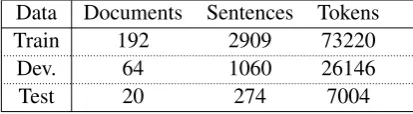
Data Documents Sentences Tokens
Train 192 2909 73220
Dev. 64 1060 26146
[image:2.595.312.519.63.120.2]Test 20 274 7004
Figure 2: Corpus statistics.
3 Data Annotation
We use a two-stage annotation pipeline to create the labels shown in Figure 1. Event mentions are first detected, followed by factuality judgments. As motivated in Section 1, we use instructions that are easily understandable by workers with no lin-guistic training and improve overall quality by ag-gregating multiple judgments to get the final label.
Event Annotation Given a sentence, we high-light one token at a time and ask workers if it refers to an event. We use the following instructions:
We consider events to be things that may or may not occur either in the past, present or fu-ture (e.g., earthquake, meeting, jumping, talk-ing, etc.). In some cases, it is not so clear whether a word is referring to an event or not. Consider these harder cases to be events.
along with 25 example annotations that covered a large variety of cases such as nominals, statives, generic events, light verbs, and non-events. These examples include both toy sentences and sentences from the corpus to annotate. For efficiency, we did not annotate a short list of stop words, copular verbs, and auxiliaries.
Factuality Annotation For factuality, we present a sentence with one highlighted event token at a time with the following prompt:
On a scale from 3 to -3, rate how likely the high-lighted event did or will happen according to the author of the sentence.
1 2 3 4 5 6 7 8 9 40
50 60 70 80 90 100
1 2 3 4 5 6 7 8 9 40
50 60 70 80 90 100
Event Agreement Factuality Agreement
k
F1
(%)
Pearson’
s
r
[image:3.595.310.525.61.174.2](%)
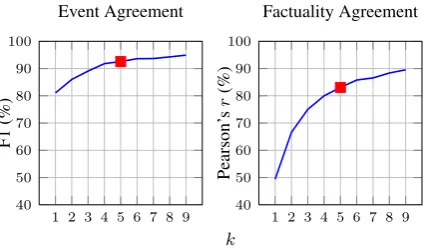
Figure 3: Agreement statistics as a function ofk, the number of judgments aggregated. We choose k = 5 in both tasks for our experiments, as de-noted by the red square.
Data collection We gathered data on Crowd-Flower.2 For quality control, annotators are
rdomly presented test questions with known an-swers. For each example, we collect and aggregate 5 judgments, as described below. For comparison, we annotated TempEval-3 (Uzzaman et al., 2013), keeping the existing test split and randomly hold-ing out a quarter of the trainhold-ing examples to create a development set. Figure 2 shows data statistics. The annotation cost is 0.5¢ per judgment for de-tection and 2¢ per judgment for factuality.
Aggregated Agreement We introduce a simple scheme to measure agreement with aggregate data, for example when the majority class from a pool of judgments is used for the final label. Instead of comparing individuals, we want to know how often the aggregates will agree, if we were to have different groups of annotators doing the task.
Formally, we assumeN samples{(xi, yi)|i= 1, . . . , N}, where eachxiis a token within a sen-tence, andyi ={yji |j = 1, . . . , M}is the set of M judgments forxi. LetY be the set of possible labels,Y={−1,1}for detection andY = [−3,3] for factuality. Let AGG : Yk → Y be an ag-gregation function, which mapskjudgments to a single aggregate one. For event detection, we set AGG(y1, . . . , yk)to return the majority value from the set of judgments {y1, . . . , yk}. For factual-ity, we set AGG(y1, . . . , yk) = k1Pkj=1yj, which computes the mean value.
To estimate the agreement between aggregates ofk judgments, we collect pairs of disjoint sub-sets of size k from theM judgments. Givenyi, we define the set of aggregate judgment pairs:
2http://crowdflower.com
FactBank Labels
CT- PR- PS- PS+ PR+ CT+ CTu NA Uu
Discretized
ratings
-3 39 0 0 0 0 0 0 0 29
-2 29 2 0 0 0 0 0 0 44
-1 16 4 1 0 0 3 0 0 58
0 15 0 5 2 0 7 0 1 95
1 7 0 1 30 4 27 2 0 337
2 4 1 0 20 42 260 0 0 564
[image:3.595.77.290.64.188.2]3 2 0 0 1 10 2760 0 0 771
Figure 4: Confusion matrix between FactBank la-bels and our discretized factuality ratings.
{(AGG(y0),AGG(y00)) | y0, y00 ⊂ yi ∧ |y0| =
|y00| = k ∧y0 ∩ y00 = ∅}.3 To measure how
well these aggregates agree, we treat AGG(y0)as a candidate hypothesis and AGG(y00)as the gold la-bel and compute the appropriate evaluation metric to measure aggregate agreement. We use the F1 score for detection and Pearson’s correlation for factuality, as described in Section 5.
We experiment withk = 1, . . . ,9 for 100 sen-tences, allowing aggregates of up to 9 judgments, as seen in Figure 3. Aggregate agreement for both tasks improve with larger k, but returns quickly diminish. Therefore, we chose k = 5 for the full data collection to reasonably trade off between quality and quantity. In absolute terms, the agree-ment at this level is strong (92.6% F1 for detection and 83.1% correlation for factuality), demonstrat-ing that aggregate non-expert judgments can pro-duce high-quality annotations.
Comparison to FactBank We compare our fac-tuality ratings, rounded to the nearest integer, to FactBank annotations (author source only) for overlapping events. The confusion matrix from Figure 4 shows there is strong correlation between our ratings and FactBank labels with specified cer-tainties and polarities. These labels are CT-, PR-, PS-, PS+, PR+, and CT+, corresponding to events that are seen as (certainly/probably/possibly) (not happening/happening).
We differ most significantly in events labeled Uu (underspecified) by FactBank, which consist largely of nested events, such as “Sandors said he’d double his money” or “Sandors hoped he’d
double his money.” While FactBank annotators would label both doubleevents as Uu, our anno-tations can indicate nuances based on the author’s wording (i.e.,saidvs.hoped). The large variation 3In practice, we sample judgment pairs rather then
in the Uu column of the confusion matrix suggests that the factuality of an event is rarely perceived as completely neutral, even when the author does not commit to a belief in the event’s occurrence.
4 Approach
Learning For the detection task, we learn a lin-ear SVM classification model. For the factuality task, we assume a dataset withN examples of la-beled events {(xi, yi) | i = 1, . . . , N}, and we learn a regression model: yi = w>φ(xi). We
in-troduce a learning objective for regression:
min
w kwk1+C
N
X
i=1
max(0,|yi−w>φ(xi)| −)
that combines the advantages of LASSO (Tibshi-rani, 1996) and support vector regression (Drucker et al., 1997). It induces sparse feature weights while being insensitive to errors less than.
Features For the detection model, we include features given the input wordx: (1) lemma ofx, (2) part of speech ofx, (3) indicator for whetherx is a hyponym of theeventsynset in WordNet and the part of speech ofx, (4) Brown clusters ofxand its part of speech, and (5) all dependency paths fromx up to length 1. For the factuality model, given the input event mentionx, we include: (1) lemma of x, (2) part of speech ofx, and (3) all dependency paths fromxup to length 2.
For dependency paths, we include all edge labels, the target word is omitted, and each node may or may not be lexicalized; we include all possible configurations. For example in “John did not expect to return”, the dependency path:
not←[neg]—expect—[xcomp]→return, would produce the following features:
not←[neg]—expect—[xcomp]→h∗i h∗i←[neg]—expect—[xcomp]→h∗i
not←[neg]—h∗i—[xcomp]→h∗i h∗i←[neg]—h∗i—[xcomp]→h∗i
These dependency features allow for context-dependent reasoning, including many of the cases in Figure 1 where the factuality of an event de-pends on the identity of a neighboring verb.
5 Experimental Setup
Baselines For detection, we include a baseline reimplementation of the NAVYTIME (Chambers,
2013) classification detector, one of the top per-formers in the TempEval-3 event detection task.
For factuality, we include three baselines: (1) A one-vs.-rest multi-class classifier (DISCRETE) us-ing our features (Section 4) and labels that are dis-cretized by rounding to the nearest integer, (2) a regression model (SVR) trained with the standard SVR objective using our features, and (3) a re-gression model (PRABHAKARAN) trained with the standard SVR objective using features from Prab-hakaran et al. (2010). These features are highly informative, but their lexical features are restricted to a small set of manually defined words.
Implementation Details The SVM models (NAVYTIME, DISCRETE, SVR, PRABHAKARAN, and our detection model) were trained with SVM-Light (Joachims, 1999). We use CPLEX4to solve
the linear program optimizing the regression ob-jective in Section 4. All hyperparameters were tuned on the development set.
We use the Stanford dependency parser (de Marneffe et al., 2006) for extracting dependency path and part-of-speech features. We use WordNet (Miller, 1995) to generate lemma and hyponym features. Brown clusters with 100, 320, 1000, and 3200 clusters from Turian et al. (2010) are used in the detection features.
Evaluation Metrics We use the standard F1 score for the evaluation of detection. For event factuality, we report two metrics, the mean abso-lute error (MAE) relative to the gold standard la-bels and Pearson’s correlation coefficient. While MAE is an intuitive metric that evaluates the abso-lute fit of the model, Pearson’s r better captures how well a system is able to recover the varia-tion of the annotavaria-tions. Pearson’sr is also con-veniently normalized such thatr = 0for a system that blindly chooses the best a priori output and r= 1for a system that makes no error.
6 Results
Detection Results Figure 5 shows development and test results for detection event mentions.5 We
see a small drop in precision and large gains in recall, but a significant increase in F1, primarily
4http://tiny.cc/cplex
5We performed two-sided bootstrap resampling statistical
Model Dev. Test
P R F1 P R F1
Our system 90.1 90.9 90.5 85.5* 87.8 86.6
[image:5.595.314.521.60.148.2]NAVYTIME 84.7* 79.6* 82.1* 87.7 78.3* 82.7*
Figure 5: Results for the detection task.
Model Dev. Test
MAE r MAE r
Our system 46.2 74.9 51.1 70.8
SVR 50.3* 74.8 57.1* 69.4
[image:5.595.77.289.64.113.2]DISCRETE 50.3* 68.6* 52.4 62.2* PRABHAKARAN 58.7* 51.1* 62.0* 50.8*
Figure 6: Results for the factuality task.
due to the use of distributional features and more general dependency features.
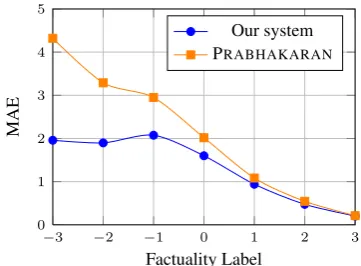
Factuality Results Figure 6 shows development and test results for predicting the factuality of gold-labeled event mentions. Our system shows an overall improvement in performance over all baselines, demonstrating that the regression model works well for this data. It is able to make more graded judgments that correlate with the aggre-gate opinions of untrained annotators. As shown in Figure 8, which compares the mean average er-ror for different buckets of factuality labels, we observe the largest gains over PRABHAKARANin examples with low factuality, where lexical cues are especially critical.
Error Analysis We manually studied 50 devel-opment samples where our factuality model pro-duced the largest absolute errors. Figure 7 summa-rizes the error types. The biggest challenge is the wide variety of sparse lexical cues. For example, the sentences “Wong Kwan will be lucky tobreak
even” and “Thatsale could still fall through if fi-nancing problems develop” require modeling the influence of “lucky to” and “fall through.” Even when these types of features do appear in the train-ing data, they tend to be very rare.
We also find cases that require inference over longer distances than our model permits. Con-sider the sentence “Mesa had rejected a general proposal from StatesWest tocombinethe two car-riers.” To know thatcombineis not likely to hap-pen, we must infer that it is conditioned on the proposal, which was rejected. Finally, we find that world knowledge and pragmatic inference is sometimes required. For example, in the sen-tence “There was no hint of trouble in the last
Error type %
Missed lexical cue (unseen in training) 52 Missed lexical cue (seen in training) 12
Long distance inference 16
World knowledge & pragmatics 12
[image:5.595.77.285.148.219.2]Annotation error 8
Figure 7: Error types for the 50 examples with the largest absolute development error.
−3 −2 −1 0 1 2 3
0 1 2 3 4 5
Factuality Label
MAE
Our system PRABHAKARAN
Figure 8: Mean absolute error in the development set for different labels rounded to the nearest inte-ger. Our system’s improvement is greater when predicting events with low factuality, which re-quires modeling sparse lexical cues.
conversation between controllers and TWA pilot Steven Snyder,” the pragmatic implication that
troublelikely happened requires common knowl-edge about flights.
7 Conclusion
We studied event detection and scalar factuality prediction, demonstrating that non-expert annota-tor can, in aggregate, provide high-quality data and introducing simple models that perform well on each task. There is significant room for fu-ture work to improve the results, including jointly modeling the factuality of multiple events and in-tegrating factuality models into information ex-traction and question answering systems.
Acknowledgments
[image:5.595.322.503.194.327.2]References
Nathanael Chambers. 2013. Navytime: Event and
time ordering from raw text. InSecond Joint
Con-ference on Lexical and Computational Semantics. Marie-Catherine de Marneffe, Bill MacCartney, and
Christopher D. Manning. 2006. Generating typed dependency parses from phrase structure parses. In Proceedings of the 5th International Conference on Language Resources and Evaluation.
Marie-Catherine de Marneffe, Christopher D. Man-ning, and Christopher Potts. 2012. Did it hap-pen? The pragmatic complexity of veridicality
as-sessment. Computational Linguistics, 38(2):301–
333.
Mona T Diab, Lori Levin, Teruko Mitamura, Owen Rambow, Vinodkumar Prabhakaran, and Weiwei Guo. 2009. Committed belief annotation and tag-ging. InProceedings of the Third Linguistic Annota-tion Workshop, pages 68–73. Association for Com-putational Linguistics.
Harris Drucker, Christopher JC Burges, Linda Kauf-man, Alex J Smola, and Vladimir Vapnik. 1997.
Support vector regression machines. InAdvances in
Neural Information Processing Systems, pages 155– 161.
Yvette Graham, Nitika Mathur, and Timothy Baldwin. 2014. Randomized significance tests in machine
translation. InProceedings of the ACL 2014 Ninth
Workshop on Statistical Machine Translation. Thorsten Joachims. 1999. Svmlight: Support
vec-tor machine. SVM-Light Support Vector Machine
http://svmlight.joachims.org/, University of Dort-mund, 19(4).
Jin-Dong Kim, Tomoko Ohta, Sampo Pyysalo, Yoshi-nobu Kano, and Jun’ichi Tsujii. 2009. Overview of bionlp’09 shared task on event extraction. In Proceedings of the Workshop on Current Trends in Biomedical Natural Language Processing: Shared Task, pages 1–9. Association for Computational Lin-guistics.
Adam Meyers, Ruth Reeves, Catherine Macleod, Rachel Szekely, Veronika Zielinska, Brian Young, and Ralph Grishman. 2004. The nombank project:
An interim report. InHLT-NAACL 2004 workshop:
Frontiers in corpus annotation, pages 24–31.
George A Miller. 1995. Wordnet: a lexical
database for english. Communications of the ACM,
38(11):39–41.
Martha Palmer, Daniel Gildea, and Paul Kingsbury. 2005. The proposition bank: An annotated
cor-pus of semantic roles. Computational linguistics,
31(1):71–106.
Vinodkumar Prabhakaran, Owen Rambow, and Mona Diab. 2010. Automatic committed belief tagging.
InColing 2010: Posters, pages 1014–1022, Beijing, China, August. Coling 2010 Organizing Committee. James Pustejovsky, Patrick Hanks, Roser Sauri, An-drew See, Robert Gaizauskas, Andrea Setzer, Dragomir Radev, Beth Sundheim, David Day, Lisa
Ferro, et al. 2003. The timebank corpus. InCorpus
linguistics.
Roser Sauri and James Pustejovsky. 2009. Factbank:
a corpus annotated with event factuality. Language
Resources and Evaluation, 43(3):227–268.
Rion Snow, Brendan O’Connor, Daniel Jurafsky, and Andrew Y Ng. 2008. Cheap and fast—but is it good?: evaluating non-expert annotations for natu-ral language tasks. InProceedings of the conference on empirical methods in natural language
process-ing, pages 254–263. Association for Computational
Linguistics.
Zhiyi Song, Ann Bies, Stephanie Strassel, Tom Riese, Justin Mott, Joe Ellis, Jonathan Wright, Seth Kulick,
Neville Ryant, and Xiaoyi Ma. 2015. From
light to rich ere: Annotation of entities, relations,
and events. Proceedings of the 3rd Workshop on
EVENTS at the NAACL-HLT, pages 89–98.
Sandeep Soni, Tanushree Mitra, Eric Gilbert, and Jacob Eisenstein. 2014. Modeling factuality judgments
in social media text. In Proceedings of the
Asso-ciation for Computational Linguistics (ACL), Balti-more, MD.
Robert Tibshirani. 1996. Regression shrinkage and se-lection via the lasso. Journal of the Royal Statistical Society. Series B (Methodological), pages 267–288. Joseph Turian, Lev Ratinov, and Yoshua Bengio. 2010. Word representations: a simple and general method for semi-supervised learning. InProceedings of the 48th annual meeting of the association for compu-tational linguistics, pages 384–394. Association for Computational Linguistics.