Transcomplex Topology and Elementary Functions
Tiago S. dos Reis and James A.D.W. Anderson,
Member, IAENG
Abstract—The set of transcomplex numbers, introduced else-where, is a superset of the complex numbers that allows division by zero. Here we introduce a topology for the transcomplex numbers and extended the elementary functions from the com-plex domain to the transcomcom-plex domain. We give a geometrical construction of non-finite angles and discuss the totalisation of computer subroutines to provide transcomplex functions.
Index Terms—transcomplex topology, transcomplex exponen-tial, transcomplex logarithm, transcomplex elementary func-tions, non-finite angles.
I. INTRODUCTION
In [6] we introduced the set of transcomplex numbers,
CT, and proved that transcomplex arithmetic is consistent. The set of transcomplex numbers contains the ordinary set of complex numbers and the set of transreal numbers as proper subsets. Transreal numbers were introduced in [5] and were proved consistent in [5] [10]. Transcomplex numbers are a new system of numbers which is total with respect to the four elementary arithmetical operations of addition, subtraction, multiplication and division. In particular, division by zero is allowed. This means that infinitely many exceptional states are removed from mathematics and from computer programs. This is of practical importance because it makes it possible to guarantee that if a program compiles then it does not terminate due to a logical exception. This is of very wide utility. In particular, meta-programs, such as genetic algo-rithms, can combine subprograms arbitrarily in the search for optimal solutions. The application of transarithmetic in computer hardware and software was discussed in, among other places, [1] [2].
The setCT is given by
CT =
ßx
y; x, y∈C
™
.
In [6] we defined fractions so that they allow a denominator of zero and we proved that transcomplex arithmetic is consistent. We named two special transcomplex numbers:
infinity, ∞:= 10, and nullity, Φ := 00. Every transcomplex number can be written as a fraction, xy, where x is an ordinary complex number and y is either one or zero. It is worth saying that x1
y1 × x2 y2 =
x1x2
y1y2 for allx1, x2∈Cand y1, y2 ∈ {0,1}. In particular, Φ×z = Φ for all z ∈ CT. Furthermore, x1
y = x2
y if and only if there is a positiveα∈R
such thatx1=αx2, for allx1, x2∈Candy∈ {0,1}. Hence CT=C∪x0; x∈C, |x|= 1 ∪
0 0 .
Now let xy ∈ CT. When y 6= 0 we have xy ∈ C,
whence xy = reiθ for some r ∈ [0,∞) and θ ∈ (−π, π]. When y = 0, xy = x
0. If x = 0 then
x y =
0 0 =
Manuscript received 6th March, 2016; revised 31st March, 2016. Tiago S. dos Reis is with the Federal Institute of Education, Sci-ence and Technology of Rio de Janeiro, Brazil, 27215-35 e-mail: [email protected]
J.A.D.W. Anderson is with the School of Systems Engineering, Reading University, England, RG6 6AY e-mail: [email protected]
Φ = Φ × eiθ for any θ ∈ (−π, π]. If x 6= 0 then x
y = x
0 =
x/|x|
0 = 1 0 ×
x/|x|
1 = ∞ ×
x
|x| = ∞ ×e
iθ for
some θ ∈ (−π, π]. From now on we write Φeiθ := 0 0,
where θ ∈ (−π, π] is arbitrary, and ∞eiθ := x
0 where
θ = Arg(x). Hence every transcomplex number can be written asreiθwherer∈[0,∞]∪{Φ}andθ∈(−π, π]. Thus
CT ⊂ reiθ; r∈[0,∞]∪ {Φ}, θ∈(−π, π] . Further-more, clearly,
reiθ; r∈[0,∞]∪ {Φ}, θ∈(−π, π] ⊂ CT. Therefore
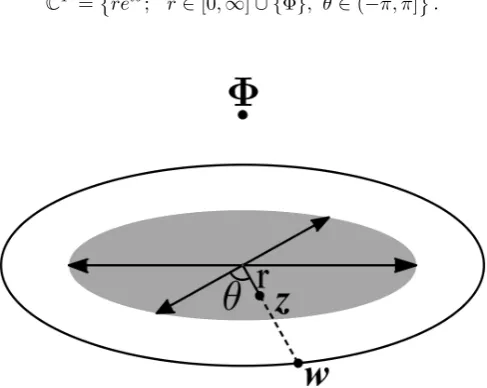
[image:1.595.305.549.264.458.2]CT =reiθ; r∈[0,∞]∪ {Φ}, θ∈(−π, π] .
Fig. 1. Transcomplex plane showingz=reiθwithrfinite andw=∞eiθ
The transcomplex plane is shown in Figure 1. The usual complex plane, C, is shown as a grey disk. It has no real bound but, after a gap, it is surrounded by a circle at infinity,
∞eiθ; θ∈(−π, π] . The point at nullity,Φeiθ, lies off the
finite combination, using the four, elementary arithmetical operations, between elementary functions is an elementary function.
II. TOPOLOGY, LIMITS ANDCONTINUITY
LetD:={z∈C; |z|<1},D:={z∈C; |z| ≤1} and
ϕ:CT \ {Φ} → D⊂ CT reiθ 7→ 1
1+1
r
eiθ . (1)
Note thatϕ|Cis an homeomorphism betweenCandDwith
respect to the usual topology onC.
Proposition 1: Defined:CT ×
CT →Rwhere
d(z, w) =
0, ifz=w= Φ
2, ifz= Φor elsew= Φ.
|ϕ(z)−ϕ(w)|, otherwise
We have that d is a metric on CT and, therefore, CT is a metric space.
Proof: Clearly, for all z, w ∈ CT, d(z, w) = 0 if and only if z = w, d(z, w) = d(w, z) and d(z, w) ≥ 0. If
z, w, u∈CT\ {Φ}thend(z, u) =|ϕ(z)−ϕ(u)|=|ϕ(z)− ϕ(w) +ϕ(w)−ϕ(u)| ≤ |ϕ(z)−ϕ(w)|+|ϕ(w)−ϕ(u)|=
d(z, w) +d(w, u). The reader can verify that the triangular inequality is also true when z, w, u ∈ CT \ {Φ} does not
hold.
Proposition 2: The topology on C, induced by the topol-ogy of CT, is the usual topology ofC. That is, if U ⊂CT is open on CT thenU ∩Cis open (in the usual sense) on Cand ifU ⊂Cis open (in the usual sense) onCthenU is open on CT.
Proof:Let us denote the ball of centrezand radiusρon CT as BCT(z, ρ), that is, BCT(z, ρ) ={w∈ C
T; |ϕ(z)−
ϕ(w)|< ρ}, and denote the ball of centrez and radiusρon Cas BC(z, ρ), that is, BC(z, ρ) ={w∈C; |z−w|< ρ}.
LetU ⊂CT be open on
CT and letz∈U ∩C. AsU is open onCT, there is a positiveε∈
Rsuch thatBCT(z, ε)⊂
U. As ϕ is continuous, there is a positive δ∈R such that if w∈CT \ {Φ} and|z−w|< δ then|ϕ(z)−ϕ(w)|< ε.
ThusBC(z, δ)⊂BCT(z, ε)∩C⊂U∩C, whence U∩Cis open (in the usual sense) onC.
Now, let U ⊂C be open (in the usual sense) on C and let z ∈ U. Notice that z = reiθ for some r ∈ [0,∞) and some θ ∈ (−π, π]. As U is open (in the usual sense) on C, there is a positive ε ∈ R such that BC(z, ε) ⊂ U. As
ϕ−1 is continuous, there is a positive δ∈
R such thatδ <
|ϕ(z)−eiθ| and if ϕ(w)∈D and|ϕ(z)−ϕ(w)|< δ then
|z−w|< ε. ThusBCT(z, δ)⊂BC(z, ε)⊂U, whenceU is open on CT.
Corollary 3: IfA ⊂CT is closed on CT thenA∩C is closed (in the usual sense) onC.
Remark 4: Note that, by the definition of the metric of CT, obviouslyϕis an homeomorphism.
Remark 5: Because of Proposition 2:
i) Let (xn)n∈N ⊂ C and let L ∈ C, it follows that limn→∞xn=LonCT if and only iflimn→∞xn=L, in the usual, sense on C.
ii) Let A ⊂ C, f : A → C, x ∈ A0 and L ∈ C, it follows that limx→xf(z) = L on CT if and only if
limx→xf(z) =L, in the usual sense, on C.
iii) Givenx∈A, it follows thatf is continuous inxonCT
if and only iff is continuous in x, in the usual sense, onC.
Proposition 6: CT is disconnected.
Proof: CT =reiθ; r∈[0,∞], θ∈(−π, π] ∪ {Φ} and the sets reiθ; r∈[0,∞], θ∈(−π, π] and{Φ} are open.
Notice thatΦis the unique isolated point ofCT.
Remark 7:
i) Let(xn)n∈N⊂C
T. Notice thatlim
n→∞xn= Φif and only if there isk∈Nsuch thatxn= Φfor alln≥k. ii) Let A⊂ C, f :A → CT andx ∈A0, it follows that
limx→xf(z) = Φ if and only if there is a
neighbour-hoodU of xsuch that f(z) = Φfor allx∈U \ {x}. iii) If Φ∈Athenf is continuous inΦ.
Proposition 8: CT is a separable space.
Proof: (Q+Qi)∪ {Φ} is countable and dense inCT.
Proposition 9: Every sequence of transcomplex numbers has a convergent subsequence.
Proof: Let (xn)n∈N ⊂ CT. If {n; xn 6= Φ} is a
finite set then clearly limn→∞xn = Φ. If {n; xn 6= Φ} is an infinite set then denote, by (yk)k∈N, the subsequence
of (xn)n∈N of all elements of (xn)n∈N that are distinct
from Φ. Note that (ϕ(yk))k∈N (ϕ defined in (1)) is a
bounded sequence of complex numbers, whence it has a convergent subsequence, denoted(ϕ(ykm))m∈N. Asϕis an
homeomorphism,(ykm)m∈Nis convergent.
Proposition 10: CT is compact.
Proof:AsCT is a metric space and every sequence from CT has a convergent subsequence,CT is compact.
Corollary 11: LetA⊂CT. It follows that Ais compact if and only ifA is closed.
Proposition 12: CT is complete.
Proof:Every compact, metric space is complete andCT is compact and metric.
III. ELEMENTARYFUNCTIONS
A. Polynomial Functions
domain, 0×xk = 0 for all complex x but 0×xk = 0
does not hold for all transcomplex x. In order to avoid this problem we adopt the following definition.
Definition 13: A function, f, is a transcomplex, polyno-mial function if and only if there is n, k∈N;n1, . . . , nk ∈
{1, . . . , n − 1} and a, an1. . . , ank, an ∈ C such that an1. . . , ank, an are different from zero and
f :CT −→ CT z 7−→ anxn+an
kx
nk+· · ·+an
1x
n1+a .
Remark 14: For every non-constant, transcomplex, poly-nomial function, f, we have thatf(Φ) = Φ.
B. Exponential Functions
In [9] we defined the transreal, exponential function. We have that e−∞= 0,e∞=∞andeΦ= Φ.
For every ordinary, complex number, z=reiθ, we have
exp(z) = exp reiθ
= exp (rcos(θ) +irsin(θ))
= ercos(θ)(cos(rsin(θ)) +isin(rsin(θ))).
In particular, when θ ∈ {0, π}, we have that sin(θ) = 0 whence
exp reiθ
= ercos(θ)(cos(rsin(θ)) +isin(rsin(θ)))
= ercos(θ)(cos(0) +isin(0))
= ercos(θ).
Motivated by this, we extend the exponential function to the transcomplex domain in the following way.
Definition 15: A function,f, is a transcomplex, natural, exponential function if and only if
f :CT −→ CT reiθ 7−→ exp reiθ
whereexp reiθ
=ercos(θ) ifθ∈ {0, π}andexp reiθ
=
ercos(θ)(cos(∞sin(θ)) +isin(∞sin(θ)))if θ /∈ {0, π}. Notice thatexp (∞) = exp ∞ei0
=e∞cos(0) =e∞and exp (−∞) = exp ∞eiπ
=e∞cos(π)=e−∞. Furthermore, if θ∈(−π, π]\ {0, π} then
exp ∞eiθ
= e∞cos(θ)(cos(∞sin(θ)) +isin(∞sin(θ))) = e∞cos(θ)(Φ +iΦ)
= e∞cos(θ)Φ
= Φ.
Therefore:
i) exp(z) =ez for every z∈ C. ii) exp(−∞) = 0.
iii) exp(∞) =∞. iv) exp ∞eiθ
= Φfor allθ∈(−π, π]\ {0, π}. v) exp(Φ) = Φ.
Remark 16: Notice thatexpis discontinuous in all infini-ties.
Remark 17: Unfortunately, the property exp(z +w) = exp(z) exp(w)does not hold for allz, w∈CT. For example,
let z=
1
√
2+ 1
√
2i
0 and w=
1
√
2− 1
√
2i
0 . We have that z+w=
1
√
2+ 1
√
2i
0 +
1
√
2− 1
√
2i
0 =
1
√
2+ 1
√
2i + 1
√
2− 1
√
2i
0 =
√
2 0 =
1 0 =∞
whenceexp(z+w) =e∞ =∞. But z =∞eπ4i andw =
∞e−π4i whenceexp(z) = exp(∞eπ4i) = Φ andexp(w) =
exp(∞e−π4 i) = Φ. Thus exp(z) exp(w) = Φ×Φ = Φ.
Thereforeexp(z+w)6= exp(z) exp(w). Another example is whenz=∞andw=i. We have thatz+w=∞+i=∞ whenceexp(z+w) = exp(∞) =∞butexp(z) =e∞=∞ and exp(w) = ei whence exp(z) exp(w) = ∞ei. Thus
exp(z+w)6= exp(z) exp(w).
C. Logarithmic Functions
In [9] we defined the transreal, logarithmic function. We have thatln(0) =−∞,ln(∞) =∞andln(Φ) = Φ.
A function, f, is the complex, logarithmic function if and only if f(reiθ) = ln(r) +iθ for all r ∈ (0,∞) and θ ∈ (−π, π]. Motivated by this, we extend the logarithmic function to the transcomplex domain in the following way.
Definition 18: A function, f, is a transcomplex, natural, logarithmic function if and only if
f :CT −→ CT
reiθ 7−→ ln(r) +iθ .
Remark 19: Notice that, for every θ ∈(−π, π], we have ln(∞eiθ) = ln(∞) +iθ=∞+iθ=∞. Soln(z) =∞for
every transcomplex infinityz.
Remark 20: The property ln(exp(z)) = z does not hold for allz∈CT. Ifθ∈(−π, π]\{0, π}thenln(exp(∞eiθ)) =
ln(Φ) = Φ6=∞eiθ. Butln(exp(z)) =z holds in the other
cases. Indeed:
• if z =a+bi ∈ C, where a, b ∈ R and b ∈ (−π, π], then we already know thatln(exp(z)) =z,
• if z = Φ then ln(exp(z)) = ln(exp(Φ)) = ln(Φ) = Φ =z,
• if z = −∞ then ln(exp(z)) = ln(exp(−∞)) = ln(0) =−∞=z, and
• if z =∞ thenln(exp(z)) = ln(exp(∞)) = ln(∞) = ∞=z.
In the same way exp(ln(z)) = z does not hold for all z∈
CT. Ifθ∈(−π, π]\ {0} thenexp(ln(∞eiθ)) = exp(∞) =
∞ 6= ∞eiθ. But exp(ln(z)) = z holds in the other cases. Indeed:
• ifz∈C\ {0} then we already know thatexp(ln(z)) = z,
• ifz= 0 thenexp(ln(z)) = exp(ln(0)) = exp(−∞) = 0 =z,
• if z = Φ then exp(ln(z)) = exp(ln(Φ)) = exp(Φ) = Φ =zand
• ifz=∞thenexp(ln(z)) = exp(ln(∞)) = exp(∞) = ∞=z.
Remark 21: We know that, for all z, w ∈ C \ {0},
ln(zw) = ln(z) + ln(w). The reader can prove this with simple calculations.
Remark 22: Definition 18 can give us powers of every transcomplex base so we define zw:= exp(wln(z))for all
z, w∈CT.
D. Trigonometric Functions
In [9] we defined the transreal trigonometric functions. We have thatsin(−∞) = cos(−∞) = tan(−∞) = csc(−∞) = sec(−∞) = cot(−∞) = sin(∞) = cos(∞) = tan(∞) = csc(∞) = sec(∞) = cot(∞) = sin(Φ) = cos(Φ) = tan(Φ) = csc(Φ) = sec(Φ) = cot(Φ) = Φ.
A function, f, is the complex, sine function if and only
f(z) =exp(iz)−2exp(i −iz) for allz∈Candf is the complex, cosine function if and only f(z) = exp(iz)+exp(2 −iz) for all
z∈C. Furthermore, for all k∈Z, it is the case that sin(cos(zz)), 1
sin(z), 1 cos(z) and
cos(z)
sin(z) are lexically well-defined at
π
2 +
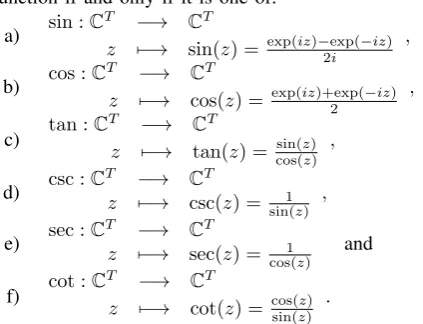
kπ andkπ in the transcomplex domain. Because of this we extend the trigonometric functions to CT in the following way.
Definition 23: A function is a transcomplex, trigonometric function if and only if it is one of:
a) sin :C
T −→
CT
z 7−→ sin(z) =exp(iz)−2exp(i −iz) , b) cos :C
T −→
CT
z 7−→ cos(z) = exp(iz)+exp(2 −iz) , c) tan :C
T −→
CT
z 7−→ tan(z) = sin(cos(zz)) , d) csc :C
T −→
CT
z 7−→ csc(z) = sin(1z) , e) sec :C
T −→
CT
z 7−→ sec(z) = cos(1z) and f) cot :C
T −→
CT
z 7−→ cot(z) =cos(sin(zz)) .
Remark 24: In [9] we show that sin2(x) + cos2(x) = 1x for allx∈RT. Unfortunately this property does not hold for all transcomplex numbers. We have thatsin2(z) + cos2(z) = 1zif and only ifz∈CT\{−i∞, i∞}. Note that, by Remark 22,1z= Φif z∈
CT \C.
IV. TOTALISATION
A. Recursive Totalisation
The work, above, develops the elementary, transcomplex functions as functions of transcomplex numbers, which numbers are expressible as tuples, hr, θi, of a transreal radius, r, and a transreal angle, θ. This is adequate from a mathematical point of view but it is not sufficient for computer science where total functions are wanted whose domain can be recursively decomposed into the entire do-main of transreal numbers so that, here, r and θ could be any transreals. As usual when a negative r occurs, we map r to its modulus and increment the angle by π so that all transreal radii are admitted. We observe that for all non-finite angles, θ ∈ {−∞,∞,Φ}, it is the case that
reiθ = r(cos(θ) +isin(θ)) = r(Φ + Φ) = rΦ = Φ so that the exponential, logarithmic and trigonometric functions
admit all transreal angles. The totalisation of the remaining elementary functions is immediate.
It is well known that the trigonometric functions can be defined, equivalently, by power series or by geometrical constructions. The totalisation of angle, just given, relies on power series. We now give a geometrical construction of the transreal angles.
[image:4.595.51.263.350.512.2]B. Geometrical Construction of the Transreal Angles
Fig. 2. Transreal cone
Let us explore both finite and non-finite angles in a geometrical construction before settling on a definition of transreal angle.
Consider a transreal cone with apexA, as shown in Figure 2. A right cross-section of the cone is a circle on which a radius,r, may be drawn. On the circle at unit radius,r= 1, mark off, not necessarily distinct, points P andQ. Project the linesAP andAQ, taking a pointP0 anywhere on AP, including the point P00 at A, the point P∞0 on the circle at infinity and the pointPΦ0 at the point at nullity, shown asΦ in the figure. Similarly takeQ0 onAQ.
Atr= 1the angle fromP toQ is defined to be the arc lengthP Q˜ taken zero, positive or negative according to the usual sign convention. It is then shown that identical plane rotations arise for all non-negative, finite radii,0< r <∞, when the angle is given byP Q˜=˘P0Q0/r when P0 andQ0 lie on the circle with radius r. We now consider the cases
r∈ {0,∞,Φ}. The reader is free to construct negative radii in a double cone.
At r = Φ we have P˙Φ0QΦ0 /rΦ = ΦΦˆ/0 = 0/0 = Φ, which is to say that the angle nullity occurs atr= Φ. Now
reiΦ=r(cos(Φ) +isin(Φ)) =r(Φ + Φ) =rΦ = Φ for all
transrealr. Thus the nullity rotation, by angle nullity,θ= Φ, maps the whole of its domain onto the point at nullity,Φ.
At r = ∞ the zero angle, θ = 0, arises when P∞0 and
Q0∞ are co-punctal but when P∞0 and Q0∞ are distinct we haveθ=P˚∞0 Q∞0 /r∞=∞/∞= Φso that only the angles zero and nullity can arise, from this geometrical construction, in the circle at infinity. This computed angle of nullity is degenerate in the sense that it hides the true value of any non-zero, finite angle in the circle at infinity. That is it hides all points∞eiθ withθ6= 0. Information hiding is discussed
in [4]. We shall presently avoid this degeneracy.
We now construct the infinite angle via a winding on the ordinary, unit cone.
By definitionP andQlie in the unit circle, separated by an angleθ=P Q˜. WhenP andQare distinct we take an arc length α=P Q˜ and when P andQare co-punctal we take
α= 2π. We now take the arc at a smaller radius and wind it fromP0, once fully round the cone, and continue exactly to Q0. This winding marks off the angle θ1 =θ+ 2π. We
continue in this way, recursively winding at smaller radii, to produce the family of angles θk = θ+ 2kπ. We suppose that the winding process is continuous to that at r= 0 we produce the windingθ∞=θ+ 2∞π=∞. But this rotation is identically the rotation at r = 0 so the infinite angle is equivalent to the nullity angle. This agrees with the result obtained from power series.
Notice that all transreal angles are given uniquely when we define a zero angle at a fixed point, Z, on the base of the cone. Let us take Z = Qin Figure 2. Now all angles,
θ, in the principle range −π < θ ≤ π are given uniquely by a point in the unit circle with radius r = 1. All finite angles, −∞ < θ < ∞, are given uniquely by windings on the cone at all positive radii, 0 < r ≤ 1. And the equivalence class of all non-finite angles is given uniquely by the apex of the cone atr= 0. Hence the apex of the unit cone uniquely defines the non-finite angle and the unit cone, with the apex punctured and a zero point identified, defines each finite angle uniquely. Thus there is an injection from transreal angles to points on the unit cone, with the zero point identified. This being the case we accept the winding construction in the unit cone as our definition of transreal angle and simply note the extraneous behaviour in the circle at infinity and the point at nullity.
In the definition we have just adopted, we assume continu-ity of the winding process to obtain the infinite angle equal to the nullity angle, which is what we wanted to achieve. This commits us to continuity of winding everywhere, including all applications of winding in topology, in complex analysis and in mathematical physics.
V. DISCUSSION
We have equipped the set of transcomplex numbers with a topology, given by a metric, that contains the usual topology of the complex numbers. This preserves many properties of complex numbers and leads to consistent generalisations of them. In particular it extends the usual geometrical con-structions of the real trigonometric functions to their tran-sreal counterparts, from which we obtain the transcomplex, trigonometric functions. Thus the topology provides a firm foundation for our work. As CT is a metric space, all usual results of that space follow. For example:CT is a Hausdorff space; the limit of a sequence, when it exists, is unique;
whenA⊂CT,f :A→
CT,x∈A0 andL∈CT, we have that limx→xf(z) = L if and only if limn→∞f(xn) = L
for all (xn)n∈N ⊂A\ {x} such thatlimn→∞xn =x; and
when A⊂CT,f :A→
CT andx∈A, we have thatf is continuous inxif and only iflimn→∞f(xn) =f(z)for all (xn)n∈N⊂Aandlimn→∞xn=x.
In [8] we adopted the following procedure to extend an elementary function from the real to the transreal domain. If the usual expression of the function is lexically well-defined, at a transreal number, then we define the function by simply applying its expression at that transreal number. If the function,f, is not lexically well-defined at a transreal number,x, but there is a limit,limx→xf(z), then we choose
to define the function at x by limx→xf(z). Otherwise we
choose to define the function by way of its power series if it converges. And if, nevertheless, its power series does not converge, we keep the function undefined. But the transcomplex space is more complicated than transreal space. Transreal space has only two infinite numbers and there is only one path, one direction, to each one of these infinities but there are several (infinite) paths and directions to each infinite transcomplex number. Hence many limits do not exist at infinite transcomplexes.
Now let us address some remarks to why we did not adopt other ways to define the exponential function on the transcomplex plane.
i) We cannot define the transcomplex, exponential func-tion by a lexical expression because the exponential is not defined by finitely many arithmetical operations. In particular we cannot take the usual algebraic definition that if z=a+bi thenexp(z) = ea(cos(b) +isin(b)) because the infinite transcomplex numbers do not have any algebraic representation.
ii) We cannot define the transcomplex, exponential function by limits because, for every r ∈ [0,∞), exp reiθ
= exp (rcos(θ) +irsin(θ)) =
ercos(θ)(cos(rsin(θ)) +isin(rsin(θ))), whence there is nolimr→∞exp reiθfor everyθ∈(−π, π]\{0, π}. iii) We cannot define the transcomplex, exponential
func-tion by power series because 1 + P∞
n=1
(∞eiθ)n
n! =
1 +P∞
n=1∞
einθ
n! = 1 +
P∞
n=1∞einθdiverges for every
θ∈(−π, π]\ {0, π}.
iv) We could think about the homeomorphism ϕ. Notice that the circle at infinity, {∞eiθ; θ ∈ (−π, π]}, is a
homeomorphic copy, by the function ϕ, of the unitary circle, ∂D := {eiθ; θ ∈ (−π, π]}. So, in order to define exp at an infinite transcomplex number ∞eiθ, we could transform ∞eiθ toϕ(∞eiθ) =eiθ, then we would take exp eiθ = exp (cos(θ) +isin(θ)) =
ecos(θ)(cos(sin(θ)) + isin(sin(θ))), after that
we would transform ecos(θ)(cos(sin(θ)) +
isin(sin(θ))) to |eecos(cos(θθ))(cos(sin((cos(sin(θθ))+))+iisin(sin(sin(sin(θθ))))))| =
cos(sin(θ)) + isin(sin(θ)) and, finally, we would transform cos(sin(θ)) + isin(sin(θ)) to
ϕ−1(cos(sin(θ)) +isin(sin(θ))). In this way, denoting
the function C\ {0} 3z7→ |zz| ∈∂D by h, we would define exp ∞eiθ
:= (ϕ−1 ◦ h◦ exp◦ϕ) ∞eiθ
expRT. In factexpCT(−∞) = expCT(∞eiπ) = (ϕ−1◦
h◦exp◦ϕ) ∞eiπ
= (ϕ−1◦h◦exp) ϕ ∞eiπ
= (ϕ−1◦h◦exp) eiπ
= (ϕ−1◦h◦exp) (−1) = (ϕ−1◦
h)(exp(−1)) = (ϕ−1 ◦h)(e−1) = ϕ−1(h(e−1)) =
ϕ−1Äe−1
|e−1|
ä
=ϕ−1(1) =∞ 6= 0 = exp
RT(−∞).
In future we intend to extend the differential and integral calculi from the complex to the transcomplex domain, open-ing up the way to extend our generalisation of Newtonian Physics [4] to both relativistic and quantum physics.
VI. CONCLUSION
The transcomplex numbers, introduced elsewhere, contain the complex, transreal and real numbers and support division by zero, consistently, in all of their arithmetics.
Here we supply the set of transcomplex numbers with a topology that contains the usual topology of both the com-plex and real numbers. It is easy to see that our transcomcom-plex topology also contains transreal topology. Thus we maintain all of these topologies within a single number system.
We extend the exponential from the complex to the transcomplex domain so that it contains the complex, tran-sreal and real exponentials. Hence we obtain the transcom-plex logarithm and the transcomtranscom-plex, trigonometric functions and all transcomplex, elementary functions, such that they contain their complex, transreal and real counterparts.
We give a geometrical construction of transreal angle. Thus the equivalence of geometrical and power series defi-nitions of the trigonometric functions is maintained.
All of the transarithmetics are total. This removes infinitely many exceptions from mathematics and from computer pro-grams. Thus our corpus of work continues to offer both theoretical and practical advantages.
Our geometrical construction, of angle, assumes continuity of the winding process so we are committed to this conti-nuity wherever winding occurs, for example in topology, in complex analysis and in mathematical physics.
REFERENCES
[1] J. A. D. W. Anderson. Trans-Floating-Point Arithmetic Removes Nine Quadrillion Redundancies From 64-bit IEEE 754 Floating-Point Arithmetic. InLecture Notes in Engineering and Computer Science: Proceedings of The World Congress on Engineering and Computer Science 2014, WCECS 2014, 22-24 October, 2014, San Francisco, USA., volume 1, pages 80–85, 2014.
[2] J. A. D. W. Anderson. Transmathematical Basis of Infinitely Scalable Pipeline Machines. In Slawomir Koziel, Leifur Leifsson, Michael Lees, Valeria V. Krzhizhanovskaya, Jack Dongarra and Peter M.A. Sloot, editor,International Conference On Computational Science, ICCS 2015 Computational Science at the Gates of Nature, Procedia Computer Science, volume 51, pages 1828–1837, 2015.
[3] J. A. D. W. Anderson and T. S. dos Reis. Transreal limits expose category errors in ieee 754 floating-point arithmetic and in mathematics. InLecture Notes in Engineering and Computer Science: Proceedings of The World Congress on Engineering and Computer Science 2014, WCECS 2014, 22-24 October, 2014, San Francisco, USA., volume 1, pages 86–91, 2014.
[4] J. A. D. W. Anderson and T. S. dos Reis. Transreal newtonian physics operates at singularities. Synesis, 7(2):57–81, 2015.
[5] J. A. D. W. Anderson, N. V¨olker, and A. A. Adams. Perspex machine viii: Axioms of transreal arithmetic. In Longin Jan Lateki, David M. Mount, and Angela Y. Wu, editors,Vision Geometry XV, volume 6499 ofProceedings of SPIE, pages 2.1–2.12, 2007.
[6] T. S. dos Reis and J. A. D. W. Anderson. Construction of the transcomplex numbers from the complex numbers. InLecture Notes in Engineering and Computer Science: Proceedings of The World Congress on Engineering and Computer Science 2014, WCECS 2014, 22-24 October, 2014, San Francisco, USA., volume 1, pages 97–102, 2014.
[7] T. S. dos Reis and J. A. D. W. Anderson. Transdifferential and transintegral calculus. InLecture Notes in Engineering and Computer Science: Proceedings of The World Congress on Engineering and Computer Science 2014, WCECS 2014, 22-24 October, 2014, San Francisco, USA., volume 1, pages 92–96, 2014.
[8] T. S. dos Reis and J. A. D. W. Anderson. Transreal calculus. IAENG International Journal of Applied Mathematics, 45(1):51–63, 2015. [9] T. S. dos Reis and J. A. D. W. Anderson. Transreal limits and
elementary functions. In Haeng Kon Kim; Mahyar A. Amouzegar; Sio long Ao, editor, Transactions on Engineering Technologies – World Congress on Engineering and Computer Science 2014, pages 209–225. Springer-Verlag, 2015.