
Benchmarking for FINAN A case study at FINAN Financial Analysis
35
0
0
Full text
(2) Benchmarking for a software company. Benchmarking for FINAN A case study at FINAN Financial Analysis. Author: Robert Balkema University of Twente, Enschede, The Netherlands Master Business Administration: Financial Management “FINAN financial analysis”, Zwolle, The Netherlands 22 August 2011 Supervisory committee: Internal Supervisor:. Dr. T. De Schryver, University of Twente Prof. Dr. H. De Groot, University of Twente. External Supervisor:. Drs. R van Aalderen, FINAN Financial Analysis Ir. R. Ankersmit, FINAN Financial Analysis. Master’s thesis: Robert Balkema. 2.
(3) Benchmarking for a software company. Management summary This report is written to inform FINAN about what their clients are doing when they are benchmarking. FINAN will support this process with their software. Accountancy firms, a lot of them are clients of FINAN, want to sell more advice hours to their clients (the entrepreneurs). Benchmarking is one of these possibilities to give more advice. FINAN wants to participate in this process by providing software applications for this process. The main objective of this research is to see what benchmarking is according to the theory and practice. This resulted in the following research questions: Main question: How is benchmarking of organisations done? The main question is divided into four sub-question: 1. 2. 3. 4.. What kind of benchmark frameworks are there according to the literature? What criteria must a benchmark framework have according to the literature? What criteria must a benchmark framework have according to practice? What practical problems exist with benchmarking?. Benchmarking Framework: Every framework is adapted to needs of the users. All benchmarking activities are explained using the general steps defined by Longbottom (2000). 1) Planning The first step concerns making plans to carry out the benchmark project. The subjects of the benchmark study are defined. The partners are selected. The measures that will be used to make the comparison need also be selected or constructed in this step, these are called performance indicators. To summarize, the entire benchmarking process is planned. 2) Analysis The second step is the step where improvement areas are identified. First the data is collected. The indicators need to be compared to the value of the partners. Based on this an analysis of the performance of the subject is made. The outcomes of this analysis should be presented and used in the next step. Learning from others is the goal with benchmarking. Learning from the partners takes place in this step. When for privacy reasons benchmarking partners are anonymous, then learning is harder. You can only view your performance in relations to the other partners. 3) Implementation What is learned from the analysis is put in to practice in step 3. Based on the analysis the improvements are made. To make the improvements, plans should be actualized and implemented. 4) Review In the final step the changes that are made need to be monitored. The entire process is evaluated. Based on the evaluation the benchmark process is improved. Benchmarking is a continuous process.. Master’s thesis: Robert Balkema. 3.
(4) Benchmarking for a software company Recommendations FINAN: Useful benchmarking The benchmark study must be relevant and usable. When this is not the case the benchmark process will stop. When the organisations cannot improve their performance they will not participate in the benchmarking study anymore. This works negative in two ways. There is a client less, but also data less. Which in turn makes that the benchmarks give you less information. Therefore are here some recommendations to keep the software useful: The software should be continuously improved, needs and wishes of the clients need to investigated and implemented. This is why evaluation of the benchmark process is important. To keep the usefulness of the benchmarking software high, learning should be facilitated. Learning is the main objective of benchmarking. This can be done by for example bringing organisations in contact with each other. FINAN should offer a total benchmarking package. Every step of the benchmarking framework should be supported with one application. This enhances the usability and user friendliness. Distinguish your self FINAN should distinguish themselves from other organisations who provide benchmarking platforms. Possible points to distinguish FINAN are: Document imports like SBR. The data can be uploaded to the application instead of filled up manually. This saves the user of the software a lot of time. It should also be possible, next SBR, to upload data from accounting software. For these documents is a mapping necessary, so all data is presented in a similar way. Otherwise a comparison is not possible. With SBR this is not necessary, therefore SBR is preferred. FINAN can make benchmarking reports automatically. With a few mouse clicks a report can be generated. This module of FINAN should be added to the software. FINAN should implement advanced stochastic and econometric techniques to compare organisations in their software. An example of such a method is Data Envelopment Analysis or Stochastic Frontier Analysis. Opportunities to sell benchmarking Other possible clients for the benchmarking software could be: Inter-branche organisations, trade-organisations and franchise organisations. These organisations would like to see how an individual establishment is performing in relation to the others. They can then give advice to improve the performance. Insurance companies, they could use benchmarking for example to compare hospitals or other medical organisations. Which organisation deliver the best care against the lowest price. Governments: they are also participating in benchmarking. Higher governments use benchmarking to control local authorities. These benchmarking studies are also used to inform the tax-payers about the performance and actions of the governments.. Master’s thesis: Robert Balkema. 4.
(5) Benchmarking for a software company. Preface The report you are now reading is the thesis to complete my Master’s degree in Business Administration at the University of Twente, in Enschede. The thesis is about benchmarking and is commissioned by FINAN, a software company. Benchmarking is a hot topic at the moment, therefore benchmarking is a very interesting topic to study. I would like to thank my supervisors from FINAN, Ronald van Aalderen en Ramon Ankersmit, for their support. Lots of Monday afternoons we discussed benchmarking and my thesis. Also I would like to thank the person’s who I interviewed. They gave good insides in how benchmarking is done in practice. Last but not least, I would like to thank my supervisors from the University of Twente, dr. Tom de Schryver and prof. dr. Hans de Groot. They were a great help with writing my thesis.. Robert Balkema. Master’s thesis: Robert Balkema. 5.
(6) Benchmarking for a software company. Table of Contents Management summary .................................................................................................................................... 3 Preface ............................................................................................................................................................. 5 Table of Contents ............................................................................................................................................. 6 List of Abbreviations: ....................................................................................................................................... 8 Glossary ........................................................................................................................................................... 8 1. 2. Introduction ............................................................................................................................................. 9 1.1. FINAN financial analysis ........................................................................................................................ 9. 1.2. Research Objective and Questions....................................................................................................... 10. Literature review ................................................................................................................................... 12 2.1. What is benchmarking? ....................................................................................................................... 12. 2.2. Typologies of benchmarking ................................................................................................................ 12. 2.3 Benchmarking framework ................................................................................................................... 15 2.3.1 Planning ........................................................................................................................................... 16 2.3.2 Analysis ............................................................................................................................................ 19 2.3.3 Implementation ............................................................................................................................... 23 2.3.4 Review ............................................................................................................................................. 23 2.4 Other topics regarding benchmarking ................................................................................................. 23 2.4.1 Limitations of benchmarking ........................................................................................................... 23 2.4.2 Benchmarking in SME’s ................................................................................................................... 24 2.5 3. Summary of the literature ................................................................................................................... 24. Research Methodology .......................................................................................................................... 26 3.1 Research Design ................................................................................................................................... 26 3.1.1 Case-Study ....................................................................................................................................... 26 3.1.2 Selection and description of the cases ............................................................................................ 27 3.1.3 Organisation A ................................................................................................................................. 27 3.1.4 Organisation B ................................................................................................................................. 27 3.1.5 Organisation C ................................................................................................................................. 27 3.2 Data Collection .................................................................................................................................... 27 3.2.1 Interviews ........................................................................................................................................ 27 3.2.2 Other data ....................................................................................................................................... 27. 4. Results ................................................................................................................................................... 28. 5. Benchmarking and Finan........................................................................................................................ 28. 6. Conclusion and recommendations ......................................................................................................... 28 6.1. Conclusion ............................................................................................................................................ 28. Master’s thesis: Robert Balkema. 6.
(7) Benchmarking for a software company 6.1.1. General benchmarking framework? ............................................................................................... 28. References ..................................................................................................................................................... 30 Appendix .......................................................................................................................................................... 1 Appendix A: Benchmarking Frameworks from literature ................................................................................... 1. Master’s thesis: Robert Balkema. 7.
(8) Benchmarking for a software company. List of Abbreviations: APQC:. American Productivity and Quality Center, The APQC is an American organisation which supports performance improvement within organisations (www.apqc.org). Benchmarking is a major activity of the APQC, they claim they have the largest benchmarking database in the world.. Glossary Advisor:. The client of FINAN, the advisor will advise the entrepreneur based on the benchmark.. Benchmark:. The measure what needs to be compared to, the standard.. Benchmarking: The process were the benchmarks are compared and the processes will be improved. (A more extensive definition is given in the chapter concerning benchmarking theory.) Benchmarking clearinghouse: An organisation that gathers, stores and spreads the benchmarking information from and to the appropriate parties. Benchmark platform: Software that subtracts information out of a database filled with data, based on this information a benchmark study can be performed. Client:. The institute for which FINAN develops the benchmark tool. Data:. Raw information, mostly financial figures, that needs to be processed to usable information for comparison.. End users:. The entrepreneurs who will use the benchmarking information. FINAN:. Company who develops the benchmarking software, the principal of the this research. Procedure:. The method used to select the performance indicators and find the data that is needed. Which can be translated into an IT-system.. Subject:. What is benchmarked, the process, department, company as a whole. Master’s thesis: Robert Balkema. 8.
(9) Benchmarking for a software company. 1 Introduction Because the construction of the annual accounts and the controlling practices are more and more done with computers by the accountancy firms, less revenues are generated trough these practices. Therefore accountancy firms want to give more advice to their clients to cover this decrease in revenue. Benchmarking of financial performance of companies could be one of those advising services the accountants can deliver to their clients. The initiator of this study is FINAN, a software developer who has many accountancy firms as clients. FINAN is already supporting benchmarking for two organisations. FINAN wants to know what their clients are doing when they use benchmarking. In this research the answer to that question is given. Also recommendations for other possibilities for FINAN to support benchmarking will be made.. 1.1. FINAN financial analysis1. In the beginning of the eighties computers were not often used for the analysis of financial data. The “CIMK” (a Dutch institute for small and midsized companies) started with the development of a financial model which could be used on a so called “mainframe” computer (a very large computer where multiple persons can work on together, this could as much as thousands of people). In 1982 the “CIMK” began to cooperate with the “University of Groningen”. The result of this cooperation was the development of the first software for financial analysis. This software consisted of two parts: “HISAN” and “FINPRO”. “HISAN” was used for financial analysis on historical data and “FINPRO” could be used for the construction of financial prognosis. Shortly after this, software for the analysis of start-up firms was added. This was called “STARTPRO”. These three parts are the basis of what now is called “FINAN financial analyser”. The use of the software was growing, more and more clients were using this software to do financial analysis. The users of the software are banks, accountants and other financial advisors. In 1994 the “CIMK” and the “University of Groningen” decided it would be best to establish a company for the development and distribution of software. Consequently in 1994 “FINDESK BV” was founded. The first years of this new software company were very successful and in 1999 the first windows application was released, this was also a success. By this time the name of the software was changed to “FINAN financial analyser”. Parallel to this, the trademark was changed from “FINDESK BV” in to “FINAN financial analysis”. Today “FINAN financial analysis” (after this called FINAN) has about 35 employees and the company is growing fast. Currently there are three business units: Banking, Accountancy and Retail Banking. Employees sometimes switch jobs between the business units. This is especially the case between the business units “Banking” and “Accountancy”. “Retail Banking” is the most autonomous business unit. The business units have their own products. “Banking” delivers software that supports the banking processes mainly for business banking and credit service processes. “Accountancy” delivers software especially to financial advisors and accountancy firms. The “Retail Banking” business unit develops products for the processes of consumer banking. FINAN is market leader in the field of financial rating software. FINAN offers innovative SaaS (Software as a Service) solutions for customer specific portals and financial front-, mid- and back-office applications. FINAN delivers software where the customers can perform financial analysis with. The main goal of FINAN is to help optimize the credit service process. A few examples of software that FINAN develops are rating software, applications of firm valuations and project financing applications. An example of a question that can be answered with the software of FINAN is: How does the capital structure change when a specific investment is made? Among the clients of FINAN are five of the ten largest banks, accounting firms, advisors. Examples are ING Group, Van Lanschot Bankiers, Deloitte, SRA and the KNVB. FINAN delivers not only to large organizations, also mid- and small-sized companies are in the customer base of FINAN.. 1. Adapted from the FINAN company website: www.finan.nl (01-10-2010)("FINAN (company website),"). Master’s thesis: Robert Balkema. 9.
(10) Benchmarking for a software company The main type of benchmarking that FINAN intends to support with their software is the same type that organisations with a benchmarking platform offer. An organisation with a benchmarking platform offers to its customers (organisations) a service where they, when they have a subscription, can get statistics of their performance indicators in comparison to their own peer group. To subscribe to this service the organisations have to pay a fee and hand in their own statistics. The statistics are most of the time performance indicators. An example of such a provider is the APQC (American Productivity and Quality Center). The APQC claims to have the world largest benchmarking database ("American Productivity and Quality Center (Company website)," 2010). When using a benchmark platform is that organisations do not communicate directly to each other. The service provider shows only aggregated data. Therefore anonymity can be ensured (Kerschbaum, 2008). This is an important aspect of the privacy restriction of some benchmarking studies. Some organisations do not want to participate in a benchmarking study when there is not enough privacy. FINAN will not be an organisation with a benchmarking platform, they will only develop the software used by their clients. The clients of FINAN will offer the service of a benchmarking platform.. 1.2 Research Objective and Questions The initiator of this research, FINAN, wants to know what their clients do with benchmarks. Therefore FINAN needs to know how benchmarking is done by its clients and how it should be done according to theory. The criteria and demands for benchmarking are derived from the literature, the cases, and from the existing benchmarking software of FINAN. To reach this goal the following main question will be answered: How is benchmarking of organisations done? The main question is divided into four sub-questions. These are stated below: 1. 2. 3. 4.. What kind of benchmark frameworks are there according to the literature? What criteria must a benchmark framework have according to the literature? What criteria must a benchmark framework have according to practice? What practical problems exist with benchmarking?. The first two questions will be answered by doing a desk research. For this research the literature on benchmarking will be examined. An overview of the literature will be given in chapter 2. The questions 3, 4 and 5 are answered by doing field research, by investigating three cases. The research methodology will be discussed in chapter 3 and the results of the three case-studies are described in chapter 4. In chapter 5 the framework for FINAN, based on the literature study and the interviews, will explained. In the last chapter the discussion and conclusions of the research are presented. Also recommendations for FINAN are made in the last chapter.. Master’s thesis: Robert Balkema. 10.
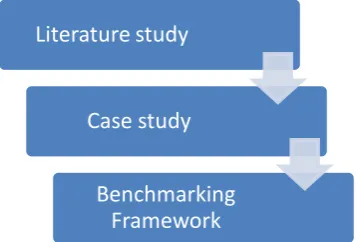
(11) Benchmarking for a software company. Literature study. Case study Benchmarking Framework Figure 1 Steps in the Research Design. Master’s thesis: Robert Balkema. 11.
(12) Benchmarking for a software company. 2 Literature review In this chapter the theory about benchmarking is discussed. The answer to the first two research questions will be given. These questions concern the subject how benchmarking should be done according to the literature. First the concept of benchmarking and its origins is explained. In the second paragraph benchmark typologies are explained, the third paragraph is about the benchmarking frameworks. In this last paragraph is explained how the benchmarking process should be organised. In the final part of this chapter some general remarks about benchmarking are made. The chapter ends with a summary of the benchmarking literature that is used.. 2.1 What is benchmarking? A benchmark can be defined according to the Oxford Dictionary as follows; “a standard or point of reference against which things may be compared”. Benchmark is originally a term from surveying land. It is a point from which all other points are measured. Benchmarks are also used in businesses to improve business strategies, and operational performance. The topic of this research is the benchmarking practice to improve the performance of businesses. Benchmarking in the business environment is a much discussed topic in science as well as in practice. Benchmarking could be used for improvement of business processes. Learning from others is an important part of benchmarking. Benchmarking is used to improve an organization’s activities that could be more efficient and/or effective compared to other relevant organizations’ performance (Francis & Holloway, 2007). Targets could be set using benchmarking, because benchmarking sets realistic goals that are unarguable (Walsh, 2000). Benchmarking in the business environment has its roots in the manufacturing sector, but today benchmarking is used in numerous different sectors. Many benchmarking studies are carried out. This has led to many definitions of benchmarking. There is substantial similarity between the benchmarking definitions. Most definitions are about a systematic way of improvement of the processes of the organisation, by looking at, and learning from others. Furthermore not only the financial figures must be compared but also non-financial figures are important. From these definitions it is clear that the ultimate purpose of benchmarking is to compare a organisation with other (better) organisations to improve the performance of the first or both organisations.. 2.2 Typologies of benchmarking In literature there are many benchmark typologies defined. Distinctions can be made in the type of selection criteria that are used when benchmarking partners are selected. Or between what subjects are selected to benchmark. Also a distinction can be made whether the benchmarking project is voluntary or not. In the remaining of this paragraph the typologies are explained. Performance Benchmarking Performance benchmarking is about comparing your organisation with competitors and industry leaders on measures like price, product quality or service level, to be short all kinds of performance measures (Finnegan, 1996 , p. 58). In this way can performance gaps be found. Performance benchmarking has become a component of numerous certification and accreditation systems (Maleyeff, 2003). When the benchmarking partners choose to be anonymous, performance benchmarking is the only type that is used. Strategic Benchmarking The focus with strategic benchmarking is on potential change an organisation can adapt by sharing the data with other noncompeting organisations. Strategic benchmarking is done so that significant business trend opportunities are identified (Finnegan, 1996 , p. 58).. Master’s thesis: Robert Balkema. 12.
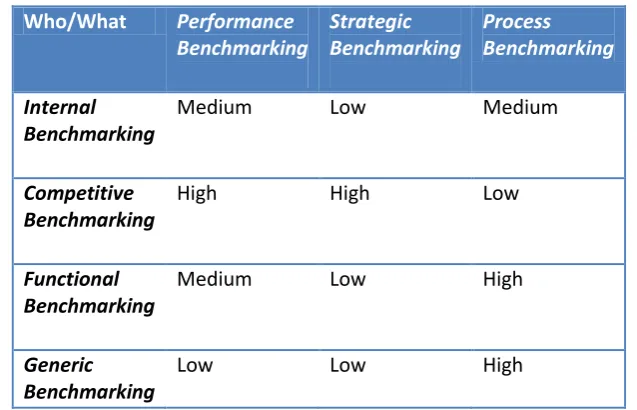
(13) Benchmarking for a software company Process Benchmarking With process benchmarking one or more key business processes are observed, so they can be improved by the organisation. This requires face-to-face studies, so that the observed organisation needs to be directly involved of the benchmark study (Finnegan, 1996 , p. 58). Internal Benchmarking Camp defined in Francis and Holloway (2007) internal benchmarking as comparison with similar processes within the own organisation. Departments who are performing tasks, or have processes that have concerted practices could study each other and learn. This is the most easiest form of benchmarking to start with. (Francis & Holloway, 2007). Competitive Benchmarking Also from Camp (in Francis and Holloway (2007)) is competitive benchmarking. This is about comparing the own organisation with the best direct competitors in the industry. The performance and results of the own organisation are compared to the “best” in the industry. Functional Benchmarking Camp defined also functional benchmarking in Francis and Holloway (2007). With functional benchmarking the own processes or technology is compared to other organisations in the same industry. The purpose is to have the best process. Generic Benchmarking Generic benchmarking is the comparison of work processes with other who have innovative, exemplar work processes. The comparison can be made to all kinds of partners, not necessarily in the same industry. Generic benchmarking is also defined by Camp in Francis and Holloway (2007). The different typologies or classifications of the benchmarking process complement each other. Not all combinations make sense. For example the combination of internal benchmarking and strategic benchmarking has no meaning because the strategy should be coherent (Bhutta & Hug, 1999). On the other hand a strategy comparison with a competitor could reveal lots of useful information. In table 1 is given what kind of typologies work well together and which do not. The distinction in typologies is made between type of comparison in organisations and the subject of the benchmark.. Master’s thesis: Robert Balkema. 13.
(14) Benchmarking for a software company. Who/What. Performance Strategic Process Benchmarking Benchmarking Benchmarking. Internal Medium Benchmarking. Low. Medium. Competitive High Benchmarking. High. Low. Functional Medium Benchmarking. Low. High. Generic Low Benchmarking. Low. High. Table 1: Benchmarking typologies correlating with each other or not (Bhutta & Hug, 1999). There are more typologies defined in literature. Below are three other, more general, typologies explained. These types of benchmarking could be used to describe every kind of benchmarking. Global benchmarking defines the region in which the benchmarking partners are searched. Compulsory and Voluntary benchmarking are about whether participation in the benchmarking study is mandatory or not. Global Benchmarking The geographical distinction in benchmarking literature, global benchmarking, is important since not only large firms are doing benchmarking (Kyrö, 2003). For large firms local benchmarking was not a very usable option, relevant partners were in many cases not available locally. Therefore global benchmarking should be seen as benchmarking classified in a geographical way. The partner alliances could be classified locally, regionally, in the same country or even all over the world found. Mainly for small companies this distinction is relevant (Kyrö, 2003). Global benchmarking can also be all other types of benchmarking. Compulsory Benchmarking There can also be made a distinction between compulsory and voluntary benchmarking. Bowerman et al. (2002) did a research in the public sector in the UK, especially local authorities. In the public sector compulsory benchmarking is used. They found that compulsory benchmarking is used to control the participating organisation, as where voluntary benchmarking is used for improving the performance. These benchmark studies are most of the time not confidential, but presented to the tax-payers. The tax-payers can view the performance of the local authorities. This type of benchmarking can be characterized as a pull-system. The data is pulled out of the benchmarking organisations. Voluntary Benchmarking When organisations are going to benchmark on their own initiative or participate in a study because they choose for it by themselves this is called voluntary benchmarking. This is the opposite of compulsory benchmarking. The purpose of a voluntary benchmark is to learn from each other, and improving the performance of the organisation. Instead of controlling the organisation by an umbrella organisation (Bowerman, et al., 2002). Voluntary benchmarking is a push-system, the benchmarking organisations hand-in their own data. Starting a benchmarking project is the own choice of the organisation.. Master’s thesis: Robert Balkema. 14.
(15) Benchmarking for a software company. 2.3 Benchmarking framework There is a lack of scientific models in the literature about benchmarking, most models are developed in practice. For example Bogan and English (1994) identify a large number of companies that are benchmarking, all frameworks are developed in practice and adapted to the needs of the company who uses the framework. An overview of different benchmark frameworks is given in Appendix A. As can be seen in appendix A most frameworks capture the same steps in the benchmarking framework. Not all steps are always present, they are sometimes named differently or done in another order. As with the definitions, these different frameworks have a lot in common. Bhutta and Huq (1999) say about the number of frameworks and the common factors they have the following: “one is intimidated by the numerous methods adopted to do what actually accounts to the same thing.” Al frameworks come in essence down to the following four stages: planning, analysis, implementation and review (Bogan & English, 1994, p. 81; Longbottom, 2000). Every framework has its own focus. In appendix A a few examples of benchmarking frameworks are presented. Freytag and Hollensen (2001) defined a benchmarking framework. In this framework they define also bench-learning and bench-action. The framework involves seven steps, these are also described in Appendix A. Bench-learning means that not only rankings are made between organisations but also improvement points are identified. On these points the organisation should look at other, better performing, organisations. From these companies could be “learned” how to perform better. Benchaction is where the changes should be made on the organisation’s processes, based on benchlearning. Van Hoorn, et al. (2006) developed a framework for a benchmarking project of academic hospitals in the Netherlands. In the original framework nine steps are defined. Evaluation is a step that is often not named in benchmark processes (see also appendix A). In the process used in the benchmark project between academic hospitals in The Netherlands (Van Hoorn, et al., 2006; Van Hoorn & Wendt, 2008, 2010) this step was added later. The focus of the framework is on describing all variables in a similar way and developing indicators as well as data gathering methods in a manner that these are comparable. The so called “apples and oranges” comparison is prevented. Most frameworks lack this part according to the developers of the framework (Van Hoorn, et al., 2006). Bogan and English (1994, p. 83) explain that there is no process design that fulfils each individual organisations’ needs and that a design that suites the organisational cultures has far more benefits than establishing a national standard benchmark process. Freytag and Hollensen (2001) also wonder the question to what extent a general model can be used. Every company is operating under different conditions. Freytag and Hollensen (2001) state that: “a benchmark process must deal with these differences. A benchmark process should be adapted to each unique situation.” The benchmarking process is explained using four general steps. The four general benchmarking steps of Longbottom (2000) are explained below. The order of the steps, or the activities in each steps are not the same in the different frameworks. Every framework is adapted to needs of the users. All benchmarking activities are explained using the general steps defined by Longbottom (2000). 1) Planning The first step concerns making plans to carry out the benchmark project. The subjects of the benchmark study are defined. The partners are selected. The measures that will be used to make the comparison need also be selected or constructed in this step, these are called performance indicators. To summarize, the entire benchmarking process is planned. 2) Analysis The second step is the step where improvement areas are identified. First the data is collected. The indicators need to be compared to the value of the partners. Based on this an analysis of the performance of the subject is made. The outcomes of this analysis should be. Master’s thesis: Robert Balkema. 15.
(16) Benchmarking for a software company presented and used in the next step. Learning from others is the goal with benchmarking. Learning from the partners takes place in this step. When for privacy reasons benchmarking partners are anonymous, then learning is harder. You can only view your performance in relations to the other partners. 3) Implementation What is learned from the analysis is put in to practice in step 3. Based on the analysis the improvements are made. To make the improvements, plans should be actualized and implemented. 4) Review In the final step the changes that are made need to be monitored. The entire process is evaluated. Based on the evaluation the benchmark process is improved. Benchmarking is a continuous process. The next paragraph discuss in detail what should be done in each of the four steps. In the bar that is presented above each of the different steps it shown where in the process the step is situated. What should be done during the different steps of the benchmark frameworks is explained in the next paragraphs. The generic framework defined in the last paragraph is used as a guide. Within each step is explained what should be done according to the literature. In the bar can be seen what step is described below. It is not necessarily the best way to use the four steps in this order. As explained before, a general framework is not necessarily useful. Every benchmark process has different requirements. With the four steps, planning, analysis, implementation and review all aspects of a benchmark process are taken into account. The order of the four steps could be different in specific situations. 2.3.1. Planning. 1. Planning. 2. Analysis. 3.Implementation. 4. Review. 2.3.1.1 Subject selection When selecting a subject to benchmark, one must always keep in mind that the subject is really important for the company’s success. This can be a process, department or the company as a whole. According to Carpinetti and de Melo (2002) managers who want to improve a process in the organisation are the ones who make the decisions about the subjects that will be benchmarked and those that will not. These managers have a strong operational view of the improvements needed. These managers do not take the overall strategy in to account. Therefore it would be good to align the different needs for improvement with the overall strategy and prioritized to competitive criteria for selecting a benchmark subject (Carpinetti & de Melo, 2002). In deciding what subjects are selected for the benchmarks two criteria need to be followed (Freytag & Hollensen, 2001): . They should be of strategic importance to the business; Improvements in the areas will make a significant contribution to overall business results.. Master’s thesis: Robert Balkema. 16.
(17) Benchmarking for a software company 2.3.1.2 Partner selection The partner(s) need to be selected to which the comparison will be made. Partner selection can be done internally and externally. Internal partners are departments who perform similar tasks. External partners are companies with for example the same processes, outputs etc (Freytag & Hollensen, 2001). The comparison can be done with one partner or a group of partners. The comparison can even be made to the entire industry. Using a large number of organisations helps to ensure that relevant information is collected and that good practice is identified (Bhutta & Hug, 1999). A large group of partners helps to avoid the drawbacks of one-to-one comparisons that cannot ensure an eventual process improvement, because the sample of companies was too small to identify new and innovative working practices (Fernandez, McCarthy, & Rakotove-Joel, 2001). The word “partner” is chosen to describe the comparison group (or sample), because the organisations work closely together when benchmarking. Data on key processes is shared. This can give the competition a big advantage. Organisations receive information about other organisations in return, so they can learn. Privacy is important in a benchmarking study because companies do not want to lose their competitive advantages. Poor performing companies may be embarrassed and will therefore not share their performance data. Therefore the benchmarking platform can be used. The advantage is that organisations that have subscribed to this service do not communicate with each other; they only see anonymous statistics of the performance indicators. In the benchmarking code of conduct from the American Productivity and Quality Center, which is also used by the European equivalent, is five the lower bound of the number of companies participating in a benchmarking study. This will ensure that the data is sufficiently aggregated (APQC, 2010; EFQM, 2009). Also the data could not be traced back to one organisation. There needs to be a basis for comparison. Questions that could be asked to identify possible partners in this stage: . Are the companies comparable? Do the companies have the same size? Are the companies in the same sector? Do the companies have the similar processes?. When the partners agree in doing a benchmark research it may be wise to draw a contract, or a code of conduct. Topics that need to be covered are the confidentiality, exchange of what data will be provided and also how the data will be used. Another important legal issue is that cost should not be discussed with competitors if costs are an element of pricing (Bogan & English, 1994, p. 97). This is to ensure there will be no price fixing. Also market or customer allocation, dealing arrangements, bid rigging, bribery or misappropriation should not be initiated during a benchmarking project. There is a European Benchmarking Code of Conduct (2009), which is based on the Benchmarking Code of Conduct of the APQC. The APQC provides a benchmarking platform for organisations, and they argue that when starting with benchmarking the benchmarking code of conduct should be followed. Other serious legal issues are defined by Boulter (2003). Boulter states that there is a fundamental misalignment with purpose of intellectual property rights and the objectives of benchmarking. Property rights are there to protect a monopoly of exploiting creative efforts from for example competitors. With benchmarking, on the other hand, these creative efforts are shared with, for example competitors. Another legal problem that Boulter (2003) points out is that of competition law. Benchmarking facilitates knowledge transfer/information exchanges, the legality of which is governed by competition law. The law in the European Union prohibits decisions and concerted practices that have as their object or effect the prevention, distortion or restriction of competition in. Master’s thesis: Robert Balkema. 17.
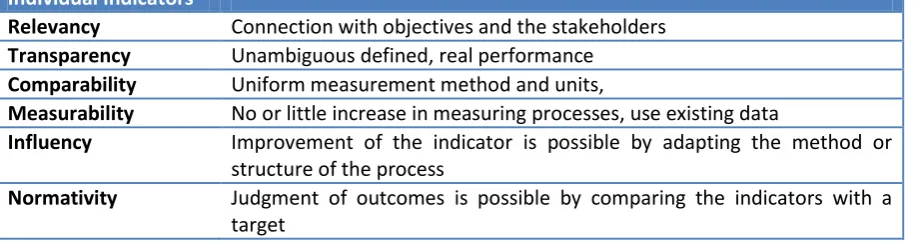
(18) Benchmarking for a software company the Common Market. Most danger with competition law is in oligopolistic markets for homogeneous products. Boulter (2003) identified the benchmark processes with the highest risk in competition law. 2.3.1.3 Performance indicators The indicators need to be constructed in such a way that the different organisations can be compared to each other. The so called comparison between apples and oranges need to be avoided. Successful performance measurements describe factors critical to successful business operations (Bogan & English, 1994, p. 46). Van Hoorn and Wendt (2008, p. 18) indicated that the individual indicators must satisfy six characteristics: transparency, comparability, measurability, influence and normativity (see table 3). To add on this, Maleyeff (2003) states that: “an apples and oranges” comparison can be avoided by ensuring that the indicators are defined and measured in a consistent way, the indicator should involve the same priority of customer service in each organization compared and the organisations would reasonably expected to perform similarly given their variety of customers, suppliers, location etc.”. Maire (2002) indicates that the characteristics of the individual indicators should be sufficiently generic so the indicators can be used in different companies. At the same time, the indicators should be detailed enough to extract relevant information. Limit the use of indicators to as little as possible, ideally only those which are shared by all the partner companies should be used (Maire, 2002). Individual indicators Relevancy Transparency Comparability Measurability Influency Normativity. Connection with objectives and the stakeholders Unambiguous defined, real performance Uniform measurement method and units, No or little increase in measuring processes, use existing data Improvement of the indicator is possible by adapting the method or structure of the process Judgment of outcomes is possible by comparing the indicators with a target. Table 2 criteria of indicators. Performance measurement systems can be used to get a complete picture of the organisation. The advantage of using an existing performance management system is that the organisations who are participating in a benchmarking project do not have to endure large costs to get the needed data. The use of existing performance management lowers the barrier to join the benchmarking project. The indicator types that are used most are financial performance, customer satisfaction and quality of products/services (Cassell, Nadin, & Older Gray, 2001). Quantitative measures can be measured relatively easy, these are used most according to Cassel e al. (2001). Qualitative measures are used less, this is probably because they are more subjective and harder to measure. An example of a performance management system that is used in the literature is the balance scorecard (BSC) from Kaplan and Norton (1992). The BSC is used alongside benchmarking to make sure that the entire spectrum of indicators is used to describe the company (Chiang & Lin, 2009; Punniyamoorthy & Murali, 2008). The BSC is based on the strategy of the company. The strategy is translated into indicators and these indicators are divided in to four perspectives: financial, customer, internal, and innovation and growth. Because the BSC does not only look at the past using financial figures, it can also map the performance on the long and short term strategic goals. The different perspectives are linked to each other, therefore improvements in other perspectives can be predicted. For example, improvements in innovation and growth lead to better performance in the internal processes. This improvement in internal processes leads to higher customer satisfaction. Which in turn leads to higher sales and better financial performance. The BSC could be used to develop a set of indicators that describe the entire organisation.. Master’s thesis: Robert Balkema. 18.
(19) Benchmarking for a software company The total set of indicators that are selected by the stakeholders need to have some characteristics. When the final choice of indicators is made, these characteristics need to be fulfilled. The set of indicators need to be complete, it should cover the entire spectrum of the benchmark subject. Also the set of indicators should be limited in size. All unusable indicators should be filtered out. To work with the indicators over a longer period, the set of indicators should be future proof. This means that there will not be any foreseeable adaption’s necessary for the set of indicators. Set of indicators Completeness Handling Future proof. Covers the entire spectrum of the desired business processes or subject Limited in size, not include unusable indicators No foreseeable adaption’s of the indicator set are necessarily. Table 3 criteria for the total set of indicators used for benchmarking (Van Hoorn & Wendt, 2008). Bogan and English (1994, p. 47) make a distinction between leading and lagging indicators. The indicators that are selected should apply as well to elements located at the strategic level, as to elements on the operational levels (Maire, 2002). Leading indicators are indicators that predict future system performance. For example rising employee turnover and higher error rates can predict a declining customer satisfaction (Bogan & English, 1994, p. 47). Lagging indicators on the other hand describe how the system has performed in the past. Examples of lagging indicators are the traditional financial measures like profits or return on assets. 2.3.2. Analysis. 1. Planning. 2. Analysis. 3.Implementation. 4. Review. 2.3.2.1 Data collection To analyze the performance of the organisation data must be collected first. How data can be collected according to the literature is discussed here. First is explained what is taken into account when selecting a data collection method. The second topic that is discussed is the type of information. Finally the actual data collection methods are discussed. Drivers for what data collection method should be used are (Coers, Gardner, & Higgins, 2002, p. 47): The requirements of the benchmarking initiative The percentage of information that needs to be quantitative vs. qualitative The time frame for providing information and recommendations The information that is available in the public domain and how closely it meets the project needs. The available budget The information could be classified in two categories, namely: quantitative and qualitative (Kozak, 2004, p. 138). Coers et al. (2002, p. 51) explain that there are the following types of information that could be gathered in a benchmarking process: Metrics and measures: This quantitative form of information concerns the performance of the subjects. This data could be used to determine performance gaps based on a numerical set of indicators. Process information: This is qualitative information about the structure, enablers, and integration with other processes. This makes sure that is understood what makes the performance of the process. Supporting information: This is qualitative information concerning tools that are used in the process (job description, training information). This can be easily adapted to improve the process.. Master’s thesis: Robert Balkema. 19.
(20) Benchmarking for a software company Coers et al. (2002, p. 51.) explain that there are two types of research that can be done to gather the benchmarking data. These types of research are secondary and primary research and are explained below. In general information gathered in the public domain will not provide details or specifics. Information from the public domain can also be used to select benchmarking partners. Regarding the cost and time can be said the following: “The more in-depth the project, the more time it will require and more costly it will be “ (Coers, et al., 2002, p. 50) From this sentence can be concluded that it is important to have the right depth in the benchmarking project. Otherwise the costs are higher than the benefits of the benchmarking project. Secondary research Libraries, associations, professional organisations, online databases, the internet and professional benchmarking search professionals are all sources for secondary research. There is ample information available in the public domain. This might even be all the information you need. When using industry data you need a consistent method of defining the industry. You could use standard definitions like the SBI code of the Dutch statistical office (CBS, 2010). When the classification is made, you need to ask where the data comes from. Will you find your own data, or buy data from external parties. Data that is obtained by secondary research is quantitative. When doing secondary research it is important to use recent and reliable information. Also the amount of information that is needed to determine and understand performance of the subjects might not be enough. Primary research Primary research for a benchmarking project can be divided in three different research methods: surveys, telephone interviews and face to face meetings. The three research methods are described below. Surveys (written or online) The survey is one of the most commonly used methods for gathering large amounts of data. Today probably written surveys are not used very often anymore, they are replaced by surveys that can be filled in online. The data that is obtained through these surveys can be quantitative and qualitative. Telephone interviews Telephone interviews can be used in multiple ways. They can be used as a follow up of secondary or online surveys but they can also be used as a simple, convenient, and inexpensive means of gathering new data. The data that is obtained by these surveys can be quantitative and qualitative. Face to face meetings or site visits Personal or site visits require most time, but they are most detailed. They can be extremely useful to extend on your previous surveys. The data that is obtained by these surveys can be quantitative and qualitative. SBR Another way of gathering the right data is using new technological improvements. One of those new improvements is Standard Business Reporting (SBR. In the Netherlands the SBR program is an initiative of the government that arises from the Dutch Taxonomy Project (www.sbr-nl.nl). With the SBR reporting system XBRL (eXtensible Business Reporting Language) is used. With SBR the financial advisors can exchange electronic data with the government or banks. In the Netherlands, three big banks (ABN AMRO, ING and Rabobank), agreed upon delivering electronic credit reports. The advantage of this is that all the data is delivered in a standard format. With the appropriate software Master’s thesis: Robert Balkema. 20.
(21) Benchmarking for a software company the electronic data can be translated in to usable information. With benchmarking there is a possibility of using SBR or another XBRL taxonomy (Jacobs, 2007, p. 74). When the data used in the SBR program can be used with benchmarking, some possible data issues could be avoided. The data is already in a standard format, so with the appropriate software this data could easily be imported in the benchmark software. The quality of the data can be assured with this process and the data of the different organisations is presented in a similar way. The reports that are used for benchmarking are already there and no new systems have to be developed. This lowers the entry barriers to benchmarking. Other issues that should be taken into account when collection data When performing the research, the measuring of the indicators, it is important to define to what extent the data must be correct. Finnegan (1996, p. 128) says that the data must be roughly right. By this is meant that the level of detail should be low enough so that different process steps can easily be recognized. But detail must be high enough so that the steps in the process can be understood well. This should not be the case for data that comes from accounting systems. That data should be correct. Of course accounting systems can deliver data which is incorrect, or there is missing some data. Therefore there should be a quality check of the data in the system. The collection methods should be uniform, in every organisation the same method should be used (Freytag & Hollensen, 2001). Uniform collection methods are very important, but also the way to handle inconsistent, corrupt or missing data. What should be done when there are issues with the data quality should be defined in this step. The new SBR reporting format can be of great use here, because less flaws are made. When measuring the indicators of a benchmarking subject it is important to look only at stable subjects (Maleyeff, 2003). Walsh (2000) called this the measuring of business as usual. When presenting the business as usual in a graph over time, this line shows how the indicator is actually performing. Business as usual lines are not set, the lines are calculated based on historical data. From these lines can be seen whether or not the subject is stable over time or not. When there are points not on the trend line, you have to identify the cause and review if the subject is not stable or the particular data point does not need to be taken into account in the measurement process. With a compulsory benchmark the data can demanded by the controlling agency (Bowerman, et al., 2002). This will ensure that certain formats are used. This again makes it easier to describe the benchmarking partners in a similar way. This way of benchmarking is a a pull-system. The voluntary benchmarking is a push-system. The compulsory benchmarking is done because the data is available, in the case of the government for controlling purposes. This way the controlling institutions can present useful information to the organisations they control. These organisations can improve their processes by using this new information. 2.3.2.2 Data analysis In step 6 of the roadmap benchmarking the performance indicators are measured. In this step the performance of the indicators of the different organisations are compared to each other. The purpose of this step is to identify the “gaps” in the performance of the initiating organisation. When the indicators show a negative gap, an improvement might be needed. On the opposite side, when there is a positive gap the organisation outperforms the comparison group. A performance gap can be formalized as follows: Performance Gap = internal measurement – benchmark. When analyzing the performance differences it is important that these are statistically sound. To do this Maleyeff (2003) did a study where he identified a few principles that need to be taken into account. This principles are summed up in table 4. First of all the organizational entities need to be stable over the data collection period. When the entities are stable, performance data can be compared over time. If the entities are not stable over the data collection period, the source of this. Master’s thesis: Robert Balkema. 21.
(22) Benchmarking for a software company unexpected change in performance needs to be determined and investigated separately. In other words the business as usual should be measured only (Walsh, 2000).The second principle is that random variation of the indicator (related to its sample size) should be taken into account. When indexes are used as indicator, both the numerator and the denominator should be known when comparing the indexes. Also the amount of random variation in a performance index will be inversely related to the sample size of the index. The third principle concerns the care that needs to be taken with the characteristics of the partner or partners where the comparison is made to. When a difference in an indicator is measured, it does not necessarily mean that a problem exists or improvements are necessary. It is possible to make a target specially designed to the needs and characteristics of a specific organisation. The final principle Maleyeff (2003) identified is that the indicators can influence the behaviour of the employees. If the benchmarking activities are not carefully carried out, employee morale may decrease and for example customer satisfaction will decrease instead of increase. This problem may occur when the performance measures do not describing the subject correctly. Principles when analyzing the performance Measure only the business as usual The organisation need to be stable over time, unexpected or large change in performance need to be identified and investigated separately Random variation needs to be taken Random variation will influence the performance in to account Characteristics of the partners need Do not compare organisations that are totally different to be similar Indicators influence the behaviour Employees need to have influence on the indicators. of the employees Employees will also make sure they will perform good on the indicators Table 4: Principles when analyzing the performance (Maleyeff, 2003). To identify the gaps in performance, a method is needed to define a benchmark on a statistically solid basis. Finnegan (1996), he argues that it is best to keep your calculations simple, the use of for example averages, percentages, and minimum and maximum values, also Pareto charts and pie charts will improve your chances of avoiding conflicts. Today also more advanced models are used. A method that is used is Data Envelopment Analysis (DEA) (Berg & Lin, 2008; Bogetoft & Otto, 2011; Rickards, 2003). When using DEA the relative performance is measured for each Decision Making Unit (DMU). The inputs and outputs are used to compute this efficiency. DEA is a nonparametric linear programming procedure.. Figure 2 Input and outputs measures for DEA. There are also other methods to do the analysis. Walsh (2000) elaborates on four methods in his research; the counting method, the distance method, the histogram method and the capability index method. Another used method is Stochastic Frontier Analysis (SFA) (Bogetoft & Otto, 2011). SFA determines the efficiency with a sophisticated economic specification of the production relationship. Its advantage is that the approach attempts to account for the effects of noise in the data (Berg & Lin, 2008). Bogetoft and Otto (2011) implemented in the open source software of R, a statistical. Master’s thesis: Robert Balkema. 22.
(23) Benchmarking for a software company software package, a benchmarking module. In this module are the DEA and SFA module implemented. 2.3.3. Implementation. 1. Planning. 2. Analysis. 3.Implementation. 4. Review. 2.3.3.1 Construction of improvement plans Only when the reasons behind the organisations’ different practices are absolutely clear will the analytical measure, the metric that shows the size of the difference, be understandable (Finnegan, 1996, p. 137). Therefore it is important that people with knowledge of the specific company should advise which practices or processes should be improved or could explain the statically differences in scores of the most relevant variables. 2.3.3.2 Implementing improvement plans Just knowing what performance gaps there are and what causes them is not enough. Improvement is necessary to stay ahead or to catch up with the competition. Therefore the construction of improvement plans is step 8 of the roadmap benchmarking. Converting the benchmark analysis in an improvement plan is not easy. Only when the reasons behind the organisations’ different practices are absolutely clear will the analytical measure, the metric that shows the size of the difference, be understandable (Finnegan, 1996, p. 137). Therefore it is important that people with knowledge of the specific company should advise what practices or processes should be improved. Freytag and Hollensen (2001) call this part “benchaction”. When constructing an improvement plan some topics should be taken care of. Just literally copying processes of industry leaders will not lead to good results. Differences are found in business practices, work standards, work environment, economics and culture(Cassell, et al., 2001). 2.3.4. Review. 1. Planning. 2. Analysis. 3.Implementation. 4. Review. 2.3.4.1 Monitor changes When the improvements are made in organisations they need to be monitored and adjusted when necessary. This step also stimulates further improvement together with the evaluation step. The feedback from this steps helps with the improvements to the entire process (Fernandez, et al., 2001). 2.3.4.2 Evaluation The final step of the roadmap benchmarking is the evaluation of the improvement plans. This should be done by the entrepreneur. From this evaluation it can be seen whether or not the improvements have helped. When performing a benchmark study it is important to evaluate. Because benchmarking is a continuous process, each time the process is evaluated improvements should be made to the framework (Fernandez, et al., 2001).. 2.4 Other topics regarding benchmarking 2.4.1 Limitations of benchmarking Benchmarking sounds straightforward but there are some very important issues that need to be taken into account. One important issue for this research is how data can be obtained to set a benchmark. It may be difficult to obtain data with enough quality and usefulness from other companies (Freytag & Hollensen, 2001). This is the so called garbage in, garbage out principle. When data is constructed in different ways, or there is a lot missing data, outcomes of the benchmark process will be of little use. Another important issue relating to the previous, is that the privacy of. Master’s thesis: Robert Balkema. 23.
(24) Benchmarking for a software company companies that are participating needs to be taken into account. This might also have legal consequences. Another important issue is that there should not be too great a focus on the numbers only. Also the process of gathering the numbers or data is important. 2.4.2 Benchmarking in SME’s Most end-users of the benchmark software of FINAN will be small- and medium sized enterprises (SMEs). Cassel et al.(2001) did a research in the UK on benchmarking in SMEs. Their findings were that the most popular benchmarking indices were financial performance, customer satisfaction and quality of products/ services. Most of the indices used are quantitative. Qualitative measures, concerning human resource and organisational issues, are used less. However the companies in the sample found these indicators useful and effective. Another finding of Cassel et al. (2001) was that; where benchmarking was used it was found to be very effective. With companies who are not using benchmarking there were low levels of interest in benchmarking. Reasons for this might be that there are not enough resources available in SMEs and the formal processes used in benchmarking are not suited for SMEs according (Cassell, et al., 2001).. 2.5 Summary of the literature The first two research questions, about what benchmark frameworks there are and what criteria a benchmark framework should have, are now answered. We have looked at a couple of benchmarking frameworks. There are too many benchmarking frameworks defined in literature to review all. The second research question, concerns the criteria that must be met in by the framework according to the existing literature, is also answered in this chapter. In Table 5 is an overview given. In the literature study there were unfortunately no published researches found on the question does benchmarking really work? Is the performance of companies that are benchmarking better than the performance of other companies who are not benchmarking? The reason that such a study is not found is that there are not many studies performed. This is because such a study has a large scale and it this hard to determine what the cause of the performance of a company is. There are many factors that influence the performance. There is also a lack of scientific frameworks and classifications of benchmarks. In the literature study there were no scientific frameworks or classifications found. Ten Tije et al. (2010) came also to this conclusion. May be the cause of this is the same as why there is no real research done whether benchmarking works or not, it is hard to determine what works best. What framework would fit best for FINAN will be described in chapter 5. This will not only be based on literature but also on the field study by the clients of FINAN. The methods used in the field study are described in the next chapter, chapter 3. In chapter 4 the results of the field study are presented. Which contained interviews and evaluation of related documents.. Master’s thesis: Robert Balkema. 24.
(25) Benchmarking for a software company. Basic framework of Fernandez (2001) 1. Planning. 2. Analyis. Criteria from literature Select similar process or subjects (organisations) strategic importance significant contribution to overall business results Select only partners who are similar Comparable Same size Same sector Same processes Select indicators who are similar Relevancy Transparency Comparability Measurability Influence Normative Completeness Handling Future proof Do not compare organisations that are totally different. . Data collection methods Secondary research Mail/online survey Interview telephone survey Personal visits All kinds of Methods Data Envelopment Analysis Or other statiscal or econometric methods Other principle that should be taken into account: The organisation needs to be stable over time, unexpected or large changes in performance needs to be identified and investigated separately Random variation will influence the performance. 3. Implementation. . Construction of improvement plans Implementation of improvement plans. 4. Review. . Evaluation of the benchmark study Repeat the study, continuous improvement. Table 5: Description of what criteria must me bet by the framework according to the literature. Presented in the generic framework. Master’s thesis: Robert Balkema. 25.
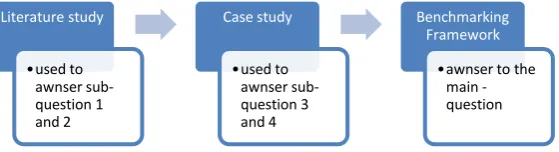
(26) Benchmarking for a software company. 3 Research Methodology In this chapter the field study of this research is discussed. First the research design will be described, next the selection of the cases is presented, finally the data collection method is discussed. In this research three cases will be described. The data is collected by interviewing benchmarking experts of the organisations that are selected in the case study.. 3.1 Research Design First the theory of benchmarking is described, second step is study of the practical experiences of benchmarking from the clients of FINAN. Clients of FINAN who are involved with benchmarking are studied. This research could be characterized as a case-study with three cases. The purpose of studying the clients of FINAN is that the use of benchmarking and the goals of benchmarking that the clients have are discovered. Because these clients are already performing benchmark studies, also practices which are working good regarding benchmarking can be identified. Other practical problems can be found and a solution to these problems can be implemented in the benchmarking framework, what the end result should be of this study. In the figure below the steps in this study are graphically presented.. Literature study •used to awnser subquestion 1 and 2. Case study •used to awnser subquestion 3 and 4. Benchmarking Framework •awnser to the main question. Figure 3: Indication which questions are answered in which step of the Research Design. 3.1.1 Case-Study The case-study method is used to see how benchmarking is done in practice by the clients of FINAN. According to Swanborn (2008, pp. 22,23) the most important characteristics of a case-study are: one social/ or few system are examined, in its natural environment, following a certain process, using multiple data-sources and notion of varied perceptions. Swanborn excludes as a case-study doing a single survey in for example a certain village. A case-study is intensive research (Swanborn, 2008, pp. 13,22). When are case-studies appropriate to use? In his book about case-studies Swanborn (2008, p. 31) talks about positive and negative considerations that could argue for doing a case-study research. A positive consideration is that the choice for a case-study, and no other research strategy, is made based on the problem statement. This means that the methodology that is chosen is the best for answering the research questions. When the choice for a case-study is made on negative considerations, it is meant that there are limitations to the circumstances at which the research must be carried out. The considerations to use the case-study method in this research are mostly positive. The choice to do a case-study is made because detailed information of the possible different opinions of participants are needed. The purpose of this study is to inform FINAN how benchmarking is done by its clients. Also to know which problems there are in practice with benchmarking and there solutions are of interest in this research. A negative consideration is that there is not enough time to do a full scale benchmarking experiment. Also a survey is not useful because there are only three possible participants in the research. A detailed case-study can be done without excluding participants. In the next paragraph the cases will be described.. Master’s thesis: Robert Balkema. 26.
(27) Benchmarking for a software company 3.1.2. Selection and description of the cases. 3.1.3. Organisation A. 3.1.4. Organisation B. 3.1.5. Organisation C. 3.2. Data Collection. 3.2.1 Interviews To find out how benchmarking is done in practice and how FINAN can facilitate benchmarking, interviews were held. What needs to be find out is how the benchmarking used in practice, what are the goals of benchmarking by the organisations. Also the opinion of the benchmark practitioners about the benchmarking processes is the objective. According to Baarda and de Goede (1999) an interview is the best method to gain information about attitudes, opinions and knowledge. This is why the choice for an interview is made. The interviews are semi-structured. The interview is not completely structured because the interviewed practitioners could give their opinions and also extra information or relevant experiences could explained more in depth. The general steps of the benchmark framework of Longbottom (2000) are followed as a rough guide. This is done so the whole spectrum of doing the benchmarks is covered. Because a detailed description of the benchmarking practices is needed and there are not many cases, therefore the interviews could be held orally. An additional advantage is that the interviews are according to Baarda and de Goede (1999) that open and hard questions can be explained and more extensive answers are gathered. In general the questions can be explained so no misunderstandings about questions occur. The questions in the interviews were open, this is done so the practitioner could also give extra information on the questions. Also extra information could be asked or given. Also it was possible to make a side-step in the interview. With these side-steps extra information or experiences with benchmarking could be mentioned by the interviewers. 3.2.2 Other data Besides the interviews also other data is used. What methods are used is described in this paragraph. First of all is the existing software FINAN, what is used for benchmarking by Organisation A and Organisation B, examined. Also public parts of the reports that are the result of the benchmarking studies are reviewed. The confidential parts of the reports were not available. There are also documents and websites examined. The results of these collection methods are all described in chapter four together with the interviews. In this chapter methodology of the field study is explained. With the intensive study of three cases an answer to the research question is tried to be found. A choice for a case-study has been made because there are only three organisations in the client base who are benchmarking. Also the type of questions could be best answered by doing a case-study. The results of the field study are presented in the next chapter. The development of the benchmarking framework is clarified in chapter 5. In the last chapter will the discussion, conclusion and the recommendations be discussed.. Master’s thesis: Robert Balkema. 27.
(28) Benchmarking for a software company. 4 Results 5 Benchmarking and Finan 6 Conclusion and recommendations This report is written to inform FINAN about what their clients are doing when they are benchmarking. FINAN will support this process with their software. Accountancy firms, a lot of them are clients of FINAN, want to sell more advice hours to their clients (the entrepreneurs). Benchmarking is one of these possibilities to give more advice. FINAN wants to participate in this process by providing software applications for this process. The main objective of this research is to see what benchmarking is according to the theory and practice. This resulted in the following research questions: Main question: How is benchmarking of organisations done? The main question is divided into four sub-question: 1. 2. 3. 4.. What kind of benchmark frameworks are there according to the literature? What criteria must a benchmark framework have according to the literature? What criteria must a benchmark framework have according to practice? What practical problems exist with benchmarking?. In this chapter the answers to the research questions will shortly be described using the most important results of the literature study and the field study. Based on the conclusions will some recommendations made to FINAN and further research.. 6.1 Conclusion When comparing the sub-research questions, answered in the previous section, we can answer the main question: How should benchmarking be done? From literature was learned that most benchmarking frameworks could be described in four general steps (Longbottom, 2000). From the field study becomes clear that these steps also cover the methods used in practice, at least for the clients of FINAN. The most important goal of benchmarking is learning from each other. 6.1.1 General benchmarking framework? Tough there is a lack of scientific models, there are many benchmarking frameworks defined in the literature. The models are developed in practice. Every organisation makes her own model, satisfying the organisations own needs. Despite of all the different frameworks that are used, there is some similarity in every model. The names of the different steps can be different, some steps are split up in more steps or carried out in another order. But all steps can be classified in to the following four general steps: 1) 2) 3) 4). Planning; Analysis; Implementation; Review.. Master’s thesis: Robert Balkema. 28.
Figure

+3

Related documents
(2019) 'A ranking based attention approach for visual tracking.', in 2019 IEEE International Conference on Image Processing (ICIP) ; proceedings.. Piscataway, NJ:
limit are considered to use non-compliant fuel with 95 % confidence limit. Note that the compliance threshold is modified to account for the bias in our data, so it can be used
The development and adoption of a MAP also supports the work of the Liquor Control and Licensing Branch and is a recommended strategy to reduce the public safety risk associated
We will divide our theme units into 9 curriculum areas: Language Arts, Math, Science, Social Studies, Music, Art, Physical Education,.. Health,and
1987/8 - Rutgers, NJ Recycling Act; Supply Chain Response; Supply Chain Waste Research (Archeology).. 1992 - US Federal Executive Orders (13101); NJ EO; Research, LCA, Waste
All eight HPD colleges—allopathic medicine, dental medicine, health care sciences, medical sciences, nursing, optometry, osteopathic medicine, and pharmacy—plus researchers from
[r]
The split screen technology demonstration dnp Supernova 08-85 dnp Supernova 20-25 Standard white Da-Lite gain 1. See full Gary Kayye ISE video here -
