D E B A T E
Open Access
Knowledge
‘
Translation
’
as social learning:
negotiating the uptake of research-based
knowledge in practice
K. L. Salter
1*and A. Kothari
1,2Abstract
Background:Knowledge translation and evidence-based practice have relied on research derived from clinical trials, which are considered to be methodologically rigorous. The result is practice recommendations based on a narrow view of evidence. We discuss how, within a practice environment, in fact individuals adopt and apply new evidence derived from multiple sources through ongoing, iterative learning cycles.
Discussion:The discussion is presented in four sections. After elaborating on the multiple forms of evidence used in practice, in section 2 we argue that the practitioner derives contextualized knowledge through reflective practice. Then, in section 3, the focus shifts from the individual to the team with consideration of social learning and
theories of practice. In section 4 we discuss the implications of integrative and negotiated knowledge exchange and generation within the practice environment. Namely, how can we promote the use of research within a team-based, contextualized knowledge environment? We suggest support for: 1) collaborative learning environments for active learning and reflection, 2) engaged scholarship approaches so that practice can inform research in a collaborative manner and 3) leveraging authoritative opinion leaders for their clinical expertise during the shared negotiation of knowledge and research. Our approach also points to implications for studying evidence-informed practice: the identification of practice change (as an outcome) ought to be supplemented with understandings of how and when social negotiation processes occur to achieve integrated knowledge.
Summary:This article discusses practice knowledge as dependent on the practice context and on social learning processes, and suggests how research knowledge uptake might be supported from this vantage point.
Keywords:Knowledge translation, Social learning, Reflective practice, Situated learning, Informal knowledge
Over the years, the Evidence-Based Practice (EBP) movement has gained widespread acceptance attribut-able, in part, to the increasing emphasis on the need for public accountability and transparency in decision-making at the patient, organization and policy levels within the healthcare sector [1, 2]. By shifting the em-phasis in decision-making away from clinical expertise and placing it with evidence supplied through rigorous scientific study, practice can be viewed as part of a lo-gical, explicit, transparent, and measurable process [3,
4]. When based on evidence systematically synthesized from methodologically rigorous academic sources, clin-ical decisions in prescribed circumstances are be viewed as rational, logical and scientific rather than founded on habit or intuition [2, 4]. Over time, practice that is based on the results of methodologically sound research evi-dence has become synonymous with best practice [3, 5].
Knowledge translation (KT) seeks to narrow the per-ceived gap between knowledge and practice [6, 7]. KT has been defined as‘a dynamic and iterative process that
includes synthesis, dissemination, exchange and
ethically-sound application of knowledge to improve the health of Canadians, provide more effective health services and products and strengthen the health care system’ (CIHR, www.cihr-irsc.gc.ca/e/29418.html). To determine which knowledge should be ‘translated’ or * Correspondence:[email protected]
1Graduate Program, Health and Rehabilitation Sciences, Western University,
London, ON, Canada
2
School of Health Studies, Western University, London, Ontario, Canada
promoted for application in practice, KT, like EBP, has relied on the use of the traditional evidence hierarchy in which specific forms of scientific endeavour are assigned greater value on the basis of methodological rigour, while other forms of inquiry and other sources of knowledge or ways of knowing are discounted or rejected [2, 4, 8]. Reliance on linear, techno-rational notions of translation from research generation to se-lection to creation and dissemination of clinical prac-tice guidelines may have created a ‘second translation gap’ [9]. It has been suggested that it is time to put aside this linear metaphor of knowledge ‘translation’ and contemplate instead the way in which a practi-tioner might incorporate information from a wider range of knowledge sources in the consideration of practice change [2, 10, 11]. As an alternative, the adoption of research-based evidence by healthcare practitioners can be conceived as part of an ongoing, reflexive and dynamic process of integrated social
learning in which knowledge is negotiated,
co-produced and emergent [1–3, 8, 12].
If one rejects the assumptions associated with the traditional, linear, EBP-linked view of knowledge transla-tion, is it possible to describe a process of social learning in which knowledge is both emergent, and pluralistic, and in which practice and knowledge are not separated? The purpose of this paper is to discuss how individuals can adopt and apply research-based evidence in practice through ongoing, iterative cycles of learning that include processes of reflection and collective negotiation of shared practices. If the ongoing, learning process through which research-based evidence is selected and integrated by practitioners is better understood, then it may be possible to capitalize on this process by identify-ing potential points of intervention through which im-proved research uptake can be facilitated in the future.
We begin, in Section 1.0, by suggesting that, despite the emphasis on a narrowly-defined sample of research-based evidence selected for‘translation’into practice set-tings, multiple forms of evidence are applied at the point of care delivery. Reflective practice, discussed below in section 2.0, is contrasted with evidence-based practice to describe a process that produces contextualized know-ledge drawing on a variety of knowknow-ledge sources for practice decisions. In section 3.0, the idea of team-based contextualized knowledge developing from individual theories of practice is highlighted. Examples of how social learning communities can negotiate across knowledge sources to derive a communal understand-ing of practice norms are presented. Implications for practice, related to measuring KT efforts and possible points of intervention to support the uptake of re-search findings within social learning communities, are discussed in section 4.0.
Multiple ways of knowing Hierarchies of evidence
According to Sackett, the practice of evidence-based medicine represents the conscientious and explicit inte-gration between the best available evidence derived from systematic research with clinical expertise in decision-making [13]. The process of selecting what research findings represent the best available evidence and should be used to inform the development of recommendations, guidelines or protocols and, of course, to guide practice is based on the application of a traditional hierarchy of evidence in which the highest value is assigned to the pooled analysis or systematic review of the results of high-quality, methodologically-rigorous randomized controlled trials (RCTs). The RCT is considered the methodological gold standard for empiric inquiry ad-dressing intervention efficacy [14]. Forms of research inquiry that do not employ research techniques designed to reduce bias and promote internal study validity (e.g., those that offer uncontrolled within or between group observation, report consensus or case study findings) are not considered to be of sufficient rigour to guide prac-tice and can only be considered in the absence of higher quality evidence [2, 4, 15].
Adherence to traditional hierarchy or levels of evi-dence mechanisms discourages the use of research from a variety of systematic modes of inquiry designated as weak or considered insufficiently empiric [3]. Empiric evidence has been described as observable and reprodu-cible, transparent, open to scrutiny, and originating in experiment and observation rather than in theory [16]. The RCT is an example of a very specific type of empiric research; however, qualitative inquiry also produces em-piric results based on observation and is inclusive of both reflection and experience [16]. While it is increas-ingly recognized that systematic, qualitative study has value in uncovering hidden meaning or exploring know-ledge in context, as well as illuminating participant expe-riences in interventions, the findings, which are not reproducible, are often regarded as not empirical enough [4, 14, 17]. The hierarchies of evidence approaches that currently dominate the EBP-linked KT landscape typic-ally do not recognize or include findings derived from qualitative study.
experimental environments [2, 3, 18, 19]. The creation of a selected and distilled evidence base will perpetuate the gap between knowledge and practice if the evidence chosen and the knowledge translation tools created from it (e.g., guidelines, recommendations, protocols) conflict with broad-based knowledge user conceptualizations of evidence that are more inclusive of knowledge derived from multiple sources [2, 20]. This includes research con-ducted using methods not recognized within the domin-ant evidence hierarchies.
Practice-based ways of knowing
The notion of evidence as an object to be transferred or translated from researcher to practitioners [1, 8, 21, 22] is a limited conceptualization founded on a series of as-sumptions about knowledge and practice as follows: a) that knowledge is not emergent, or pluralistic in nature, but instead can be characterized as an objective series of empiric research findings that are value-neutral [4, 10], b) that knowledge can, in fact, be separated from prac-tice in a way that is both useful and meaningful [3, 10, 23], and c) that practice is little more than the applica-tion of a series of rapid decisions informed by a selected research evidence base [3, 10].
Practice environments themselves are complex and uncertain, and bear little resemblance to the strictly con-trolled experimental environment [3]. Context is a com-plex, multi-layered concept that addresses the practical circumstances of practice environments [14] as well as workplace culture. It is characterised by factors that in-clude organizational artefacts such as institutional lan-guage, forms and routines, as well as shared values, team structures and effectiveness, and leadership styles [24]. Information gathered from efficacy research, even when presented in guidelines or recommendations, may not be sufficient to address application in practice environ-ments; healthcare practitioners might judge the informa-tion contained in guidelines or recommendainforma-tions to be impractical or irrelevant, particularly if the‘evidence’as presented does not fit with what is already known, based on knowledge gained from multiple sources, including clinical expertise [2, 20, 22, 25]. Further, efforts to stimu-late practice changes across an organization may be resisted on account of cultural norms and structural pri-orities, suggesting that practice improvements need to be supported by organizational structures and processes if they are to take hold. Understanding practice change and the integration of new research findings into applied practice contexts may also require the adoption of a pluralistic definition of evidence more typical of defini-tions already employed by practitioners [8, 20].
It is generally acknowledged that a variety of know-ledge sources inform practice and service delivery. In the context of the real-world practice environment, evidence
can be defined, in its broadest terms, as that which in-forms effective judgement or decision-making [20]. In the description of the practice of evidence-based medi-cine, we are told that application of ‘best evidence’must consider clinical experience, and context, including pa-tient circumstance [26]. Indeed, most decisions made in practice are based on information that comes from a variety of sources, including clinical experience or ex-pertise, contextual or cultural knowledge as well as prac-tical, ethical, esthetic, and personal knowledge, rather than the results of selected empiric research alone [3, 4, 20, 27, 28]. Wharf-Higgins and colleagues characterize this information as a composite of ‘evidence’derived from both hard and soft sources. Soft evidence, the authors sug-gest, is primarily tacit in nature, built on experience and situated in context, while hard forms are represented by technical and explicit knowledge and information, and that includes research-based evidence [20].
According to Lam [29], human knowledge can be“ ar-ticulated explicitly” or “manifested implicitly”. The former, explicit (or hard) knowledge is characterised by ease of communication and transfer. Tacit knowledge is, by contrast, personal and embodied. It is, by nature, in-tuitive, unarticulated and action-oriented [29]. Human activity must be considered in relation to location and cannot be understood effectively in isolation; as humans we engage with both our surroundings and ‘others’ within our surroundings [30]. Learning is generated through integrative interactions with the world and in-volves both individual and collective practices [29–33]. Practice, Nicolini suggested, is the site of knowing. [30] The way in which soft or implicit, knowledge-in-practice is revealed, and shared between practitioners and across communities plays an important role in how new infor-mation is incorporated in the knowledge composite that influences practice [10, 21, 27, 30].
If knowledge-in-practice is emergent, synthesized from different sources within social contexts, the production of more and better clinical guidelines or best practice recommendations is unlikely to narrow the perceived gap between research and practice in a significant way. Research findings, such as those selected for translation via products such as clinical guidelines, represent only one among multiple potential sources of knowledge used in the negotiation of a social and professional under-standing of evidence that can be applied in practice [1, 2, 8, 34]. The integration of information based on research findings with knowledge from other sources may be negotiated and applied by healthcare practi-tioners via processes of individual and collective reflection [1, 35].
frameworks [19]. While EBP and traditional KT have been associated with an “acontextual, generalized, un-biased and predictive type of knowledge”(p 132), reflect-ive practice is percereflect-ived as being associated with knowledge that is subjective and bound by context [19]. Reflective practice, in addition, is based on the idea that knowledge cannot be meaningfully separated from ac-tion [23]. However, these two perspectives both have value when viewed outside of the language of the trad-itional evidence hierarchy, and placed within the daily practice contexts of healthcare professionals. Under-standing the process of evidence integration and self-evaluation of performance in achieving appropriate and acceptable practices is considered part of EBM [26] and reflection is an important means by which one acquires and develops professional knowledge in practice. EBP may benefit from the use of reflective practice, through the valuing and integration of personal and professional judgements and experiences as essential components of the evidence base [19].
Reflective practice
In 1983, Schön suggested that the dominant epistemol-ogy of practice, which he called ‘technical rationality’, was one in which practice consisted of “instrumental problem-solving made rigorous through application of scientific theory and technique” (p. 21) [36]. Professional knowledge, suitable for application in instrumental problem-solving was characterized as specialized, firmly-bounded, scientific and standardized. Further, Schön suggested that as an essential step to inform adaptation and adoption, professional knowledge was valued ac-cording to an accepted hierarchy in which evidence pro-duced via basic science was assigned greater value than applied science, which in turn was perceived as more valuable than specific problem-solving, skills-based knowledge (Schein, 1973 as cited in [36]). Overall, the further removed from specific or situated context(s) and more general the knowledge or information, the greater the value assigned to it.
Like the creation of a‘best evidence’knowledge prod-uct or guideline that relies on traditional evidence hier-archies and is separate from, but used to inform action in context,‘technical rationality’is an insufficient model to describe clinical practice or practice change [23, 36, 37]. Practice, as Schön observed, is not made up of easily identified and neatly packaged problems with corre-sponding evidence-based solutions [36]. The scope of practice, the problems and challenges faced by practi-tioners, are often greater than can be addressed by the direct application of research-based evidence alone. In-stead, other forms of knowledge grounded in the experi-ence of practice itself are required, in addition to research-based evidence, in order to address complex,
uncertain or ill-defined situations encountered within the practice environment [36–38].
Practices have been defined as combinations of 1) bod-ily and mental activities, 2) artefacts and their use and 3) a background, or tacit knowledge which both organizes and gives meaning to the practice [39]. Practices are not simply descriptions of human activity, but are also meaning-making, identity-forming and order-producing [30, 40, 41]. Schon suggested that practice referred to coordinated performance of professionals in completion of their tasks as informed by their specific context [36]. Over time, practitioners, or groups of practitioners, ne-gotiate repertoires of techniques, tools, languages, and other explicit artefacts as well as implicit relations, and tacit conventions via interaction with the context and with each other [29, 36, 40].
In the course of daily practice, individual healthcare practitioners develop a repertoire of techniques, expecta-tions, images, percepexpecta-tions, and so on. Over time, their personal repertoire becomes increasingly spontaneous, automatic and tacit [36]. This experience-based know-ledge, or tacit know-how, is generated in the midst of practice [36, 42, 43], sometimes in response to triggers (like unexpected patient outcomes), and is implicit in patterns of action. Reflective practice, or the critical as-sessment of one’s own actions in order to understand and develop professional skills and abilities [23], pro-vides the practitioner with a means to access this other-wise difficult-to-express form of knowledge and bring experience-based, action-resident knowledge into con-scious awareness [3]. Externalization of tacit knowledge, or making the implicit explicit, makes it more amenable to critical review, evaluation, and revision [3, 16, 42].
Social learning and theories of practice
sources, including valid and reliable research findings, in order to change and improve their personal theor-ies [10, 22, 23, 42, 43].
Externalized tacit knowledge, such as might be sur-faced from a process of critical reflection, becomes more mobile and can be shared more easily with others. Indi-vidual practitioners might seek out other members of their practice community with whom they can ex-change experience-based information as they evaluate and re-evaluate their own evolving theories of prac-tice [20, 22, 43]. The acquisition of experience-based knowledge from other practitioners will also be influ-enced by the presence (or absence) of shared under-standings or perspectives associated with membership in their own local practice culture. Members of the same practice community, for instance, will share overlapping perspectives, and some common tacit un-derstanding for ‘the way things are done’ [34, 42, 43]. Shared narratives or storytelling are commonly used within such a community to share practice-based knowledge [22, 44], as well as knowledge about the local context. Discursive activities such as conversa-tions, discussions, and dialogues are critical tools for establishing associations between different knowledge sources and practice [30]. Interpretation of experi-ences made available through narrative devices, such as metaphor, used within discursive activity can be fa-cilitated by the common perspectives held within a single practice context or community [40, 42].
Processes of comparison and evaluation are not lim-ited to other team members or professional colleagues who have common contextual understandings. Practi-tioners also examine their know-how against other avail-able sources of knowledge including formal, research-based evidence [3, 16]. However, the evidence that is considered for this purpose and the extent to which it is integrated into knowledge-for-practice may be influ-enced by filters derived from personal experience, as well as by other members of the practice environment [43]. A recent scoping review conducted by Thomas & Law [27] identified critical reflection as an important fa-cilitator of research uptake in practice. The review au-thors suggest that, while tacit knowledge influences the way in which other forms of knowledge are integrated and applied in practice, ongoing reflective practice is an important cognitive process associated with the integra-tion of research evidence.
The process of evaluating and reviewing existing per-sonal practice theory in light of knowledge from other sources and then reconciling and merging new informa-tion with it has been described as one of combinainforma-tion [42]. The combination and contextualization of know-ledge from varying sources is simultaneously an individ-ual and social process. Combination involves checking
and re-checking know-how against the experience of others, examining research-based knowledge and partici-pating in a negotiated process of trial and error to arrive at a revised theory of practice, or a new understanding of how things should be done [22, 40, 42]. This revised behavioural schema can then be internalized by the indi-vidual practitioner, filtered through their own tacit knowledge and clinical experience [34, 42, 43]. In this way, practice, or at least the theories of practice or be-havioural schemata that are used to guide practice, and the knowledge that informs these theories, is dynamic and emergent.
Individual and collective mindlines
Gabbay & LeMay theorised that, similar to personal the-ories of practice, practitioners develop “clinical mind-lines”, which are internalized, collectively-reinforced, often tacit, and informed by multiple knowledge sources including the practice-based experience of other health-care practitioners in addition to current clinical practice guidelines, recommendations or practice policy [22]. Ac-cording to Gabbay & LeMay, mindlines are developed through mechanisms of social learning and, like personal theories of practice or internalized behavioural sche-mata, they are dynamic and emergent [22]. Mindlines are constantly assessed, evaluated, checked against the experience of colleagues and other sources of informa-tion such as clinical practice guidelines or research evi-dence, tested, and revised [22]. In addition, they may be constrained or enabled by the demands of the clinical organization; that is, the physical, social or cultural con-text, in which practice occurs [22].
Individual mindlines share a reciprocal relationship with collective mindlines; each contributes to the devel-opment of the other [22]. In their extensive ethno-graphic observations of clinicians within general practices, authors Gabbay & LeMay noted that key to this ongoing and, ultimately successful, process of nego-tiation between practice knowledge, the evidence, con-textual factors and what was actually done was the existence of a thriving community of practice (CoP) that had developed within the observed environment(s) [22].
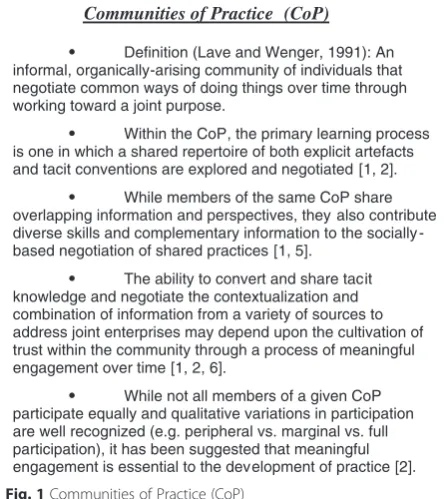
of appropriate practice for the group. When the results of a collective combination process was internalized by the individual practitioner to become part of their own individual mindline or theory of practice, it would be subject to the influence of their own previous experience and knowledge; however, these personal representations remained within the accepted and agreed upon conven-tions of shared practice [22]. The social process of collective review, assessment and negotiation has the po-tential to combine knowledge from formal or research sources with practice-based experience. However, the resulting clinical mindline, theory of practice, or ac-cepted group norm in context may not represent a dir-ect operationalization of the best available empiric research or even the current best practice guideline [20, 22]. What is accepted as ‘normal practice’ may be con-sidered a negotiated truce; the potential for conflict exists amid the vast repertoire of knowledge and per-spectives that become apparent when elements of the practice change and conventions are reconsidered [41]. Thus, knowledge-practice that has emerged from in-dividual and collective processes of reflection, review, and co-negotiation for application in context might be considered evidence-informed (See Fig. 1 for further in-formation regarding communities of practice).
Implications
If knowledge ‘translation’ is conceived of as a naturally-occurring, ongoing and iterative process of critical re-flection and social learning in which practitioners, both individually and collectively, check, check and
re-negotiate both personal and shared theories of practice, then the potential to support opportunities for research uptake in concert with this process should be identified.
Collaborative learning environments
Learning is not constrained to a structured classroom, but is a fundamentally social phenomenon occurring outside of situations one might identify as a formal edu-cational opportunity [40, 43, 46]. In a true learning organization, both informal and formal learning oppor-tunities are respected and encouraged [46]. If the process by which new research-based evidence or evidence-based guidelines are combined with existing knowledge for application in practice is one of social learning [1, 6] then the social context (i.e. the existing practice organization) has the potential to influence this process.
In learning supportive environments, ample opportun-ity should be provided to facilitate participation in both formal and informal activities associated with learning, including the negotiation of shared repertoire through engagement in discussion, debate or other forms of storytelling, as well as individual engagement in active learning in practice [20, 22, 24, 46, 47]. The CoP is a so-cial, interpretive approach to learning that supports these activities, naturally. Therefore, the formation of spontaneous CoPs should be encouraged and supported [22, 46] and the work of knowledge creation, innovation and skills development legitimized [46]. In so doing, in-dividual practitioners are not viewed as passive subjects to change, but rather as active agents engaged in shaping knowledge to be applied within the practice environ-ment [47].
Active learning is a process of engagement with ex-perience via critical reflection, learning from practice, and evaluation [24]. Activities such as ongoing critical reflection, experiential learning, shared conversation, and collective negotiation help to support evidence-informed change in the workplace [24, 48–50], as do programs that support strong mentorship [51–55]. To address the challenges of practice in complex healthcare environments, practitioners can use the metacognitive processes of reflection to promote change, particularly within contexts described as“collaborative learning envi-ronments”[27]. A focus on continuous, ongoing learning and improvement encourages reflection on and evalu-ation of evidence from practice as well as from external sources and their ability to integrate new evidence into practice [48]. The adoption of active learning strategies and support for collaborative learning is not a single per-son activity–success in fostering a culture of social, en-gaged learning depends on the commitment of all team members within the practice environment [24].
Communities of Practice (CoP)
Definition (Lave and Wenger, 1991): An informal, organically-arising community of individuals that negotiate common ways of doing things over time through working toward a joint purpose.
Within the CoP, the primary learning process is one in which a shared repertoire of both explicit artefacts and tacit conventions are explored and negotiated [1, 2].
While members of the same CoP share overlapping information and perspectives, they also contribute diverse skills and complementary information to the socially -based negotiation of shared practices [1, 5].
The ability to convert and share tacit knowledge and negotiate the contextualization and combination of information from a variety of sources to address joint enterprises may depend upon the cultivation of trust within the community through a process of meaningful engagement over time [1, 2, 6].
While not all members of a given CoP participate equally and qualitative variations in participation are well recognized (e.g. peripheral vs. marginal vs. full participation), it has been suggested that meaningful engagement is essential to the development of practice [2].
Potential barriers to active and collaborative learning
In healthcare settings, joint or team working can be about creating new ways of thinking and communicating across professional boundaries that includes negotiating shared knowledge and ways of doing things that are ac-cepted in context [56, 57]. Of course, simply linking in-dividuals together in a practice group or team does not instantly create a learning culture or a community of practice. The presence of strong boundaries established along occupational or disciplinary lines is known to con-strain knowledge sharing [57, 58]. Co-creation of know-ledge and meaning across established professional boundaries, whether in teams or in communities of practice, depends on the cultivation of trusting relation-ships and accumulation of social capital, both of which require time and effort [59]. In addition, moving toward an effective culture of learning and practice change re-quires a willingness to address professional divisions around roles and identities. An unwillingness to examine issues raised by boundaries, possible conflicts, roles and existing power differentials within healthcare contexts limits communication and the exchange or movement of knowledge [60, 61].
Facilitating ‘evidence-informed practice’ is often based on a techno-rational, problem-solving approach rather than a social, collaborative and active learning approach. Didactic programs offer training to promote evidence-based skills such as searching the literature or evaluating research. While these skills are not unimportant, the success of active learning approaches relies on the avail-ability of leaders or facilitators with the appropriate skills and abilities to lead and sustain active learning and prac-tice development based on collaborative or social learn-ing perspectives. Key facilitators/leaders should be identified and appropriate training and leadership devel-opment opportunities should be provided to enable leaders to develop skills in supporting active learning, critical reflection on their own leadership style and pro-moting sustainability of a learning culture [49, 62]. Simi-larly, knowledge brokers act to support the flow of knowledge acting as learning coordinators within their own community or group or functioning as knowledge ambassadors between groups [58].
Engaged scholarship
In their recent scoping review, Thomas & Law describe several characteristics of collaborative learning environ-ments that support the uptake of research-based evi-dence and support evievi-dence-based practices [27]. In addition to working environments that support both in-dividual and collaborative reflective practices and the provision of opportunities for mentoring of students, the authors cited commitment to engaged scholarship, pri-marily through the use of action-research methods, that
included academics, healthcare practitioners and stu-dents [27]. Engaged scholarship is defined as a collabora-tive form of inquiry in which all parties contribute to the co-production of a new, contextualised form of know-ledge created from the perspectives and skill sets of all invested parties [63]. This type of collaboration rests on the notion that the processes of knowledge production and translation are social and that the academic and practice worlds can create a collaborative space in which collective action can occur [9]. The expectation that ac-companies the idea of co-negotiated knowledge or en-gaged scholarship is that collaborative action in knowledge production is positively associated with knowledge implementation [9]. If practice is allowed to inform research, through the adoption of action research methods that support collaborative engagement at all stages of inquiry, the results would provide a more real-istic representation of what works within real world con-texts [64–66].
Importance of clinical experience
Clinical or professional experience, including tacit know-how, is a highly valued, and frequently consulted source of knowledge [20, 22, 27, 67–69]. New know-ledge, whether from individual clinical experience or evidence-based clinical practice guidelines, may be checked repeatedly against the professional experience of trusted colleagues, professional authorities or opinion leaders who share an understanding of both practice cul-ture and context and who are able to assess the fit be-tween new knowledge (e.g. clinical practice guidelines) and the current knowledge held by practitioner(s) or by the community of practice [20, 22]. Credibility, in this instance, is not associated with the methodological or technical quality, but with the professional experience of the source who is perceived as a knowledgeable member of the same professional or practice community, and who shares both professional identity and an under-standing of context with the information seeker(s) [20, 27]. Information that seems to fit well and that can be confirmed by a trusted knowledge source within a professional CoP is more likely to be in-cluded in the collective process of negotiating shared knowledge-in-practice [20, 22, 28].
facilitators in local collaborative learning environments are equipped with high-quality evidence that is context-ually appropriate represents one way to work within existing social processes of learning in order to facilitate the uptake of valid research-based information.
In consideration of evaluation
Revised conceptualizations of the ways in which evi-dence is integrated into practice requires revisions to the ways in which evidence-informed practice is studied and evaluated. In an evidence-informed practice, like the one described by Gabbay and LeMay [22], knowledge from a variety of sources that include multiple forms of research-based evidence and experience-based know-how, is transformed through negotiation and combin-ation. As knowledge translation and social learning reflects collaborative, engaged and participatory pro-cesses, evaluation approaches should reflect these basic values. Strategic evaluation should be appropriate to the evaluation of complex interventions and integrate ap-proaches that are both inclusive and participatory [48, 49]. In the interests of ongoing theoretical development in the area of knowledge translation, evaluations should illuminate how and under what circumstances research-based evidence is used and combined with other sources of knowledge in order to identify appropriate outcomes that reflect integrated knowledge and the related social negotiation processes rather than relying on determina-tions of whether practice change was achieved. In addition, consideration should be given to the possibility for critical appraisal of all forms of knowledge that be-come part of the review and negotiation process in the creation of shared knowledge-in-practice [22, 67, 70].
Additional considerations for future research
It has been suggested that ‘reflective capacity’ is an es-sential characteristic for professional competency inso-much as the ability to engage in reflective practice provides the practitioner with the means to engage with new evidence and knowledge to improve practice [35, 71–73]. Reflection and reflective practice, both indi-vidual and collective, has been identified as a poten-tial facilitator of research uptake by practitioners [27], perhaps through reflection on action in terms of how one could perform to improve future practice [10, 73]. However, relatively little is known about the association between the processes of reflective prac-tice, both individual and collective, and the integra-tion of research-based informaintegra-tion into negotiated knowledge-in-practice or clinical mindlines [27]. Fu-ture efforts should also examine the development of reflective capacity at multiple levels (i.e. individual, team/group and organizational levels) within an ex-pansive learning organization that recognizes and
provides time, space and support for both informal and formal learning activities. Future work might also focus on how reflective capacity is different or simi-lar to organizational readiness for evidence-informed practice.
Summary
Traditional models of knowledge translation have relied heavily on a linear, techno-rational based model in which selections of research-based information are used to in-form practice guidelines that are disseminated for appli-cation. It is suggested that knowledge used in practice is collaboratively constructed, drawing upon information from a variety of sources – not just a selection of research-based evidence, as informed by use of a trad-itional hierarchy of evidence [2]. This collective negoti-ation of shared practice represents a triangulnegoti-ation of multiple and valued ways of knowing that is inclusive of the both the cultural and contextual complexities of the healthcare environment [8]. Understanding the individ-ual, collective and social processes of learning and prac-tice, supporting collaborative learning environments and undertaking evaluation that reflects the true complexity of the integrative and negotiated knowledge exchange within the practice environment represent important steps forward.
Competing interests
The authors declare that they have no financial or non-financial competing interests pertaining to this manuscript.
Authors’contributions
KS was responsible for development of the paper and wrote the initial draft of the manuscript. AK participated in developing and refining the work, and both authors worked together in subsequent revisions of manuscript. Both authors read and approved the final manuscript.
Authors’information
Salter K is a PhD candidate in health promotion and whose primary interest lies in knowledge translation. Kothari A is an Associate Professor and Faculty Scholar in the School of Health Studies, Faculty of Health Sciences.
Acknowledgements
The authors would like to acknowledge the contributions of Drs. Elizabeth Anne Kinsella (Associate Professor, Faculty of Health Sciences, Western University), and Sandra Regan (Assistant Professor, Arthur Labatt Family School of Nursing, Western University), whose critical examination and insightful comments were an important part of the development process for this manuscript.
Ms. Salter was supported by the Mary Horney Fellowship in Rehabilitation Medicine, Parkwood Hospital, London, ON. Dr. Kothari is partially supported through a CIHR new investigator award in knowledge translation.
Received: 11 September 2014 Accepted: 8 February 2016
References
1. McWilliam CL. Continuing education at the cutting edge: promoting transformative knowledge translation. J Contin Educ Health Prof. 2007;27(2):72–9.
3. Mantzoukas S. A review of evidence-based practice, nursing research and reflection: levelling the hierarchy. J Clin Nurs. 2008;17(2):214–23. 4. Porter S. Fundamental patterns of knowing in nursing the challenge of
evidence-based practice. Adv Nurs Sci. 2010;33(1):3–14.
5. Barry KJ. Collective inquiry: understanding the essence of best practice construction in mental health. J Psychiatr Ment Health Nurs. 2007;14(6):558–65. 6. Davis D. Continuing education, guideline implementation, and the
emerging transdisciplinary field of knowledge translation. J Contin Educ Health Prof. 2006;26(1):5–12.
7. Graham ID, Logan J, Harrison MB, Straus SE, Tetroe J, Caswell W, et al. Lost in knowledge translation: time for a map? J Contin Educ Health Prof. 2006;26(1):13–24.
8. Kitto S, Sargeant J, Reeves S, Silver I. Towards a sociology of knowledge translation: the importance of being dis-interested in knowledge translation. Adv Health Sci Educ. 2012;17(2):289–99.
9. Rycroft-Malone J, Wilkinson J, Burton CR, Harvey G, McCormack B, Graham I, et al. Collaborative action around implementation in Collaborations for Leadership in Applied Health Research and Care: towards a programme theory. J Health Serv Res Policy. 2013;18(3 Suppl):13–26.
10. Greenhalgh T, Wieringa S. Is it time to drop the‘knowledge translation’ metaphor? A critical literature review. J R Soc Med. 2011;104(12):501–9. 11. Ward V, Smith S, House A, Hamer S. Exploring knowledge exchange: A
useful framework for practice and policy. Soc Sci Med. 2012;74(3):297–304. 12. McWilliam CL, Kothari A, Ward-Griffin C, Forbes D, Leipert B Evolving the
theory and praxis of knowledge translation through social interaction: A social phenomenological study. Implement Sci 2009, 4(1).
13. Sackett DL, Rosenberg WMC, Gray JAM, Haynes RB, Richardson WS. Evidence based medicine: What it is and what it isn’t - It’s about integrating individual clinical expertise and the best external evidence. Br Med J. 1996;312(7023):71–2.
14. Wilkinson JE. Using qualitative methodologies to evaluate randomized controlled trials: An ontological and epistemological paradox or a pragmatic recognition that context matters? Worldviews Evid Based Nurs. 2011;8(2):63–5. 15. Tomlin G, Borgetto B. Research Pyramid: A New Evidence-Based Practice
Model for Occupational Therapy. Am J Occup Ther. 2011;65(2):189–96. 16. Rolfe G. The deconstructing angel: nursing, reflection and evidence-based
practice. Nurs Inq. 2005;12(2):78–86.
17. Pilcher J, Bedford LA. Hierarchies of Evidence in Education. J Contin Educ Nurs. 2011;42(8):371–7.
18. Kinsella EA, Whiteford GE. Knowledge generation and utilisation in occupational therapy: Towards epistemic reflexivity. Aust Occup Ther J. 2009;56(4):249–58.
19. Mantzoukas S, Watkinson S. Redescribing reflective practice and evidence-based practice discourses. Int J Nurs Pract. 2008;14(2):129–34.
20. Higgins JW, Strange K, Scarr J, Pennock M, Barr V, Yew A, et al.“It’s a feel. That’s what a lot of our evidence would consist of”: public health practitioners’perspectives on evidence. Eval Health Prof. 2011;34(3):278–96. 21. Malterud K. Reflexivity and metapositions: strategies for appraisal of clinical
evidence. J Eval Clin Pract. 2002;8(2):121–6.
22. Gabbay J, le May A. Practice-based evidence for health care: clinical mindlines. London: Routledge; 2011.
23. Kinsella EA. Professional knowledge and the epistemology of reflective practice: Original article. Nurs Philos. 2010;11(1):3–14.
24. McCormack B, Dewing J, McCance T. Developing person-centred care: addressing contextual challenges through practice development. Online J Issues Nurs. 2011;16(2):3.
25. Kitto S, Bell M, Peller J, Sargeant J, Etchells E, Reeves S, et al. Positioning continuing education: boundaries and intersections between the domains continuing education, knowledge translation, patient safety and quality improvement. Adv Health Sci Educ. 2013;18(1):141–56.
26. Straus SE, Sackett DL. Getting Research Findings into Practice: Using Research Findings in Clinical Practice. BMJl. 1998;317(7154):339–42. 27. Thomas A, Law M. Research utilization and evidence-based practice in
occupational therapy: A scoping study. Am J Occup Ther. 2013;67(4):e55–65. 28. Stewart M. Whose evidence counts? An exploration of health professionals’
perceptions of evidence-based practice, focusing on the maternity services. Midwifery. 2001;17(4):279–88.
29. Lam A. Tacit Knowledge, Organizational Learning and Societal Institutions: An Integrated Framework. Org Stud. 2000;21(3):487–513.
30. Nicolini D. Practice as the site of knowing: Insights from the field of telemedicine. Org Sci. 2011;22(3):602–20.
31. Ray T. Rethinking Polanyi’s concept of tacit knowing: from personal knowing to imagined institutions. Minerva. 2009;47(1):75–92. 32. Cook SDN, Brown JS. Bridging epistemologies: The generative dance
between organizational knowledge and organizational knowing. Org Sci. 1999;10(4):381–400.
33. Freeman R. The practice of policy making. Evid Policy. 2011;7(2):127–36. 34. Kothari A, Bickford JJ, Edwards N, Dobbins MJ, Meyer M. Uncovering tacit
knowledge: a pilot study to broaden the concept of knowledge in knowledge translation. BMC Health Serv Res. 2011;11:198.
35. McCarthy J, Alexander A, Baldwin M, Woodhouse J. Valuing professional judgement. In: McCarthy J, Rose P, editors. Values-based Health and Social Care: Beyond Evidence-Based Practice. Thousand Oaks: Sage Publications Inc; 2010.
36. Schon DA. The Reflective Practitioner: How professionals think in action. New York: Basic Books, Inc.; 1983.
37. Kinsella EA. Technical rationality in Schön’s reflective practice: dichotomous or non-dualistic epistemological position. Nurs Philosophy. 2007;8(2):102–13. 38. Rose P, Phillips S. Caring: Values and Evidence. In: McCarthy J, Rose P,
editors. Values-based Health and Social Care: Beyond Evience-Based Practice. Thousand Oaks: Sage Publications Inc; 2010.
39. Bueger C. Pathways to practice: praxiography and international politics. Eur Political Sci Rev. 2014;6(3):383–406.
40. Wenger E. Communities of practice: learning, meaning and identity. New York: Cambridge University Press; 1998.
41. Nicolini D, Roe B: Surfacing the multiple. Diffractive methods for rethinking professional practice and knowledge. In: Reconceptualising Professional Learning. edn. Edited by Fenwick T, Nerland M: Routledge; 2014.
42. Nonaka I. A dynamic theory of knowledge creation. Org Sci. 1994;5(1):14–37. 43. Eraut M. Informal learning in the workplace. Stud Contin Educ.
2004;26(2):247–73.
44. Brown JS, Duguid P. Organizational learning and communities of practice: toward a unified view of working, learning and innovation. Org Sci. 1991;2(1):40–57.
45. Handley K, Sturdy A, Fincham R, Clark T. Within and beyond communities of practice: making sense of learning through participation, identity and practice. J Manag Stud. 2006;43(3):641–53.
46. Wenger E. How we learn. Communities of practice. The social fabric of a learning organization. Healthc Forum J. 1996;39(4):20–6.
47. Tynjälä P. Toward a 3-P Model of Workplace Learning: A Literature Review. Vocations and Learning. 2013;6(1):11–36.
48. McCormack B, Dewing J, Breslin L, Coyne-Nevin A, Kennedy K, Manning M, et al. Practice development: Realising active learning for sustainable change. Contemp Nurse. 2009;32(1–2):92–104.
49. Boomer CA, McCormack B. Creating the conditions for growth: A collaborative practice development programme for clinical nurse leaders. J Nurs Manag. 2010;18(6):633–44.
50. Matthew-Maich N, Ploeg J, Jack S, Dobbins M. Transformative Learning and Research Utilization in Nursing Practice: A Missing Link? Worldviews Evid Based Nurs. 2010;7(1):25–35.
51. Ploeg J, Skelly J, Rowan M, Edwards N, Davies B, Grinspun D, et al. The Role of Nursing Best Practice Champions in Diffusing Practice Guidelines: A Mixed Methods Study. Worldviews Evid Based Nurs. 2010;7(4):238–51. 52. Balakas K, Potter P, Pratt E, Rea G, Williams J. Evidence Equals Excellence:
The Application of an Evidence-Based Practice Model in an Academic Medical Center. Nurs Clin North America. 2009;44(1):1.
53. Brewer BB, Brewer MA, Schultz AA. A Collaborative Approach to Building the Capacity for Research and Evidence-Based Practice in Community Hospitals. Nurs Clin North America. 2009;44(1):11.
54. Cullen L, Titler M, Rempel G. An Advanced Educational Program Promoting Evidence-Based Practice. West J Nurs Res. 2011;33(3):345–64.
55. Wells N, Free M, Adams R. Nursing research internship - Enhancing evidence-based practice among staff nurses. J Nurs Admin. 2007;37(3):135–43. 56. Baxter S, Brumfitt S. Professional differences in interprofessional working.
J Interprof Care. 2008;22(3):239–51.
57. Ferlie E, Fitzgerald L, Wood M, Hawkins C. The nonspread of innovations: The mediating role of professionals. Acad Manage J. 2005;48(1):117–34. 58. Waring J, Currie G, Crompton A, Bishop S. An exploratory study of
knowledge brokering in hospital settings: Facilitating knowledge sharing and learning for patient safety? Soc Sci Med. 2013;98:79–86.
60. Xyrichis A, Lowton K. What fosters or prevents interprofessional
teamworking in primary and community care? A literature review. Int J Nurs Stud. 2008;45(1):140–53.
61. Addicott R, McGivern G, Ferlie E. Networks, organizational learning and knowledge management: NHS cancer networks. Public Money Manag. 2006;26(2):87–94.
62. Manley K, Solman A, C J: Working Towards a Culture of Effectiveness in the Workplace. In: Practice Development in Nursing and Healthcare edn. Edited by McCormack B, Manley K, Titchen A. [e-book]: Wiley-Blackwell; 2013: 146–168.
63. VandeVen AH, Johnson PE. Knowledge for Theory and Practice. Academy Manag Rev. 2006;31(4):802–21.
64. Glasgow RE, Lichtenstein E, Marcus AC. Why don’t we see more translation of health promotion research to practice? Rethinking the efficacy-to-effectiveness transition. Am J Public Health. 2003;93(8):1261–7. 65. Rivera MD, Birnbaum AS. Health promotion practice and the road ahead:
addressing enduring gaps and encouraging greater practice-to-research translation. Health Promot Pract. 2010;11(6):779–83.
66. Green LW, Glasgow RE. Evaluating the relevance, generalization, and applicability of research: issues in external validation and translation methodology. Eval Health Prof. 2006;29(1):126–53.
67. Malterud K. The art and science of clinical knowledge: evidence beyond measures and numbers. Lancet. 2001;358(9279):397–400.
68. Pravikoff DS, Tanner AB, Pierce ST. CE Credit: Readiness of U.S. Nurses for Evidence-Based Practice. Am J Nurs. 2005;105(9):40–52.
69. Spenceley SM, O’Leary KA, Chizawsky LLK, Ross AJ, Estabrooks CA. Sources of information used by nurses to inform practice: An integrative review. Int J Nurs Stud. 2008;45(6):954–70.
70. Kothari A, Rudman D, Dobbins M, Rouse M, Sibbald S, Edwards N. The use of tacit and explicit knowledge in public health: a qualitative study. Implement Sci. 2012;7:20.
71. Mann K, Gordon J, MacLeod A. Reflection and reflective practice in health professions education: a systematic review. Adv Health Sci Educ. 2009;14(4):595–621.
72. McCarthy J, Grumley S. A values-based era in professional caring. In: McCarthy J, Rose P, editors. Values-based Health and Social Care: Beyond evidence-based practice. Thousand Oaks: Sage Publications Inc; 2010. 73. Ng SL. Reflection and reflective practice: Creating knowledge through
experience. Seminars Hearing. 2012;33(2):117–34.
• We accept pre-submission inquiries
• Our selector tool helps you to find the most relevant journal
• We provide round the clock customer support
• Convenient online submission
• Thorough peer review
• Inclusion in PubMed and all major indexing services • Maximum visibility for your research
Submit your manuscript at www.biomedcentral.com/submit