R E S E A R C H
Open Access
A particle swarm optimization-based algorithm
for finding gapped motifs
Chengwei Lei
*, Jianhua Ruan
** Correspondence: [email protected]; [email protected]
Department of Computer Science, The University of Texas at San Antonio, San Antonio, TX 78249, USA
Abstract
Background:Identifying approximately repeated patterns, or motifs, in DNA sequences from a set of co-regulated genes is an important step towards deciphering the complex gene regulatory networks and understanding gene functions.
Results:In this work, we develop a novel motif finding algorithm (PSO+) using a population-based stochastic optimization technique called Particle Swarm Optimization (PSO), which has been shown to be effective in optimizing difficult multidimensional problems in continuous domains. We propose a modification of the standard PSO algorithm to handle discrete values, such as characters in DNA sequences. The algorithm provides several features. First, we use both consensus and position-specific weight matrix representations in our algorithm, taking advantage of the efficiency of the former and the accuracy of the latter. Furthermore, many real motifs contain gaps, but the existing methods usually ignore them or assume a user know their exact locations and lengths, which is usually impractical for real
applications. In comparison, our method models gaps explicitly, and provides an easy solution to find gapped motifs without any detailed knowledge of gaps. Our method allows the presence of input sequences containing zero or multiple binding sites. Conclusion:Experimental results on synthetic challenge problems as well as real biological sequences show that our method is both more efficient and more accurate than several existing algorithms, especially when gaps are present in the motifs.
Background
Computational prediction of transcription factor binding sites (TFBS) from co-expressed/ co-regulated genes is an important step towards deciphering complex gene regulatory net-works and understanding gene functions. Given the promoter sequences of a set of co-expressed/co-regulated genes, the goal is to find short DNA sequences (“motifs”) whose occurrences (with allowed mismatches) in the sequences cannot be explained by a back-ground model. An accurate identification of such motifs is computationally challenging, as they are typically very short (8-15 bases) compared to the promoter sequences (hundreds to thousands bases). Furthermore, there is often a great variability among the binding sites of any given TF, and the biological nature of the variability is not yet well understood. Finally, in many cases, the TFBS may appear only in a subset of the putatively co-regulated genes.
Despite the challenge, many computational methods have been developed and have been proven useful in predicting real binding sites [1]. The existing algorithms can be roughly classified into two broad categories according to the motif representations: those based on position-specific weight matrices (PWMs), and those based on consen-sus sequences. Examples of the former include well-known programs such as MEME [2], AlignACE [3], GibbsSampler [4], and BioProspector [5]. The latter category includes Weeder [6], YMF [7], MultiProfiler [8], and Projection [9]. In general, PWM offers a more accurate description of motifs than consensus sequences, but the score of PWM is more difficult to optimize. On the other hand, consensus-based algorithms often rely on enumerating short subsequences, which may be impossible for longer motifs. For an excellent survey of the existing methods and an assessment of their rela-tive performance, see [1,8].
Recently several consensus-based motif finding algorithms have been developed using evolutionary algorithms, because of their efficiency in searching over multidimensional solution spaces. For example, GAME [10] and GALFP [11] are based on genetic algo-rithms, and have been shown to outperform many PWM-based algorithms. In a previous work, we proposed a motif finding algorithm based on the classical Particle Swarm Opti-mization (PSO) strategy [12], where we used the set of positions on each sequence together as a solution, and searched the solution space by PSO algorithm. To keep the solution space continuous, we restructured the original sequences using a sequence map-ping. Although the algorithm shows a good performance on small input size (for example 20 sequences and 1000 bases for each sequence), the algorithm becomes slow for larger data sets, as the number of possible motif positions grows exponentially as the number of sequences increases. Several other motif finding methods have also been developed based on PSO, for example, Hybrid-PSO [13] and PSO-EM [14]. Hybrid-PSO uses a similar basic idea as our previous work [12], and therefore has the same problem we mentioned above. PSO-EM simply uses PSO to find candidate motifs, which are then used as seeds by other expectation-maximization based motif finding algorithms, such as MEME [2].
In this paper, we develop a novel algorithm, called PSO+, for finding motifs. This new method has the following contributions. First and most importantly, PSO+ differs from other motif finding algorithms by explicitly modeling gaps, which provides an easy solu-tion to find gapped motifs. Many real motifs contain posisolu-tions of low informasolu-tion (gaps), but the existing algorithms usually do not allow gaps, or require a user to specify the exact location and length of gaps, which is often impractical for real applications. Second, we use both consensus and PWM representations in our algorithm, taking advantage of the efficiency of consensus and the accuracy of PWMs. Our method also allows some input sequences to contain zero or multiple binding sites, which is common in real biology data set, but ignored by some of the algorithms. Finally, we propose a novel modification to the PSO update rule to accommodate discrete values, such as characters in DNA sequences, which may also be useful in other applications.
Methods
Introduction to Particle Swarm Optimization
organisms such as bird flocking [15]. The system is initialized with a population of random solutions and searches for the optimal solution by updating iteratively. Each potential solution, called particle (or agent), is represented by a point in the multiple-dimensional solution space. When searching for the optimum solution, particles fly around the solution space with a certain velocity (speed and direction). During flight, each particle adjusts its position and velocity according to its own experience and the experience of its neighbors. Specifically, each particle keeps track of the best solution it has encountered so far. This solution is called pbest, which stands for personal best. The system also keeps track of the global optimum of all the particles, hence called gbest. The fundamental concept of PSO consists of changing the velocity of each parti-cle at each time step toward itspbestandgbestlocations [15].
Method overview
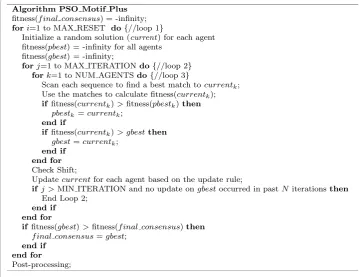
Figure 1 shows the main structure of the algorithm, which contains three loops. The most inside loop, loop3, evaluates the fitness value of each agent and updates informa-tion for the whole system. Using its current solution, an agent first finds out a best match from each sequence, calculates the fitness value (see below), and updates pbest, gbest if necessary. Loop2 is the main part of the PSO+ algorithm. From a random initial solution, each agent continuously searches for better solutions in the neighbor-hood, taking information from its own experience (pbest), and the experience of all agents (gbest). The actual movement of each agent is determined by the update rule (see below). Finally, as a stochastic algorithm, the final solution of PSO+ depends on its starting solutions; the purpose of loop1 is therefore to restart the system several times, from independent random solutions, to ensure a high overall success rate.
Algorithm PSO Motif Plus
fitness(final consensus) = -infinity;
fori=1 to MAX RESET do{//loop 1}
Initialize a random solution (current) for each agent fitness(pbest) = -infinity for all agents
fitness(gbest) = -infinity;
forj=1 to MAX ITERATIONdo{//loop 2}
fork=1 to NUM AGENTSdo{//loop 3}
Scan each sequence to find a best match tocurrentk; Use the matches to calculate fitness(currentk);
iffitness(currentk)>fitness(pbestk)then
pbestk=currentk;
end if
iffitness(currentk)> gbestthen
gbest=currentk;
end if end for
Check Shift;
Updatecurrentfor each agent based on the update rule;
ifj >MIN ITERATION and no update ongbestoccurred in pastN iterationsthen
End Loop 2;
end if end for
iffitness(gbest)>fitness(final consensus)then
final consensus=gbest;
end if end for
Post-processing;
At the final step, we use post-processing to remove and/or add some binding sites, therefore allowing zero or multiple binding sites on each sequence. A flow chart is shown in Additional file 1 Figure S1.
Solution space and fitness function
To utilize the PSO+ algorithm, we need to represent a solution as a vector, and deter-mine a fitness function appropriate for the problem. As discussed in Background, a motif of length lcan be represented either as a position-specific weight matrix (PWM), which is a 4×l matrix of real numbers specifying the probability of each base at each position, or a consensus describing the most dominate base at each position. The matrix can be converted into a vector of length 4l, although some care needs to be exercised to ensure proper normalization. The consensus representation is more effi-cient in searching for new instances, and may lead to faster convergence, while the PWM is more powerful in representing weaker motifs and is more accurate in evaluat-ing the motif quality. We decided to use both representations in our algorithm, to take advantage of both forms. The solution is initialized as a consensus. During the scan-ning stage, we use the consensus representation. After the best matches to the consen-sus are found from all the sequences, we compute a PWM based on the set of matches, and compute the fitness of the solution based on the PWM.
Given a solution, i.e., a consensus, it is first used to scan the input sequences to find a best match on each sequence. Let X= (x1x2 ... xl) be the consensus sequence and
Y= (y1y2...yl) be a putative binding site.
The matching score betweenX andYis computed using the following equations:
M X Y x y
a b p a b
i i i
a
( , ) ( , )
( , ) log ( . / ) log ( . /
=
= + =
∑
, and
if
1 0 25
0 25 4
4 pp pa b) otherwise
⎧ ⎨ ⎪ ⎩⎪
where pais the background frequency for base ain the input sequences or in the whole genome. As most genomes contain more AT’s than CG’s, this formula gives unequal weight to different types of matches/mismatches. A match between two bases with lower background frequency would have higher score than that between two bases with higher background frequency. For uniform base frequency pA=pC=pG= pT = 1/4,s (a, b) = 1 ifa=band 0 otherwise, corresponding to an intuitive match/ mismatch score.
Given a set of matches of a consensus, W=w1, w2, ..., wnwhere each wiis a
subse-quence with length l, we compute the fitness of the consensus using the information content (IC) score:
IC fb j f j p
b j
l
b b
=
∑
∑
=1
2
( ) log ( ( ) / ),
Initial solutions and number of agents
Similar to all stochastic algorithms, the performance of PSO+ partially depends on the initial solutions. The convergence of the algorithm can be significantly improved if at least one of the agents has an initial solution near the optimal solution. In this work we consider two strategies. The first strategy is to simply generate a set of random consensus. The second strategy is to randomly choose a subsequence from the input sequence as an initial solution. Although the first strategy would allow the maximum coverage, the probability that any randomly generated consensus is near the optimal solution is very low, as there are 4l possible solutions for a motif of length l. For the second strategy, we assume that the actual binding site is closer to the consensus than to random sequences. Since there is usually about one binding site per sequence, it is very likely that some agents may select a binding site as an initial solution. More pre-cisely, assuming that the average sequence length isL and the motif length is l, the probability that a randomly selected sequence is a binding site is 1/(L −l + 1). Also because of the Check Shift step in the algorithm, a random solution that contains a large suffix or prefix of the binding site can often lead to the recovery of the real motif quickly. We usually allow a binding site to be shifted by two bases to its left and right, respectively. Therefore, each true binding site can provide up to 5 initial solutions that are similar to the real motif. For this reason, we suggest the minimum number of agents to be (L−l+ 1)/5 to ensure a high convergence probability. In our experiments on both synthetic and real sequences, we have found that the second strategy usually leads to much faster convergence and therefore is implemented as the default option.
Modified PSO+ update rule for discrete problems
After each iteration, each agent needs to update its currentsolution based on the old current, its own pbest, andgbestof the system, each of which is a vector. The standard PSO algorithm is designed for optimization problems in the continuous domain; there-fore, a new solution can be easily obtained by a sum of the three solution vectors mul-tiplied by some random weights. In our case, however, each solution is a vector of ACGT’s and they cannot be manipulated by multiplication and summation. In order to generate a new solution, we use the following rule, which is applied independently to each position of the motif:
i*=arg max (i c ri iweight( ))xi andx′ =xi*,
wherex′is the new character being generated,x1,x2,x3are the characters incurrent,
pbest, andgbest, respectively,x4is a random character from ACGT,ciis a scaling factor
to determine the relative importance of the four terms,riis a uniform random number, and the function weight gives a higher weight to characters having lower background frequency. This strategy effectively suppress characters with lower occurrence, when compared to an alternative strategy that randomly picks a character proportional to its number of occurrences inx1,x2,x3andx4. For example, assumingci= 1 and the weight
function returns a constant, ifx1 =x2=x3 = A andx4 = C, the alternative strategy
All agents stop their movements if the number of iterations exceeds an upper limit, or if there has been no update for a certain number of iterations and a minimum num-ber of iterations has passed.
Check shift
Similar to many motif finding algorithms, the output of PSO+ algorithm may have a shift issue: the start positions of the binding sites may be one or two positions away from the real position, and it is difficult for the algorithm to escape from such local optima. To circumvent this problem, we periodically check whether shifting the bind-ing sites by a small number (up to 3 bases) can improve the quality of the solution. This is done in the CHECK SHIFT step.
Gapped motifs
Many real motifs containdo-not-carepositions in their consensus. Furthermore, these do-not-carepositions are often consecutive, forming a motif with two short conserved regions with some fixed distance in between. We call these do-not-carepositions gaps and the motifs gapped motifs. Most motif finding algorithms do not consider gaps explicitly. For consensus-based algorithms, ignoring gaps can lead to serious mistakes when a consensus is forced to be selected for a gap position, which has no dominant characters.
Gap representation
We solve this problem by asking the users to provide two parameters, motif length l, and gap length k. Importantly, when we search for gapped motifs, we allow gaps to appear as the suffix or prefix of a motif. This is very useful if the actual gap is shorter than k, or if the non-gap region of the motif is shorter than l - k. Furthermore, if a real motif contains no gaps, our algorithm will automatically put all gaps in the flank regions. While our algorithm may increase the guesswork from the user by asking for gap length as an additional parameter, it actually gives the user more flexibility in determining the appropriate motif and gap lengths.
To find gapped motifs, we introduce a bit vector of length l. The bit vector contains exactly k0’s andl -k1’s, where a 0 means the position falls in a gap. This vector is initialized randomly and latter updated by masking out the columns in the PWM with low IC values. Given this vector, when calculating the match score between a consen-sus and a potential binding site, we only consider the positions with 1’s. When we compute the fitness (IC score) of a motif given all the binding sites, we consider all columns, because in this case we have all the information to derive a PWM.
Gap insert strategy
Flexible gap length
If the actual gap is shorter than the given number, or if the motif is shorter than expected, gaps can appear as suffix and/or prefix of the motif. Furthermore, the algo-rithm will automatically put all gaps in the flank regions if the real motif contains no gaps.
By default, we use 8-base motif with 0 gapfor short motifs,12-base motif with 2 gaps for medium-length motifs, and16-base motif with 4 gapsfor long motifs. This strategy works well for the unknown length motif finding problems in this paper. The program allows a user to change the parameters by themselves.
Post-processing
The basic algorithm described above assumes that there is one and only one binding site on each sequence, which is certainly not always true. To address this problem, we use a statistically-inspired strategy to refine the binding sites. We assume that at least a good fraction of the sequences contain at least one binding site. We calculate the match score for each putative binding site returned from the basic algorithm. Let Q1, Q2, and Q3 represent the lower quartile, median, and upper quartile of the match scores. The interquartile range (IQR) of the match scores is then computed by Q3 -Q1. All binding sites with a match score below Q1 - IQR are dropped as false binding sites. We also rescan the input sequences using the consensus for additional putative binding sites. A binding site with match score higher than Q2 is considered a true binding site. A PWM is constructed using the final set of binding sites.
Results and discussion
To evaluate the performance of our algorithm, we tested it on two types of sequences. The first type of test data consists of synthetic DNA sequences, also known as the (l, d)-motif challenging problem [16]. The second type of data contains real promoter sequences. The algorithm is implemented in C. The test datasets are included in Addi-tional file 2.
Evaluation using synthetic data sets
We tested our algorithm on the (l, d)-motif challenge problem. Each challenge pro-blem includes n sequences of length L, each of which contains a variant of a pre-defined consensus of length l. The variants were generated by choosing dpositions randomly from the consensus and changing them to random bases.
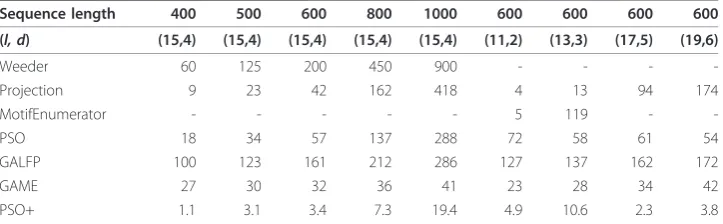
parameters that can recover the embedded motifs with 100% accuracy. Running time was based on the average of 10 runs on 5 sets of sequences.
As shown in Table 1 PSO+ is significantly more efficient than the other algorithms. Our previous PSO algorithm was based on a very different problem formulation and is considerably slower than PSO+. It is worth noting that the running time of the evolu-tionary algorithms, GAME and GALFP, are much slower than PSO+ in general, but their running time only increases slightly with sequence lengths. This might be because these two algorithms spend a significant amount of time in initialization, independent of sequence lengths.
Next, we compared these algorithms on their performance on challenge problems with varying motif lengths and number of error, while sequence lengths were fixed at 600 bp. The current algorithm outperforms the existing algorithms again on these test sequences (Table 1 right half). Similar to our previous PSO-based algorithm, the run-ning time of PSO+ is relatively independent of motif lengths.
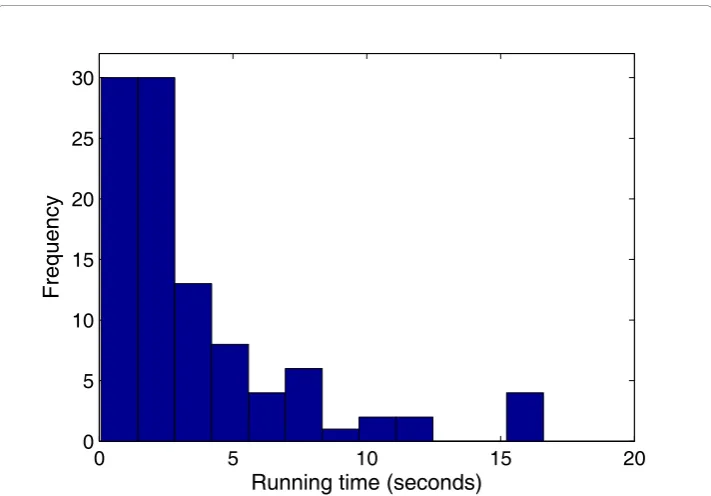
Third, we ran PSO+ 100 times on independent sequences, and plotted the running time in Figure 2. As shown, the running time has a long-tail distribution, meaning in some rare cases the algorithm may need an extremely long time to converge. Because of this, the algorithm runs faster than the average running time in most cases. A better strategy for detecting local optima may eliminate some of these rare cases and improve the overall efficiency. The running time results for GALFP/GAME are shown in Addi-tional file 1 Figure S2 and Figure S3.
Finally, we tested our algorithm using synthetic sequences containing gapped motifs, and compared with the existing algorithms. We first generated sequences with embedded gapped motifs, much like the synthetic challenge problems, except that each embedded motif contains some gaps in the middle positions. Only two algorithms, namely, PSO+ and GALFP, can correctly identify these synthesized gapped motifs. It is not surprising to see that the other algorithms, which are not designed to find gapped motifs, failed at these synthetic test cases. Remarkably, GALFP had basically the same accuracy as PSO+. With further investigation, we found that using synthetic data sets with purely random background noise is insufficient to demonstrate the limitation of existing algorithms on finding gapped motifs. This is because gapped motifs can be approximately represented by a PWM with uniformly distributed base frequencies in the gapped positions, and that a motif generated by the synthetic model with a purely random background is either strong enough so that it can be found by both PSO+ and GALFP, or it is so weak that neither algorithm can find it. Therefore, we further gener-ate two additional types of test cases with gapped motifs. Each test case of the first Table 1 Running time (seconds) on (l, d)-motif challenge problems
Sequence length 400 500 600 800 1000 600 600 600 600
(l, d) (15,4) (15,4) (15,4) (15,4) (15,4) (11,2) (13,3) (17,5) (19,6)
Weeder 60 125 200 450 900 - - -
-Projection 9 23 42 162 418 4 13 94 174
MotifEnumerator - - - 5 119 -
-PSO 18 34 57 137 288 72 58 61 54
GALFP 100 123 161 212 286 127 137 162 172
GAME 27 30 32 36 41 23 28 34 42
type consists of 20 sequences of length 600, and each sequence contains a gapped motif of length 15 and gap length 5 and a non-gapped motif of length 15. For this type of test cases, GALFP (as well as the other algorithms listed in Table 1) always report the non-gapped motif; while the PSO+ algorithm report the gapped motif as first motif, and the non-gapped motif as the second motif. For the second type of test cases, we generate 30 sequences of length 600. We then generate a gapped motif of length 15 and gap length 5, and embed it on 10 of the sequences, while leave the remaining 20 sequences without any embedded motifs. For this type of test cases, only GALFP and PSO+ can report the correct motif. GALFP only reports a single motif and it has a 91 percent accuracy. PSO+ has an accuracy of 96 percent when only reporting a single motif for each test case, while its accuracy improved to 98 percent with two motifs each test case and 100 percent with eight motifs each test case.
Experiments on real biological sequences
To test the performance of our algorithm on real biological sequences, we used the same eight representative test cases used in [11], which covered different lengths of motifs and both gapped and non-gapped motifs. In these data sets, some sequences may contain zero or more binding sites. Details of the data sets are available in [11]. Based on these data sets, it has been reported that two genetic algorithms, GALFP [11] and GAME [10], are significantly more accurate than five popular algorithms: MEME [2], Bioprospector (BP) [5], BioOptimizers based on MEME (BOM) and BioOptimizers based on Bioprospector (BOB) [18]. Therefore, we only compared PSO+ with GALFP and GAME directly.
As in [11], we measure accuracy by precision, recall, andF-score. Precision is defined as c/p and recall is defined as c/t, where c, p and t are the number of correctly
0 5 10 15 20
0 5 10 15 20 25 30
Running time (seconds)
Frequency
predicted binding sites, the number of predicted binding sites and the number of true binding sites in the sequences, respectively. TheF-scorecombining bothprecision and recallis defined asF= 2 * Precision * Recall = (Precision + Recall). Table 2 shows the average results of PSO+, GALFP [11] and GAME [10] on 20 runs (the bold entries are the winners). As shown, PSO+ and GALFP have about the same accuracy. PSO+ has the best F-scores on 4 of 8 test cases while GALFP has the best F-scoreson 3 test Table 2 Comparisons of average performance on the 8 real datasets, the bold numbers are the best results among three algorithms
GAME GALFP PSO+
Precision Recall F-score Precision Recall F-score Precision Recall F-score
CREB 0.43 0.42 0.42 0.70 0.84 0.76 0.76 0.68 0.72
CRP 0.79 0.78 0.78 0.99 0.73 0.84 1 0.78 0.88
ERE 0.52 0.78 0.62 0.82 0.76 0.79 0.92 0.92 0.92
E2F 0.79 0.87 0.83 0.77 0.85 0.81 0.68 0.7 0.69
MEF2 0.52 0.55 0.53 0.91 0.98 0.95 1 1 1
MYOD 0.14 0.14 0.14 0.57 1 0.72 0.20 0.43 0.27
SRF 0.71 0.86 0.78 0.75 0.89 0.82 0.80 0.56 0.66
TBP 0.81 0.74 0.77 0.87 0.87 0.87 0.86 0.91 0.88
cases. More in-depth investigation reveals that PSO+ generally has the highest preci-sion (5 out of 8), while GALFP has the highest recall (3 out of 8). This indicates that PSO+ reported less but more accurate binding sites than GALFP.
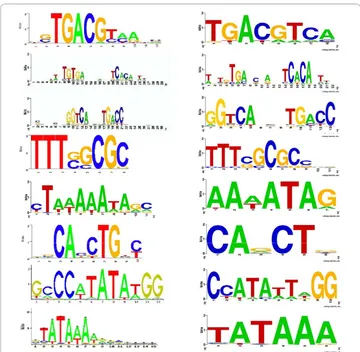
Interestingly, two of the eight cases (CRP, ERE) are clearly gapped motifs, as shown in Figure 3. PSO+ won in both cases, especially in ERE (average F-score: 0.92, 0.79, and 0.62, for PSO+, GALFP and GAME, respectively), indicating that the gap model in our algorithm is effective. On the other hand, even though our algorithm has a much larger search space by allowing gaps, its performance on the other six motifs that do not have gaps is still among the best. Figure 4 shows the results of PSO+ on the ERE motif, with or without the gap option. Without the gap option, our algorithm attempts to maximize the total information content of all positions, which results in a motif with relatively uniform information content across all positions. In contrast, with the gap option, our algorithm automatically determines the low-information positions and treats them as gaps, and therefore improves the accuracy of the final result. With the gap option turned on, the Pearson correlation coefficient between the predicted and true motif PWMs is improved from 0.92 (p= 10-22) to 0.97 (p= 10-33).
Finally, it takes our algorithm 20 to 60 seconds for each of the 8 test cases. In com-parison, the average running time is about 62 seconds for GALFP, and 291 seconds for GAME.
Conclusions
In this work, we have proposed a novel algorithm for finding DNA motifs based on Particle Swarm Optimization (PSO). Our contributions include a novel modification of the PSO update rule to allow discrete variables, a model to allow gapped motifs, and a simple method to ne-tune the motif when some sequences contain zero or multiple binding sites. Experimental results on synthetic challenge problems as well as real bio-logical sequences show that our method is both more efficient and more accurate than several existing algorithms, especially when gaps are present in the motifs. We are working to finalize our program, which will be freely available to the research commu-nity soon.
Additional material
Additional file 1: Supplemental Materials. Additional figures, tables and discussion.
Additional file 2: Experimental Dataset. The synthetic data sets and real biological sequences used in the paper.
Acknowledgements
This work was supported in part by a NIH grant SC3GM086305 and a grant from the San Antonio Life Sciences Institute. The authors also wish to thank the Computational Biology Initiative (UTHSCSA/UTSA) for providing access to their high-performance computing facility.
Authors’contributions
CL and JR conceived of the research and designed the study. CL implemented the algorithm and conducted the experiment. CL wrote the paper and JR helped with the manuscript preparation. Both authors read and approved the final manuscript.
Competing interests
The authors declare that they have no competing interests.
Received: 12 May 2010 Accepted: 13 December 2010 Published: 13 December 2010
References
1. Tompa M, Li N, Bailey T, Church G, De Moor B, Eskin E, Favorov A, Frith M, Fu Y, Kent W, Makeev V, Mironov A, Noble W, Pavesi G, Pesole G, Regnier M, Simonis N, Sinha S, Thijs G, van Helden J, Vandenbogaert M, Weng Z, Workman C, Ye C, Zhu Z:Assessing computational tools for the discovery of transcription factor binding sites.Nat Biotechnol2005,23:137-44.
2. Bailey T, Elkan C:Fitting a mixture model by expectation maximization to discover motifs in biopolymers.Proc Int Conf Intell Syst Mol Biol1994,2:28-36.
3. Roth F, Hughes J, Estep P, Church G:Finding DNA regulatory motifs within unaligned noncoding sequences clustered by whole-genome mRNA quantitation.Nat Biotechnol1998,16:939-45.
4. Lawrence C, Altschul S, Boguski M, Liu J, Neuwald A, Wootton J:Detecting subtle sequence signals: a Gibbs sampling strategy for multiple alignment.Science1993,262:208-14.
5. Liu X, Brutlag D, Liu J:BioProspector: discovering conserved DNA motifs in upstream regulatory regions of co-expressed genes.Pac Symp Biocomput2001, 127-38.
6. Pavesi G, Mauri G, Pesole G:An algorithm for finding signals of unknown length in DNA sequences.Bioinformatics 2001,17:S207-14.
7. Sinha S, Tompa M:Discovery of novel transcription factor binding sites by statistical overrepresentation.Nucleic Acids Res2002,30:5549-60.
8. Keich U, Pevzner P:Finding motifs in the twilight zone.Bioinformatics2002,18:1374-81. 9. Buhler J, Tompa M:Finding motifs using random projections.J Comput Biol2002,9:225-42.
10. Wei Z, Jensen ST:GAME: detecting cis-regulatory elements using a genetic algorithm.Bioinformatics2006, 22:1577-1584.
11. Chan TM, Leung KS, Lee KH:TFBS identification based on genetic algorithm with combined representations and adaptive post-processing.Bioinformatics2008,24(3):341-349.
12. Lei C, Ruan J:A novel swarm intelligence algorithm for finding DNA motifs.International Journal of Computational Biology and Drug Design2009,2:323-339.
13. Zhou W, Zhou C, Liu G, Huang Y:Identification of Transcription Factor Binding Sites Using Hybrid Particle Swarm Optimization.RSFDGrC2005, 438-445.
14. Hardin C, Rouchka E:DNA Motif Detection Using Particle Swarm Optimization and Expectation-Maximization. Proceedings of the 2005 IEEE Swarm Intelligence Symposium2005.
15. Eberhart R, Shi Y, Kennedy J:Swarm IntelligenceMorgan Kaufmann; 2001.
16. Pevzner P, Sze S:Combinatorial approaches to finding subtle signals in DNA sequences.Proc Int Conf Intell Syst Mol Biol2000,8:269-78.
17. Sze SH, Zhao X:Improved Pattern-Driven Algorithms for Motif Finding in DNA Sequences.Proc Int Conf Intell Syst Mol Biol2006, 198-211.
18. Jensen ST, Liu JS:BioOptimizer: a Bayesian scoring function approach to motif discovery.Bioinformatics2004, 20(10):1557-1564.
doi:10.1186/1756-0381-3-9
Cite this article as:Lei and Ruan:A particle swarm optimization-based algorithm for finding gapped motifs.
BioData Mining20103:9.
Submit your next manuscript to BioMed Central and take full advantage of:
• Convenient online submission
• Thorough peer review
• No space constraints or color figure charges
• Immediate publication on acceptance
• Inclusion in PubMed, CAS, Scopus and Google Scholar
• Research which is freely available for redistribution