http://www.sciencepublishinggroup.com/j/ijast doi: 10.11648/j.ijast.20180204.13
ISSN: 2640-1282 (Print); ISSN: 2640-1312 (Online)
Evaluation of
Atriplex nummularia
as a Roughage Source
for Growing Lambs: Effects on Performance, Rumen
Fermentation and Some Blood Mineral Concentrations
Mahmoud Abdelatife Mohamed Abdullah
1, Ibrahim Mohamed Ibrahim Youssef
2, *,
Mamdouh Alsayed Eissa
31
Department of Animal Production, Faculty of Agriculture, Assiut University, Assiut, Egypt
2
Department of Nutrition and Clinical Nutrition, Faculty of Veterinary Medicine, Beni-Suef University, Beni-Suef, Egypt
3Department of Soils and Water, Faculty of Agriculture, Assiut University, Assiut, Egypt
Email address:
*
Corresponding author
To cite this article:
Mahmoud Abdelatife Mohamed Abdullah, Ibrahim Mohamed Ibrahim Youssef, Mamdouh Alsayed Eissa. Evaluation of Atriplex
nummularia as a Roughage Source for Growing Lambs: Effects on Performance, Rumen Fermentation and Some Blood Mineral
Concentrations. International Journal of Animal Science and Technology. Vol. 2, No. 4, 2018, pp. 55-61. doi: 10.11648/j.ijast.20180204.13
Received: November 16, 2018; Accepted: December 8, 2018; Published: January 11, 2019
Abstract:
This study was conducted to evaluate the feeding of Atriplex nummularia as a source of roughages for sheep. Its effects on performance, some blood minerals and ruminal fermentation activities were assessed. Fifteen growing lambs (about 30.5± 1.20 kg B.W.) were randomly allocated into three groups, each with five lambs. The animals in the first group served as a control and were fed on a basal diet consisting of concentrate mixture and wheat straw. The second and third groups were received the same basal diet with substituting the wheat straw by 50% and 100% of Atriplex nummularia hay, respectively. The animals fed the Atriplex showed a decrease in feed intake and an increase in water intake. However, the body weight was not affected in lambs fed 50% Atriplex hay of the roughage amount, but decreased in those fed on that hay alone. Feeding of Atriplex increased the total protozoa count and total VFAs in the rumen, but decreased the ammonia N concentration. The increase of VFAs production resulted in a decrease in ruminal pH values. The plasma Na level was increased in both Atriplex treatments, but the K and Cl levels were higher in lambs fed on Atriplex hay alone. The obtained results indicate that the Atriplex nummularia hay can be used as an unconventional roughage source in sheep rations. It can be included at a level reaching the half of roughage amount fed to animals without any adverse effect on body weight. Moreover, itcan improve the rumen fermentation and the utilization of degradable protein in the rumen as indicated by the increase in total protozoa count and total VFAs production with reduction of ammonia N concentration in the rumen.Keywords: Atriplex nummularia
, Sheep, Rumen Protozoa, Fermentation, Minerals1. Introduction
Atriplex nummularia (old man saltbush) is a halophyte shrub contains about 10.0 to 26.0% crude protein and 18.0 to 35.0% ash [1]. It contains high concentrations of Ca, P, Mg, Na, K, Cl and S [2]. Sometimes, these constituents can reduce feed intake and produce mineral imbalance, but in some cases it can increase the product quality such as wool production due to sulfur content [3, 4]. Atriplex species have high resistance to drought and salt tolerance, so it is
and also adapted to saline ones [7]. The ability of these plants to produce high quality forage under contamination conditions allows using non-traditional resources in agriculture production [8].
Saltbush shrub can be used in the rations of cattle, sheep and goats [1, 2, 9, 10]. Feeding of Atriplex species alone to sheep can at best maintain live body weight, but increased their weight when supplemented with hay [2]. Consequently, Atriplex can be effectively used not just to rejuvenate saline soils, but also as a source of productive feed [11, 12, 13, 14]. Saltbush shrub is better regarded as a supplement rather than forage to be fed as alone diet. Ruminants grazing old- man saltbush require low salt and high-energy feeds to complement the feeding value of saltbush via achieving the dilution of salts in a balanced diet and enhancing feed consumption and nutrient levels. Saltbush, as a supplement, has high nutritive value as a palatable source of minerals, crude protein and antioxidants. Combining saltbush with other complementary ingredients is a feasible solution to improve the animal performance [15]. However, there is a lack of information about the effect of saltbush on rumen ecology and fermentation. Therefore, the current study was conducted to assess the use of Atriplex nummularia as a source of roughages in diets of sheep. Its effects on performance, rumen fermentation and some blood mineral levels were investigated.
2. Materials and Methods
2.1. Preparation of Saltbush Hay
The old man saltbush (A. nummularia) was transplanted at 1st of September, and cut at maturity stage on 15th of April. During this period, the climate was hot in summer and cold in winter without rainfall. The collected green plants were sun dried and prepared in the form of hay by distributing them into layers and exposure to sunlight for 7 days. All parts of the plant either leaves (fine or medium-thickness), branches and stems were used in hay making. Then, the saltbush hay was chopped with a 5 cm screening mill and used in the experimental diets.
2.2. Chemical Analyses of Concentrate and Roughages
The concentrate mixture, wheat straw and saltbush hay were analyzed chemically for dry matter (DM), crude protein (CP), crude fiber (CF), and ash contents by using the techniques of AOAC [16]. Neutral detergent fiber (NDF) and acid detergent fiber (ADF) were determined according to Van Soest et al. [17] methods. The elemental composition of the used concentrates and roughages was measured after digestion by H2SO4 and H2O2 as described by Parkinson and
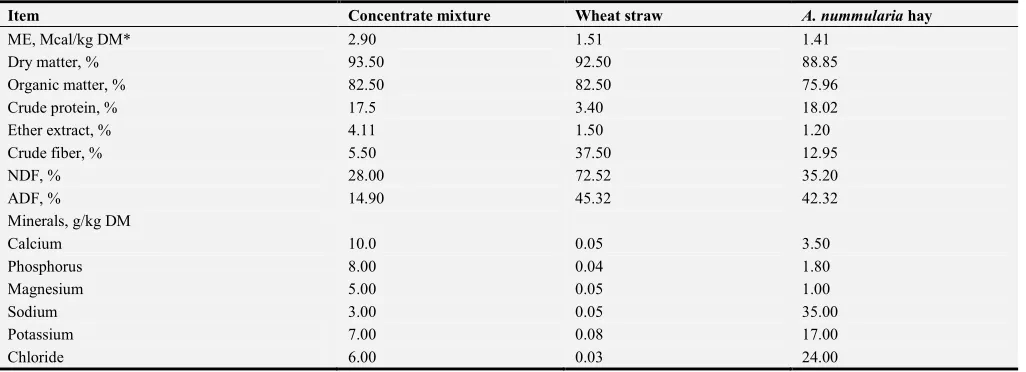
Allen [18]. The mineral elements, especially calcium, phosphorus, magnesium, sodium, chloride and potassium, were measured in the feed samples by means of atomic absorption spectrophotometer (Model 2300, Perkin-Elmer, USA). The chemical analyses of the concentrate mixture, wheat straw and saltbush hay are shown in Table 1.
2.3. Animals, Management and Feeding
Fifteen growing native lambs, of nearly equal body weight (about 28.0 kg), were randomly allocated into three groups, each with five lambs. The animals were housed individually in pens. The trial lasted for 60 days; 15 days pre-experimental or adaptation period and 45 days- feeding period on saltbush. During the pre-experimental period, the lambs were fed on concentrate mixture and wheat straw as basal diets. At the beginning of experiment, the animals were reweighed and their weight were recorded (about 30.5 kg). The lambs in the first group served as a control (CON) and continued in feeding on concentrate mixture plus wheat straw. The animals in other groups were fed on the concentrate mixture with A. nummularia hay. The Atriplex hay was gradually substituted half the amount of wheat straw in group 2 (ATR50) or replaced the straw totally in group 3 (ATR 100). The concentrate mixture contained 53.0% yellow ground corn, 18% soybean meal, 26.3% wheat bran, 2.0% limestone, 0.5% salt and 0.20% trace mineral and vitamin premix. The premix comprised (per kg) 20,000,000 IU vitamin A, 200,000 IU vitamin D3, 10,000 mg vitamin E, 10,000 mg Fe, 2500 mg Cu, 20,000 mg Mn, 100 mg Mo, 100 mg Co, 800 mg I, 20,000 mg Zn and 100 mg Se. The animals were fed 65% of their requirements as concentrate mixture, while roughage was given ad lib with determining its consumed amounts. Consequently, the proportions of concentrate and roughage in the rations were about 65 and 35%, respectively. The rations were formulated to satisfy or exceed the nutrient requirements of lambs according to NRC of sheep [19]. Moreover, the rations were daily offered in almost two equal portions at 8.00 am and 4.00 pm. The feed refusals were collected just before offering the rations of the next day and weighed to determine the daily feed intake. The amount of ration per animal was adjusted biweekly according to the body weight, based on NRC [19] guidelines for sheep. The lambs had a free excess to water, and the total water consumption of each animal was measured daily prior to feeding. Also, the ratio of water intake per feed intake was calculated. The animals were weighed at the onset and end of the experiment as well as at biweekly intervals during the experiment.
2.4. Ruminal Fermentation Activities
for total VFAs determination. The total VFAs acids were measured by using the procedures of Warner [22].
2.5. Blood Mineral Concentrations
At the end of experiment, ten ml of blood samples were collected from the jugular vein of each lamb, before morning feeding, in tubes containing potassium ethylene diamine tetra-acetic acid (K-EDTA). Afterwards, the blood samples were immediately centrifuged at 3000 rpm for 15 minutes and the plasma was separated and stored at -20 ˚C until the chemical analysis. The plasma samples were analyzed for calcium, phosphorus, magnesium, sodium, potassium, and chlorine by atomic absorption spectrophotometry as in the feed samples.
2.6. Statistical Analysis
The results were statistically analyzed by using SAS statistical program [23]. The data were evaluated via using the procedure of General Linear Models (GLM) for analysis of variance. The obtained results were subjected to ANOVA tests accompanied by Duncan’s multiple range test to detect the differences among the treatments. The figures are presented as means ± SE. The data were considered significant at probability values lower than 0.05 (p< 0.05).
3. Results
The A. nummularia hay was analyzed and found to contain about 18.0% CP as well as high mineral contents (Table 1). Moreover, the ME content of Atriplex hay was nearly identical to that of wheat straw (about 1.41 Mcal/kg DM), but its fiber content was lower than wheat straw (12.95 vs. 37.50%). The high ash content of Atriplex resulted in a lower organic matter when compared to wheat straw (75.96 vs.
82.50%).
The concentrate intake did not differ among the treatments, whereas the amount of roughage intake decreased (p< 0.05) with increasing the proportion of Atriplex hay in the diet (Table 2). Thus, lambs fed on A. nummularia hay exhibited a lower (p< 0.05) total feed intake than the control. However, the water intake was increased (p< 0.05) in animals fed on that hay. Consequently, the ratio of water intake/ feed intake was higher (p< 0.05) in Atriplex fed groups compared to the control. Unexpectedly, the increase in water intake was equal in lambs fed 50% (ATR50) or 100% (ATR100) Atriplex hay. Nevertheless, the BW and weight gain of lambs fed 50% saltbush hay of the roughage amount (ATR50) was similar to that of the control, but was decreased in those fed on that hay alone as roughage.
Concerning the rumen fermentation (Table 3), the feeding of A. nummularia hay decreased (p< 0.05) the ruminal pH compared to the control (6.10 vs. 6.70). However, it increased (p< 0.05) the total protozoa count in comparison to the control (5.76 x 10⁶ vs. 1.64 x 10⁶). Moreover, the Atriplex improved the total VFAs production in the rumen fluid (13.0 vs. 9.16 mmol/100 ml), but reduced the ammonia N concentration (9.20 vs. 11.3 mg/100 ml).
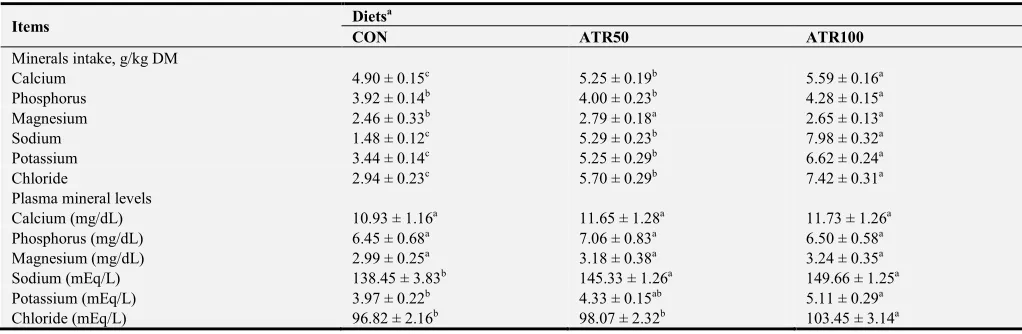
The effects of A. nummularia hay on minerals intake of animals as well as on its concentrations in blood plasma are shown in Table 4. It was found that Atriplex hay increased (p< 0.05) the minerals intake of lambs in group 2 and 3. The effect on minerals intake was markedly higher in lambs fed on saltbush hay alone as roughage (group 3). However, the Atriplex feeding only increased (p< 0.05) the plasma Na concentration in both Atriplex treatments and the plasma K and Cl in lambs fed the A. nummularia hay alone. Nevertheless, there were no significant differences (p> 0.05) in plasma Ca, P and Mg levels among the treatments.
Table 1. Chemical composition (% or g/kg DM) of concentrate mixture, wheat straw and Atriplex nummularia hay (on dry matter basis).
Item Concentrate mixture Wheat straw A. nummularia hay
ME, Mcal/kg DM* 2.90 1.51 1.41
Dry matter, % 93.50 92.50 88.85
Organic matter, % 82.50 82.50 75.96
Crude protein, % 17.5 3.40 18.02
Ether extract, % 4.11 1.50 1.20
Crude fiber, % 5.50 37.50 12.95
NDF, % 28.00 72.52 35.20
ADF, % 14.90 45.32 42.32
Minerals, g/kg DM
Calcium 10.0 0.05 3.50
Phosphorus 8.00 0.04 1.80
Magnesium 5.00 0.05 1.00
Sodium 3.00 0.05 35.00
Potassium 7.00 0.08 17.00
Chloride 6.00 0.03 24.00
Table 2. Effect of Atriplex nummularia feeding on performance of lambs throughout the experiment.
Items Diets
a
CON ATR50 ATR100
Concentrate intake (kg DM/d) 0.49 ± 0.15 a 0.49 ± 0.14 a 0.49 ± 0.16 a
Roughage intake (kg DM/d) 0.30 ± 0.14a 0.22 ± 0.16b 0.18 ± 0.13c
Total feed intake (kg DM/d) 0.79 ± 0.16a 0.71 ± 0.16b 0.68 ± 0.19c
Water intake (L/d) 2.29 ± 0.14b 3.74 ± 0.27a 3.55 ± 0.24a
Water intake/Feed intake (L/kg DM) 2.88 ± 0.15b 5.22 ± 0.32a 5.20 ± 0.27a
Initial body weight (kg) 30.37 ± 0.62a 30.63 ± 0.62a 30.67 ± 1.54a
Final body weight (kg) 38.66 ± 0.85a 39.62 ± 0.63a 36.88 ± 1.02b
Weight gain (kg) 8.63 ± 0.24a 8.75 ± 0.14a 6.25 ± 0.25b
Average daily gain (g) 191.66 ± 5.32a 194.44 ± 3.21a 138.88 ± 5.55b
a Diets were CON (its roughage was wheat straw alone, without A. nummularia), ATR50 (half of wheat straw was replaced by A. nummularia), ATR100 (its roughage was A. nummularia alone, without wheat straw).
Table 3. Effect of Atriplex nummularia feeding on pH, total protozoa count, ammonia N and total volatile fatty acids concentrations in the rumen of lambs.
Items Diets
a
CON ATR50 ATR100
pH value 6.70 ± 0.14a 6.06 ± 0.08b 6.10 ± 0.19b
Total protozoa count (×106/ml) 1.64 ± 0.42c 4.59 ± 0.69b 6.92 ± 0.97a
Ammonia N concentration (mg/100 ml) 11.30 ± 0.52a 9.44 ± 0.35b 8.96 ± 0.46b
Total VFAs concentration (mmol/100 ml) 9.16 ± 0.44c 12.00 ± 0.28b 13.92 ± 0.57a
a Diets were CON (its roughage was wheat straw alone, without A. nummularia), ATR50 (half of wheat straw was replaced by A. nummularia), ATR100 (its roughage was A. nummularia alone, without wheat straw).
Table 4. Effect of Atriplex nummularia feeding on minerals intake and mineral levels of blood plasma in lambs.
Items Diets
a
CON ATR50 ATR100
Minerals intake, g/kg DM
Calcium 4.90 ± 0.15c 5.25 ± 0.19b 5.59 ± 0.16a
Phosphorus 3.92 ± 0.14b 4.00 ± 0.23b 4.28 ± 0.15a
Magnesium 2.46 ± 0.33b 2.79 ± 0.18a 2.65 ± 0.13a
Sodium 1.48 ± 0.12c 5.29 ± 0.23b 7.98 ± 0.32a
Potassium 3.44 ± 0.14c 5.25 ± 0.29b 6.62 ± 0.24a
Chloride 2.94 ± 0.23c 5.70 ± 0.29b 7.42 ± 0.31a
Plasma mineral levels
Calcium (mg/dL) 10.93 ± 1.16a 11.65 ± 1.28a 11.73 ± 1.26a
Phosphorus (mg/dL) 6.45 ± 0.68a 7.06 ± 0.83a 6.50 ± 0.58a
Magnesium (mg/dL) 2.99 ± 0.25a 3.18 ± 0.38a 3.24 ± 0.35a
Sodium (mEq/L) 138.45 ± 3.83b 145.33 ± 1.26a 149.66 ± 1.25a
Potassium (mEq/L) 3.97 ± 0.22b 4.33 ± 0.15ab 5.11 ± 0.29a
Chloride (mEq/L) 96.82 ± 2.16b 98.07 ± 2.32b 103.45 ± 3.14a
aDiets were CON (its roughage was wheat straw alone, without A. nummularia), ATR50 (half of wheat straw was replaced by A. nummularia), ATR100 (its roughage was A. nummularia alone, without wheat straw).
4. Discussion
The saltbush hay can be used as a source of protein [18%) and minerals. The Atriplex species is characterized by high salt content as well as high levels of calcium, phosphorus, magnesium and other chemical components [2, 4]. However, it is a poor source of energy, like wheat straw, and should be supplemented with high energy feeds. Ben Salem et al. [24] observed a low energy content in A. nummularia, which could be a limiting issue to satisfy the animal requirements. The lower feed intake and increasing water intake in animals fed the Atriplex hay is attributed to its high mineral content. Norman et al. [3] noticed that the high ash content in A. nummularia hay restricted the feed intake. Pearce et al. [25] found reduced feed intake and digestibility rate of animals fed halophyte shrub, resulting in a limited growth rate or
higher which cannot be compensated by the rumen fermentation.
The water intake increased in animals fed Atriplex hay, but it was similar in both Atriplex groups although the increased level of this shrub in the roughage. This could be due to a marked decrease in total DM intake of animals in group 3 (ATR100), which restricted the amount of water intake. However, Abu-Zanat [26] reported that the increase in water intake is relative to Atriplex addition to the diets. Similarly, Le Houérou [27] and Lefèvre et al. [28] found an increase in water consumption when using high levels of Atriplex in diets of lambs. Generally, the water intake increases as a result of the salt level increases in the diet. This is due to the fact that salty diet increases the urine excretion by increasing the action of sodium pumps which drives water from cells and to adjust the water level, the brain give signals to drink more water [29]. It was found that the Atriplex nummularia increased the total rumen protozoa count, which could be due to the higher mineral contents, especially sulfur. In addition, feeding of Atriplex increased the total volatile fatty acids production. This finding could be due to an increase in the total rumen protozoa count in these animals. Moreover, the increase in volatile fatty acid production was indicated by a decrease in ruminal pH values. But, the decrease in ruminal pH was within the range optimum for bacteria (6.0 and 7.0). The reduction in ruminal ammonia N in Atriplex fed animals could be attributed to the improvement in microbial protein synthesis, which indicates enhanced utilization of degradable protein in the rumen. Also, it is possible that the energy content of the concentrate mixture had a positive role in the effects of Atriplex inside the rumen. The results obtained in the present study are supported with that of Du Toit et al. [30]. However, Salem et al. [31] found an increase in total VFAs and ammonia N concentrations, without any change in ruminal pH, in sheep fed Atriplex halimus ensiled with enzymes.
The Ca, P and Mg contents in blood plasma was similar in control and Atriplex groups. The highest mineral intake in the Atriplex groups led to a slight increase in Na, K and Cl levels in blood plasma. Although minerals were found in concentrations above the sheep requirements by NRC [19] and there was a higher mineral intakes in Atriplex groups compared to control, the mineral levels in blood plasma were always within the reference ranges for sheep according to Kahn [32]. The maintenance of mineral levels in blood could be explained by the high water intake [33]; because of the high content of salt in the diet and the requirement for a high water turnover to excrete the surplus salt from the body [19]. In addition, Mayberry et al. [34] reported that the high water intake could flush feed particles from the digestive tract before releasing of minerals, and eliminate minerals before they can be absorbed. Consequently, the availability of minerals can be reduced. Also, the absorption of minerals can be decreased by its chemical binding to indigestible molecules or its enclosure in undigested fibers. For example, the Ca and P levels in blood serum might be decreased because A. nummularia comprises high levels of secondary metabolites mainly oxalic acid which binds with Ca forming
calcium oxalate, a complex non-digestible compound [35, 36]. In contrast, blood levels of some minerals, such as Ca and P, are hormonally maintained and they are not good indicators of mineral consumption. These findings indicate that the intake levels of Atriplex species can fulfill the mineral requirements of maintenance in sheep, and therefore, supplemental salt is not needed in the diet [37]. Nevertheless, Alazzeh and Abu-Zanat [38] found lower levels of Ca and P in blood serum than normal range in lactating ewes fed saltbush, and hence, special attention should be taken when feeding saltbush for long periods. Among the tested minerals, the plasma levels of Na, Cl and K were highly affected with the intake. This is indicated by increasing their levels in the blood plasma due to its high contents in the diets. Moreover, the high plasma levels of Na can affect the palatability and, therefore, reduce the feed intake of the animals [1]. However, the levels of plasma Na and K are considered within the normal reference range of sheep [32], as they can be regulated by aldosterone hormone [39]. Even though, the saltbush requires low salt and high-energy feeds to achieve the dilution of salts in a balanced diet and improving feed intake and nutrient levels.
5. Conclusion
The results showed that increasing the proportion of
Atriplexnummularia hay in the diets of lambs reduced the
feed intake and increased the water intake. However, the body weight was not influenced in animals fed 50% Atriplex hay of the roughage amount, but decreased in those fed on that hay alone. Moreover, feeding of Atriplex increased the total protozoa count and total VFAs production in the rumen, but decreased the ammonia N level. Including a high level of that hay in the diet raised the Na, K and Cl levels in blood plasma, but the low level increased only the plasma Na. The obtained results indicate that the Atriplex nummularia hay can be used as an unconventional roughage source in sheep rations. In the present study, it can be included at a level reaching the half of roughage amount fed to animals without any adverse effect on body weight. Moreover, it can improve the rumen fermentation and the utilization of degradable protein in the rumen as indicated by the increase in total protozoa count and total VFAs production with reduction of ammonia N concentration in the rumen.
References
[1] Ben Salem H, Norman H, Nefzaoui A, Mayberry D, Pearce K, Revell D (2010). Potential use of oldman saltbush (Atriplex nummularia Lindl.) in sheep and goat feeding. Small Ruminant Research 91: 13-28.
[3] Norman HC, Freind C, Masters DG, Rintoul AJ, Dynes RA, Williams IH (2004). Variation within and between two saltbush species in plant composition and subsequent selection by sheep. Australian Journal of Agricultural Research 55: 999-1007.
[4] Norman H, Masters D, Wilmot M, Rintoul A (2008). Effect of supplementation with grain, hay or straw on the performance of weaner Merino sheep grazing old man (Atriplex nummularia) or river (Atriplex amnicola) saltbush. Grass and forage science 63: 179-192.
[5] El Nasr HA, Kandil H, El Kerdawy A, Khamis H, El-Shaer H (1997). Value of processed saltbush and acacia shrubs as sheep fodders under the arid conditions of Egypt. Small Ruminant Research 1: 15-20.
[6] Attia-Ismail S, Elsayed H, Asker A, Zaki E (2009). Effect of different buffers on rumen kinetics of sheep fed halophyte plants. Journal of Environmental Science 19: 89-106.
[7] Eissa MA, Ahmed EM (2016). Nitrogen and phosphorus fertilization for some Atriplex plants grown on metal-contaminated soils. Soil and Sediment Contamination: An International Journal 25: 431-442.
[8] Eissa M, Ahmed E, Reichman S (2016). Production of the forage halophyte Atriplex amnicola in metal‐contaminated soils. Soil Use and Management 32: 350-356.
[9] Ahmed M, Elghandour M, Salem A, Zeweil H, Kholif A, Klieve A, Abdelrassol A (2015). Influence of Trichoderma reesei or Saccharomyces cerevisiae on performance, ruminal fermentation, carcass characteristics and blood biochemistry of lambs fed Atriplex nummularia and Acacia saligna mixture.
Livestock Science 180: 90-97.
[10] Meneses, R., Varela, G., Flores, H (2012). Evaluating the use of Atriplex nummularia hay on feed intake, growth, and carcass characteristics of creole kids. Chilean Journal of Agricultural Research 72: 74.
[11] Hopkins D, Nicholson A (1999). Meat quality of wether lambs grazed on either saltbush (Atriplex nummularia) plus supplements or lucerne (Medicago sativa). Meat Science 51: 91-95.
[12] Moreno GMB, Borba H, de Araújo GGL, Sanudo C, da Silva Sobrinho AG, Buzanskas ME, de Lima Júnior DM, de Almeida VVS, Neto OB (2015). Meat quality of lambs fed different saltbush hay (Atriplex Nummularia) levels. Italian Journal of Animal Science 14: 251-259.
[13] Obeidat BS, Mahmoud KZ, Maswadeh JA, Bsoul EY (2016). Effects of feeding Atriplex halimus L. on growth performance and carcass characteristics of fattening Awassi lambs, Small Ruminant Research 137: 65–70.
[14] Moreno GMB, Borba H, de Araújo GGL, Voltolini TV, de Moraes SA, da Silva Sobrinho AG, Neto OB, de Lima Júnior DM, Cirne LGA, Buzanskas ME (2017). Digestibility and performance of lambs fed diets containing old man saltbush hay. Semina: Ciências Agrárias 38: 455-466.
[15] Hintsa K, Berhe A, Balehegn M, Berhe K (2018). Effect of replacing concentrate feed with leaves of Oldman saltbush (Atriplex nummularia) on feed intake, weight gain, and carcass parameters of highland sheep fed on wheat straw in northern Ethiopia. Tropical Animal Health and Production 50: 1435–1440.
[16] AOAC (2005). Official Methods of Analysis of AOAC
International, 18th ed. Association of Official Analytical
Chemists, Gaithersburg, MD.
[17] Van Soest PV, Robertson J, Lewis B (1991). Methods for dietary fiber, neutral detergent fiber, and nonstarch polysaccharides in relation to animal nutrition. Journal of Dairy Science 74: 3583-3597.
[18] Parkinson J, Allen S (1975). A wet oxidation procedure suitable for the determination of nitrogen and mineral nutrients in biological material. Communications in Soil Science and Plant Analysis 6: 1-11.
[19] NRC (1985). Nutrient Requirements of Sheep. National
Research Council. Washington, DC, USA.
[20] Abou El-Naga M (1967). Some metabolic studies on rumen microorganisms. Thesis, Faculty of Agric., Unive. Alex.
[21] Conway EF (1962). Ammonia, General Method. Microdiffusion Analysis and Volumetric Error. Crosby Lockwood and Son Ltd., London, UK, p. 98-100.
[22] Warner ACI (1964). Production of volatile fatty acids in the rumen: methods of measurement. Nutrition Abstract Review 34: 339.
[23] SAS (2002). Institute SAS User’s Guide. Release 6.12 Edition: SAS institute Inc., Cary, NC.
[24] Ben Salem H, Nefzaoui A, Salem LB (2002). Supplementing spineless cactus (Opuntia ficus-indica f. inermis) based diets with urea-treated straw or oldman saltbush (Atriplex nummularia). Effects on intake, digestion and sheep growth. The Journal of Agricultural Science 138: 85-92.
[25] Pearce K, Masters D, Smith G, Jacob R, Pethick D (2005). Plasma and tissue α-tocopherol concentrations and meat colour stability in sheep grazing saltbush (Atriplex spp.). Australian Journal of Agricultural Research 56: 663-672.
[26] Abu-Zanat MMW (2005). Voluntary intake and digestibility of saltbush by sheep. Asian-Aust. Journal of Animal Science 118: 214–220.
[27] Le Houérou H (1992). The role of saltbushes (Atriplex spp.) in arid land rehabilitation in the Mediterranean Basin: a review. Agroforestry Systems 18: 107-148.
[28] Lefèvre I, Marchal G, Ghanem ME, Correal E, Lutts S (2010). Cadmium has contrasting effects on polyethylene glycol– Sensitive and resistant cell lines in the Mediterranean halophyte species Atriplex halimus L. Journal of Plant Physiology 167: 365-374.
[29] Harper ME, Willis JS, Patrick J (1997). Sodium and chloride in nutrition. Handbook of Nutritionally Essential Mineral
Elements 8217: 93-116.
[30] Du Toit CJL, Van Niekerk WA, Hassan A, Rethman NFG, Coertze RJ (2006). Fermentation in the rumen of sheep fed Atriplex nummularia cv. De Kock supplemented with incremental levels of barley and maize grain. South African Journal of Animal Science 36 (5): 74-77.
[32] Kahn CM (2005). The Merck Veterinary Manual, 9th ed. Whitehouse Station, N. J.; [Great Britain]: Merck & Co.
[33] Millsom D (2002). Direct seeding Oldman saltbush (Atriplex sp.) and associated chenopod species in saline clay. Branching Out 21: 4-6.
[34] Mayberry D, Masters D, Vercoe P (2010). Mineral metabolism of sheep fed saltbush or a formulated high-salt diet. Small Ruminant Research 91: 81-86.
[35] Blaney B, Gartner R, Head T (1982). The effects of oxalate in tropical grasses on calcium, phosphorus and magnesium availability to cattle. The Journal of Agricultural Science 99: 533-539.
[36] Cheeke P (1995). Endogenous toxins and mycotoxins in forage grasses and their effects on livestock. p. 909-918. En: Journal of Animal Science. Vol. 73, no. 3 (Mar 1995).
[37] Otal J, Orengo J, Quiles A, Hevia ML, Fuentes F (2010). Characterization of edible biomass of Atriplex halimus L. and its effect on feed and water intakes, and on blood mineral profile in non-pregnant Manchega-breed sheep. Small Ruminant Research 91: 208–214.
[38] Alazzeh A, Abu-Zanat M (2004). Impact of feeding saltbush (Atriplex sp.) on some mineral concentrations in the blood serum of lactating Awassi ewes. Small Ruminant Research 54: 81-88.
[39] . Safwate A, Davicco M, Dalle M, Barlet JP (1984). Electrolyte balance, mode of delivery and plasma aldosterone levels in newborn lambs. Reproduction Nutrition Développement 24 (4): 351-360.
[40] Feedipedia - Animal Feed Resources Information System -
INRA CIRAD AFZ and FAO.