R E S E A R C H
Open Access
Evaluation of Communities of Practice
performance developing implementation
research to enhance maternal health
decision-making in Mexico and Nicaragua
Jacqueline E. Alcalde-Rabanal
1, Victor M. Becerril-Montekio
1*and Etienne V. Langlois
2Abstract
Background:Despite the existence of proven solutions to improve maternal health, innovative approaches are still necessary to support the implementation of programs and policies in real-world settings. To address this challenge, we developed a participatory capacity strengthening model based on Communities of Practice (CoPs) of maternal health frontline personnel and decision-makers involved in implementing maternal health programs in Latin America. The activities focused on the conduct and use of implementation research to enhance maternal health decision-making. Our objective is to evaluate the performance of the Communities of Practice in using implementation research to support decision-making in maternal health programs in Mexico and Nicaragua.
Methods:We evaluated the CoPs’performance using a mixed methods approach. We appraised the performance of CoPs using five criteria: (i) integration of the CoP, (ii) ownership of the methodology, (iii) timely delivery of products, (iv) feedback to decision-makers, and (v) influence on program changes. We also included an assessment of the barriers and facilitators to the conduct and uptake of implementation research findings in maternal health decision-making.
Results:Two CoPs showed“sub-optimal”performance, one was signaled as“needing strengthening,”and three reached “optimal”performance in the use of implementation research to enhance maternal health programs. The relationships between champions, facilitators, and research team were the main internal enabling factor for success. Externally, political and epidemiological environments acted as the main barriers to the performance of CoPs.
Conclusions:Our study highlights the value of involving decision-makers in CoPs, ensuring varied skill sets and profiles of health professionals, as well as maintaining strong and continuous collaborations with researchers. Collaborative approaches and meaningful engagement of decision-makers and researchers are useful in conducting implementation research and promoting the use of evidence to improve maternal health programs in resource-strained settings.
Keywords:Implementation research, Maternal health, Participatory research, Communities of Practice
Background
Important progress has been made throughout the world in maternal health during the last 25 years [1–3]. Nevertheless, the majority of countries that committed to Millennium Development Goal (MDG) 5—reducing maternal mortality ratios by 75% between 1990 and 2015—were not able to
achieve that goal [4,5]. While MDG 5 was not met globally, many critical lessons were learned to support the new Sustainable Development Goals (SDGs) and the implemen-tation of strategies to end preventable maternal mortality by 2030 [6]. An increasing corpus of scientific evidence under-lines the complexity of factors influencing the reduction of maternal mortality worldwide [7–11]. Of particular import-ance among these factors are improvements in the quality and availability of services, training of health personnel [12, 13], responsiveness towards obstetric emergencies [14] including reference and counter-reference systems, * Correspondence:[email protected]
1Centre for Health Systems Research, National Institute of Public Health, Av.
Universidad 655, Col. Santa María Ahuacatitlán, CP 62100 Cuernavaca, Morelos, Mexico
Full list of author information is available at the end of the article
and continuum along pregnancy, delivery, and postnatal care services [15,16]. Despite recent progress to address these issues [17, 18], maternal health policies and pro-grams still face crucial challenges related to the availability of health resources, particularly for disadvantaged groups, the quality of healthcare [8, 19–22], the organization of health services delivery, and maternal health promotion and education.
Addressing these challenges requires planning, develop-ment and impledevelop-mentation of maternal health interventions that are properly informed by evidence, and increasing research utilization among decision-makers [23,24]. In this sense, learning from the important progress made in clinical care following the evidence-based medicine move-ment, there is increasing support worldwide for evidence-informed health policymaking and health systems strength-ening [25–28]. These concepts consider that the complexity of health systems demands a broad approach to evidence as a foundation for decision-making. Yet, imple-mentation of maternal health policies and programs is not easily nor always linked to the use of evidence. This phenomenon often occurs because health services officials must follow operating rules in everyday management of programs, which—albeit supporting standardization of actions—are not regularly updated and enhanced using context-sensitive evidence [29]. Uptake of evidence is also impeded by limited staff competencies, budget constraints, and lack of decision-makers’interest in research.
Progress remains slow in the implementation and scale-up of proven solutions and effective interventions to lower maternal morbidity and mortality. As such, there is a need to better understand the barriers and facilitators to the implementation of maternal health programs and policies in real-world settings, taking into consideration resource allocation, staffing, and healthcare delivery structures. By scientifically studying the effective delivery of maternal health programs, implementation research aims at optimizing the delivery of existing inter-ventions and improvements in maternal health outcomes.
Implementation research to improve maternal health policies and programs is inevitably influenced by the skills of decision-makers to identify and use evidence, as well as the knowledge derived from the health system workers’ experience [27, 29, 30]. A key to address this challenge is capacity strengthening for the adequate use of information in decision-making for health profes-sionals involved in the provision and management of maternal healthcare services.
As a response, the Alliance for Health Policy and Systems Research, an international partnership hosted by the World Health Organization (WHO), supported an initiative entitled“Capacity strengthening to demand, access and apply implementation research to scale-up maternal health programs for underserved populations
in Mexico and Nicaragua.” The overall purpose of the initiative was to foster evidence-informed decision-making towards improved maternal health outcomes [31]. It is aligned with continuing efforts to advance maternal health, including specific targets for maternal healthcare among the Sustainable Development Goals and other global strategies like the Global Strategy for Women’s, Children’s, and Adolescent’s Health 2016–2030 [32].
Mexico is classified as an upper middle-income country with an estimated maternal mortality ratio (MMR) of 38 (34 to 42) deaths per 100,000 live births in 2015 [3, 33], while Nicaragua stands among lower middle-income countries with an estimated MMR of 150 (115 to 195) in 2015 [3, 33]. Striving to address common problems and promote the sustainability of impact, the initiative developed a participatory capacity strengthening model based on Communities of Practice (CoPs) to facilitate primary healthcare units’ management and processes, including input from stakeholders involved in the imple-mentation of maternal health programs. Based on the “four As”approach developed by the Canadian Foundation for Health Improvement (CFHI) [34], the model’s objective was to strengthen individual and institutional capacities to Acquire, Analyse, Adapt, and Apply implementation research, while facilitating its integration in decision-making (Fig. 1). The expected results were executive summaries for decision-makers using a modified version of the 1:3:25 template used by the CFHI [35].
Communities of Practice for maternal health
We conceive Communities of Practice as groups of people sharing concerns, problems, activities, and interests within their working experience and possessing a deep knowledge and expertise of a specific domain. Previous evidence shows that CoPs are useful in strengthening capacities and fostering a new culture of acting together [36,37]. In this sense, CoPs provide a setting which is conducive to sharing the lessons and practices of policymakers and health managers in assessing and using scientific evidence. CoPs can also function as interactive interfaces in which researchers and practitioners meet and exchange, thus fostering their personal and professional development [38, 39]. Experiences in different settings demonstrate the advantages of CoPs to support the use of evidence in low- and middle-income countries, particularly for priority-setting approaches to support evidence-informed health system strengthening [40]. CoPs thus have the potential to act as effective and collaborative platforms to strengthen capacities for the use of evidence in health policy and systems decision-making.
support the conduct and use of implementation research to improve maternal health programs in Latin America and the Caribbean. An important knowledge gap concerns the contribution of Communities of Practice to health system decision-making and their contribution in light of barriers and facilitators to the use of implementation research to support maternal health programs.
The objective of this paper is to evaluate the imple-mentation and performance of Communities of Practice in the development of implementation research to enhance informed decision-making in maternal health programs in Mexico and Nicaragua, highlighting the barriers and facilitators to the use of evidence.
Methods
Phase 1—Development and training of CoPs
We established CoPs in three states of Mexico (Hidalgo, Morelos, and Veracruz) and three departments of Nicaragua (Chontales, Jinotega, and Matagalpa) where existing national maternal health programs were being implemented. The selection of states and departments was based on two main criteria: (a) maternal mortality rates above national averages and (b) presence of health authorities willing to participate in the project. Two research teams, one in Mexico and one in Nicaragua, met with the pertinent health authorities to agree on the objectives of the project, the definition of settings, and the profile of CoPs’members. Initial contacts with health authorities helped ensure that stakeholders engaged in the CoPs had the authority to perform program-matic changes and improve implementation processes using research findings. The research team documented the context of each CoP emphasizing the most relevant aspects, including sociopolitical, organizational, and epidemiological events. The six CoPs included strategic personnel—health unit directors, maternal health program managers—and
tactic frontline staff, including physicians, nurses, and health promoters directly involved in the implementation of mater-nal health programs. The six CoPs were assigned the same funding to perform the implementation research projects. Development, training, and activities of the six CoPs followed a streamlined process and participation was on a voluntary basis (Fig.2).
During the first workshop, the research team identified the CoPs’ “policy champions,” namely health personnel with high interest and agency to support the project and communicate its importance to higher level health authorities [39]. We further identified a “facilitator” in each CoP, to act as mediator between the research team, the policy champion, and the CoP members while guiding and promoting members’participation. We selected facili-tators based on their leadership skills and abilities in using information and communication technologies.
2014, four leaders from each CoP attended a 5-day training workshop in Nicaragua focused on the development and execution of implementation research protocols. One more leader per CoP received a full scholarship to attend courses during the Mexico National Institute of Public Health Summer Program on Epidemiology and Public Health.
Phase 2—Performance evaluation
We assessed the process and performance of the CoPs using a mixed methods evaluation scheme, including an appraisal of the barriers and facilitators to the use of implementation research in maternal health decision-making. In order to appraise the performance of each CoP, we developed an evaluation form based on relevant literature focusing on group collaboration [44] to assess collaborative engagement and decision-making processes [45]. Performance was appraised in relation to five criteria: (a) integration of the CoP, (b) ownership of the methodology, (c) timely delivery of products, (d) feedback to decision-makers, and (e) influence on decision-makers (Table1). The grid was filled in using data from the field diaries describing the process followed by each CoP and the concept systems platform (Additional file1).
Using this evaluation form, the research team analyzed the information for each CoP and reached a consensus on the corresponding ratings. We then computed the summative score obtained by each CoP as a proxy for their performance. In order to assess different degrees of progress, cut-off points were developed based on terciles of the maximum possible score; the scores were then organized in three ranges 5 to 12 = sub-optimal, 13 to 20 = needs strengthening, and 20 to 25 = optimal.
All members gave informed consent to participate in the CoPs including workshops and online activities. The whole project received authorization from the research and ethics committees of the National Institute of Public Health of Mexico (INSP) and the Centre for Health Research and Studies of the National Autonomous University of Nicaragua, while the implementation research protocols of each CoP were approved by the pertinent health authorities.
Results
The final number of participants in the CoPs varied from 17 in Veracruz (Mexico) to 54 in Jinotega (Nicaragua) (Table 2). A total of 326 participants attended the first workshop and 200 participants completed the online concept mapping activities. Attendance to the first work-shop followed an invitation by local health authorities, while participation in the subsequent events was voluntary and depended on individual interest and disposition. No pressure was exerted on individuals to participate or not in the project. The process of integration of the CoPs followed the general group integration dynamics, as exemplified by the cases of Hidalgo and Morelos (Mexico) (Fig.3). The number of professionals who completed the concept mapping process served as the baseline to assess the CoPs’ performance. Taking into account all CoP members at the beginning of the project, 35% of participants were physicians, 37% were nurses, and the remaining 28% were other health personnel or management professionals. By the end of the project, the proportions changed to 43% physicians, 42% nurses, and 15% other.
Figure 4 shows the rating for each CoP. The CoPs of Veracruz in Mexico, as well as Jinotega and Matagalpa in Nicaragua, barely reached the ratings of 11, 5, and 11 points, respectively. The CoPs of Hidalgo and Morelos (Mexico) obtained the maximum rating of 25 points, while the CoP of Chontales (Nicaragua) achieved 15 points.
Integration of the CoP
The CoPs of Chontales (Nicaragua) and Hidalgo and Morelos (Mexico) obtained the highest scores. The CoP leaders (champion, facilitator) supported consensus
decision-making among participants using available communication mechanisms and motivating active participation. These CoPs created specific WhatsApp groups to support rapid communication among their members. They used social media to monitor progress in different tasks, develop meeting agendas, and stimulate exchanges whenever problems arose. Based on the establishment of horizontal and collaborative relationships among health personnel, health authorities, and the research team, ideas and proposals were regularly discussed and the facilitators triggered consensus building within the group.
Table 2Number and nature of health professionals participating in CoPs of Mexico and Nicaragua, 2013–2015
Year Profession Mexico Nicaragua Total
Hidalgo Morelos Veracruz Total Chontales Jinotega Matagalpa Total No. %
2 Physicians 13 21 5 39 16 14 1 31 70 35.0
0 Nurses 11 11 5 27 6 28 12 46 73 36.5
1 Other 4 4 7 15 20 12 10 42 57 28.5
3 Total 28 36 17 81 42 54 23 119 200 100
2 Physicians 13 17 5 35 9 15 1 25 60 42.9
0 Nurses 11 12 5 28 9 12 10 31 59 42.1
1 Other 3 2 7 12 2 5 2 9 21 15.0
5 Total 27 31 17 75 20 32 13 65 140 100
Table 1CoPs performance assessment criteria. Mexico and Nicaragua, 2013–2015
Criteria Source of evidence Value
1 3 5
Integration of the CoP Proper communication and consensus mechanisms among CoP members
Concept Systems Global platform
Few members of the CoP communicate among them, while most of them participate randomly in group tasks and discussions
Good communication among all members, but the CoP faces difficulties in finding consensus for action and irregular members’ presence and/or active participation in group tasks and discussions
Good communication among all members facilitating consensus for action and fostering group work and regular members’ presence and/or active participation in the group tasks and discussions
Ownership of the methodology Creative and effective use of implementation research methodology
Results reports presented by CoPs (field diary)
The methodology is deficiently used due to organization problems inside the CoP
The methodology is used and most difficulties are solved
The methodology is used in a swift manner and difficulties are solved with innovative procedures
Timely delivery of products* Capacity to generate and deliver good quality products on time
Results reports presented by CoPs (field diary)
Failure to deliver any of the three main products on time and with satisfactory technical quality
Delivery of the first or second main products with minor technical flaws
Timely delivery of all three main products with satisfactory technical quality
Feedback to decision-makers Presentation of results to maternal health personnel and authorities
Reports on meetings with health authorities (field diary)
The final results of the CoP’s work are only socialized among its members
The final results of the CoP’s work are socialized among peer health personnel or local level health authorities
The final results of the CoP’s work are socialized among local high-level health authorities and health system staff
Influence on program changes Use of evidence generated by the CoP by health authorities
Follow-up of modifications in the maternal health services with decision-makers
The results of the CoP’s work have not been used but its own organization has been useful
The results of the CoP’s work have been used for the implementation of actions to improve the maternal health program in which its members work
The results of the CoP’s work have been used for the implementation of actions to improve the maternal health program in which its members work as well as interventions in other domains
The other three CoPs showed lack of organization among facilitators and champions. This caused delays in the completion of tasks and gradually discouraged participants. There was random attendance to workshops and CoPs did not work as cohesive groups. Most of the time, the tasks were accomplished by the facilitator and/or a few CoP members and lacked general consensus.
Ownership of the methodology
The capacity strengthening model was set up to train the CoPs on the conduct of implementation research and the use of research findings to inform decision-making. Throughout the project implementation, the individual CoPs either followed strictly, adapted, or were unable to incorporate implementation research methods Fig. 3Group dynamics
in their activities. For instance, while the CoP of Morelos respected the proposed literature review process, those of Hidalgo and Matagalpa modified the methods according to the availability of their members. These three CoPs were able to complete the literature reviews according to the established criteria: number of reviewed articles related to the research objectives, identification of main concepts, and final report. On the other hand, the CoPs of Veracruz and Jinotega were unable to follow or adapt the project’s methodology. The CoPs of Matagalpa and Chontales were able to integrate some methodological components, but failed to fully reach the intended goals.
Timely delivery of outputs
Output 1—Literature review
Each CoP carried out a literature review on priority implementation challenges for their maternal health program, based on the outcomes of the concept mapping exercise. The CoPs of Hidalgo and Morelos delivered complete literature review reports. The CoPs of Jinotega, Chontales, Veracruz, and Matagalpa failed to deliver adequate review results to support their program work.
Output 2—Implementation research protocols
The three Mexican CoPs developed research protocols to tackle specific implementation problems based on clear objectives and research questions, together with quantita-tive and qualitaquantita-tive methods suitable to address them. In Veracruz, the CoP delivered the protocol with a 4-month delay and following uneven participation of its members. In Hidalgo and Morelos, all members of the CoPs actively worked on the implementation research protocols and data collection instruments. The CoPs in Chontales and Matagalpa (Nicaragua) also delivered their protocols and instruments, albeit only a small number of participants contributed to the process in Chontales. Table3 summa-rizes the issues addressed by the six implementation research protocols.
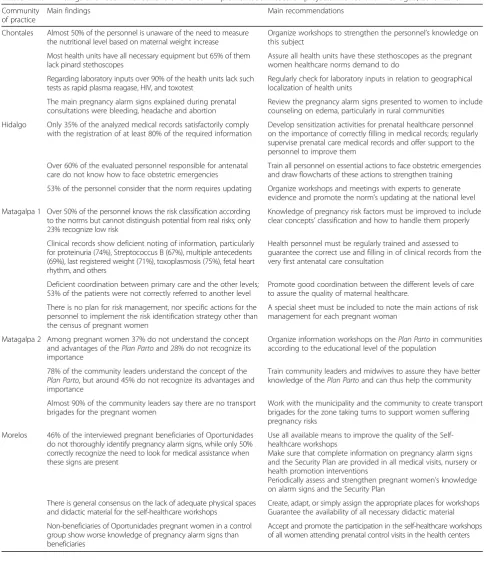
Output 3—Implementation research results and conclusions Each CoP was committed to present an executive summary of the main findings including key recommendations informed by the implementation research results. Figure3 shows that five out of six CoPs were successful in delivering this deliverable. Table 4 offers a summary of the main findings and recommendations of the implementation research projects finalized by the CoPs.
Feedback to decision-makers
The CoPs of Chontales, Hidalgo, and Morelos met with their regional health authorities and presented the main implementation research findings and recommendations. The decision-makers acknowledged the empirical reports and shared them with their staff, with a view of assessing the recommendations to improve implementation and scale-up of maternal health programs.
The CoPs of Jinotega and Veracruz did not present any results to the state’s health authorities, as the imple-mentation research projects were not completed. Finally, the two separate groups of the Matagalpa CoP were not able to engage and share results with the corresponding health authorities.
Influence on decision-makers
In the state of Hidalgo, the implementation research shed light on poor health personnel’s compliance to national guidelines and norms in antenatal care. After presentation of the findings from the CoP, the health ministry designed and implemented initiatives aiming to improve adherence to antenatal care guidance and standards in primary healthcare facilities. In Morelos, the implementation research showed strong acceptability and feasibility of self-healthcare workshops taught to pregnant women. As such, the health ministry used the findings to adapt health promotion and education interventions targeting pregnant women, in order to improve their response when facing potential maternal health complications. Even when some CoPs did not have a very good performance, the activities and relationships created by the improvement approach
Table 3Titles of the six protocols developed by CoPs of Mexico and Nicaragua, 2013–2015 Community of practice Protocol titles
Chontales Compliance with prenatal healthcare quality norms in the family and communitarian health units of El Ayote and Nueva Guinea in the SILAIS of Chontales
Hidalgo Compliance with the NOM-007-SSA2-2010 concerning prenatal control in the Health Jurisdiction of Tula, Hidalgo, in 2014
Matagalpa 1 Failures in the response to risk factors of pregnancy by prenatal control health personnel in the Salud Trinidad Guevara Health Center, Matagalpa
Matagalpa 2 Assessment of the implementation of thePlan Partostrategy for the reduction of maternal and perinatal mortality in the San José Health Center, municipality of Matigas, in 2014
Morelos Assessment of the implementation of the Alarm Signs Identification and Complications Prevention Workshops addressed to pregnant women in Morelos in 2014
had a positive influence by creating local initiatives to improve the implementation of maternal health programs.
Discussion
In Mexico and Nicaragua, the CoP initiative was set up to strengthen the capacities of maternal health program
personnel to generate and use implementation research as important evidence for public health decision-making [22]. The research process was collaboratively conducted by health staff and the research team and embedded in health services management. As such, the process can be considered a case of “embedded research,” as
Table 4Main findings and recommendations of the CoP implementation research projects. Mexico and Nicaragua, 2013–2015 Community
of practice
Main findings Main recommendations
Chontales Almost 50% of the personnel is unaware of the need to measure the nutritional level based on maternal weight increase
Organize workshops to strengthen the personnel’s knowledge on this subject
Most health units have all necessary equipment but 65% of them lack pinard stethoscopes
Assure all health units have these stethoscopes as the pregnant women healthcare norms demand to do
Regarding laboratory inputs over 90% of the health units lack such tests as rapid plasma reagase, HIV, and toxotest
Regularly check for laboratory inputs in relation to geographical localization of health units
The main pregnancy alarm signs explained during prenatal consultations were bleeding, headache and abortion
Review the pregnancy alarm signs presented to women to include counseling on edema, particularly in rural communities
Hidalgo Only 35% of the analyzed medical records satisfactorily comply with the registration of at least 80% of the required information
Develop sensitization activities for prenatal healthcare personnel on the importance of correctly filling in medical records; regularly supervise prenatal care medical records and offer support to the personnel to improve them
Over 60% of the evaluated personnel responsible for antenatal care do not know how to face obstetric emergencies
Train all personnel on essential actions to face obstetric emergencies and draw flowcharts of these actions to strengthen training
53% of the personnel consider that the norm requires updating Organize workshops and meetings with experts to generate evidence and promote the norm’s updating at the national level
Matagalpa 1 Over 50% of the personnel knows the risk classification according to the norms but cannot distinguish potential from real risks; only 23% recognize low risk
Knowledge of pregnancy risk factors must be improved to include clear concepts’classification and how to handle them properly
Clinical records show deficient noting of information, particularly for proteinuria (74%), Streptococcus B (67%), multiple antecedents (69%), last registered weight (71%), toxoplasmosis (75%), fetal heart rhythm, and others
Health personnel must be regularly trained and assessed to guarantee the correct use and filling in of clinical records from the very first antenatal care consultation
Deficient coordination between primary care and the other levels; 53% of the patients were not correctly referred to another level
Promote good coordination between the different levels of care to assure the quality of maternal healthcare.
There is no plan for risk management, nor specific actions for the personnel to implement the risk identification strategy other than the census of pregnant women
A special sheet must be included to note the main actions of risk management for each pregnant woman
Matagalpa 2 Among pregnant women 37% do not understand the concept and advantages of thePlan Partoand 28% do not recognize its importance
Organize information workshops on thePlan Partoin communities according to the educational level of the population
78% of the community leaders understand the concept of the Plan Parto, but around 45% do not recognize its advantages and importance
Train community leaders and midwives to assure they have better knowledge of thePlan Partoand can thus help the community
Almost 90% of the community leaders say there are no transport brigades for the pregnant women
Work with the municipality and the community to create transport brigades for the zone taking turns to support women suffering pregnancy risks
Morelos 46% of the interviewed pregnant beneficiaries of Oportunidades do not thoroughly identify pregnancy alarm signs, while only 50% correctly recognize the need to look for medical assistance when these signs are present
Use all available means to improve the quality of the Self-healthcare workshops
Make sure that complete information on pregnancy alarm signs and the Security Plan are provided in all medical visits, nursery or health promotion interventions
Periodically assess and strengthen pregnant women’s knowledge on alarm signs and the Security Plan
There is general consensus on the lack of adequate physical spaces and didactic material for the self-healthcare workshops
Create, adapt, or simply assign the appropriate places for workshops Guarantee the availability of all necessary didactic material
Non-beneficiaries of Oportunidades pregnant women in a control group show worse knowledge of pregnancy alarm signs than beneficiaries
researchers actively collaborated with maternal health programs staff and health authorities, whose role was central in the implementation research projects [46,47].
Our evaluation suggests that three CoPs performed sub-optimally, while three others showed good integration and ownership of methods. The performing CoPs were thus able to generate relevant implementation evidence as a basis for recommendations to enhance maternal health programs.
Out of the six CoPs, two were able to support decision-makers in addressing newly identified
impedi-ments to implementation. Furthermore, the high
performing CoPs provide insights on the enabling factors conditioning success of such collaborative platforms. One facilitator is to start with a direct contact with high-level health authorities in each setting. Another critical condition for success is the formation of a collaborative group of actors, champion, facilitator, and research team, working in a participatory fashion.
Effective champions are people who act as interlocutors with authorities to ensure institutional support, while maintaining good horizontal relationships with the members of the CoP. Similarly, CoP facilitators who effectively fulfill their role are recognized by the community as peers with charismatic leadership and organizational capacities and possessing a deep knowledge of the institu-tional context. These facilitators recognized the importance of collaboration and close contact with the CoP members, as well as regular communication with the champion and the research team. The dynamic of the three actors is key to create synergies and stimulate collaborative work among all members of the CoP.
The integration of the CoP and trust among its members, including the facilitator and champion, were crucial in empowering stakeholders and developing a sense of ownership on the implementation research findings generated. Similarly, strong and continuous relationship-building between the research team, facilita-tors, champions, and health authorities in the generation of evidence contributed to strengthening the value of evidence to inform maternal health decision-making. The co-production of implementation research findings by health personnel through an embedded research approach also stimulated the context sensitivity and rele-vance of research for health authorities. Simultaneously, the research team ensured the methodological rigor and scientific quality of the evidence produced. In that regard, our study echoes previous experience speaking to the relevance and potential impact of implementation research embedded in real-world health system settings, including in Latin America and the Caribbean [47,48].
Another internal factor to consider is the way in which information and communication technologies were intended to be and were actually used by the CoPs. In
spite of the generalization of mobile devices and social networks, the difficulty of using them for sustained and in-depth working arrangements became evident during the first months of the project. In fact, the nature of social networks, particularly of Facebook groups and pages, proved to be suitable for short, direct communi-cation. But the exchange and generation of deeper content was not always facilitated or promoted by such platforms. Hyperlinks and short messages with clear-cut information travel efficiently on social media, but the interface is not conducive to deeper discussions and evidence-informed exchanges. As a result, the project changed its scope and relied more on live workshops where CoP members met physically to discuss, reflect, and mutually strengthen their capacities.
Externally, various political and epidemiological challenges as well as constant changes among health authorities affected the CoPs’activities. The CoP of Veracruz struggled with constant political turmoil and turnover of health officials. The dengue and chikungunya epidemics in Nicaragua, and in a less important manner in Veracruz, inevitably diverted the CoPs from their original objectives. Nevertheless, the CoP proved to be an important organizational tool in the fight against these epidemics in Nicaragua, which is an unexpected and encouraging positive externality [22].
Important obstacles to the performance of the CoPs conversely include the lack of direct contact with the highest level health authorities at the onset of the project and the failure to establish a good and regular communi-cation among the three agents of the triad. When the champion or the facilitator was institutionally unable to devote the necessary time to the project or not sufficiently committed to the CoP, the community showed a clear lack of unity. In such circumstances, fewer members had important responsibilities and were responding in timely or effective manners.
to improve implementation of health interventions. We thus argue for greater co-production of implementation science through collaborative approaches between research professionals and decision-makers. Such efforts can be informed by context-sensitive guidance for health profes-sionals interested in collaborative models in health systems research, including implementation research [50].
Conclusions
Communities of Practice are relevant platforms to conduct implementation research with the active participation of stakeholders embedded within health systems. This strategy can help bridge the gap between research and action, by generating evidence to improve the implementation of health programs. The role of specialized research personnel collaborating in the CoPs is crucial to uphold scientific validity and ensure technical feasibility. At the same time, engagement of decision-making authorities is essential to ensure political feasibility and participation of frontline health personnel is crucial for operative improvements. Effective functioning of CoPs is also made possible by a collaborative approach in which trust and engagement of peers are essential. Communities of Practice have the potential to stimulate greater integration of decision-makers in real-world research, thus providing value to their tacit knowledge and stimulating a culture of evidence to inform decision-making.
While more research is needed to inform CoP functioning in various health system settings, this study suggests that engagement and mutual support between healthcare staff, decision-makers, and researchers in low- and middle-income countries is a useful approach to co-produce evidence and improve health program implementation and health system strengthening.
Additional file
Additional file 1:Report template for meetings with CoPs. (DOCX 14 kb)
Abbreviations
CoP, CoPs:Community of Practice, Communities of Practice; MMR: Maternal mortality ratio; SDGs: Sustainable Development Goals
Acknowledgements
Not applicable.
Funding
This article is based on the results of the project“Strengthening capacities to demand, access and apply implementation research to scale-up maternal health programs for underserved populations in Mexico and Nicaragua,” which was financed by the Alliance for Health Policy and Systems Research/ World Health Organization (SPHQ14-APW-2064).
Availability of data and materials
The datasets used during the current study are available from the corresponding author on a reasonable request.
Authors’contributions
JA and VB conceived the original idea of the paper. VB wrote the first draft, EL improved the internal coherence of the paper, and all three authors made significant contributions to the final version of the manuscript. All authors read and approved the final manuscript.
Ethics approval and consent to participate
The study reported in this paper received approval from the ethics committees of the National Institute of Public Health of Mexico (INSP) (CI: 1151, No. 1366 May 17, 2013), while the implementation research protocols of each CoP were sent to and approved by the pertinent health authorities.
Consent for publication
Not applicable
Competing interests
The authors declare that they have no competing interests.
Publisher’s Note
Springer Nature remains neutral with regard to jurisdictional claims in published maps and institutional affiliations.
Author details
1
Centre for Health Systems Research, National Institute of Public Health, Av. Universidad 655, Col. Santa María Ahuacatitlán, CP 62100 Cuernavaca, Morelos, Mexico.2Alliance for Health Policy and Systems Research, World Health Organization, 20 Avenue Appia, 1211 Geneva, Switzerland.
Received: 9 October 2017 Accepted: 5 March 2018
References
1. Bergevin Y, Fauveau V, McKinnon B. Towards ending preventable maternal deaths by 2035. Semin Reprod Med. 2015;33(1):23–9.
2. Langer A, Meleis A, Knaul FM, Atun R, Aran M, Arreola-Ornelas H, et al. Women and health: the key for sustainable development. Lancet. 2015;386:1165–210. 3. WHO, UNICEF, UNFPA, World Bank Group and the UNPD. Trends in maternal mortality: 1990 to 2015. 2015. Available from: http://apps.who.int/iris/bitstream/ 10665/194254/1/9789241565141_eng.pdf?ua=1 Accessed 12 Jun 2016. 4. Nations U. Millennium development goals indicators. Available from:.http://
mdgs.un.org/unsd/mdg/Data.aspx. Accessed 9 Aug 2016.
5. Nations U. Sustainable development goals knowledge platform. Available from:https://sustainabledevelopment.un.org/sdg3. Accessed 9 Aug 2016. 6. WHO. Human reproduction programme. Strategies toward ending preventable
maternal mortality ( EPMM ). World Health Organ. 2015;6736:1–4. 7. The Lancet Maternal Health Series steering group. Maternal health. An
Executive Summary for The Lancet’s Series. Every woman, every newborn, everywhere has the right to good quality care. Lancet. 2016. Available from:
http://www.thelancet.com/pb/assets/raw/Lancet/stories/series/maternal-health-2016/mathealth2016-exec-summ.pdf.
8. Lazcano-Ponce E, Schiavon R, Uribe-Zuniga P, Walker D, Suarez-Lopez L, Luna-Gordillo R, et al. Coverage for birth care in Mexico and its interpretation within the context of maternal mortality. Salud Publica Mex. 2013;55(Suppl 2):S214–24. 9. Randive B, Diwan V, De Costa A. India’s conditional cash transfer programme
(the JSY) to promote institutional birth: is there an association between institutional birth proportion and maternal mortality? PLoS ONE. 2031;8(6): e67452.https://doi.org/10.1371/journal.pone.0067452.
10. Zureick-Brown S, Newby H, Chou D, Mizoguchi N, Say L, Suzuki E, et al. Understanding global trends in maternal mortality. Int Perspect Sex Reprod Health. 2013;39(1):32–41.
11. Ceschia A, Horton R. Maternal health: time for a radical reappraisal. Lancet. 2016;388:2064–6.
12. Fauveau V, Sherratt DR, de Bernis L. Human resources for maternal health: multi-purpose or specialists? Hum Resour Health. 2008;6:21.
13. Dogba M, Fournier P. Human resources and the quality of emergency obstetric care in developing countries: a systematic review of the literature. Hum Resour Health. 2009;7(1):7. Available from: http://www.human-resources-health.com/content/7/1/7
15. Heredia-Pi I, Serván-Mori E, Reyes-Morales H, Lozano R. Brechas en la cobertura de atención continua del embarazo y el parto en México. Salud Publica Mex. 2013;55(Supl. 2):S282–8. Available from:http://www.scielo.org.mx/pdf/spm/ v55s2/v55s2a23.pdf
16. Montgomery AL, Fadel S, Kumar R, Bondy S, Moineddin R, Jha P. The effect of health-facility admission and skilled birth attendant coverage on maternal survival in India: a case-control analysis. PLoS ONE. 2014;9(6):e95696.https:// doi.org/10.1371/journal.pone.0095696.
17. Pyone T, Sorensen BL, Tellier S. Childbirth attendance strategies and their impact on maternal mortality and morbidity in low-income settings: a systematic review. Acta Obstet Gynecol Scand. 2012;91:1029–37. 18. Yuan B, Malqvist M, Trygg N, Qian X, Ng N, Thomsen S. What interventions
are effective on reducing inequalities in maternal and child health in low-and middle-income settings? A systematic review. BMC Public Health. 2014; 14:634. Available from:https://bmcpublichealth.biomedcentral.com/articles/ 10.1186/1471-2458-14-634.
19. Mathai M. To ensure maternal mortality is reduced, quality of care needs to be monitored and improved alongside increasing skilled delivery coverage rates. BJOG An Int J Obstet Gynaecol. 2011;118(SUPPL. 2):12–4.
20. TunçalpӦ, Were W, MacLennan C, Oladapo O, Gülmezoglu A, Bahl R, et al. Quality of care for pregnant women and newborns—the WHO vision. BJOG. 2015;122:1045–1049. Available from:http://doi.wiley.com/10.1111/ 1471-0528.13451.
21. Sacks E, Langlois ÉV. Postnatal care: increasing coverage, equity, and quality. Lancet Glob Health. 2016;4:e442–3.
22. Langlois EV, Becerril Montekio V, Young T, Song K, Alcalde-Rabanal J, Tran N. Enhancing evidence informed policymaking in complex health systems: lessons from multi-site collaborative approaches. Health Res Policy Syst. 2016;14(1):20. Available from:http://www.health-policy-systems.com/ content/14/1/20
23. Lavis JN, Posada FB, Haines PA, Osei E. Use of research to inform public policymaking. Lancet. 2004;364:1615–21.
24. Villanueva Egan LA, Schiavon ER. Intervenciones latinoamericanas basadas en evidencia para reducir la mortalidad materna. Revista CONAMED. 2013; 18:21–30. Available from:https://dialnet.unirioja.es/servlet/articulo?codigo= 4237220&info=resumen&idioma=SPA
25. Oxman AD, Lavis JN, Lewin S, Fretheim A. SUPPORT tools for informed health policymaking (STP)1: what is evidence-informed policymaking? Health Res Policy Syst. 2009;7:1–7. Available from:https://health-policy-systems.biomedcentral.com/articles/10.1186/ 1478-4505-7-S1-S1.
26. Ciliska D, Thomas H, Buffett C. A compendium of critical appraisal tools for public health practice. Natl Collab Cent Methods Tools [Internet]. 2008; 2008(February). Available from:http://www.nccmt.ca/uploads/media/media/ 0001/01/b331668f85bc6357f262944f0aca38c14c89c5a4.pdf.
27. National Collaborating Centre for Methods and Tools. A model for evidence-informed decision-making in public health. 2012. Available from:
http://www.nccmt.ca/pubs/FactSheet_EIDM_EN_WEB.pdf
28. DeSavigny D, Taghreed A. In: DeSavigny D, Taghreed A, editors. Systems thinking for health systems strengthening. Geneva: World Health Organization; 2009.
29. Pantoja T, Opiyo N, Lewin S, Paulsen E, Ciapponi A, Oxman A, et al. Implementation strategies for health systems in low-income countries: an overview of systematic reviews. Cochrane Database Syst Rev [serial on the Internet]. (2017, Sep 12), [cited January 23, 2018]; 9 CD011086. Available from: MEDLINE Complete.
30. Peters D, Tran N, Adam T. Implementation research in health. In: A practical guide. Geneva: World Health Organization; 2013. Available from:http://r4d. dfid.gov.uk/pdf/outputs/HealthPolicy/implementationguide_eng.pdf. 31. Becerril-Montekio V, Alcalde-Rabanal J, Darney BG, Orozco-Nuñez E. Using
systematized tacit knowledge to prioritize implementation challenges in existing maternal health programs: implications for the post MDG era. Health Policy Plan. 2016;31(8):1031–8.
32. World Health Organization. Global strategy for women’s, chilren’s and adolescent’s health 2016–2030. Available from: http://www.who.int/life-course/partners/global-strategy/en/. Accessed 23 Jan 2018.
33. The World Bank. Country and lending groups. Available from:https:// datahelpdesk.worldbank.org/knowledgebase/articles/906519-world-bank-country-and-lending-groups. Accessed 20 Sep 2016.
34. Canadian Foundation for Health Improvement. Is research working for you? A self-assessment tool and discussion guide for health services
management and policy organizations. Ottawa: Canadian Foundation for Health Improvement. Author Retrieved…[Internet]. 2005; Available from:
http://www.cfhi-fcass.ca/Libraries/Documents/SAT-Self-Assessment-Tool.sflb. ashx.
35. Canadian Foundation for Health Improvement. Reader-friendly writing—1:3: 25 [Internet]. Ottawa: Canadian Foundation for Health Improvement. Available from:http://www.cfhi-fcass.ca/Migrated/PDF/
CommunicationNotes/cn-1325_e.pdf.
36. Wenger E. Communities of practice. In: A brief introduction. Available from:
https://scholarsbank.uoregon.edu/xmlui/bitstream/handle/1794/11736/ A%20brief%20introduction%20to%20CoP.pdf?sequence%E2%80%B0= %E2%80%B01.
37. Snyder WM, Wenger E, De Sousa Briggs X. Communities of practice in government: leveraging knowledge for performance. Public Manag. 2003; 32(4):17–21. Available from: https://www.researchgate.net/profile/William_ Snyder3/publication/245706269_Communities_of_practice_in_government_ Leveraging_knowledge_for_performance/links/54592d7f0cf26d5090ad02b1/ Communities-of-practice-in-government-Leveraging-knowledge-for-performance.pdf
38. Bertone MP, Meessen B, Clarysse G, Hercot D, Kelley A, Kafando Y, et al. Assessing communities of practice in health policy: a conceptual framework as a first step towards empirical research. Health Res Policy Syst. 2013; 11(October 2013):39. Available from:http://www.pubmedcentral.nih.gov/ articlerender.fcgi?artid=3819672&tool=pmcentrez&rendertype=abstract
39. Best A, Clark P, Leischow S, Trochim WMKE. What we know. Managing knowledge content. In: National Cancer Institute. Greater Than the Sum: Systems Thinking in Tobacco Control. Tobacco Control Monograph No. 18. Bethesda, MD: U.S. Department of Health and Human Services, National Institutes of Health, National Cancer Institute. NIH Pub. No. 06-6085. 2007. p. 187-224.
40. Rouvier M, González-Block MÁ, Sesia P, Becerril-Montekio V. Problemas del sistema de salud en estados de México con alta incidencia de mortalidad materna. Salud Publica Mex. 2013;55(2):185–92.
41. Meessen B, Kouanda S, Musango L, Richard F, Ridde V, Soucat A. Communities of practice: the missing link for knowledge management on implementation issues in low-income countries? Trop Med Int Health. 2011; 16(8):1007–14.
42. Concept Systems Global [Internet]. [cited 2015 Jun 1]. Available from:http:// www.conceptsystemsglobal.com/
43. WMKE T. Concept mapping for evaluation and planning. Eval Program Plann. 2006;12:216.
44. Jäppinen A-K, Ciussi M. Indicators of improved learning contexts: a collaborative perspective on educational leadership. Int J Leadersh Educ. 2015;3124(September):482–504. Available from:http://www.tandfonline. com/doi/abs/10.1080/13603124.2015.1015616
45. Arar NH, Nandamudi D. Advancing translational research by enabling collaborative teamwork: the TRACT approach. J Res Interprof Pract Educ. 2012;2:303–19. Available from:http://www.jripe.org/index.php/journal/ article/view/76
46. Vindrola-Padros C, Pape T, Utley M, Fulop NJ. The role of embedded research in quality improvement: a narrative review. BMJ Qual Saf. 2017;26: 70–80. Available from: Available from:http://qualitysafety.bmj.com/content/ 26/1/70.
47. Langlois EV, Nhan TT, Ghaffar A, Reveiz LB-PF. Embedding research in health policy and systems in the Americas. Rev Panam Salud Publica. 2017;41:e68. Available from:http://iris.paho.org/xmlui/bitstream/handle/123456789/ 34037/v41a682017.pdf?sequence=1&isAllowed=y&ua=1
48. Allotey P, Reidpath DD, Ghalib H, Pagnoni F, Skelly WC. Efficacious, effective, and embedded interventions: implementation research in infectious disease control. BMC Public Health 2008;8:343.
49. Gonzalez-Block Miguel A, Mariel R, Victor B, Paola S. Mapping of health system functions to strengthen priority programs. The case of maternal health in Mexico. BMC Public Health. 2011;11:164.