Lincoln University Digital Thesis
Copyright
Statement
The
digital
copy
of
this
thesis
is
protected
by
the
Copyright
Act
1994
(New
Zealand).
This
thesis
may
be
consulted
by
you,
provided
you
comply
with
the
provisions
of
the
Act
and
the
following
conditions
of
use:
you
will
use
the
copy
only
for
the
purposes
of
research
or
private
study
you
will
recognise
the
author's
right
to
be
identified
as
the
author
of
the
thesis
and
due
acknowledgement
will
be
made
to
the
author
where
appropriate
you
will
obtain
the
author's
permission
before
publishing
any
material
from
the
thesis.
The impact of the relationship between the customer and the
software development team on the outcome of a software
development project
A thesis
submitted in partial fulfilment
of the requirements for the Degree of
Doctor of Philosophy
at
Lincoln University
by
Dipendra Ghimire
ii
ABSTRACT
Abstract of a thesis submitted in partial fulfilment of the requirements for
the Degree of Doctor of Philosophy
The impact of the relationship between the customer and the software
development team on the outcome of a software development project
by
Dipendra Ghimire
Agile software is a collection of software development methods based on iterative and incremental development processes. In an Agile software development approach, the requirements and solutions are obtained through the collaboration and coordination of cross-functional teams with the customer. Agile software development processes aim to produce higher quality software than traditional approaches, and this is supported by both anecdotal and empirical evidence. However, there is little understanding about the relationship between the software development team and the product owner, and the impact this relationship has on project outcomes. The Teamwork model can be used to understand the relationships in the team using Agile software development.
Agile software development adopts sets of practices and roles for organizing work during a software development project. However, some challenges exist in Agile software development that impact on the relationships between development team and the product owner. This research identifies these challenges with Agile and explains their impact on the relationship using the Teamwork model.
iii conducted, one with software development teams and one with product owners. Discussion of the results from both studies are presented and then compared in order to understand the relationships from both perspectives.
The findings indicated that there were challenges in communication, project requirements, project priorities and project timelines within the team as well as between the team and the product owner. Challenges in communication, project priorities, interpersonal issues and project requirements, have an impact on the completion time of the project. The Teamwork model explained some of the relationship challenges between the Agile software development team and the customer. Challenges that fall outside the original Teamwork model contributed to understanding what factors constituted effective teamwork when applying an Agile process to software development.
As a result of the findings from this current research, a revision to the Teamwork model was proposed that introduced two additional constructs: team motivation and organizational culture to the model. Team motivation impacts on the coordination, communication and team support. Organizational culture sets the overall context for the relationship between product owner and software development team. Communication within the relationship has the highest impact on project outcomes.
iv
Acknowledgements
Having completed my Masters in information technology, I became interested in undertaking research on software development. Looking at the previous research about software development projects, it became evident that the development process had changed over time but, even so, not all the projects were successful. Therefore, my PhD journey had developed my understanding about the relationships between software development teams and the product owner. This study owes a great deal to the experience and expertise of many in the software industry, whose support and interest were vital for the completion of this project.
First, I would like to extend my gratitude and many thanks to my supervisors, Dr Stuart Charters and Dr Shirley Gibbs, who have provided me with endless wisdom, encouragement and clarity in the process. They have also helped me to keep on track with time and the field of study. Their dedication and support are beyond words to express my gratitude. I have gained confidence and learnt much from their guidance and commitment to intellectual consistency.
I would like to extend my appreciation to all the respondents who took part in this study. My thanks to the Agile professional Network Christchurch, Agile Welly and Agile Auckland. I would also like to thank Jilly Marshall and Mikee Marshall for their support and
encouragement with my study.
v
CHAPTER 1: INTRODUCTION ... 1
1.1 RESEARCH INTEREST AND MOTIVATION ...2
1.2 THESIS OUTLINE ...3
1.3 SUMMARY ...6
CHAPTER 2: LITERATURE REVIEW ... 7
2.1 RELATIONSHIPS ...8
2.1.1 Workplace relationships ...8
2.1.2 Team relationships ...9
2.1.3 Customer relationships ...9
2.1.4 Software development ... 10
2.2 SOFTWARE DEVELOPMENT METHODS ... 10
2.3 AGILE SOFTWARE DEVELOPMENT ... 11
2.3.1 Extreme programming (XP) ... 14
2.3.2 Feature-driven development ... 14
2.3.3 Scrum ... 15
2.3.4 Adaptive software development ... 17
2.3.5 Dynamic systems development method ... 18
2.4 AGILE SOFTWARE DEVELOPMENT TEAMS ... 19
2.4.1 Developer ... 19
2.4.2 Software tester ... 20
2.4.3 Scrum master ... 20
2.4.4 Business analyst ... 21
2.4.5 Customer representative/Product owner ... 21
2.5 RELATIONSHIPS IN AGILE SOFTWARE DEVELOPMENT ... 22
2.5.1 Customer relationships ... 22
2.6 RELATIONSHIP BETWEEN THE TEAM MEMBERS ... 24
2.6.1 Customer-team relationships ... 25
2.7 CONTRACTS MODEL ... 26
2.7.1 Fixed- price contracts ... 26
2.7.2 Target-cost contracts ... 27
2.7.3 Time and materials contracts ... 27
2.8 CHALLENGES IN AGILE SOFTWARE DEVELOPMENT PROJECTS ... 30
2.9 TEAMWORK ... 31
2.9.1 Teamwork in Agile development ... 32
2.10 TEAMWORK MODEL ... 33
2.11 COORDINATION THEORY (MALONE & CROWSTON, 1994) ... 36
2.12 DECISION-MAKING PROCESS ... 37
2.13 THE THEORY OF HOLOGRAPHIC ORGANIZATION ... 38
2.14 AGENCY THEORY ... 39
2.15 STEWARDSHIP THEORY ... 40
2.16 DISCUSSION ... 41
2.17 SUMMARY ... 43
CHAPTER 3: METHODS ... 45
3.1 INTRODUCTION ... 45
3.2 OVERVIEW ... 45
3.3 RESEARCH DESIGN ... 48
3.4 INSTRUMENT DEVELOPMENT... 50
3.5 INSTRUMENT VALIDATION ... 50
3.6 CONTENT VALIDATION ... 50
vi
3.7.1 Data collection from the pilot study ... 53
3.7.2 Findings ... 54
3.8 PILOT STUDY CONCLUSIONS ... 56
3.9 DATA COLLECTION FROM SOFTWARE DEVELOPMENT TEAMS ... 57
3.9.1 Sample selection and conducting the online questionnaire ... 57
3.9.2 Sample selection and conducting the interviews ... 59
3.10 PRODUCT OWNER STUDY ... 60
3.10.1 Product owner study instrument validation ... 61
3.11 DATA COLLECTION FROM CUSTOMER REPRESENTATIVES/PRODUCT OWNERS ... 61
3.12 SUMMARY ... 62
CHAPTER 4: SOFTWARE DEVELOPMENT TEAM STUDY RESULT AND DISCUSSION ... 63
4.1 INTRODUCTION ... 63
4.2 QUESTIONNAIRE ... 63
4.2.1 Organizational profile ... 64
4.2.2 Employment information ... 66
4.2.3 Agile approaches used ... 69
4.2.4 Practices used for projects ... 70
4.3 TEAM CHALLENGES ... 72
4.3.1 Challenges within the team ... 73
4.3.2 Challenges between the development team and the product owner... 74
4.4 IMPACT OF CHALLENGES ON PROJECTS ... 76
4.5 TEAM MEMBER VIEWS ON THE TYPE OF RELATIONSHIP ... 85
4.6 INTERVIEWS ... 88
4.7 THEMES ... 90
4.8 MAJOR THEMES IDENTIFIED ... 91
4.8.1 Communication ... 93
4.8.2 Feedback ... 98
4.8.3 Team support ... 102
4.8.4 Organisational culture ... 108
4.8.5 Team engagement ... 112
4.8.6 Product owner engagement ... 116
4.8.7 Confidence ... 121
4.8.8 Team motivation ... 124
4.9 SUMMARY ... 128
CHAPTER 5: PRODUCT OWNERS’ STUDY RESULTS AND DISCUSSION ... 129
5.1 INTRODUCTION ... 129
5.2 DATA COLLECTION ... 129
5.3 QUANTITATIVE DATA ... 130
5.3.1 Respondent experience ... 130
5.3.2 Challenges between the product owner and the development team... 130
5.4 INTERVIEWS ... 135
5.5 FACTORS CONTRIBUTING TO THE CHALLENGES ... 135
5.5.1 Communication ... 137
5.5.2 Team Support ... 141
5.5.3 Feedback ... 143
5.5.4 Product owner engagement ... 146
5.5.5 Team involvement ... 149
5.5.6 Confidence ... 151
5.5.7 Organizational culture ... 154
vii
CHAPTER 6: COMBINED DISCUSSION CHAPTER ... 159
6.1 INTRODUCTION ... 159
6.2 TEAMWORK MODEL IN AGILE SOFTWARE DEVELOPMENT PROJECTS... 166
6.2.1 Team support ... 172
6.2.2 Feedback ... 172
6.2.3 Product owner engagement ... 175
6.2.4 Team engagement ... 177
6.2.5 Confidence ... 177
6.2.6 Communication ... 179
6.2.7 Team motivation ... 180
6.2.8 Organizational culture ... 181
6.3 SUMMARY ... 182
CHAPTER 7: CONCLUSION AND FUTURE WORK ... 183
7.1 INTRODUCTION ... 183
7.2 RESEARCH FINDINGS... 184
7.3 CONTRIBUTION OF THIS RESEARCH... 186
7.4 LIMITATION OF THE STUDY ... 187
7.5 FUTURE WORK ... 188
7.6 SUMMARY ... 188
REFERENCES: ... 189
APPENDICES ... 203
APPENDIX A: CONTENT VALIDATION TABLE ... 203
APPENDIX B: PILOT STUDY QUESTIONNAIRE ... 205
APPENDIX C: ETHICS APPROVAL ... 216
APPENDIX D: INVITATION LETTER ... 220
APPENDIX E: SOFTWARE DEVELOPMENT TEAMS QUESTIONNAIRE... 224
APPENDIX F: SOFTWARE DEVELOPMENT TEAM INTERVIEW QUESTIONS: ... 236
APPENDIX G: PRODUCT OWNER STUDY QUESTIONNAIRE... 237
viii List of Figures
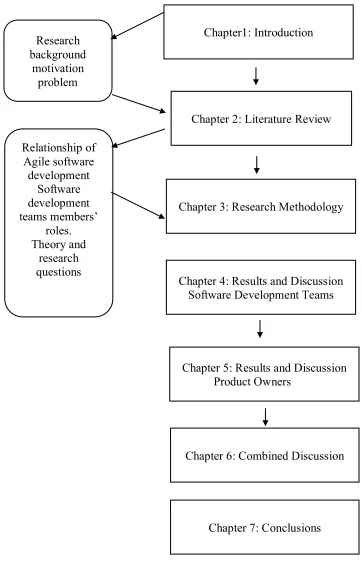
Figure 1-1 Thesis structure ... 5
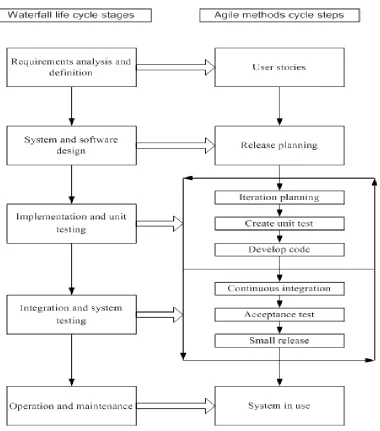
Figure 2-1 Waterfall model vs Agile (Huo et al., 2004) ... 12
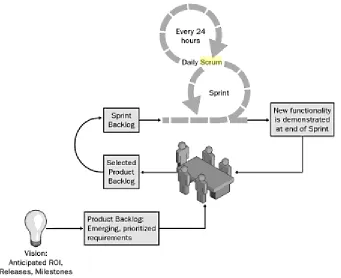
Figure 2-2 The Scrum process (Schwaber, 2004) ... 16
Figure 2-3: Teamwork model (Dickinson & McIntyre, 1997) ... 34
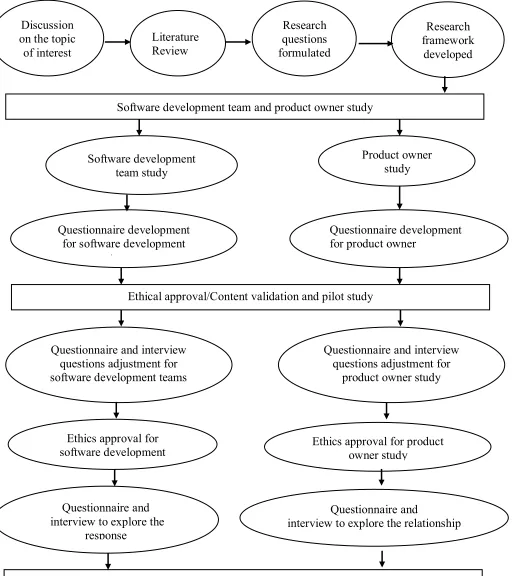
Figure 3-1 Research design overview ... 49
Figure 4-1 Approaches used for the project ... 70
Figure 4-2 Practices used in projects ... 71
Figure 4-3 Development team views on type of relationship for Successful projects ... 87
Figure 4-4 Coding process for the communication theme ... 97
Figure 4-5 Coding process for the feedback theme... 101
Figure 4-6 Coding process for team support ... 107
Figure 4-7 Coding process for organizational culture ... 111
Figure 4-8 Coding process for Team engagement ... 115
Figure 4-9 Coding process for product owner engagement ... 120
Figure 4-10 Coding process for the confidence theme ... 123
Figure 4-11 Coding process for team motivation ... 127
Figure 6-1 Mapping the Teamwork model with results from the software development team and product owner studies ... 171
ix List of Tables
Table 2-1 Relationship types ... 8
Table 2-2 Agile approaches ... 13
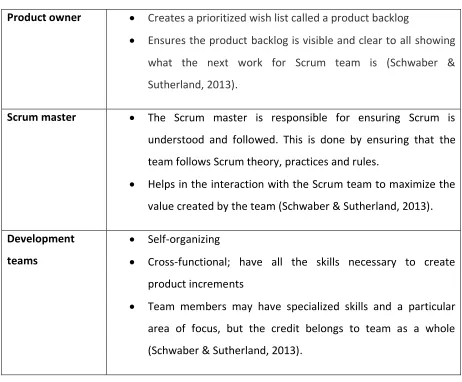
Table 2-3: Summary of roles in a Scrum team ... 17
Table 2-4 People’s success factors (Chow & Cao, 2008) ... 28
Table 2-5 Process success factors (Chow & Cao, 2008) ... 29
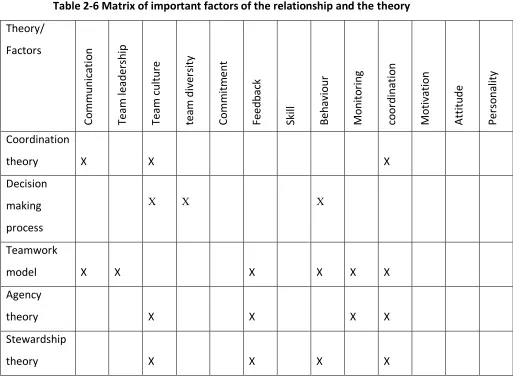
Table 2-6 Matrix of important factors of the relationship and the theory ... 43
Table 3-1 k* value evaluation (Polit et al., 2007) ... 52
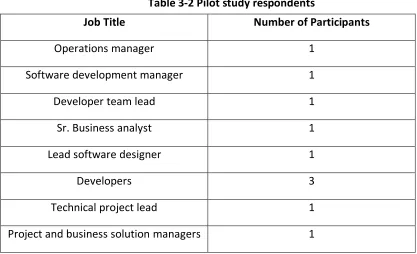
Table 3-2 Pilot study respondents ... 55
Table 3-3 Pilot study approaches used ... 56
Table 4-1 Organizational categorization ... 65
Table 4-2 Project Contract Models ... 65
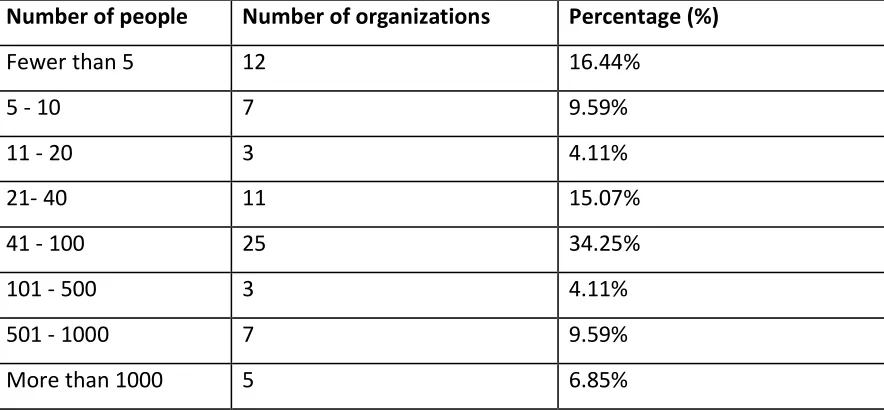
Table 4-3 Organization size by number of employees in software development roles ... 66
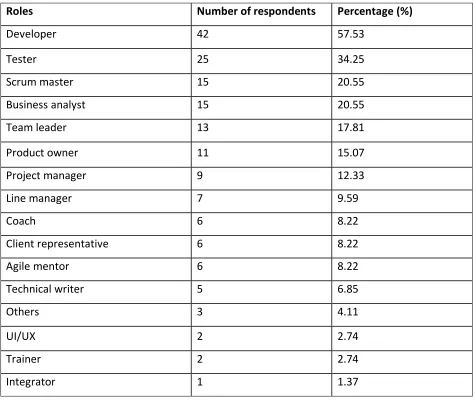
Table 4-4 Software Development Team Study Respondents’ roles ... 67
Table 4-5 Number of roles of each team member ... 68
Table 4-6 Respondents years of experience ... 69
Table 4-7 Number of practices used in a project... 72
Table 4-8 Challenges within the team ... 74
Table 4-9 Challenges with the customer ... 75
Table 4-10 Correlation coefficients between availability and timeframe ... 78
Table 4-11 the correlation coefficient between the availability and timeframe ... 80
Table 4-12 Non-significant correlations between different variables ... 83
Table 4-13 Relationship on the projects ... 86
Table 4-14 Respondents’ roles... 89
Table 4-15 Respondent and project type ... 90
Table 4-16 Number of respondents’ comments for each factor ... 92
Table 5-1 Respondents’ experience ... 130
Table 5-2 Challenges between the product owner and the development team in a typical sprint ... 131
Table 5-3 number of respondents’ comments on each factor ... 136
Table 6-1 Impact of factors on the project ... 166
Table 6-2 Themes identified from this study ... 167
Table 6-3 Description of factors identified from this current study ... 168
1
Chapter 1:
Introduction
Software development is the process of turning a need into executable computer code that satisfies that need. Early software development used the concept of “code and fix, code
some more, fix-some-more” without any planning (Leffingwell, 2007; Martin, 2005). Later, in the 1960s, plan-driven methods, based on sequential activities, were introduced. The plan-driven methods used for software development include: Waterfall (Nuseibeh, 2001), Spiral (Fitzgerald, Russo, & O'Kane, 2003) and Prototyping (Paetsch, Eberlein, & Maurer, 2003a). These methods involve a number of different sequential stages that include: requirement specifications, requirement analysis, design, coding, testing and maintenance (Awad, 2005). Often bugs in software are not found until the latter stages of the development process when they are difficult to fix. Developers may be required to spend significant amounts of time fixing the errors affecting the overall productivity and efficiency of the project (Fowler, 2001).
The Waterfall model (Boehm, 2002) of software development is one of the most widely used due to its straightforward and structured nature (Larman & Basili, 2003). The waterfall approach is a predictive method for the software development process based on documentation (Boehm & Turner, 2003c). Activities included in this approach consist of requirement analysis, design and testing of code, and well-defined documentation. The defined process must be followed step-by-step (Huo et al., 2004). Although the Waterfall model, and other traditional methods, are still used in software development there are some concerns about its slow adaptation to constantly changing business requirements and a tendency to overrun the budget or fall behind the schedule (Petersen & Wohlin, 2010). Agile software development methods were proposed as an alternative to traditional methods. Agile software development projects are reported to have been more successful than traditional software development projects (Huo et al., 2004).
2 a common understanding of the project and the ability to adapt to changes in the project (Lee & Xia, 2010; Moe, Dingsøyr, & Dybå, 2008). During the project there is direct contact between the software development team members and a customer representative, often called the product owner. Because of this, there is a relationship between the product owner and the customer. Research interest and motivation for this research is discussed in the following section.
1.1 Research interest and motivation
Software is used in many organizations to perform essential business operations; software, therefore, has become a vital business tool (Fenton & Bieman, 2014; Gollenia, 2016). The software development industry has provided many examples where there has been a failure in software development projects (Highsmith, 2013; Kaur & Sengupta, 2013). Examples include those recorded by Chow and Cao (2008), Misra et al., (2009) and Moe et al., (2010). Several factors have been identified as contributing to the failure of software development projects. Such a failure of a software development project, where huge amounts of money and other resources needed to be invested, led the researcher to consider this as a suitable area to investigate. Researchers in the software engineering have previously explored the behaviour of the Agile software development team but have not examined the relationship with the customer.
The purpose of this research is to understand the relationship between the software development team and product owner in Agile software development projects and the impact of that relationship on project outcomes.
The high level research question to be investigated is:
“What impact does the relationship between the software development team and the product owner have on Agile software project outcomes?”
3 1.2 Thesis outline
Chapter 1: Introduction
This chapter presents the research background, motivation for this research, the contribution of the research and the structure of the thesis.
Chapter 2: Literature Review
In this chapter studies about relationships, Agile software development studies about Agile are explored. The origin and principles of Agile methods are discussed, and the roles involved in Agile software development teams are investigated. Further, the relationship between the customer representative and the software development team are studied in detail.
This chapter also includes discussion on a range of theories used in understanding relationships in teams. A number of these theories are explored individually with the aim of selecting a model that best suits this study that can be applied to answer the research questions.
Chapter 3: Research Methods
Chapter 3 outlines the methodological framework this research is based on and describes the methods used to collect the data. This chapter also presents the research process used in this study, the rationale behind the choice of the mixed method data gathering techniques used, and the justification of the method selected for this study.
Chapter 4: Software Development Team Results and Discussion
Chapter 4 presents the findings from the data collection in detail. The data analysis techniques used for this study are described. The results are studied, reviewed and explained. The results gathered are analysed and discussed in detail, the challenges tabulated, and a detailed analysis undertaken to explore the relationships. Data analysis of both the quantitative data and qualitative data, the results and a discussion are presented in this chapter.
Chapter 5: Product Owner Study - Results and Discussion
4 Data analysis from both the quantitative and qualitative studies are presented and discussed in this chapter.
Chapter 6: Combined Discussion
In this chapter results from the software development team and product owners’ studies are compared and discussed. The findings from the study are also discussed in relation to the Teamwork model in this chapter.
Chapter 7: Conclusions
This chapter provides the overview of the findings of this study. The contribution of this thesis, limitations of the study, and a discussion of the practical implications of the results from this study are discussed in this chapter.
Appendices:
The pilot study results, Human ethics approval, questionnaire and interview questions for both studies are here.
5 Chapter1: Introduction
Chapter 2: Literature Review
Chapter 3: Research Methodology
Chapter 4: Results and Discussion Software Development Teams
Chapter 6: Combined Discussion Research
background motivation
problem
Relationship of Agile software development
Software development teams members’
roles. Theory and
research questions
Chapter 5: Results and Discussion Product Owners
Chapter 7: Conclusions
6 1.3 Summary
7
Chapter 2:
Literature Review
This study is about understanding the impact of the relationships between the software development team and the owner of the projects. The purpose of this literature review is to explore the existing literature about relationships, particularly those that occur in workplaces, and about approaches to software development and the issues experienced with them. This review will focus on the relationships between the customer and the software development team. Particular attention is paid to relationships, in general, software development, software development teams, stakeholders involved in software development, and the relationships between the development team and the customer representative during the software development process.
To describe the relationships between the customer and software development team, the Teamwork model, Agency theory and Stewardship theory are reviewed as potential theories. In the first instance, relationships are described, in general, followed by software development and then Agile software development. This literature review has the following structure:
• Relationships
• Software development methods
o Agile software development
o Agile software development teams • Relationships in Agile software development • Challenges in Agile software development projects • Teamwork
• Teamwork in Agile software development
o Teamwork model
o Coordination theory
o Decision-making process
o The theory of holographic organization
o Agency theory
o Stewardship theory • Discussion
8 2.1 Relationships
Relationships are ongoing interactions that occur between people (Gabarro, 1990). These interactions can be based on regular business or social commitments (Berscheid, 1999). The
structure of people’s lives primarily comprise his or her relationship with self, others, groups and institutions (Herrnstein & Murray, 2010). Other than family relationships, the relationships with organizations and colleagues we spend time with are probably prominent within most people’s lives (Greenhaus, Collins, & Shaw, 2003). In an organisational sense, different types of relationships are formed that involve more than one person (Garbarino & Johnson, 1999) Examples of the types of relationships that occur in a typical workplace include: workplace relationships, team relationships and customer relationships (Chen & Popovich, 2003; De Dreu & Weingart, 2003; Eby, Rhodes, & Allen, 2007). These relationships are presented in Table 2-1 and are discussed in the following sections.
Table 2-1 Relationship types
Workplace relationships Workplace relationships are interpersonal
relationships that exist and develop within an organization.
Team relationships A team relationship is formed through
interactions between team members
Customer relationships The customer relationship is the result of
interactions between the customer and people within an organisation that are providing services
2.1.1 Workplace relationships
9 indicated that the quality of employee relationships was associated with the quality of information shared between the employees and the increased commitment of employees to the organization and satisfaction with their job.
“Business is not just doing deals; business is having great products, doing great engineering, and providing tremendous service to customers. Finally, business is a cobweb of human relationships.”
Ross Perot 1
With the quote, above, it is clear that there are different human relationships involved in undertaking business and these relationships are critical to the business (Harter, Schmidt, & Hayes, 2002). Another example of a relationship that occurs within a workplace is the relationship between teams, or subsets of workers. Team relationships are discussed in the following section.
2.1.2 Team relationships
A team is a group of people working together to achieve common objectives (Mohrman, Cohen, & Morhman Jr, 1995). A team relationship is formed through interactions between team members (Chatman & Flynn, 2001). Team relationships include the interaction between the team members in sharing of information and feedback, and recognising the needs and feelings of team members (Lovelace, Shapiro, & Weingart, 2001). Neuman, Wagner, & Christiansen, (1999) examined personality factors within a group of 323 retail assistants working in 82 teams. Their study identified a significant relationship between the team relationships and work-team performance. They suggested that a team will be more effective when the personalities of the team members are diverse and each member brings unique attributes to the team.
A team in an organization deals with the customer to provide services. During this process a relationship exists between the business and the customer. The customer relationship is explained in the following section.
2.1.3 Customer relationships
A customer is a recipient of a service provided by an organization (Mittal & Kamakura, 2001). The customer relationship is the result of interactions between the customer and people within the organisation providing the services (Harrison & Norman, 2001). Fornell
10 (1992) measured customer satisfaction using three indicators: expectations, perceived performance and loyalty. Their study was based on the literature related to customer satisfaction and dissatisfaction. Their study found that customer satisfaction has important implications on the performance of an organization to improve services (Fornell, 1992).
Software development happens in a particular workplace where the different people involved in a project work together. As in other workplaces, there are a number of interrelated relationships that occur (Cramton & Webber, 2005). These include the relationships between the team members themselves and also between team members and the customer. In the following section, software development, Agile software development, the different roles in Agile software development are discussed.
2.1.4 Software development
The use of software in organizations and businesses is increasing, with many organisations requiring software to be customized for their operations (Moniruzzaman & Hossain, 2013). Software for such organizations can be developed in-house or by a third-party. In the acquisition of custom software two parties exist, the customer who wants the software and the development team who creates the software (Wiegers & Beatty, 2013). The relationship between with the customer in Agile software development is discussed in section 2.6.1
2.2 Software development methods
In the early days of software development a sequence-based method was introduced, known as a plan-driven approach (Awad, 2005). One of the most common plan-driven approaches is the Waterfall model. This model works through the process of analysis, design, testing, implementation and maintenance in a sequential manner (Royce, 1970). Some argue that this model is flawed as it is impossible to complete any phase of a non-trivial project perfectly before moving on to the next phase (Awad, 2005).
Many software companies, because of the straightforward nature of the waterfall approach, use this method; however, there are some concerns about this approach (Munassar & Govardhan, 2010). These concerns include the slow adoption, constantly changing business requirements, the tendency to overrun budgets and projects failing to meet the schedule (Hannay & Benestad, 2010). Because there are a set of steps followed in the waterfall
11 Van Lamsweerde (2000) surveyed 8000 projects developed using a waterfall approach. These projects were from 350 software companies in the US and findings revealed that one third of the projects never reached completion and half of those that did reach completion did so by achieving only partial functionality, with major cost overruns and significant time delays. When respondents were asked about the cause of such failures, 50% reported that this was due to poor detail in the project requirements, 13% of respondents reported a lack of user involvement, 12% requirement incompleteness, 11% changes in requirements, 6% unrealistic expectations and 5% unclear objectives (Van Lamsweerde, 2000).
In more recent times a new group of software development methods, known collectively as Agile Software Development, has been introduced to reduce the problems projects have in traditional software development (Highsmith & Cockburn, 2001)
2.3 Agile software development
Agile methods are based on an iterative and incremental cycle of development where solutions and requirements are developed through collaboration and coordination between cross-functional teams (Schatz & Abdelshafi, 2005). Agile software development focuses on flexibility, allowing for any changes in requirements that may occur during the software development process (Greer & Hamon, 2011).
In 2001, seven practitioners created the Agile manifesto to define the approach now known as Agile Software Development. The Agile manifesto defines four main values and twelve principles. The values are (Fowler & Highsmith, 2001):
• Individual and interactions over processes and tools • Working software over comprehensive documentation • Customer collaboration over contract negotiation • Responding to change over following plans
12 approach (Keegan & Turner, 2001). A comparison between a traditional approach and an Agile approach in relation to software development and release process is illustrated in Figure 2-1
Figure 2-1 Waterfall model vs Agile (Huo et al., 2004)
13 Agile software development approaches have the potential to provide a higher level of customer satisfaction within a shorter development cycle, with lower bug rates and quicker adoption of rapidly changing business requirements (Boehm & Turner, 2003a; Parnas, 2006). For example, Vijayasarathy & Turk (2008) found that Agile software development projects in several different parts of the world showed an increased productivity, of 80%, with compared to the traditional software development approach. They also mentioned that there was increased job satisfaction and improved predictability of schedule/costs/quality. However, they did not quantify the improvement. This means that it is difficult to know exactly how these improvements were demonstrated. (Vijayasarathy & Turk, 2008). The evaluation criteria used by Vijayasarathy & Turk (2008) were user satisfaction, delivery time, maintainability and cost. The main incentive for applying the Agile development approach is cost savings to achieve a faster development cycle while still delivering quality software (Moniruzzaman & Hossain, 2013; Wiegers & Beatty, 2013). The aim of an Agile approach is to develop software quickly in an environment of rapidly changing requirements (Cao & Ramesh, 2008). Different Agile software methods focus on different aspects of the software development life cycle, such as the practice and management of software projects (Pressman, 2005).
A range of software development approaches have had the Agile descriptor applied, these methods are shown in Table 2-2
Table 2-2 Agile approaches
Name Reference
Extreme programming (XP) (Beck, 2000)
Scrum (Schwaber, 1997)
Feature-driven development (FDD) (Palmer & Felsing, 2001) Adaptive software development (ASD), (Highsmith & Cockburn, 2001) Dynamic systems development method (DSDM) (Stapleton, 1997)
14 2.3.1 Extreme programming (XP)
Extreme programming (XP), a widely used Agile method (Beck & Andres, 2004; Beck et al., 2001b), aims to enable successful software development despite constantly changing requirements. The XP process begins with user stories for capturing the requirements. A user story, in the software development context, describes a type of user, what they require and why they require it (Beck et al., 2001a). A user story is designed to be short enough to be written on a post-it note and is usually written in language a business customer would understand, essentially, user stories consist of what the user is looking for (Cohn, 2004). These stories may be the addition of functions on the current project or the requirements for a new project. User stories are collected from stakeholders and are used to describe a variety of deliverable requirements. The requirements for the project gathered from the user stories are assigned priorities in agreement with the customer and delivered in an incremental approach (Wiegers & Beatty, 2013). The development team then makes a commitment for the delivery date and the working software is delivered to the customer, typically, in intervals of 1–3 weeks. XP is said to improve the delivery of software projects by embracing communication, simplicity, feedback, respect and courage (Fitzgerald, Hartnett, & Conboy, 2006). XP avoids any activities that are not immediately required for the current implementation stage of a project (Stoica, Mircea, & Ghilic-Micu, 2013).
Another Agile software development Feature-driven Development (FDD) is explained in detail in the following section.
2.3.2 Feature-driven development
Feature-driven development (FDD) involves an object oriented approach (Beck et al., 2001b). Using this approach, objects are identified along with their attributes (Lunn et al., 2000). Objects are tangible things and include: roles, events, people, places, organization, devices and location. Operations performed by, and required for, each object are characterized and a link is established between these objects (Booch, 1986). In an object oriented approach an ordered sequence of messages between two objects can be established during the running time.
15 long term value to the organization (Boehm & Turner, 2003a). A feature list is created that groups the features into sets and subject areas. After completing the grouping process a development plan is created, features are designed and then built (Boehm & Turner, 2003a).
Features are an important aspect of FDD, whereas user stories are the primary source of the requirements in Scrum, which is explained in detail below.
2.3.3 Scrum
16 Figure 2-2 The Scrum process (Schwaber, 2004)
17 Table 2-3: Summary of roles in a Scrum team
Product owner • Creates a prioritized wish list called a product backlog
• Ensures the product backlog is visible and clear to all showing what the next work for Scrum team is (Schwaber & Sutherland, 2013).
Scrum master • The Scrum master is responsible for ensuring Scrum is
understood and followed. This is done by ensuring that the team follows Scrum theory, practices and rules.
• Helps in the interaction with the Scrum team to maximize the value created by the team (Schwaber & Sutherland, 2013).
Development teams
• Self-organizing
• Cross-functional; have all the skills necessary to create product increments
• Team members may have specialized skills and a particular area of focus, but the credit belongs to team as a whole (Schwaber & Sutherland, 2013).
Scrum is a commonly used method for software development and project management (Khalid, Zahra, & Khan, 2014). However, another Agile approach, Adaptive Software Development, focuses more on results and self-organization to achieve the project goal (Huda, 2011), as discussed in the following section.
2.3.4 Adaptive software development
18 • Mission-driven planning
• Component-based focus • Use of time-boxing
• Explicit consideration of risk
• Focus on collaboration for requirement gathering • Emphasizes learning throughout the process
Adaptive Software Development is an Agile software method for building complex projects where ASD teams focus on human collaboration and team self-organization (Beck et al., 2001a). ASD encourages iterative and incremental development with constant prototyping (Highsmith, 2013).
The Dynamic System Development Method (DSDM) is similar to both XP and ASD and is used for projects with tight timeline constraints. This approach is explained below.
2.3.5 Dynamic systems development method
The dynamic systems development method (DSDM) (Stapleton, 1997) is an Agile software development approach often used for systems that have tight time constraints (Beck et al., 2001b). This method follows nine guiding principles that are listed below (Beck et al., 2001b):
• Active user involvement is imperative.
• DSDM teams must be empowered to make decisions. • The focus is on frequent delivery of the products.
• Fit for purpose is the essential criterion for the acceptance of deliverables.
• Iterative and incremental development is necessary to provide coverage for the acceptance of deliverables.
• All changes during development are reversible. • Requirements are base lined at a high level • Testing is integrated throughout the life-cycle
19 Team collaboration and interactions are the hallmarks of the Agile methods described above (Boehm & Turner, 2003a). XP is noted for pair programming and Scrum practices collaboration among the cross-functional teams (Beck et al., 2001a). A hallmark of all of the Agile development methods is the use of a cross-functional team (Hoda, Noble, & Marshall, 2013).
2.4 Agile software development teams
Agile approaches focus on the people more than the process (Cockburn & Highsmith, 2001b). This focus places an emphasis on factors such as skill, talent and communication (Cockburn & Highsmith, 2001b) rather than processes. Agile software development teams are self-organizing with cross-functional team members (Moe, Dingsøyr, & Dybå, 2010). For example, Agile software development members have different expertize to meet the common goals of the project, such as back-end programming, front-end programming and testing (Martin, 2003). Collaboration and team interactions are the basis of Agile development (Boehm & Turner, 2003a). Robinson and Sharp (2008) mentioned that Agile teams could have faith in their own abilities, show respect for their team members and maintain trust within the team.
There are a range of people involved in software development projects, including developers, testers, project leaders, and business analysts and, typically, the members of the teams are made up of a mixture of these roles. Most teams also include a customer representative or product owner, or have access to one during the development process (Coram & Bohner, 2005). Each of these roles is discussed in detail in the following sections. 2.4.1 Developer
20 of the software tester is integral to the project’s success (Utting & Legeard, 2010). This role is discussed in the following section.
2.4.2 Software tester
Software testers the part of an Agile team who are involved in testing the software projects for quality assurance (Perry, 2007). The role of the software testers is to test the functions according to the testing criteria (Coram & Bohner, 2005). Testing criteria are created at the beginning of the project from the users’ stories, in conjunction with the product owner, to test the function quality and performance, to meet the users’ requirements. There are different testing procedures, such as automating test cases, test-driven development, acceptance test-driven development and manual testing for quality assurance, and the testers work closely with the development team during this process (Janzen & Saiedian, 2005; Shore, 2007; Utting & Legeard, 2010). Software testers interact with the whole team, especially the software developers and the product owner, to communicate the test results (Coram & Bohner, 2005). As with all members of an Agile development team, the software testers attend all meetings relating to the software project to understand the requirements and give feedback (Shore, 2007). Testers generally provide feedback about the testing to the other team members during the stand-ups. Testers work in the self-organizing team to ensure the quality of the product developed (Deemer et al., 2010).
2.4.3 Scrum master
21 A business analyst is required to understand the business domain and feed the business requirements of a software project to the team. The role of business analyst is explained in the following section.
2.4.4 Business analyst
A business analyst analyses the business domain, looking at how the business operates and then documents the business processes (Smith & Fingar, 2003). The role of a business analyst in an Agile software team is to produce the requirements in collaboration with the users. The business analyst also works with the business side of an organization to develop test cases for the system and create a shared understanding of the product to be built (Cohn, 2004; West et al., 2010). Business analysts perform a liaison function between the business side of an organization and the IT solution providers (Cohn, 2004). For example, the business analyst prepares the functional requirements for a software requirement specification (SRS) containing a full description of the expected behaviour of the software (Wiegers & Beatty, 2013). Software requirement specifications (SRS) are routinely used in developing, testing and quality assurance (Wiegers & Beatty, 2013).
Business analyst facilitates the process of getting information development needs from the customer/product owner. The customer/ product owner role is defined in following section.
2.4.5 Customer representative/Product owner
One of the tenets of an Agile approach is to involve the customer or a representative of the customer at all stages of the development process (Coram & Bohner, 2005). Customer representatives are people who are either from the client organisation or from the development organisation who act as customer representatives (Wiegers & Beatty, 2013). It is recommended that, for an Agile approach to be successful, where possible, a full time customer representative is present on-site who works directly with the software development team (Boehm, 2002). Customer representatives are responsible for providing the requirements and evaluating the project against the business values (Paetsch et al., 2003a). Customer representatives in Agile software development also define the scope of the project by collaborating with the software development teams (Wiegers & Beatty, 2013).
22 who is acting as a customer. The product owner is responsible for the timely flow of deliverables, the overall productivity of the team and the quality of the solution (Wiegers & Beatty, 2013). A product owner can be from the client organization or internal to the software development organization (in this case they are called a proxy product owner) (Kettunen, 2009).
The different roles in Agile software development are described above. In the following section the relationships in relation to Agile software development are discussed.
2.5 Relationships in Agile software development
The different types of relationships that occur in an organization were described in section 2.4. In the following section, the relationships specific to Agile software development teams are described.
2.5.1 Customer relationships
Building a good relationship with a customer is important in building good software (Wiegers & Beatty, 2013). For example, if you have a close working relationship with the customer they might be more involved in having a discussion about eliciting the requirements (Leau et al., 2012b). Having a good working relationship involves true collaboration between the parties involved in the project, who each understand that their roles and responsibilities are crucial to a project (Highsmith, 2002). Ceschi et.al (2005) found that companies using an Agile approach tended to regulate their relationships with the customer by employing flexible contracts instead of fixed contracts with predefined functions, budgets and timeline.
23 use of an Agile approach. For example, in their study, Pikkarainen et al. (2012) viewed collaboration between the customer and development team that had been established using workshops. Those workshops were conducted to introduce organisations to an Agile approach. In addition to the workshops, a session was held to get feedback and knowledge from the stakeholders. Collaboration and coordination increased the team spirit and facilitated the team in overcoming design problems through the daily stand-up meetings. However, they said that collaboration and communication did not work as planned for all the projects because the team failed to apply the iterative approach. They said that the practice of collaboration was not adopted because the development team did not have the necessary knowledge about working within an Agile process and management was not involved in organizing the planning meetings. Customer involvement was found to be one of the reasons for a project’s success since before the requirements are implemented, this needs to be understood by the developers and, in doing this, they should be able to talk to the customer (Paetsch, Eberlein, & Maurer, 2003b).
Agile software development focuses on communication to help reduce the loss of information between the customer and the development teams (Melnik & Maurer, 2004). Communication with the customer should be maximized in Agile software development through direct communication between the customer and the software development teams (Wiegers & Beatty, 2013). Feedback is important in Agile projects to help the development team to enhance the project (Lindstrom & Jeffries, 2004). Face-to-face communication, emails and telephones were some of the methods used for giving and receiving feedback. The feedback given was on the project performance and changes needed to meet the users’
24 the full support of the development team members and direct communication helped both the development team and the customer to receive quicker feedback.
Communication with the customer can be made face-to-face or by email, telephone or through conference calls (Korkala, Abrahamsson, & Kyllönen, 2006). Orkala et al. (2006), using four case studies, found that face-to-face communication proved to be more effective and better with an on-site customer. From their study, it was found that face-to-face communication enabled quick feedback and also had the ability to transmit multiple non-verbal cues to team members. For example, email has the capability to transfer the information but the physical expression involved while transferring the information was missed (Daft, Lengel, & Trevino, 1987).
Often software development projects, both those using traditional and Agile methods, are influenced by different types of relationships between the customer and the development team (Dybå & Dingsøyr, 2008; Faraj & Sproull, 2000). These types relationships include: relationships within the team members; and the customer-team relationship. Each of these relationships is discussed in the sections that follow.
2.6 Relationship between the team members
25 Software development project can be done with the people located in the different places who work as a virtual team. Virtual teams in software development coordinate their work using issue tracking systems such as Jira and GitHub. These tools allow developers to work from anywhere and communicate asynchronously (Abrahamsson et al., 2017; Ghobadi, 2015).
In software development, the implementation of team structure is not simple and does not necessarily result in success. Because putting people to work together is not just enough. People working together apply different approaches and interpretations to their work. This can result in the conflict. This means that there are human factors involved while people are working in a team(Destefanis et al., 2016).
2.6.1 Customer-team relationships
26 feedback on time and appear to have a lack of understanding of the Agile processes (Hoda et al., 2011).
2.7 Contracts model
In some Agile projects contracts are used to reduce the perceived risk between the customer and the development teams (Highsmith, 2009). In contract-based Agile projects the pricing of the projects must be agreed upon between the parties before software development starts (Poppendieck & Poppendieck, 2007). Poppendiek & Poppendieck (2007) suggested two ways to understand contracts, where the purpose of contract is to either:
• Protect each party from opportunistic behaviour on the part of other party.
• Set up appropriate incentives for companies to work together in a synergistic matter.
Both these points are related to trust between the development team and the customer. When there is no significant trust between the development team and customer, one would likely try to prevent each of them from opportunistic behaviour (Turk, France, & Rumpe, 2014b).
A contract model in Agile software development is characterized by payment and the sharing of the risk between the customer and the supplier (Gopal & Sivaramakrishnan, 2008; Opelt et al., 2013). Some of the commonly used Contract models in Agile software development are Time and Materials, Fixed-price and Target-cost (Franklin, 2008; Opelt et al., 2013). These contract models are explained in the following sections
2.7.1 Fixed- price contracts
27 requirements from the list. The risk in such a situation is that the changes in the requirements may exceed the deadline of the project and, hence, increase the cost (Poppendieck & Poppendieck, 2003b). In some projects both the customer and supplier want to share the risk uses target-cost contracts (Franklin, 2008).
2.7.2 Target-cost contracts
In Target-cost Contract models the risk is shared between the customer and the supplier, and the two parties agree on a price for a defined scope of work (Eckfeldt, Madden, & Horowitz, 2005). If the cost of completing the requirements of the project exceeds the target price, the customer and the supplier will share the extra cost (Eckfeldt et al., 2005). Sharing the risk helps this type of contract model to be more accessible than the other types of contract, as discussed previously (Poppendieck & Poppendieck, 2003a). Trust is important in all contracts; however, a greater level of trust is needed when it comes to a Time and Materials contract, because it gives the development team a possibility to take advantage (Eckfeldt et al., 2005).
The type of contract model is chosen according to the trust, the risk customer wants to take and which best suits for the customer and the supplier (Franklin, 2008).
2.7.3 Time and materials contracts
A Time and Materials contract is a contract model in which the customer pays the supplier by the hour, at a specified fixed hourly rate, and for the material used (Franklin, 2008). In this type of contract the customer is able to adjust the scope’s priorities in each sprint. This type of contract is not commonly used in situations where the customer or the supplier have little knowledge of each other because of the difficulty in establishing these (Poppendieck & Poppendieck, 2003a). A Time and Materials contract allows flexibility in the design of the software increments (Franklin, 2008). However, this model is not feasible for many customers where they require agreement on the scope upfront (Franklin, 2008).
28 impact on the relationship between the customer and the software development teams. These factors are summarized in Table 2-4 and 2-5.
Table 2-4 People’s success factors (Chow & Cao, 2008)
People Failure factors Success factors
Lack of necessary skill-set Team members with high competence and expertize Lack of project management
competence Team members with great motivation Lack of team work Managers knowledgeable of the
Agile process Resistance from groups or
individuals
Managers who have a light touch or adaptive management style
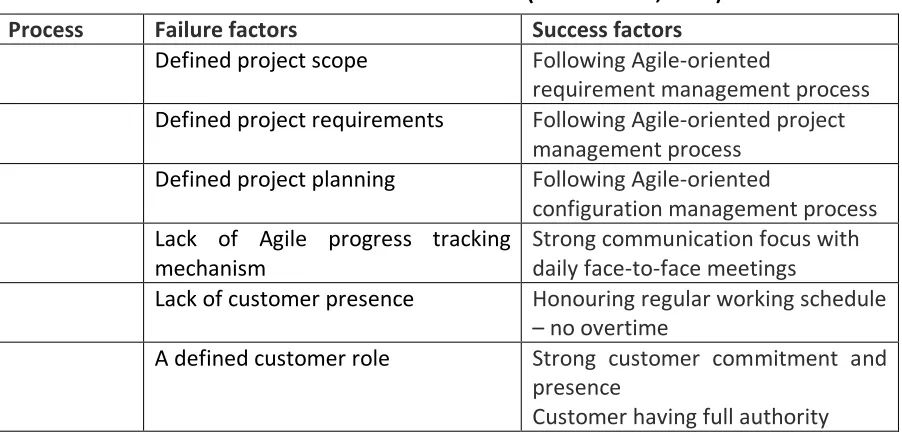
29 Table 2-5 Process success factors (Chow & Cao, 2008)
Process Failure factors Success factors
Defined project scope Following Agile-oriented
requirement management process Defined project requirements Following Agile-oriented project
management process Defined project planning Following Agile-oriented
configuration management process Lack of Agile progress tracking
mechanism
Strong communication focus with daily face-to-face meetings
Lack of customer presence Honouring regular working schedule – no overtime
A defined customer role Strong customer commitment and presence
Customer having full authority
After identifying the critical success and failure factors, Chow and Cao (2008) conducted a web-based survey, gathering feedback from 109 Agile projects from 25 different countries. The findings from this survey helped them further refine their list of critical success factors, resulting in a list of the most critical success factors.
These are:
• Correct delivery strategy
• A proper practice of Agile software engineering techniques • A high calibre team.
Three other factors that could be critical for success were also identified: • A good Agile project management process,
• An Agile-friendly team environment • Strong customer involvement.
30 included in their review were with Agile teams new to the Agile approach and they suggested further investigation was needed with teams that have been using Agile for a longer period of time.
2.8 Challenges in Agile software development projects
31 allow a customer the opportunity to delay making decisions about product requirements (Leau et al., 2012a). In turn, changes to requirements may be caused by contractual conflicts (Batra et al., 2010). This may be due to changes that affect the cost or the schedule of a project (Wiegers & Beatty, 2013). In some projects, a gap exists in the expectations of the customer and those of the development team in Agile software projects (Batra et al., 2010). For example, a problem may look simple to a customer but the development team knows it will be a complex change that will impact on the cost and timeline (Grisham & Perry, 2005). Ceschi et.al (2005) says that challenges exist in the customer-development team relationships. For example, one challenge they found was that some customers want faster, lower cost and higher quality software projects whereas developers are after more time and stable requirements.
2.9 Teamwork
The teamwork concept encourages the team members to listen, provide feedback, support and recognize the interests of team members for a better performance. Such characteristics are important for the team members because they promote the individual as well as team performance (Katzenbach & Smith, 2005).
self-32 managing teams have positive effects on the performance of the team, some studies found it can be difficult to implement self-managing teams, who risk failure when there is not enough leadership support (Hackman, 1987).
2.9.1 Teamwork in Agile development
Teamwork in Agile software development is regarded as a black box, while the responsibilities of each team member are divided with collaboration between the team members (Hummel & Epp, 2015). In Agile software development team members are responsible for the end product. These products are developed by building a shared understanding of both the task and the teamwork (Moe et al., 2010). The project goal, project plans, project status and responsibilities must be visible to all the parties involved (Meredith & Mantel Jr, 2011; Moe et al., 2010). There are different activities involved between the team members that may impact the relationship within the team as well as between the team and management (Turk et al., 2014a). These relationships may impact the team performance and the outcome of the project.
Relationships are key in many workplaces and take several different forms (Turk et al., 2014a). These may be relationships between colleagues in a general sense or between groups of colleagues in a more formal sense. There is also a need for relationships to occur between those in a workplace and those outside with whom they deal in order to perform the work (Lee & Xia, 2010; Ryan & O’Connor, 2013).
33 Agile software development focuses on flexibility and allows for changes in requirements that may occur during the software development process (Greer & Hamon, 2011).
This research explores the challenges that can occur between the customer and the development team when an Agile software development approach is taken. After exploring the challenges between the development team and the customer, the relationship between the customer and Agile software development team is explained from a theoretical prospective. Therefore, the research questions are:
RQ1: The literature suggests that there are challenges between the software development team and the customer representative in Agile software development projects. To what extent do these challenges exist?
RQ2: What types of challenges are present in Agile software development projects?
RQ3: What is the impact of challenges on the relationship between the customer and the Agile software development team?
RQ4: Does the nature of the relationship between the customer and the development team impact on the project outcome?
This concludes the review of the Agile software development approach. Theory selection for this research is the topic of the next major sections. Theories such as Coordination theory (Malone & Crowston, 1994), the Decision-making process, the Teamwork model (Dickinson & McIntyre, 1997), the Theory of holographic organization (Morgan & Ramirez, 1984), Agency theory (Ross, 1973) and Stewardship theory (Donaldson & Davis, 1991) are examined. Once the different theories are explained and its literature examined, a mapping exercise is undertaken to discover a theory that has the potential to explain the relationships in Agile software development teams.
2.10 Teamwork model
34 Figure 2-3: Teamwork model (Dickinson & McIntyre, 1997)
The definition and relationship of each of the component of the Dickinson & McIntyre (1997) Teamwork Model are:
Communication: Communication involves the active exchange of information between the members of the team. Communication creates the link between the other components of the Teamwork model.
Team orientation: This component includes team members’ self-awareness and attitudes towards the leadership.
Team leadership: This component of a teamwork model consists of direction by the team members and implies the planning and organizing of activities to enable team members to respond.
Monitoring: This component of the Teamwork model refers to the awareness of activities and the performance of the team members. Monitoring is helpful in ensuring that team members are capable of their individual tasks and have a substantive understanding of the task of other members.
Feedback:This component refers to learning from the team member’s performance, which requires receiving, giving and seeking feedback from other members working in the team. Back up: This component refers to a team member helping other team members to complete a task.
Coordination: This component refers to the activities that will help the team member to complete the functions (Dickinson & McIntyre, 1997).
35 components and identifies some of the challenges with team orientation, team leadership and coordination within the team.
Moe et al. (2010) proposed using the Teamwork model in a bid to understand teamwork in a Scrum project. The purpose of this model was to understand the nature of self-managing Agile teams and the challenges in introducing self-managing teams in work places that have previously adopted more traditional approaches to software development (Moe et al., 2010). A single-case holistic study project was designed by Moe et al. (2010) to understand teamwork. A Scrum approach was used with the focus placed on human factors that influenced teamwork (Moe et al., 2010). In this project, data were collected from direct observations, project documents and interviews conducted with the Scrum master, the product owner and developers. The Scrum team was visited once or twice a week, with 60 observations in total. Various strategies were used to analyse the data. First, the Scrum project was described in detail so an understanding of the project was gained, including specific project details. Then, aspects of team work were described using Dickinson & McIntyre’s (1997) model by referring to the events in the three main phases of the project.
The results showed that bringing individual work values, such as responding constructively to other views, providing support and recognizing others’ achievements, that a self-managing team required effort on the part of all team members. However, it was also noted that such changes take time to achieve (Moe et al., 2010). Dickinson & McIntyre (1997) proposed that team leadership and team orientation promoted team members capabilities to monitor the performance of other team members. However, Moe et al. (2010) found that in Scrum teams that were identical in structure, the developers focused on their own modules, typically creating their own plans and making their own decisions. They also found that team members often considered problems they experienced to be personal, such as someone not willing to share information. These findings pointed to low team orientation, resulting in team members being unaware of what others were doing and the team leader not being able to monitor team performance.
36 adaptable and dynamically changing over time, which is relevant to the Agile software development methodology.
2.11 Coordination theory (Malone & Crowston, 1994)
The coordination theory, proposed by Malone and Crowston (1990), is based on organizational theory and has been applied in fields such as economics (Simon, 1981) and computer science (Cytron, 1987). Coordination theory is constructed on the principle that activities can be coordinated between actors (Malone & Crowston, 1990), where actors may be the stakeholders, managers or staff working under the management. This is a descriptive-based theory that is used to understand the particular activities in organizational settings.
Strode et al (2012) applied coordination theory in the context of software development. In their study they investigated coordination activities in an organization using teamwork. From their study, they suggested that consideration should be given to activities, such as Agile practises at project, iteration and incorporating ad hoc activities in addition to the coordination strategy with the current coordination theory.