
FORMULATION AND EVALUATION OF LIQUISOLID COMPACTS OF AMLODIPINE BESYLATE
5
0
0
Full text
(2) Manpreet Kaur et al. IRJP 2013, 4 (1) kept on orbital shaker for 48hrs at 25 ⁰C. The solutions were then centrifuged at 500 rpm for 1 hr to separate out undissolved drug. The solutions so obtained were diluted with methanol and the concentration of drug was analysed by UV Spectrophotometer at 366nm. 18 Determination of angle of slide Angle of slide is used as a measure of flow properties of powders. Determination of angle of slide is done by weighing the required amount of carrier material and placing it at one end of the metal plate having a polished surface. The end is gradually raised till the plate becomes angular to the horizontal at which powder is about to slide. This angle is known as the angle of slide. Angle of 33⁰ is regarded as optimum. Determination of Flowable Liquid Retention Potential (Ф value) The term “Flowable Liquid Retention Potential” (Ф value) of a powder material describes its ability to retain a specific amount of liquid while maintaining good flow properties. The Ф value is defined as maximum weight of liquid that can be retained per unit weight of powder material in order to produce an acceptably flowing liquid / powder admixture. Ф value = weight of liquid weight of solid Calculation of Liquid Load Factor (Lf) Liquid Load Factor is used to calculate the amount of carrier and coating materials required in the formulation. Lf = Φ +φ.(1/ R) Where, Φ and φ are the Ф-values of the carrier and coating material, respectively. 19-20 Coprocessing of Superdisintegrants The co-processed superdisintegrants were prepared by solvent evaporation method. A blend of crospovidone and sodium starch glycolate (in the ratio of 1:1, 1:2 & 1:3) was added to 10ml of ethanol. The contents of the beaker (250 ml capacity) were mixed thoroughly and stirring was continued till most of ethanol evaporated. The wet coherent mass was granulated through #44-mesh sieve. The wet granules were dried in a hot air oven at 60º C for 20 minutes. The dried granules were sifted through #44-mesh sieve and stored in airtight container till further use. 21 Preparation of Liquisolid System Calculated quantities of Amlodipine Besylate and proplylene glycol were accurately weighed and mixed at 25 ⁰C for 1 min at 60 rpm. Calculated quantities of carrier (Avicel PH-101) was incorporated to the admixture of drug + vehicle and blended thoroughly. The coat material (Aerosil 200) was added and mixed. The powder is left standing for 10 min and then it is scraped off from the walls of mortar with the help of aluminium spatula. The optimum concentration of coprocessed superdisintegrants (1:1) is then added. The formulated powder is passed through a sieve to obtain the particles of same size. Then the powder is compressed using a rotary press. Precompression Studies of Prepared Liquisolid Powders Flow properties The flowability of a powder is of critical importance in the production of pharmaceutical dosage forms in order to get a uniform feed as well as reproducible filling of tablet dies, otherwise, high dose variations will occur. a) Angle of repose (θ) It was measured according to the fixed funnel method by using. θ = tan-1 (h/r) where, h = height of the heap, r = radius of the heap b) Bulk and tapped Density A fixed weight of each of the liquisolid powder formulae prepared were placed in a graduated cylinder & the volume occupied was measured and the Initial Bulk Density (ρB). The cylindrical graduate was then tapped at a constant velocity till a constant volume is obtained when the powder is considered to reach the most stable arrangement; the volume of the powder was then recorded as the Final Tapped Density (ρT). c) Carr’s Compressibility index (C) C = [1-(ρB/ρT)] x 100 Where, ρB = Bulk Density, ρT = Tapped Density d) Hausner ratio (H) H = ρT/ρB Where, ρB = Bulk Density, ρT = Tapped Density 22 Drug-Excipient Interactions It is very important to check for any drug-excipient interactions in the dosage forms as the drug can produce toxic metabolites or total suppression of drug activity may take place due to interactions. a) X-Ray Diffratrometry (XRD) Polymorphic changes in the drug are important since they might affect the dissolution rate and bioavailability. Therefore, it was necessary to study these changes of Amlodipine Besylate in Liquisolid Compacts. XRD spectra of samples were recorded using a high power X-Ray Diffractrometer with Cu as target. b) Differential Scanning Calorimetry (DSC) The possible interactions of drug and excipients in liquisolid compact were determined by DSC. Thermograms of drug and liquisolid mixture were recorded using a differential scanning calorimeter. Accurately weighed (2-5mg) sample was heated in pierced aluminium pan from 30 ⁰C to 300 ⁰C at heating rate of 10⁰C/min under stream of nitrogen at flow rate of 50ml/min. 23 Evaluation of Prepared Liquisolid Tablets Weight Variation Test Twenty tablets were individually weighed and the average was calculated. Each tablet was observed of the deviation from the average weight. Hardness Tablet Hardness was measured by Monosanto Hardness Tester. Optimum hardness values should be 2-5 kg/cm2 Friability 5 tablets were accurately weighed and placed in the drum of Roche Friabilator. The drum was rotated at 25rpm for 4 min. Then tablets were removed, dedusted and re-weighed. F = [1-(W/W0)] x 100 Where, W = Final Weight of Tablets, W0 = Initial Weight of Tablets Optimum values of friability should be < 1 % Disintegration Time (DT) The DT was measured for LS tablets in distilled water at 37⁰C + 2⁰C using disintegration apparatus. Dissolution Studies Dissolution studies of LS tablets were carried out in USP Apparatus II (Paddle Type). Tablets were placed in dissolution vessels containing 900ml of phosphate buffer (pH 6.8) maintained at 37 + 0.5⁰C at 50rpm. Sink conditions were maintained.. Page 157.
(3) Manpreet Kaur et al. IRJP 2013, 4 (1) Wetting Time Five circular tissue papers of 10 cm diameter are placed in a petridish with a 10 cm diameter. Ten millimeters of watercontaining Eosin, a water-soluble dye, is added to petridish. A tablet is carefully placed on the surface of the tissue paper. The time required for water to reach upper surface of the tablet is noted as a wetting time. Water Absorption Ratio A piece of tissue paper folded twice was placed in a small petridish (internal diameter = 6.5 cm) containing 6 ml of water. The tablet was placed on the paper and the time required for the complete wetting was measured. Water absorption ratio (R) = Wa - Wb × 100 Wb Where, Wb = weight of the tablet before water absorption, Wa = weight of the tablet after water absorption 24 RESULTS AND DISCUSSION Saturated Solubility Studies Saturation Solubility Studies were carried out to select the best solvent for liquisolid system. Following table gives the results of solubility studies. Amlodipine Besylate showed maximum solubility in Propylene Glycol, hence the same was selected as non-volatile solvent. Figure 1 shows the results of solubility studies.. Angle of slide Angle of slide study was performed on carrier and coat material. Table 1 shows the angle of slide of carrier and coat material. Table 1: Angle of Slide Excipients Angle of Slide Avicel PH 101 37⁰ (+ 0.5) Aerosil 200 29⁰ (+ 0.5). Each value represents mean + SD (n=3) Flowable Liquid Retention Potential (Ф value) Ф value of Carrier and Coat Materials in Propylene Glycol were cited in the literature & found to be 0.164 and 1.5 respectively. Liquid Load Factor (Lf) According to mathematical model proposed by Spireas et. al. equation for Avicel PH-101 and Aerosil 200 in Porpylene Glycol was calculated by using R values as Lf = 0.164 + 1.5 (1/R) Liquisolid powder systems were prepared with different excipient ratios like 10, 15 and 20 and powder system with best flow properties was selected. Coprocessed Superdisintegrants According to the trails optimum concentration was found out to be 1:1 as this concentration of sodium starch glycolate and crospovidone exhibit quick disintegration and improved drug dissolution.. Figure 1: Solubility Studies of Amlodpine Besylate. Preparation of Liquisolid System Table 2 : Composition of different Amlodipine liquisolid formulae prepared using PG as a liquid vehicle according to the mathematical model R Aerosil Super-disintegrant Unit Weight Formulation Amlodipine Lf Avicel 101 conc. in PG Q = W/Lf q = Q/R 4% (mg) 10% 10 0.314 175.15 17.5 10 257.65 F1 F2 15 0.264 208.33 13.88 10 287.22 F3 20 0.239 230.12 11.50 12 308.63 F4 20% 10 0.314 95.54 9.55 6.4 141.49 F5 15 0.264 113.63 7.57 6.6 157.81 20 0.239 125.52 6.27 6.8 168.59 F6 F7 30% 10 0.314 68.98 6.89 4 101.54 F8 15 0.264 82.04 5.47 4.5 113.67 F9 20 0.239 90.62 4.53 4.8 121.62. Page 158.
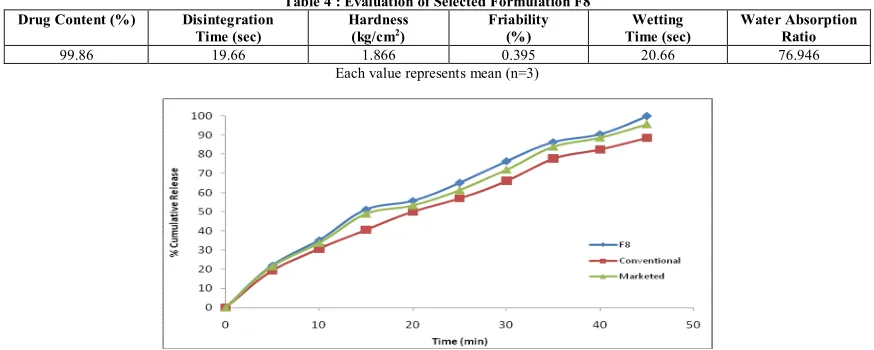
(4) Manpreet Kaur et al. IRJP 2013, 4 (1) Precompression Studies of Prepared Liquisolid Powders Flow Properties Formulation F1 F2 F3 F4 F5 F6 F7 F8 F9. Table 3 : Flow properties of prepared liquisolid powders of respective formulae Angle of Repose (θ) Bulk Density Tapped Density Carr's Index (g/ml) (g/ml) (%) 0.581 (+ 0.004) 38.888 (+ 0.02) 0.355 (+ 0.04) 35⁰ (+ 0.5) 0.5541 (+ 0.01) 31.428 (+ 0.08) 0.38 (+ 0.01) 19.5⁰ (+ 0.5) 0.366 (+ 0.02) 0.513 (+ 0.015) 28.571 (+ 0.02) 15⁰ (+ 0.5) 0.387 (+ 0.04) 0.688 (+ 0.006) 43.75 (+ 0.01) 36⁰ (+ 0.5) 0.385 (+ 0.05) 0.623 (+ 0.003) 38.095 (+ 0.04) 35⁰ (+ 0.5) 0.318 (+ 0.03) 0.716 (+ 0.016) 55.555 (+ 0.06) 26⁰ (+ 0.5) 0.45 (+ 0.04) 0.771 (+ 0.012) 41.666 (+ 0.03) 30⁰ (+ 0.5) 0.414 (+ 0.01) 0.725 (+ 0.007) 42.857 (+ 0.02) 25⁰ (+ 0.5) 0.342 (+ 0.04) 0.65 (+ 0.007) 47.368 (+ 0.03) 36⁰ (+ 0.5). Drug-Excipient Interactions X-Ray Diffratrometry (XRD) The absence of characteristic peaks of Amlodipine in the Liquisolid system showed that the drug is entirely converted into amorphous or solublized form. The absence of crystallinity of the drug in the liquisolid system might be due to result in solublization in liquid vehicle which was absorbed into carrier material and adsorbed onto coating material. Drug Content (%) 99.86. Disintegration Time (sec) 19.66. Hausner's Ratio 1.636 (+ 0.012) 1.458 (+ 0.015) 1.4 (+ 0.012) 1.777 (+ 0.017) 1.615 (+ 0.021) 2.25 (+ 0.004) 1.714 (+ 0.007) 1.75 (+ 0.022) 1.9 (+ 0.015). Differential Scanning Calorimetry (DSC) There were no interactions between drug and excipients due to absence of characteristic peak of amlidipine in Liquisolid system that is a result of complete solbilization or amorphization of drug in the non-volatile liquid vehicle. Evaluation of Liquisolid Tablet Liquisolid powder formula F8 was selected as optimized on the basis of flow properties, compressibility, hardness and drug content.. Table 4 : Evaluation of Selected Formulation F8 Hardness Friability (kg/cm2) (%) 1.866 0.395 Each value represents mean (n=3). Wetting Time (sec) 20.66. Water Absorption Ratio 76.946. Fig. 2 : Comparison of in-vitro Release Study of Optimized Liquisolid Formula F8, Conventional tablet and Marketed Formulation Of Amlodipine. The Optimized formulation F8 showed 99.86 % release in 45 min, Conventional tablet showed 88.60% release and Marketed Formulation showed 95.78 % release. F8 exhibited higher dissolution rate as compared to Marketed Formulation and conventional tablet. CONCLUSION From the above results it was possible to conclude that the wettability of Amlodipine was improved by making a suspension in Propylene Glycol as non-volatile organic solvent. Amlodpine liquisolid tablets produced a powder of optimal flow properties and readily compressible into tablets without any liquid oozing out phenomenon. The prepared tablets showed good wettability, rapid disintegration, and acceptable dissolution rate comparable to the generic product. ACKNOWLEDGEMENT We are very thankful to Aurobindo Pharma Limited, Hyderabad. India for providing the gift sample of drug Amlodipine Besylate.. REFERENCES 1. http://en.wikipedia.org/wiki/Amlodipine 2. Thakur N, Khokra SL, Sharma D, Thakur NS, Purohit R, Arya V. A review on pharmaceutical applications of liquisolid technique. Amer J Pharmatech Res. 2011; 1(3). 3. Baby DA, Saroj S, Sabitha M. Mechanism of solubility of liquisolid formulation in non volatile solvent: A review. Asian J Pharma Clinical Res. 2012;4(3). 4. Burra S, Yamsani M, Vobalaboina V. The liquisolid technique: An overview. Brazilian J Pharma Sci. 2011;47(1):475-82. 5. Sambasiva Rao A, Aparna T. Liquisolid technology: An overview. Int J Res Pharma Biomed Sci. 2011;2(2). 6. Karmarkar AB, Gonjari ID, Hosmani AH, Dhabale PN, Bhise SB. Liquisolid tablets: A novel approach for drug delivery. Int J Health Res. 2009;2(1):45-50. 7. Kavitha K, Kotha NS, Raju L, Ganesh NS, Ramesh B. Effect of dissolution rate by liquisolid compact approach: An overview. Scholars Res Lib. 2011;3(1):71-83. 8. Tayel SA, Soliman II, Louis D. Improvement of dissolution properties of carbamazepine through application of the liquisolid tablet technique. Eur J Pharma Biopharma. 2008;69:342-347. 9. Javadzadeh Y, Siahi MR, Asnaashari S, Nokhodchi A. Liquisolid technique as a tool for enhancement of poorly water-soluble drugs and evaluation of their physicochemical properties. Acta Pharm. 2007;57,99–109.. Page 159.
(5) Manpreet Kaur et al. IRJP 2013, 4 (1) 10. Hentzschel CM, Optimization of the liquisolid technology – Identification of highly effective tableting excipients for liquid adsorption. Hamburg 2011. 11. S.S. Spireas, C.I. Jarowski, B.D. Rohera, Powdered solution technology: principles and mechanism. Pharm. Res.1992;1351–1358. 12. S.S. Spireas, S. Sadu, R. Grover, In-Vitro release evaluation of hydrocortisone liquisolid tablets, J. Pharm. Sci. 1998;867–872. 13. Kumar KS, Prabha KS, Satish K, Satyanarayana K, Kumar RH. Solubility enhancement of a drug by liquisolid technique. Int J Pharma Bio Sci. 2010;1(3). 14. Elkordy AA, Essa EA, Dhuppad S, Jammigumpula P. Liquisolid technique to enhance and to sustain griseofulvin dissolution: Effect of choice of non-volatile liquid vehicles. Int J Pharm. 2012;15;434(12):122-32. 15. Khanfar M, Sheikh SM, Hawari R. Formulation factors affecting the release of ezetimibe from different liquisolid compacts. Pharm Dev Technol. 2012. 16. El-Hammadi M, Awad N. Investigating the use of liquisolid compacts technique to minimize the influence of pH variations on loratadine release. Aaps Pharm Sci Tech. 2012;13(1):53-8. 17. Zhao X, Zhou YQ, Potharaju S, et al. Development of a self microemulsifying tablet of cyclosporine - The liquisolid compact technique. Int J Pharma Sci Res. 2011;2(9): 2299-2308.. 18. Saeedi M, Akbari J, Semnani KM, Fard RE, Sar-Reshteh-Dar S, Soleymani A. Enhancement of dissolution rate of indomethacin using liquisolid compacts. Iranian J Pharma Res. 2011;10(1):25-34. 19. Kasture SV, Gondkar SB, Darekar AB, Priyobrata D, Bhambar KV. Enhancement of dissolution rate of lansoprazole using liquisolid tablet technique. Int J Pharma Res. 2011;3(2):27-31. 20. Shaikh S, Nazim S, Shaikh A, et al. Design and characterization of orodispersible tablets of aceclofenac. Int J Adv Pharma Sci. 2010;1:364368. 21. Shirsand SB, Ramani RG, Swamy PV. Novel co-processed superdisintegrants in the design of fast dissolving tablets. Int J Pharm Bio Sci. 2010;1(1). 22. Fahmy RH, Kassem MA. Enhancement of famotidine dissolution rate through liquisolid tablets formulation: In vitro and in vivo evaluation. Eur J Pharm Biopharm. 2008;69:993-1003. 23. Sharma G, Khatry S, Arora S. Formulation and characterization of liquisolid compacts of valsartan. Journal of Pharmacy Research. 2012;5(8):4158-4162. 24. Jonwal N, Mane P, Mokati S, Meena A. Preparation and in vitro evaluation of mouth dissolving tablets of Domperidone. Int J Pharmacy Pharm Sci. 2010;2(3):171-173.. Source of support: Nil, Conflict of interest: None Declared. IRJP is an official publication of Moksha Publishing House. Website: www.mokshaph.com. All rights reserved.. Page 160.
(6)
Figure

Related documents
- Comparative qualitative analysis of essential oils in species Satureja subspicata showed similarities with other species from Lamiaceae family such as Th ymus L. In fact,
19% serve a county. Fourteen per cent of the centers provide service for adjoining states in addition to the states in which they are located; usually these adjoining states have
She has conducted 12 such trainings in India and abroad and also conducted fourteen ISO 22000 FSMS Auditor/Lead Auditor Courses of Nigel Bauer & Associates-UK both
He delivered a special address at the “Five day residential training course on reporting of court proceedings by media and administration of justice for legal
National Conference on Technical Vocational Education, Training and Skills Development: A Roadmap for Empowerment (Dec. 2008): Ministry of Human Resource Development, Department
The total productivity loss of informal care to people with dementia was estimated to be $881 million per annum (Access Economics, 2009d). The cost to the care recipient in
The purpose of this study was to explore the viability of an international distance English-language program in the development of linguistic and cross-cultural proficiency among
KEYWORDS: university, value creation, university ecosystem, entrepreneur, knowledge generation, Innovation Value Institute, Intel, research, collaboration,
