© 2017 IJSRST | Volume 3 | Issue 1 | Print ISSN: 2395-6011 | Online ISSN: 2395-602X Themed Section: Science and Technology
Reversible Texture Synthesis Using Three Level Security in Steganography
Rashmi A. Sonawane
*1, Mrs. Dipti Sonawane
2*1ME Student, Computer Science and Engineering , GHRIEM Jalgaon, Maharashtra, India 2
Assistant Professor, Computer Science and Engineering, GHRIEM Jalgaon, Maharashtra, India
ABSTRACT
A texture synthesis process resample a smaller texture image, which synthesizes a new texture image with a similar local appearance and an arbitrary size. the texture synthesis process into Steganographic to conceal secret messages. In contrast to using an existing cover image to hide messages, our algorithm conceals the source texture image and embeds secret messages through the process of texture synthesis. This allows us to extract the secret messages and source texture from a Stego synthetic texture. This approach offers three distinct advantages. First, scheme offers the embedding capacity that is proportional to the size of the Stego texture image. Second, a Steganalytic algorithm is not likely to defeat our Steganographic approach. Third, the reversible capability inherited from our scheme provides functionality, which allows recovery of the source texture. algorithm can provide various numbers of embedding capacities, produce a visually plausible texture images, and recover the source texture.
Keywords : Data Embedding, Example-Based Approach, Reversible, Steganography
I.
INTRODUCTION
Steganography a singular method of information hiding techniques. It embeds messages into a host medium in order to conceal secret messages so as not to arouse suspicion by an eavesdropper. A typical Steganographic application includes covert communications between two parties whose Steganography [1] is a particular method of information hiding techniques. It inserts the messages in to the host medium in order to hide the secret messages so as not to arouse mistrust by an eavesdropper .The typical Steganographic application includes translate the communication between two parties whose presence is unknown to a possible attacker and whose success depends on detecting existence of this communication[3]. Generally the host medium used for Steganography includes meaningful digital media such as digital image, text, Audial, video, 3D model [4] etc. In This Project a Steganography with multilayer embedding technique We have Use. Here texture synthesis process will re-samples a small texture image in order to create new texture image with similar presence and uninformed size.
The texture synthesis process will hide the secret messages and source texture. It will also allow us to mine the secret messages and source texture from Stego synthetic texture. Steganography a singular method of information hiding techniques. It embeds messages into a host medium in order 0suspicion by an eavesdropper. A typical Steganographic application includes covert communications between two parties whose existence is unknown to a possible attacker and whose success depends on detecting the existence of this communication. In general, the host medium used in Steganography includes meaningful digital media such as digital image, text, audio, video, 3D model, etc. A large number of image Steganographic algorithms have been investigated with the increasing popularity and use of digital images.
Most image Steganographic algorithms adopt an existing image as a cover medium.
distortion. Consequently, a compromise must be reached between the embedding capacity and the image quality which results in the limited capacity provided in any specific cover image. image Steganalysis is an approach used to detect secret messages hidden in the Stego image. A Stego image contains some distortion, and regardless of how minute it is, this will interfere with the natural features of the cover image. This leads to the second drawback because it is still possible that an image Steganalytic algorithm can defeat the image Steganography and thus reveal that hidden message is being conveyed in a Stegoimage. In this project, we propose Steganography and strong encryption are being outlawed. Steganography is the concept of hiding of a data or image within another image so that hidden information is invisible. The key concept behind Steganography is that message to be transmitted is not detectable to casual eye, but hackers are tracked.
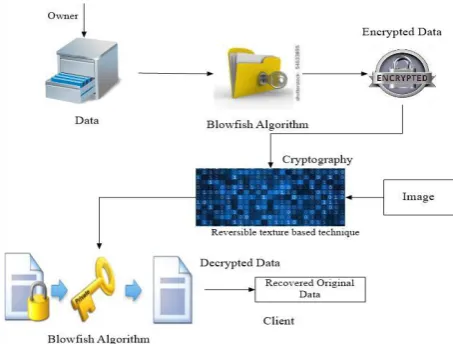
The past method can deploy the phishing attack by the adversary. The proposed of system using Steganography using reversible texture. Using weave the texture synthesis process into Steganography to conceal secret messages. A texture synthesis process re-samples a smaller texture image which synthesizes a new texture image with a similar local appearance and arbitrary size. Reversible texture based technique, to protect the information against eaves droppers. The Steganography is an art or practice of concealing a file, message, image, or video within another file, message, image, or video. So using this technique, personal information is hiding with in image and preventing misuse of their information.
Figure 1. Architecture diagram for Steganography
The meaning of Steganography is to hide text, audio, video behind the image. The main purpose of Steganography is to hide information in such a way that attacker cannot detect hidden messages.
The application of Steganography includes a secure conversion of communication between two parties whose existence is unknown to an attacker and their success depends on detecting the existence of this communication [1]. In a stenographic system, the information-hiding process is embedding process replaces these redundant bits with data from the hidden message to form a Stego medium.[2] The goal of Steganography is to keep the secret message undetectably. Most stenographic methods take over an existing image as a cover medium. When embedding secret messages into this cover image, distortion of image may occur. Because of this reason two drawbacks occur .First, the size of the cover image is fixed, so more secret messages are embedded allow for more image distortion. Therefore to maintain image quality it will provide limited embedding capacity to any specific cover image. Second, that image Steganalysis approach is used to detect hidden messages in the Stego image.
This approach can defeat the image Steganography and reveals that a hidden message is being carried in a Stego image. Steganography is the method of hiding a message, file, image, or video within another file, message, image, or video. The word Steganography combines from the two Greek words ―Steganos‖ means ―protected‖, and ―grapheins‖ means ―writing‖. The advantage of Steganography than cryptography is that the secret message does not attract the attention of the attackers by simple observation. The cryptography protects only the content of the message, while Steganography protects the both messages and communication environment.
Literature Survey
Pixel-based algorithms produce the orchestrated picture pixel by pixel and use spatial neighborhood correlations to pick the most comparable pixel in an example composition as the yield pixel. Since every yield pixel is dictated by the as of now integrated pixels, any wrongly blended pixels amid the procedure impact whatever remains of the result bringing about proliferation of blunders.
A. Lossless Data Embedding Capacity in the LSB
J. Fridrich , M. Goljan, and R. Du [7] proposed a scheme for detecting least signifficant bit (LSB) non-sequential embedding in digital images. The length of secret message is derived by examine the lossless capacity in the LSB and shifted LSB plane. The method analyzing lossless data embedding capacity in the LSBs. Randomizing the LSBs in the decreasing order of lossless capacity in the LSB Plane. Thus, the lossless capacity used to measure the degree of randomization of the LSB plane. Note that, the LSB plane of most images is random and it does not have any easily recognizable structure. To capture the degree of randomization using classical statistical quantities constrained to the LSB plane is unreliable. The loss-less capacity revolves the fact that the LSB plane is related none the less to the other bit planes. Even if this relationship is nonlinear, the lossless capacity seems to measure this. relationship equitably well. So, this method is used for Steganography detection. In this technique, can be reliably detect the presence of secret messages in the images. If the set of tiles is rich enough and there is no periodicity, we can inside the tiles anything we want such as texture, geometric primitives etc. Using this method the user can Wang tiles on her own. The system interactively displays the result of the tiling. Using Wang Tiles method, once the tiles are called, can be creates large expanses of non-periodic texture as needed very efficiently at runtime. Wang Tiles are squares shaped and each edge is has a color. A valid tiling requires matching colors to all shared edges between tiles. Another advantage is that, using a small set of tiles created from sample patches of a Y. Guo, G. Zhao[8] proposes video texture synthesis method. Two key factors, such as frame representation and blending artifacts, that synthesis performance. To improve the synthesis performance from two features.
First, effective frame representation is used to capture both the longitudinal information in temporal in spatial domain. Second, Artifacts that reduce the synthesis quality are significantly suppressed on the basis of a dieomorphic growth model. The proposed video texture synthesis approach has mainly two stages such as video stitching stage and transition smoothing stage. In the video stitching stage, a video texture synthesis model is proposed to generate an innite video. This paper presents a new spatial temporal descriptor to gives an effective representation for different types of dynamic textures. In the second stage of video synthesis, a smoothing method is presented to improve synthesis quality. It aims to set up a dieomorphic growth model to emulate local dynamics around stitched frames. First, a Multi-frame LBPTOP frame signature is proposed to capture both the spatial and temporal information. Based on this frame signature, it identies the most appropriate matching pairs of frames. Second, a dieomorphic growth model is applied to identify matching frames. For smoother transition, this growth model can emulate temporal motion around matching frames and estimate virtual frames.
This synthesis method has some advantages First, combines the spatial and temporal description in each feature, which enhances the ability of capturing the relationships among neighboring frames. Second, considers abundant temporal discriminative information, which makes it exile adaptive to dynamic textures with different properties. Third, gets more natural visual by using the dieomorphic growth model.
B. A Non-Parametric Method for Texture Synthesis
various clustering techniques. This method generates texture as a Markov Random Field (MRF). It assumes the probability given the brightness values of its spatial neighborhood and the rest of the images are independent. The neighborhood of a pixel is design as a square window around that pixel.
C. Patch-Based Algorithms
Patch-based algorithms attach patches from a source texture rather than a pixel to synthesize textures. The method of Cohen et al. and Xu et al. improves the image quality of pixel-based synthetic textures because texture structures inside the patches are preserved. However, since patches are attached with a small overlapped region during the synthetic process, one has to make an effort to ensure that the patches agree with their neighbors.
D. A Pixel-Based Algorithm
A pixel-based algorithm Secret messages to be hidden are encoded into hued spotted examples and they are straight forwardly painted on a blank image. A pixel- based algorithm coats whatever is left of the pixels utilizing the pixel-based texture synthesis strategy, in this manner disguising the presence of spotted examples. Patch-based algorithms [8], [9] glue patches from a source composition rather than a pixel to synthesise textures. This methodology of Cohen et al. also, Xu et al. enhances the picture nature of pixel-based engineered surfaces in light of the fact that composition structures inside the patches are kept up. Then again, since patches are stuck with a little covered district amid the manufactured procedure, one necessities to try to guarantee that the patches concur with their neighbors. L. Liang, C. Liu [16] presented the patch-based sampling methodology and utilized the feathering methodology for the covered ranges of nearby patches.
II.
METHODS AND MATERIAL
A. Markov Random Field (MRF) Method
Fast Texture Synthesis using Tree-structured Vector Quantization, Author Li- Yi Wei and Marc Levoy present a simple algorithm that can synthesize different type of textures. The inputs to the algorithm contain any
random noise image with user species size and an example texture patch. To make the visually plausible image like algorithm makes modifications in random noise image. Since this technique require only texture patch it becomes edibles and easy to use. There are two major components in the algorithm, the searching algorithm and multi resolution pyramid. The advantages of this algorithm are its image processing speed and image quality: The algorithm give better quality of synthesized image texture than previous techniques, while it increase the computation speed twice faster order of magnitude than older approaches which generate same result as this algorithm.
B .Wang Tile Method
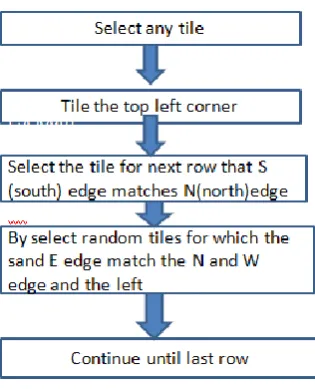
A simple system for patch with a small set of Wang Tiles. The tiles are made up with patterns, texture or geometry that when aggregate create a representation which is continuous. Wang Tile is nothing but the process of tiles by using non-periodic pattern. This process is very efficient in runtime.
Figure 2: Wang Tile Method
C. Multiscale Texture Synthesis
The Example-based texture synthesis algorithms to generate the form of novel images. This algorithm is used to create the scale of Example which contains numerous information. The graph is to be created which give the example from satellite distance. The author uses texture synthesis which minimizes the disadvantage of the previous approach which is based on the single input exemplar. When we give the input as exemplar image to exemplar based texture synthesis, the output is novel image. The described algorithms make it practical to produce a non-periodic texture, larg while designing a small exemplar of the texture. One of the disadvantage is that exemplar have resolution. Therefore it conveys information for tiny band of spatial scales. When exemplar is small than texture feature and the texture feature is smaller than exemplar pixel, are combined. The exemplar graph is combination of vertices and edges. it is a directed weighted In real time texture include the features which are frequently changed the spatial scales. Therefore to remove this shortcoming the author invents technique for multi scale texture synthesis from small amount of input exemplars. The author give the better approach for example based representation. The Exemplar graph contain loop which represent self identical texture as shown in above diagram. This can provide smooth way to transform input resolution to output resolution. Loops give the more expressive look than single exemplar because single exemplar cant give level of details as shown in following Fig
Figure 3: Concept of looping used in texture synthesis
This all technique is used for optimization for CPU and GPU. Finally this is used in animation and zooming. At time we must the construction called super exemplar which is used to map the exemplar graph into different forms.
III.
RESULTS AND DISCUSSION
Advantages of Proposed System
Our approach offers three advantages.
First, since the texture synthesis can synthesize an arbitrary size of texture images, the embedding capacity which our scheme offers is proportional to the size of the stego texture image.
Secondly, a steganalytic algorithm is not likely to defeat this Steganographic approach since the Stego texture image is composed of a source texture rather than by modifying the existing image contents.
Third, the reversible capability inherited from our scheme provides functionality to recover the source texture. Since the recovered source texture is exactly the same as the original source texture, it can be employed to proceed onto the second round of secret messages for Steganography if needed.
IV.
CONCLUSION
retrieval model for reranking images. Based on the classifiers for all the predefined attributes, each image is represented by an attribute feature consisting of the responses from these classifiers. A hyper graph is then used to model the relationship between images by integrating low-level visual features and semantic attribute features. We perform hyper graph ranking to re-order the images, which is also constructed to model the relationship of all images. Its basic principle is that visually similar images should have similar ranking scores and a visual-attribute joint hyper graph learning approach has been proposed to simultaneously explore two information sources.
V.
REFERENCES
[1]. N. F. Johnson and S. Jajodia , "Exploring Steganography: Seeing the unseen," Computer, vol. 31, no. 2, pp. 26–34, 1998.
[2]. N. Provos and P. Honeyman, "Hide and seek: An introduction to Steganography," IEEE Security Privacy, vol. 1, no. 3, pp. 32–44, May/Jun. 2003 [3]. F. A. P. Petitcolas, R. J. Anderson, and M. G.
Kuhn, "Information hiding survey," Proc. IEEE, vol. 87, no. 7, pp. 1062–1078, Jul. 1999.
[4]. Y.-M. Cheng and C.- M. Wang, "A high-capacity steganographic approach for 3D polygonal meshes," Vis. Computer ., vol. 22, nos. 9–11, pp. 845–855, 2006.
[5]. S.-C. Liu and W.H. Tsai, "Line-based cubism-like image—A new type of art image and its application to lossless data hiding," IEEE Trans. Inf . Forensics Security, vol. 7, no. 5, pp. 1448– 1458, Oct. 2012.
[6]. I.-C. Dragoi and D. Coltuc, "Local-prediction-based difference expansion reversible watermarking," IEEE Trans. Image Process., vol. 23, no. 4, pp. 1779–1790, Apr. 2014.
[7]. J. Fridrich, M. Goljan, and R. Du, "Detecting LSB Steganography in color, and gray-scale images," IEEE MultiMedia, vol. 8, no. 4, pp. 22–28, Oct./Dec. 2001.
[8]. Y. Guo, G. Zhao, Z. Zhou, and M. Pietikäinen, "Video texture synthesis with multi-frame LBP-TOP and diffeomorphic growth model," IEEE Trans. Image Process., vol. 22, no. 10, pp. 3879– 3891, Oct. 2013.
[9]. L.-Y. Wei and M. Levoy, "Fast texture synthesis using tree-structured vector quantization," in Proc. 27th Annu. Conf. Computer Graph. Interact. Technology., 2000, pp. 479–488.
[10]. A. A. Efros and T. K. Leung, "Texture synthesis by non-parametric sampling," in Proc. 7th IEEE Int. Conf. Computer. Vis., Sep. 1999, pp. 1033– 1038.
[11]. C. Han, E. Risser , R. Ramamoorthi, and E. Grinspun, "Multiscale texture synthesis," ACM Trans. Graph., vol. 27, no. 3, 2008, Art. ID 51. [12]. H. Otori and S.Kuriyama, "Data-embeddable
texture synthesis," in Proc. 8th Int. Symp. Smart Graph., Kyoto, Japan, 2007, pp. 146–157.
[13]. H. Otori and S. Kuriyama, "Texture synthesis for mobile data communications" IEEE Computer . Graph. Appl., vol. 29, no. 6, pp. 74–81, Nov./Dec. 2009.
[14]. M. F. Cohen, J. Shade, S. Hiller, and O. Deussen, "Wang tiles for image and texture generation," ACM Trans. Graph., vol. 22, no. 3, pp. 287–294, 2003.
[15]. K. Xu et al., "Feature-aligned shape texturing," ACM Trans. Graph., vol. 28, no. 5, 2009, Art. ID 108.