www.orientjchem.org
An International Open Access, Peer Reviewed Research Journal
2019, Vol. 35, No.(2): Pg. 792-797
This is an Open Access article licensed under a Creative Commons license: Attribution 4.0 International (CC- BY). Published by Oriental Scientific Publishing Company © 2018
Theoretical Study of the Interconversions of Selected Isomers
from C
8H
13+System : A DFT level of Study
JOSEpH LIANbUANgA
1* and ZODINpUIA pACHUAU
2Department of Chemistry, Mizoram University, Aizawl -796004, Mizoram, India. *Corresponding author E-mail: [email protected]
http://dx.doi.org/10.13005/ojc/350241
(Received: January 25, 2019; Accepted: March 30, 2019)
AbSTRACT
The selected isomers of C8H13+ were calculated to predict its relative energies and their
stability for each species at the levels of density functional theory (DFT) using 6-311G+dp basis set. We also attempted to predict the isomerisation or mechanistic pathways by locating the transition states through the interruption of diagonal matrix as confirmed by the imaginary Eigen value one. The isomers of the known and new isomers are revealed and analysed after optimisation. The geometrical analysis proposed that Iso- VII might be the most stable isomer which is also proved by heat of reactions analysis and the activation energy of all the inter conversions are compared in the energy profile diagram.
Keyword: Bicyclo[5.1.0]octane, Bicycle[4.2.0]octane, Octahydropentalene, Heat of reactions, Geometrical analysis and energy profile diagram.
INTRODUCTION
The inactive compounds of cyclo-octane have many importances in various field and are used for increasing the specific impulse in liquid propellant rocket engine and rocket power unit for realizing the same1 and some active species like
Bicyclo [4.2.0]octane used in cardiovascular disorder like thrombosis, hypertension, atherosclerosis and inhibiting gastric acid secretion2. There are seven(7)
isomers under this system of study which are taken from C8H13+ system. All these isomers are under
fused bicyclic rings which are- Bicyclo[5.1.0]octane, bicycle[4.2.0]octane and Octahydropentalene, because of the hydride shift and formation of new
bond we have two Isomers under bicyclo[5.1.0] octane- Iso-I and Iso-II, three isomers (Iso-III, Iso-IV and Iso-V) under bicycle[4.2.0]octane and Iso-VI and Iso-VII under Octahydropentalene. We predicted the inter conversion as to know the precursor for the preparation of these isomers. We have known that these isomers are the backbone of drugs and we can use this system for making required molecule3.
Methodology
approaches to the class of zero differential Overlap (ZDO) methods where all the two electron integrals including two-centre charge distributions are excluded5. A series of approximations are used to
speed up calculations and a number of corrections are made to correct these approximate quantum model for all the isomers6. The electron density
which is a function of space and time is used in DFT; it also improved Hartree-Fock by treating the correlated motion of electrons7. The exchange
correlation energy is typically separated into the exchange part and correlation part especially in LDA. Here, Local Spin-density approximation (LSDA) is involved (Kumar 2008). The main aim is to minimize the energy of different isomers that can be obtained
by optimization using density functional theory at B3LYP level of theory using 6-311G+(dp) basis set8.
The isomers obtained are arranged according to their stability orders.
RESULTS AND DISCUSSION
All of these Isomers are fused bicyclic rings9. Iso-I and Iso-II [Bicyclo( 5.1.0)Octane] are formed by a combination of cycloheptane and cyclopropane. Both Iso- III, Iso- IV and Iso-V are under Bicyclo[4.2.0]Octane but they are differed in cation positions. Octahydropentalene structure is seen in Iso-VI and Iso-VII.
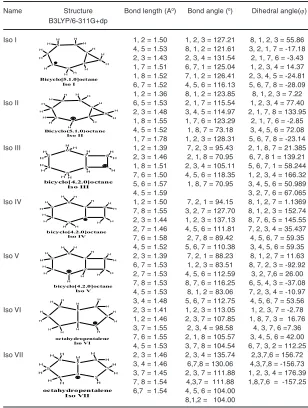
Table 1: geometrical analysis of bond length, bond angle and dihedral angle
Name Structure Bond length (A0) Bond angle (0) Dihedral angle(j)
B3LYP/6-311G+dp Iso I 4 3 2 1 7 6 5 8 H H H H H H H H H H H H H Bicyclo[5.1.0]octane Iso I
1, 2 = 1.50 1, 2, 3 = 127.21 8, 1, 2, 3 = 55.86 4, 5 = 1.53 8, 1, 2 = 121.61 3, 2, 1, 7 = -17.18 2, 3 = 1.43 2, 3, 4 = 131.54 2, 1, 7, 6 = -3.43 1, 7 = 1.51 6, 7, 1 = 125.04 1, 2, 3, 4 = 14.37 1, 8 = 1.52 7, 1, 2 = 126.41 2, 3, 4, 5 = -24.81 6, 7 = 1.52 4, 5, 6 = 116.13 5, 6, 7, 8 = -28.09 1, 2 = 1.36 8, 1, 2 = 123.85 8, 1, 2, 3 = 7.22 Iso II 4 3 2 1 7 6 5 8 H H H H H H H H
H H H
H
H
Bicyclo(5.1.0)octane Iso II
6, 5 = 1.53 2, 1, 7 = 115.54 1, 2, 3, 4 = 77.40 2, 3 = 1.48 3, 4, 5 = 114.97 2, 1, 7, 8 = 133.95 1, 8 = 1.55 1, 7, 6 = 123.29 2, 1, 7, 6 = -2.85 4, 5 = 1.52 1, 8, 7 = 73.18 3, 4, 5, 6 = 72.08 1, 7 = 1.78 1, 2, 3 = 128.31 5, 6, 7, 8 = -23.14
Iso III 6
5 4 3 2 7 1 8 H H H H H H H H H H H H H bicyclo[4.2.0]octane Iso III
1, 2 = 1.39 7, 2, 3 = 95.43 2, 1, 8, 7 = 21.385 2, 3 = 1.46 2, 1, 8 = 70.95 6, 7, 8 1 = 139.21 1, 8 = 1.51 2, 3, 4 = 105.11 5, 6, 7, 1 = 58.244 7, 6 = 1.50 4, 5, 6 = 118.35 1, 2, 3, 4 = 166.32 5, 6 = 1.57 1, 8, 7 = 70.95 3, 4, 5, 6 = 50.989
4, 5 = 1.59 3, 2, 7, 6 = 67.065
Iso IV 6
5 4 3 2 7 1 8 H H H H H H H H H H H H H bicyclo[4.2.0]octane Iso IV
1, 2 = 1.50 7, 2, 1 = 94.15 8, 1, 2, 7 = 1.1369 7, 8 = 1.55 3, 2, 7 = 127.70 8, 1, 2, 3 = 152.74 2, 3 = 1.44 1, 2, 3 = 137.13 8, 7, 6, 5 = 145.55 2, 7 = 1.46 4, 5, 6 = 111.81 7, 2, 3, 4 = 35.437 7, 6 = 1.58 2, 7, 8 = 89.42 4, 5, 6, 7 = 59.35 4, 5 = 1.52 5, 6, 7 = 110.38 3, 4, 5, 6 = 59.35
Iso V 6
5 4 3 2 7 1 8 H H H H H H H H H H H H H bicyclo[4.2.0]octane Iso V
2, 3 = 1.39 7, 2, 1 = 88.23 8, 1, 2, 7 = 11.63 6, 7 = 1.53 1, 2, 3 = 83.51 8, 7, 2, 3 = -92.92 2, 7 = 1.53 4, 5, 6 = 112.59 3, 2, 7,6 = 26.00 7, 8 = 1.53 8, 7, 6 = 116.25 6, 5, 4, 3 = -37.08 4, 5 = 1.53 8, 1, 2 = 83.06 7, 2, 3, 4 = -10.97 3, 4 = 1.48 5, 6, 7 = 112.75 4, 5, 6, 7 = 53.56
Iso VI 7
3 2 1 8 6 5 4 H H H H H H H H H H H H H octahydropentalene Iso VI
2, 3 = 1.41 1, 2, 3 = 113.05 1, 2, 3, 7 = -2.78 1, 2 = 1.46 2, 3, 7 = 107.85 1, 8, 7, 3 = 16.76 3, 7 = 1.55 2, 3, 4 = 98.58 4, 3, 7, 6 =7.36 7, 6 = 1.55 2, 1, 8 = 105.57 3, 4, 5, 6 = 42.00 4, 5 = 1.53 3, 7, 8 = 104.54 6, 7, 3, 2 = 112.25 Iso VII octahydropentalene Iso VII 7 3 2 1 8 6 5 4 H H H H H H H H H H H
H 2, 3 = 1.46 2, 3, 4 = 135.74 2,3,7,6 = 156.72
3, 4 = 1.46 6,7,8 = 130.06 4,3,7,8 = -156.73 3, 7 = 1.45 2, 3, 7 = 111.88 1, 2, 3, 4 = 176.39 7, 8 = 1.54 4,3,7 = 111.88 1,8,7,6 = -157.25 6,7 = 1.54 4, 5, 6 = 104.00
The bond length of Iso-I ranges between 1.43 Ao to 1.53 Ao and there is a double bond between carbon 3 and 2. The bond length of Iso-II has 1.36 Ao to 1.55 Ao and the cabocation is shifted to carbon 2, two double bonds are formed inside the isomer and it is arranged as chair form which gives more stability than the other isomers. Iso-III has a bond length ranges from 1.39 Ao to 1.59 Ao, the carbocation position at carbon 1 changes the bond length and breaking of bond between carbon & and 2 position and double bond is seen between 1 and 2. The shifting of hydrogen in Iso-IV formed a carbocation at 2 position, the bond length of Iso-IV ranges from 1.44 Ao to 1.58 Ao, the short and long distance of the carbons are due to the distortion of the rings, so Iso-V also ranges from 1.39 Ao to 1.53 Ao . The shortest distance is only because of the formation of double bond between 2 and 3. In Iso-VI, the ranges of bond lengths are 1.41 Ao to 1.55 Ao, the double bond environment of 2, 3 and 1, 2 are 1.41 and 1.46 respectively. The carbocation is formed at 3 positions, the bond length of 2,3 and 3,4 are 1.46 each and the opposite side of the bond length between 6,7 and 7,8 are 1.54 each.
The highest bond angle is observed in the double bond carbon (2,3,4= 131.54) of Iso-I and it is made by cycloheptene and the smallest close ring cyclopropane on the other side, the whole isomer is a boat like structure and the orientation of Iso-II is Chair-Boat conformation and the new two double bonds caused distortion of the ring . Iso-III, Iso-IV and Iso-V are made by a combination of cyclohexane and cyclobutane (But the position of carbocation changes accordingly), the cyclobutane part is broken in all the isomers which give the different variety of bond angles inside and outside the ring as shown in Table 1 but among these isomer Iso-IV is supposed to have the most stable isomer because the carbocation is located at the common carbon at 2 position and their bond angle ranges from 70.95 to 118.35, 89.42 to 137.13 and 83.06o to 116.25o respectively as shown in the table- I. Same conditions are discernible in Iso-VI and Iso-VII, even though the structures are same as these isomers are made by two two cyclopentane, the positions of cations are different among these isomers so that we got the different ranges of bond angle. Cation is seen at 2 carbon in Iso-VI and at 3 carbon at Iso-VII. Iso-VII is the most stable isomer as we see from the three dimensional arrangement which can be proved
by symmetrical nature of the bond angles ( 2,3,7 and 4,3,7 = 111.88o , 4, 5, 6 and 8,1,2 = 104.00o).
There are irregular dihedral angles in Iso-I because of the cation at carbon 3 inside cycloheptene ring, the dihedral angle ranges from -3.1546 jto 55.86. The 1,2 hydrite shift brought new orientation in Iso-II, there is a breaking of bond (between 1 and 7 carbons) and two new double bonds are formed (between 1 and 2, 7 and 8 carbons) which give symmetrical arrangement among the carbons, the dihedral angles of 1,2,3,4 and 4,5,6,7 are 77.40j and -69.97j and their difference is only 8j Iso- III, Iso-IV and Iso - V are in the same class of bicyclo (4.2.0) Octane but they differ in the position of cations, the ranges of dihedral angles of Iso-III are 21.38j to 166.32j. Among these isomers, Iso-IV is supposed to be the most stable with the dihedral angle ranges from 1.13j to 152.74j which might be due to the position of cation at the common carbon 2. And Iso-V ranges between 17.47j to 152.86j but there is distortion of the molecule. Iso-VI and Iso - VII are in the same class of octahydropentalene and Iso-VII is more stable between them which is also the cation carbon exactly at the common carbon which caused less effect inside the whole isomer and the ranges of dihedral angles are 13.85j to 176.20j respectively.
Heat of reaction
Table2 : Relative energies of the selected C8H13+ isomers at the level of b3LYp/6-311g+dp
Name of Calculate B3LYP/ RE
Isomers Isomers 6-311+G** Kcal/mol
Iso- I -312.4185733 34.98
Iso -II -312.4535592 13.03
Iso- III -312.4358412 24.14
Iso- IV -312.4589163 9.67
Iso- V -312.4433548 19.43
Iso- VI -312.4550922 12.07
Iso -VII -312.474324 0
Characteristic features of transition
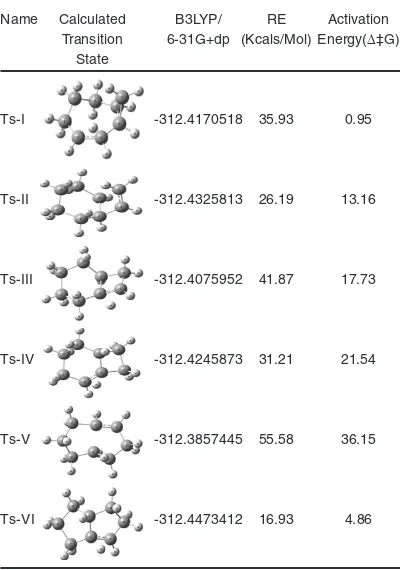
We have six transition states i.e. Ts-I, Ts-II, Ts-III, Ts-IV, Ts-V and Ts-VI which come under fused ring isomers only and their structures are shown in Table –III (Calculated) and in Fig. 1 (Predicted). So the hartree energies can be compared after converted into Kcals/mol by studying three dimentional arrangement and from density functional method (DFT) observations. The order of energies as calculated by B3LYP/6-311G+ dp strategy is Ts-VI > Ts-II > Ts-IV > Ts-I > Ts-III> Ts-V as shown in Table – II. Here, the most stable transition states Ts-VI is found between Iso-VI to Iso-VII. All of their hartree values are compared and convert it into Kcals/mol with respect to the highest stable isomer ( Iso-VII). The highest relative energy (which is also the lowest stable transition state) is found in Ts- V (between Iso-V to Iso-VI) and their difference is 55.58 Kcals/mol and. All of the transition states have one (1) imaginary frequency value. In the meantime, according to the activation
energy barrier as calculated by activation energy of transition state to reactant, the order of transition state can be arrange as Ts-I > Ts-VI > Ts-II > Ts-III > Ts-IV > Ts-V.
Table 3: Heat of formation and activation energy of the transition state as calculated by
b3LYp/6-311g+dp level of theory
Name Calculated B3LYP/ RE Activation Transition 6-31G+dp (Kcals/Mol) Energy(∆‡G)
State
Ts-I -312.4170518 35.93 0.95
Ts-II -312.4325813 26.19 13.16
Ts-III -312.4075952 41.87 17.73
Ts-IV -312.4245873 31.21 21.54
Ts-V -312.3857445 55.58 36.15
Ts-VI -312.4473412 16.93 4.86
Reaction Mechanism
of Iso-VII from Iso-VI was done by 2,3-hydride shift passing through the barrier of 4.86 Kcals/mol as shown in the potential energy Diagram ( Figure 2).
Energy profile diagram
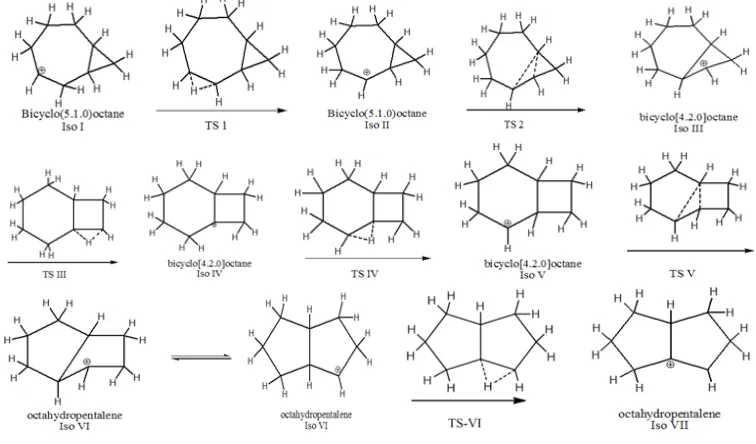
The energy profile diagram of selected isomers from Iso- I to Iso –VII and Ts-I to Ts-VI are given as.
Fig. 1. predicted reaction pathway of Iso- I to Iso- VII
Fig. 2. Energy profile diagram of interconversion of selected isomers of C8H13+
CONCLUSION
1) From the above reaction, the three isomers namely- Bicyclo (5.1.0) Octane, Bicyclo(4.2.0) octane and Octahydropentalene are involved in the interconversion.
2) The Pople basis function with the mixing of d-orbital and p-orbital with diffused function (B3LYP/6-311G+dp) is used for the calculation, another level of calculation might be required
for comparison for further studies.
3) From the calculation, the stability order can be arrange as Iso-VII > Iso- IV >Iso-VI > Iso- II > Iso-V > Iso-III >Iso-I.
4) The stability of the transition state with respect to the most stable isomer can be written as Ts-VI > Ts-II > Ts-IV > Ts-I > Ts-III> Ts-V. 5) According to the activation energy barrier,
the transition state can be arrange as follows - Ts-I > Ts-VI > Ts-II > Ts-III > Ts-IV > Ts-V. 6) The thermochemistry and intrinsic reaction
coordinate (IRC) calculations are needed to compare with these results for further studies.
ACKNOwLEDgEMENT
The author thankfully to the University of Mizoram and Lunglei Government college for their scientific support.
Conflict of Interest
There is no conflict of interest.
REFERENCES
1. Ma C, Liu T, Yang L, Zu Y, Chen X, Zhang L, Zhang Y, Zhao C, Ionic liquid-based microwave-assisted extraction of essential
2. Watson P, Coutsias A, Thompson A, Martin S, Topology of cyclo-octane energy landscape, .
The journal of Chemical Physics., 2010, 132, 234115(1-6).
3. Lewars E. G, Computational Chemistry. Introduction to the Theory and Applications of Molecular and Quantum Mechanics. Kluwer Academic Publishers, Dordrecht., 2010, 600-620.
4. Almenningen A, Allinger L, Mastryukov S, Dorofeeva O, The Molecular structure and conformation of cyclo-octane as determined by electron diffraction and Molecular Mechanics Calculations. Journal of Phys. Chem., 1985,
89(2), 252-257.
5. Kumar S. H,A Comparative QSPR Study of Alkanes with the Help of Computational Chemistry.
Bull Korean Chem. Soc., 2008, 29(1), 67-76.
6. Prasad R K, Quantum Chemistry (4th Edition),
New Age International, New Delhi., 1996. 7. Axel D. B, Perspective: Fifty years of density
functional theory in chemical physics. The journal of chemical Physics., 2014, 140, 18A301. 8. Joshua A.P, Dannenberg J.J, A comparison
of the Behavior of Functional / Basis Set Combinations for Hydrogen-Bonding in the water Dimer with Emphasis on Basis Set Superposition Error. Journal of Computational Chemistry., 2011, 32, 1519–1527.