Licensed under Creative Common Page 715
http://ijecm.co.uk/
ISSN 2348 0386
“MEASURING ORGANIZATION PERFORMANCE”
FROM BALANCED SCORECARD TO
BALANCED ESG FRAMEWORK
Charles Omondi Ondoro
Lecturer and Chair of Department, Department of Business Administration Maseno University, Kenya
Abstract
Continuous performance is the objective of any organization because only through this, can
organizations grow and progress. Moreover, organizational performance is one of the most
important constructs in management research. Knowing the determinants of organizational
performance is important especially in the context of the current economic crises because it
enables the identification of those factors that should be treated with an increased interest in
order to improve the performance. Reviewing past studies reveals both unidimensional and
multidimensional conceptualization of organizational performance. Further review reveals
inadequate and mixed operationalization of the performance constructs both in practice and in
research. Through exploration and synthesis of literature, this paper advances a Balanced ESG
framework for performance measurement. Industry practitioners and researchers are expected
to find it useful as it exposes external and internal as well as long term and short term
perspectives of performance.
Keywords: Performance, Balanced Scorecard, Balanced ESG Framework, Assessment
INTRODUCTION
Licensed under Creative Common Page 716 How can it be defined and measured in a reliable and valid manner? These are the questions that must be answered candidly today and even more candidly tomorrow as the organizations keep confronting changes in the world and subsequently invent new ways to perform. Stephen and Mary (2002) define performance as accumulated end results of all the organization’s work
processes and activities. It is about how effectively an organization transforms inputs into outputs (Thursby, 2000) and comprises the actual output or results as measured against its intended outputs. According to Richard et al. (2009) organizational performance encompasses three specific areas of firm outcomes: financial performance, product market performance and shareholder return but Liptons (2003) proposes that firm performance is the ability of the firm to prevail. There is hardly a consensus about its definition, dimensionality and measurement and this limits advances in research and understanding of the concept (Santos and Brito, 2012). As the debate on what organization performance rages on, the approach on how to measure it has attracted even more scholarly attention.
MEASURING PERFORMANCE
Performance measurement estimates the parameters under which programs, investments, and acquisitions are reaching the targeted results (Perez et al., 2007). According to TRADE (2000) most performance measures can be grouped into one of the following six general categories. The first category is effectiveness: A process characteristic indicating the degree to which the process output (work product) conforms to requirements. The second group is efficiency: A process characteristic indicating the degree to which the process produces the required output at minimum resource cost. The third is quality: The degree to which a product or service meets customer requirements and expectations. The fourth is timeliness: A measures of whether or not a unit of work was done correctly and on time. Criteria must be established to define what constitutes timeliness for a given unit of work. The criterion is usually based on customer requirements. Productivity is the fifth category. It refers to the value added by the process divided by the value of the labor and capital consumed. Lastly is safety which measures the overall health of the organization and the working environment of its employees. According to Zeppau and Tatiana (2003), there is no single, ‘one best’ approach to performance
measurement but the need for balance between quantification and relying on the numbers versus qualitative evidence when telling the ‘performance story’ should not escape practitioners
and researchers minds.
Licensed under Creative Common Page 717 performance is a relevant construct in management research and frequently used as a dependent variable. It is one of the most commonly used construct as the final dependent variable (Richard et al., 2009) in various fields (Cho & Pucik, 2005; Sila & Ebrahimpuor, 2005; Wiklund & Shepherd, 2003). For example, Boyd et al. (2005) found that in the papers published by the four leading management journals from 1998 to 2000, performance was the most common dependent and in 38.1% of the cases it was measured using a single indicator. Through their literature review, Franco-Santos and Bourne (2005) argue that it is critical to identify and select appropriate measures and targets of performance. Most of these measures are grouped into one of the following general categories; profitability, quality, productivity and growth and customer satisfaction (Perez et al., 2007; Liptons, 2003 and Roberts, 2004).
According to Cavenaghi (2001), for years financial performance measurement was seen as the only way, the correct and legitimate way of assessing effectiveness and efficiency in an organization. Miller and Swope (2006) argue that performance assessment can be structured around seven areas. The seven areas are effectiveness, productivity, quality, customer satisfaction, efficiency, innovation and financial durability. Balanced Scorecard (Kaplan & Norton, 1992) presents yet another approach. Kaplan and Norton suggest that performance measures should be multidimensional in nature covering both financial and non-financial measures. They developed four perspectives: financial, customer, internal processes, and innovation. Kaplan and Norton (2001) argue that one of the most important strengths of the Balanced Scorecard is that each unit in the organization develops its own specific or unique measures that capture the unit’s strategy, beside common measures that are employed for all units. The approach derives its four perspectives from organization’s vision, strategy, and
objectives (Atkison et al., 2007). But among other limitations and like in most approaches to performance measurement, not all stakeholders are included in the BSC. In particular, suppliers and public authorities which can be decisive for many organizations (Norreklit, 2003).
Licensed under Creative Common Page 718 Kaplan and Norton (1992), takes only three stakeholders into account: investors, clients and employees. The Performance Prism also considers employees, vendors, intermediaries, regulation authorities and the community. The model considers stakeholder satisfaction and contribution in a unique way.
Investors receive satisfaction from superior financial performance (Chakravarthy, 1986) which is represented by three complimentary aspects; profitability, growth and market value (Cho & Pucik, 2005). Glick et al., (2005) advance that profitability measures a firm’s past ability to generate returns while Whetten (1987) argues that growth demonstrates a firm’s past ability
to increase its size. Increasing size, even at the same profitability level, will increase its absolute profit and cash generation. Larger size also can bring economies of scale and market power, leading to enhanced future profitability. Market value represents the external assessment and expectation of firms’ future performance. It should not only have a correlation with historical
profitability and growth levels, but also incorporate future expectations of market changes and competitive moves.
Customers want companies to provide them with goods and services that match their expectations (Fornell, 1996). Therefore customer satisfaction is another aspect to consider. To do that, companies must understand their needs, avoid defects and improve the perceived quality and value added by their offerings. Customer satisfaction increases the willingness-to-pay and thus the value created by a company (Barney & Clark, 2007). Employees’ satisfaction
is related to investments in human resources practices. This group tends to value clearly defined job descriptions, investment in training, career plans and good bonus policies (Harter et al., 2002). The satisfaction of these stakeholders, according to Chakravarthy (1986), translates itself into a firm’s ability to attract and retain employees and lower turnover rates. This in turn
translates to performance.
Indirectly stakeholders like governments and communities are affected by a number of firm’s actions, especially social and environmental ones. Social and environmental performance
Licensed under Creative Common Page 719 Research on organizational performance suffers from problems such as lack of consensus, selection of indicators based on convenience and little consideration of its dimensionality (Crook et al., 2008; Richard et al., 2009). Combs et al.(2005) analyzed publications in the period 1980 to 2004 and identified 238 empirical studies that used 56 different indicators financial performance, as a measure prevailing. Carton and Hofer (2006) and Richard et al. (2009) reported a similar picture in other time periods. Santos and Brito (2012) included Brazilian journals in their analysis and reported a similar situation. Many studies measure firm performance with a single indicator and represent this concept as unidimensional, even while admitting its multidimensionality (Glick et al., 2005). Research is left without direction and one can only hid little advice from Richard et al., (2009) who contend that if several dimensions exist, a researcher should choose the dimensions most relevant to his or her research. Ray et al. (2004) stress this while warning against the difficulties of testing the resource based theory (RBT) using aggregated measures of performance and suggesting the use of indicators directly connected to the resources under analysis
Corporate governance is very often found in studies oriented toward the organizational performance. One of the most important and often cited studies belongs to Gompers et al. (2003). They have built an index for measuring corporate governance using a sample of 1,500 U.S. firms in the 90s. This study has demonstrated the existence of a positive relationship between the quality of corporate governance and firm performance. Brown & Caylor (2009) have obtained similar results in their research which is an extension of the research carried out by Gompers et al.(2003). Drobetz et al. (2004) also identified a positive impact of corporate governance on the performance of German firms. In Japan, Bauer et al. (2008) using the database provided by GMI, showed that companies with better governance are more efficient than companies with weaker governance by up to 15% annually. Literature on studies involving organization performance measurement and how its constructs have been arrived at has left the situation more confusing. Balanced Scorecard Framework appeared to have solved the issue but critical look at it reveals inadequacy.
SUPPORT FOR BALANCED SCORECARD (BSC)
Licensed under Creative Common Page 720 all employees (Rohm, 2006). The communication strategy of the BSC allows managers to understand how measurement results are affected by their actions (Burney & Widener, 2007). Once the BSC requires company concretely define a mission, a vision and an organizational strategy, then the BSC can be seen as a means of communication and strategy implementation (Tayler, 2010). The BSC assumes a hierarchical system of objectives spread over four prospects and aligned with the financial perspective (Figge et al., 2002). It describes the organization strategies through the objectives and measures than organization has chosen (Niven, 2003). Employees understand strategy/objectives making them connect with company.
Moreover, BSC facilitates assessment and feedback on an ongoing basis clarifying the operational strategy and facilitating communication (Pandey, 2005). It serves as an engine to efficiently align the company with the strategy in a way that is consistent with managers’ actions
and efforts (Voelpel et al., 2005). The approach is balanced and considers both internal and external aspects of the business. It highlights the importance of internal processes to achieve business results and also the external view from customers and market position (Olve et al., 2003). The framework focuses attention of management in just a few steps and makes bridges between the different functional areas (Akkermans & Oorschot, 2002). It does not only translate strategy into operational terms but also focuses on the business units and employees about their role in fulfilling the organization mission (Frigo & Krumwiede, 2000).
CRITIQUE OF BALANCED SCORECARD
BSC makes assumptions about causal relationships between performance indicators which may actually cause dysfunctional organization behavior with negative consequences on the organizational performance (Norreklit, 2000). According to Norreklit BSC doesn’t include all
stakeholders. In particular, suppliers and public authorities, who can be decisive for many organizations, are left out. The framework provides no mechanism to maintain the relevance of the initially defined measures (Platts & Tan, 2002). Maltz et al. (2003) contend that the lack of focus on the human resources dimension of organizations is yet another great weakness of the BSC while Kennerley & Neely (2003) argue the framework contains a serious failure in their construction. It focuses management strictly on a set of pre-defined indicators and measures making them not able to respond to simple and fundamental questions, such as “what our competitors are doing?” The BSC does not monitor competition or technological developments.
Licensed under Creative Common Page 721 between financial and non-financial measures as suggested in the framework (Anand et al., 2005). Richardson (2004) also notes that organizations over concentrate in the task of generating indicators and give less time to the definition of strategy resulting into indicators that are not aligned with the strategic objectives. Another twist in the disagreement with BSC is that it is difficult to study. Othman et al. (2006) argue that it has had different meanings at different times. Very often the organizations do not understand what exactly the BSC is and what its implementation involves (Othman, 2009). Davies (2007) notes that the framework presents the danger of establishing "narrow goals", not realizing that to achieve them it is necessary to obtain adequate levels of organizational capabilities and competences.
TOWARDS THE ESG FRAMEWORK
ESG is an acronym for Environmental, Social and Governance (Corporate) performance issues. According to World Business Council for Sustainable Development (WBCSD) and the United Nations Environment Programme Finance Initiative (UNEP FI) (2010, March) the term ESG is global and has emerged to describe the environmental, social and corporate governance issues investors are considering to comprehensively understand corporate behaviour. Leading global companies of the future will be those that provide goods and services and reach new customers in ways that address the world’s major challenges. The challenges include poverty, climate change, resource depletion, globalization and demographic shifts.’ ESG framework displays one
or more of the following characteristics: Issues that have traditionally been considered non-financial or not material, a medium or long-term horizon, qualitative objects that are readily quantifiable in monetary terms, externalities (costs borne by other firms or by society at large) not well captured by market mechanisms, a changing regulatory or policy framework, patterns arising throughout a company’s supply chain (and therefore susceptible to unknown risks) and
public-concern focus WBCSD and UNEP FI (2010, March). A growing number of firms are looking to the ESG Framework. This is because it offers a more structured approach to determining performance (UN, 2011). The conviction is that companies that are oriented towards ESG and address ESG issues achieve better growth, cost savings, profitability, strengthening of stakeholder relations and improving their brand and reputation (WEF, 2011). The last two are key parameters for sustained performance and long term prosperity of an organization. According to Blankenship (2015) stock exchanges should issue ESG reporting guidance to companies by the year 2016. These way stakeholders will be able to access consistent and comparable information. The member institutions of the WBCSD and UNEP FI believe that a company’s management of ESG factors, as well as a company’s leadership on
Licensed under Creative Common Page 722 by the capital markets. Both organizations believe that ESG factors can be financially material and can enhance long-term, sustainable company value (WBCSD and UNEP FI, March, 2010).
The literature presents various approaches to performance measurement both in practice and research. The approaches have diverse limitations. The Performance Prism and BSC presented means that managers and researchers have relied on for a long time. But the limitations present opportunity to look beyond especially in the new world order where sustainable performance should be the rule rather than the exception. An integrated performance measurement approach the bears financial and non financial considerations, one that is inward and outward focused and that captures sustainability issues is lacking.
PROPOSED INTEGRATED PERFORMANCE MEASUREMENT FRAMEWORK:
THE BALANCED ESG FRAMEWORK
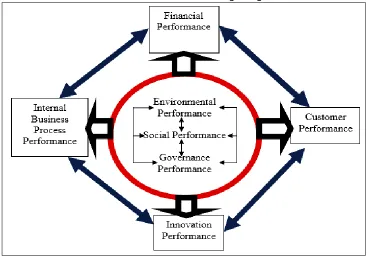
The framework is an integration of elements of BSC and ESG. ESG elements, environmental aspects, social aspects and governance aspects are central and at the heart of performance and performance measurement. They represent external and long term performance perspectives which the BSC is criticized for having missed. The BSC elements, Customer Perspective, Innovation Perspective, Internal Business Process Perspective and Financial Perspective integrate with the ESG elements to deliver a comprehensive performance assessment framework.
Figure 1: Performance assessment framework integrating BSC and ESG elements
Licensed under Creative Common Page 723 CONCLUSION
The gap the paper sought to fill was that of lack of a comprehensive approach for performance measurement which practitioners and researchers have continued to face. The paper concludes, through literature analysis that for performance measurement to be adequate, long term and short term as well as internal and external perspectives are very important. Balanced ESG framework is proposed. The model advances the elements of BSC and ESG in an integrated way. Researchers and practitioners are expected to find it a useful tool.
REFERENCES
Adams, C. & Neely, A. (2006). Using the performance prism to boost the success of mergers & acquisitions. New York, Accenture.
Adams, C. & Neely, A. (2003). The new spectrum: How the performance prism framework helps. Norwalk, Business Performance Management.
Barney, J., & Clark, D. N. (2007). Resource-based theory. New York: Oxford.
Blankenship, M. (2015, October). Principles of Responsible Investment. UNEP Finance Initiative
Bourne, M., Kennerley, M., & Franco-Santos, M. (2005). Managing through measures: a study of impact on performance. Journal of Manufacturing Technology Management, 16(4):373-395
Boyd, B. K., Gove, S., & Hitt, M. A. 2005. Construct measurement in strategic management research: Illusion or reality? Strategic Management Journal, 26: 239–257.
Brown, L., Caylor, M. (2009). Corporate governance and firm operating performance. Journal of Operations & Production Management, 27(8): 784 - 801.
Cavalluzzo, K. S., & Ittner, C. D. (2004). Implementing performance measurement innovations: Evidence from government. Accounting, Organizations and Society, 29(3-4):243-267.
Cavenaghi, V. (2001). Gestão do desempenho empresarial: A contribuição da área de Graduação em Engenharia de Produção, manufatura. Tese (Doutorado em Engenharia de Produção) - Programa de Pós- USP, São Paulo.
Chakravarthy, B. S. (1986). Measuring strategic performance. Strategic Management Journal, 7(5): 437-458.
Cho, H., & Pucik, V. (2005). Relationship between innovativeness, quality, growth, profitability, and market value. Strategic Management Journal, 26(6):555-575.
Combs, J. G., Crook, T. R., & Shook, C. L. (2005). The dimension of organizational performance and its implications for strategic management research. In D. J. Ketchen & D. D. Bergh (Eds.), Research methodology in strategy and management (259-286)
Crook, T. R., Ketchen, D. J., Jr., Combs, J. G., & Todd, S. J. (2008). Strategic resources and performance: a meta-analysis. Strategic Management Journal, 29(11):1141-1154.
Drobetz, W., Schillhofer, A., & Zimmermann, H. (2004). Corporate Governance and Expected Stock Returns: Evidence from Germany. European Financial Management, 10 (2): 267-293
Fornell, C., Johnson, M. D., Anderson, E. W., Cha, J., & Bryant, B. E. (1996). The American customer satisfaction index: nature, purpose and findings. Journal of Marketing, 60(4): 7-18
Licensed under Creative Common Page 724 Glick, W. H., Washburn, N. T., & Miller, C. C. (2005). The myth of firm performance. Proceedings of the Annual Meeting of American Academy of Management. Honolulu, Hawaii.
Gompers, P., Ishii, J., Metrick, A. (2003). Corporate governance and equity prices. Review of Quantitative Finance and Accounting, 2, 129-144
Hamann, P. M., Schiemann, F., Bellora, L., & Guenther, T.W. (2013). Exploring the dimensions of organizational performance: A construct validity study. Organizational Research Methods, 16(1): 56-67 Johnson, R. D. A., & Greening, D. W. (1999). The effects of corporate governance and institutional ownership types on corporate social performance. Academy of Management Journal, 42(5): 564-576. Julnes, P. d. L., & Holzer, M. (2001). Promoting the utilization of performance measures in public organizations: An empirical study of factors affecting adoption and implementation. PublicAdministration Review, 61(6): 693-708.
Kaplan, R. S., & Norton, D.P. (1992). The balanced scorecard – measures that drive performance. Harvard Business Review 70 (1): 71-79.
Kaplan, R. S., & Norton, D. P. (2001). The Strategy focused organization: How balanced scorecard companies thrive in the new business environment. Boston, Harvard Business School Press.
Kueng, P. (2002). Performance measurement systems in the service sector: the potential of IT is not yet utilised. International Journal of Business Performance Management, 4(1): 95-114.
Lipton, M. (2003). Guiding growth: How vision keeps companies on Course. Boston, Harvard Business School Press.
Miller, B. A., & Swope, S. (2007). Assessing Organizational Performance in Higher Education. International Journal of Educational Advancement. 16(3): 258-263.
Neely, A. (2007). Business performance measurement. Cambridge: Cambridge University Press. Neely, A., & Adams, C. (2000) Perspectives on performance: The performance prism.
Neely, A., Adams, C.& Crowe, P. (2001). The Performance Prism in Practice. Measuring Business Excellence, 5(2):6-12
Neely, A., Gregory, M., & Platts, K. (1995). Performance measurement system design. International Journal of Operations Management. 14(4): 81-114.
Norreklit, H. (2003). The Balanced Scorecard: What is the score? A Rhetorical Analysis of the Balanced Scorecard. Accounting, Organizations and Society, 28(6): 591-619
Nudurupati, S. S., & Bititci, U. S. (2005). Implementation and impact of IT-supported performance measurement systems. Production Planning & Control, 16(2):152-162.
Pérez, L.M., Polanco, R., Rios, J. C., Montealegre, J., Valderrama, L., Herrera, R., & Besoaín, X.(2007). The increase in endochitinases and β-1,3-glucanases in the mutant Th650-NG7 of the Trichoderma harzianum Th650, improves the biocontrol activity on Rhizoctonia solani infecting tomato. IOBC/WPRS Bulletin, 30(6), 135-138.
Pierre J. R., Timothy M. D., George S. Y. & Gerry J. (2009) Measuring organizational performance: Towards Methodological Best Practice, Journal of Management, 20(5): 78 - 80.
Ray, G., Barney, J. B., & Muhanna, W. A. (2004). Capabilities, business processes, and competitive advantage: choosing the dependent variable in empirical tests of the resource-based view. Strategic Management Journal, 25(1): 23-37.
Richard, P. J., Devinney, T. M., Yip, G. S., & Johnson, G. (2009). Measuring organizational performance: towards methodological best practice. Journal of Management, 35(3): 718-804.
Roberts, J. (2004). The modern firm: Organizational design for performance and growth. Oxford, Oxford University Press.
Licensed under Creative Common Page 725 Sila, I., & Ebrahimpour, M. (2005). Critical linkages among TQM factors and business results. International Journal of Operations and Production Management, 25(11): 1123-1155.
TRADE (2000) Performance Measurement Process. www.orau.gov/pbm/handbook/1-1.pdf
UN PRI Guide for Limited Partners (2011). World Economic Forum Report: Accelerating the transition towards sustainable investing.
Waddock, S. A., & Graves, S. B. (1997a). Quality of management and quality of stakeholder relations. Business and Society, 36(3): 250-279.
Waddock, S. A., & Graves, S. B. (1997b). The corporate social performance-financial performance link. Strategic Management Journal, 18(4): 303-319.
WBCSD & UNEP FI, (2010, March). Translating ESG into sustainable business value: Key insights for companies and investors report from an international workshop series.
Whetten, D. A. (1987). Organizational growth and decline process. Annual Review of Sociology, 13(1): 335-358.