Effort Estimation in Global Software Development
-A Systematic Review
Dilani Wickramaarachchi1and Richard Lai2 1 Department of Industrial Management, Faculty of Science,
University of Kelaniya, Sri Lanka [email protected] 2
Department of Computer Science and Information Technology, La Trobe University, Melbourne, Australia.
Abstract. Global Software Development (GSD) is becoming increasingly preva-lent, with software development teams being distributed around the world and work-ing in collaboration with partner companies despite geographic and time differ-ences. The main advantage of GSD which makes it attractive is the greater avail-ability of human resources at lower costs. However, there are several disadvan-tages which are caused by the distance which separates the development teams. Coordination and communication become more difficult when the software devel-opment teams are located in different places, resulting in hidden costs involved in this process. As such, the effort estimation models used for collocated software de-velopment are inadequate for estimation in GSD. Thus, effort estimation in GSD is becoming an important area of research. Many researchers have focused on effort estimation in GSD over the last decade. This paper presents the findings of a sys-tematic review of the related literature by summarizing the hidden costs in GSD, and discussing the open research issues in effort estimation in GSD.
Keywords:Global Software Development, Business Process Outsourcing, Effort Estimation, Global Software Engineering, Distributed Software Development, Off-shoring, Insourcing, Onshoring.
1.
Introduction
Global software development can be defined as any aspect of software engineering that involves the combined efforts of software professionals in different locations (separated by significant distances [1]/ distributed beyond the limits of a nation[2]). Significant dis-tance can be further described as dispersed across national boundaries. Sakthivel calls it offshore system development: system development in another country [3]. Global soft-ware development (GSD) is also known as Globally Distributed Softsoft-ware Development (GDSD), Global Software Engineering (GSE) [4] collaborative software development [5] and global virtual teams development[6].
anyone around the world. This opens the way to locate digital services around the world. However, many people are not aware that most of the software we use today is the result of intense cooperation between project managers, architects, analysts, developers, testers and other people who are located all around the world [8]. Currently, it is becoming nec-essary for companies to offshore Information Technology (IT) services in order to survive in a competing market. This argument is supported by the survey conducted in U.S. in 2009 which shows the value of the offshore software development market has increased 25-fold over the last 10 years [9].
However, GSD brings both opportunities and challenges [4, 10, 11]. The main factors which motivate organizations to utilize GSD are (i) low-cost labour, (ii) access to inter-national talents, (iii) reduction of product cycle time, and (iv) opportunity for innovation [9, 10]. Conversely, the major challenges of GSD are the different time zones, language, and cultural differences which makes communication and coordination much harder [10, 12]. One of the main problems in communication is negotiation with globally distributed teams which increases project planning and tracking costs [12]. A major challenge in co-ordination is the synchronization of virtual teams [12]. Further, globally distributed teams have fewer opportunities for informal communications that are essential to coordinate development effort, manage task dependencies, and maintain awareness [12].
In spite of the growing attention on GSD, there is a limited understanding of how to ensure GSD is a success and why it fails [13]. According to Aron and Singh [14] sev-eral studies illustrate that half of the organizations which shift processes offshore fail to generate the expected financial benefits and some of them are failing completely [15]. GSD projects and case studies range from announcements of remarkable victory to total collapse [4]. The cost-benefit trade-off in GSD is still not fully understood [16]. No re-search so far has imparted a clear vision of the true amount of investment necessary to make global software projects work [4]. Hence, offshoring not only offers opportunities to gain extra profit, but also brings extra threats that adversely influence profits. Despite these threats, offshoring is becoming a norm in the software industry [17]. Therefore, the challenge is how the threats can be reduced, in order to increase the chance of high prof-its. Rephrasing this question provides an overview of our topic of research: utilizing effort estimation in GSD to identify the potential benefits and threats in advance.
Due to the increasing popularity of GSD, effort estimation in GSD has become an important area of research. This paper presents the findings of a systematic review of the related literature by summarizing the hidden costs in GSD, and discussing the open research issues in effort estimation in GSD.
1.1. Global Software Development Research
Terminology/ Taxonomy used in GSD: Wider acceptance of GSD by the software in-dustry has resulted in different classification schemes depending on the way it has been absorbed by the industry. Global software work is enabled through various collabora-tive forms such as inter-organizational outsourcing, organizational offshoring, intra-national near-shoring, to name a few. However, since GSD scenarios are diverse, what works in one context might not be directly applicable in another [19]. The classification and terminology used in GSD is not yet properly standardised. Thus, it would be helpful for future researchers to be familiar with classification schemes and terminology to have a better understanding of the research problems. To improve the readability of the paper, the classifications and terminologies used in this paper are given below.
Simplified Matrix of GDSD Business Model: The GDSD business model matrix rep-resents the relationship structure and geographic location of the work. [20].
Fig. 1.Simplified Matrix of the GDSD Business Model
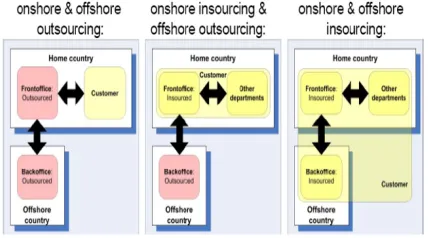
As our main focus is GSD, the two models in the second column in the above matrix will be the area of interest in our study. In offshoring, there are different types of coop-eration. Fabriek [8] introduced three different cooperation types and their interactions are illustrated in Fig.2.
Even though it may not be very common, another cooperation type can be added, this being onshore outsourcing and offshore insourcing.
As stated by Herbsleb and Moitra [2], the processes employed in offshore outsourcing might be different to those employed in internal offshoring, and the characterization in this case could make a difference for the practice of GDSD. Moreover, research conducted in one type of distribution is not necessarily valid for all types of GDSD. Therefore, the different characteristics of GSD that will be encountered in this study are explained in Table 1.
2.
Systematic Review Procedure
This systematic review has been carried out following the structured procedure proposed by Kitchenham [25, 26]. It permits the identification, evaluation and interpretation of all the available relevant studies related to particular research questions. Thus, it provides results of a high scientific value by synthesizing existing work according to a predefined strategy.
2.1. Question Formulation
Questions have been formulated to communicate the message in logical way, emphasizing the need for effort estimation in GSD, the difficulty of effort estimation in an offshore environment, the available models and the significance of the research problem.
The research questions that guide the systematic review are:
1. What initiatives have been carried out in relation to effort estimation in GSD? 2. What are the additional challenges involved in the process of effort estimation in
GSD?
3. What are the effort estimation models for GSD available in the literature? 4. What systematic studies have been conducted on effort estimation in GSD?
The ultimate goal of this systematic review is to provide a critical analysis of recent re-search by identifying the importance of effort estimation, the estimation models for GSD in the literature and future directions for improvement.
2.2. Source Selection
In order to carry out a comprehensive analysis, the search strings were established by combining the key words through logical connectors AND and OR.
The studies were obtained from the following search sources: IEEE Xplore, ACM Digital Library, Science Direct, Springer Link, Wiley Interscience and Google Scholar. The quality of these sources guarantees the quality of the study. Further, some white papers on hidden costs in GSD are referred to because of the unavailability of this infor-mation from the above mentioned sources.
Table 1.Different characteristics of GSD
Characteristic Categories Description
Ownership/ Collaboration mode
Inter-organization/ Offshore outsourcing
Software development is moved to an external third party in another country [5]
Intra-organization/
Internal offshoring, offshore insourcing
Software development is moved to a division of a specific company estab-lished in another country [5]
Offshoring A generic term when the relationship of the overseas company is unknown [5]. (Transfer of organization function to another country [21])
Number of distributed sites
Two, three, four, etc. The complexity of communication. co-ordination and control in GSE projects is dependent on the number of dis-tributed sites. Increasing the number of collaboration partners increases the number of sources of threat and also the complexity of trust achievement [22]
Location Geographic Distance: Near shore
Far shore
Near shoring: jobs are transferred to ge-ographically closer countries [21]. Scal-ing these distances from near shore to far shore makes a difference to how the teams interact. The impact of two collaborated remote teams is symmetric [19]
Time Zone:
Overlapping hours in collaborating sites
The impact of two collaborating remote teams is asymmetric
Perspective Customer/client Supplier/ provider Collaboration/relationship
The perspective of reported empirical findings may vary between suppliers, originators or collaboration in general [23]
Reason for GSD Cost, resources, speed, new market
Studies show that there is a dependency between the reasons for implementing GSE scenarios and the actual success of collaboration [7]
Development Process Extended work bench model Centralized project management and control [24]
2.3. Studies Selection
The inclusion criteria for determining whether a study should be considered relevant were based on the title, abstract, keywords and the conclusion. In some cases, it was necessary to read the entire document to determine its relevance.
3.
Results
3.1. Q1. What initiatives have been carried out in relation to effort estimation in GSD?
Significant research on software effort estimation began in the early 1960s and since then, it has been evolving [27]. As software grew in size and importance, it also grew in com-plexity which makes effort prediction much harder [27]. Accurately predicting software development effort is a crucial concern of many organizations today [28]. Underestimat-ing development cost and schedules can lead to a massive loss and overestimatUnderestimat-ing can result in a waste of resources and missing opportunities.
The main drivers of GSD are globalization and outsourcing [1], and in order to sur-vive and succeed in todays competitive software industry. GSD has become a necessity [29]. GSD can be considered as a part of the trend of globalization of business operations [29]. Most software development companies are moving from traditional centralized lo-cal development to distributed global development [15]. This evolution is taking place due to the availability of high quality and low cost software professionals in different coun-tries. It further encourages communication between dispersed groups [15] by increasing knowledge of each others work while accelerating the time to market [4].
Although, for several decades, there has been a growing trend to utilize GSD, it is hard to find any published documented evidence that proves GSD reduces the total software development effort and cycle time [12]. Researchers are divided on the impact of software offshoring, and contradictory arguments have been espoused. For example, some claim that the follow-the-sun model helps to reduce cycle time [30] whereas others claim it is a quick-and-dirty strategy that converts a scheduling problem into a quality disaster [12]. Therefore, the true benefits of GSD must be properly understood if we wish to fully realize them [10].The cost-benefit trade-offs of GSD are still not well understood [31], but it is very important to clarify this in order to estimate the effort required in GSD.
Benefits worth the risk in offshore software development [32] have become a widespread topic in the discipline. A survey and analysis of the literature on information systems out-sourcing in [33] assesses the research done up to 2004 in IS outout-sourcing.
It is important to identify the true impact (positive and negative) of software offshoring to estimate the real effort necessary for software offshoring. Different opinions given by scholars as reasons to offshore are summarized in Table 2 (Positive impact + , Negative impact - ).
Table 2.An overview of reasons to offshore Literature Salary sa ving Lar ge skilled labor pool Closer pr oximity to mark et and customer New opportunities Reduced cycle time Inno v ation & best practice Quality impr o v ement
A. Almeida, et al. (2009)[34]
-(increased) A. Khan and Z Muhammad
(2009) [35] partially realized partially realized partially realized partially realized C. Ebert and P. De Neve
(2001) [11]
+ + +
Chan, K. and L. Chung (2002) [36]
+
D. Damian and D. Moitra (2006) [17]
+ + + +
D. Damian et al. (2003) [37] + +
D. Farrell (2006) [38] +
D. Smite (2007) [7] +
D. mite and J. Borzovs (2008) [4]
+ +
Davis, G. et al. (2006) [39] + E. Carmel and R. Agarwal (2001) [18]
+ +
E. Conchir et al. (2009) [9] +
E. Conchuir et al. (2006) [10] partially realized partially realized partially realized not real-ized partially realized G. Seshagiri (2006) [12] +
H. Holmstrom, et al. (2006) [40]
+ + +
J. D. Herbsleb and R. E. Grinter (1999) [30]
+
J. Herbsleb et al. (2000) [41] + + +
M. Bass and D. Paulish (2004) [42]
+
M. Fabriek et al. (2007) [8] + +
M. Maznevski and K. Chu-doba (2000) [6]
+
N. Huda et al. (2009) [15] + +
R. Aron and J. Singh (2005) [14]
+ + +
R. Grinter et al. (1999) [43] + + R. Ravichandran and N.
Ahmed (1993) [44]
+ + + +
S. Krishna et al. (2004) [45] + + +
S. Sakthivel (2005) [3] + + W. Aspray et al. (2006) [46] +
W. DeLone et al. (2005) [13] + +
-the cycle time of offshore development which incurs some cost. Despite this, it is obvious that the primary motivation behind offshore development is cost [48].
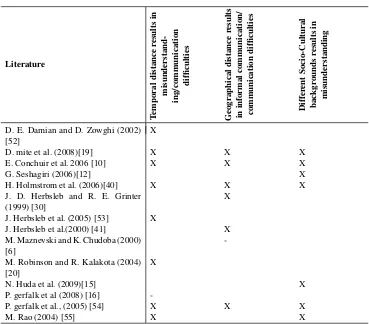
Typically, only the potential benefits of GSD are discussed in many research articles and their realization is taken for granted [33]. An overview of GSD project case stud-ies shows that the observed results can vary from tremendous successes to total failures [38]. However, GSD also introduces a number of challenges in relation to communica-tion, coordination and control of the development process. These challenges arise due to the distances involved in three major dimensions of geographical, temporal, and socio-cultural issues. As a consequence, much research and practice has focused on trying to find ways to overcome these GSD challenges [10].
Table 3.An overview of GSD overheads
Literature
T
emporal
distance
results
in
misunderstand-ing/communication
difficulties
Geographical
distance
results
in
inf
ormal
communication/
communication
difficulties
Differ
ent
Socio-Cultural
backgr
ounds
results
in
misunderstanding
D. E. Damian and D. Zowghi (2002) [52]
X
D. mite et al. (2008)[19] X X X
E. Conchuir et al. 2006 [10] X X X
G. Seshagiri (2006)[12] X
H. Holmstrom et al. (2006)[40] X X X
J. D. Herbsleb and R. E. Grinter (1999) [30]
X
J. Herbsleb et al. (2005) [53] X
J. Herbsleb et al.(2000) [41] X
M. Maznevski and K. Chudoba (2000) [6]
-M. Robinson and R. Kalakota (2004) [20]
X
N. Huda et al. (2009)[15] X
P. gerfalk et al (2008) [16]
-P. gerfalk et al., (2005) [54] X X X
M. Rao (2004) [55] X X
and poor relationships [50]. Generic offshore characteristics can be referred to as distance measures because each of them implies a certain type of distance between the client and supplier [51]. Different views on GSD overheads found in the literature are presented in Table 3. A small time difference has a significant effect on the productivity of software development [56].
Table 2 and 3 clearly indicate that offshoring not only offers opportunities to gain extra profit, but also brings particular threats which can adversely influence profit. This shows that GSD has its own driving forces, restrictions, payoffs, and challenges [29]. Despite these threats, offshoring is becoming a norm in the software industry [17] which motivates us to study effort estimation in GSD. Further, the unavailability of a proper estimation model for GSD and the unsuitability of collocated software development effort models for GSD [57] was a further motivation for us to conduct the survey.
3.2. Q2. What additional challenges are involved in the process of effort estimation in GSD?
Organisations are eagerly embracing the concept of globally distributed software devel-opment to reduce cost, and increase efficiency and productivity which drive the business forward. Most measure the advantages of GSD by calculating the salary variation in dif-ferent parts of the world and distribute the work to lower wage countries. But at the end of the project, it is sometimes true that the calculated cost benefits have not been real-ized. Thus, the reality of the cost deviation is not only related to the wage differences in collocated and distributed projects.
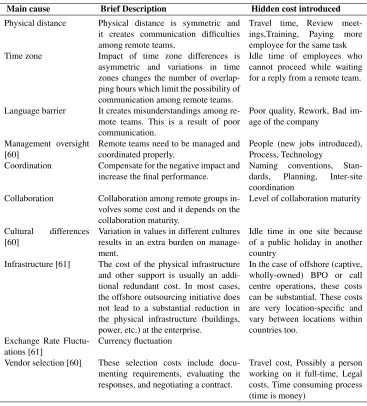
GSD is technically and managerially complex and presents a variety of challenges to be managed [40]. These challenges introduce some additional costs to the process of GSD. Additional costs are referred to as hidden costs, invisible costs, indirect costs, distribution costs and transition costs by different articles. In this paper, we use the term hidden cost to refer to additional costs. Hidden costs include travel time and expense for management oversight, review meetings, training, communication and coordination [12] etc. This cost can negatively impact productivity. In [12], Seshagiri claims that lower per-hour wages are offset by much lower overall productivity. Despite the significant advantage in labour cost, poor software quality drives up the cost [12].
Some firms have high expectations without gauging the actual effort involved [58]. However, it is becoming evident from experience that the reality of the situation does not simply lie in the salary difference. Several opinions of industry professionals on software offshoring are as follows: ”On paper, it looks extremely attractive. A Russian programmer charges 80 percent less than an American. But when you parse it all out, the total cost of offshoring a given IT job is generally comparable to getting the work done domestically, says Tom Weakland, a partner at management consultancy Diamond Cluster. It’s just that few companies are aware of these real costs. Most companies can’t accurately measure their productivity and costs prior to and after outsourcing,” says Weakland [59].
It is clear that lower wages, higher quality and higher productivity are the benefits of GSD that should result in significant cost savings and improve the companys bottom line. Unfortunately, GSD projects do not always produce these positive objectives as the outcome, mainly due to hidden costs.
Table 4.Hidden costs involved in the process of GSD
Main cause Brief Description Hidden cost introduced
Physical distance Physical distance is symmetric and it creates communication difficulties among remote teams.
Travel time, Review meet-ings,Training, Paying more employee for the same task Time zone Impact of time zone differences is
asymmetric and variations in time zones changes the number of overlap-ping hours which limit the possibility of communication among remote teams.
Idle time of employees who cannot proceed while waiting for a reply from a remote team.
Language barrier It creates misunderstandings among re-mote teams. This is a result of poor communication.
Poor quality, Rework, Bad im-age of the company
Management oversight [60]
Remote teams need to be managed and coordinated properly.
People (new jobs introduced), Process, Technology
Coordination Compensate for the negative impact and increase the final performance.
Naming conventions, Stan-dards, Planning, Inter-site coordination
Collaboration Collaboration among remote groups in-volves some cost and it depends on the collaboration maturity.
Level of collaboration maturity
Cultural differences [60]
Variation in values in different cultures results in an extra burden on manage-ment.
Idle time in one site because of a public holiday in another country
Infrastructure [61] The cost of the physical infrastructure and other support is usually an addi-tional redundant cost. In most cases, the offshore outsourcing initiative does not lead to a substantial reduction in the physical infrastructure (buildings, power, etc.) at the enterprise.
In the case of offshore (captive, wholly-owned) BPO or call centre operations, these costs can be substantial. These costs are very location-specific and vary between locations within countries too.
Exchange Rate Fluctu-ations [61]
Currency fluctuation
Vendor selection [60] These selection costs include docu-menting requirements, evaluating the responses, and negotiating a contract.
Travel cost, Possibly a person working on it full-time, Legal costs, Time consuming process (time is money)
there is no proper mechanism by which to evaluate whether the benefits outweigh the challenges. So, it is necessary to identify the hidden costs of these challenges to deter-mine whether they are measurable when estimating the cost involved in GSD. Table 4 lists the most significant hidden costs identified in the literature survey with the main cause and a brief description.
All these measurable and immeasurable costs should be considered when evaluating the total cost of offshoring. Measuring immeasurable costs is one of the biggest chal-lenges in software effort estimation. Most of the software development cost is related to salaries and recent evidence shows that team-related factors can affect the projects per-formance and its cost [62]. Selecting an appropriate team size is a challenging task [63]. Larger teams facilitate a better distribution of skills, but lead to higher communication and coordination costs [64].
Q2.1. Are we really saving money or just shifting the cost burden? Because of these additional costs introduced in the process of offshoring, if the company adds up the costs at the end of the project, it might discover that the projected savings are not there. But, it will be too late to take action to correct it. So, there should be a method which can be used to estimate the total cost of the GSD before starting the project.
Table 5.Summary of the findings relating to offshore software costs
Summary of Findings Relating to Cost Source
Only 54 percent of offshore agreements realized the expected cost sav-ings.
Hirschheim and Lacity, 2000 [65]
One in every three offshoring contracts targeting cost reductions failed to meet expectations.
Caldwell, 2002a, 2002b
38 percent of the participants paid hidden costs, 31 percent stated that vendors became complacent once contracts were in place, 20 percent experienced greater than expected employee turnover, and 44 percent found that vendors did not have the capability to provide the expected level of quality and cost savings.
Deloitte, Touche, and Tohmatsu, 2003
Only 50 percent of offshoring in the near future will be successful. Deloitte, Touche, and Tohmatsu, 2003 A study of 116 offshoring decisions found that 38 percent of these
ar-rangements were successful, 35 percent were failures, and 27 percent had mixed results relative to cost, quality, flexibility and other consid-erations.
Kern and Willcocks, 2003
Half the organizations that shifted processes offshore failed to generate the financial benefits they expected.
Aron and Singh, 2005 [14]
70 percent of companies have had significant negative experiences and are offshoring with increasing caution and in a conservative manner.
Murray and Crandall ,2006[66]
In a survey of 50 companies, about 14 percent of outsourcing operations were deemed a failure.
Barthelemy, J.,(2001)[67] Dun and Bradstreet Survey finds 50 percent of outsourcing relationships
worldwide fail within five years, the principal cause being poor planning for new and evolving business processes
Overall, this means the IT budget may reduce at the beginning but it does not ensure that total cost of the project will be low, as work quality, dissatisfaction and time delay may add more cost to the project. The severity of the problem can be seen from the findings of different surveys which are presented in Table 5.
As Table 5 shows, in many cases, offshoring projects have produced disappointing results. In some projects, cost savings are close to 50 percent whereas there are no cost savings at all in others. An insufficient cost analysis leads to a false estimation of the expected savings [69].
In order to prevent disappointing cost savings, the implementation of a realistic method to predict total costs by considering all cost categories is required [69]. Without a proper understanding of offshore complexity, hidden costs and risks will blindside IT decision makers and prevent the attainment of anticipated wage rate savings [70].
Table 6.Techniques to reduce the cost of IT offshoring
Technique Description
Vendor contract (in the case of outsourcing)
A contract which includes Service-Level Agreements (SLAs) signed off by all parties, including business users. Vendors must demonstrate the operation of defined processes for all work identified in the contract and how they will ensure they are followed.
Industry standard Consistent and appropriate use of industry standards like Capability Maturity Model Integration (CMMI).
Achievable project plan A comprehensive and achievable project plan for transitioning support services from the current provider to the vendors support team. Knowledge notebook Detailed application knowledge notebooks captured by the vendor from
the current application experts, including the current team leader. Vender training
pro-gram
In order to communicate with application users, a training program defining the companys business functions and terminology must be de-veloped for the vendors team.
Verifiable training pro-cess
A verifiable process for cross-training and re-training vendor support staff on critical application functions, problem history, and business knowledge.
Communication infras-tructure
Communication procedures, infrastructure and protocols in place where appropriate, video/audio conferencing facilities.
Performance report Work status, resource utilization, SLA performance metrics report, schedules and recipients clearly defined. Customer satisfaction reports should be based on actual work performed not periodic and anecdotal customer satisfaction surveys.
Data collection A data collection tool must be used throughout the vendors entire sup-port team that captures data on all supsup-port activities: work type, status, scheduling and backlog, resource loading, time tracking and data re-quired for accurate SLA performance reporting.
QA reviews Quality Assurance (QA) processes and reporting in place for both the transition of services and continued support operations. Operational QA reviews are for the life of the contract and are usually quarterly unless problems demand more frequent back-checks.
Process improvement programs
3.3. Q3. What effort estimation models for GSD are available in the literature?
Due to the increasing tendency to utilize GSD in the last few decades, researchers have focused on effort estimation in GSD. This paper reviews the most up-to-date research published in this field. GSD effort estimation is quite different to collocated software development as GSD consists of additional cost factors. Despite its brief history, a con-siderable amount of research has already been directed towards effort estimation in GSD by introducing new models, identifying the unsuitability of existing collocated models and raising the problem of not having a proper model. This demonstrates the significance of the problem. However, only a handful of effort models have been introduced to predict the effort required for GSD. In fact, most of this research is still in the initial stage.
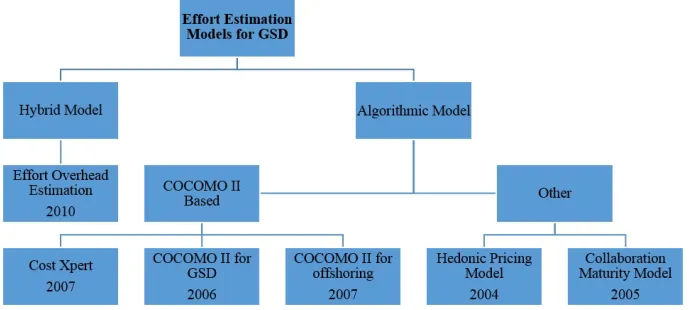
The identified models can be divided into two categories, based on the approach used for their development, as shown in Figure 3. A detailed discussion on these models fol-lows with the authors critical review.
Fig. 3.Existing Effort Estimation Models for GSD
Figure 3 shows the name of the model and also which year it was introduced to il-lustrate the research trends on effort estimation in GSD over the last decade. All these models were introduced after 2004.
Effort Overhead Estimation -2010: The most recent work published to date (Nov 2010) is that of Lamersdorf, Fernndez-del Viso Torre et al. in [72]. Their model was designed specifically for developing individual cost models using expert estimations and project data. The initial development of the model is based on a Spanish GSD organisation which is the premier IT company in Spain and a leading IT multinational in Europe. Cost drivers for the specific distributed development context are identified and a causal model is built by conducting interviews with six of the most experienced practitioners in the company.
This method can be used in organisations where only a small amount of data is available. The CoBRA process comprises the following five steps.
1. Collect possible cost drivers 2. Rank and select cost drivers 3. Build causal model
4. Quantify causal relationships 5. Analyse past projects
The initial cost drivers for step 1 were collected based on the literature search and the results of previous empirical studies. The main focus of the collection of possible cost drivers was the identification of factors causing overheads in distributed development and other factors were disregarded. The selection of the factors and the determination of their causal relationship was done via group discussion. Afterwards, each expert estimated the quantitative impact of each factor on cost overhead. Using the data from past projects, the nominal productivity is then computed. Practitioners were asked to rank the selected cost drivers. These results were then aggregated into one list of factors and formed a causal model.
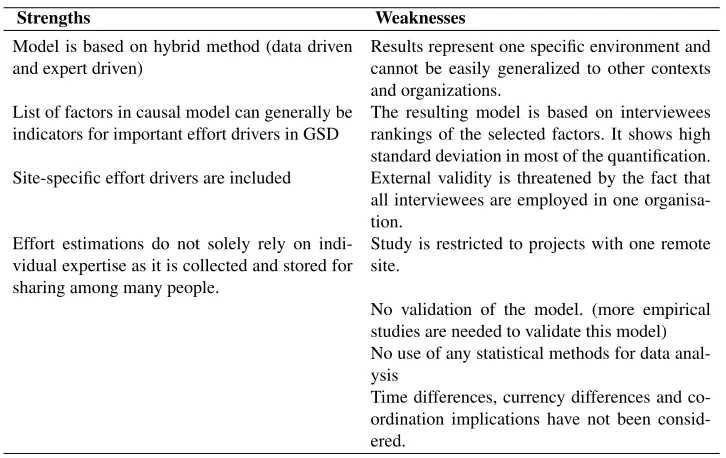
Unfortunately, steps 4 and 5 have not been completed and the model is yet to be validated. This will be done in future work. The unavailability of project data was the major obstacle for validation. The strengths and weaknesses of the model are presented in Table 7.
Table 7.Strengths and weaknesses of Effort Overhead Estimation
Strengths Weaknesses
Model is based on hybrid method (data driven and expert driven)
Results represent one specific environment and cannot be easily generalized to other contexts and organizations.
List of factors in causal model can generally be indicators for important effort drivers in GSD
The resulting model is based on interviewees rankings of the selected factors. It shows high standard deviation in most of the quantification. Site-specific effort drivers are included External validity is threatened by the fact that all interviewees are employed in one organisa-tion.
Effort estimations do not solely rely on indi-vidual expertise as it is collected and stored for sharing among many people.
Study is restricted to projects with one remote site.
No validation of the model. (more empirical studies are needed to validate this model) No use of any statistical methods for data anal-ysis
Time differences, currency differences and co-ordination implications have not been consid-ered.
on one company, it may not be applicable to other companies. It is recommended that a similar study be conducted with a large number of data sources and expertise from different companies around the globe.
COCOMO II Based Models: The Constructive Cost Model (COCOMO) II is the most widely used software development cost estimation model for collocated software devel-opment [73]. It is accepted internationally in organisations of all sizes [73]. The standard COCOMO 11 approach does not address the characteristic of distributed development in great detail. There is only multisite development cost driver linked to geographical distributed software development. As this is the only factor related to distributed devel-opment, it cannot reflect the inherent complexity and various overhead drivers for GSD. Therefore, it has been accepted that this model is not sufficient for effort estimation in GSD and many researchers have attempted to extend the COCOMO II model for the GSD environment.
Cost Xpert-2007: Cost Xpert is a different approach introduced by Madachy using CO-COMO II for distributed environments and has been adapted widely. As distributed sites in a GSD project might have different characteristics, this model suggests effort multi-pliers for every site. Cost Xpert is different to the other models as its work allocation is based on phase rather than module or specific function. It allows different calendars for multiple teams in a project. [74]. This model has been developed with the support of the University of Southern California (USC) Centre for Systems and Software Engineering to better estimate globally distributed projects.
The new model adapts traditional cost estimation formulas for distributed teams by using phase-sensitive effort multipliers. A project can be defined in terms of the distri-bution of software work by phase per team. The unique attributes of each team are also used in the calculations for more detailed and accurate estimation. The model leverages the phase-sensitivity of effort multipliers to capture the variance due to different team characteristics by phase [74].
Examples of major global companies helping with the model include Unisys, Wipro Technologies and Cognizant Technologies. Companies are using the model in its cur-rent spreadsheet form (until it is included in a future Cost Xpert product update). Data is being collected for further model validation and local calibrations. The strengths and weaknesses of the model are presented in Table 8.
This model is attractive as it considers cost factors related to people in different teams (labour calendar, labour categories, rates with local currencies) at different phases for the calculations. But collaboration and coordination which has a major impact in the global environment has not been considered for the estimation and additional effort drivers are not introduced.
Table 8.Strengths and weaknesses of Cost Xpert
Strengths Weaknesses
Work allocation by phase vs module Model may not be suitable for systems where work allocations are based on modules Different working calendars for each team is
possible
Collaboration and coordination has not been considered
Effort multipliers are phase sensitive No validation Industry collaboration No quantification
Additional cost drivers to COCOMO 11 are not introduced
complexity factors resulting from geographic distribution have been identified as follows, similar to the main classification of the effort multiplier cost drivers in COCOMO 11 [73]. These complexity factors below have been identified in several projects and are presented in different contributions (Siemens project):
– Product factors: Novelty of the software to be developed, architectural adequacy
– Personnel factors: Cultural fit, skill level, shared understanding, information sharing constraints
– Project Factors: Novelty of collaboration model, tools and infrastructure, physical distance
The objective of this research was to provide a decision-making framework for man-agers to calculate the trade-off between the collocated and distributed development of a software product. Evidence is not available to show whether the objective was achieved or not. Even though it suggests a set of new effort multipliers that consider the impact of distributed collaboration, it does not quantify the impact with a justification.
It is stated that further work for this research requires the verification and improvement of cost factors, calibrating the relevance of each project factor and refining the COCOMO II model for global software cost estimation [73]. It seems this is still at a very early stage and needs further research. Project data have been collected from globally distributed projects to increase the understandability of the system. They observed from the data that there was not only a cost associated with communication among sites but there was also an organizational cost associated with staff.
Table 9.Strengths and weaknesses of Refinement to COCOMO II for GSD
Strengths Weaknesses
Complexity factors resulting from geographical distribution have been identified and nine new effort drivers are introduced
No quantification of the identified complexity factors
Additional multipliers are categorised based on the original category in COCOMO II
No validation
Does not appear to be a systematic approach to identifying factors
COCOMO II for Offshoring-2007: The most comprehensive approach published to date on estimating the effort in distributed software projects is the extension to the well-known COCOMO II by Betz and Mki [75]. They focused on the widely used post-architecture model in COCOMO 11 and undertook the amplification of COCOMO II has been carried out in three steps. They started with the identification of additional cost drivers for distributed development, categorizing them into different groups and assigning a value for each group/driver [75].
The existing cost drivers of COCOMO II were analyzed and their relevance to global software development was identified [75]. Additional cost drivers for offshore outsourcing software development were identified by conducting a qualitative survey based on semi-structured interviews with German software producers [75]. Newly introduced factors identified in the interviews were categorized based on theoretical thought, the research in the literature and expert opinion.
Eleven new effort multipliers were added to the equation and these were termed Effort Multipliers Outsourcing (EMO) [75]. These factors were categorized into four groups: Outsourcing Factors, Buyers Outsourcing Maturity, Providers Outsourcing Maturity and Coordination Factors [75] which are presented in Table 10.
Table 10.Effort Multipliers Outsourcing (EMO) [75]
Outsourcing Factors Buyers Outsourcing Maturity
Providers Outsourc-ing Maturity
Coordination Factors
CULT BOXP OOXP OFIT
BALA BUPM PUPM PMGM
TMZN CODS - TESP
Outsourcing Factors: defines three basic and static cost drivers which may arise when collaborating with an international partner. The cost drivers are: cultural distance (CULT), barrier of language (BALA), and the different time zones (TMZN). The capabilities of the employees are not quantified by these factors because they are very abstract [75].
Buyers Outsourcing Maturity: defines cost drivers which specify the offshore outsourc-ing maturity of the buyer. Three factors are critical: buyers outsourcoutsourc-ing experience (BOXP), buyers project managers (BUPM), and contract design (CODS). The BOXP refers to the actual experience of the buyer with offshore outsourcing projects. The BUPM evaluates the capabilities of the buyers project manager in comparison with their offshore qualifi-cations. The CODS refers to the complexity of a collaboration contract [75].
Coordination Factors: are cost drivers originating from the interaction between two part-ners. The additional effort is represented by three factors: outsourcers fit (OFIT), project management (PMGM), and team spirit (TESP). The OFIT refers to the right selection of a particular partner. The wrong partner increases the effort. The PMGM refers to the increased effort which is inherent in any offshore outsourcing project. The TESP also decreases the possible effort by raising the team spirit through team building meetings, common goals, and a mixture of off- and onshore team members [75].
According to the COCOMO 11 categories and values, additional factors were cate-gorised and quantified with numerical values as the second and third phase of the ampli-fication process.
The estimated result of the amplified COCOMO II model shows that the effect of offshore outsourcing software development projects increases by at least 50 percent and at the most by 750 percent in the worst case scenario [75]. But it also indicates that there can still be a cost advantage as the wage level in some countries is eight times higher than in others [75].
They are aware of the lack of validation because of missing data on actual offshore outsourcing software development projects. But they claim that they are confident that this approach is heading in the right direction and it needs to be further calibrated.
It should be noted that this is still a work in progress and the model needs more calibration and validation [75]. This model has been simplified by reducing the number of collaborative companies to two, which is not always recommended in the context of GSD.
Table 11.Strengths and weaknesses of COCOMO II for Offshoring
Strengths Weaknesses
Most comprehensive models published for GSD in the literature.
Model has been simplified by restricting collab-oration companies to two.
Follows a systematic approach compared to other models published so far.
Lack of validation because of missing data of actual offshoring software development. 11 new effort drivers are introduced to
CO-COMO 11.
Quantification has not been conducted in a sys-tematic way and the derivation of numerical val-ues is not very clear.
Comparison of two similar modules with COCOMO 11: Several factors in COCOMO 11 are affected by GSD which encouraged the researchers in [75] to consider several factors from the existing model. Table 12 provides more detail.
Table 12.Comparison of two extensions to COCOMO II
COCOMO II Effort Drivers COCOMO II for GSD COCOMO II for Offshoring
Product (5) Not considered 1 document match to life cycle
needs
Platform (3) Not considered Not considered
Personnel (6) Not considered All personnel
Project (3) 1multisite development 1multisite development New Effort Drivers 9 new drivers were introduced 11 new drivers were introduced
Table 13.Comparison of existing effort estimation models
Factor Effort Overhead Estimation
COCOMO II for GSD
COCOMO II for offshore outsourc-ing
Cost Xpert 2007
Contributions Important factors for a particular company
No clear outcome Effort is higher in outsourcing
Consideration of dissimilar attributes at each site Main focus GSD effort
over-head Offshore insourc-ing Offshore outsourc-ing Distributed global development Modelling tech-nique
Hybrid Algorithmic Algorithmic Algorithmic
Development method
COBRA COCOMO II COCOMO II COCOMO II
Software size measure
Not considered KLOC, Function point KLOC, Function point KLOC, Function point Estimation method Qualitative and quantitative
Quantitative Quantitative Quantitative
Number of
projects used for the study
1 Based on the
litera-ture
Several projects 4
Number of remote sites supported
2 Not given 2 More than 2
Quantification/ calibration
Done partially Not done Done partially Used existing model (N/A)
Validation Not done Not done Done partially Not done
Evidence of in-dustry collabora-tion
Yes No No Yes
Site-specific effort drivers
Only general Only general Only general Considered specific
Site-dependent impact
Yes Yes Yes No
Task-dependent impact
Summary of the findings: The aforementioned discussion highlights the related work on effort estimation in GSD. According to the information presented in Table 13, the following observations can be made.
– Most of the models are based on quantitative algorithmic techniques and 75 percent of them are based on the widely used COCOMO 11.
– None of the models performs proper calibration so they are not in a form which is suitable for use.
– The models have not been empirically validated.
– None of the models addresses the two main GSD-specific characteristics sufficiently. Only the CostXpert model considers dissimilar attributes in each site but it does not have new GSD effort drivers to measure communication and coordination overhead in a distributed environment. The other two extensions to COCOMO 11 have new effort drivers to measure additional effort but they do not consider dissimilar attributes in each location.
– All the existing studies on GSD effort overhead calculations are limited to two remote sites and therefore, complexity in multi-site interaction has received limited attention.
– Site-dependent parameters have been considered to an acceptable level whereas task-dependent parameters have received limited attention.
– All these models are still at an early stage and further research is required to improve them and make them suitable for use in practice.
Overall, the above review of the existing literature related to GSD effort estimation methods has enabled the identification of the following knowledge gaps which need to be addressed in future research.
– The effort model should address both dissimilar attributes at each site and GSD over-heads related to collaboration.
– Effort versus cost in GSD: The existing models mainly aim to calculate effort only. In the literature on collocated effort estimation, no difference is usually made between effort and cost. This is mainly because all costs in software development are personnel costs, which depend directly on effort. However, in GSD, cost rates differ between sites. Therefore, effort and cost cannot be used as synonyms in the GSD context and the estimation of effort is not sufficient for decision making, hence a cost estimation model is also required.
– The evaluation of GSD overhead in multiple interactions: The existing suggestions are limited to overhead calculation when only two sites are connected. When the distributed site has multiple interactions, additional impact analysis is not straightfor-ward and a standard procedure is needed. Figure 4 shows an example of five different sites to illustrate the increased complexity.
– The following concerns are noted in relation to the calculation of GSD overhead at each site:
• The calculation of additional effort for S3, S4 and S5 is quite straightforward as they interact with only one other site.
Fig. 4.Interaction between geographical locations
in nature (language differences, cultural differences etc.), these values cannot be added together. It is necessary to devise a standard scale which considers both the interaction values and the number of interactions. To obtain the interaction value, work dependency must be known.
– Model calibration and validation: The scarcity of GSD project data in the public do-main prevents the calibration and validation of the models.
– The literature review indicates that communication and coordination impacts are un-predictable if the work dependency among sites is unknown. Therefore, the lack of a systematic work allocation method has become a major hurdle for accurate effort estimation in GSD.
Q4. What systematic studies have been conducted on effort estimation in GSD?
No systematic literature surveys have been conducted on effort estimation models in GSD whereas surveys have been conducted on cost estimation approaches [27], systematic re-views [76] and software estimation techniques for traditional collocated software develop-ment [77]. Our study reflects that this is a high time to conduct a proper systematic review on effort estimation in GSD. This is evidenced by the large number of research papers recently published in this discipline which create the requirement of having a systematic arrangement of published research work for future researchers quick reference.
At the International Conference on Global Software Engineering 2010, the prelimi-nary results from a survey conducted in a multinational organization on the application of estimation techniques in GSD projects [78] was presented. The survey was carried out using an online questionnaire to record the opinions of people in the selected organization which has 3595 employees in the IT department. Recommendations were given based on the 551 answers received from the employees in the IT department. According to the sur-vey results, estimation techniques used for GSD applications in this company are Delphi, Function points, Planning Poker, Usecase points, Expert judgment and Historical data. Some of the employees were not aware of the techniques used for estimation.
involved in the project. Further, it can be seen that although different kinds of effort esti-mation techniques are used by GSD projects, none of them is considered a proper model for the distributed global environment.
4.
Research Directions and Future Challenges
The systematic study conducted on effort estimation in GSD clearly indicates that effort estimation has become a prominent research problem in the software engineering disci-pline. Many researchers have worked in this area, some since the early 2000s. Our survey shows the importance of effort estimation and the contribution of the knowledge of many researchers to enhance the immature area of effort estimation in GSD. In this section, we identify the unsolved challenges in this area. In particular, different research directions in relation to effort estimation in GSD are discussed.
Research Direction: Answering the questions in section 3 will open an avenue for new research challenges. A new question that can be formulated is as follows:
How should the effort of a distributed offshore software development/GSD project be estimated in order to increase the chance of success?
The previous discussion provides a foundation and basic information on the complex-ity of GSD and the available methods in the literature for effort estimation. According to the definition of project success, if the project can be completed within the planned budget while achieving other goals such as time, scope and quality, the project will be successful. By introducing a proper model to estimate the development cost, the success rate of a globally distributed project can be improved.
How can a negative influence on the success of offshore development projects be quantified? If organizations can find an answer to this question, they will be able to select the best offshoring partner who has a less negative impact before starting the project. This will solve the problem to a certain level. This solution has become a viable one as many potential offshoring partners are available all over the world with attractive labour costs at first sight. However, it has been realized that attractive cheap labour does not show the true picture. Hence, many researchers have already highlighted the significance of the problem and the importance of effort estimation in GSD.
Balancing the success factors and coordination measures: In the introduction, we mentioned that the main reason for offshoring is the reduction of software development costs. The expectation of cost reduction is mostly not realized [80]. The main reason for this is that not all costs involved in the process of GSD are included in the cost estimation. The expected cost reduction is mostly based on lower wages in other countries. The co-ordination measures should be added into an offshore software development project. This costs extra time and money. Sakthivel (2005) [3] mentions sourcing, contracting, project management and risk estimation costs as part of this increase in costs.
In short, the problem we have is: does offshoring save money? To answer this ques-tion, the following points can be made:
1. Offshoring allows cheap labour
3. Quality communication requires proper coordination measures 4. Coordination measures cost money
1 is less than OR greater than 4 decides whether it is worthwhile to go offshore. Our analysis indicates that all the models proposed by researchers are still in their early stages. A detailed discussion with a critical review is given in section 3, which shows that the communication and coordination which has a great impact on the GSD effort has not been considered in the proposed models. All the models proposed to date mainly focus on traditional software development in a global environment using collo-cated models which have been extended. Most of these models were developed in the seventies and eighties. Thus, it is doubtful that the foundations of these models are ap-plicable to todays technology. But when we observe the technological advancements of the software industry, component-based software development, service-oriented architec-ture, open-source software development and enterprise resource planning are the widely used emerging technologies. Component-based software development (CBSD) is more suitable for GSD as it can easily recombine and reuse new products [82]. It has been sug-gested that CBSD will improve GSD practices by allowing each site to take ownership of particular components, which in turn, will result in reduced inter-site communication and coordination activities [83]. Hence, scholars should focus on developing effort estimation models for globally distributed development using the emerging technologies.
Although, none of the models proposed so far is sufficient to estimate the required effort for GSD using the emerging technologies, these models have made a valuable con-tribution for future research with their findings. For example, task allocation methods, the impact of collaboration maturity, suitable contract types based on the type of project and the identification of cost drivers in GSD are some of the significant contributions to future research in this area.
Success in terms of scope, quality, time and costs is dependent on the choice of coordi-nation measures. A firm has to choose the right coordicoordi-nation measures in order to achieve success. If costs are important and time and quality are less important, less coordination measures are required. If time or quality is important, the offshore project needs extra coordination measures. This was also noted by Harmsen, Lubbers and Wijers (1995) [81]
5.
Conclusions
It is very challenging and almost impossible to propose a model suitable for use across the globe as required by the nature of GSD. Since GSD scenarios are diverse, what works in one context might not directly apply in another. Hence, a one-fits-all solution is not applicable and will not be of much use to anyone. Thus, we need to devise a model which is customisable, based on the factors which are relevant to where the software is developed. Hence, our next step is to select the most widely used technology for global software development and design a research framework to develop an estimation model for the selected technology, incorporating additional the cost drivers involved in GSD. As the design specification is the input for most software estimation models, it is necessary to investigate how a design specification (software architecture) differs when software is developed in a globally distributed environment.
Table 14.Issues in software effort estimation
Issue Description
Definition Lack of clear and accepted definitions for drivers, such as size, quality, com-plexity, experience, etc.
Quantification The majority of the cost drivers are hard to quantify. Often one has to use mea-sures such as many, moderate, few, etc.
Objectivity Subjectivity
This is a potential risk factor. What may be complex for developer A may not be complex for developer B.
Correlation It is difficult to consider one driver by itself. A change in the value of driver A may have consequences for the values of several other cost drivers. This makes measurability difficult.
Relation be-tween driver and effort
For estimation, it is important to predict the relation between, for example, soft-ware size and the required effort, a specified quality level and required effort, etc. From the literature, we know that there is little clarity around these rela-tions.
Calibration It is impossible to talk about ”the most important” cost drivers in isolation. It differs from situation to situation.
Effectiveness and efficiency
There is conflict between effectiveness and efficiency. From the effectiveness perspective, it is worthwhile to pay a lot of attention to, for example, user partic-ipation. For the efficiency of a project, it is justifiable to avoid user involvement. Human factors Almost all research agrees on the dominating influence of cost drivers, such as experience and quality of the personnel. This means that investment in ’good’ developers is important.
Reuse In many studies, reuse is regarded as (one of) the most important ways to in-crease productivity.
summa-rize progress in order to see the big picture of the published research to identify gaps and commonalities [19].
In addition to the above challenges, there are several common issues which apply to estimation models. In estimation, it is necessary to identify the most dominant cost factors. When making an estimation, one has to identify which cost drivers are the most important for the specific situation, what the values are for the cost drivers and what influences the effort. There are several issues that need special attention in software effort estimation which are presented in Table 14.
Acknowledgments.A La Trobe University postgraduate scholarship and a write-up awards which supported this work are hereby acknowledged by the first author.
References
1. P. Taylor, D. Greer, P. Sage, G. Coleman, K. McDaid, and F. Keenan, ”Do agile GSD experience reports help the practitioner?,” Proceedings of the international workshop on Global software development for the practitioner, pp.87-93, 2006.
2. J. Herbsleb and D. Moitra, ”Global software development,” Software, IEEE, vol. 18, pp. 16-20, 2002.
3. S. Sakthivel, ”Virtual workgroups in offshore systems development,” Information and Software Technology, vol. 47, pp. 305-318, 2005.
4. D. mite and J. Borzovs, ”Managing Uncertainty in Globally Distributed Software Development Projects,” Datorzin tne un inform cijas tehnolo ijas, p. 9, 2008. 5. R. Prikladnicki and J. Audy, ”Process models in the practice of distributed software
development: A systematic review of the literature,” Information and Software Tech-nology, 2010.
6. M. Maznevski and K. Chudoba, ”Bridging space over time: Global virtual team dy-namics and effectiveness,” Organization science, vol. 11, pp. 473-492, 2000. 7. D. Smite, ”Project Outcome Predictions: Risk Barometer Based on Historical Data,”
in International Conference on Global Software Engineering(ICGSE 2007), 2007, pp. 103-112.
8. M. Fabriek, M. van den Brand, S. Brinkkemper, F. Harmsen, and R. Helms, ”Im-proving offshore communication by choosing the right coordination strategy,” Cite-seer2007.
9. E. Conchir, P. gerfalk, H. Olsson, and B. Fitzgerald, ”Global software development: where are the benefits?,” Communications of the ACM, vol. 52, pp. 127-131, 2009. 10. E. Conchuir, H. Holmstrom, P. Agerfalk, and B. Fitzgerald, ”Exploring the assumed
benefits of global software development,” in International Conference on Global Soft-ware Engineering(ICGSE 2006) 2006, pp. 159-168.
11. C. Ebert and P. De Neve, ”Surviving global software development,” Software, IEEE, vol. 18, pp. 62-69, 2001.
12. G. Seshagiri, ”Global Software Development-Point/Counterpoint-GSD: Not a Busi-ness Necessity, but a March of Folly,” IEEE Software, vol. 23, pp. 62-65, 2006. 13. W. DeLone, J. Espinosa, G. Lee, and E. Carmel, ”Bridging global boundaries for IS
14. R. Aron and J. Singh, ”Getting offshoring right,” Harvard business review, vol. 83, p. 135, 2005.
15. N. Huda, N. Nahar, J. Tepandi, and P. S. Deo, ”Key barriers for global software product development organizations,” in Management of Engineering and Technology, 2009. PICMET 2009. Portland International Conference on, 2009, pp. 1081-1087. 16. P. gerfalk, B. Fitzgerald, H. Holmstrm Olsson, and E. Conchir, ”Benefits of global
software development: The known and unknown,” Making Globally Distributed Soft-ware Development a Success Story, pp. 1-9, 2008.
17. D. Damian and D. Moitra, ”Guest Editors’ Introduction: Global Software Develop-ment: How Far Have We Come?,” Software, IEEE, vol. 23, pp. 17-19, 2006. 18. E. Carmel and R. Agarwal, ”Tactical approaches for alleviating distance in global
software development,” Software, IEEE, vol. 18, pp. 22-29, 2001.
19. D. mite, C. Wohlin, R. Feldt, and T. Gorschek, ”Reporting Empirical Research in Global Software Engineering: a Classification Scheme,” 2008.
20. M. Robinson and R. Kalakota, ”Offshore outsourcing: Business models, ROI and best practices,” Atlanta, GA: Mivar Press, Inc, 2004.
21. J. Miguel, ”Challenges and improvements in distributed software development: A systematic review,” Advances in Software Engineering, vol. 2009, 2009.
22. N. Moe and D. mite, ”Understanding lacking trust in global software teams: A multi-case study,” Product-Focused Software Process Improvement, pp. 20-34, 2007. 23. R. Gonzalez, J. Gasco, and J. Llopis, ”Information systems outsourcing: A literature
analysis,” Information and management, vol. 43, pp. 821-834, 2006.
24. A. Avritzer, D. Paulish, Y. Cai, and K. Sethi, ”Coordination implications of software architecture in a global software development project,” Journal of systems and soft-ware, 2010.
25. B. Kitchenham and S. Charters, ”Guidelines for performing systematic literature re-views in software engineering,” Engineering, vol. 2, 2007.
26. B. Kitchenham, ”Procedures for performing systematic reviews,” Keele, UK, Keele University, vol. 33, 2004.
27. B. Boehm, C. Abts, and S. Chulani, ”Software development cost estimation approach-esA survey,” Annals of software engineering, vol. 10, pp. 177-205, 2000.
28. M. Shepperd, ”Software project economics: a roadmap,” in Proceedings of the In-ternational Conference on Software Engineering - Future of Software Engineering (FOSE ’07), 2007, pp. 304-315.
29. S. Sharma, ”Global Software Development-Point/Counterpoint-Making Global Soft-ware Development Work,” IEEE SoftSoft-ware, vol. 23, p. 62, 2006.
30. J. D. Herbsleb and R. E. Grinter, ”Splitting the organization and integrating the code: Conway’s law revisited,” in Software Engineering, 1999. Proceedings of the 1999 International Conference on, 1999, pp. 85-95.
31. J. Espinosa and E. Carmel, ”The effect of time separation on coordination costs in global software teams: A dyad model,” in Proceeding of the 37th Hawaii International Conference on System Sciences, 2004, p. 10.
32. A. Delmonte and R. McCARTHY, ”Offshore software development: Is the benefit worth the risk,” 2003, pp. 16071613.
34. A. Almeida, R. Souza, G. Aquino, and S. Meira, ”Effort Drivers Estimation for Brazilian Geographically Distributed Software Development,” Software Engineering Approaches for Offshore and Outsourced Development, pp. 60-65, 2009.
35. A. Khan and Z. Muhammad, ”Exploring the Accuracy of Existing Effort Estimation Methods for Distributed Software,” 2009.
36. K. Chan and L. Chung, ”Integrating process and project management for multi-site software development,” Annals of software engineering, vol. 14, pp. 115-143, 2002. 37. D. Damian, F. Lanubile, and H. Oppenheimer, ”Addressing the challenges of software
industry globalization: the workshop on Global Software Development,” in ICSE ’03 Proceedings of the 25th International Conference on Software Engineering, 2003, pp. 793-794.
38. D. Farrell, ”Smarter offshoring,” Harvard business review, vol. 84, p. 84, 2006. 39. G. Davis, P. Ein-Dor, W. King, and R. Torkzadeh, ”IT offshoring: History, prospects
and challenges,” Journal of the Association for Information Systems, vol. 7, pp. 770-795, 2006.
40. H. Holmstrom, E. Conchuir, P. Agerfalk, and B. Fitzgerald, ”Global software devel-opment challenges: A case study on temporal, geographical and socio-cultural dis-tance,” 2006.
41. J. Herbsleb, A. Mockus, T. Finholt, and R. Grinter, ”Distance, dependencies, and delay in a global collaboration,” 2000, pp. 319-328.
42. M. Bass and D. Paulish, ”Global software development process research at Siemens,” in The 3rd International Workshop on Global Software Development, 2004, pp. 11-14.
43. R. Grinter, J. Herbsleb, and D. Perry, ”The geography of coordination: dealing with distance in R and D work,” 1999, pp. 306-315.
44. R. Ravichandran and N. Ahmed, ”Offshore systems development,” Information and management, vol. 24, pp. 33-40, 1993.
45. S. Krishna, S. Sahay, and G. Walsham, ”Managing cross-cultural issues in global software outsourcing,” Communications of the ACM, vol. 47, pp. 62-66, 2004. 46. W. Aspray, F. Mayadas, and M. Vardi, ”Globalization and offshoring of software,”
Report of the ACM Job Migration Task Force, Association for Computing Machinery, 2006.
47. J. Herbsleb, A. Mockus, T. Finholt, and R. Grinter, ”An empirical study of global software development: distance and speed,” 2001, pp. 81-90.
48. A. Gopal, T. Mukhopadhyay, and M. Krishnan, ”The role of software processes and communication in offshore software development,” Communications of the ACM, vol. 45, pp. 193-200, 2002.
49. M. Jennex and O. Adelakun, ”Success factors for offshore information system de-velopment,” Journal of Information Technology Cases and Applications, vol. 5, pp. 12-31, 2003.
50. C. Cramton, ”The mutual knowledge problem and its consequences for dispersed collaboration,” Organization science, vol. 12, pp. 346-371, 2001.
51. J. Dibbern, J. Winkler, and A. Heinzl, ”Explaining variations in client extra costs between software projects offshored to India,” MIS quarterly, vol. 32, pp. 333-366, 2008.
53. J. Herbsleb, D. Paulish, and M. Bass, ”Global software development at siemens: ex-perience from nine projects,” 2005, pp. 524-533.
54. P. gerfalk, B. Fitzgerald, H. Holmstrm, B. Lings, B. Lundell, and E. Conchir, ”A framework for considering opportunities and threats in distributed software develop-ment,” 2005, pp. 4761.
55. M. Rao, ”Key issues for global IT sourcing: Country and individual factors,” ED-PACS, vol. 32, pp. 1-11, 2004.
56. J. Espinosa, N. Nan, and E. Carmel, ”Do gradations of time zone separation make a difference in performance? A first laboratory study,” 2007, pp. 12-22.
57. M. Muhairat, S. Aldaajeh, and R. Al-Qutaish, ”The Impact of Global Software De-velopment Factors on Effort Estimation Methods,” European Journal of Scientific Research, vol. 46, pp. 221-232, 2010.
58. C. Ranganathan and S. Balaji, ”Critical capabilities for offshore outsourcing of infor-mation systems,” Working Papers on Inforinfor-mation Systems, 2007.
59. B. Businessweek, ”The Hidden Cost of IT Outsourcing,” 2003.
60. S. Overby, ”The hidden costs of offshore outsourcing,” CIO-FRAMINGHAM MA-, vol. 16, pp. 60-66, 2003.
61. neoIT, ”RESEARCH SUMMARY: Total Cost of Offshore (TCO): Understanding The True Offshore Financial Rewards and Costs,” Offshore Insights White Paper Series, vol. Volume 2, Issue 4, 2004.
62. N. Gorla and Y. Lam, ”Who should work with whom?: building effective software project teams,” Communications of the ACM, vol. 47, pp. 79-82, 2004.
63. P. Pendharkar and J. Rodger, ”The relationship between software development team size and software development cost,” Communications of the ACM, vol. 52, pp. 141-144, 2009.
64. S. Faraj and L. Sproull, ”Coordinating expertise in software development teams,” Management Science, vol. 46, pp. 1554-1568, 2000.
65. R. Hirschheim and M. Lacity, ”The myths and realities of information technology insourcing,” Communications of the ACM, vol. 43, pp. 99-107, 2000.
66. M. Murray and R. Crandall, ”IT offshore outsourcing requires a project management approach,” SAM Advanced Management Journal, vol. 71, p. 4, 2006.
67. J. Barthelemy, ”The hidden costs of IT outsourcing,” Sloan Management Review, vol. 42, pp. 60-69, 2001.
68. D. Bradstreet, ”Dun and Bradstreet’s Barometer of Global Outsourcing,” ed. Business Wire: vol, 2000.
69. M. Amberg, G. Herold, R. Kodes, R. Kraus, and M. Wiener, ”IT Offshoring-A Cost-Oriented Analysis,” Manuscript for the CISTM,, 2005.
70. I. Computer Aid, ”The Challenges of Offshore Outsourcing: Understanding the Risks and Hidden Costs,” World Leaders in IT Process and Productivity, 2004.
71. C.W. L. I. I. P. a. Productivity, ”Use Field-Proven Techniques to Avoid the Hidden Costs of IT Outsourcing, Computer Aid News and Notes.”
72. A. Lamersdorf, A. Fernndez-del Viso Torre, J. Mnch, C. Snchez, and D. Rombach, ”Estimating the Effort Overhead in Global Software Development,” International Conference on Global Software Engineering(ICGSE 2010), 2010.
74. R. Madachy, ”Distributed global development parametric cost modeling,” Software Process Dynamics and Agility, pp. 159-168, 2007.
75. S. Betz and J. Mki, ”Amplification of the COCOMO II regarding Offshore Software Projects,” Offshoring of software development, p. 33, 2008.
76. M. Jorgensen and M. Shepperd, ”A systematic review of software development cost estimation studies,” Software Engineering, IEEE Transactions on, vol. 33, pp. 33-53, 2006.
77. M. Nasir, ”A Survey of Software Estimation Techniques and Project Planning Prac-tices,” Proceedings of the Seventh ACIS International Conference on Software En-gineering, Artificial Intelligence, Networking and parallel!Distributed Computing, 2006.
78. C. Peixoto, J. Audy, and R. Prikladnicki, ”Effort Estimation in Global Software De-velopment Projects,” International Conference on Global Software Engineering(ICGSE 2010), 2010.
79. E. Carmel and P. Tjia, Offshoring information technology: sourcing and outsourcing to a global workforce: Cambridge Univ Pr, 2005.
80. R. Kuni and N. Bhushan, ”IT application assessment model for global software devel-opment,” in International Conference on Global Software Engineering(ICGSE 2006), 2006, pp. 92-100.
81. F. Harmsen, I. Lubbers, and G. Wijers, ”SuccessDriven Selection of Fragments for Situational Methods: The S3 Model,” 1995, pp. 104-115.
82. J. Kotlarsky, I. Oshri, J. Hillegersberg, and K. Kumar, ”Globally distributed component-based software development: an exploratory study of knowledge management and work division,” Journal of Information Technology, vol. 22, pp. 161-173, 2007. 83. J. Kotlarsky, I. Oshri, J. van Hillegersberg, and K. Kumar, ”Globally distributed
component-based software development: an exploratory study of knowledge manage-ment and work division,” Journal of Information Technology, vol. 22, pp. 161-173, 2007.
Dilani N.Wickramaarachchi received her PhD degree in Computer Science and Com-puter Engineering from La Trobe University (LTU), Australia. She holds the MSc degree in Computer Science from University of Colombo School of Computing, Sri Lanka and the BSc degree in Industrial Management and Information Technology from University of Kelaniya, Sri Lanka, She is a senior lecturer in the department of Industrial Management, Faculty of Science, University of Kelaniya. Her current research interest areas are global software development, software testing and software measurement.
Richard Lai is with the Department of Computer Science and Information Technology at La Trobe University, Australia. Prior to joining La Trobe, he has spent more than 10 years in the computer and communications industry. He was ranked as the worlds number one scholar in systems and software engineering consecutively for four years (1999-2002), according to an annual survey published in the Journal of Systems and Software. His cur-rent research interests include component-based software system, software measurement, requirements engineering, and global software development.