Available online on 15.09.2016 athttp://jddtonline.info
Journal of Drug Delivery and Therapeutics
An International Peer Reviewed Journal Open access to Pharmaceutical and Medical research
© 2016, publisher and licensee JDDT, This is an Open Access article which permits unrestricted noncommercial use, provided the original work is properly cited
RESEARCH ARTICLE
EVALUATION OF OINTMENT ACTIVITY BASED ON
TERMINALIA MANTALY
EXTRACT
Soumahoro
Ibrahima aimé
1, d’Almeida Kayi Marie-Anne
1, 2, GNAHOUE Goueh
4,
KRA Adou Koffi Mathieu
1, DJAMAN Allico Joseph
1 ,321
Laboratory of Biochemical Pharmacodynamic, UFR Biosciences, University of Felix Houphouet Boigny 22 B.P. 582 Abidjan 22 Côte d’Ivoire
2
Laboratory of molecular biology UFR of Biosciences, Université Felix Houphouet Boigny 22 B.P. 582 Abidjan 22 Côte d’Ivoire
3
Departement of clinical and fundamental Biochemestry Unit of Pasteur Institute (Côte d’Ivoire) 01 BP 490Abidjan 01
4
Laboratory of Biochemestry Microbilogy Ecole Nationale Supérieur ENS
*Correspondance and drawn with share, Email [email protected] Cell: 22505247000
Received 14 June 2016; Review Completed 02 Sep 2016; Accepted 02 Sep 2016, Available online 15 Sep 2016
DOI: http://dx.doi.org/10.22270/jddt.v6i5.1314 URI: http://jddtonline.info/index.php/jddt/article/view/1314
ABSTRACT
In Côte d’Ivoire pharmacopoeia the antifungal virtues of the bark of Terminalia mantaly are known. It bark is used to cure affections such as cutaneous candidiasis, gingivitis and diarrhoea. This work aims to compare the anticandidosic activities of the crude extract of T. mantaly and an ointment containing shea butter and the crude extract of T. mantaly. The anticandidosic activity of the crude Shea butter was also evaluated and kétoconazole was used as standards for antifungal assay.
Shea butter, kétoconazole, crude extract of T. mantaly and the ointment were separately incorporated to Sabouraud agar using the agar slanted double dilution method. The anti-fungal tests were performed by sowing 1000 cells of Candida albicans on a previously prepared medium culture. Antifungal activity was determined by evaluating of anti-fungal parameters values (minimal fungicidal concentrations MFC and IC50).
The results of the tests indicate that C. albicans is sensitive to each substance tested, however crude Shea butter has only fungistatic activity and the ointment (MFC= 1.874µg/mL) was the most active. This ointment is 52 times more active than the crude extract of T mantaly (MFC is of 97.5 µg/mL), 208.11 more active than kétoconazole (MFC = 390 µg/mL).
Keywords: Terminalia mantaly, Activity, ointment
INTRODUCTION
In the world, the infectious diseases knew higher fresh outbreak during the last decades (1Dromer et al., 2013).The diseases due to pathogenic resistant species are in great progression (2Assob and Nsagha, 2014) and mycosis are among these pathologies (3 Hitchkock, 1993: 1Dromer et al., 2013; 2Assob and Nsagha, 2014). This fresh outbreak of mycosis comes from several factors. Among them, change in the clinical spectrum of classic pathogenic, apparition of diverse resistances in the usual antifungals and the strong progress of immunodépressive affections such as HIV-AIDS (3 Chabasse, 1994; 4 Chabasse et al., 2009; 1Dromer et al., 2013). Their frequency, their recurring character and their gravity did not cease growing in West Africa generally and in Côte d'Ivoire in particular (5 Akakpo-Akue, 2009; 6Attoh-Toure et al., 2009).
Furthermore, at the end of an ethnobotanic survey realized by our research team in 1991 in the area of Issia in Côte d'ivoire, T mantaly was collected and identified among this plants species frequently used for their anti-infectious properties (18 Zirihi, 1991). In Côte d'ivoire,this plant is used against gastroenteritidis, oral affections, skin disorders, genital candidiasis, arterial high blood pressure and diabetes (19 Riviere et al., 2005, 20 Yayé et al., 2012). Otherwise, recent works proved
that T. mantaly possesses excellent antibacterial and antifungal activities (15 Kueté et al., 2010; 21-22Yayé et al., 2011 et 2012; 23 Ackah et al., 2014; 24 Kra et al., 2014). For better appreciation of the use of T mantaly in human therapeutics, the present study was initiated to evaluate and compare the anticandidosic activities of the crude hydroethanolic extract of T. mantaly and to those of the ointment formulated from this extract.
MATERIAL AND METHODS
Plant Material
Bark of Terminalia mantaly
The Plant material was a powder obtained after crushing the dried bark pieces of T mantaly codified TEKAM1.
Shea Butter
The Shea butter (SB) was extracted from nuts of
Butyrospermum parkii (G Don) Kotschy (Sapotaceae).
This species spontaneously grows in the north of Côte d'Ivoire. The SB was heated and purified by decantation.
Microorganism Studied
The tested fungus was the clinical and identified strain
of C. albicans (13-298). This strain was provided by the
Laboratory of Mycology of the Medical Sciences Faculty of the Felix Houphouët Boigny University (Abidjan, Côte d'Ivoire).
METHODS
Preparation of the vegetable extracts
Extraction
The plant bark was cut into small pieces and carefully air-dried for 2 weeks at room temperature in the laboratory, under continuous ventilation, away from sunlight and dust. After this step, the vegetal piece was crushed to a fine powder with an electric grinder IKA-MAG. The powder obtained were codified TEKAM1.
The hydro-ethanolic rough extracts were prepared from TEKAM1. Hundred grams (100g) of bark powder was extracted by homogenization in a blender with 1 L of mixture of ethanol 70% and distilled water 30%. After six cycles of homogenization, the homogenates obtained were first wrung out in a fabric square and then filtered twice successively with absorbent cotton and once with Whatman 3 mm filter paper. The resulting filtrate was concentrated under vacuum using a Büchi rotary evaporator at 60°C (25 Zirihi et al., 2011). This powder was hermetically sealed in polyethylene bags and stored away from light and moisture until the time of
extraction. Dark powder obtained is the hydro-ethanolic crude extract codified TEKAM1-X0
The shea butter (SB)
SB is a clear yellow product. It was used as excipient main of the ointment. It melting point is between 33 and 42 °C. Its density at 15°C is between 0,915 and 0,920.
Oitment Quality
Macroscopic Characters
The clear brown ointment obtained by the mixture of Shea and extract TEKAM 1- X0 codified TEPOM. It is an unctuous cream with soft consistency. The smell like of the Shea butter
Homogénéity
The ointment homogeneity was verified by applying on thin (confinement) layer a plane surface using a spatula. The regular distribution or not of the extracts in excipient was noted. It presents a very homogeneous without curds and smooth aspect to the touch.
pH Measure
The pH determined was that of a dilution to the tenth of the ointment in heater distilled water. The pH obtained is generally 5, 5.
Medium and ointment preparation
The anti-fungal tests were carried out on culture medium Sabouraud (Biomerieux / Ref: 180930; batch 401513b). The incorporation of plant extracts into the agar was made using the agar slanted double dilution method (26 Ajello et al., 1963; 27 Holt, 1975; 28 Zirihi et al., 2003).
For each substance as TEKAM1, SB, and the ointment, serial tests were realized and each serie include 12 tests tubes. Ten test tubes contain mixture of vegetable extract and agar. The others 2 tubes constitute the pilot. Among these two tubes, one without vegetable extract was considered as witness of germs growth control while the second without germs and extract was constitute witness of culture medium sterility control growth. Extract concentrations range in the tubes from 2500µg/mL to0,003µg/mLwith geometrical connection of reason ½. All the tubes were pressure-sealed at 121°C during 15 min, and then tilted with small base at room temperature to allow their cooling and solidification of the agar (29Ackah, 2004; 30Teas, 2008; 31Kporou, 2009; 22Yayé, et al., 2011; 32Ouattara et al., 2013).
To obtain the ointment codified TEPOM, 48g of Shea butter were added by small fractions to 2g of TEKAM1 -X0 and mixed until obtaining complete homogeneity (33Raoult, 1983; 34Mathieu and Fonteneau, 2008;35 Klusiewicz, 2008; 36Charpentier 2008; 37Mautrait and Raoult, 2009). Dimethylsulfoxide (DMSO with 1%) was used to facilitate the homogenization of both substances (38Boutet, 1967; 39Bean et al., 1969).
Anti-microbial test
Fungal germs culture on slanted agar previously prepared was made by sowing 1000 cells of C. albicans
for 48 h. At the end of the incubation time, colonies were counted out by direct counting with a colony counter pen (Ceinceware, number 23382). The growth in the 10 experimental tubes was expressed as survival percentage, calculated, compared to 100% of growth in the growth control tube. The formula to calculate this is shown below.
The processing of these data permitted to calculate the MFC values. (26Ajello et al., 1963; 28Holt, 1975) In practice, the MFC is the extract concentration in the tube, which gave 99.99% inhibition compared to the control growth tube It also made possible to plot the curves of activity of the extracts and the graphically determination of the IC50 values.
Formula to calculate the survival percentage:
S: Survival (%)
n: Number of colony in one experimental tube
N: Number of colony in the growth control tube.
RESULTS
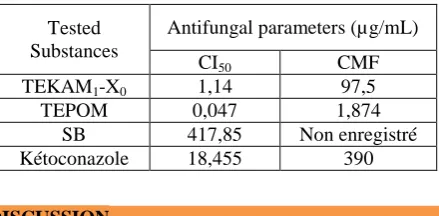
After 48 hours of incubation at 30ºC, we observed comparatively to control tube a progressive decrease in the number of colonies gradually as the concentrations of the plant extract increased in the experimental tubes. The results were summarized in the form of curves of activity on Figure 1 and in table I containing the various values of MFC and IC50.
In general, all sensitivity curves showed a progressively decreasing pace with slopes that are stronger or not as strong according to the extracts. The TEPOM accentuated slope curve illustrates high anti-fungal potency. In contrast the Shea slope curve is less accentuated. It reveals low anti-fungal potency of this SB.
Figure 1: Sensitivity of Candida albicans to TEKAM1-X0, SB, TPOM and Kétoconazole
Table I: Values of anti-fungal parameters of TEPOM, TEKAM1- X0 and Kétoconazole
Tested Substances
Antifungal parameters (µg/mL)
CI50 CMF
TEKAM1-X0 1,14 97,5
TEPOM 0,047 1,874
SB 417,85 Non enregistré
Kétoconazole 18,455 390
DISCUSSION
The analysis of the whole results shows that C. albicans
is sensitive to all substances tested namely TEKAM1-X0, SB, TEPOM and Kétoconazole according to relation dosis-dependent. However, the levels of these anti-fungal activities are variable from one substance to another.
According to the classification scale of the levels of the activities of 24Kra et al.,(2014), TEPOM, TEKAM1-X0
and Kétoconazole anti-fungal activities are classified as very high levels of activity. The anticandidosic activity of SB is very low. Among these substances, TEPOM is
most active on C. albicans for having generated the lowest values of MFC (1.874µg/mL) and IC50 (0.047µg/mL). In contrast, of TEPOM, SB was the less active. It generated a fungistatic activity because none tested concentration completely inhibited the growth of
C albicans. On picture 1, its activity curve slope is very
weak. The activities of TEKAM1-X0 (MFC=97.5µg/mL and IC 50 = 1.14µg/mL) and Kétoconazole (MFC = 390µg/mL and IC 50 = 18.455µg/mL) range between these two extremes.
On the basis of CMF and IC50 values, the comparison reveals that TEKAM1-X0 is 4 times more active than Kétoconazole and 366.53 times more active than SB. Moreover, TEPOM is 52.02 times more active than TEKAM1-X0, 208.64times more active than Kétoconazole and 8890.42 times more active than SB. So, incorporation of TEKAM1-X0 extract in the Shea butter has generated a strong increase in the antifungal activity of this crude extract. This activity was multiplied by 52.02. The SB has noticeably maximized anticandidosic activity of TEKAM1-X0. This TEPOM can be a cure against skin mycosis. A similar product has
0 25 50 75 100
0 97.5 195 292.5 390
Su
rviv
al
o
f
C.
alb
ica
n
s
(%)
concentration (µg/mL)
Pommade TEKAM1-Xo BK Ketoconazole
S=
N
n
already been formulated by 6Akakpo -Akué et al. (2009). These authors developed an antifungal cream using hydroethanolic extract of T.catappa and a neutral cream. This codified cream DAEL exhibited an excellent antifungal activity against C. albicans (MFC =3μg/mL)
and T mentagrophytes (MFC = 2.4μg/mL). This DAEL
cream was also used to cure diverse dermatosis such as the cropping trichophytic moths, the croppings microsporic moths, the intertrigo interdigito-plantar, the dermatophytie of the skin glabrous, the pityriasis versicolor. However, the comparison of the anticandidosic activities of TEPOM with that of DAEL antifungal cream (MFC=3µg/mL) reveals that TEPOM is 1.6 times more active than DAEL cream.
On the other hand, the qualities of the obtained ointment are similar to those obtained by 40Rokia et al.,(2006) by its consistence, its pH (5.5) and its perfect homogeneity. However, the very strong anticandidosic activity of TEKAM1-X0 has already been reported by24-18 Kra et
al., (2014 and 2015) and 21Yayé et al., (2012) who
worked in similar conditions with T mantaly barks. However the comparison of extract’s performances reveals that TEKAM1-X0 from the present study is respectively 2 times and 21.92 times more active than the extracts prepared by these authors.
The differences of performances of these extracts could be explained by the fact that we did not collect the barks in the same area, and we did not test the extracts on the same C. albicans strain. And each fungal strain has its own sensitivity to anti-fungal drugs.
Works of 41Baba-moussa et al. (1999) also showed that extracts from Terminalia avicennioides produced a strong antifungal activity against C albicans. But the comparison reveals that TEKAM1-X0 (MFC = 97.5 μ G / ml) is 2.54 to 41 times more active than the extracts obtained by these authors. TEKAM1-X0 is also 31,2 times more active than MISCA-X1.1 (CMF=3.125 mg/mL) prepared from Mitracarpus villosus by 31Kporou
et al., (2009).On the other hand TEKAM1-X0 is 8 to 128
times more active than methanolic and ethanolic extracts of the leaves and the fruits of Rubus sanguineus tested by 42Zeidan et al (2013) on C albicans. In addition, the
dichloromethane extracts of Olea cuspidate and Olea
glandulifera are 256.41 to 512.82 times less active than
TEKAM1-X0 because they produced antifungal activities with values going from 25 mg/ml to 50 Mg / mL on C albicans (43Majgaine and Verma, 2013). TEKAM1-X0 is respectively 16 times and 69 times less active than the hydroalcoholic extracts T3-X12 of
Terminalia catappa tested by 44Ackah et al.,(2008) on C.
albicans .
Concerning SB, its anti-fungal activity is certainly due to the fact that it contains 3 to 17 % of insaponifiables which are the karitenes A, B, C and D, the β-amyrine, basseol, the butyrospermol, the parkeol, the luseol; Karistérols A and B and vitamins A and D which give her bacteriostatic antioxidant and fungistatic properties. The results of the present study confirm the very high antimicrobial potency extracts from plants in the
Terminalia genus. Moreover results of many previous studies are in agreements with this study concerning their strong antimicrobial activities.
CONCLUSION
The present study focuses on the anti-infectious potency
of Terminalia mantaly. The results of these experiences
show that sensitivity of C. albicans is dose-response relationship. The extract effectiveness is more important when it is incorporated in ointment than used alone. TEPOM activity being 52 higher times than isolated crude extract, then SB noticeably increased anticandidosic extract activity. Furthermore TEPOM being much more active than the kétoconazole, this ointment can be a cure against skin mycosis. Finally from the present study it appears that using Terminalia
mantaly as antimicrobial in rural area is justified.
REFERENCES
1. Dromer F., Lortholary O., Bretagne S., Garcia-Hermoso D., Desnos-Ollivier M., Sitbon K., Renaudat C., Blanc C. & Hoinard D. Centre National de Référence Mycoses Invasives et Antifongiques. Rapport annuel d’activité. Réseaux Instituts Pasteur France. 2013, 49 p
2. Assob J.C.N. And Nsagha D.S. African medicinal plant derived products as therapeutic arsenals against multidrug resistant microorganisms. J. Pharmacog. Phytother. 2014; 6:59-69
3. Hitchkock C.A. Resistance of Candida albicans to azole antifungal agents. Biochem. Soc. Trans. 1993; Vol. 21, 1039-1047pp.
4. Chabasse D. Les champignons opportunistes Nouveaux apparus en médecine. Revue générale.J MÃ © Mycol d. 1994;4: 9-28.
5. Chabasse D, Pilet M, Bouchara J.P. Emergence de Nouveaux champignons Pathogènes en médecine. Rev francoph Lab. 2009; 71-86.
6. Akakpo-Akue J.M., formulation dune crème à base de l’huile de MISCA, DEA Biotech. Pharma. S.N., UFR Biosciences Univ. Abidjan, 2006, 29p
7. Attoh- Toure H., Ekra K.D., Tiembre I., Coulibaly A., Aka L.N., Douba A., Ouhon J, Assoumou A. Etude de la flore fongique dermatophytique de l’hôpital général Felix Houphouët-Boigny D’abobo (Abidjan) J. sci. pharm. biol., 2009 ; 10(1) :64-71.
8. Vanden B. H. Mechanisms of antifungal resistance. Rev. Iberoam. Micol. 1997; Vol. 14, 44-49pp.
9. Sanglard D., Ischer F., Calabrese D., De Micheli M. And Bille J. Multiple resistance mechanisms to azole antifungals in yeast clinical isolates. Drug Res. Updates. 1998; Vol. 1, 255-265pp.
10. Freiman A. Et Sasseville D. Les médicaments antifongiques en dermatologie. Dermatologie. Conférences Scientifiques. Division de dermatologie, Centre Universitaire de Santé. Mc GILL. 2006 ; 6 p.
11. Ake -Assi. L Et Guindo S. (1991). Plantes utilisées dans la médecine traditionnelle en Afrique de l’Ouest. Éd : Roche.151p
12. Cowan M.M. (1999). Plant product as antimicrobial agents. Clin. Microbiol. Rev. 12:564-582p.
13. Hostettmann K. And Marston, A. Twenty years of research into medicinal plants: results and perspectives. Phytochem. Rev. 2002; Vol. 1, 275-285.
15. Nkomo M., Kambizi. Antimicrobial Activity of gunnera perpensa and heteromorpha arborenscens var.abyssinica J. Med. Plants Res. 2009; 3(12):1051-1055.
16. Kuete V., Tabopda T.K, Ngameni B., Nana F., Tshikalange Te, Ngadjui B.T. Antimycobacterial, antibacterial and antifungal activities of Terminalia superba (Combretaceae).
South African Journal of Botany. 2010; 76:125-131.
17. Ahon G. M., Kra A.K.M., Aw S., Zirihi G. N., Ackah J.A.A. B., Siaka S., Kporou K. E., Akakpo-Akue M. J. And Djaman A. J.. Improvement of the antifungal activity of the hydro-alcoholic extract of Terminalia superba on the in vitro growth of three pathogenic fungi. Inter. J. Biol. Pharma. Al. Sci. (IJBPAS). 2012; Vol. 1, 1434-1442pp.
18. Kra A.K.M., Siaka S., Ahon GM; Kassi A.B.B., Ouattara S., AW Sadat, Coulibaly A., Soro Y., And Djaman A.J. Antifungal Activity Of Terminalia Superba (Combretacée) Journal of Experimental Biology and Agricultural Sciences, April - 2015; 3(2):162-173
19. Zirihi G.N. Contribution au recensement, a l’'identification et à la connaissance de quelques espèces végétale traditionnelles utilisées en medecine traditionnelle chez les Bétés du département d’Issia. Thèse de doctorat de Doctorat 3ème Cycle de Botanique, FAST. Abidjan. Côte d’Ivoire: Université Cocody; 1991. p. 253.
20. Riviere C., Nicolas J.-P., Caradec M.-L., Desire O. Et Schmitt A. Les plantes de la région Nord de Madagascar : une approche ethno pharmacologique. Bull. Soc. Fr. Ethnopharmacol. & Soc. Eur. Ethnopharmacol. 2005; 36:36-49.
21. Yaye Y. G., Ackah J.A.A.B., Kra A. K. M. And Djaman A.J. Antifungal activity of different extracts of Terminaliamantaly
H. Perrier on the in vitro growth of Aspergillus fumigatus.
Europ. J. Sci. Res. 2012; Vol. 82, 132-138pp.
22. Yayé Y. G., Kra A K M, ACKAH J.A.A.B et DJAMAN A.J. « Evaluation de l’activité antifongique et essai de purification des principes actifs ses extraits de Terminalia mantaly
(H.Perrier), Une combrétacée, sur la croissance in vitro de
Candida albicans» Bulletin de la Société Royale des Sciences de Liège, 2011; V 80, 2011, p. 953 – 964
23. Ackah J.A.A.B., Yaye Y.G., Yapi H.F., Kra A.K.M., and Djaman A.J. Antifungal Activity of Terminalia mantaly on the in vitro Growth of Cryptococcus neoformans International Journal of Biochemistry Research & Review,
2013; 3(1):63-73.
24. Kra Adou Koffi Mathieu, Ahon Gnamien Marcel, Djo-Bi Djè, Ouattara Sitapha, Coulibaly Adama, Djaman Allico Joseph (2014) Antifungal activities of medicinal plants extracts of Ivorian pharmacopoeia Journal of Intercultural Ethnopharmacology; 159-166
25. Zirihi G Nl, Koffi N, Kassy N J, Coulibaly Ka Djaman A.J. L'évaluation de la Comparaison et des activités antifongiques de Terminalia Catappa et Terminalia Mantaly (combretacial) in vitro sur la croissance d'Aspergillu fumigatus. Journal of Plantes médicinales recherche, 2011; 6(12) :2299-2308. 26. Ajello L.; Georg L.K.; Kaplan W. & Kaufman L., 1963.
Laboratory manual for medical mycology. 2nd. Ed. JOHN WILEY and Sons, Inc. New- York
27. Holt R. J. Laboratory test of antifungal drugs. J. Clin. Path., 1975; 18 :767- 774
28. Zirihi. N.G. & Kra A.K.M.,. Evaluation de l'activité antifongique de Microglossa pyrifolia (LARMARCK) O. KUNTZE (Asteraceae) "PYMI" sur la croissance in vitro de
Candida albicans. Rev Méd. et Pharm. Afric., 2003; Vol. 17, 11–19
29. ACKAH J.B.A.. Spectre anti-infectieux de MISCA-F3 sur la croissance in vitro Candida albicans, Trichophyton mentagrophytes, Trichophyton rubrum, Cryptococcus neoformans, Aspergillus fumigatus et Aspergillus flavus. Mémoire DEA. Biotechnologie, Université de Cocody, Abidjan. Côte d’Ivoire. 32pp.30
Teas, 2008
30. Hussain N, Kakoti BB, Review on ethnobotany and phytopharmacology of cordia dichotoma, Journal of Drug Delivery and Therapeutics, 2013; 3(1) :110-113
31. Kporou KE, Kra AK, Ouattara S, Guédé-Guina F. Evaluation de la sensibilité de Candida albicans aux extraits de
Mitracarpus scaber une rubiaceae codifiée MISCA. Bull Soc Roy Sci Liège; 2009; 78: 12-23.
32. OUATTARA S., KPOROU K.E, KRA A.K.M. YAPI H. Optimisation de l' in vitro une activité antifongique de l'extrait hydroalcoolique de Treminalia ivoriensis A. Chev. J Nat Prod Resour usine. 2013; 4: 29-33.
33. ROBERT RAOUL. (1983). Technique professionnelle et documents pharmaceutiques : à l'usage des préparateurs en pharmacie, du personnel de la pharmacie hospitalière, des stagiaires et étudiants en pharmacie, des moniteurs de cours et des pharmaciens Ed. Broché
34. Mathieu M-J, Fonteneau J-M. (2008). Le manuel porphyre du préparateur en pharmacie: préparation du BP, formation. Collection porphyre, Ed. Wolters Kluwer France, - 1177-1410pp.
35. Klusiewicz P., Fonteneau J-M (2008). Cahier de préparation en pharmacie -Travaux pratiques de préparation et de conditionnement des médicaments page 85-87.Collection porphyre, Ed. Wolters Kluwer France, 7 fev. - 281 p 36. Charpentier B., Hamon-Lorleac'h F., Harlay A., Ridoux L.
(2008).: Guide du préparateur en pharmacie, Ed. Elsevier Masson, - 1358 p
37. Mautrait C, Raoult R. (2009). La préparation (mode d'emploi) ; Ed. Wolters Kluwer France, 468 p
38. Boutet J.P. (1967). Le diméthylsulfoxyde (DMSO) de la pétrochimie à la pharmacie. Thèse Doct, vétér. École nationale vétérinaire. Toulouse.
39. Bean G. A., Rambo G. W., Klarman W. L. Influence of dimethylsulfoxyde (DMSO) on conidial pigmentation and consequent UV light sensitivity of aflatoxin producing strains of Aspergillus flavus. Life Sci., 1969 ; 8, 1185-1191
40. Sanogo R, Konipo A, Maiga Arama A, Diallo D, Bougoudogo F. Formulation d'une pommade dermiqlœ à base d'extraits de mitracarpus SCABER (ZUCC) Pharm. Méd. Trad. Afr. 2006, Vol. XlV. pp. 159-177
41. Baba-Moussa F, Akpagana K, Bouchet P. Activités antifongiques de sept Combretaceae Afrique de l'Ouest utilisée en médecine traditionnelle. J. Ethnopharmacol, 1999; 66: 335-338.
42. Zeidan R, Oran S, Khleifat K, Matar S. Antimicrobial activity of leaf and fruit extracts of Jordanian Rubus sanguineus Friv. (Rosaceae). African Journal of Microobiology Research.
2013; 7: 5114-5118µ.
43. Majgaine P., Verma D.L. Antifungal Activity Of Olea Cuspidata And Olea Gladulifera Linn; Journal Of Pharmacy Volume, 2013; 3, 5, Pp 20-23
44. Ackah JA, Kra AK, Zirihi GN, Guédé-Guina F. Evaluation et essais d’optimisations de l’activité anticandidosique de
Terminalia catappa Linn. (TEKAM3), un extrait de combretacée de la pharmacopée Ivoirienne. Bull Soc Roy Sci Liège; 2008, 77:120-36
Cite this article as:
Soumahoro IA, Marie-Anne DK, Goueh G, Mathieu KRA AK, Joseph DA, Evaluation of ointment activity based
on Terminalia mantaly extract, Journal of Drug Delivery & Therapeutics. 2016; 6(5):41-45