Geschke Center
Doctoral Dissertations Theses, Dissertations, Capstones and Projects
2011
An Exploration of the Perceptions of Elementary
Principals on the Process and Benefits of the
Principal Evaluation
Shelly D. Viramontez
University of San Francisco, [email protected]
Follow this and additional works at:https://repository.usfca.edu/diss
Part of theEducational Administration and Supervision Commons, and theEducational Assessment, Evaluation, and Research Commons
This Dissertation is brought to you for free and open access by the Theses, Dissertations, Capstones and Projects at USF Scholarship: a digital repository @ Gleeson Library | Geschke Center. It has been accepted for inclusion in Doctoral Dissertations by an authorized administrator of USF Scholarship: a digital repository @ Gleeson Library | Geschke Center. For more information, please [email protected].
Recommended Citation
Viramontez, Shelly D., "An Exploration of the Perceptions of Elementary Principals on the Process and Benefits of the Principal Evaluation" (2011).Doctoral Dissertations. 14.
AN EXPLORATION OF THE PERCEPTIONS OF ELEMENTARY PRINCIPALS ON THE PROCESS AND BENEFITS OF THE PRINCIPAL EVALUATION
A Dissertation Presented to
The Faculty of the School of Education Department of Leadership Studies Organization and Leadership Program
In Partial Fulfillment
of the Requirements for the Degree Doctor of Education
by
ii
An Exploration of the Perceptions of Elementary Principals on the Process and Benefits of the Principal Evaluation
This qualitative case study investigated the principal evaluation process as
described and experienced by principals and principal evaluators and the feedback provided
in the principal evaluation process. The conceptual framework, VAL-Ed was used because
it is grounded in research literature and is based on leadership standards.
The participants were six elementary principals and three principal evaluators from
each of the three participating districts. This study contradicted earlier research, in finding
principal evaluations are aligned to professional standards and principals report their
evaluation is beneficial. The study found the informal feedback that occurs during the
evaluation process is perceived as more beneficial than the formal document. The study
found principals were often concerned with the blurring of the lines of the evaluator’s role
in the district and the role as evaluator. The study found a need to provide training for
principal evaluators.
Keywords: Principal Evaluations, School Administrator Evaluations, Principal
iii
approved by the members of the committee, has been presented to and accepted by the
Faculty of the School of Education in partial fulfillment of the requirements for the degree
of Doctor of Education. The content and research methodologies presented in this work
represent the work of the candidate alone.
Shelly Viramontez December 5, 2011
Candidate
Dissertation Committee:
Chris N. Thomas, Ph.D. December 5, 2011 Chairperson
Patricia A. Mitchell, Ph.D. December 5, 2011
iv
I acknowledge this dissertation work would not have happened without the support
of friends, family and faculty. First I would like to thank my former superintendent, Dr.
Johanna VanderMolen for her constant encouragement and gentle nudging for me to
continue my academic pursuits. Additionally, I thank my colleague, Dr. Ruth Bareket for
sharing her doctoral journey with me and allowing me to see the possibility of balancing
work, family and research. I am sincerely grateful to my Director, Lori Siewert for her
words of encouragement and her practical support in resolving my formatting dilemmas. I
also acknowledge my administrative assistant, Melanie Lawler for making sure I was out of
the office in time to make it to my classes in the City. Also, thanks to my current
superintendent, Dr. Eric Andrew, for his encouraging words in the final stages of the
process.
I feel so fortunate to have had so many wonderful mentors from the faculty at USF.
In particular, I benefitted greatly from the members on my dissertation committee. I
appreciate Dr. Mitchell’s insights on my research as well as her overall influence on my
continued leadership development. I am grateful of Dr. Capitelli’s willingness to lend her
time and knowledge to refining my dissertation and finally, I am so indebted for the
ongoing support from Dr. Thomas. As my advisor and teacher, his support and
encouragement has been invaluable to my making it through what once seemed a daunting
and insurmountable task. His guidance made it manageable, possible and achievable.
I am thankful for my friends who encouraged me along the way, assuring me I
could do what I was often unsure I could accomplish. My family has been my refuge and
v
am grateful to my daughter Megan for her encouragement throughout this process and for
pushing me to hurry things up in time for my soon coming granddaughter. I am thankful to
my parents for their unfailing support and encouragement through this and many other
earlier pursuits. While all of the support from these has been appreciated, it would not
have been possible without the encouragement from my husband, Joe. He was patient with
the lost weekends due to class demands, papers to write and research to review. He only
complained a little about the tuition expense and he has consistently been a cheerleader in
my corner. I am keenly aware this accomplishment was not mine alone, it never would
vi
DISSERTATION ABSTRACT ...ii
ACKNOWLEDGEMENT ... iv
TABLE OF CONTENTS ... vi
LIST OF TABLES ... ix
LIST OF FIGURES ...x
CHAPTER I: THE RESEARCH PROBLEM ...1
Statement of the Problem ...1
Background and Need for the Study ...3
Purpose Statement ...5
Research Questions ...6
Conceptual Framework ...6
Significance of the Study ... 14
Definition of Terms ... 16
CHAPTER II: REVIEW OF THE LITERATURE ... 18
Introduction ... 18
Purpose of Principal Evaluations ... 19
Evaluation Process and Implementation ... 24
Feedback Aspects of the Evaluation Process ... 27
Performance Measurement and Evidence Used in the Principal Evaluation ... 29
Inclusion of Professional Standards ... 37
Specific Principal Evaluation Instruments ... 41
Summary ... 44
CHAPTER III: METHODOLOGY ... 46
Restatement of the Purpose ... 46
Research Questions ... 46
Research Design ... 46
Research Setting ... 47
Sample ... 56
Human Subject Approval ... 56
Instrumentation ... 57
Interviews ... 57
Supporting Document Examination ... 59
Observations ... 59
vii
Reliability ... 62
Limitations ... 63
Data Collection Procedures ... 64
Data Analysis ... 66
Researcher’s Profile ... 70
CHAPTER IV: FINDINGS ... 72
Introduction ... 72
Profiles of the Participants ... 73
Gary ... 73
Tammy ... 73
Natalie ... 73
Joyce ... 74
Kevin ... 74
Rhonda ... 74
Sharon ... 74
David ... 75
Mary ... 75
Results of the Study ... 75
Key Findings from the Research ... 76
The Evaluation Process for Principals ... 77
Goal Setting ... 78
Progress Monitoring ... 82
Support in Principal Development ... 84
Influence and Benefit of the Principal Evaluation Process ... 84
Performance Measurements Used in the Evaluation ... 87
Summary of How the Principal Evaluation Process is Conducted and Experienced by Elementary Principals ... 91
Principal Evaluators Descriptions ... 93
Position of the Principal Evaluator ... 93
Performance Measures ... 98
Challenges of Evaluating Principals ...102
Summary of the Principal Evaluation Process as Experienced and Described by Principal Evaluators ...104
Performance Feedback ...105
Type of Feedback ...105
Benefits of Feedback ...109
Summary of Findings ...111
CHAPTER V: DISCUSSION, IMPLICATIONS, RECOMMENDATIONS AND CONCLUSIONS ...116
viii
and Experienced by Elementary Principals ...126
The Principal Evaluation Process from the Perspective of the Evaluator ...127
Summary of Discussion of Findings of the Principal Evaluation Process as Described and Experienced by Principal Evaluators ...133
Discussion and Findings on How the Evaluation Process Provides Performance Feedback for the Principal ...134
Summary of Discussion and Findings on How the Evaluation Process Provides Performance Feedback for the Principal ...139
Examining this Study with the VAL-Ed Conceptual Framework ...140
Recommendations for Further Research ...146
Recommendations and Implications for Practice ...149
Concluding Thoughts ...151
REFERENCES ...154
APPENDIXES ...159
APPENDIX A: INTERVIEW QUESTIONS ...159
APPENDIX B: EDUCATION LEADERSHIP STANDARDS ...162
APPENDIX B1: INTERSTATE SCHOOL LEADERS LICENSURE CONSORTIUM (ISLLC) STANDARDS ...162
APPENDIX B2: CALIFORNIA STANDARDS FOR EDUCATIONAL LEADERSHIP (CPSEL) ...165
APPENDIX C: EVALUATION AND SUPPORTING DOCUMENTS ...168
APPENDIX C1: MAXWELL UNIFIED SCHOOL DISTRICT...168
APPENDIX C2: FOLGERS UNIFIED SCHOOL DISTRICT ...204
APPENDIX C3: YUBAN UNIFIED SCHOOL DISTRICT ...231
ix
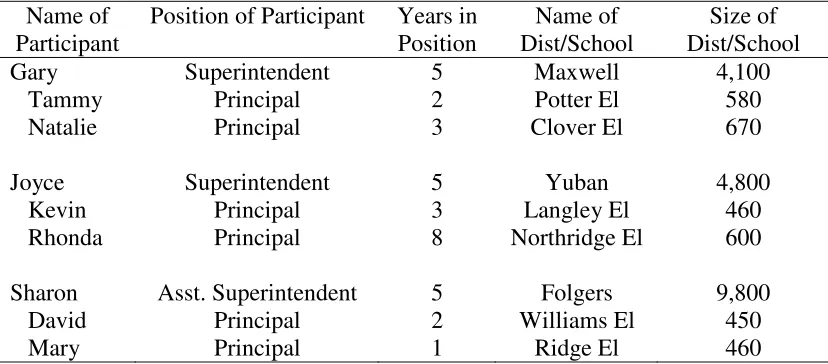
1 Profile of Research Study Participants ...48
2 Ethnic Demographics of Participating Districts and Schools Compared to the State...48
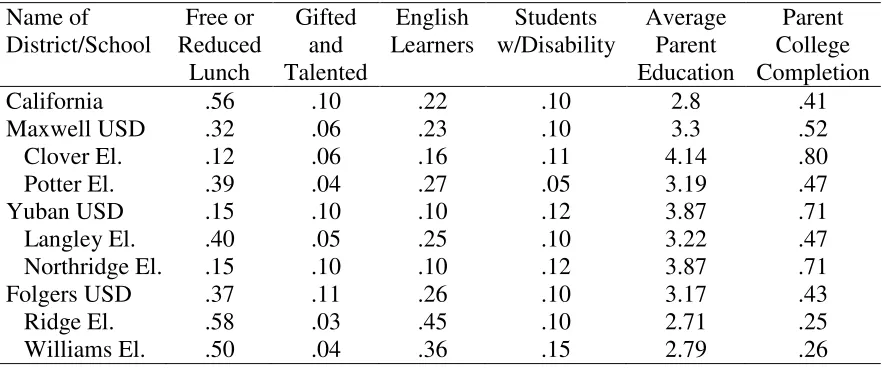
3 Language, Economic and Parent Education Demographics of Participating Districts and Schools Compared to the State ...50
x
CHAPTER I
THE RESEARCH PROBLEM
Statement of the Problem
The “Race to the Top Fund,” signed by President Obama in February of 2009,
provided a competitive grant program designed to reward and encourage states that are
creating the conditions for improving education innovation and reform (U.S. Department
of Education, 2009). A key element of the Race to the Top reform program is to improve
teacher and principal effectiveness based on performance. Specifically, the plan calls for
designing and implementing rigorous, transparent, and fair evaluation systems for
teachers and principals. These evaluations are to be used to inform decisions regarding
professional development, compensation, promotion, retention, and tenure (U.S.
Department of Education, 2009).
In an interview with the Director of the National Association of Elementary School
Principals (NAESP), the U.S. Secretary of Education, Arne Duncan expressed concern
that many principal evaluations do not help principals to learn and grow (Connelly &
Duncan, 2010). Secretary Duncan indicated that there is much work to be done to
improve principal evaluations and to assure that this process provides support,
encouragement, and suggestions for improvement for principals. The Education
Secretary believes improvement in principal evaluations will result in support for
children and the education system (Connelly & Duncan, 2010). Education has been
slower than many other fields in developing and adopting well-crafted and reliable ways
to assess the performance of its leaders (The Wallace Foundation, 2009, p.1). Secretary
the Education Code and district policies mandate principal evaluations, it is still left to
districts to interpret and design the evaluation process (Goldring, Huff, Spillane &
Barnes, 2009). Few principal evaluations are aligned to professional standards and
rigorously tested for reliability and consistency (Condon & Clifford, 2009; Kimball,
Milanowski & McKinney, 2009). Principals typically do not find the process beneficial
(Kempher & Robb-Cooper, 2002), as most evaluations are not aligned to leadership
aimed at improving student achievement (Catano & Stronge, 2006). Very little is known
about how principals are evaluated, the outcomes of the evaluations, or the quality of the
evaluations (Ginsberg & Berry, 1990).
Policy makers are pushing for effective evaluation systems and leveraging funding to
entice states and districts into compliance. For instance, the Race to the Top Fund
allocates $4.35 Billion to be distributed to states who comply with the reform efforts
being touted, including the essential reform of teacher and principal evaluation systems
(U.S. Department of Education, 2009). While there is a political push for these efforts,
there is very little research on this topic (Murphy, Elliott & Goldring, 2006). A search
conducted on January 11, 2011 of the Education Resources Information Center (ERIC)
yielded only 25 responses for peer-reviewed articles on the inquiry for “principal
evaluation.” This indicates an obvious gap in the research for principal evaluations.
In a conversation with Gail Connelly, the Director of the National Association of
Elementary School Principals (NAESP), U. S. Education Secretary Duncan encouraged
reformers to look for local examples of successful principal evaluations (Connelly &
Duncan, 2010), although relatively few exemplary examples have been brought forward.
Gene Wilhoit, of the Council of Chief State School Officers (CCSSO), on behalf of the
state education chiefs in all 50 states, the District of Columbia, the Department of
Defense Education Activity, and five U.S. extra-state jurisdictions; Wilhoit wrote the
following statements as commentary to the Race to The Top Fund’s requirement that
states reform teacher and principal evaluation systems in order to be eligible for the
funds.
CCSSO strongly agrees that increasing the number and percentage of effective teachers and principalsmust be a high priority. The nation must invest heavily in improving teachers and leaders. We urge the Department, however, to ensure that the Notice’s definitions of “effective principal” and “effective teacher” do not
inadvertently limit innovative state and local approaches to evaluating and supporting teachers and leaders. Significantly improved systems of evaluation and support are needed, but given the limited evidence currently available about what systems and structures work best, we caution the Department to move slowly in this area, so that a range of approaches can be developed, implemented, and refined.
(www.ccsso.org/Documents/2010/News).
There is a need to research current practices in principal evaluations and the
performance measurements used. It is important to understand whether the evaluation
structure is based on professional educational leadership standards or some other set of
guidelines. This research intended to contribute to the knowledge base regarding the
elements of principal evaluations by examining current school district practices in
Northern California.
Background and Need for the Study
A comprehensive review of the research on school leadership found that the
quality of the principal alone accounts for 25% of a school’s impact on student learning
(Marzano, Waters & McNulty, 2005). In spite of this critical role, we continue to have an
evaluated (Ginsberg & Berry, 1990). Principals play a critical role in student learning,
but they are evaluated almost as an afterthought (Rutherham, 2010). According to
researchers, Fenton et al, (2010) most principal evaluation systems tend to focus too
much on the wrong things, lack clear performance standards, and lack rigor in both their
design and attention to implementation. This important feedback mechanism is often
based upon folklore, traditions, and longstanding practices within the organization. The
home recipe style of evaluations demonstrates the lack of valid and reliable instruments;
rather, the evaluations are developed and based on personal opinions and local practice,
not on research findings and these evaluations are often subjective and methodologically
flawed (Ginsberg & Berry, 1990).
In an attempt to provide essential principles to guide the role of school leadership,
representatives from states and national professional associations collaborated to create
the Interstate School Leaders Licensure Consortium (ISLLC) Standards for School
Leaders. The Council of Chief State School Officers (CCSSO) published the ISLLC
Standards in 1996, as shown in Appendix B1. The number of states using the ISLLC
standards as a basis for designing their own leadership standards increased to over 80% in
the decade following the creation of the ISLLC (1996) standards (Fenton, et al., 2010).
In 2001, representatives from the California School Leadership Academy at
WestEd, Association of California School Administrators (ACSA), California
Commission on Teacher Credentialing, California Department of Education, and
California colleges and universities adapted the ISLLC (1996) into what became the
California Professional Standards for Educational Leadership (CPSEL) (WestEd, 2004),
In spite of the development of standards for principals, there is little consistency
in the use of these standards in the principal evaluation process. Principal evaluation
systems simply have not been a high priority for most states and local school systems
(Fenton, et al., 2010). With the introduction of the Race to the Top funds and other
policy pressures requiring effective principal evaluations (U.S. Department of Education,
2009), there is a need for greater understanding of the principal evaluation process as
defined and experienced by the evaluator and those principals being evaluated. The
ineffectiveness of principal evaluations (Kempher & Robb-Cooper, 2002) is clearly a
noteworthy gap in our educational system. As policy makers and educators strive to
attain accountability and assure effective evaluation systems for educators, the process
must start with our school site leaders. This study sought to offer additional insight to
educational leaders and policy makers regarding the process of evaluating principals.
Purpose Statement
The purpose of this study was to examine the principal evaluation process in three
public school districts in Northern California. Specifically, the study explored the
experience of the principal evaluation process from the perspectives of the participating
elementary school principals. In addition, this study investigated the process of the
evaluation from the perspective of the evaluator, with specific attention to the
implementation process of the evaluation, performance measurements used for the
evaluation, and the feedback provided to principals.
This research study sought to inform policy makers and education practitioners of
current principal evaluation systems by seeking to understand the evaluation process as
researcher’s understanding of actual principal evaluation processes and practices, which
was examined using the conceptual framework developed by Goldring, Porter, Murphy,
Elliott and Cravens (2009).
Research Questions
1. How is the principal evaluation process conducted as described and experienced by
elementary principals in a Northern California School district?
2. How is the principal evaluation process conducted as described and experienced by
principal evaluators in a Northern California school district?
3. How does the evaluation process provide performance feedback for the principal?
Conceptual Framework
The conceptual framework for this study was based on the leadership assessment
instrument developed by Goldring, et al. (2009) as illustrated in Figure 1. This
framework focuses on the assessment of leadership job performance, both the behaviors
and practices of leaders. While this framework assessed principals and leadership teams
effectiveness in exercising the preferred behaviors and practices resulting in desired
outcomes, this study used the model exclusively to examine principal evaluation systems.
This framework was chosen because it acknowledges the complexity of the role of the
school principal, includes contextual factors, and assesses the effectiveness of the
principal on outcomes, or value-added, such as student achievement. The framework,
which is based on empirical research, attempts to capture the general aspects of how
education leaders should be assessed. It consists of the major constructs that focus on
leadership behaviors that lead to school performance and ultimately to student success
Figure 1 Model for Vanderbilt Assessment of Leadership in Education (VAL-Ed)
This framework was developed to establish a conceptual model for leadership
assessment in the United States (Goldring, et al., 2009). The Vanderbilt Assessment of
Leadership in Education (VAL-Ed) focuses on the assessment of leadership job
performance, both leadership behaviors and practices. The VAL-Ed is grounded in
research literature, is based on standards and is different from current leadership
evaluation frameworks being used throughout the nation. The model is anchored and
aligned with the Interstate School Leaders Licensure Consortium (ISLLC) standards.
The core components refer to the characteristics that support the learning of students.
Figure 1 illustrates the following: the principal brings specific attributes into the
role of school principal, as shown in the yellow boxes, he or she then engages in
leadership behaviors through effective processes and essential components as shown in
the lavender box and these leadership behaviors influence the school performance and
schooling as shown in the blue box to obtain the outcomes of student achievement as
illustrated in the orange box. All of these are influenced by contextual factors as shown
in the green box.
The yellow boxes of Figure 1, knowledge and skills, personal characteristics, and
values and beliefs are the specific inputs of the individual. Knowledge and skills would
be those previous experiences of the principal, for instance the instructional background
or previous job experiences. For instance, a principal who had previously worked as a
curriculum coordinator for the school district would have different knowledge and skills
than a principal who had experience as an assistant principal. Personal characteristics
could be the principal’s personality style, such as being extraverted or introverted,
analytical or reactionary. The values and beliefs are the ideologies of the principal, for
instance the belief that all children can learn or valuing others by including subordinates
in decision processes (Murphy, et al., 2006).
The green box at the bottom of Figure 1 considers another type of input. Rather
than the individual characteristics of the yellow boxes, this demonstrates the specific
contextual factors, which include the experience of the principal as well as the specific
demographics of the school. The consideration of context is an important benefit of this
model for principal evaluations.
The lavender box of Figure 1 illustrates the leadership behaviors the principal
engages in. This is accomplished by combining the core components, also known as
“what” the principal does with the six key processes, known as “how” the principal
behaviors result from doing the right things in the right way to influence school
performance and to ultimately impact student success.
These leadership behaviors involve the principal establishing high expectations
for student learning; assuring rigorous curriculum; guaranteeing quality instruction;
establishing a culture of learning and professional behavior; creating connections to
external communities; and maintaining systemic performance accountability. As
previously noted, the model was developed to assess school principals and leadership
teams, but this study will use the model as it applies to school principals.
In addition to the core components, the VAL-Ed framework entails six key
leadership processes, also known as “how” the principal influences the organization to
obtain the desired outcomes of improved student learning. The researchers of this
framework established the key processes as the interconnectedness of planning,
implementing, supporting, advocating, communicating and monitoring.
The essential process of planning is defined as “articulating shared direction and
coherent policies, practices, and procedures for realizing high standards of student
performance” (Goldring, et al., 2009, p. 15). Planning supports principals’ ability to
focus on and engage in the core behaviors previously discussed. Once the principal has
planned for the critical elements, they must actually implement the planned activities.
Implementation results when principals take the initiative to actually execute the critical
components, such as getting the staff to implement a rigorous curriculum and a systemic
assessment and accountability procedure. Another key process is supporting, which is
done by ensuring the resources necessary to achieve the core components are accessible
assure the instruction is afforded to all students by establishing policies and practices that
honor and respect diversity. For instance, assuring special needs students receive content
rich instruction, or adopting a school policy that assures all students have access to
gateway coursework, such as algebra.
Effective communication is another important aspect of the key leadership
processes. Communication is essential to “developing a culture of learning and
professional behavior” (Goldring, et al., 2009, p. 18). A final process is to assure that
what has been planned and implemented is actually working. Monitoring is an important
process, as the principal should continually assess whether or not the school is achieving
the stated goals. The interconnectedness of the essential behaviors and key processes is
evident as monitoring is necessary to maintain systematic performance accountability.
The blue box of Figure 1 demonstrates the principal’s influence on the school to
support the learning of all students and to enhance the ability of teachers to teach
(Murphy, et al., 2006). These influences are establishing high standards of performance,
assuring rigorous curriculum, and quality instruction, providing a culture of learning and
professional behavior as well as establishing connections to external conditions and
having systemic performance accountability (Goldring, et al., 2009).
The establishment of high expectations for student learning means the principal
articulates clear and public standards and expectations for learning for all students, not
just for high performing students. “Rigorous curriculum is defined as ambitious
academic content provided to all students in core academic subjects” (Goldring, et al.,
2009, p. 9). The principal guarantees quality instruction by assuring effective pedagogy
teachers provide the metacognitive strategies students need to understand the material (p.
10). Establishing a culture of learning and professional behavior “is leadership that
ensures there are integrated communities of professional practice in the service of student
academic and social learning” (Goldring, et al., 2009, p.11). The collaborative culture is
demonstrated by having shared goals and values, a focus on student learning, sharing best
practices and having reflective dialogue (p. 11). Another essential behavior of principals
is the ability to link families and other people, agencies and institutions to the school
community in ways that will advance students’ academic and social learning (p. 12). A
final core component for school principal behaviors is the leader’s ability to incorporate
internal and external accountability systems through frequent reference to and the use of
established criteria in meetings, classroom observations, discussion of curriculum and
other areas of interaction with school staff. Having these elements are at the core of
standards-based reform as articulated in the No Child Left Behind (NCLB) legislation
(Goldring, et al., 2009).
The principal’s influence on school performance will ultimately influence the
academic and social learning of students. These outcomes, also known as value added, as
illustrated in the orange box in Figure 1 influence student achievement, attendance and
graduation and college enrollment. This model demonstrates the influence the school
principal has on teaching and learning, which accounts for 25% of the influence on
student learning (Marzano, et al., 2005).
The VAL-Ed framework is aligned with the ISLLC standards, which were
developed by the National Policy Board for Educational Administration (NPBEA), under
standards to anchor the profession of educational leadership as it headed into the 21st
century. At its foundation, ISLLC was comprised of 24 states, most of the members of
the NPBEA, and other key stakeholder groups, such as the National Alliance of Business,
with an interest in the health of leadership in America’s schools and school districts
(Murphy, 2003).
ISSLC standard 1 refers to a vision of learning, this framework connects the core
component of high standards for student performance and the key processes of planning,
implementing, supporting, advocating, communicating and monitoring. An example of
standard 1 in practice as assessed by this framework would be the principal “develops
rigorous growth targets in learning for all students and allocates school resources
primarily toward reaching academic and social learning goals” (Goldring, 2009, p. 22).
ISLLC Standard 2 refers to the school culture and teaching and learning. An
example of the core components and key processes of this standard is illustrated by, the
principal “provides teachers with time to work on developing and strengthening the
curricular program, observes each teacher’s instructional practices routinely to provide
feedback and develops a culture of shared responsibility for the social and academic
learning of students” (Goldring, 2009, p. 22).
Goldring et al. (2009) states, the principal’s management of the school to support
learning is at the center of standard 3, the core components and key processes required to
do this would be, the principal “secures and allocates resources to build a culture focused
on student learning and implements a learning environment in which all students are
known and cared for and secures and allocates resources to build a culture focused on
The role of leadership fostering relationships between the school and the broader
community is ISLLC standard 4, the core components and key processes of this would
include, the principal “builds relationships with individuals and groups in the community
to promote high standards of academic and social learning, allocates resources to build
family and community partnerships that advance student learning and challenges the
community to meet the needs of children at risk” (p. 23).
Standard 5 consists of integrity, fairness and ethics, the core components and key
processes of this standard would be, the principal “advocates that leaders are accountable
for meeting the needs of diverse students in acquiring academic and social learning,
advocates a culture of learning that respects diversity of students, encourages a culture of
respect and fairness for students and discusses standards of professional behavior with
faculty” (p. 23).
ISLLC standard 6 encompasses the political, social, economic, legal and cultural
context of learning, the core components and key process of this would be, the principal
“promotes mechanisms for reaching families who are least comfortable at school,
communicates goals, needs, and accomplishments with leaders in the community, and
advocates for social services needed by students and families” (p. 23).
The conceptual framework is grounded in research of effective principal
behaviors and processes that will bring about improved student achievement. It is
anchored in and aligned with the ISLLC standards. The developers of this framework
aligned the VAL-Ed to the ISLLC standards because of the wide acceptance of the
standards of educators and policy designers. Over 40 states, all members of the National
throughout the nation use some form of the standards (Goldring, et al., 2009). The
VAL-Ed conceptual framework will be used as a lens for understanding the actual practices of
the participating principal and evaluators in the research study. The researcher sought to
understand which elements of the research based VAL-Ed, were present in the evaluation
process of the participating Northern California school districts.
Significance of the Study
This study made a contribution to the limited literature regarding principal
evaluations. In particular, limited research exists on this topic since the introduction of
the No Child Left Behind Act of 2001, which created a sense of urgency for improving
student learning in the United States (U.S. Department of Education, 2009). With over
six million students enrolled in kindergarten through twelfth grade, California has more
public school students than any other state (Ed-Data, 2011); therefore, it is essential that
we understand the principal evaluation process in the state where the largest number of
students is educated. This study focused specifically on districts in Northern California
and sought to address the lack of research regarding principal evaluations, specifically in
California.
Understanding the actual process and systems used contributed to the current
literature and sought to provide additional understanding of the principal evaluation
process. There are political factors urging the improvement of principal evaluation
systems as well. According to U.S. Secretary of Education, Arne Duncan
where we have those examples of success. This is an area where we have a lot of work to do together (Connelly & Duncan, 2010).
The purpose of this study was to examine specific practices in Northern California
school districts and to seek to understand the current processes and experiences of
principals and principal evaluators. This research intended to inform policy makers and
educational practitioners of current evaluation practices in light of the standards aligned
VAL-Ed conceptual framework. This study contributed to the need for research on this
topic and it may contribute to examples of success at the local level. This study
contributed to the body of literature and will inform principal evaluation practices.
This case study provided local examples of effective aspects of principal
evaluation systems, an area that U.S. Secretary of Education, Arne Duncan expressed,
“this is an area where we have lots of work to do together” (Connelly & Duncan, 2010).
Some positive trends are noted in this study, specifically, all of participants in the study
reported their principal evaluations being aligned to the California Professional Standards
for Educational Leaders (CAPSEL). This study also demonstrated the perceived benefit
of the process, with all principals reporting benefit from the principal evaluation process.
This study also demonstrated perceived benefit with the use of outcome data such as
student achievement and attendance data. There is still much work to be done in this area
of research and this study has provided an important contribution to the body of research
and provides additional insight to local, state and national education leaders and policy
Definition of Terms
The researcher has provided the following terms as used in this research study:
• Documents – reference materials and paperwork used in the evaluation process,
such as principal handbooks and training materials, evaluation templates, board
policies, and other items used in the principal evaluation.
• Evaluation – the formal process conducted to provide the principal information
about his or her job performance. It is typically a written document provided to
the principal annually to provide information to the principal regarding his or her
current performance in specific selected areas and to provide information about
areas needing improvement.
• Evaluation process – all components of a system by which principals are
evaluated, including the underlying standards upon which judgments are made,
the instruments used to assess performance, and other related tools and processes
(Fenton, et al., 2010)
• Feedback – written and oral information provided to the principal regarding areas
in which he or she is being effective as well as areas needing additional attention.
• Leadership standards – there are two major professional standards used and
referenced, the Interstate School Leaders Licensure Consortium (ISLLC)
standards, as shown in Appendix B1; and those adapted for California, the
California Professional Standards for Educational Leaders (CAPSEL) in
• Performance measurement – those identified elements used to evaluate the
principal’s performance. Examples of performance measurement used are:
student achievement, attendance and suspensions.
• Principal – the credentialed administrator in charge of the day-to-day operations
of the school.
• Principal evaluator – the individual responsible for conducting the evaluations of
school principals, typically the Superintendent or Assistant Superintendent of the
school district.
• Strategic Plan – A document designed by district leadership to reflect
stakeholders’ voice and needs in the development of system goals; provide
indicators and measures to track and report progress on goal attainment; set long
and short term targets for continuous improvement; provide clear direction to
align Board, district, site, administrative and staff evaluation goals; provide timely
CHAPTER II
REVIEW OF THE LITERATURE
Introduction
Research has revealed that even when the Education Code and district policies
mandate principal evaluations, it is still left to districts to interpret and design the
evaluation process (Goldring, Huff, Spillane & Barnes, 2009). Few principal evaluations
are aligned to professional standards and rigorously tested for reliability and consistency
(Condon & Clifford, 2009; Kimball, Milanowski & McKinney, 2009). Principals
typically do not find the process beneficial (Kempher & Robb-Cooper, 2002). As most
evaluations are not aligned to leadership aimed at improving student achievement
(Catano & Stronge, 2006). Very little is known about how principals are evaluated, the
outcomes of the evaluations, or the quality of the evaluations (Ginsberg & Berry, 1990).
This review of the literature was designed to provide the reader with pertinent
background information about the theories and studies on school principal evaluation
systems, procedures and perceptions. Specifically regarding the purpose of principal
evaluations; the process and implementation of principal evaluations; the feedback
provided through the principal evaluation; performance measurements and evidence used
to inform the principal evaluation; and the inclusion of professional standards in the
evaluation process. This research study sought to understand the evaluation process as
reported by the participating elementary principals and principal evaluators in order to
understand the actual experience of these participants and to determine whether the
participating principals’ experience was consistent with the literature of effective and
Purpose of Principal Evaluations
When examining a process, it is important to first understand the purpose for
which the process was developed. A focal element of researching the principal
evaluation process is to understand the purpose of the principal evaluation as stated in the
literature.
The overall purpose of principal evaluations is to provide a basis for sound
decision-making and increased effectiveness. However, the methods used by many
districts are not designed to improve principal performance, but simply intended to
satisfy accountability requirements of mandatory principal evaluations. In many
jurisdictions, the primary purpose of the evaluation of principals is to fulfill the annual
requirement from school boards. Until recently, the primary focus of principal
evaluations was conformity, loyalty, and physical appearance, with minimal attention
provided to reaching specified performance standards or organizational results (Hart,
1994; Thomas, Holdaway & Ward, 2000).
Green (2004) established that formal evaluation of principals must be for a
specific purpose, with the typical reasons for conducting principal evaluations being to
assess the attainment of institutional goals; help with the improvement of professional
performance; provide data for personnel decisions; improve the effectiveness of an
administrative team; provide data for reassignment or retraining; and to conduct research
on administrator effectiveness. The Wallace Foundation (2009) has funded researchers to
study ways to strengthen education leadership aimed at improving student learning.
climate of continuous learning and improvement throughout the organization. In this age
of accountability, school districts must assure student achievement.
According to Stine (2001), the principal evaluators, often the superintendent;
needs a system to make the appropriate decisions of continued employment, promotion,
reassignment, or termination and to provide a diagnostic tool for identifying strengths and
areas for improvement in the employee. According to Kearney (2005), district
supervisors should use both the formative and summative function of principal
evaluations to develop professional growth plans, goals and objectives.
Although researchers indicate that an important aspect of the evaluation process is
to provide guidance for professional development, it does not necessarily provide that
desired outcome. In the Davis and Hensley (1999) study of 14 principals and six
superintendents from Northern California, principals reported that formal evaluations
were not helpful in shaping or directing their professional development or in promoting
school effectiveness, because principals did not trust the motives or intentions of district
office evaluators. Yavuz (2010) found similar results in a study of elementary principals
conducted in Turkey. The principals reported not knowing what was actually expected of
them and half of the primary principals interviewed did not think their supervisors could
objectively evaluate them.
A nationwide study found that even though principals agreed their evaluations
were generally positive, accurate and consistent with job expectations fewer found it
relevant to enhancing their motivation and improving their performance (Reeves, 2005).
Principals reported a belief that the evaluation processes were inconsistently carried out
students. Another insight shared by the participating principals was the little time
evaluators actually spent on the campus directly observing their leadership behaviors
(Davis & Hensley, 1999).
The researchers funded by a grant from the Wallace Foundation (2009) contend,
the federal No Child Left Behind Law have shifted the role of the principal to focus much
more on leading the essential teaching and learning activities in their schools. Principals
serve a vital role in supporting student achievement, because leadership is second only to
teaching among school-based factors in influencing students’ learning (Leithwood, Louis,
Anderson & Wahlstrom, 2004). The evaluation process used by district officials can
support the need to focus on teaching and learning. Researchers found school principals
were more likely to engage in learner-centered leadership behaviors when school districts
used evaluation processes to hold principals accountable for important school and district
goals; focus on the principal’s knowledge, skills and behavior; emphasize goal setting,
curriculum design, teacher professional development and evaluation and monitoring
student achievement (Sun & Youngs, 2009).
Researchers have noted many challenges in principal evaluations achieving the
intended purpose and benefit. The principal evaluation is often seen as a one-time form to
be completed rather than an ongoing process aimed at continuous improvement (Green,
2004; The Wallace Foundation, 2009). Ginsberg and Thompson (1992) found
appropriate means of evaluating principals is difficult because the complex job is not
agreeable to simple characteristics or descriptions, the nature of the principal’s work
varies considerably and there are varying expectations for principals’ behavior from the
of 800 principals in Ontario, Canada. The study revealed problems in principal
evaluations resulted because the policies lacked detail regarding the evaluation process,
the standards of performance were not well publicized and therefore not clearly
understood, and finally the practices outlined were not always the practices actually
implemented (Leithwood, 1986; Thomas, et al., 2000).
Research indicates a disparity between the perceptions of principals being
evaluated and those of their evaluators (Fletcher & McInerney 1985; Sun & Youngs,
2009). In a study by Harrison and Peterson (1986), surveys were conducted with 200
principals and 142 superintendents in a Southern state to compare the perceptions about
how the components of a state mandated principal evaluation system were implemented.
The researchers found five critical pitfalls in the perceptions of principals and
superintendents regarding the evaluation of principals. The first was the variance in the
perceptions of superintendents’ favorable perception of the evaluation compared to the
principals’ perception of the evaluation processes. The second pitfall was the finding that
principals were much less clear on the processes and procedures used by their evaluators
than were the superintendents. The third problem was the widely held divergent views
about the purposes and priorities of the principal evaluation. Superintendents perceived
the instructional leadership practices to be central to the evaluation and principals
perceived operational management functions as being most critical. The fourth problem
was the variance in perception of the influence of community opinions, principals
believed that community opinions formed the basis of their evaluations and that
that principals were more likely to report weak communication with their superintendent
regarding the purposes, process and outcomes of the evaluations.
Another example of the disparity of perceptions between evaluators and principals
is found in the study conducted by Fletcher and McInerney (1995). The researchers
conducted a content analysis study of the principal evaluation instruments used by all
public school superintendents in Indiana with five or more principals. The findings
revealed differences between the 21 principal performance domains that superintendents
considered important and the content of the actual principal evaluation instruments used.
The National Policy Board established these domains for Educational Administration in
1993. Over 90 percent of the superintendents gave the highest rating to the domains of
leadership, instructional programs, motivating others, and judgment. However, when the
content of the instruments actually used by these superintendents was examined, it was
revealed that the reported areas most valued were not those areas actually evaluated
(1995). The research suggests inconsistency between the stated purpose of the evaluation
and the actual implementation of the process.
The literature revealed the purpose of the principal evaluation is to: assess the
attainment of institutional goals, such as student learning; improve principals’
performance; assure continual improvement; identify strengths and weaknesses; inform
professional development; and staffing decisions of retention and promotion.
Unfortunately, the literature demonstrated the purpose was not necessarily achieved, as
principals reported not knowing what was actually expected of them, and the process was
principals’ performance. The literature also revealed disparity between the evaluations as
experienced by the principal compared to the purpose stated by the principal evaluator.
This literature will inform the researcher as the study seeks to understand the
evaluation as reported by the participating principals and evaluators, specifically the
stated purpose and experiences of the participants.
Evaluation Process and Implementation
In examining principal evaluations, it is important to understand the literature
regarding the principal evaluation process and implementation. Generally, principals are
evaluated annually, in a study of medium and large public school districts with
enrollment exceeding 10,000 students, over 75 percent of the responding 193
superintendents reported conducting annual evaluations (Kimball, Heneman &
Milanowski, 2007). An analysis of practices for principal evaluations found a wide range
of models in use with the two most common being the use of a rating scale and
management by objectives (Green, 2004, p. 21).
Three types of evaluations were identified in a study of 17 districts in California,
checklists, narrative and measurement against a set of predetermined goals (Lashway,
2003). Harrison and Peterson (1986) identified three stages of an effective evaluation
process: setting criteria, sampling performance and communicating results to the
principal regarding their continued growth. Anderson (1991) listed nine steps which
school systems should use to identify effective evaluation practices: (1) identify the
purposes for evaluation, (2) develop clear performance expectations, (3) involve
principals in planning, (4) encourage goal-setting and self-reflection, (5) observe
collect artifacts, (8) adopt a cyclical approach to evaluation, (9) reward outstanding
performance.
An extensive study was conducted by reviewing the principal evaluation
documents of 68 urban school districts in 43 states as part of the Wallace Foundation’s
State Action for Educational Leadership Project (SAELP) by researchers Goldring,
Cravens, Murphy, Porter, Elliott and Carson (2009) to determine how urban districts
conducted and implemented principal evaluations. The researchers concluded that the
critical behaviors performed by principals to influence student achievement were not
emphasized in the evaluation instruments. Goldring et al. (2009b) determined that nearly
half of the evaluation protocols were not directly aligned with professional standards;
rather the majority of the evaluation protocols were based on rating scales. A major
concern resulted from the finding that factors relating to the principal’s role in fostering a
rigorous curriculum, high quality instruction, or connections with external communities
received the least amount of attention in the school district evaluation documents
(2009b).
Rating scales usually involve the school district developing a form of the adopted
list of expectations; this form is then completed by the principal’s evaluator and provided
to the principal. Principals receiving an evaluation from a rating scale do not find the
evaluation helpful for improving their performance (Green, 2004, p. 22). Management
by objectives involves the principal and the evaluator setting measurable goals at the
beginning of the evaluation period. An advantage of management by objectives is the
removal of subjectivity from the evaluation, for instance if the objective was to increase
be evaluated on reaching or not reaching the defined goals. According to the researcher,
a disadvantage of this type of evaluation system may lead to the principal focusing on
short-term goals rather than on important long-term goals (p. 23). Less frequently used
evaluation instruments are the degree evaluation and assessment centers. The
360-degree evaluation gathers input from various stakeholders in the school system. District
administrators, other principals in the district, parents, students, and community members
are the most common sources of input (p. 27). Assessment centers are another type of
principal evaluation. These simulations attempt to assess the principals’ ability to
manage simulated school leadership activities. This process is used to determine a
principal’s strength and to identify particular areas of needed improvement. This type of
evaluation would not necessarily assess the actual performance of the principal in his or
her own school; rather it would just grade their performance on simulated activities (p.
30).
The literature on the implementation of principal evaluations demonstrated a wide
range of models in use across school districts with the two most common types being
rating scales and management by objectives. Rating scales were not deemed useful for
improving practice by principals. Check lists and narrative evaluations were often used
to assess progress towards predetermined goals and a noted advantage of management by
objectives was the removal of the subjective aspect of the evaluation. Other instruments
used were 360-degree evaluations and assessment centers, but these were used much less
frequently than the two most common types of evaluations. The literature on the
implementation of principal evaluations will inform the research study as the researcher
Feedback Aspects of the Evaluation Process
In order for the principal evaluation to attain the purpose of improving principals’
leadership practices, the principal being evaluated must be afforded effective information
aimed at informing the principal of areas in which he or she is being effective as well as
areas needing additional attention. The evaluation process is expected to provide the
principal with information of ways in which he or she can improve upon skills, attitudes
and knowledge (Thomas, et al., 2000). The ultimate goal in evaluation is to translate
performance data into performance knowledge and meaning that can be effectively and
successfully acted upon (Harbour, 2009).
Principal evaluations can serve as a powerful communication tool for informing
the principal of areas of continued growth and improvement by identifying gaps between
the current practices and the desired outcomes. It allows the opportunity to focus the
principal on those behaviors that are associated with student learning (Goldring, et al.,
2008). Principals will grow professionally when they personally reflect on their
leadership and therefore, their evaluation should be the impetus for this reflection.
Principal evaluations should provide continuous feedback that is essential for ongoing
professional growth (Green, 2004, p. 46).
Performance information should be provided in a timely manner as it is of little
value if it is delivered too late (Harbour, 2009). A goal of the evaluation process is to
provide timely and effective feedback. However principals report their evaluations lack
the specificity to indicate what behaviors should be changed and the feedback provided
was not useful and the criteria used for the evaluation was often unclear (Reeves, 2005).
fail to give principals clear feedback on what they could be doing more or better to
improve teaching and learning (The Wallace Foundation, 2009). An additional concern
revealed in the research was the finding that principals perceive their evaluations to be
based on the subjective feelings of the evaluator rather than by measurable performance
indicators (Reeves, 2005).
Ideally, the evaluation provides information about the principal’s strengths and
weaknesses that will be useful and applicable to a variety of purposes across varied
contexts. The evaluation should be flexible enough to consider variation in career stages,
a novice principal has different needs from a veteran principal and each requires feedback
to further his or her skills. Therefore, the content, timeliness and assisted support should
match the difference in needs between a novice and veteran principal (The Wallace
Foundation, 2009).
A study of 76 principals was conducted in a large Western school district to
examine principals’ perceptions of the quality of feedback, usefulness, fairness and
overall satisfaction in the evaluation process. Half of the principals received the
traditional district evaluation and the other half received a new standards-based
evaluation. Kimball, Milanowski and McKinney (2009) found the standards based
evaluation provided better feedback and satisfaction for the principals than the traditional
evaluation.
The literature confirmed the principal evaluation is to translate data into
performance knowledge that can then be acted upon. Information provided on the
evaluation can serve to inform the principal of areas of continued growth and
provided to be useful for informing them of how to improve their practice. Evaluations
aligned to standards were found to provide better feedback and satisfaction for principals
than those not aligned to standards. These findings will inform the study as the
researcher will examine documents and interview content to determine the type of
feedback provided for principals participating in the study. The feedback provided
through the evaluation process would be contingent on the performance measurement
used to assess the principal’s performance.
Performance Measurement and Evidence Used in the Principal Evaluation
An important aspect of the principal evaluation would be to determine the
elements of performance to be used to assess the principal’s effectiveness. “An
evaluation is a judgment of worth or value that ideally should be based on some set of
quantitative performance measures” (Harbour, 2009, p. 8). The essential aspect of
successful performance measurement is to collect only those performance measures that
can and actually will be used to help us better understand, manage and improve
performance (p. 13). The evaluation of principals must be grounded in what we know
about the qualities of effective principals (Green, 2004, p. 9).
High quality assessments measure what they are designed to measure, are consistently applied and tested for fairness, are a continual process for professional growth and development, are based on evidence from multiple sources, reinforce the
organization’s core goals, provide actionable feedback on the essential aspects of the leader’s role and they support a culture of continuous growth and improvement (The Wallace Foundation, 2009, p. 2).
Measurements of performance should be about four to six interrelated measures of key
aspects of performance, which represent the critical aspects of the job (Green, 2004, p.
is to “determine what matters: style or substance” (2004, p. 3). Valentine (1987)
recommends data sources for principal evaluation be derived from student attendance
records, test scores, committee reports, newsletters, clippings and time logs. He also
recommended shadowing the principal and soliciting information from staff students and
parents. There is an extensive list of possible data to be used, but it should be limited to
those items most relevant to the particular school’s goals (Stine, 2001).
Stine’s (2001) analysis of 17 school districts in California revealed the use of
three standard formats for principal evaluations, free form, check lists and management
by objectives. Basic criteria suggested for evaluating principals was clustered into three
groups of (1) planning and instruction, (2) personnel, motivation and conflict
management, and (3) outside contacts. Stine noted these assessments often lacked any
professional improvement plan for the principal. Thomas et al. (2000) analyzed relevant
research and determined principal evaluations are based on the following aspects: (1)
results; (2) valid job descriptions; (3) personal qualities; and (4) research findings related
to role behaviors that improve school performance. A results based, also termed an
outcomes based evaluation assesses and sometimes compensates principals based on the
extent to which they achieve mutually agreed upon objectives for the year. The
researchers also found basing the principal evaluation on the job description, as
recommended by the Joint Committee on Standards for Educational Evaluation (1988)
depends on valid job descriptions that fit most principals and consider the local context
and individual school priorities.
Lipham, Rankin and Hoeh (1985) observed that questionnaires, checklists,
attempt to measure performance but these instruments and procedures only measure the
frequency of behavior rather than its potency or quality. Ginsberg and Berry (1990)
noted that personal profiles, dossiers and self-evaluations have also been added to the list
of performance measurement procedures. Lindahl (1986) supported the use of job
description for the evaluation process to provide structure, but the job description alone is
insufficient for the assessment of effectiveness (Stine 2001).
Green (2004) suggested looking at principal evaluations through an organizational
theory model and measure the degree to which principals fulfill the responsibilities of
their jobs, determine the processes they use to perform their work and the skills they need
in order to be successful. According to the researcher, the four responsibilities of the
school principal are:
(1) To ensure that the organization accomplishes it’s mission, (2) to ensure that the internal systems work as they should so that the organization can be
successful, (3) to help the organization cope and adapt to change, and (4) to nurture the ethos and traditions that define what is good about the school and what the school community should preserve. (2004, p. 15)
The four functions that encompass what administrators should implement are to lead,
organize, plan and control. Effective principals guide the subordinate members of the
organization, they create structures for efficient use of resources, they set goals and
establish strategies for reaching goals and they review personnel performance and
monitor organizational progress (Green, 2004, p. 16). The professional skills required for
an effective school principal encompass the three broad categories of technical,
interpersonal and intrapersonal. Some of the technical skills required are: making
decisions, planning projects, managing the budget, scheduling and effectively using
ability to motivate others. Examples of intrapersonal skills would be self-discipline,
flexible, and the ability to persevere through challenging times of high stress (Green,
2004, p. 17).
With the emphasis on interpersonal skills, it would seem important to acquire
input from the teachers, but that information is not necessarily solicited. In the study of
medium and large public school districts, of the responding 193 superintendents, only 26
percent reported using teacher feedback as part of the evaluation measurement (Kimball,
Heneman & Milanowski, 2007).
According to Goldring et al. (2008), to do their jobs well, principals carry out
multiple responsibilities, both internal and external to the school environment. The
complexity of the principal’s role creates the challenge for identifying the leadership
dimensions that should be assessed (Glasman & Heck, 1992; Hart, 1994; Oyinlade,
2006). Supervisors of school principals use as a criterion for their evaluation the degree
to which principals implement the duties assigned to them. However, the researchers
acknowledged the challenge of determining the degree of implementation because of the
complexity of the many responsibilities required of the role of principal (Yavuz, 2010).
Prior to high stakes testing, principals were evaluated on successful completion of job
tasks and the general responsibilities of the management aspects of their role. These
managerial duties applied to effective supervision of school programs, pupil personnel,
community relations, facilities, student behavior and coordinating professional
development for staff (Goldring et al., 2008).
Principal evaluation systems continue to place the most attention on management and
Relatively little attention is given to measuring the impact of principal performance on
school and district outcomes (Ginsberg & Berry, 1990; Portin, 2006). However, the most
critical change in expectations of school principals is on what they do to support the
improvement of teaching and learning.
Principals can no longer simply be administrators and managers. They must be instructional leaders focused on improving student achievement. They must be the force that creates collaboration and cohesion around school learning goals and the commitment to achieve those goals (The Wallace Foundation, 2009).
A critical element of principal evaluations should be around the principal’s ability to
develop instructional capacity of others by developing teacher leaders and content experts
(2009).
Olyinlade (2006) developed an evaluation system for assessing school leadership
effectiveness by identifying the essential behavioral leadership qualities. Instead of
looking at task completion, this evaluation process measures the knowledge, skill and
abilities of the principal. According to the researchers of the Wallace Foundation (2009),
a powerful evaluation system maintains focus on the core elements of effective leadership
for learning, but is adaptable to different contextual factors and therefore, principals and
their evaluators may prioritize different leadership actions and behaviors, even if their
student test scores are similar.
In a study of 56 California elementary school principals and 328 teachers that
measured perceptions of a principal’s implementation of 34 role-based administrative
actions, researchers found overall agreement within and between schools regarding
perceptions of the role of the principal. The administrative actions were organized into
three leadership dimensions: governing the school, maintaining a positive school culture
principals working in effective schools are consistently rated higher on each of the three
leadership dimensions, however the amount of time the principal had worked at the
school was not significantly related to perceptions of his or her effectiveness (Heck &
Marcoulides, 1996).
Performance expectations and indicators identify what effective education leaders
do to promote quality teaching and student learning and describe how leaders approach
their work in ways that are observable and measurable (The Wallace Foundation, 2009).
A meta-analysis conducted by Waters, Marzano and McNulty (2003) identified 21
leadership behaviors and their correlated effect on student learning. The researchers
found there would be a 10-percentile point increase in student test scores resulting from
the work of an average principal if he or she improved the “demonstrated abilities in all
21 responsibilities” by one standard deviation (p. 4).
Measuring the principal’s performance based on desired outcomes, such as
increased student achievement is an essential aspect of the Race to the Top funds (U.S.
Department of Education, 2009), but researchers have expressed concern that this ignores
contextual factors and assumes direct causal relationships between what the principal
does and the outcomes achieved (Heck & Marcoulides, 1996; Goldring et al., 2008).
Five researchers from the University of Minnesota and five researchers from the
University of Toronto conducted a six-year investigation of the links of leadership and
student learning funded by the Wallace Foundation. The research indicates areas of
principal influence that should be considered in measuring performance. One of the key
findings of the research was the importance of collective leadership and its positive effect