Orthogonal Sequences Based Multi-CFO
Estimation and Semi-Blind ICA Based Equalization
for Multiuser CoMP Systems
Yufei.Jiang1,2, Xu Zhu1, Enggee Lim2, and Yi Huang1
1 Dept. of Electrical Engineering and Electronics, the University of Liverpool, L69 3GJ
Brownlow Hill, Liverpool, U.K.
{Yufei.Jiang, Xuzhu, Yihuang}@liverpool.ac.uk
2 Dept. of Electrical and Electronic Engineering, Xi’an Jiao Tong Liverpool University,
215000, Suzhou, China {[email protected]}
Abstract. We propose a low-complexity carrier frequency offset (CFO) estimation approach and an independent component analysis (ICA) based semi-blind equalization structure for the orthogonal frequency division mul-tiplexing (OFDM) based multiuser coordinated multi-point (CoMP) sys-tems. A group of orthogonal sequences are employed to enable sepa-ration and simultaneous estimation of multiple CFOs at base stations, di-viding a complex multi-dimensional search into series of low-complexity mono-dimensional searches. Then, a small number of pilot symbols at-tached to the source data, are used to resolve the ambiguity problem in the ICA equalized signals. It has a low complexity, as the permuta-tion and quadrature ambiguity can be eliminated simultaneously, rather than sequentially by the previous precoding aided method. Simulation re-sults show that the proposed semi-blind equalization structure has a bit error rate (BER) performance close to the ideal cases of the zero forc-ing (ZF) and minimum mean square error (MMSE) based equalizations with perfect channel state information (CSI) and no CFO, and also signif-icantly outperforms the constant amplitude zero autocorrelation (CAZAC) sequences based CFO estimation method.
Keywords:carrier frequency offset (CFO), coordinated multi-point (CoMP), orthogonal frequency division multiplexing (OFDM), independent compo-nent analysis (ICA).
1.
Introduction
allow base stations to connect to each other through a backhaul link, where they could exchange the messages and jointly process the received multiple users’ signals on the same frequency band. This technology is called the uplink co-ordinated multi-point reception (CoMP) [2], which has received much atten-tion recently, and has been adopted by the 3GPP LTE-Advanced standard [2] as a key technology to reduce inter-cell interference and to improve the ser-vice coverage. CoMP can explore the interferences between the cells, which is different from other existing methods by treating them as noise [3]-[6]. There-fore, CoMP enables vast spectral efficiency in current wireless communication systems structure.
1.1. Related Work
Channel estimation and multiuser detection play an important role in multiuser CoMP systems. Two types of approaches, namely training based methods [7]-[9] and blind methods [10]-[15], are commonly used in wireless communications to estimate the channel state information (CSI) and to recover the transmit sig-nals. On the one hand, transmitting training signals or pilots reduces the spec-tral efficiency, especially in wireless communication systems with very scarce bandwidth resource. Most of previous works related to the training sequence bring considerably extra bandwidth. [7] and [8] propose an adaptive MIMO sin-gle carrier frequency-domain equalization. However, their training overhead are up to 13% and 10%, respectively. In [9], the training sequences are used to ini-tialize the equalizer coefficients to combat the Doppler shift. Although the train-ing overhead is as low as 0.05%, the actual traintrain-ing sequences are up to 160 for one transmit antenna at each time of initialization. On the other hand, the pure blind methods increase the computational complexity, particularly at the receiver. If little prior knowledge or information is available at the receiver, the semi-blind approaches [16]-[18] can be employed as a good trade-off relation-ship between the number of training symbols and the computational complexity. Blind source separation method can obtain the channel state information, without introducing extra training sequences. The equalizer coefficient can be directly obtained from the statistics of the received data, with the no need to use extra bandwidth and spectral. In fact, blind source separation method is divided into second order statistics (SOS) [12]-[15] and higher order statistics (HOS) [9], [16]-[18]. The Higher Order Statistic is more against the Gaussian noise, as the fourth or higher cumulants of Gaussian noise are equal to zero. In [12]-[13], a non-redundant linear precoding is applied to the source data, and the blind channel estimation is obtained, by exploring the signal covariance matrix via the precoding, based on the second order statistics of the received signals at the receiver. This work is extended to the MIMO case in [14] and [15]. However, all the papers above are based on the SOS only, which is sensitive to the Gaussian noise.
data directly from the statistics of the received signals, by maximizing the non-Gaussianity of the received signals, without knowing the CSI, as long as the received signal corresponds to a linear mixture. However, as a common draw-back of blind approaches, phase, quadrature and permutation ambiguity still exist in the ICA based approaches. In [9], ICA was applied on all subcarriers, and the statistical correlation between subcarriers is used to resolve the fre-quency dependent permutation. However, this approaches propagate bit errors and ambiguity errors across subcarriers. In [16] and [17], a large number of training sequences are used to eliminate the ambiguity, which, however, re-duces the spectral efficiency of the system. In [18], the precoding is employed at the transmitter, by superimposing the reference data to the source data. At the receiver, the permutation and phase ambiguity is eliminated, by using the correlation property between the reference symbols, without consuming extra spectral. However, it is very sensitive to the precoding constant and the frame length, and has a good bit error rate (BER) performance only when data frame size is large enough.
Orthogonal frequency division multiplexing (OFDM) [19]-[28] is an effective technology to combat frequency selective fading, and has been adopted in the fourth generation (4G) wireless communication systems. One of the main draw-backs of OFDM systems is their sensitivity to the carrier frequency offset (CFO), due to the imperfect local oscillators between transmitter and receiver, destroy-ing the orthogonality among the subcarriers, and inducdestroy-ing the additional inter-carrier interference (ICI). In the OFDM based multiuser-CoMP system, multiple CFOs exist between mobile terminals and base stations, introducing multiple access interference (MAI). The optimum maximum likelihood (ML) based CFO estimation method is proposed in [19]. However, it can only be used in single CFO systems, and its complexity is prohibitive in real systems with multiple CFOs, due to the exhaustive multi-dimensional search. In [20], a sub-optimal CFO estimation, using constant amplitude zero autocorrelation (CAZAC) se-quences, is proposed. However, there is a mutual interference due to multi-ple CFOs at each base station, resulting in a biased CFO estimation. Space time block codes transmission with multiple CFOs are proposed in cooperative wireless communication in [21]. However, it does not consider the multi-CFO estimation and the channel estimation. An optimum ML based estimator is pro-posed for downlink multiuser CoMP systems in [22]. However, its complexity is very high. An approach of approximation for ICI matrix based on the Hadamard sequence is proposed in [23], However it is a biased CFO estimation method. Moreover, in [24]-[28], they require transmitting a large number of training se-quences for accurate CFO estimation.
1.2. Main Contributions of this Work
– First, a group of orthogonal sequences are employed for separation of multi-ple CFOs during the preamble, based on their orthogonal cross-correlation. The simultaneous multi-CFO estimation is performed at each base station, by using the property of the CFO-induced inter-carrier interference (ICI). This is different from other existing works, as a multi-dimensional search is divided into a series of low-complexity mono-dimensional searches.
– Second, an ICA based semi-blind equalization structure in CoMP OFDM systems is proposed, where a small number of pilot symbols are used to eliminate the permutation and quadrature ambiguity induced by ICA, based on exploring the cross correlation between the original and equalized pilot symbols. It also requires a lower complexity than the method in [18], as the permutation ambiguity and the quadrature ambiguity can be solved simul-taneously, rather than sequentially as in the precoding aided approach.
– Simulation results show that the proposed orthogonal sequences based multi-CFO estimation and ICA based semi-blind equalization scheme pro-vides a BER performance close to the ideal case with perfect CSI and no CFO, and has a much better mean square error (MSE) performance than the CAZAC sequence based CFO estimation method [20].
The system model is presented in Section 2. The orthogonal sequences based multiple CFOs estimation is described in Section 3. The ICA based semi-blind structure is proposed in Section 4. Section 5 is the complexity analysis. Simulation results are shown in Section 6. Section 7 draws the conclusion.
Throughout the paper, We use bold symbols to represent vectors/matrices, and use superscripts∗,T andH to denote the complex conjugate, transpose, and complex conjugate transpose of a matrix, respectively. IN and 0N are an
(N ×N)identity matrix and an(N×N)all-zero matrix, respectively. diag{x}
denotes a diagonal matrix whose diagonal elements are entries of vector x.
[X]u,v is the entry of matrixXin theu-th row andv-th column. The real part of a complex is denoted byℜe{·}. | · |denotes the absolute value of a complex number. The angle of a complex is expressed as̸ {·}. || · ||is the Frobenius norm.
2.
SYSTEM MODEL
We consider an uplink multiuser-CoMP OFDM system. A total ofKusers trans-mit different signals simultaneously, using the same set ofN subcarriers to the M separated base stations. A single antenna is assumed for each base sta-tion and each user. Each receiver experiences multiple CFOs from K users. The source signal of each user is transmitted in frames, containingNsOFDM blocks, while each OFDM block is prepended with a cyclic prefix (CP) of length Lcp before the transmission, and removed at the receiver to avoid inter-block interference.
We define thek-th user’s signal vector assk(i) = [sk(0, i), sk(1, i), . . . , sk(N−
1) in the i-th (i = 0,1, . . . , Ns −1) block transmitted by the k-th user. F is the N-point unitary DFT matrix with the (u, v) entry[F]u,v = √1NWuv, where W = e−j2π/N (u, v = 0,1,· · · , N−1). The channel is assumed to be quasi-static block fading [1], and the CSI remains constant for the duration of a frame.
hm,kis the channel impulse response matrix between thek-th user and the m-th base station wim-thLpaths. ϕm,k =△fm,k/f0 is the normalized CFO, where
△fm,k is the CFO between thek-th user and them-th base station, andf0 is the subcarrier spacing. At the m-th receiver, after the removal of CP, the re-ceived signals vector ym(i) = [ym(0, i), ym(1, i), . . . , ym(N−1, i)]T in thei-th block combined with allK users’ signals and multiple CFOs is expressed as [19]-[28]
ym(i) =
K∑−1
k=0
E(ϕm,k)hm,kFHsk(i) +zm(i) (1)
whereE(ϕm,k) = diag{[1, Q,· · ·, Q(N−1)]}is the normalized CFO matrix with Q=ej2πϕm,kN ,zm(i)is the additive white Gaussian noise (AWGN) vector, whose entries are independent and identically distributed (i.i.d.) complex Gaussian random variables with zero mean and variance of σ2. Equation (1) is trans-formed to the frequency domain by taking theN-point DFT ofym(i):
Ym(i) =Fym(i) =
K∑−1
k=0
FE(ϕm,k)·hm,k·FHsk(i) +Zm(i)
=
K∑−1
k=0
Cm,kHm,ksk(i) +Zm
(i)
(2)
whereYm(i) = [Ym(0, i), Ym(1, i), . . . , Ym(N−1, i)]T is the frequency-domain received signals vector at them-th base station.Cm,k=FE(ϕm,k)FH
is the ICI matrix caused by the CFO between the k-th user and the m-th base station.
Hm,k=Fhm,kFH=diag{[Hm,k(0), Hm,k(1),· · · , Hm,k(N−1)]}is the relevant channel frequency response matrix between them-th base station and thek-th user, withHm,k(n) denoting the channel frequency response element on the n-th subcarrier.Zm(i) =Fzm(i)is the frequency-domain noise matrix.
It can be shown that the ICI matrixCm,khave the following properties. PropertyI:Cm,kis a circulant matrix transformed from diagonal matrixE(ϕm,k) [11].
PropertyII: The sum of the elements in any row or any column is equal to one. That is,∑Nu=0−1[Cm,k]u,v= 1,
∑N−1 v=0[C
m,k
]u,v= 1and
∑N−1 u=0
∑N−1 v=0[C
m,k
]u,v= N.
3.
Orthogonal Sequences Based Multi-CFO Estimation
matrix of size(Np×P), whereNpis the number of subcarriers andPis the train-ing sequence length durtrain-ing the preamble. Thek-th user’s ICI matrix along with the channel frequency response matrix,i.e.,Cm,kHm,k, at them-th base station can be separated from other users’ signals, accomplished by the application of a group of orthogonal sequences on Np subcarriers and K users during the preamble. The properties listed in Section2 are used to estimate the channel frequency response matrixHˆm,k, and then thek-th user’s ICI matrixCˆm,kat the m-th base station is decoupled. Finally, multiple CFOs are searched for from a range of trail CFO values in the frequency domain atM base stations simulta-neously.
With the known k-th user’s orthogonal training sequence matrix Skoth, the combination of the ICI matrix and the channel frequency response matrixUm,k
between the k-th user and the m-th receiver is separated from other users’s signals at them-th receiver as
Um,k= 1
PY m oth[s
k oth]
H (3)
whereYmorthis the received training sequences matrix of sizeNp×P during the preamble at the m-th receiver. In order to allow multi-CFO separation at each base station, the orthogonal training matricesSkothandSkoth′ of thek-th user and thek′-th user must satisfy:
Skoth[Skoth′ ]H =
{
PIN k=k′ 0N k̸=k′
(4)
We found out that these sequences can be obtained from a group of well studied Hadamard matrices [18], [30]-[31], where any two different rows are orthogonal to each other. We select a unique row in a Hadamard matrix, and apply it onto each subcarrier of different users during the preamble. Note that, the training sequences are obtained from a Hadamard matrix which can be created only for the case wherePis a multiple of4[30]-[31].
Shown from (4), although any two different users’ training sequences matri-ces are orthogonal to each other on all subcarriers, and thus each user’s CFO-induced ICI matrix can be separated from other users’ signals, the separated ICI matrix of each user is still coupled with the channel frequency response matrix. However, the ICI matrix is a circulant matrix, and the channel frequency response matrix is a diagonal matrix. Based on the properties of the ICI matrix and the channel frequency repones matrix,Hˆm,k, the estimate of the channel frequency response matrix between them-th receiver and thek-th user, is writ-ten as
ˆ
Hm,k=diag
{N∑−1
u=0
[Um,k]u
}
(5)
where[Um,k]u is theu-th row of matrixUm,k, and
∑N−1 u=0[U
m,k
Then, the CFO-induced ICI matrixCˆm,kbetween thek-th user and them-th base station is obtained with very low complexity as:
ˆ
Cm,k=Um,k[Hˆm,k]−1 (6)
In reality, the value of CFO △fm,k, is less than half of the subcarrier spacing [9],[11], so the normalized CFO is in the range of −0.5 to 0.5. Since the ICI matrix is estimated, the CFO ϕˆm,k between the k-th user and the m-th base station is estimated by searching for the minimum distance betweenCˆm,kand
C=FE( ˜ϕ)FHwith the trial CFO valueϕ˜as
ˆ
ϕm,k=arg min
˜
ϕ∈(−0.5,0.5)
Cˆm,k−C2 2
=arg min
˜
ϕ∈(−0.5,0.5)
Cˆm,k−FE( ˜ϕ)FH2 2
(7)
The multiple CFOs can be estimated simultaneously, dividing the complex multi-dimensional search into a series of low-complexity mono-dimension searches. However, it is hard to compensate for multiple CFOs if not impossible [21], be-cause each base station has received multiple CFOs from users, resulting in that the number of different CFOs may be more than the number of users’ sig-nals. The traditional CFO compensation by pre-multiplying the CFO value is impossible at the receiver. To solve this problem, a CFO correction technique is used under the feedback model in [31]-[32], by feeding the CFOs between different users from base stations back to users, aiming at reducing the differ-ences of transmission frequencies among users. Then, the CFO compensa-tion is performed by pre-multiplying the inverse of the ICI matrix CˆHm with ad-justed CFO value toy(i) = [y0(i),y1(i), . . . ,yM−1(i)]T at each base station as
˙
y(i) = ˆCHmy(i)in the i-th block. The compensation error matrix between base stationmand userkis denoted as Qm,k = ˆC
H
mCm,k. The compensation error matrix may become a non-identity matrix, meaning that a subcarrier frequency component is affected by other subcarrier frequency components.
4.
ICA Based Semi-Blind Equalization
permutation and quadrature ambiguity, by using the cross-correlation between the equalized and original pilot symbols. The received signals vectorY˙(n, i) = [ ˙Y0(n, i),Y˙1(n, i),· · ·,Y˙M−1(n, i)]T on then-th subcarrier is re-expressed as
˙
Y(n, i) =Q(n)H(n)s(n, i) +Z(n, i) (8)
wheres(n, i) = [s0(n, i), s1(n, i),· · ·, sK−1(n, i)]T is theKusers’ signals vector on the n-th subcarrier, Q(n) is the CFO estimation error matrix on the n-th subcarrier,H(n)andZ(n, i)are theM×Kchannel frequency response matrix andM ×1noise vector on then-th subcarrier, respectively.
4.1. ICA Based Frequency-Domain Equalization
ICA aims to extract the original source data from the linear mixture based on the statistics of received signals. To obtain the spatially uncorrelated signals, principal component analysis (PCA) [10]-[11] is first used to whiten the received signals, as a standard ICA preprocessing step. The whitening matrix W(n)is obtained from the eigenvalue decomposition of the autocorrelation matrix of received signals as
Ryy(n) =E{Y˙(n, i) ˙Y H
(n, i)}=U(n)Λ(n)UH(n) (9)
The whitening matrix is given as
W(n) =Λ−1/2(n)UH(n) (10)
such that
W(n)E{Y˙(n, i) ˙YH(n, i)}WH(n) =IK (11) JADE [10]-[11], one of the well-established ICA algorithms, based on the joint diagonalization of cumulant matrices of the received signal, is applied on each frame of lengthNs to get the unitary matrixV(n)on then-th subcarrier. The ICA equalized signals vector˜s(n, i) = [˜s0(n, i),s˜1(n, i),· · ·,˜sK−1(n, i)]T on then-th subcarrier and in thei-th OFDM block is given by:
˜
s(n, i) =V(n)W(n) ˙Y(n, i) + ˜Z(n, i) (12)
whereZ˜(n, i) =V(n)W(n)Z(n, i)is the output noise matrix from the ICA based equalization. However, there exists an ambiguity matrixG(n)in˜s(n, i),i.e.
˜
s(n, i) =G(n)s(n, i) (13)
It is assumed that theNsblocks in a data frame on then-th subcarrier has the same ambiguity matrixG(n)composed of two indeterminacies as
G(n) =P(n)D(n) (14)
4.2. Phase Deviation
A de-rotation process can correct possible phase deviations in the ICA equal-ized signals, to ensure that all of the symbols, including the separated pilots and source symbols on then-th subcarrier in a frame, have a same phase ro-tation on each separated substream. The equalized signals vector ˇs(n, i) = [ˇs0(n, i),sˇ1(n, i),· · ·,ˇsK−1(n, i)]T after phase correction is denoted as
ˇ
s(n, i) = ˜s(n, i)[αk(n)/|αk(n)|] (15)
where
αk(n) =
( 1
Ns−1 Ns
∑
i=0
[˜sk(n, i)]4
)−1 4
ejπ4 (16)
is the de-rotation factor obtained from the statistical characteristics of s˜(n, i)
with QPSK modulation. The de-rotation process introduces a phase rotation of θ(θ ∈ {0,π2, π,32π}) in ˇs(n, i), which might vary from frame to frame, and from user to user.
4.3. Permutation and Quadrature Ambiguity Resolution
After the de-rotation process, the data in a frame for each separated user on a subcarrier has the same quadrature and permutation ambiguity, which can be resolved by utilizing the cross correlation property between the original and equalized pilot symbols. The cross correlationρπk(n),k(n)between the ICA equalized pilot symbolsˇspil,πk(n)(n, i)and the original pilot symbolsspil,k(n, i) on then-th subcarrier for thek-th user is defined as
ρπk(n),k(n) =
1
Npil N∑pil−1
i=0
{[ˇspil,πk(n)(n, i)e
jθπk(n)]s∗
pil,k(n, i)} (17)
whereθπk(n)= π
2l l∈ {0,1,2,3}is the possible phase rotation for theπk(n)-th separated user on then-th subcarrier. In the noiseless case, i.e.σ2 = 0, we have
ρπk(n),k(n) =
{
1 πk(n) =k
0 πk(n)̸=k
(18)
The phase rotation ofθπk(n)on theπk(n)-th user can be found by
ejθπk(n)= spil,k(n, i)
ˇ
spil,πk(n)(n, i)
(19)
In the presence of noise, we can search for the largest real part of cross correlation to find the correct order πkcor(n)and the phase rotation θcorπcor
si-multaneously for the separatedπk-th user:
[θπcorcor k (n), π
cor
k (n)] = arg max θπk(n),πk(n)
ℜe{ρπk(n),k}
= arg max
θπk(n),πk(n)
ℜe
{
1
Npil N∑pil
i=1
{[ˇspil,πk(n)(n, i)e
jθπk(n)]·s∗
pil,k(n, i)}
}
(20)
πcor
k (n)is considered as the correct order which can be arranged into the matrix of
P−1(n) =diag{[πcor0 (n), πcor1 (n),· · ·, πKcor−1(n)]} (21) andθcor
πcor
k (n)is the correct phase rotation matrix as
D−1(n) =diag{[ejθ cor πcor
0 (n), e
jθcor πcor
1 (n), . . . , e
jθcorπcor
K−1(n)]} (22)
Theπkcor(n)andθcorπcor
k (n)are considered as the highest possibility of being the correct order and the correct phase rotation, when the real part is the largest one.
5.
Complexity Analysis
In this section, the complexities of the proposed CFO estimation approach and the pilot aided ICA based equalization are presented in terms of the number of complex multiplications. The complexity of the ML based CFO estimation method [19] and the precoding aided and ICA based equalization structure [8] are also analyzed for comparison.q= 1/∆is the homogenization of step size ∆between−0.5and0.5for the CFO search.
As shown in Table 1, the proposed CFO estimation method has a much lower complexity than the ML based CFO estimation approach which requires an exhaustive search with an prohibitive complexity for real systems and is im-practical for real systems. The multiple CFOs are separated with the complex-ity order ofN2M KP, while the matrix inversion dominates the computational complexity in the ML based CFO estimator, and hasN2K3P3M times higher complexity than the proposed CFO estimation method. For the CFO search, the complexity of the ML based CFO estimator increases exponentially with the number of base stations and users,i.e.,qM Kmultiplications are required, while the hadamard sequences based multi-CFO estimation has the computational complexity ofqK, which increases linearly with the increase of the number of users. The proposed CFO estimation method benefits from dividing a complex multi-dimensional into a number of low-complexity one-dimensional searches. Also, the complexity of the simultaneous multi-CFO estimation is independent of the number of base stations.
0 5 10 15 20 25 30 10−4
10−3 10−2 10−1 100
SNR in dB
BER
N=64, Ns=256, K=2 and M=2
Pilot aided ICA based semi−blind EQ
Precoding aided ICA based semi−blind EQ [18] ZF with perfect CSI and no CFO
MMSE with perfect CSI and no CFO
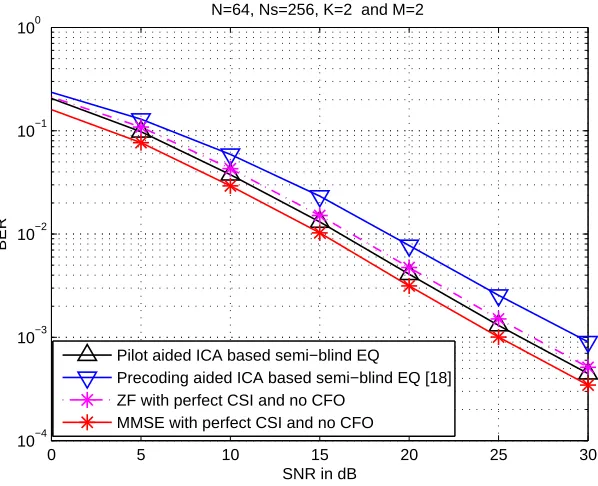
Fig. 1.BER performances of semi-blind equalization structures with CFO, in comparison to ZF and MMSE based equalization in the perfect case (EQ: equalization)
The proposed pilot aided semi-blind equalization requires a much lower complexity than the precoding aided method. The proposed semi-blind equal-ization uses a small number of pilot symbols to eliminate the ambiguity, with only a complexity of4N NpilK. While the precoding aided semi-blind structure requires a pair of precoding-decoding process at both transmitter and receiver side, and has a good BER performance only when the frame size is big, be-cause a large number of received blocks are required to eliminate the ambigu-ity. Also, the permutation and quadrature ambiguity can be resolved simultane-ously by the proposed method, rather than sequentially as in [18]. Therefore, the proposed pilot aided and ICA based equalization has lower computational complexity.
6.
Simulation Results
0 5 10 15 20 25 30 10−6
10−5 10−4 10−3 10−2 10−1 100
K=2 and M=2
SNR in dB
Normalized of CFO
P=16 P=32
Orthogonal sequences CAZAC sequences [20]
Table 1.Computational Complexity
CFO Estimation
Orthogonal sequences Maximum likelihood [19]
Item Complexity order Item Complexity order
CFO separation N2M KP Problem formulation for CFO(N KP)4M2
CFO search qK CFO search qM K
Ambiguity Elimination
Pilot aided Precoding aided [18]
Item Complexity order Item Complexity order
Ambiguity elimination4N NpilK Reordering N Ns(K!)
Quadrature elimination N K
0 5 10 15 20 25 30
10−7 10−6 10−5 10−4 10−3 10−2 10−1
SNR in dB
MSE
K=2, M=2, N=8 and P=32
CFO=[ −0.5 0.5; −0.5 0.5] CFO=[ −0.1 0.3; −0.2 0.2] CFO=[−0.1 0.1; −0.1 0.1]
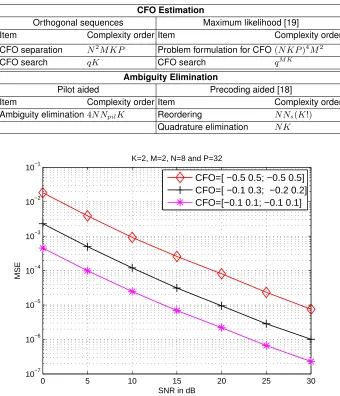
Fig. 3.Impact of different CFOs on the MSE of CFO estimation
0 5 10 15 20 25 30 10−6
10−5 10−4 10−3 10−2 10−1
SNR in dB
Normalized MSE
M=2, N=8 and P=32
K=2, CFO=[−0.1 0.1; 0.1 −0.1]
K=3, CFO=[−0.1 0.1 −0.1; 0.1 −0.1 0.1] K=4, CFO=[−0.1 0.1 −0.1 0.1; 0.1 −0.1 0.1 0.1]
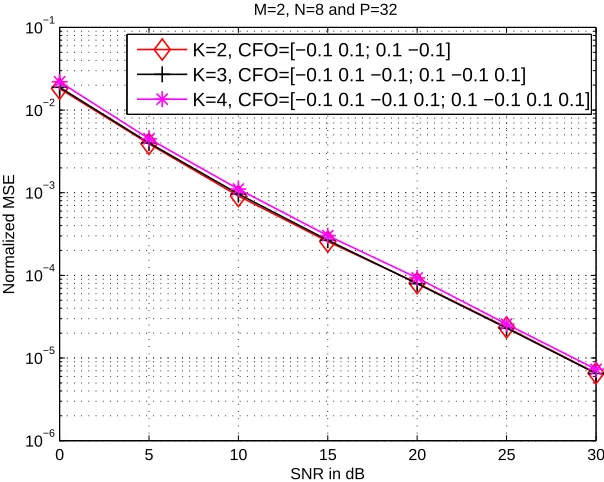
Fig. 4.Impact of the number of users on the normalized MSE performance of the CFO estimation
station during the preamble. A step size∆=0.001 results in a search ofq= 1000
possible CFO values within the range of -0.5 to 0.5 for the CFO search. Fig. 1 demonstrates the BER performance of the proposed orthogonal se-quences based multi-CFO estimation and ICA based equalization scheme, com-pared with the zero forcing (ZF) based and the minimum mean square error (MMSE) based equalization methods. The precoding aided semi-blind equal-ization method [18] is also used for comparison. The CFOs are set to [-0.3 0.3; 0.3 -0.3] and the precoding constant is set to0.25[18]. The proposed multi-CFO estimation and ICA based structure provides a BER performance close to the ZF based and the MMSE based equalization methods with perfect CSI and no CFO. The pilot aided and ICA based structure outperforms the precoding aided method by around1−2dB, showing the effectiveness of our proposed method in ambiguity elimination.
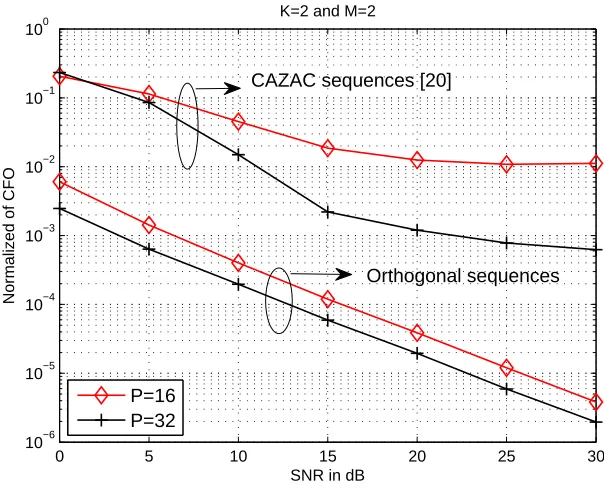
Fig. 2 demonstrates the MSE performance of the proposed orthogonal train-ing sequence based multi-CFO estimation for multiuser OFDM CoMP systems, with training sequences lengthP = 16andP = 32. The CFO estimation MSE is defined as
MSE=
M∑−1
m=0 K∑−1
k=0
0 20 40 60 80 100 120 140 10−7
10−6 10−5 10−4 10−3 10−2
CFO=[0.3 0.3; −0.3 −0.3], N=8, K=2 and M=2
Pilot length P
MSE
SNR=0 dB SNR=10 dB SNR=20 dB SNR=30 dB
The CFOs are set to [-0.3 0.3; 0.3 -0.3]. The proposed CFO estimation method significantly outperforms the CAZAC sequences based method in [20] in terms of the MSE performance, especially at high signal-to-noise ratio (SNR). This is because our proposed method can successfully separate multiple user’s ICI matrices, and achieve multi-CFO estimation at each base station, while the CAZAC sequence based CFO estimation can not completely eliminate the MAI caused by different CFOs at base station.
Fig. 3 shows the impact on the MSE performance of multi-CFO estimation with different sets of CFOs over a range of SNRs. The MSE performances im-prove as the SNR increases and have no error floor at high SNR region. The CFOs as [-0.1 0.1; 0.1 -0.1] has the best MSE performance, while the CFOs as [-0.5 0.5; 0.5 -0.5] has the worse performance. Their performance gap implies that the performance becomes better when the CFO value is closer to zero.
0 50 100 150 200 250 300
10−3 10−2 10−1 100
Frame length
BER
N=64, K=2 and M=2
Pilot aided and ICA based semi−blind EQ
Precoding aided and ICA based semi−blind EQ [18]
SNR=10 dB
SNR=20dB
Fig. 6.Impact of frame size on the BER performances of pilot aided and precoding aided semi-blind equalization structures (EQ: equalization)
CFO estimation is normalized to
NMSE=
∑M−1 m=0
∑K−1 k=0[(ϕ
m,k−ϕˆm,k)]2
∑M−1 m=0
∑K−1 k=0[ϕm,k]2
(24)
The proposed CFO estimation presents a robust performance against the in-crease of the number of users.
Fig. 5 shows the impact of the pilot length on performance of the proposed CFO estimation method with different SNRs. The MSE performance for CFO es-timation improves with the increase of pilot length, until the pilot length reaching a aroundP = 32for different SNRs. It then becomes steady.
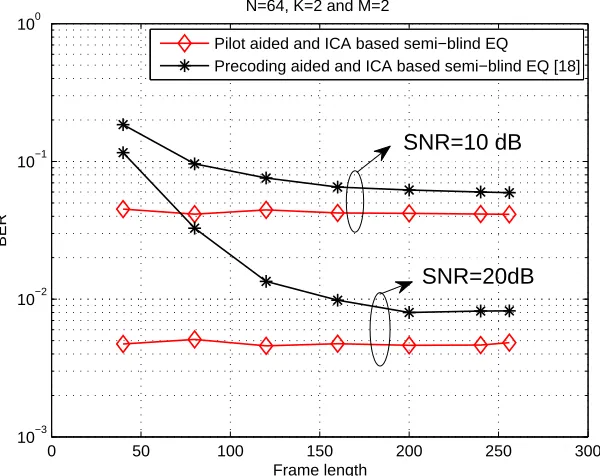
Fig. 6 demonstrates the impact of frame size on the BER performance of the pilot aided and precoding aided semi-blind equalization structures, at SNR
= 10 dB and20dB. The performance of the pilot aided method remains con-stant over a wide range of frame sizes, while the precoding aided method is very sensitive to the change of frame length from small to medium. This is be-cause the precoding aided approach requires a large frame of data to achieve a good performance. Thus, the pilot aided ICA based equalization is more robust against channel variations.
7.
Conclusion
We have proposed a low-complexity orthogonal sequences based multi-CFO estimation approach, and a pilot aided and ICA based semi-blind equalization structure for multiuser-CoMP OFDM systems. Based on the properties of the orthogonal sequences extracted from the Hadamard matrix, the multiple CFOs are separated and estimated simultaneously. The multi-dimensional multi-CFO search is divided into a serials of one-dimensional searches with low complex-ity and high accuracy. By utilizing the cross-correlation between the original and equalized pilot symbols, the permutation and phase ambiguity due to the ICA model are resolved simultaneously, without increasing the computational complexity. The proposed pilot-aided semi-blind equalization structure does not provide a BER performance closed to the ideal case with perfect CSI and no CFO, but also has a much better MSE performance than the CAZAC sequence based CFO estimation scheme [10]. The proposed CFO estimation has a robust performance against the increase of the number of users, and its MSE perfor-mance becomes better when the CFO value is closer to zero. The proposed pilot aided ICA based equalization is more robust against channel variations, than the precoding aided semi-blind structure.
Appendix: Proof of Property II of ICI Circulant Matrix
written as
[E(ϕ)FH]a,v=
1
√
N[Q aW−av]
a,v (25)
By left multiplying the unitary DFT matrix to (25), the ICI matrix is formed, and its element[C]u,vin theu-th row and thev-th column(u= 0,1,· · · , N−1;v=
0,1,· · · , N−1)is written as
[C]u,v= [FE(ϕ)FH]u,v
=
[
1
N N∑−1
a=0
Wua(QaW−av)
]
u,v
= 1
N N∑−1
a=0
[
QaWa(u−v)
]
u,v
(26)
SubstitutingQ=ej2Nπϕ andW =e−j2π/N into (26) yields
N∑−1
v=0
[C]u,v=
1
N N∑−1
u=0 N∑−1
a=0
[
ej2πa(ϕ+v−u)
]
u,v
= 1
N N∑−1
a=0
[
ej2πaN(ϕ+v) +e
j2πa[(ϕ+v)−1]
N +. . .+e
j2πa[(ϕ+v)−(N−1)]
N ] v = 1 N [ N+
N∑−1
a=1
[
ej2πaN(ϕ+v) +e
j2πa[(ϕ+v)−1]
N +. . .+e
j2πa[(ϕ+v)−(N−1)]
N ]] v = 1 N [ N+
N∑−1
a=1
ej2πaN(ϕ+v)
[
1 +e−jN2πa +e
−j4πa
N +· · ·+e
−j2π(N−1)a N
]]
v (27)
since (1 +e−jN2πa +· · ·+e
−j2π(N−1)a
N ) in (27) is the geometric sequence with
common ratio ofe−jN2πa and initial term of1, (27) is rewritten as
N∑−1
u=0
[C]u,v=
1
N
[
N+
N∑−1
a=1
ej2πaN(ϕ+v)
(
e−j2πa−1 e−j2π(NN−1)a −1
)]
v
= 1
(28)
Similarly,∑Nv=0−1[C]u,v= 1and
∑N−1 v=0
∑N−1
u=0[C]u,v=Ncan be proved.
References
2. 3GPP Technical Report 36.913 Version 9.0.0: Requirements for further advance-ments for Evolved Universal Terrestrial Radio Access (E-UTRA)(LTE-Advanced) (Re-lease 9) (Dec. 2009)
3. Sklavos, A., Weber, T., Costa, E. Haas, H., Schulz, E.: Joint detection in multi-antenna and multi-user OFDM systems. Multi-Carrier Spread Spectrum and Related Topics. pp. 191-198 (May 2002)
4. Shamai, S., Somekh, O., Zaidel, B.: Multi-cell communications: a new look at in-terference. IEEE Journal on Selected Areas in Communications. vol. 28, no. 9, pp. 1380-1408 (Dec. 2010)
5. Andrews, J.: Interference cancellation for cellular systems: a contemporary overview. IEEE Transaction on Wireless Communication. vol. 12, no. 2, pp. 19-29 (Apr. 2005) 6. Marsch, P., Khattak, S., Fettweis, G.,: A framework for determining realistic capacity
bounds for distributed antenna systems. In: Proceedings of the IEEE Information Theory Workshop. pp. 571-575, Chengdu, China (Oct. 2006)
7. Coon, J., Armour, S., Beach, M., McGeehan, J.: Adaptive frequency domain equal-ization for single-carrier MIMO systems. In: Proceedings of the IEEE International Conference on Communications. pp. 2487-2491, Paris, France (Jun. 2004)
8. Wu, Y., Zhu, X. Nandi, A. K.,: Adaptive layered space-frequency equalization for single-carrier MIMO systems. In: Proceedings of the 13th European Signal Process-ing Conference. Antalya, Turkey (Sep. 2005)
9. Sarperi, L., Zhu, X. Nandi, A. K.,: Semi-blind layered space-frequency equalization for single-carrier MIMO system with block transmission. IEEE Transactions on Wireless Communications. vol. 7, no. 4, pp. 1203-1207 (Apr. 2008)
10. Cardoso, J.F.: High-order contrasts for independent component analysis. Neural Computation. vol. 11, pp. 157-192 (Jan. 1999)
11. Hyvarinen, A., Karhunen, J., Oja, E.: Independent component analysis. John Wiley & Sons, New York, U.S.A. (May 2002)
12. Petropulu, A., Zhang, R., Lin, R.: Blind OFDM channel estimation through simple linear precoding. IEEE Transactions on Wireless Communication. vol. 3, no. 2, pp. 647-655 (Mar. 2004)
13. Lin, R., Petropulu, A.: Linear precoding assisted blind channel estimation for OFDM systems. IEEE Transactions on Vehicular Technology. vol. 56, no. 3, pp. 1155-1164 (May 2007)
14. Gao, F., Nallanathan, A.: Blind channel estimation for OFDM systems via a gen-eralized precoding. IEEE Transactions on Vehicular Technology. vol. 56, no. 3, pp. 1155-1164 (May 2007)
15. Gao, F., Nallanathan, A.: Blind channel estimation for MIMO OFDM systems via nonredundant linear precoding. IEEE Transactions on Signal Processing. vol. 55, no. 2, pp. 784-789 (Jan. 2007)
16. Obradovic, D. Madhu, N., Szabo, A., Wong, C. S.: Independent component analysis for semiblind signal separation in MIMO mobile frequency selective communication channels. In: Proceedings of the IEEE international Conference on Neural Networks. pp. 53-58. Budapest, Hungary (Jul. 2004)
17. He, L., Ma, S., Wu, Y., Ng, T.: Semiblind iterative data detection for OFDM systems with CFO and doubly selective channels. IEEE Transaction on Communications. vol. 58, no. 12, pp. 3491-3499 (Dec. 2010)
19. Morelli, M., Mengali, U.: Carrier-frequency estimation for transmissions over selec-tive channels. IEEE Transactions on Communications. vol. 48, no. 9, pp. 1580-1589 (Aug. 2000)
20. Wu, Y., Bergmans, J. W. M., Attallah, S.: Carrier frequency offset estimation for multiuser MIMO OFDM uplink using CAZAC sequences: performance and sequence optimization. In: Proceedings of the IEEE Wireless Communications and Networking Conference. pp. 1-5, Budapest, Hungary (Apr. 2009)
21. Wang, H., Xia, X., Yin, Q.: Distributed space-frequency codes for cooperative com-munications systems with multiple carrier frequency offsets. IEEE Transactions on Wireless Communications. vol. 8, no. 2, pp. 1045-1055 (Feb. 2009)
22. Zarikoff, B. W., Cavers, J. K.: Coordinated multi-cell systems: carrier frequency offset estimation and correction. IEEE Transactions on Selected Areas in Communications. vol. 28, no. 9, pp. 1490-1501 (Dec. 2010)
23. Wu, M., Wu, Y.: A new ICI matrices estimation scheme using Hadmard sequences for OFDM systems. IEEE Transactions on Broadcasting, vol. 51, no. 3, pp. 305-314 (Sep. 2005)
24. Xia, X., Ching, P., Chen, Y., Ma, W.: Signal Detection in a SpaceCFrequency Coded Cooperative Communication System With Multiple Carrier Frequency Offsets by Ex-ploiting Specific Properties of the Code Structure. IEEE Transactions on Vehicular Technology. vol. 58, no. 7, pp. 3396-3409 (Sep. 2009)
25. Weng, L., Au, E. K. S., Chen, P. W. C., Murch, R. D., Cheng, R. S., Mow, W. H., Lau, V. K. N.: Effect of carrier frequency offset on channel estimation for SISO/MIMO-OFDM systems. IEEE Transaction on Wireless Communications. vol. 6, no. 5, pp. 1854-1863 (May 2007)
26. Sezginer, S., Bianchi, P., Hachem, W.: Asymptotic Cramer Rao bounds and training design for uplink MIMO-OFDMA systems with frequency offsets. IEEE Transactions on Signal Processing. vol. 55, no. 7, pp. 3606-3622 (Jul. 2007)
27. Tsai, Y., Huang, H., Chen, Y., Yang, K.,: Simultaneous carrier frequency offset es-timation for multi-point transmission in OFDM systems. In: Proceedings of the IEEE Global Telecomunication Conference. pp. 1-5, Houston, USA (Dec. 2011)
28. Mehrpouyan, H., Blostein, S.,: Synchronization in cooperative networks: Estimation of multiple carrier frequency offsets. In: Proceedings of IEEE Internation Conference Commununications. pp. 1-6, Cape Town, South Africa (May 2010)
29. Iossifides, A. C.: Complex orthogonal coded binary transmission with amicable Hadamard matrices over Rayleigh fading channels. In: Proceedings of the IEEE Symposium on Computers and Communications. pp. 335-340, Kerkyra, Greece (Jun. 2011)
30. Trinh, Q. K., Fan, P. Z.: Construction of multilevel Hadamard matrices with small alphabet. Electronics Letters . vol. 44, no. 21, pp. 1250-1252 (Oct. 2008)
31. Papadogiannis, A., Bang, H.J., Gesbert, D., Hardouin, E.: Efficient selective feed-back design for multicell cooperative networks. IEEE Transactions on Vehicular Tech-nology. vol. 60, no. 1, pp. 196-205 (Jan. 2011)
Yufei Jiangreceived the M.Sc degree in Telecommunications and Computer Networks from the London South Bank University, London, U.K., in 2008. He is currently working towards a Ph.D. degree on a joint programme between the University of Liverpool, Liverpool, U.K., and the Xi’an JiaoTong Liverpool University, Suzhou, China. His research interests include MIMO, space-time process, OFDM, cooperative communication, synchronization and blind source separation.
Xu Zhureceived the B.Eng. degree (with first class honors) from the Depart-ment of Electronics and Information Engineering, the Huazhong University of Science and Technology, Wuhan, China, in 1999, and the Ph.D. degree from the Department of Electrical and Electronic Engineering, the Hong Kong Uni-versity of Science and Technology, Hong Kong, in 2003. Since May 2003, she has been with the Department of Electrical Engineering and Electronics, the University of Liverpool, Liverpool, U.K., where she is currently a senior lecturer. Dr. Zhu was the vice chair of the 2006 and 2008 ICA Research Network In-ternational Workshops. She has acted as session chair and technical program committee member for more than 20 international conferences, such as IEEE GLOBECOM 2009 and IEEE ICC 2010. Her research interests include cooper-ative communications, cognitive networks, cross-layer design, MIMO and adap-tive equalization, etc.
Eng Gee Lim received the BEng(Hons) and PhD degrees in Electrical and Electronic Engineering from the University of Northumbria, UK in 1998 and 2002 respectively. Dr Lim worked for Andrew Ltd, a leading communications systems company in the United Kingdom from 2002 to 2007. His responsibil-ities were to conduct the research and development for a cost-effective solu-tion for all terrestrial microwave systems operating at frequencies between 400 MHz and 90 GHz. Dr Lim joined Xi’an Jiaotong-Liverpool University in 2007, where he is currently an associate professor. His research interests are Anten-nas, RF/microwave engineering, EM measurements/simulations, and Wireless Communication Network.
Yi Huang received BSc in Physics (Wuhan, China), MSc (Eng) in Microwave Engineering (Nanjing, China), and DPhil in Communications from the University of Oxford, UK in 1994. He has been conducting research in the areas of wireless communications, applied electromagnetics, radar and antennas for the past 25 years. His experience includes 3 years spent with NRIET (China) as a Radar Engineer and various periods with the Universities of Birmingham, Oxford, and Essex at the UK as a member of research staff. He worked as a Research Fellow at British Telecom Labs in 1994, and then joined the Department of Electrical Engineering & Electronics, the University of Liverpool, UK as a Faculty in 1995, where he is now a full Professor in Wireless Engineering, the Head of High Frequency Engineering Research Group and MSc Programme Director.
book Antennas: from Theory to Practice (John Wiley, 2008). He has received many research grants from research councils, government agencies, charity, EU and industry, acted as a consultant to various companies, and served on a number of national and international technical committees and been an Editor, Associate Editor or Guest Editor of four of international journals. He has been a keynote/invited speaker and organiser of many conferences and workshops (e.g. IEEE iWAT 2010, WiCom 2006, 2010 and LAPC2012). He is at present the Editor-in-Chief of Wireless Engineering and Technology, a UK National Rep of European COST-IC1102, Executive Committee Member of the IET Electro-magnetics PN, a Senior Member of IEEE, and a Fellow of IET.