REVIEW ARTICLE
APPROXIMATE STRONGLY NONLINEAR EQUATION BY SPLINE METHOD
1,*
Adel. Almarashi and
2Abo-el-nor.Abd-alla
1
Department of Mathematics, College of Science, Jazan University, Kingdom of Saudi Arabia
2
Department of Mathematics, Education College, Thamar University, Thamar, Yemen
ARTICLE INFO
ABSTRACT
In this paper, we employ an approximate analytical method, namely the spline method(SM) to investigate a thin film of a third grade fluid down an inclined plane and provided accurate solution unlike other erroneous results available in the literature. The variation of the velocity field for different parameters is compared with the numerical values obtained by the Runge – Kutta Fehlberg method and with the homotopy perturbation method (HPM). Moreover, we found that for all values of parameters (SM) agrees well with the numerical disparate HPM.
Copyright © 2014 Adel. Almarashi and Abo-el-nor.Abd-alla.This is an open access article distributed under the Creative Commons Attribution License, which
permits unrestricted use, distribution, and reproduction in any medium, provided the original work is properly cited.
INTRODUCTION
Most scientific phenomena are inherently nonlinear such as heat transfer and many of them have no analytical solution. Therefore, many different methods have been established by researchers to overcome such nonlinear problems. These methods include the artificial parameter method by (He, 2000), the variation iteration method by (He, 2006). The homotopy perturbation method (HPM) provides an approximate analytical solution in a series form. The HPM has been widely used by numerous researchers successfully for different physical systems such as bifurcation, symptomatology, non linear wave equations, oscillators with discontinuities by (He, 2005) reaction- diffusion equation and heat radiation equation by (Ganji and Rajabi, 2006; Ganji and Sadighi, 2006). Significant classes of fluids commonly used in industries are non-Newtonian fluids. The applications of these fluids arise in areas such as synthetic fibers, food stuffs, drilling oil, gas wells and polymers among others (Ellahi and Riaz, 2010;Ellahi, 2012). The related literature indicates that the third grade fluid has been investigated by many researchers for different geometries and with different techniques.
Her, we consider the steady unidirectional flow of an incompressible third-grade fluid down a uniform inclined plane. For the third grad fluid, the first four terms of Taylor series are using the stress rate of strain relation. The third grade fluid models are complicated due to a large number of physical parameters that have to determine experimentally. The steady flow of third grad fluid in abounded domain with Dirichlet boundary conditions analyzed by (Adrianaet, 2008). (Bresch and Lemoine, 2009) have shown the existence of the solutions for non-stationary third grad fluids and used homogenous boundary condition for the global
and local existence of the fluid velocity equation. Many researchers Busuioc et al., 2008, (Khan and Mahmood, 2012), (Kumaran
et al., 2012) and (Zhany and Li, 2005) have investigated thin film flow of third grad fluid, in addition (Hameed and Ellahi, 2011)
studied thin film flow for MHD fluid on moving belt. Moreover, Ellahi, 2012 and (Ellahi et al., 2011 ), successfully provided the
series solution for non- Newtonian MHD flow with variable viscosity in a third grad fluid and discussed heat transfer in porous
cylinder. Spline methods used in solution fractional differential equation by (Al faour et al., 2008) and (Majid et al., 2014).
Mathematical modeling of non-Newtonian fluid flow gives rise to nonlinear differential equations. Many numerical and analytical techniques have been proposed by various researchers. An efficient approximate analytical solution will find enormous applications. In this paper, we have solved the governing nonlinear differential equation of the present problem using spline method and compared with numerical and HPM methods.
*Corresponding author: Adel. Almarashi
Department of Mathematics, College of Science, Jazan University, Kingdom of Saudi Arabia
ISSN: 0976-3376
Vol. 5, Issue 12, pp.872-878, December, 2014Asian Journal of Science and TechnologySCIENCE AND TECHNOLOGY
Article History:
Received 13th September, 2014
Received in revised form
07th October, 2014
Accepted 28th November, 2014
Published online 30th December, 2014
Key words:
Strongly Non Linear Equations, Third Grade Fluid,
This paper organized as follows: first Section 2, governing equations of the problem are presented. In Section 3, we described the basic principles of spline method. The spline method solution is given in Section 4. In Section 5, we analyzed the comparison of the solution using SM with the numerical method and HPM.
Governing equation
The thin film flow of an incompressible third grad fluid down on an inclined plan with inclination ( ) is governed by the
following nonlinear boundary value problem in a dimensionless form (Siddiqui et al., 2008)
... (1)
Subject to the boundary conditions:
Where y is the fluid velocity, is the density ,
μ
is dynamic vislosity ,β
1 ,β
2 are the material constants of the third grad fluid, gis acceleration due to gravity.
Basic principles of SM
Now we give the definition and some properties of the differential of spline function.
Definition ( 1 ): (cubic spline function): we define
... (2)
... (3)
... (4)
Formulation of the method
Writing as following:
From Eqs ( 2 ) and ( 3 ) into Eq (1) to get
... (6)
From condition
and
We can write by
such that
;
and from
,
we can writeand
... (7)
Substitute in (6) we have,
... (8)
Then equation ( 8 ) can be solved by solving for non linear equation using some iterative method , in this work we use Newton – Rapheson method to find values of S
... (9)
... (10)
The algorithm
Step 1 put
Step 2
Step 3 evaluate
from(8)by Newton – Raphison method using(7 ) ( 9 ).
Step 4 evaluate
from(8)by Newton – Raphison method using(7 ) (10).
Step 4 compute error between
by least square
.
Numerical Examples and Results
In this section presents the effects of controlling parameters on the velocity profile in the form of graphical and tabulated results. In order to validate the accuracy of our approximate solution SM, we have presented a comparative study of SM solution with numerical and exiting solutions. The numerical results will be denoted by NM and homotopy perturbation method by HPM. The
numerical results are from the Runge- Kutta Fehlberg fourth- fifth order method and HPM results are from (Siddiquiet al.,
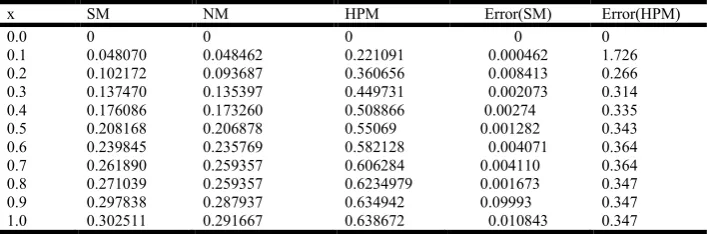
2008). Table 1 showes the comparision of our present SM results with NM and HPM for and the absolute
errors.
Table 1. Comparison of SM with NM and HPM for
x SM NM HPM Error(SM) Error(HPM)
0.0 0 0 0 0 0
0.1 0.048070 0.048462 0.221091 0.000462 1.726
0.2 0.102172 0.093687 0.360656 0.008413 0.266
0.3 0.137470 0.135397 0.449731 0.002073 0.314
0.4 0.176086 0.173260 0.508866 0.00274 0.335
0.5 0.208168 0.206878 0.55069 0.001282 0.343
0.6 0.239845 0.235769 0.582128 0.004071 0.364
0.7 0.261890 0.259357 0.606284 0.004110 0.364
0.8 0.271039 0.259357 0.6234979 0.001673 0.347
0.9 0.297838 0.287937 0.634942 0.09993 0.347
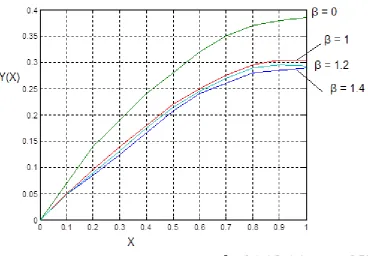
Figure 2.Effects on velocity profile for various values of
The numerical results come from the Rung – Kutta Fehlberg fourth-fifth order method (NM) and the HPM results come from
(Siddiqui et al., 2008). Table 1 illustrates the comparison of our introduce SM results with NM and HPM for
and the absolute errors. It is worth mentioning here that spline method lowest error is better if I compared to HPM.
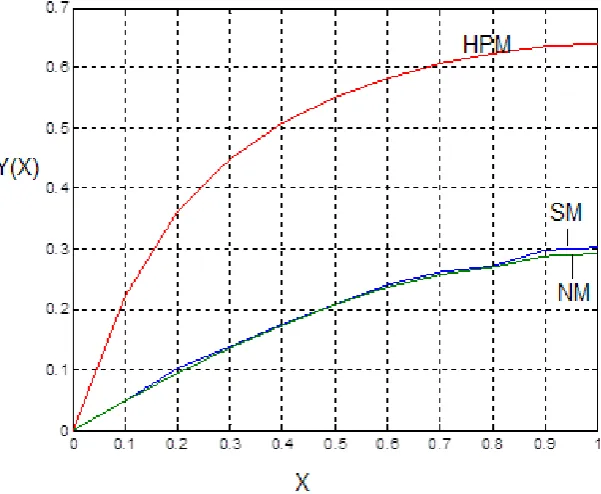
The advantage of SM can be concluded from Fig. 1 in which we compared the solution using SM with NM and HPM for particular values of the controlling parameters. Fig. 2 illustrates the velocity profile for different values of the controlling parameters. For the fixed value of and increasing values of parameter β, a decrease in the velocity profile is observed. Fig. 3 depicts that for increasing value of m keeping fixed value of β will cause the velocity profile to also increase. This is an
agreement with the corresponding results for HPM show in (Siddiqui et al., 2008). However, the values of velocity profile of Fig.
3 obtained via SM are much closer to the numerical values as compared to HPM solution in (Siddiqui et al., 2008).
Figure 3. Effects on velocity profile for various values of
Conclusion
In this work, we have studied a thin film flow of third grade fluid down an inclined plane. Both approximate analytical and
numerical results are obtained for this nonlinear problem. The results are sketched and discussed for the fluid parameter β and for
constant β. It is found that B- cubic spline method (SM) results are much better than HPM results. For large values of non-
Newtonian parameters HPM solution is invalid whereas SM solution is convincing. Finally, we conclude that SM provides a simple and easy way to control and adjust the convergence region for strong nonlinearity and is applicable to highly nonlinear fluid problems.
REFRENCES
Adriana, V., Dragose, I. and Marius, P. 2008. On steady third grade fluids equations, Nonlinearity. 21 ,1621-1635,
Alfaour, O., Almarashi, A. and Alfaour, 2008. Approximate solution for system of multi- term initial value problem of Fractional
Differential Equations by Spline functions, Sana'a University Journal of Science and Technology, 1, 251-264,
Bresch, D. and Lemoine, J. 2009. On the existence of solutions for nonstationary third –grade fluids, Int.J. Non- Linear Mech., 34,
485-498,
Busuioc, A., Iftimie, D. and Paicu, M. 2008. On steady third grad fluids equations. Nonlinearity. 21, 1621-1635.
Ellahi, R. 2012. A study on the convergence of series solution of non-Newtonian third grade fluid with variable viscosity: by means of homotopy analysis method. Adv. Math. Phys11.Article ID 634925, (1-11),
Ellahi, R. and Riaz, A., 2010. Analytical solution for MHD flow in a third grade fluidn with variable viscosity. Math. Comput.
Model., 52, 1783-1793,
Ellahi, R., Zeeshan, A., Vafai, K. and Rehman, H.U. 2011. Series solutions for magneto hydrodynamic flow of non-Newtonian nanofluid and heat transfer in coaxial porous cylinder with slip conditions . J.Nanoeng. Nanosyst. 225(3), 123-132,
Ganji, D. and Rajabi, A. 2006. Assessment of homotopy-perturbation and perturbation methods in heat radiation equations. Int.
Commun. Heat Mass Transfer, 33, 391-400,
Ganji, D., Sadighi, A. 2006. Application of He’s homotopy-perturbation method to nonlinear coupled systems of reaction
diffusion equations. Int. J. Nonlinear Sci. Number. Simul., 7(4), 411-418,
Hameed, H. and Ellahi, R. 2011. Thin film flow of non –Newtonian MHD fluid on a vertically moving belt. Int. J. Number.
Method Fluids., 66(11), 1409- 1419,
He, J. 2005. Application of homotopy perturbation method to nonlinear wave equations. Caos Fractals. 26,695-700,
He, J. 2006. Some asymptotic method for strongly nonlinear equations. Int. J. Mod. Phys., 20(10), 1141-1199,
He,J. 2000. Variational international method for autonomous ordinary differential system. Appl. Math. Comput., 114, 115-123,
Khan, N. and Mahmood, T. 2012. The influence of slip condition on the thin film flow of third order fluid. Int. J. Nonlinear Sci.,
13(1) ,105-116,
Kumaran, V., Tamizharasi, R., Merkin, J. and Varjravelu, K. 2012. On thin film flow of third- grade fluid down an inclined plane.
Arch. Appl. Mech., 82, 261-266,
Mabood, F., Khan, A., Ahmed, I. 2013. Application of optimal homotopy asymptotic method for heat transfer in hollow sphere
Majid, A., Ismail, A. and Rashid, A. 2014. Numerical Method Using Cubic B-Spline for a Strongly Coupled Reaction-Diffusion
System, DOI: 10.1371/journal.pone.,0083265, of a third grade fluid down an inclined plane, Chaos Solitons
Fractals,35,140-147,
Siddiqui, A., Mahmood, R., Ghori, Q. 2008. Homotopy perturbation method for thin film flow
Zhany, R. and Li, X. 2005. Newtonian effects on Lubricant thin film flows, J.Eng.Math., 51,1-13,