PARALLELISM IN BIOMEDICAL IMAGE
PROCESSING FOR REAL TIME GUI USING MATLAB
Sunil Nayak
1, Prof. Rakesh Patel
21,2
Department of Instrumentation and Control,L. D. College Of Engineering, Ahmedabad(India)
ABSTRACT
Bio medical images are quite known for their time consuming phenomenon of processing as it is
having more number of pixels. Graphical user Interface has been recent t in trends for processing
image such that extracting features in order to make decision. The main problem in GUI is that the
quick response is not done due to algorithm is not meeting with the timing constraint with real
time. This condition is due to long algorithm is executed in the sequential way. This research
article contains the way to reduce the time required to fetch the output b ased on the length of the
algorithm. For algorithm edge detection techniques have been taken into consideration and
sequential and parallel execution is compared.
Keywords: Parallel Image Processing, Real time processing, Parallel Computing.
I. INTRODUCTION
Edge detection operators are for boundary conditions and can be used in various ways to
distinguish the image details in terms of multiple aspects. One has to use various methods of edge
detection techniques to identify defect in image. In biomedical ima ge it is most often use of such
image processing task. The manner in which the image is repeatedly processed the time required
will be long here each edge detection operator is depicted along with mathematical description and
time taken by the each operator to execute the function.
II. ANALYSIS OF THE BASIC OPERATORS
Taylor series analysis depicts that differencing adjacent points provides an estimate of the first
order derivative at a point. If the difference is taken between points separated byx then by Taylor expansion for we obtain:
2
' '' 3
( ) ( ) ( ) ( ) 2 !
x
x x f x x f x f x O x
……….(1)
By rearrangement, the first order derivative
'
( ) f x
' ( )
( ) ( )
f x x f x
f x O x
x
………(2)
This shows that the difference between adjacent points is an estimate of the first order derivative,
with error O(x).This error depends on the size of the interval x and on the complexity of the
curve. When x is large this error can be significant. The error is also large when the high -order
derivatives take large values. In practice, the short sampling of image pixels and the reduced high
-frequency content make this approximation adequate.[1]
A change in intensity can be identified by differencing adjacent points. Horizontally adjacent
points which are differentiated will detect vertical changes in intensity and is often called a
horizontal edge detector by virtue of its action[2]. A horizontal operator will not show up
horizontal changes in intensity since the difference is zero. When applied to an image the action of
the horizontal edge-detector forms the difference between two horizontally adjacent points, as such
detecting the vertical edges. The operators are classified as[5]:
1. First Order Operator
2. Second Order Operator
3. Nonlinear Operator
First-order edge detection
Many filter masks have been introduced which approximate the first derivative of the image
gradient. Three of the most general are shown in below. All three are created as a combination of
two kernels: one for the x-derivative and one for the y-derivative.
i) Roberts Operator
The Roberts cross operator was earliest edge detection operators. It creates basic first order edge
detection and uses two templates which difference pixel values in a diagonal manner, as contrary to
along the axes’ directions. The two templates are called M+ and M− are given in Fig.1
Fig.1 Roberts operator
The simple 2X2 Roberts operators were one of the earliest methods employed to detect edges. The
regions corresponding to edges. The Roberts operator is implemented using two convolution masks, each
designed to respond maximally to edges running at 45 to the pixel grid, which return the image
x-derivative and y-x-derivative, Gx and Gy respectively. The magnitude |G| and orientation uof the image
gradient are thus given by
|G|= 2 2
x y
G G … … ….. …….. ……….…. ………. …… (3)
This gives an orientation for a vertical edge which is darker on the left side in the image.
ii) Prewitt edge detection operator
Edge detection is akin to differentiation. Since it detects change it is bound to respond to noise ,as well as
to step-like changes in image intensity[4]. It is therefore prudent to incorporate averaging within the edge
detection process. We can then extend the vertical template, Mx, along three rowand the horizontal
template, My, along three columns. These give the Prewitt edge detection operator, which consists of two
templates shown in fig. 2.
Fig 2. Prewitt operator
The edge magnitude M is the length of the vector and the edge direction is the angle of the
vectorM (x, y) M x(x, y)2 M y(x, y)2 ………
….. (4)
Signs ofMxandMycan be used to determine the appropriate quadrant for the edge direction.
1 ( , )
( , ) ta n
( , ) M y x y x y
M x x y
………… ……….…….…
… (5)iii) Sobel edge detection operator
The weight at the central pixels for both Prewitt templates, is doubled, this gives Sobel edge
detection operator. Itconsists of two masks to determine the edge in vector form. It performs
better than prewitt operator. The coefficients of smoothing within the Sobel operator are shown
Fig. 3 Sobel Operator
iv) Canny edge detection operator
The Canny edge detection operator combined with three main objectives [6]:
1. Optimal detection with no spurious responses
2. Good localization with minimal distance between detected and true edge position
3. Single response to eliminate multiple responses to a single edge.
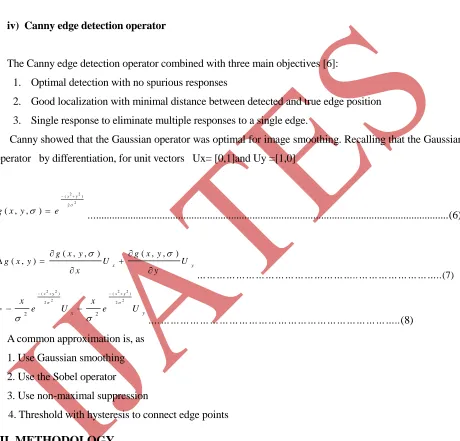
Canny showed that the Gaussian operator was optimal for image smoothing. Recalling that the Gaussian
operator by differentiation, for unit vectors Ux= [0,1]and Uy =[1,0]
2 2 ( y )
2 2
( , , )
x
g x y e
…...(6)
( , , ) ( , , ) ( , ) g x y x g x y y
g x y U U
x y
………..………..(7)
2 2 2 2
( y ) ( y )
2 2 2 2 2 2 x x x y x x
e U e U
….………..(8) A common approximation is, as
1. Use Gaussian smoothing
2. Use the Sobel operator
3. Use non-maximal suppression
4. Threshold with hysteresis to connect edge points
III. METHODOLOGY
Four methods are applied sequentially and then four methods were partitioned using two core parallel
pools and applied two groups of methods to each core [3].The more mathematical rigorous edge detection
technique will be analyzed by time consumed and according to that the data will be portioned. It is
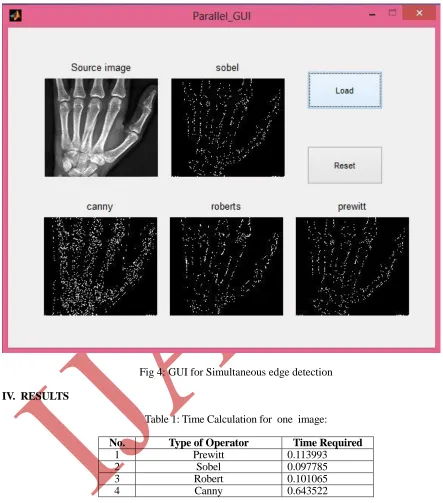
Case: The x ray image of third metacarpal fracture has been taken into investigation for edge detection
and GUI has been developed for the same.
Fig 4: GUI for Simultaneous edge detection
IV. RESULTS
Table 1: Time Calculation for one image:
No. Type of Operator Time Required
1 Prewitt 0.113993
2 Sobel 0.097785
3 Robert 0.101065
4 Canny 0.643522
Sequential time of execution:Elapsed time is 0.956365 seconds.
The images are divided in two parts for two cores time required is as follows:
Core1: Prewitt and Sobel Time elapsed is 0.371915
Most significant time taken into the consideration and is of 0.371915 seconds.
Efficiency = Es/Ep;[7]………..(9)
Where Es = Sequential time
Ep = Parallel time
E = 0.956365/0.371915 = 2.57146.
Plotting between two algorithm accuracy the time difference is depicted below.
The figure5 shows the time difference by time elapsed in second by parallel and sequential algorithm. As
number of core is doubled the performance is improved and can be felt.
Fig.5: Time difference in sequential and parallel execution for Total execution
V. CONCLUSION
The two cores operate efficiently and reduce the time of observer to analyze the results. It is
highly desirable to use multicore where using larger datasets as time required manipulating such
results is larger in sequential manner.GUI is the tool for real time means no delay between input
and output for the process so that the methodology adopted should be used in order to have real
time application in MATLAB.As Canny and Prewitt requires more amount of time due to
mathematical procedure one should make sure that both should not be allocated to one c ore else
contrary condition of timing violation will be there[8].
REFERENCES
[1] Dr. S.K.Mahendran, A comparative study on Edge Detection Algorithms for computer
aided fracture detection systems, International Journal of Engineering & Innovative
technology , Volume 2.Issue 5,November 2012
[2] Fundamentals of Digital Image Processing: A Practical Approach with Examples in
Matlab by Chris Solomon, Toby Breckon, ISBN 978 0 470 84472
4,WileyBlackwell Publication
[3] Parallel and Distributed Computing Toolbox Documentation From Mathworks, Inc.
[4] Feature Extraction and Image Processing Second edition by Mark S. Nixon, Alberto
S. Aguado © 2008 Elsevier Ltd
[5] Digital Image Processing by BarndJahne © Springer-Verlag Berlin Heidelberg 2002
[6] Handbookof Image And Video Processing Editor Al Bovik © 2000 by Academic Press
[7] Advanced Computer Architecture And Parallel Processing byHesham El -Rewini and
MostafaAbd-El-Barr, ISBN: 0-471-46740-5, Wiley Series On Parallel And Distributed
Computing
[8] Multi-Core Programming: Increasing Performance through Software Multi -threading by
ShameemAkhter& Jason Roberts, ISBN 0-9764832-4-6, INTEL PRESS
[9] Textbook of Digital Image Processing By M. Anji Reddy and Y. Hari Shankar© 2006
BS Publication
[10]Learning to Program with MATLAB: Building GUI Tools by Craig S. Lent, © 2013