between lean construction and building
information modelling
Sacks, R, Dave, B, Koskela, LJ and Owen, RL
Title Analysis framework for the interaction between lean construction and building information modelling
Authors Sacks, R, Dave, B, Koskela, LJ and Owen, RL
Type Conference or Workshop Item
URL This version is available at: http://usir.salford.ac.uk/9546/
Published Date 2009
USIR is a digital collection of the research output of the University of Salford. Where copyright permits, full text material held in the repository is made freely available online and can be read, downloaded and copied for noncommercial private study or research purposes. Please check the manuscript for any further copyright restrictions.
CONSTRUCTION AND BUILDING
INFORMATION MODELLING
Rafael Sacks1, Bhargav A. Dave2, Lauri Koskela3 and Robert Owen4
ABSTRACT
Building with Building Information Modelling (BIM) changes design and production processes. But can BIM be used to support process changes designed according to lean production and lean construction principles? To begin to answer this question we provide a conceptual analysis of the interaction of lean construction and BIM for improving construction. This was investigated by compiling a detailed listing of lean construction principles and BIM functionalities which are relevant from this perspective. These were drawn from a detailed literature survey. A research framework for analysis of the interaction between lean and BIM was then compiled. The goal of the framework is to both guide and stimulate research; as such, the approach adopted up to this point is constructive. Ongoing research has identified 55 such interactions, the majority of which show positive synergy between the two.
KEY WORDS
Building information modelling, information flow, lean construction.
INTRODUCTION
Lean Construction and Building Information Modelling (BIM) are effecting fundamental change in the architecture/ engineering/construction (AEC) industry. While the two are conceptually independent and separate, there appear to be synergies between them that extend beyond the essentially circumstantial nature of their approaching maturity contemporaneously. Their parallel adoption in state-of-the-art construction practice is a potential source of confusion when assessing their impacts and effectiveness. Does BIM, as a process, have features that would be intrinsically instrumental in eliminating dominant wastes in construction? Will the organizational forms stimulated by the introduction of BIM be neutral, conducive or hindering regarding lean? What characteristics of BIM systems promote flow, and what characteristics interrupt flow?
1 Associate Professor, Faculty of Civil and Env. Engineering, Technion – Israel Institute of
Technology, Haifa 32000, Israel Phone +972-4-8293190, [email protected]
2 Research Fellow, School of the Built Environment, University of Salford, Salford, UK, Phone
+44-161-2953431, [email protected]
3 Professor, School of the Built Environment, University of Salford, Salford, UK Phone
+44-161-2956378, [email protected]
As a starting point, we define the two concepts for the specific purposes of the framework analysis (these should not be construed as an attempt to provide authoritative definitions, but only to provide the proper context for the discussion that follows):
Lean Construction: Lean construction refers to the application and adaptation of
the underlying concepts and principles of the Toyota Production System (TPS) to construction. Like in the TPS, the focus in lean construction is on reduction of waste, increase of value to the customer, and continuous improvement. While many of the principles and tools of the TPS are applicable as such in construction, there are also principles and tools in lean construction that are different from those of the TPS.
Building Information Modelling:The glossary of the BIM Handbook (Eastman
et al. 2008) defines BIM as “a verb or adjective phrase to describe tools, processes and technologies that are facilitated by digital, machine-readable documentation about a building, its performance, its planning, its construction and later its operation.” The result of BIM activity is a ‘building information model’. BIM software tools are characterized by the ability to compile virtual models of buildings using machine-readable parametric objects that exhibit behaviour commensurate with the need to design, analyse and test a building design (Sacks et al. 2004). As such, 3D CAD models that are not expressed as objects that exhibit form, function and behaviour cannot be considered building information models.
However, the BIM Handbook also states in its introduction that BIM provides “the basis for new construction capabilities and changes in the roles and relationships among a project team. When implemented appropriately, BIM facilitates a more integrated design and construction process that results in better quality buildings at lower cost and reduced project duration.” In this sense, BIM is expected to provide the foundation for some of the results that lean construction is expected to deliver.
That lean construction and BIM are not dependent upon one another (i.e. that lean construction practices can be adopted without BIM, and BIM can be adopted without lean construction) is illustrated by the numerous cases of separate adoption of each in design and construction companies within the past decade. However, we propose that neither can fully achieve its potential for improvement of the results of construction projects unless they are integrated, as they are in the Integrated Project Delivery (IPD) approach. In the words of the American Institute of Architects document on IPD (Eckblad et al. 2007), “Although it is possible to achieve Integrated Project Delivery without Building Information Modelling, it is the opinion and recommendation of this study that Building Information Modelling is essential to efficiently achieve the collaboration required for Integrated Project Delivery.”
The following sections of this paper provide a formal exposition of this idea by defining the interrelationships between the two. This is done by means of a framework that juxtaposes BIM functionalities and lean principles, establishes the theoretical relationships between them, and identifies the constructive and destructive interactions between them in implementation.
EMERGING RESEARCH AND EMPIRICAL EVIDENCE LINKING BIM & LEAN THINKING
opportunities that were needed and which could reinforce the business processes directly, and by making sure by testing that they were an appropriate “fit” to the organisational infrastructure (people, process and other ICT). BIM provides this opportunity to the construction industry as it reinforces the core construction processes. However, to date, the results of much of the construction industry’s investment in ICT have been less than satisfactory for a number of reasons (Dave et al. 2008). Too much emphasis has been placed on solutions which focus mainly on peripheral issues (such as Enterprise Resource Planning systems) rather than core processes, and three core organisational issues – people, process and technology – have not been addressed with the required balance.
The individual areas of Lean Construction and BIM have been researched extensively in recent years. However, there seems to be a lack of research initiatives that exploit both of these areas. Some of the few instances where efforts have been made to integrate the areas of BIM and Lean Construction are discussed in the following paragraphs.
In an effort to evaluate the impact of what they termed ‘Computer Advanced Visualisation Tools’ (CAVT), Rischmoller et al. (2006) used a set of lean principles as the theoretical framework. They placed key emphasis on value generation during the design stage of the construction project. Based on a case study conducted over a four year period, it was concluded that application of CAVT results in waste reduction, improved flow and better customer value, indicating a strong synergy between the lean construction principles and CAVT.
In another attempt to integrate lean construction processes with BIM, Khanzode et al. (2006) attempted to provide a conceptual framework to link Virtual Design & Construction (VDC) with the Lean Project Delivery Process (LPDS). As with CAVT, the VDC concept can be taken to represent BIM, or aspects of BIM, due to the similarities in underlying principles and technologies. Here too, results from a case study confirmed that the application of VDC enhances the Lean Project Delivery Process when applied at the correct stages.
Sacks et al. (2009b) discussed the potential contributions of BIM to visualisation of the product and process aspects of construction projects in terms of lean construction principles. They provided examples that illustrate the use of BIM and related technologies to enable a “pull flow” mechanism to reduce variability within the construction process.
converges. On this project a unique professional role, defined as “Lean/BIM project integrator”, has been created. The positive results reported to date demonstrate how the new project management process combines the areas of Lean and BIM to leverage maximum benefit.
Gilligan and Kunz (2007) reported that the use of VDC in an earlier project was considered to contribute directly to the implementation of lean construction methods:
‘Early interaction between the design and construction teams driven by owner Sutter
Health’s Lean Construction delivery process used 3D models to capitalize on true
value engineering worth nearly $6M’. Khanzode et al. (2005) provide additional
descriptions of the project and the use of VDC and lean methods in its construction. Eastman et al. (2008) provide ten detailed case studies of BIM implementation, two of which focus on projects in which prefabrication was used extensively. In the context of detailed design for fabrication and delivery by subcontracted suppliers of prefabricated elements, they comment that ‘Lean construction techniques require careful coordination between the general contractor and subs to ensure that work can be performed when the appropriate resources are available onsite. ….. Because BIM provides an accurate model of the design and the material resources require for each segment of the work, it provides the basis for improved planning and scheduling of sub-contractors and helps to ensure just-in-time arrival of people, equipment, and materials.’
In general, silo mentalities (Jones and Saad 2003) prevail and document-based information exchange across professions and throughout supply chains ensures that information and, particularly, any associated intelligence, is either corrupted or even lost. The use of an iterative and incremental set-based design (Larman 2004), pulled from an end user or client perspective is virtually impossible within current structures, or at least rarely achieved. Such collaborative Lean approaches, linked with an effective knowledge management system and BIM, would facilitate options design and engineering, based on alternatives which build on prior knowledge, across projects and on topical alternatives available within the project team.
The management and utilisation of federated integrated databases is still evolving (O’Brien et al. 2006), as are the issues of knowledge management, such as automated capture, eternal data compatibility and semantic search capabilities. Even transparent model sharing and the automated propagation of changes have yet to be achieved on most projects, and yet these capabilities and more would be required for either BIM and/ or Lean to be applied in a holistic manner.
Improved technical skills at the BIM hub (the ‘model manager’ and ‘knowledge manager’) and at the workface are required, particularly in the areas of multi-skilling and up-skilling (Carley et al. 2003). Structured careers and training are needed to support both BIM and Lean techniques; otherwise neither continuous improvement (one of the key Lean tenets (Imai 1986)), nor true knowledge management necessary for holistic BIM, can be achieved.
RELEVANT LEAN CONSTRUCTION PRINCIPLES
1982). In the following, we present a list that has been specifically compiled for the analysis of interconnections between lean and BIM.
In selecting such principles, a number of criteria were used. Regarding the focus of the principles, it is interesting to consider the four types of principles, as defined by Liker: philosophy, process, people and partners, problem solving. From these, only principles relating to philosophy are assumed not to relate to BIM. Another choice concerns whether the principles should be descriptive or prescriptive. For example, Hopp and Spearman (1996) present a number of descriptive manufacturing laws, whereas most lean authors have prescriptive principles. Here, the mainstream approach has been adapted, and the applicable descriptive laws have been transformed into prescriptive principles.
A further choice is about the meaning of “process”. As it has been contended elsewhere (Koskela 2004), popular accounts, like Womack & Jones (2003), may confound the two involved concepts, namely flow and value generation, and thus blur the existence of two conceptualizations from which principles are being derived. Historically, lean was initiated based on the flow concept, and the value concept, cultivated by the quality movement, was later merged into lean. Here, principles are explicitly derived from both concepts. Each principle is presented in generic terms, but if its application in construction deviates from the mainstream, the construction specific features are briefly commented.
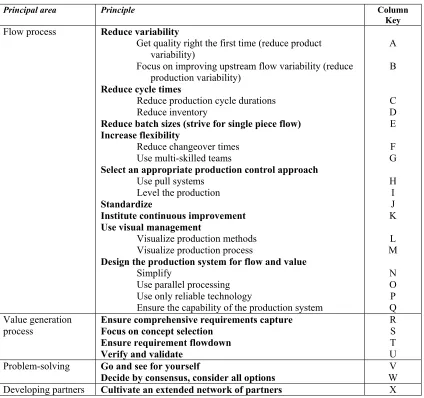
In the following paragraphs the principles are listed in bold, with detailed prescriptions noted in italics:
Reduce variability. This is a foundational principle that has been derived through
two domains, industrial engineering and quality engineering. In statistical quality theory (Shewhart 1931), the target is to reduce the variability in the significant
product characteristics. In queuing theory based understanding of production (Hopp
and Spearman 1996), the target is to reduce temporal variability of production flows. These two types of variability interact in a complex way.
Reduce cycle times. Because variability expands cycle times, this principle can
be used as a driver towards variability reduction. However, reduction of cycle times also has intrinsic value. Due to the definitional connection between work-in-progress and cycle time (expressed in Little’s Law), this principle is roughly equivalent to
inventory reduction. In construction, reduction of cycle times should be focused on
several levels of analysis: total construction duration, stage of construction, flow of materials (from factory to installation), and task (Koskela 2000).
Reducing batch sizes, or striving for single piece flow, is an effective technique
for reducing the expansion of cycle times due to batching. In construction, abstract conceptualizations of ‘products’ that can be counted in a batch are needed. These are commonly predefined as packaged sets of tasks performed in distinct spaces, such as apartments (Sacks and Goldin 2007).
Increase flexibility. Here flexibility may be associated with work station
capability and capacity, routings, etc. Flexibility reduces cycle times and also otherwise it simplifies the production system. In construction, multi-skilled teams provide an example. Reduced setup or changeover times increase routing flexibility with short cycle times.
Select an appropriate production control approach. In a pull system, a
customer), whereas in a push system, a plan pushes activities into realization. The pull
system has come to be closely associated to lean. However, in reality most production
control systems are mixed push-pull systems, and the task is to select the best method for each stage of production (Huang and Kusiak 1998). Levelling of production facilitates the operations of a pull system. In construction, the push system is realized through plans and schedules. The look-ahead procedure in the Last Planner System of production control provides an example of pulling.
Standardize. Standardization of work serves several goals. Both temporal and
product feature variability can be reduced, and continuous improvement is enabled. Employees are also empowered to improve their work.
Institute continuous improvement. Through continuous improvement,
variability can be reduced, and also technology incrementally improved. The scientific experimentation method for improvement was suggested by Shewhart (1931) – it is now known under the name of Deming cycle.
Use visual management. Visual management is closely connected to
standardization, where visualization of production methods offers easy access to standards and supports compliance with them. It is also closely connected to continuous improvement, in that visualization of production processes enables perception by workers of the process state and of measures of improvement.
Design the production system for flow and value. This principle stresses the
importance of production system design (this phrase intends to cover also the product development and design stage). Generally, criteria derived from the two concepts of production should be used in this endeavour. Another important issue is that production system design should support production control and continuous improvement. There are several heuristics for production system design, advising towards simplification, use of parallel processing and use of only reliable technology. From the viewpoint of value, ensuring the capability of the production system is important.
Ensure comprehensive requirements capture. This is the first principle
addressing solely the value generation concept. For obvious reasons, value generation requires comprehensive requirements capture. In practice, this is a notoriously problematic stage.
Focus on concept selection. Designing divides into concept design and detail
design. The development of different concepts and their evaluation should be addressed with necessary emphasis, as there is a natural tendency to rush to detail design. Set based design is an application of this principle that is applicable for building design (Parrish et al. 2007).
Ensure requirement flow-down. The next challenge from the point of view of
value generation is to ensure that all requirements flow down to the point where the smallest parts of the product are designed and produced.
Verify and validate. Also in the realm of value generation, this principle, well
known from the V model of systems engineering, reminds that intent is not enough but all designs and products should be verified against specification and validated against customer requirements.
Go and see for yourself. This “going to gemba”principle stresses the importance
tends to stress the importance of site visits of those who usually do not practise them: for example, estimators and managers.
Decide by consensus, consider all options. This principle derives from the
practice of Toyota (Liker 2003). By extending the circle of decision makers, a wider knowledge base can be ensured for the decisions. By extending the number of options considered, the probability of finding the practically best solution is increased.
Cultivate an extended network of partners. This principle implies that an
[image:8.595.87.511.262.660.2]extended network of partners should be built, challenged and helped to improve. In construction, this can either happen in the framework of one project (alliancing), or on a longer term basis (framework agreements).
Table 1: Lean Principles
Principal area Principle Column
Key
Flow process Reduce variability
Get quality right the first time (reduce product variability)
Focus on improving upstream flow variability (reduce production variability)
Reduce cycle times
Reduce production cycle durations Reduce inventory
Reduce batch sizes (strive for single piece flow) Increase flexibility
Reduce changeover times Use multi-skilled teams
Select an appropriate production control approach
Use pull systems Level the production
Standardize
Institute continuous improvement Use visual management
Visualize production methods Visualize production process
Design the production system for flow and value
Simplify
Use parallel processing Use only reliable technology
Ensure the capability of the production system
A B C D E F G H I J K L M N O P Q Value generation
process Ensure comprehensive requirements capture Focus on concept selection Ensure requirement flowdown
Verify and validate
R S T U Problem-solving Go and see for yourself
Decide by consensus, consider all options
V W Developing partners Cultivate an extended network of partners X
BIM FUNCTIONALITY
constraints (Sacks et al. 2004). Object modelling implies the use of software objects, which group data and the methods to manipulate them, to represent real-world concepts (Galle 1995). The concepts may be physical, such as parts of a building, or abstract, such as a cost estimate or a structural analysis result (Turk et al. 1994). The adjective ‘parametric’ implies the possibility to re-use object ‘class’ definitions to represent multiple occurrences of similar things; these are termed ‘instances’ of a class, and have different attribute values, but the same basic structure. Inheritance of class attributes and methods in a hierarchy make it possible to build extensive taxonomies of objects, with complex behaviours, fairly efficiently. Parametric constraints, which are applied to the resulting model object instances, enable expression and application of rules that govern the way the objects behave when manipulated, so that they can be programmed to respond to actions on them in the way that we would expect their real-world counterparts to behave. For example, when a wall is moved in a BIM design tool, we naturally expect a door within it to move with it. In summary, it is this technology that enables BIM tools to model building’s form, function and behaviour (Tolman 1999), and that makes all of the aspects of functionality listed below possible.
For the purposes of the analysis, we focus on the exhibited functionality, rather than the core technology. The items listed in the following text have been phrased with care to express bare functionality, avoiding a priori assumptions concerning the potential benefits or drawbacks of their use. They are drawn primarily from Eastman et al. (2008) and Sacks et al. (2004).
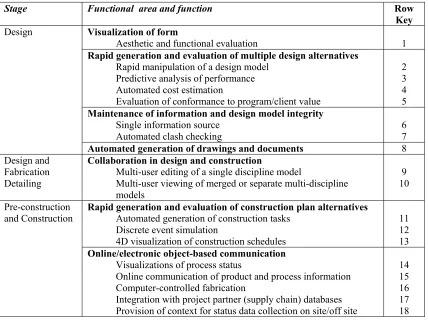
Visualization of form (for aesthetic and functional evaluation). All BIM
systems provide the ability to render the designs with some degree of realism, making them accessible to non-technical project participants and stakeholders.
Rapid generation and evaluation of multiple design alternatives. This includes:
a. Rapid manipulation of a design model by taking advantage of the parametric relationships and behavioural ‘intelligence’, which maintain design coherence, and automated generation and layout of detailed components (e.g. automated connection detailing in steel construction).
b. Predictive analysis of performance (structural analysis, energy, thermal analysis, etc.). Some BIM software have analysis tools, such as finite-element structural analysis, built-in, while others can export relevant pre-processed data for import to external third-party analysis tools.
c. Automated cost estimation with links to online sources of cost data.
d. Evaluation of design intent and conformance to program/client value using rule checking (such as code compliance checking).
Maintenance of information and design model integrity. This capability is
achieved because BIM tools store each piece of information once, without the repetition common in drawing systems where the same design information is stored in multiple drawings or drawing views. Design integrity is also enhanced where the
automatic clash-checking capabilities of model integration software tools are used to
identify and remove physical clashes between model parts.
Automated generation of drawings and documents. Different BIM software
the reports, thus automatically maintaining integrity between the model and the reports (Eastman et al. 2008).
Collaboration in design and construction is expressed in two ways: ‘internally’,
where multiple users within a single organization or discipline edit the same model
simultaneously, and ‘externally’, where multiple modellers simultaneously view
merged or separate multi-discipline models for design coordination. Whereas in the
internal mode objects can be locked to avoid inconsistencies when objects might be edited to produce multiple versions, in the external mode only non-editable representations of the objects are shared, avoiding the problem, but enforcing the need for each discipline to modify its own objects separately before checking whether conflicts are resolved.
Rapid generation and evaluation of multiple construction plan alternatives,
including:
1. Automated generation of construction tasks and modelling of dependencies and pre-requisites (such as completion of preceding tasks, space, information, safety reviews) and resources (crews, materials, equipment, etc.)
2. Discrete event simulation of construction procedures and plans 3. 4D visualization of construction schedules
Online/electronic object-based communication. At present, online
communication is largely limited to the use of project intranets and more sophisticated model-servers. However, more sophisticated systems that integrate product information in BIM tools with process information from enterprise-wide information systems have moved beyond early research and have been implemented in isolated cases, but are not yet widespread. These newer tools enable visualizations
of process and product status using the graphic building model views to deliver the
information to workers in construction environments (Sacks et al. 2009b). The KanBIM system (Sacks et al. 2009a), which delivers integrated product and process information directly, is one example. In the near future, these systems will also use building model views to provide the context for collection of status data on- and off- site.
Direct information transfer to support computer-controlled fabrication of
construction components (rebar, structural steel members, etc.) using numerically-controlled machines is already common. Similarly, business-to-business integration between companies collaborating in construction projects is also possible on the basis of product specifications that originate in building models.
RESEARCH FRAMEWORK FOR ANALYSIS OF THE INTERACTION OF LEAN AND BIM
Table 2: BIM Functionality
Stage Functional area and function Row
Key Visualization of form
Aesthetic and functional evaluation 1
Rapid generation and evaluation of multiple design alternatives
Rapid manipulation of a design model Predictive analysis of performance Automated cost estimation
Evaluation of conformance to program/client value
2 3 4 5
Maintenance of information and design model integrity
Single information source
Automated clash checking 6 7 Design
Automated generation of drawings and documents 8 Design and
Fabrication Detailing
Collaboration in design and construction
Multi-user editing of a single discipline model
Multi-user viewing of merged or separate multi-discipline models
9 10
Rapid generation and evaluation of construction plan alternatives
Automated generation of construction tasks Discrete event simulation
4D visualization of construction schedules
11 12 13 Pre-construction
and Construction
Online/electronic object-based communication
Visualizations of process status
Online communication of product and process information Computer-controlled fabrication
Integration with project partner (supply chain) databases Provision of context for status data collection on site/off site
14 15 16 17 18
CONCLUSIONS
The objective of this work is to explore the potential synergy between lean construction and BIM. At the outset, the different ways of conceptualizing lean construction (including the whole project life cycle) and BIM, respectively, as presented in prior literature, were examined. Based on this, a framework or taxonomy of analyses was created for assessing the interconnections of lean and BIM. This rigorous framework is expected to be useful for future research (both empirical and design science research) relating to this interaction. In a broader sense, the framework and the analysis can be seen as an exemplar of the interactions between new information technologies and the production systems they serve. As such, it may be useful for research and analysis of such systems beyond construction.
In the context of design science, this is constructive research, because it proposes a conceptual view of the influence of an approach to design technology that has a transformative influence not only on the design process but on the construction process as a whole.
Reduce Variability Reduce cycle time
s
Reduce batch sizes Increase flexibility Select an appropri
ate pr oduction co ntr ol appr oach Standar dise Institute continuou s im pr ovem en t
Use visual m
anagem
ent
Design the pr
oduction sy stem fo r flo w an d
value Ensu
re co mp reh en siv e req ui remen ts cap tu re
Focus on concept selection Ensu
re req ui re men ts fl
owdown Verify and V
alidat
e
Go and see f
or
your
self
Decide by consensus consider all options Cultivate an extended networ
k of
par
tners
Lean Principles
BIM Functionality
A B C D E F G H I J K L M N O P Q R S T U V W X
Visualization of form 1
2
3
4
Rapid generation and evaluation of multiple design alternatives
5
6
Maintenance of information and design model integrity 7
Automated generation of drawings and documents 8
9
Collaboration in design and construction 10
11
12
Rapid generation and evaluation of multiple construction plan
alternatives 13
[image:12.595.67.784.88.462.2]14 15 16 17 Online/electronic object-based communication 18
REFERENCES
Carley, L. A., Haas, C. T., Borcherding, J. D., and Goodrum, P. M. (2003). "Experiences with multiskilling among non-union craft workers in US industrial construction projects." Engineering, Construction and Architectural
Management, 10(6), 374-381.
Dave, B., Koskela, L., Kagioglou, M., and Bertelsen., S. (2008). "A critical look at integrating people, process and Information Technology within the construction industry." Proceedings of the 16th Annual Conference of the
International Group for Lean Construction IGLC16, P. Tzortzopoulos and M.
Kagioglou, eds., University of Salford, Manchester, 795-808.
Deming, W. E. (1982). Out of the crisis, Massachusetts Institute of Technology, Cambridge, MA.
Eastman, C. M., Teicholz, P., Sacks, R., and Liston, K. (2008). BIM Handbook: A Guide to Building Information Modeling for Owners, Managers, Architects,
Engineers, Contractors, and Fabricators, John Wiley and Sons, Hoboken, NJ.
Eckblad, S., Ashcraft, H., Audsley, P., Blieman, D., Bedrick, J., Brewis, C., Hartung, R. J., Onuma, K., Rubel, Z., and Stephens, N. D. (2007). "Integrated Project Delivery - A Working Definition." AIA California Council, Sacramento, CA. Galle, P. (1995). "Towards integrated, "intelligent", and compliant computer
modeling of buildings." Automation in Construction, 4, 189-211.
Gilligan, B., and Kunz, J. (2007). "VDC Use in 2007: Significant Value, Dramatic Growth, and Apparent Business Opportunity." #TR171, Center for Integrated Facility Engineering, Stanford University, Stanford, CA, pp 36.
Hopp, W. J., and Spearman, M. L. (1996). Factory Physics, IRWIN, Chicago.
Huang, C.-C., and Kusiak, A. (1998). "Manufacturing control with a push-pull approach." Int. J. Prod. Res., 36(1), 251 - 275.
Imai, M. (1986). KAIZEN: The Key to Japan’s Competitive Success, McGraw-Hill/Irwin.
Jones, M., and Saad, M. (2003). Managing Innovation in Construction, Thomas Telford.
Khanzode, A., Fischer, M., and Reed, D. (2005). "Case Study of the Implementation of the Lean Project Delivery System (LPDS) using Virtual Building Technologies on a Large Healthcare Project." 13th Conference of the
International Group for Lean Construction, R. Kenley, ed., UNSW, Sydney,
Australia, 153-160.
Khanzode, A., Fischer, M., Reed, D., and Ballard, G. (2006). "A Guide to Applying the Principles of Virtual Design & Construction (VDC) to the Lean Project Delivery Process." CIFE, Stanford University, Palo Alto, CA.
Khemlani, L. (2009). "Sutter Medical Center Castro Valley: Case Study of an IPD Project." AECBytes, Khemlani, L., CA, available at
http://www.aecbytes.com/buildingthefuture/2009/Sutter_IPDCaseStudy.html. Koskela, L. (1992). "Application of the New Production Philosophy to Construction."
Technical Report # 72, Center for Integrated Facility Engineering, Department
of Civil Engineering, Stanford University.
Koskela, L. (2000). "An exploration towards a production theory and its application to construction," D. Tech thesis, Helsinki University of Technology, Espoo, 296, available at http://www.inf.vtt.fi/pdf/publications/2000/P408.pdf.
Larman, C. (2004). Agile And Iterative Development : A Manager's Guide, Addison-Wesley, Boston.
Liker, J. E. (2003). The Toyota Way, McGraw-Hill, New York.
O’Brien, W. J., Hammer, J., and M., S. (2006). "From SEEKing Knowledge to Making Connections: Challenges, Approaches and Architectures for Distributed Process Integration." Intelligent Computing in Engineering and Architecture, Springer, Berlin/Heidelberg.
Parrish, K., Wong, J.-M., Tommelein, I. D., and Stojadinovic, B. (2007). "Exploration of Set-Based Design for Reinforced Concrete Structures." 15th Conference of
the International Group for Lean Construction, C. Pasquire and P.
Tzortzopoulous, eds., Michigan State Unviversity, East Lansing, Michigan, 213-222.
Rischmoller, L., Alarcon, L. F., and Koskela, L. (2006). "Improving Value Generation in the Design Process of Industrial Projects Using CAVT." Journal of
Management in Engineering, 22(2), 52-60.
Sacks, R., Eastman, C. M., and Lee, G. (2004). "Parametric 3D Modeling in Building Construction with Examples from Precast Concrete." Automation in Construction, 13, 291-312.
Sacks, R., and Goldin, M. (2007). "Lean Management Model for Construction of High-Rise Apartment Buildings." Journal of Construction Engineering and
Management, 133(5), 374-384.
Sacks, R., Radosavljevic, M., and Barak, R. (2009a). "The Principles for BIM-enabled Lean Production Management Systems for Construction." Innovative Construction Research Centre, Reading, UK.
Sacks, R., Treckmann, M., and Rozenfeld, O. (2009b). "Visualization of Work Flow to Support Lean Construction." ASCE Journal of Construction Engineering
and Management, in press.
Schonberger, R. J. (1996). World Class Manufacturing : The Next Decade, The Free Press, New York.
Shewhart, W. A. (1931). Economic Control of Quality of Manufactured Product, Van Nostrand Reinhold Co., (Republished in 1981 by the American Society for Quality Control, Milwaukee, WI), Princeton, NJ.
Tolman, F. P. (1999). "Product modeling standards for the building and construction industry: past, present and future." Automation in Construction, 8, 227-235. Turk, Z., Isakovic, T., and Fischinger, M. (1994). "Object-Oriented Modeling of
Design System for RC Buildings." Journal of Computing in Civil Engineering, 8(4), 436-453.
Womack, J. P., and Jones, D. T. (2003). Lean Thinking: Banish Waste and Create