O R I G I N A L R E S E A R C H
Clinical Ef
fi
cacy of Transurethral Resection of the
Prostate Combined with Oral Anticholinergics or
Botulinum Toxin
–
A Injection to Treat Benign
Prostatic Hyperplasia with Overactive Bladder: A
Case
–
Control Study
This article was published in the following Dove Press journal: Clinical Pharmacology: Advances and Applications
Farzad Allameh 1 Abbas Basiri1
Mohammadreza Razzaghi2 Amir reza Abedi3
Morteza Fallah-karkan2,3 Saleh Ghiasy3
Seyyed Mohammad Hosseininia3 Saeed Montazeri 3
1Urology and Nephrology Research
Center, Shahid Beheshti University of Medical Sciences, Tehran, Iran;2Laser
Application in Medical Sciences Research Center, Shohada-e-Tajrish Hospital, Shahid Beheshti University of Medical Sciences, Tehran, Iran;3Department of
Urology, Shohada-e-Tajrish Hospital, Shahid Beheshti University of Medical Sciences, Tehran, Iran
Introduction: Recent investigations showed that anticholinergic drugs could use for the
management of storage symptoms after transurethral resection of the prostate (TURP). The use of intravesical botulinum toxin-A (BTX-A) for the management of overactive bladder is rapidly increasing. In this research, we assess the efficacy of BTX-A vs solifenacin in men suffering from bladder outlet obstruction–over active bladder (BOO-OAB) managed with TURP.
Methods:In this case–control study, 50 men with BOO-OAB randomized into two groups. The
control group (A) underwent TURP and subsequently managed by solifenacin 5 mg daily, and the case group (B) underwent TURP and BTX-A injection in the bladder wall in the same session. Treatment success was the primary outcome and defined as post-injection improvement in the storage score of the International Prostate Symptom Score (IPSS) from baseline.
Results:The IPSS, post-void residual volume, frequency, incomplete emptying, nocturia and
urgency subscores considerably ameliorated after 12 weeks and 36 weeks for both groups, but it was more significant in the case arm. The quality of life (QoL) scores significantly improved after the treatments in both groups. Intervention group showed significant reductions regarding urgency incontinence compared with the solifenacin group at 12th and 36th weeks.
Conclusion: BTX-A is an effective and well-tolerated treatment in patients with benign
prostatic hyperplasia (BPH) who are candidates of TURP and simultaneously suffer from OAB symptoms.
Keywords: anticholinergic drug, benign prostatic hyperplasia, botulinum toxin-A, over
active bladder, solifenacin, TURP
Introduction
One of the treatment challenges for general practitioners and urologists is the lower urinary tract symptoms (LUTS) associated with benign prostatic hyperplasia (BPH).1–4 In men, bladder outlet obstruction (BOO) may be accompanied by Detrusor Overactivity (DO) due to BPH, or secondary to obstruction. BOO leads to DO by BPH-induced physiological alterations in the bladder wall, denervation caused by ischemia and changes in neuronal mechanisms that control the bladder contraction.5,6 The storage symptoms are the most distressing symptoms of BPH. These symptoms include over active bladder (OAB) symptoms, which consist of:
Correspondence: Saeed Montazeri Urology Resident, Shohada E Tajrish Hospital, Shahid Beheshti University of Medical Sciences, Tehran, Iran Tel +98 21 22749221
Email [email protected]
Clinical Pharmacology: Advances and Applications
Dove
press
open access to scientific and medical research
Open Access Full Text Article
Clinical Pharmacology: Advances and Applications downloaded from https://www.dovepress.com/ by 118.70.13.36 on 27-Aug-2020
frequency, urgency, and urge incontinence and voiding symptoms such as intermittency, slow stream and hesi-tancy are more common. Thus, an essential goal in the management of concomitant symptoms of DO and BPH is to treat these bothersome symptoms.7
The most effective treatment for the amelioration of LUTS presented in BPH is transurethral resection of the prostate (TURP), but despite this treatment, a higher per-centage of storage symptoms in comparison with voiding symptoms tend to remain.8–11Moreover, long term follow-up of patients who underwent TURP showed that symp-toms related to OAB tend to reoccur in more than 60%,12,13 which has led to an assumption of a direct association between DO and BPH; however, this associa-tion has been disputed.14
Some investigations have recommended that adminis-tering anticholinergic drugs could treat the storage symp-toms, regardless the presence of BOO.15 Recently, a meta-analysis suggested that administering anticholiner-gic drugs did not increase the acute urinary retention rates, but there were no significant alterations in neither the International Prostate Symptom Score (IPSS) nor the maximum urinary flow.16 On the other hand, BPH is a disease that presents in older men, so an important point is considering the possibility of subjects taking medica-tions for other disorders.10
BTX-A injection has been used in several urological disorders, such as voiding dysfunction, including OAB.17 An increasing trend emerged in using intravesical BTX-A for the treatment of overactive bladder. On the other hand, an increasing evidence demonstrates this technique to be well-tolerated, effective and with minimal or no adverse effects.18,19In the present study, the effects of BTX-A vs solifenacin in men with BOO-OAB who managed with TURP were evaluated.
Methods
Population
This was a case–control study that took place from November 2015 to May 2018. Twenty-five men of 50 years and older diagnosed with BOO-OAB completed the investigation in Shohadaye-Tajrish Hospital, Shahid Beheshti University of Medical Sciences, Tehran, Iran. The control group consisted of 25 patients as well, which for the management of the selection bias, matched accord-ing to demographic and clinical features of the case arm.
Eligible subjects were required to have urinary fre-quency (micturition≥8/24 hrs), urgency, urge incontinence (1 or more experience/24 hrs). Also, subjects required to have the following criteria: volume to thefirst contraction less than 350 mL, urodynamically confirmed DO (Involuntary detrusor contraction≥ 10 cm H2O), IPSS of 18 or higher (administered once at thefirst screening and again after BPH drug washout when pertinent), Qmax≤15 mL per second, voided volume of 125 mL or less and undergoing washout period for any BPH medication.
Subjects with a history of prostate/bladder cancer, bladder stones or bladder diverticulum, an elevated serum prostate-specific antigen level (>4 ng/mL), pelvic radiotherapy, neurological diseases, history of urethral Stenosis/stricture, patients who needed open prostatectomy due to significant high prostate volume (≥80 cc), acute urinary tract infection, previous outpatient BOO proce-dures, post-void residual (PVR) ≥400 mL, urinary reten-tion in the last 12 months, clean intermittent catheterization/indwelling catheter, bladder training (within ten days) and cases with a history of adverse reaction to anticholinergic or BTX-A were excluded.
Study Protocol
At initial presentation, all cases evaluated by a complete urologic physical examination and history. The diagnosis of BOO-OAB based on the history, IPSS, Urodynamic Study (UDS) and transabdominal Ultrasonography for prostate volume and residual volume measurement. Urine culture, renal function test, and coagulative status tests done for all the cases before the procedure, and if needed, appropriate antibiotics prescribed.
The control group (A) underwent TURP and managed by solifenacin 5 mg daily (which started immediately after surgery and continued for a duration of 6 months) and the case intervention group (B) underwent TURP and Dysport injection in bladder wall in the same session (300 units diluted in 10 ccs normal saline injected into 20 points of the bladder wall. The dosage of 300 U in the study proto-col is based on the lower optimum dose of BTX-A and also the fact that the suggestive conversion ratio for Dysport compared to Botox is 2.5:1. The injection in the trigonum and near the ureteral ostium was avoided to inhibit any injury to the upper urinary tract).
Outcomes
Treatment success, which was the primary efficacy out-come defined as improvement in the storage score of IPSS
Clinical Pharmacology: Advances and Applications downloaded from https://www.dovepress.com/ by 118.70.13.36 on 27-Aug-2020
by at least 30% before injection. All cases undertake
uro-flowmetry to calculate the maximum flow rates. All sub-jects were examined for a 2-day frequency volume chart (FVC) with a graduated cylinder (the number of voids during the daytime and nighttime) before and after the intervention according to revisit time. Post-void residual (PVR) volume measured using transabdominal Ultrasonography before and after management. Follow-up sessions done at 6 and 9 months post-operatively. Any symptoms of serious adverse events or urinary reten-tion reported on the basis of case-by-case.
Statics
For statistical analysis, SPSS software (IBM corp., Chicago, IL, USA; version 20.0) used. Quantitative variables reported as mean ± standard deviation and qualitative variables reported as frequency and percentage. All nonparametric comparisons with Chi-Square tests. A P value of less than 0.05 considered to be statistically significant.
Ethics
This study was conducted in accordance with the declara-tion of Helsinki. The approval of the Shahid Beheshti University of Medical Sciences’ ethical committee and The Institutional Review Board of Tajrish Hospital obtained. After explaining the benefits, risks, and options of treatment, written informed consent acquired from all patients. The gathered information was considered confi -dential and used anonymously throughout the survey.
Results
Of the 50 men who entered the research, data acquired from 39 subjects. Four subjects in the case and seven in the control group who did not make the follow-up visits excluded from all analyses.
Table 1 presents the demographic and baseline charac-teristics. Comparison between the treatment groups was generally feasible.
Of the 18 cases treated with solifenacin, six patients experienced short-run constipation, rash, and dry mouth. One patient in the case group starts to develop voiding difficulty and urinary retention, which needed catheteriza-tion. After four days, the patient could urinate spontaneously. The total IPSS, PVR volume, frequency, nocturia, incomplete emptying and urgency subscores improved significantly after 12 weeks and 36 weeks for both groups but more significantly in case arm. In both groups, the scores of QoL significantly ameliorated after the
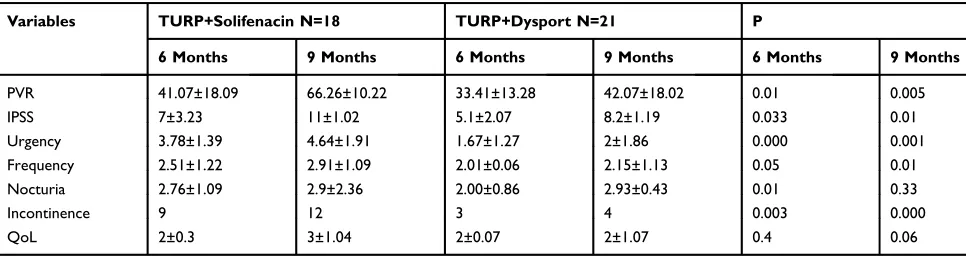
intervention. Notably, urgency incontinence rates signifi -cantly reduced in case group patients at the 12th and 36th week. Table 2 shows changes in storage symptoms at 6 and 9 months in the case arm and comparison with baseline.Table 3 illustrates changes in storage symptoms at 6 and 9 months in the control arm and comparison with baseline. Andfinally,Table 4shows changes in the storage symptoms at 6 and 9 months in the case and control groups.
At the 12th week, daytime frequency in the case group reduced from 7.5±2.6 before treatment with BTX-A to 6.1 ±2.00 after treatment (P < 0.001) and nighttime frequency reduced from 2.5 ±1.6 before treatment to 2.1 ±1.03 after treatment (P < 0.003), all of which were statistically sig-nificant. On the other hand, also at 12th week, in the control group, daytime frequency showed reduction from 7.7 ±2.1 before treatment with solifenacin to 6.9 ±2.3 (P < 0.031) after treatment and nighttime frequency showed reduction from 2.5 ±1 before treatment with solifenacin to 2 ±1.2 after treatment (P < 0.039) which were also statistically signifi -cant. At 36th week, daytime frequency reached 6.7 ± 2.3 (P < 0.014) and nighttime frequency reached 2.8 ±1.2 (P < 0.002) in case group; while in the control group day-time frequency was 7.1 ±2.1 (P < 0.001) and nightday-time frequency was 2.2 ±1.01 (P < 0.004).
Discussion
LUTS, which are suggestive of BPH accounts for one of the most common urological complaints that affect the quality of life. However, storage symptoms reduce QoL more significantly and are more vexing.20 Both storage and voiding symptoms co-exist in male LUTS, and the OAB is presented in 50% to 70% of patients.21 BOO results in functional and morphological modifies in the bladder wall (eg: ischemia, partial denervation, neurotrans-mitter imbalance, changes in electrical characteristics of detrusor smooth muscle cells, spinal micturition reflex reorganization).3,22
OAB Treatments include pelvicfloor muscle training, behavioral therapy, intravesical treatments, anti-muscarinic drugs, clean intermittent catheterization, and occasionally bladder open surgery.23–25 Prostate Surgery in some of these cases can normalize the OAB-cystometric responses and in others, causes urge incontinence. Generally, after treatment with TURP, storage symptoms tend to remain more than voiding symptoms (storage symptoms remain in 40% of patients at some levels for mean duration of 3 months), thus having a negative impact on the QoL.8,12,26
Clinical Pharmacology: Advances and Applications downloaded from https://www.dovepress.com/ by 118.70.13.36 on 27-Aug-2020
Injection of BTX-A has been used in several urolo-gical disorders, such as voiding dysfunctions, including OAB.27 Moreover, in patients with detrusor overactivity, injection of BTX-A in detrusor muscle can inhibit
contractions and thus improving urinary continence.28 Many investigations present the period of induced detru-sor paralysis after BTX-A injection to be approximately nine months.10,19,28–31
Table 1Baseline and Demographic Characteristics
Variables TURP+Solifenacin N=18 TURP+Dysport N=21 P
Age, year 68.50±6.51 71.71±7.47 0.164
Prostate Volume, mL 53.03±11.23 57.10±03.07 0.231
Qmax 11.01±2.05 11.07±1.12 0.218
BCI* 164±17.01 161±16.06 0.103
OAB type III: 14 IV:4 III:17 IV:4 0.558
PVR 86.6±23.31 87.02±19.07 0.127
IPSS 24.5±6.75 24.86±5.16 0.853
Urgency 4.22±0.64 4.24±0.70 0.942
Frequency 4.08±0.31 4.03±0.55 0.921
Nocturia 4.17±0.08 4.11±0.10 0.948
QoL 4±1 4±1 0.901
Note: *Bladder contractility index.
Table 2Changes in Storage Symptoms at Months 6 and 9 in the Case Arm and Comparison with Baseline
Variables TURP+Dysport N=21 P
Baseline 6 Months 9 Months 6 Months 9 Months
PVR 87.02±19.07 33.41±13.28 42.07±18.02 0.000 0.000
IPSS 24.86±5.16 5.1±2.07 8.2±1.19 0.000 0.000
Urgency 4.24±0.70 1.67±1.27 2±1.86 0.000 0.001
Frequency 4.03±0.55 2.01±0.06 2.15±1.13 0.000 0.000
Nocturia 4.11±0.10 2.00±0.86 2.93±0.43 0.000 0.01
Incontinence 15 3 4 0.000 0.000
QoL 4±1 2±0.07 2±1.07 0.000 0.001
Table 3Changes in Storage Symptoms at Months 6 and 9 in the Control Arm and Comparison with Baseline
Variables TURP+Solifenacin N=18 P
Baseline 6 Months 9 Months 6 Months 9 Months
PVR 86.6±23.31 41.07±18.09 66.26±10.22 0.000 0.001
IPSS 24.5±6.75 7±3.23 11±1.02 0.000 0.003
Urgency 4.22±0.64 3.78±1.39 4.64±1.91 0.02 0.3
Frequency 4.08±0.31 2.51±1.22 2.91±1.09 0.001 0.01
Nocturia 4.17±0.08 2.76±1.09 2.9±2.36 0.001 0.01
Incontinence 17 9 12 0.000 0.008
QoL 4±1 2±0.3 3±1.04 0.002 0.01
Clinical Pharmacology: Advances and Applications downloaded from https://www.dovepress.com/ by 118.70.13.36 on 27-Aug-2020
Three action mechanisms that explain the clinical effects of BTX-A are as follows: inducing aflaccid paraly-sis of detrusor muscle by blocking acetylcholine released at the neuromuscular junction,30 inhibition the release of other neurotransmitters such as norepinephrine (that has a significant physiologic effect on the functional modulation of the lower urinary tract.),32and the inhibition of afferent neurotransmission.10
An alternative treatment of anticholinergic therapy is injection into the detrusor muscle. First trials with BTX-A suggested favorable results respecting the urodynamic and clinical and advantages of this novel treatment. The neuro-toxin injection into the bladder wall results in neuromuscular junction blocking and thus relaxation of the detrusor muscle.33,34
Previous researches mentioned BTX-A effects on reduced DO and urine leakage to be comparable to placebo.17–19,28,30,35,36However, the surgical management of BPH with simultaneous BTX-A injection for manage-ment of BOO-OAB has not investigated yet.
In the present study, subjects who had clinical BPH managed by TURP plus anticholinergic medication or simultaneous BTX-A injection in bladder detrusor muscle were included. Our results presented that the PVR, total IPSS, QoL scores, nocturia, frequency, and urgency sig-nificantly improved after 12 weeks and 36 weeks for both groups but more significantly in the BTX-A injection group. Also, significant reduction seen in the case group compared to the solifenacin group regarding urgency incontinence.
Conclusion
BTX-A is an effective and well-tolerated treatment in patients with benign prostatic hyperplasia (BPH) who are candidates of TURP and simultaneously suffer from OAB symptoms.
Limitation and Recommendations
A limitation of our study was low number of patients which became more problematic when four subjects in the case and seven in the control group excluded from the study due to loss of follow-up visits. Future studies with larger number of patients are needed to elucidate the efficacy of BTX-A injec-tion in male subjects with concomitant BPH and OAB using randomized clinical trials for the long-term periods compared to placebo or other medications.
Informed Consent
According to Research involving Human Participants, written informed consent acquired from all patients.
Acknowledgments
The authors are grateful thanks to the Shohada e Tajrish urology ward staff.
Author Contributions
All authors contributed to data analysis, drafting or revising the article, gavefinal approval of the version to be published, and agree to be accountable for all aspects of the work.
Disclosure
The authors have no conflicts of interest to declare.
References
1. Elterman DS, Barkin J, Kaplan SA. Optimizing the management of benign prostatic hyperplasia. Ther Adv Urol. 2012;4(2):77–83. doi:10.1177/1756287212437361
2. Karami H, Hassanzadeh-Hadad A, Fallah-Karkan M. Comparing monotherapy with tadalafil or tamsulosin and their combination ther-apy in men with benign prostatic hyperplasia: a randomized clinical trial.Urol J.2016;13(6):2920–2926.
3. Oelke M, Baard J, Wijkstra H, Jean J, Jonas U, Höfner K. Age and bladder outlet obstruction are independently associated with detrusor overactivity in patients with benign prostatic hyperplasia.Eur Urol.
2008;54(2):419–426. doi:10.1016/j.eururo.2008.02.017
Table 4Changes in the Storage Symptoms at Months 6 and 9 in Case and Control Groups
Variables TURP+Solifenacin N=18 TURP+Dysport N=21 P
6 Months 9 Months 6 Months 9 Months 6 Months 9 Months
PVR 41.07±18.09 66.26±10.22 33.41±13.28 42.07±18.02 0.01 0.005
IPSS 7±3.23 11±1.02 5.1±2.07 8.2±1.19 0.033 0.01
Urgency 3.78±1.39 4.64±1.91 1.67±1.27 2±1.86 0.000 0.001
Frequency 2.51±1.22 2.91±1.09 2.01±0.06 2.15±1.13 0.05 0.01
Nocturia 2.76±1.09 2.9±2.36 2.00±0.86 2.93±0.43 0.01 0.33
Incontinence 9 12 3 4 0.003 0.000
QoL 2±0.3 3±1.04 2±0.07 2±1.07 0.4 0.06
Clinical Pharmacology: Advances and Applications downloaded from https://www.dovepress.com/ by 118.70.13.36 on 27-Aug-2020
4. Razzaghi MR, Karkan MF, Ghiasy S, Javanmard B. Laser application in Iran urology: a narrative review.J Lasers Med Sci.2018;9(1):1. doi:10.15171/jlms.2018.01
5. Kaplan SA, Roehrborn CG, Rovner ES, Carlsson M, Bavendam T, Guan Z. Tolterodine and tamsulosin for treatment of men with lower urinary tract symptoms and overactive bladder: a randomized controlled trial. JAMA.2006;296(19):2319–2328. doi:10.1001/jama.296.19.2319 6. Greenland JE, Brading AF. The effect of bladder outflow obstruction on
detrusor bloodflow changes during the voiding cycle in conscious pigs.J Urol.2001;165(1):245–248. doi:10.1097/00005392-200101000-00072 7. Abrams P, Kaplan S, Gans HJDK, Millard R. Safety and tolerability
of tolterodine for the treatment of overactive bladder in men with bladder outlet obstruction. J Urol. 2006;175(3):999–1004. doi:10.1016/S0022-5347(05)00483-0
8. Seki N, Kai N, Seguchi H, Takei M, Yamaguchi A, Naito S. Predictives regarding outcome after transurethral resection for pro-static adenoma associated with detrusor underactivity. Urology.
2006;67(2):306–310. doi:10.1016/j.urology.2005.08.015
9. Machino R, Kakizaki H, Ameda K, et al. Detrusor instability with equivocal obstruction: a predictor of unfavorable symptomatic out-comes after transurethral prostatectomy.Neurourol Urodyn.2002;21 (5):444–449. doi:10.1002/nau.10057
10. Antunes AA, Srougi M, Coelho RF, de Campos Freire G. Botulinum toxin for the treatment of lower urinary tract symptoms due to benign prostatic hyperplasia.Nat Rev Urol.2007;4(3):155.
11. Gormley E, Griffiths D, McCracken P, Harrison G, McPhee M. Effect of transurethral resection of the prostate on detrusor instability and urge incontinence in elderly males. Neurourol Urodyn. 1993;12 (5):445–453. doi:10.1002/nau.1930120502
12. Seki N, Yuki K, Takei M, Yamaguchi A, Naito S. Analysis of the prognostic factors for overactive bladder symptoms following surgi-cal treatment in patients with benign prostatic obstruction.Neurourol Urodyn.2009;28(3):197–201. doi:10.1002/nau.20619
13. Thomas AW, Cannon A, Bartlett E, Ellis-jones J, Abrams P. The long term urodynamic follow-up of turp. J Urol. 1999;161(4):257. doi:10.1097/00005392-199904020-00030
14. de Nunzio C, Franco G, Rocchegiani A, Iori F, Leonardo C, Laurenti C. The evolution of detrusor overactivity after watchful waiting, medical therapy and surgery in patients with bladder outlet obstruction.J Urol.
2003;169(2):535–539. doi:10.1016/S0022-5347(05)63949-3
15. Dmochowski R. Antimuscarinic therapy in men with lower urinary tract symptoms: what is the evidence? Curr Urol Rep. 2006;7 (6):462–467. doi:10.1007/s11934-006-0055-4
16. Blake-James BT, Rashidian A, Ikeda Y, Emberton M. The role of antic-holinergics in men with lower urinary tract symptoms suggestive of benign prostatic hyperplasia: a systematic review and meta-analysis. BJU Int.2007;99(1):85–96. doi:10.1111/j.1464-410X.2006.06574.x 17. Crawford ED, Hirst K, Kusek JW, et al. Effects of 100 and 300 units
of onabotulinum toxin A on lower urinary tract symptoms of benign prostatic hyperplasia: a phase II randomized clinical trial. J Urol.
2011;186(3):965–970. doi:10.1016/j.juro.2011.04.062
18. Duthie JB, Vincent M, Herbison GP, Wilson DI, Wilson D. Botulinum toxin injections for adults with overactive bladder syn-drome.Cochrane Database Syst Rev.2011;12.
19. Karsenty G, Denys P, Amarenco G, et al. Botulinum toxin A (Botox®) intradetrusor injections in adults with neurogenic detrusor overactivity/neurogenic overactive bladder: a systematic literature review. Eur Urol. 2008;53(2):275–287. doi:10.1016/j.eururo. 2007.10.013
20. Eckhardt MD, Van Venrooij GE, Van Melick HH, Boon TA. Prevalence and bothersomeness of lower urinary tract symptoms in benign prostatic hyperplasia and their impact on well-being.J Urol.
2001;166(2):563–568. doi:10.1016/S0022-5347(05)65985-X
21. Yokoyama T, Uematsu K, Watanabe T, et al. Naftopidil and propi-verine hydrochloride for treatment of male lower urinary tract symp-toms suggestive of benign prostatic hyperplasia and concomitant overactive bladder: a prospective randomized controlled study. Scand J Urol Nephrol.2009;43(4):307–314. doi:10.1080/00365590 902836740
22. Mirone V, Imbimbo C, Longo N, Fusco F. The detrusor muscle: an innocent victim of bladder outlet obstruction. Eur Urol. 2007;51 (1):57–66. doi:10.1016/j.eururo.2006.07.050
23. Cumming J, Chisholm G. Changes in detrusor innervation with relief of outflow tract obstruction.Br J Urol.1992;69(1):7–11. doi:10.1111/ j.1464-410X.1992.tb15448.x
24. Chapple C, Smith D. The pathophysiological changes in the bladder obstructed by benign prostatic hyperplasia. Br J Urol. 1994;73 (2):117–123. doi:10.1111/j.1464-410X.1994.tb07477.x
25. Nitti VW, Adler H, Combs AJ. The role of urodynamics in the evaluation of voiding dysfunction in men after cerebrovascular acci-dent. J Urol. 1996;155(1):263–266. doi:10.1016/S0022-5347(01) 66614-X
26. Housami F, Abrams P. Persistent detrusor overactivity after transur-ethral resection of the prostate.Curr Urol Rep.2008;9(4):284–290. doi:10.1007/s11934-008-0050-z
27. Giannantoni A, Rossi A, Mearini E, Del Zingaro M, Porena M, Berardelli A. Botulinum toxin A for overactive bladder and detrusor muscle overactivity in patients with Parkinson’s disease and multiple system atrophy. J Urol. 2009;182(4):1453–1457. doi:10.1016/j. juro.2009.06.023
28. Reitz A, Stöhrer M, Kramer G, et al. European experience of 200 cases treated with botulinum-A toxin injections into the detrusor muscle for urinary incontinence due to neurogenic detrusor over-activity. Eur Urol. 2004;45(4):510–515. doi:10.1016/j. eururo.2003.12.004
29. Schurch B, Hauri D, Rodic B, Curt A, Meyer M, Rossier AB. Botulinum-A toxin as a treatment of detrusor-sphincter dyssynergia: a prospective study in 24 spinal cord injury patients.J Urol.1996;155 (3):1023–1029. doi:10.1016/S0022-5347(01)66376-6
30. Cruz F, Silva C. Botulinum toxin in the management of lower urinary tract dysfunction: contemporary update.Curr Opin Urol. 2004;14 (6):329–334. doi:10.1097/00042307-200411000-00006
31. Dowson C, Watkins J, Khan MS, Dasgupta P, Sahai A. Repeated botulinum toxin type A injections for refractory overactive bladder: medium-term outcomes, safety profile, and discontinuation rates.Eur Urol.2012;61(4):834–839. doi:10.1016/j.eururo.2011.12.011 32. Smith CP, Franks ME, McNeil BK, et al. Effect of botulinum toxin A
on the autonomic nervous system of the rat lower urinary tract. J Urol. 2003;169(5):1896–1900. doi:10.1097/01.ju.0000049202.56 189.54
33. Schurch B, Schmid DM, Stöhrer M. Treatment of neurogenic incon-tinence with botulinum toxin A. N Engl J Med.2000;342(9):665. doi:10.1056/NEJM200003023420918
34. Schurch B, Stöhrer M, Kramer G, Schmid D, Gaul G, Hauri D. Botulinum-A toxin for treating detrusor hyperreflexia in spinal cord injured patients: a new alternative to anticholinergic drugs? Preliminary results. J Urol. 2000;164(3):692–697. doi:10.1016/ S0022-5347(05)67283-7
35. Ehren I, Volz D, Farrelly E, et al. Efficacy and impact of botulinum toxin A on quality of life in patients with neurogenic detrusor over-activity: a randomized, placebo-controlled, double-blind study.Scand J Urol Nephrol. 2007;41(4):335–340. doi:10.1080/0036559060 1068835
36. Sahai A, Khan MS, Dasgupta P; Group GBS. Efficacy of botulinum toxin-A for treating idiopathic detrusor overactivity: results from a single center, randomized, double blind, and placebo controlled trial. J Urol.2007;177(6):2231–2236. doi:10.1016/j.juro.2007.01.130
Clinical Pharmacology: Advances and Applications downloaded from https://www.dovepress.com/ by 118.70.13.36 on 27-Aug-2020
Clinical Pharmacology: Advances and Applications
Dove
press
Publish your work in this journal
Clinical Pharmacology: Advances and Applications is an international, peer-reviewed, open access journal publishing original research, reports, reviews and commentaries on all areas of drug experience in humans. The manuscript management system is completely online and
includes a very quick and fair peer-review system, which is all easy to use. Visit http://www.dovepress.com/testimonials.php to read real quotes from published authors.
Submit your manuscript here:https://www.dovepress.com/clinical-pharmacology-advances-and-applications-journal
Clinical Pharmacology: Advances and Applications downloaded from https://www.dovepress.com/ by 118.70.13.36 on 27-Aug-2020