REVIEW ARTICLE ON VARAHIKANDA
Ashalatha M1, Lalitha B R2, Prathibha S Babshet31
Professor and HOD;2Professor;3PG Scholar;
Department of Dravyaguna, Government Ayurveda Medical College, Bengaluru, Karnataka, India
INTRODUCTION
Plants are one of the main sources of medicine since time immemorial. Ayur-veda the science of life emphasizes on use of plants and strongly envisages that each and every dravya in the universe possesses
medicinal property. Utilization of nature’s
wealth for prevention and cure of diseases plays a big role in human civilization, with a dependency of large number of human population on herbs, particularly in devel-oping countries. The amazing journey of Ayurveda from its divine origin to the pre-sent day has left us wondering about the enormous potential this science possesses. Its successful existence itself proves the value and the unique basic principles re-main eternal.
Interest in Ayurveda, has increased substantially in both developed and devel-oping countries over the past two decades. Plants have been used as medicine exten-sively. Its diverse healing modalities for millennia for anything from external to in-ternal infections, mental and emotional im-balances have increased the demand of plant based products.
With onset of scientific research in herbals, it is becoming clearer that the me-dicinal herbs have a potential in today’s
synthetic era, as number of medicines are becoming resistant. 60% of synthetic medi-cines owe their origin to plants. Ancient knowledge coupled with scientific princi-ples can come to the forefront and provide us with powerful remedies to eradicate the diseases. One such less explored drug is
Varahikanda (Dioscorea bulbifera Linn.) Review Article International Ayurvedic Medical Journal ISSN:2320 5091
ABSTRACT
Traditional medicine forms an integral part of health care system in many countries. According to WHO statistics, about 25% of the medicines are derived from plants. 80% peo-ple still depend upon traditional system of medicine. The practice of traditional medicines is based on hundreds of years of belief and observation, which originated much before the de-velopment of the modern medicine. The knowledge of traditional medicine throws light on the discovery of new and potent medicine. Systematic documentation is lacking for many medicinal plants in India. Varahikanda (Dioscorea bulbifera L.) possesses profound thera-peutical potency, belongs to the family Dioscoreaceae which includes 9 genera and 220 spe-cies which are distributed in tropical and warm temperate regions. It is attributed with
Vrushya (Aphrodisiac), Balya (Strength promoting), Rasayana (Rejuvinative) karmas. This
review highlights on all the classical references of Varahikanda.
which possesses profound therapeutical potency attributed with Vrushya (Aphrodis-iac), Balya (strength promoting), Rasayana (Rejuvinative) karmas. Diosgenin obtained from Dioscorea species is one of the major sources for the commercial production of corticosteroids and steroidal contracep-tives. This plant is found in Western ghats, Nort -Eastern region and Indo –Burma re-gion. It is cultivated in all the states in In-dia and the major yam producing states are Kerala, West Bengal, Bihar, Orissa, Ta-milnadu, Assam, Rajasthan, Gujarat and Maharashtra.
CLASSICAL REVIEW OF VARAHI-KANDA
The word “varaa” means sasya (plant) and “aahanti” is that which destroys whatever comes in its way. Varaha is an animal which destroys the plants in its way.
kanda means tuber.
Varahakanda is the tuber which is liked by the pigs.
SAMHITA KALA:1, 2, 3
Acharya Charaka in the context of
Unmada (psychological disorder) Chikitsa,
mentions Shukari as one of the ingredients of Mahapaishacha Ghrita and Chakrapani commenting on this says Shukari is Var-ahikanda. Acharya Sushruta has included
Varahakanda in kanda varga and explains
the qualities of Varahakanda. Dalhana commenting on this says Varahakanda is famous by the name Bakaluka. It is also
called as Vaarahi and Gristika. Acharya
Sushruta in Nivratasantapiya rasayana adhyaya, includes Varahi among the ash-tadasha somasamaveerya aushadha and de-scribed it as a tuber having the capacity to regenerate and looks like a black snake. Acharya Vagbhata has mentioned
Pin-daaluka in Annaswarupavijnaniya adhyaya
where Arunadatta in his commentary men-tions Pindaalu as Varahikanda. Vaktraalu,
Shabarakanda, Mulakamulabha, Twak-chadha are the synonyms.
NIGHANTU KALA4, 5, 6, 7
Nighantus like Dhanvatari, Shoda-la, Hridayadeepika, MadanapaShoda-la, Ra-janighantu and Kaiyadeva have mentioned
Varahikanda. Author of Siddhamantra placed Varahi in kaphavatagna pittala var-ga. Kaiyadeva describes the tuber of
Var-ahikanda as that which is similar to the
tes-tes of the pig in shape and possesses leaves
like taambula patra. Bhavaprakasha
Nighantu has mentioned Varahikanda as prathinidhidravya of Ruddhi and Vruddhi. The shape of the kanda resembles the head of the pig .It is also called by the name
Charmakaraluka and Gristika.
Varahikan-dadi varga has been mentioned in Nighantu Adarsha.
GANA/VARGA1-3, 4-13, 16-20
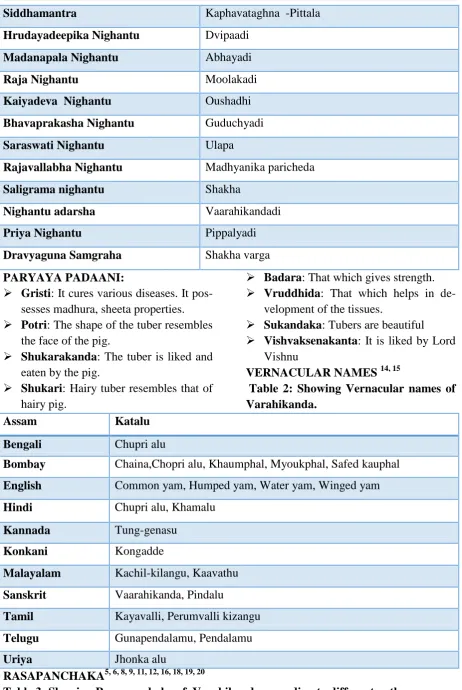
Table 1: Showing the classification of Varahikanda according to various au-thors.
Samhitas Gana /Varga
Sushruta samhita Kanda varga
Nighantu Varga
Dhanwantari Nighantu Karaveeradi
Shabdhachandrika Vrakshadhi
Shodala Nighantu Karaveeradi , Aamradi
Siddhamantra Kaphavataghna -Pittala
Hrudayadeepika Nighantu Dvipaadi
Madanapala Nighantu Abhayadi
Raja Nighantu Moolakadi
Kaiyadeva Nighantu Oushadhi
Bhavaprakasha Nighantu Guduchyadi
Saraswati Nighantu Ulapa
Rajavallabha Nighantu Madhyanika paricheda
Saligrama nighantu Shakha
Nighantu adarsha Vaarahikandadi
Priya Nighantu Pippalyadi
Dravyaguna Samgraha Shakha varga
PARYAYA PADAANI:
Gristi: It cures various diseases. It
pos-sesses madhura, sheeta properties.
Potri: The shape of the tuber resembles
the face of the pig.
Shukarakanda: The tuber is liked and
eaten by the pig.
Shukari: Hairy tuber resembles that of
hairy pig.
Badara: That which gives strength. Vruddhida: That which helps in
de-velopment of the tissues.
Sukandaka: Tubers are beautiful Vishvaksenakanta: It is liked by Lord
Vishnu
VERNACULAR NAMES14, 15
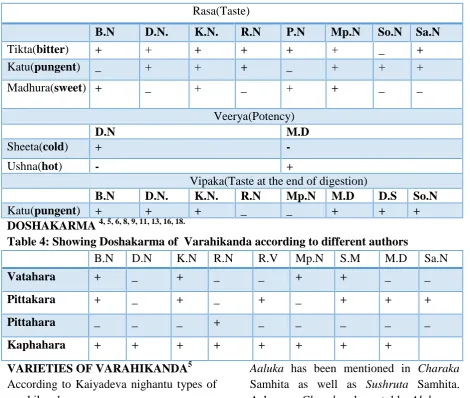
Table 2: Showing Vernacular names of Varahikanda.
Assam Katalu
Bengali Chupri alu
Bombay Chaina,Chopri alu, Khaumphal, Myoukphal, Safed kauphal
English Common yam, Humped yam, Water yam, Winged yam
Hindi Chupri alu, Khamalu
Kannada Tung-genasu
Konkani Kongadde
Malayalam Kachil-kilangu, Kaavathu
Sanskrit Vaarahikanda, Pindalu
Tamil Kayavalli, Perumvalli kizangu
Telugu Gunapendalamu, Pendalamu
Uriya Jhonka alu
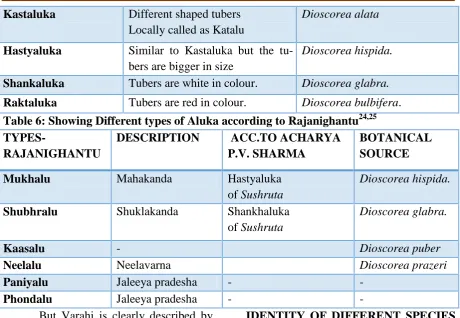
RASAPANCHAKA5, 6, 8, 9, 11, 12, 16, 18, 19, 20
Rasa(Taste)
B.N D.N. K.N. R.N P.N Mp.N So.N Sa.N
Tikta(bitter) + + + + + + _ +
Katu(pungent) _ + + + _ + + +
Madhura(sweet) + _ + _ + + _ _
Veerya(Potency)
D.N M.D
Sheeta(cold) +
-Ushna(hot) - +
Vipaka(Taste at the end of digestion)
B.N D.N. K.N. R.N Mp.N M.D D.S So.N
Katu(pungent) + + + _ _ + + +
DOSHAKARMA4, 5, 6, 8, 9, 11, 13, 16, 18.
Table 4: Showing Doshakarma of Varahikanda according to different authors
B.N D.N K.N R.N R.V Mp.N S.M M.D Sa.N
Vatahara + _ + _ _ + + _ _
Pittakara + _ + _ + _ + + +
Pittahara _ _ _ + _ _ _ _ _
Kaphahara + + + + + + + +
VARIETIES OF VARAHIKANDA5
According to Kaiyadeva nighantu types of varahikanda are
1. Shabarakanda 2. Kharakanda 3. Snukchadopama 4. Kiri
5. Mulakamulabha 6. Shoukara 7. Vadavaanala
SUBSTITUTES AND ADULTERA-TION7
Vrinda madhava mentions
Charmakaralu-ka as substitute for VarahiCharmakaralu-kanda. CONTROVERSY24, 25
The controversy of Varahi might have started with the word Aaluka. The word
Aaluka has been mentioned in Charaka
Samhita as well as Sushruta Samhita.
Acharya Charaka has told Aluka as
ahitatama among the kanda and Acharya
Sushruta has mentioned aluka in kanda
varga and has given 6 varieties of Aluka. Both the commentators of Charaka and
Sushruta Samhitas have given limited
in-formation regarding the morphological de-scriptions about these varieties.
Acharya P.V. Sharma has correlated the varieties mentioned in Sushruta and Ra-janighantu with different species of
Di-oscorea.
Table 5: Showing Different types of Aluka according to Sushruta24,25
TYPES-SUSHRUTA DESCRIPTION BOTANICAL SOURCE
Madhvaluka Romasha, Madhura Dioscorea esculenta
-Kastaluka Different shaped tubers Locally called as Katalu
Dioscorea alata
Hastyaluka Similar to Kastaluka but the tu-bers are bigger in size
Dioscorea hispida.
Shankaluka Tubers are white in colour. Dioscorea glabra.
Raktaluka Tubers are red in colour. Dioscorea bulbifera.
Table 6: Showing Different types of Aluka according to Rajanighantu24,25
TYPES-RAJANIGHANTU
DESCRIPTION ACC.TO ACHARYA
P.V. SHARMA
BOTANICAL SOURCE
Mukhalu Mahakanda Hastyaluka
of Sushruta
Dioscorea hispida.
Shubhralu Shuklakanda Shankhaluka
of Sushruta
Dioscorea glabra.
Kaasalu - Dioscorea puber
Neelalu Neelavarna Dioscorea prazeri
Paniyalu Jaleeya pradesha -
-Phondalu Jaleeya pradesha -
-But Varahi is clearly described by the commentator of Chakradatta in the context of Narasimha Choorna. The de-scription is as follows,
The creeper of Varahi has leaves similar to betel-leaves (taambula patra sadrashah). Many bulbils are present on its stem. It has flowers like Sarja and Arjuna. Shape of the tubers resemble the head of Varaha and the tubers are covered with hairs. Tubers have bitter and pungent tastes. They are aro-matic like Lotus. The vines are found in the forests and mountains. As per Dr. Bapalal Vaidya there should not be any controversy
in identifying Dioscorea species.
Di-oscorea bulbifera, DiDi-oscorea pentaphylla
either of the two should be fixed as
Var-ahikanda.
Dr. V.G Desai has given Tacca aspera Roxb as Varahikanda.
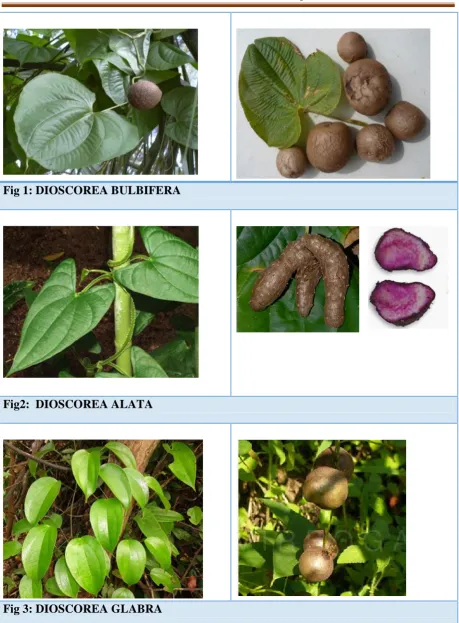
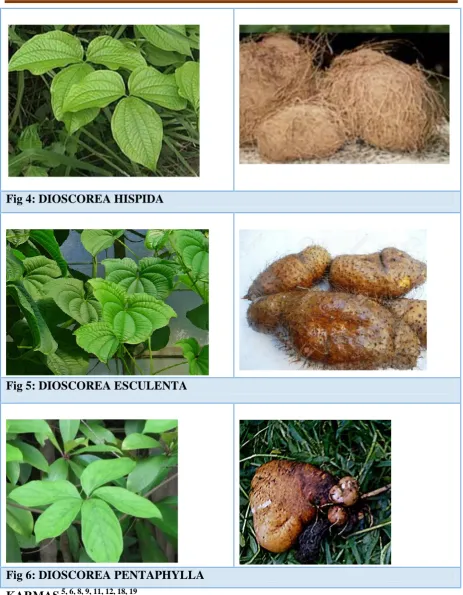
IDENTITY OF DIFFERENT SPECIES OF DIOSCOREA15
The confusion regarding the identity and nomenclature of the Indian species particu-larly the cultivated species of Dioscorea has been largerly resolved by the work of
Prain and Burkill. These authors have
clas-sified the genus into 2 broad divisions. 1. Stem twining to the right
Dioscorea alata
Dioscorea glabra
Dioscorea oppositifolia
2. Stem twining to the left Dioscorea esculenta
Dioscorea bulbifera
Dioscorea pentaphylla
Fig 1: DIOSCOREA BULBIFERA
Fig2: DIOSCOREA ALATA
Fig 4: DIOSCOREA HISPIDA
Fig 5: DIOSCOREA ESCULENTA
Fig 6: DIOSCOREA PENTAPHYLLA
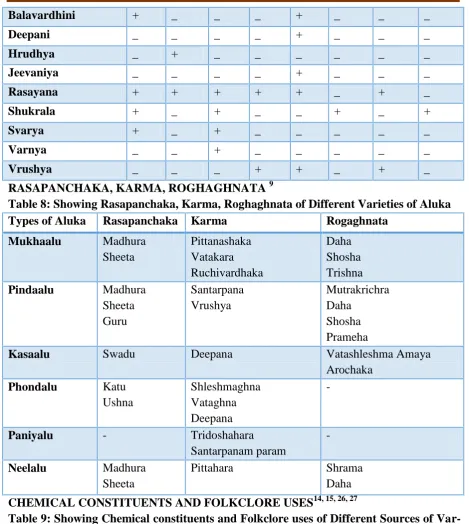
KARMAS5, 6, 8, 9, 11, 12, 18, 19
Table 7: Showing Karmas of Varahikanda according to different authors
Karmas (Action) B.N D.N K.N R.N P.N Mp.N So.N Sa.N
Ayushya _ _ _ _ _ _ _ +
Ayu vivardhana + _ + _ _ _ _ _
Agni vivardhini + _ + _ _ _ _ +
Balavardhini + _ _ _ + _ _ _
Deepani _ _ _ _ + _ _ _
Hrudhya _ + _ _ _ _ _ _
Jeevaniya _ _ _ _ + _ _ _
Rasayana + + + + + _ + _
Shukrala + _ + _ _ + _ +
Svarya + _ + _ _ _ _ _
Varnya _ _ + _ _ _ _ _
Vrushya _ _ _ + + _ + _
RASAPANCHAKA, KARMA, ROGHAGHNATA9
Table 8: Showing Rasapanchaka, Karma, Roghaghnata of Different Varieties of Aluka
Types of Aluka Rasapanchaka Karma Rogaghnata
Mukhaalu Madhura
Sheeta
Pittanashaka Vatakara Ruchivardhaka
Daha Shosha Trishna
Pindaalu Madhura
Sheeta Guru
Santarpana Vrushya
Mutrakrichra Daha
Shosha Prameha
Kasaalu Swadu Deepana Vatashleshma Amaya
Arochaka
Phondalu Katu
Ushna
Shleshmaghna Vataghna Deepana
-Paniyalu - Tridoshahara
Santarpanam param
-Neelalu Madhura
Sheeta
Pittahara Shrama
Daha
CHEMICAL CONSTITUENTS AND FOLKCLORE USES14, 15, 26, 27
Table 9: Showing Chemical constituents and Folkclore uses of Different Sources of Var-ahikanda,
Botanical source Chemical constituents Folkclore Uses
Dioscorea bulbifera Furanoid norditerpenes Diosbulbins A,G Volatile acids Cal.Oxalate Phenolics
The dried and powdered tubers are
used as application to sores and given internally with little cumin and sugar in milk as a remedy for syphilis, piles and dysentery.
Powder made into bolus with
but-ter is given to check diarrhea.
with ghee and sugar candy are a reputed remedy for piles.
Bulbils cure typhoid in children.
Root powder is used as a compo-nent of local medicine for tubercu-losis.
Dioscorea alata Tubers contain
Phenolics cyanidin- 3 glu-coside,
3 anthocyanins,
Cyanidin-3-gentiobioside ferulate
Peonidin 3- gentiobioside Alkaloid- dioscorine, Saponin- diosgenin
Tubers are antihelmenthic.
Paste of tubers is applied on
wounds, leprosy, gonorrhea, piles.
Dioscorea esculenta Albuminoids
Free from Dioscorine
Mature tubers are boiled and eaten
to increase body weight.
Dioscorea hispida Alkaloids
Steroidal Sapogenins
Paste of the tuber is applied on affected parts to treat peeling of skin.
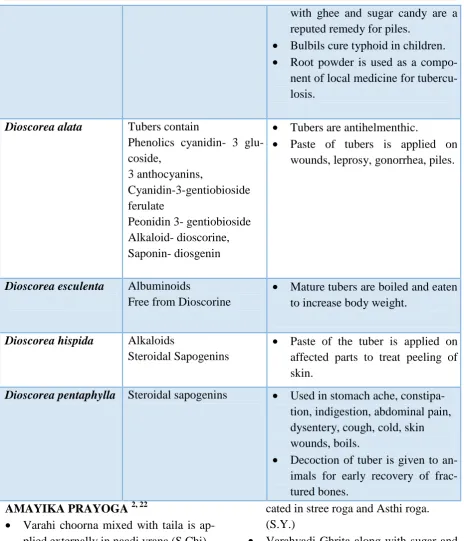
Dioscorea pentaphylla Steroidal sapogenins Used in stomach ache, constipa-tion, indigesconstipa-tion, abdominal pain, dysentery, cough, cold, skin wounds, boils.
Decoction of tuber is given to
an-imals for early recovery of frac-tured bones.
AMAYIKA PRAYOGA2, 22
Varahi choorna mixed with taila is ap-plied externally in naadi vrana (S.Chi)
Varahikanda choorna along with
madhu is consumed internally every day for one month followed with ksheera and shaali bhojana, acts as
ra-sayana.(S.U)
Varahikanda siddha ghrita
with-Draksha, Masha, Ashwagandha,
Kadaliphala and Vamsalochana is
indi-cated in stree roga and Asthi roga. (S.Y.)
Varahyadi Ghrita along with sugar and
honey given internally relieves yoni ro-ga. (S.Y)
Varahyadi ghrita used for bastikarma in
yoni rogas ( S.Y)
IMPORTANT YOGAS1, 2, 21, 22
Table 10: Showing Yogas of Varahikan-da
Yoga Adhikara/
Prakarana
Mahapaishacha Ghrita Unmada C.S Buddhi smritikaram, Unmada
Varahi choornam Rasayana S.S Rasayana
Kushadhya Ghritam Ashmari C.D Pittaja ashmari
Narasimha Choorna Vrushya C.D Vali, Palita, Khalitya, Meha, Pandu, Udara, Arshas, Grudrasi,
Bhagandara, Mutrakrichra, Kusta, Shvasa, Kasa,
Panchanimba Choorna Kusta C.D Shataru,Visphota, Paama, Kilasa Bhagandara, Naadivrana, Shlipada, Prameha, Pradara, Damstra visha, Udara
Varahyadi Choornam Choorna S.Y Kamala
Varahyadi Ghrita Ghrita S.Y Stree roga , Asthi roga
Varahyadi Ghrita (2) Ghrita S.Y Yoni roga
Vastyamayantaka ghri-ta
Ghrita S.Y Mutrakrichra, Ashmari, Vastiroga,
Prameha
PART USED23
Kanda (Tuber)
POSOLOGY23
Churna (Powder) 3- 6 gm
TRADE AND COMMERCE15
Industrial uses of Dioscorea species
includes starch, poultry, livestock
feed and production of yam flour.
It contains steroidal sapogenins,
dios-genin which is the precussor for the synthesis of the steroidal hormones used in contraceptive drugs.
DISCUSSION
References regarding Varahikanda are
found in Brihatrayee and authors of various Nighantus have described it in different Vargas.
Balya, Vrushya, Shukrala karmas which are attributed to Ruddhi and
Vruddhi are also ascribed to Varahi-kanda thus signifying the efficacy of Varahikanda as a substitute for Ruddhi
and Vrudhhi.
Varahikanda has been indicated in Kusta (skin diseases), Krimi (worms), Prameha (diabetes) rogas and is known
for its Balya, Shukrala and Rasayana
properties. Hence finds its utility in im-portant formulations like Narasimha
choorna, Vastiamayantaka ghrita, Panchanimba choorna Mahapais-chacha ghrita etc.
Morphologically the Dioscorea species
are differentiated on the basis of the stem twining towards right or left. They are also differentiated depending on the morphology of leaf, structure and col-our of the bulbils. Even in the classical references the varieties of Aluka are dif-ferentiaded on the basis of the colour and shape of the tubers. Thus the corre-lation of Dioscorea species to different
Aluka bheda is substantiated.
The controversy regarding Varahi and
different Alukas mentioned in Sushruta
Samhita has been resolved. Aluka
bhedas can be corelated with the the
Dioscorea species.
Dioscorea bulbifera is the accepted
source for Varahikanda.
All the Aluka bhedas have madhura
is used in disorders like daha, trishna
mutrakrichra etc. The karmas like vrushya(aphrodisiac),santarpana
(nour-ishing), deepana (appetizer) attributed to Aluka resembles to that of
Varahi-kanda. Phondalu which has katu rasa
and ushna veerya has vatashelshmahara (pacifies vata and kapha) and deepana
properties. Varahikanda is indicated
by most of the authors in Prameha and it is one of the indications where
Pindaluka can be used thus suggesting
the substitution of Aluka bhedas for
Varahikanda.
Diosgenin is a pharmacological active
component obtained from root and rhi-zomes of all Dioscorea species and is present in varying concentrations.
Dioscorea species, the source of Var-ahikanda is of economic importance as
tuberous crops and known for its high carbohydrate reserve. The tuber not on-ly stores food but has many of the plant secondary metabolites. It is one of the medicinally potent plants used in varied pharmacological activities like
antihy-pertensive, androgenic, estrogenic,
bone protective, immune stimulatory, free radical scavenging etc. The medic-inal value of the plant lies in the bioac-tive phytochemical constituents respon-sible for the pharmacological activities.
Based on morphology, chemical
con-stituents and actions the other species of Dioscorea like D. alata, D.
esculen-ta, D.hispida, D. pentaphylla, can be
substituted to Dioscorea bulbifera
which is the accepted source for
Var-ahikanda.
CONCLUSION
Varahikanda is a promising plant which has a wide range of chemical constituents.
Further study to explore the
traditional-ly claimed unexplored activities has to be carried out.
Steps for identification and isolation of
active constituents should be developed to confirm exact mechanism of action.
Researches to involve the other species
of Dioscorea as food and medicine should be carried out.
REFERENCES
1. Agnivesa, Charaka Samhita, Revised by Charaka and Drdhabala,
Commen-tary by Pt.Kasinath Sastri and
Dr.Gorakhanatha Chaturvedi, Re-print 2004, Varanasi, Chaukhamba Bharati Academy, Tpg-738.
2. Sushrutha, Sushrutha Samhita, with
Nibandhasangraha commentary of
Dalhanacharya and Nyayachandrika panjika of Gayadasacharya on Ni-danasthana, Edited by Jadavji Trikamji Acharya and Narayan Ram Acharya, re-print 2012, Varanasi, Chaukhambha Surbharati Prakashan, Tpg-824.
3. Vagbhata, Astanga Hrdaya, with
commentaries of Arunadatta and
Hemadri, Edited by Pt.Hari Sadasiva Sastri, Re-print 2011, Varanasi, Chau-khambha Surbharati Prakashan, Tpg-956.
4. Vaidyaacharya Keshava,
Siddhaman-tra, Commented by Prakasha, Edited
by P.V.Sharma,First edition 1977, Va-ranasi, Chaukhamba Amarabharathi Prakashan, Tpg-113.
5. Acharya Kaiyadeva, Kaiyadeva
Nighantu (Pathyapathya Vibhodhaka),
edited by Prof.Priya Vrat Sharma, Dr.Guru Prasada Sharma, First edition 1979, Varanasi, Chaukhambha Orien-talia, Tpg- 696.
6. Sri Bhavamisra, Bhavaprakasha
Nighantu, Commentary by
Dr.G.S.Pandey, Revised edition- 2010, Varanasi, Chaukhambha Bharati Acad-emy,Tpg-960
7. Vaidya Bapalal.G., Nighantu
Adar-sha, Volume I, Re-print 2007,
Varana-si, Choukhambha Bharati Academy, Tpg-919.
8. Pt.Tripathi Hariprasad, Dhanwantari
Nighantu, with Hari hindi
commen-tary, Re-print 2008, Varanasi,
Chowkhambha Krishnadas Academy, Tpg-294.
9. Pandit Narahari, Rajanighantu, writ-ten by Dr.Indradev Tripathi, edited with Dravyagunaprakasha hindi com-mentary, Revised edition 2010, Vara-nasi, Chowkhambha Krishnadas Acad-emy, Tpg-703.
10. Chakrapanidatta Shabda Chanrika
edited by Prof .P.V.Sharma, Indian In-stitute Of History Of Medicine, Tpg 108
11. Nrupa Madanapala, Madanapala
nighantu, edited by Gangavishnu
srikrishnadasa,printed in 1961,Tpg-296
12. Acharya Shodhala, Shodhala
Nighantu, Commented by
Prof.Gyanendra pandey, Edited by Prof. R.R. Dwivedi, First edition 2009, Varanasi, Chowkhambha Krishnadas Academy, Tpg-538.
13. niimh.nic.in/ebooks/e-Nighantu/
E-nighantu , Saraswathi Nighantu,
Ra-javallabha Nighantu
14. Kirtikar.K.R. and Basu.B.D., Indian
Medicinal plants with Illustrations,
Revised by E.Blatter, J.F.Caius and K.S.Mhaskar, Second edition 2001, Oriental Enterprises, Tpg- 1724
15. Wealth of India, Raw Materials, by National institute of Science Commu-nication and Information Resources, Council of Scientific and Industrial Re-search, Reprinted 2005, New Delhi,
NISCAIR Press,
16. Madhava, Madhava Dravyaguna, ed-ited by P.V. Sharma, First edition 1973, Varanasi, Chowkambha Publications, TPg 124.
17. Vopadeva, Hrdaya dipaka nighantu, Commented by Prakasa, Edited by Prof.P.V.Sharma, First edition 1977, Varanasi, Chaukhamba Amarabharathi Prakashan, Tpg-44.
18. Shaligrama, Shaligrama Nighantu,
Edition 2007, Mumbai Khemraj
Shrikrishnadas Printers and Publishers. 19. Sharma Priya Vrat, Priya Nighantu
along with the author’s Hindi comme n-tary entitled Padma, Edition 2004, Va-ranasi ; Chaukhamba Surabharathi Pra-kashana, Tpg 275.
20. Chakrapanidatta, Dravyaguna
San-graha, Commented by Shivadas Sen,
edited by Vaidya Jadavji Trikamji Acharya, Edition 2006, Varanasi, Chowkambha Publications, Tpg-224 21. Chakradatta, Edited and Translated
by Priya Vrat Sharma, Second Edition 1998, Varanasi, Chukhambha publica-tions, Tpg-731.
22. Dr.Nisteshwar K, Dr.Vidyanath R.,
Sahasrayogam, Second edition-2008,
Varanasi, Chowkambha Publications, Tpg-540
23. Sharma Priya Vrat, Dravyaguna
Vijnana,Volume II, Re-print 2011,
Va-ranasi, Chaukhambha Bharati Acade-my, Tpg-832.
24. Sharma Priya Vrat, Dravyaguna
Vijnana,Volume V, Re-print 2011,
Va-ranasi, Chaukhambha Bharati Acade-my, Tpg-438.
25. Vaidya Bapalal, Some controversial
drugs in Indian medicine, Re-print
2014, Varanasi, Chaukhambha Orien-talia, Tpg-571.
India, Volume I, Bangalore, Interline
publishers, Tpg-644.
27. Barnali Dutta, Food and medicinal val-ues of certain species of Dioscorea with special reference to Assam. Journal Of
Pharmacognosy and
Phytochemis-try.2015;3(4)15-18
CORRESPONDING AUTHOR Dr. Prathibha S. Babshet Email: [email protected]