Thyroid-Stimulating Hormone
Reference Ranges for Preterm Infants
Dinushan C. Kaluarachchi, MBBS,aDavid B. Allen, MD,aJens C. Eickhoff, PhD,bSandra J. Dawe, PhD,cMei W. Baker, MDa,cabstract
BACKGROUND AND OBJECTIVES:Many newborn screening (NBS) programs now perform repeat or serial NBS to detect congenital hypothyroidism. There is wide variation in thyroid-stimulating hormone (TSH) cutoffs used by NBS programs. Data on TSH reference ranges in preterm infants at increasing postnatal age are limited. Our study objective was to determine TSH reference ranges for preterm infants born at,32 weeks’gestation.
METHODS:We analyzed serial TSH levels on NBS performed on infants born between 22 and 31 weeks’gestation from 2012 to 2016 in Wisconsin. The study cohort was divided into 2 groups (22–27 and 28–31 weeks), and TSH percentiles were defined from birth to the term equivalent gestational age.
RESULTS:The study cohort consisted of 1022 and 2115 infants born at 22 to 27 and 28 to 31 weeks’gestation, respectively. The 95th percentile TSH level for the group born at 22 to 27 weeks’gestation gradually decreased and reached a nadir at∼10 to 11 weeks. In contrast, for the group born at 28 to 31 weeks’gestation, the 95th percentile TSH level reached a nadir at
∼5 to 6 weeks. At 3 to 4 weeks after birth, the 95th percentile TSH level ranged from 11 to 11.8mIU/mL for the group born at 22 to 27 weeks’gestation and ranged from 8.2 to 9mIU/ mL for the group born at 28 to 31 weeks’ gestation.
CONCLUSIONS:Using a statewide cohort of preterm infants, we constructed TSH reference charts from birth to the term equivalent gestation for preterm infants born at,32 weeks’gestation. Use of a single cutoff for all preterm infants might lead to misdiagnosis. The differences in TSH levels according to gestational-age categories might explain the increased frequency in congenital hypothyroidism diagnoses among preterm infants. These data are useful for defining age-adjusted NBS TSH cutoffs for preterm infants.
WHAT’S KNOWN ON THIS SUBJECT:There is wide variation in TSH cutoff levels used to identify infants with congenital hypothyroidism. Similar TSH cutoffs are used for preterm and term infants despite differences in thyroid axis physiology.
WHAT THIS STUDY ADDS:TSH percentiles vary with increasing gestational age in preterm infants. Use of a single cutoff might lead to misdiagnosis. Differences in TSH levels according to gestational-age categories and postnatal age may contribute to increased congenital hypothyroidism diagnoses.
To cite: Kaluarachchi DC, Allen DB, Eickhoff JC, et al. Thyroid-Stimulating Hormone Reference Ranges for Preterm Infants.Pediatrics. 2019;144(2):e20190290
Departments ofaPediatrics andbBiostatistics and Medical Informatics andcWisconsin State Laboratory of Hygiene, School of Medicine and Public Health, University of Wisconsin-Madison, Madison, Wisconsin
Dr Kaluarachchi designed the study, drafted the project proposal, collected data, and drafted the manuscript; Drs Allen and Dawe were involved in designing of the study and reviewed the manuscript; Mr Eickhoff was involved in designing of the study, did the data analysis, and reviewed the manuscript; Dr Baker was involved in designing of the study, drafted the project proposal, collected data, and reviewed the manuscript; and all authors approved thefinal manuscript as submitted and agree to be accountable for all aspects of the work.
DOI:https://doi.org/10.1542/peds.2019-0290 Accepted for publication Apr 30, 2019
Address correspondence to Dinushan C. Kaluarachchi, MBBS, Department of Pediatrics, University of Wisconsin-Madison, 411 McConnell Hall, 1010 Mound St, Madison, WI 53715. E-mail: kaluarachchi@ pediatrics.wisc.edu
Nearly 4 million newborn infants undergo newborn screening (NBS) annually in the United States. Congenital hypothyroidism is 1 of the most commonly diagnosed disease by NBS.1Congenital hypothyroidism also is a core condition included in the recommended universal screening panel in the United States.2 Approximately 1400 infants in the United States are diagnosed with congenital hypothyroidism each year.3
NBS programs use 3 screening strategies to detect congenital hypothyroidism in neonates: the primary thyroxine (T4)-back-up thyroid-stimulating hormone (TSH) method, the primary TSH-back-up T4 method, and the combined primary TSH plus T4 method.3,4 Primary TSH or combined TSH and T4 methods are used by 60% of NBS programs in the United States.5There is a wide variation in TSH cutoff levels used by NBS programs to identify infants with congenital hypothyroidism.5,6
Congenital hypothyroidism is diagnosed with increased frequency in infants born preterm.7–10Many NBS programs now perform repeat or serial NBS to detect congenital hypothyroidism in preterm infants.8, 10–12However, despite differences in gestational age–dependent thyroid hormone physiology, the same TSH cutoffs are used for preterm infants as for the term infants.11,12TSH cutoffs derived from term infant data could lead to overdiagnosis or underdiagnosis of congenital hypothyroidism among preterm infants. Data on TSH reference ranges in preterm infants at increasing postnatal age are limited.
Our objective for the current study was to determine TSH reference ranges for preterm infants born,32 weeks’gestation by using a statewide birth cohort of preterm infants in Wisconsin.
METHODS
The study cohort was drawn from the NBS database maintained by the Wisconsin state NBS program. The University of Wisconsin-Madison Institutional Review Board reviewed the study and determined that the study qualifies for exemption. All preterm infants born before 32 weeks’gestation from 2012 to 2016 who underwent NBS in the Wisconsin state NBS program were included in the study. Infants whosefirst NBS was done after 96 hours of life and infants with incomplete data were excluded. The information on congenital hypothyroidism screening results of this study cohort was presented in a previous publication.10
The Wisconsin state NBS program uses the primary TSH test strategy to screen for congenital hypothyroidism. The NBS program performs serial NBS for infants with extended hospital stay. After the initial
screening at 24 to 48 hours of life, for infants with a birth weight,2200 g, a second specimen is collected at 2 weeks of age, a third specimen at 28 to 30 days of life or discharge, whichever comesfirst, and the NBS is performed monthly thereafter until discharge. NBS TSH levels were measured by solid phase, time-resolvedfluoroimmunoassay from dried newborn blood spots by using PerkinElmer’s AutoDELFIA platform (Waltham, MA). The TSH
measurements were then converted to estimated serum levels with the following conversion factor: a blood concentration of 1µU/mL5a serum concentration of 2.22µU/mL
(assuming 55% hematocrit). The software on the AutoDELFIA platform was used to round the TSH values to a whole number. TSH values recorded as 0 were included as truncated values ,0.1 for the analysis.
Infant demographics and TSH values on NBS were obtained from the NBS database. All serial TSH values of the
final study cohort were included in
the analysis. TSH values recorded after diagnosis of congenital hypothyroidism were excluded. TSH values were recorded in epochs of each postnatal week from birth to term corrected gestational age. TSH values obtained within 24 to 96 hours of life were recorded as TSH values at birth or week 0. Starting from day 5, TSH values were grouped into epochs of 7 days until term corrected gestational age. References values for extremely preterm infants (22–27 weeks) and very preterm infants (28–31 weeks) were presented separately because these 2 groups have distinctly different thyroid hormone physiology, as described before.6,13We also determined TSH values at 36 (61) weeks post menstrual age (PMA) for the cohort and calculated the TSH reference values at this near-term gestational age for the 2 groups.
The data analysis was performed by using SAS version 9.4 (SAS Institute, Inc, Cary, NC). The nonparametric quantile regression approach, on the basis of B-splines, was used to construct the reference charts for TSH.14Age distributions were assumed for TSH. An estimate of the slope parameterqwas performed by using the computationally efficient simplex algorithm. The quantile regression was performed for each gestational-age group separately. TSH median,fifth, 25th, 75th, 95th, and 99th percentiles were defined from birth to the term equivalent
gestational age for extremely preterm and very preterm infants.
RESULTS
extremely preterm infants and 2115 very preterm infants. A total of 11 431 TSH values were analyzed. Extremely preterm infants had 4199 TSH values recorded (∼4 TSH levels per infant). There were 7232 TSH values recorded in very
preterm infants (∼3.4 TSH levels per infant).
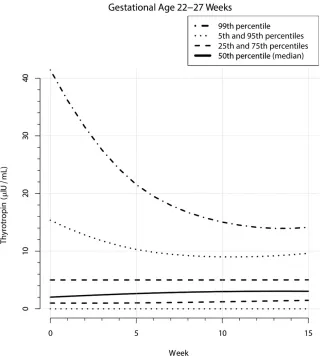
Among extremely preterm infants, the median TSH value changed minimally from 2.1mIU/mL at birth to 3.1mIU/ mL at the term corrected gestational age. In contrast, the 95th percentile TSH value was highest at birth and gradually declined until the 10th postnatal week of life. Thereafter, the 95th percentile TSH value slightly increased (Fig 1, Table 2).
Among very preterm infants, the median TSH value was 3.4mIU/mL at birth. The median TSH level gradually declined, reached a nadir at∼4 to 5 weeks of life, and then gradually increased. The 95th percentile TSH level also followed similar trend; it was highest at birth and gradually declined until thefifth to sixth postnatal week of life. Thereafter, the 95th percentile TSH level gradually increased toward that of the term corrected gestational age (Fig 2, Table 3).
At 3 to 4 weeks, when repeat NBS is commonly performed, the median TSH level ranged from 2.5 to 2.6mIU/ mL for both groups. However, the
95th percentile ranged from 11 to 11.8mIU/mL for extremely preterm infants and from 8.2 to 9mIU/mL for very preterm infants.
At 36 (61) weeks PMA, the 50th, 95th, and 99th percentile TSH levels for extremely preterm infants were 3, 9, and 13mIU/mL, respectively. The equivalent percentile TSH levels for very preterm infants were 3, 8, and 13mIU/mL, respectively (Table 4).
DISCUSSION
In this study, we define the
distribution of postnatal TSH values in extremely preterm and very preterm infants using a statewide cohort of preterm infants in
Wisconsin. To our knowledge, this is the largest study in which postnatal TSH values in preterm infants are described.
TABLE 1Characteristics of the Study Cohort
Infant Characteristic All Infants Extremely Preterm Infants (22–27 wk)
Very Preterm Infants (28–31 wk) Gestational age, mean (SD), wk 28.4 (2.3) 25.6 (1.2) 29.8 (1.1) Birth wt, mean (SD), g 1196 (397) 811 (207) 1383 (326) Sex,n(%)
Male 1660 (53) 521 (51) 1139 (54) Female 1477 (47) 501 (49) 976 (46) Race,n(%)
White 1958 (62) 583 (57) 1375 (65) African American 757 (24) 305 (30) 452 (21) Other 279 (9) 96 (9) 183 (9) Unknown 143 (5) 38 (4) 105 (5) Gestation,n(%)
Singleton 2357 (75) 789 (77) 1568 (74) Multiple 780 (25) 233 (23) 547 (26)
FIGURE 1
Findings are relatively consistent with previous studies of the Scottish preterm thyroid group,13,15in which the mean TSH concentration among extremely preterm infants at 24 hours of life was 2.3mIU/mL,14 compared with a median value of 2.1
mIU/mL in the current study. Similarly, for infants born at 28 to 30 weeks’gestation, the previously reported mean TSH concentration of 4.5mIU/mL at 24 hours of life was different only slightly from median TSH level of 3.4mIU/mL at birth for infants born at 28 to 31 weeks’ gestation in the current study.
The median postnatal TSH values of 2.6 and 2.5mIU/mL at week 4 in the current study are close to previous reports of a mean TSH value of 3.8 and 3.6mIU/mL at 28 days of life for infants born at 24 to 27 and 28 to 30 weeks’gestation, respectively.13In contrast, authors of other studies have reported that after thefirst week of life, a single range for TSH (0.8–12.0 mU/L) appeared
appropriate for all premature infants until 40 weeks postconceptional age.16However, that study included only a smaller number of extremely preterm infants, and infants who developed significant systemic illness were excluded, which limits the comparability of that study with
the current study and limits generalizability to the overall preterm infant population.
In recent decades, the incidence of congenital hypothyroidism has almost doubled.7,8This increase is attributed to increased detection among high-risk groups, including increased detection among preterm infants and methodologic shifts in NBS.7,17A number of NBS programs have elected to lower the TSH screening cutoff, which has led to increased congenital hypothyroidism detection among preterm infants.18,19However, whether mild elevation of TSH in preterm infants is harmful is largely unknown.
Infants with mildly elevated TSH levels in association with normal free thyroxine (FT4) levels are common among the preterm infant
population.9,20,21These infants with mildly elevated TSH levels and normal FT4 levels are defined as infants with subclinical
hypothyroidism.4
There are several TSH cutoffs recommended by various governing bodies in pediatrics and
endocrinology for infants with subclinical hypothyroidism who are several weeks old.3,22,23The
American Academy of Pediatrics recommends T4 supplementation for infants with persistently elevated TSH levels.10 mU/L after 1 month of life.3The American Academy of Pediatrics acknowledges that the management of infants with elevated TSH levels between 6 and 10 mU/L that persist after thefirst month of life is controversial.3The European Society of Pediatric Endocrinology recommends that providers do further investigations, such as retesting in 2 weeks, or initiate T4 supplementation immediately if the venous TSH concentration is 6 to 20 mU/L beyond 21 days of life in a well infant with an FT4 concentration within the limits for age.22The European Thyroid Association’s guideline on management of subclinical hypothyroidism in pregnancy and in children states that a serum TSH concentration.5 mU/L can be considered as abnormal after 1 month of age when modern third-generation assays are used.23It also states that there is insufficient evidence to recommend treatment in the majority of children with subclinical hypothyroidism in whom the serum TSH concentration is,10 mU/L.23
On the basis of current data, TSH levels of 6 and 10 mU/L at 4 weeks of
TABLE 2Percentiles of TSH Values (mIU/mL) for Extremely Preterm Infants.
Age, wk No. TSH Values Time of Specimen Collection, Mean (SD), h Percentile
life correspond to those in the 84th and 94th percentiles in extremely preterm infants and correspond to those in the 86th and 97th percentiles
in very preterm infants. NBS programs in United States and other countries use TSH levels anywhere from 5 to 40 mU/L as screening
cutoffs after thefirst week of life.5,6,18, 19,24–26However, no specific cutoffs for preterm infants have been used, despite differences in thyroid hormone physiology among preterm infants. This could lead to either overdiagnosis and unnecessary treatment or underdiagnosis and potential compromise in growth and neurodevelopmental outcomes in these infants, depending on the cutoff that is being used.
In the current study, we describe TSH reference ranges for preterm infants from birth to the term corrected gestational age on the basis of their degree of prematurity. We anticipate that these age-adjusted TSH cutoffs will facilitate standardization of screening for congenital
hypothyroidism diagnosis among preterm infants and aid
neonatologists and endocrinologists in making clinical decisions. We suggest using a predetermined percentile (eg, 95th or 99th
percentile) at a given postnatal age to determine if a TSH level is abnormal. However, whether infants with TSH levels above a certain percentile have abnormal growth and
neurodevelopmental outcomes should be determined by well-designed outcome research studies.
There are several limitations of the current study. Patients with
chromosomal or multiple congenital anomalies could not be excluded
FIGURE 2
TSH reference chart for very preterm infants.
TABLE 3Percentiles of TSH Values (mIU/mL) for Very Preterm Infants
Age, wk No. TSH Values Time of Specimen Collection, Mean (SD), h Percentile Fifth 10th 25th 50th
(Median)
because this information was also not available to the NBS program. Preterm infants born at gestational ages 32 to 36 weeks were not studied; hence, these data cannot be generalized to all preterm infants. TSH values given here are estimated serum values from dried blood-spot TSH values. Of note, dried blood-spot TSH values reveal a strong correlation with serum TSH values according to previous studies.27,28Strengths of the current study include a larger statewide sample size that included a greater number of infants and TSH
values than previous reported. Our study cohort is recent and includes a greater number of infants who did not survive in the past. We also report TSH reference values beyond 1 month of life up to the term corrected gestational age.
CONCLUSIONS
In this study, we define the TSH reference ranges from birth to the term corrected gestational age in extremely and very preterm infants using a statewide cohort of preterm
infants in Wisconsin. The current study reveals that NBS TSH percentiles vary with increasing gestational age. This information will be valuable for NBS programs to better define postnatal age–adjusted TSH cutoffs for preterm infants and to standardize diagnosis. Correlation between age-adjusted TSH
percentiles and long-term neurodevelopmental outcomes should be determined in future studies.
ABBREVIATIONS
FT4: free thyroxine NBS: newborn screening PMA: post menstrual age
TSH: thyroid-stimulating hormone T4: thyroxine
FINANCIAL DISCLOSURE:The authors have indicated they have nofinancial relationships relevant to this article to disclose.
FUNDING:No external funding.
POTENTIAL CONFLICT OF INTEREST:The authors have indicated they have no potential conflicts of interest to disclose.
COMPANION PAPER:A companion to this article can be found online at www.pediarics.org/cgi/doi/10.1542/peds.2019-1706.
REFERENCES
1. Feuchtbaum L, Carter J, Dowray S, Currier RJ, Lorey F. Birth prevalence of disorders detectable through newborn screening by race/ethnicity.Genet Med. 2012;14(11):937–945
2. Watson MS, Mann MY, Lloyd-Puryear MA, Rinaldo P, Howell RR. Newborn screening: toward a uniform screening panel and system. Executive summary.
Genet Med. 2006;8(5, suppl):1S–11S
3. Rose SR, Brown RS, Foley T, et al; American Academy of Pediatrics; Section on Endocrinology; Committee on Genetics; American Thyroid Association, Public Health Committee; Lawson Wilkins Pediatric Endocrine Society. Update of newborn screening and therapy for congenital hypothyroidism.Pediatrics. 2006;117(6):2290–2303
4. LaFranchi SH. Newborn screening strategies for congenital
hypothyroidism: an update.J Inherit Metab Dis. 2010;33(suppl 2):S225– S233
5. Kilberg MJ, Rasooly IR, LaFranchi SH, Bauer AJ, Hawkes CP. Newborn screening in the US may miss mild persistent hypothyroidism.J Pediatr. 2018;192:204–208
6. Williams F, Hume R. The measurement, definition, aetiology and clinical consequences of neonatal transient hypothyroxinaemia.Ann Clin Biochem. 2011;48(pt 1):7–22
7. Wassner AJ, Brown RS. Congenital hypothyroidism: recent advances.Curr Opin Endocrinol Diabetes Obes. 2015; 22(5):407–412
8. Mitchell ML, Hsu HW, Sahai I; Massachusetts Pediatric Endocrine Work Group. The increased incidence of congenital hypothyroidism: fact or
fancy?Clin Endocrinol (Oxf). 2011;75(6): 806–810
9. Kaluarachchi DC, Colaizy TT, Pesce LM, Tansey M, Klein JM. Congenital hypothyroidism with delayed thyroid-stimulating hormone elevation in premature infants born at less than 30 weeks gestation.J Perinatol. 2017; 37(3):277–282
10. Kaluarachchi DC, Allen DB, Eickhoff JC, Dawe SJ, Baker MW. Increased congenital hypothyroidism detection in preterm infants with serial newborn screening.J Pediatr. 2019;207:220–225
11. Woo HC, Lizarda A, Tucker R, et al. Congenital hypothyroidism with a delayed thyroid-stimulating hormone elevation in very premature infants: incidence and growth and developmental outcomes.J Pediatr. 2011;158(4):538–542
TABLE 4Percentiles of TSH Values (mIU/mL) at 36 Weeks’ PMA for Extremely Preterm and Very Preterm Infants
12. Ford GA, Denniston S, Sesser D, Skeels MR, LaFranchi SH. Transient versus permanent congenital hypothyroidism after the age of 3 years in infants detected on thefirst versus second newborn screening test in Oregon, USA.
Horm Res Paediatr. 2016;86(3):169–177
13. Williams FL, Simpson J, Delahunty C, et al; Collaboration from the Scottish Preterm Thyroid Group. Developmental trends in cord and postpartum serum thyroid hormones in preterm infants.
J Clin Endocrinol Metab. 2004;89(11): 5314–5320
14. Wei Y, Pere A, Koenker R, He X. Quantile regression methods for reference growth charts.Stat Med. 2006;25(8): 1369–1382
15. Murphy N, Hume R, van Toor H, et al. The hypothalamic-pituitary-thyroid axis in preterm infants; changes in thefirst 24 hours of postnatal life.J Clin Endocrinol Metab. 2004;89(6): 2824–2831
16. Clark SJ, Deming DD, Emery JR, Adams LM, Carlton EI, Nelson JC. Reference ranges for thyroid function tests in premature infants beyond thefirst week of life.J Perinatol. 2001;21(8): 531–536
17. Ford G, LaFranchi SH. Screening for congenital hypothyroidism: a worldwide view of strategies.Best Pract Res Clin Endocrinol Metab. 2014;28(2):175–187
18. Corbetta C, Weber G, Cortinovis F, et al. A 7-year experience with low blood TSH cutoff levels for neonatal screening reveals an unsuspected frequency of congenital hypothyroidism (CH).Clin Endocrinol (Oxf). 2009;71(5):739– 745
19. Mengreli C, Kanaka-Gantenbein C, Girginoudis P, et al. Screening for congenital hypothyroidism: the significance of threshold limit in false-negative results.J Clin Endocrinol Metab. 2010;95(9):4283–
4290
20. Lee JH, Kim SW, Jeon GW, Sin JB. Thyroid dysfunction in very low birth weight preterm infants.Korean J Pediatr. 2015; 58(6):224–229
21. Kaluarachchi DC, Zhao Q, Colaizy TT. Antenatal steroids and thyroid hormone function in preterm infants.
J Perinatol. 2018;38(11):1466–1470
22. Léger J, Olivieri A, Donaldson M, et al; ESPE-PES-SLEP-JSPE-APEG-APPES-ISPAE; Congenital Hypothyroidism Consensus Conference Group. European Society for Paediatric Endocrinology consensus guidelines on screening, diagnosis, and management of congenital
hypothyroidism.J Clin Endocrinol Metab. 2014;99(2):363–384
23. Lazarus J, Brown RS, Daumerie C, Hubalewska-Dydejczyk A, Negro R, Vaidya B. 2014 European thyroid
association guidelines for the management of subclinical hypothyroidism in pregnancy and in children.Eur Thyroid J. 2014;3(2):76–94
24. Vigone MC, Caiulo S, Di Frenna M, et al. Evolution of thyroid function in preterm infants detected by screening for congenital hypothyroidism.J Pediatr. 2014;164(6):1296–1302
25. Deladoëy J, Ruel J, Giguère Y, Van Vliet G. Is the incidence of congenital hypothyroidism really increasing? A 20-year retrospective population-based study in Québec.J Clin Endocrinol Metab. 2011;96(8):2422–2429
26. McGrath N, Hawkes CP, McDonnell CM, et al. Incidence of congenital hypothyroidism over 37 years in Ireland.Pediatrics. 2018;142(4): e20181199
27. McGowan S, Jones J, McMillan D, et al; Scottish Down Syndrome Screening Group. Screening for hypothyroidism in Down syndrome using the capillary thyroid stimulating hormone method.
J Pediatr. 2015;166(4):1013–1017.e2
DOI: 10.1542/peds.2019-0290 originally published online July 16, 2019;
2019;144;
Pediatrics
W. Baker
Dinushan C. Kaluarachchi, David B. Allen, Jens C. Eickhoff, Sandra J. Dawe and Mei
Thyroid-Stimulating Hormone Reference Ranges for Preterm Infants
Services
Updated Information &
http://pediatrics.aappublications.org/content/144/2/e20190290 including high resolution figures, can be found at:
References
http://pediatrics.aappublications.org/content/144/2/e20190290#BIBL This article cites 28 articles, 2 of which you can access for free at:
Subspecialty Collections
http://www.aappublications.org/cgi/collection/neonatology_sub Neonatology
sub
http://www.aappublications.org/cgi/collection/fetus:newborn_infant_ Fetus/Newborn Infant
http://www.aappublications.org/cgi/collection/endocrinology_sub Endocrinology
following collection(s):
This article, along with others on similar topics, appears in the
Permissions & Licensing
http://www.aappublications.org/site/misc/Permissions.xhtml in its entirety can be found online at:
Information about reproducing this article in parts (figures, tables) or
Reprints
DOI: 10.1542/peds.2019-0290 originally published online July 16, 2019;
2019;144;
Pediatrics
W. Baker
Dinushan C. Kaluarachchi, David B. Allen, Jens C. Eickhoff, Sandra J. Dawe and Mei
Thyroid-Stimulating Hormone Reference Ranges for Preterm Infants
http://pediatrics.aappublications.org/content/144/2/e20190290
located on the World Wide Web at:
The online version of this article, along with updated information and services, is
by the American Academy of Pediatrics. All rights reserved. Print ISSN: 1073-0397.