EFFECT OF COOLANT ON SURFACE ROUGHNESS
AND TOOL LIFE DURING TURNING
Wavdhane
Yogesh G
1, Sonavane Prasad R
2, Pawar Umesh A
3,
Prof.Firoz Pathan
4 1, 2, 3Scholar Te Mech,
4Assistant Prof. Mech Engg. Department, B.V.C.O.Engg &Reaserch Institute,
Nashik, Pune University,( India).
ABSTRACT
The major wishes of machining area unit high material removal rate, wise surface finish and low tool wear.
These objectives are achieved by reducing tool wear exploitation correct cooling system of the tool throughout
machining.The tree cutting fluids chosen where web, oil soluble oil and semi-synthetic cutting fluids the
experiment take a glance at where designed to evaluate the performance of the fluids at varied cutting
velocities of twenty,40 and 60m/min and feed rates of zero.05,0.06 and 0.07 mm/tooth. The results were
measured in vacuum flask of average surface roughness of the machined work piece, the cutting forces and so
the foremost flank wears. In further, the resultant chip formations were in addition discovered. Analysis of the
result has shown that typically, web oil had performed the only in law cutting velocities and feed rates. On the
alternative hand, soluble oil gave the bottom cutting forces and flank wears at high cutting velocities and feed
rated as compared to neat oil and artificial cutting fluid. it completely was discovered that performance of
soluble oil does not drastically modification with variation to the cutting velocities and feed rates. Thus, the
choice of soluble oil would be most applicable for general machining usage .with acceptable machining
parameter selection water mixed cutting fluids (soluble oil and semi synthetics) perform comparatively well to
delivered loss surface roughness results therefore ,this can be an inexpensive various to be utilized in industrial
production processes.Meta cutting fluids changes the performance of machining operations because of their
lubrication, cooling and chip flushing. The use of cutting fluid usually causes economy of tools and it becomes
easier to remain tight tolerances and to require care of labor piece surface properties whereas not damages.
However, the quality kinds and ways in which of the applying of cutting fluid area unit found to decrease
effectively the need increase in cutting speed and feed once the cutting fluid cannot properly enter the chip-tool
interface to relax and lubricate as a result of bulk plastic contact of the chip with the tool rake surface. Besides
that, obtained in high production machining the cutting fluid would possibly cause premature failure of the tool
by fracturing do to shut curling of the chips and thermal shocks. Because of them some alternatives has been
needed to scale back these problems.
Keywords: High Pressure coolant; Surface Finish; Roughness Average.
I. INTRODUCTION
The primary operate of the cutting fluids in metal machining operations is to function a fluid similarly as a
surface end by reducing thermal distortion and flushing away of machined chips. The goal altogether typical
metal-removal operations is to lift productivity and cut back prices by machining at the best sensible speed
together with long tool life, fewest rejects, and minimum time period, and with the assembly of surfaces of
satisfactory accuracy and end choosing the correct cutting fluid is as necessary as selecting the acceptable
machine tools, tooling, speed and feed as a result of it will forever have an effect on the output parameters. In
addition, the flexibility of the cutting fluid to penetrate into the cutting zone may be a essential issue; otherwise,
the operate of cutting fluid becomes useless. the employment of cutting fluid permits higher cutting speeds,
higher feed rates, larger depths of cut, long tool life, faded surface roughness, enhanced dimensional accuracy,
and reduced power consumption. Cutting fluids may be applied mistreatment varied strategies. The flooding
methodology is that the most ordinarily utilized in that a high volume flow is applied and floods the complete
machining Invited paper2area, effectively removing the warmth generated from the machining method.
However, improved production potency and revised laws within the machining business favors the reduction of
cutting fluid usage. it absolutely was reportable that operators UN agency area unit of times exposed to cutting
fluids area unit vulnerable to expensive cases of activity eczema and different skin diseases such sensitization to
specific irritants, oil acne, and hyper pigmentation. Additionally, improper disposal of used cutting fluids might
cause serious impact to the atmosphere through contamination of the soil, water and air. More over, cutting fluid
usage will account for 7-17% of the overall production prices through its procural, storage, maintenance and
disposal. Lowest amount lubrication (MQL) encompasses varied techniques during which the cutting fluid is
applied in terribly little quantities throughout machining. Associate in nursing example of Associate in Nursing
MQL technique is that the mist fluid application.During this methodology, terribly little droplets of the cutting
fluid area unit spread in a very gas medium, typically air, and applied at the cutting zone. In those studies, it
absolutely was shown that MQL systems had comparable machining performance with flooding applications in
turning and drilling processes. Application of the cutting fluid within the type of slender periodical jet streams
was planned by A. S. Vadarajanet. All Usage of such Associate in Nursing MQL system within the turning of
hardened tool steels had shown higher machining performance in terms of cutting force, tool life and surface
end as compared to flooding and dry machining. Custom-made this system for the edge of hardened steel with
inorganic compound mills by applying high speed and slender periodical jet at the speed of two ml/min. similar
results favoring the MQL technique over each flooding and dry machining was obtained showing comparable
machining performance. Previous studies have focused on the comparison between the varied forms of cutting
fluid delivery systems and have over that MQL systems area unit appropriate replacements for existing flooding
techniques. Later on, there's a desire to specialize in the optimization of the MQL system. One important space
is that the choice of cutting fluids, a subject that is nevertheless to be totally self-addressed. Thus, this analysis
can specialize in the analysis of cutting fluids utilized in the periodical jet MQL system.
II. FUNCTION OF COOLANT
Cutting fluids are employed in metal cutting primarily for 2 reasons:
1. To scale back friction at the tool work and power chip contact zones-lubricating action.
In addition, agent it conjointly helps in laundry away the chips from the cutting zones and in lubricating a
number of the moving components of the machine. The lubricating action of the agent reduces forces, will
increase tool life reduces the tendency to make designed – up-edge and improves the surface end .Lubricating
action of agent or cutting fluid is primarily thanks to the formation of an occasional shear strength film within
the metal surface which might be simply sheared .the formation of such film takes time. Therefore, lubricating
action of agent is a lot of necessary than its physical properties. Additives are when other to the fluid s to
enhance their lubricating properties. Cooling the work piece conjointly helps take away the warmth generated
throughout cutting and thence in retentive the strength of the tool .it conjointly helps work handling easier
.almost all the fluids, water primarily based fluids are the foremost economical for cooling as a result of their
high heat and thermal physical phenomenon. Compare to its, water primarily based fluids are 2 to 3 times
quicker .but water s doubtless to cause corrosion of machine components.
Anti corrosive additives are mixed with water supported agent to regulate this corrosive action
III. BENEFITS OF COOLANT
Coolant will offer the subsequent advantages particularly in difficult work piece materials
a) Higher machining security
b) Consistent machining method.
c) Fewer machine stoppages
d) Higher part quality,
e) Improved surface end
f) Higher chip management shorter machining times
g) Quicker cycle time
h) Higher utilization of machine capabilities
i) Increased tool life
j) These advantages may also be applied edge and drilling ideas
IV. PROPERTIES OF COOLANT
The properties of the agent is also classified as,
(a)Performance properties
(b)Service properties.
Performance properties are those that contribute to reduction in forces, improvement within the tool life, higher
surface, and dimensional stability associate degreed an economy in production.
Service properties of the agent associated with their impact on the machine, work piece and operator and their
stability. The principal service properties their as follows:
1.No un well impact on the traditional lubrication.
2.No deterioration of paint or end lubrication of the machine.
3.No oxidization or corrosion of the machine or work piece.
5.Easy flushing and detergent action on the machine sump the fluid system.
6.No foaming, fogging or misting.
7.Low cost.
8.Optimum service life.
V. TYPES OF COOLANT
5.1 Types Of Coolant: various type of coolant is as follows,
Coolant
GASEOUS TYPE SYNTHETIC COOLANT
LIQUID TYPE
• Water
• Fatty oil
• Straight mineraoil( neat oil )
• Cutting oil
Various type of coolant we are used in day today life, this type of coolant lattes see in one by one:
5.2 Gaseous Type
One of the foremost issues in agent application is that the problem for the agent to truly reach the cutting zone
throughout machining. The effectiveness of the agent will be considering with competence increased by supply
the agent within the style of gas. Mist is that the most ordinarily used foamy fluids within the style of agent. In
mist cooling system, compressed gas is employed to atomize the agent and carry it to the purpose of the cutting
within the types of mist.Gases like greenhouse emission, Freon and argonon are used for special applications.
This agent fluids performed lubricating, cooling flushing action.Gaseous application of agent significantly will
increase the effectiveness of the agent however is costlier compared to alternative strategies
5.3 Soluble Oils
Soluble oil contains:
• Mineral Oil. Provides lubricity
• Emulsifier. Breaks oil into small globules • Rust inhibitor. Since water can cause rusting.
• Bactericide. To control the growth of anaerobic bacteria which causes foul smell and renders oil useless.
"EMULSION"
Oil does not dissolve in water. Oil is suspended in water in the form of tiny globules. Breaking of the oils into
"Emulsion". "Specific heat" (ability to absorb heat) and thermal conductivity (ability to dissipate heat) of water
is much better than Oil whereas "lubricity" (ability to reduce "Friction") can be provided only by oil. In a metal
cutting operation using an emulsion” oil" provides lubricity and "water" does the cooling.
5.4 Synthetic Coolant
Synthetic oils do not contain mineral oil.
Instead they contain some synthetic chemicals as substitutes.
Its main advantages are:They are not affected by bacterial growth."Life" of synthetic coolants is very high..
They are capable of forming emulsions in hard water.
Limitations of Synthetic Oils are:
1) They provide very poor lubricity.
2) pH value is much higher around 9.5.
3) They are used in dilutions around 1:60.
Arbitrary topping of emulsion and increase in this dilution can result in "component trusting".
Synthetic coolants peel of poor quality epoxy paints on the machines.
Synthetic coolants have a very high detergency property. This results in collection of large quantities of
muck and dirt in the coolant pump. Unless the filtering mechanism is very good, this property can lead to a lot
of under sirable machining conditions.
Synthetic coolants have a tendency to foam. If the rate of coolant flow for a
Particular requirement is very high, excessive foaming can be caused. This
Would result in poor surface finish and reduced tool life.
5.5 Applications For Synthetic Coolant Usage
Carbide grinding with diamond wheel.
Very sophisticated CNC machines with low stock removal and no operator contact with coolant .Ordinary
commercial grinding where finishes not very critical.
VI. STRAIGHT CUTTING (NEAT) OILS
Straight Cutting Oils or Neat Oils are petroleum based mineral oils reinforced with “Extreme pressure" additives
(EP additives).For applications where the speed of the tool is very low, depth of cut taken is high, cutting
pressures are high, the primary role of coolant is to provide: Adequate lubricity so that friction is reduced.
Prevent chip welding of the tool of edge build up. Wash away the chips from the cutting zone. Lubricity is
provided by the mineral oil. Commonly used EP additives are chlorine and sulphur. These additives form a low
shear strength chloride or sulphide coating over the tool rake preventing chip welding. Choice of one or both of
these additives is governed by the nature of the application and the material that is being machined.
6.1 Important Properties Of Neat Oils
.
Flash Point
:
Neat
oil application generates enormous amount of friction and cutting pressures. If the quantity of coolant and the viscosity is not optimum,The friction reduced would not be sufficient. This would lead to excessive heat being generated and risk of fire.
Therefore, the flash point should be high enough to provide adequate factor of safety against chances of fire.
. The EP package:
Depending on the material that is being machined and the Severity of the operation, this has to be decided.
. Wetting agents:
To provide adequate lubricity in the cutting zone.VII. SURFACE ROUGHNESS GEOMETRY
No surface is utterly swish, however the higher the surface quality, the longer a product usually lasts, and also
the higher it performs. Surface roughness is a crucial live of product quality, since it greatly influences the
performance of mechanical components in addition as cost. Surface roughness has an impression on the
mechanical properties like fatigue attributes of components like friction, wear, lightweight reflection, heat
transmission, lubrication, etc. Surface end, by definition, is that the allowable deviation from a wonderfully flat
surface that's created by some producing processes.Whenever any method is employed to manufacture apart,
there'll be some roughness on the surface. This roughness is caused by a cutter creating small grooves on the
surface or by the individual grains of the wheel every cutting its own groove on the surface. it's laid low with the
selection of tool, speed of the tool, environmental conditions, and undoubtedly by what material ar operating
with. Even once there's no machining concerned, as in casting, molding, the surface of the mould can have
surface deviation, that successively are transferred onto the half. notwithstanding it may produce a mould that
was utterly flat, the cooling method and thermal properties of the fabric would cause surface imperfections. [ ]
7.1 Roughness Average (Ra)
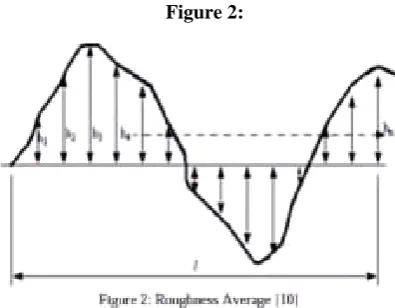
Ra is the universally recognized parameter of roughness. It is the arithmetical mean of the departures of the
profile from the mean line. Statistically Ra is a very stable, repeatable parameter as shown in figure 2. The
average roughnessIs by far the most commonly used parameter in surface finish measurement. The earliest
analog roughness measuring instruments measured only Ra by drawing a stylus continuously back and forth
over a surface and integrating (findingThe average) electronically. It is fairly easy to take the absolute value of
a signal and to integrate a signal using only analog electronics. Ra is used in the automotive and other
metalworking industries to specify surface finish of many
a type of components ranging from cylinder bores to brake drums [10]
Figure 2:
Fig: 7.1 Roughness Averange
VIII. Tool Wear And Tool Life
During machining the cutting edge of a tool gradually wears out so that intimate tool ceases to cut efficiently or
may even fail completely. Machining with a worm tool leads to increased tool forces, higher interface
temperature , poorer surface finish ,less accurate dimensions and noisier cutting action. When the wear reached
a certain stage the tool must the tool must be reground or replaced by a new tool if machining is to be continued
satisfactorily. Wear on the tool is observed in two places; on the tool flank called flank wear and on the rake
face called crater wear.
8.1 Tool Life:
Ra is the universally recognized parameter of roughness. It is the arithmetical mean of the departures of the
Tool life may be defined as the effective time interval between resharpning of tool. It is used as a measure of the
performance of a tool material or the machinability of a work material. It is also used as a criterion for
determining the effect of cutting conditions. No single definition of the tool life has been found universally
acceptable. The common methods of specified tool life are:
• Machine time
• Actual cutting time.
• Volume of metal removed per cutting edge.
• Number of identical pieces machined.
• Length of work cut per cutting edge. • Equivalent cutting speed.
Life of tool is said to be over to have failed due to any of the reasons give bellow
Flank wear: when the flank wear reaches a specified value. a value of 1.58 mm for high speed steel tools and
0.76 mm for carbide tool is to be used.
• Crater wear: as mentioned earlier failure of tool due to cratering is measured in terms of the ratio of crater
depth. The value of this ratio generally used for measuring tool life 0.6 for high speed tool and 0. For carbide
tools
• Nose wear.
8.2 Factors Affecting Tool Life:
Practical variables that influence tool life include
• Cutting speed.
• Dimension of cut.
• Tool material and geometry.
• Work material.
• Nature of cut.
• Rigidity of the machine tool work system.
• Coolant used.
8.3 Effect Of Tool Material:
Machining with steel and tool steel tool is typically through with neat oil or water soluble oil relying upon the
tactic. Carbide, ceramic and diamond tools are used with neat cutting oils at low speeds but at higher speeds
these tools got to be used with soluble oils.
Care got to be taken to use the cutting fluid at intervals the case of chemical compound tools be caused they are
susceptible to crack with unequal cooling.
IX. CONCLUSION
Neat oil gave the bottom cutting forces and flank wears at low cutting velocities and feed rates as compared to
soluble oil and artificial cutting fluid. Soluble oil gave the bottom cutting forces and flank wears at high cutting
velocities and feed rated as compared to neat oil and artificial cutting fluid. With correct machining parameter
choice, water-mixed cutting fluids (soluble oil and semi synthetic) performed relatively well to deliver low
surface roughness results. Thus, this will be a cheap alternative within the choice method.
REFFERNCES
[1] International Journal of Innovative Research in Science, Engineering and Technology „‟EFFECT OF
HIGH PRESSURE COOLANT ON SURFACE FINISH IN TURNINGOPERATION‟‟ Volume 2, Issue 7,
July 2013
[2] PERFORMANCE EVALUATION OF DIFFERENT TYPES OF CUTTING FLUID IN THE
MACHINING OF AISI 01 HARDENED STEEL USING PULSED JET MINIMAL QUANTITY
LUBRICATION SYSTEM A. Hamdan1, M. Fadzil1, K.A. Abou-El-Hossein2, M. Hamdi1
[3] An Experimental Investigation on Effect of Cutting Fluids in