Indian J. Plant Physiol., Vol. 2, No. 2, pp. 118-122 (April.-Jlllle, 1997)
SELECTION OF GROUNDNUT GENOTYPES FOR IRRIGATED
AND RAINFED ENVIRONMENTS
A ARJUNAN, N. SENTiflL AND V. DHARMALINGAM
Tamil Nadu Agricultural University, Regional Research Station, Vriddhachalam- 606 001 Received on 3 Aug., 1996, Revised on 6 Jan., 1997
SUMMARY
Superior genotypes were selected for varying environments from the two experiments involving different growth habit group of groundnut. The genotypes ICGS 76 and TAG 24 performed better under irrigated condition. Culture ICG 221 showed better performance in simulated stress environment (Rain out shelter) and the genotypes ICGV 86635, DH 43 and ICG 2716 performed better under rainfed conditon.
INTRODUCTION
Drought limits the productivity of groundnut under rainfed agricultural systems even upto 60 per cent depending upon its severity. Hence identifying genotypes which have greater ability to accumulate more dry matter coupled with water use efficiency and harvest index under water limited conditions has potential economic advantage. The traditional approach to breeding for superior yield performance under water limited condition is time consuming and expensive and require massive plant population. Identification of reliable physiological traits for selection of drought tolerant genotypes by utilizing the existing variability among cultivars in the physiological traits like dry matter production and harvest index is therefore, important. The present study was airmed at to select reliable physiological traits that are closely associated with drought tolerance and to select superior genotypes for water limited and well watered environments.
MATERIALS AND METHODS
The experiment was conducted in a split plot design with three replications having irrigation as main treatment and genotypes as sub treatment during the rainy season of 1994 at Regional Research Station, Vriddhachalam. The experimental materials consisted of 68 entries including
118
50 Spanish. 12 Virginia bunch and 6 Virginia runner types. The entries were evaluated under two experiments according to the phenology. In experiment 1:50 valentia and spanish types and the 18 virginia types were studied under two environment viz., TI: adequately irrigated with 100% CPE. T3: Rainfed. Under experiment- II: a subset of 18 selected genotypes from the above 68 genotypes were evaluated under three environments viz., T 1: adequately irrigated with 100% CPE at 4 days intervals using drip systems. T2: under rain out shelter during
40-75 days only and irrigated with 25% CPE at 4 days intervals during the treatment period only and T3: rainfed treatment. Each genotype was planted in 3 rows of 4 meter length and planting was done in two dates so as to coincide the flowering and pod setting for different groups of growth habit.
Observations were recorded for vegetative weight (Vg. Wt.), pod weight (PW) and derived parameters viz., adjustable biomass (ADBI) and harvest index (HI) were calculated during growth sampling period at 40, 75 and final harvest,. The biometrical observations were subjected to split plot analysis with irrigation as main plot and genotype as subplot. Analysis of variance used to evaluate the response of each character, treatment in each experiment and to determine genotypic and treatment variation.
IRRIGATION EFFECT ON GROUNDNliT
RESULTS AND DISCUSSION
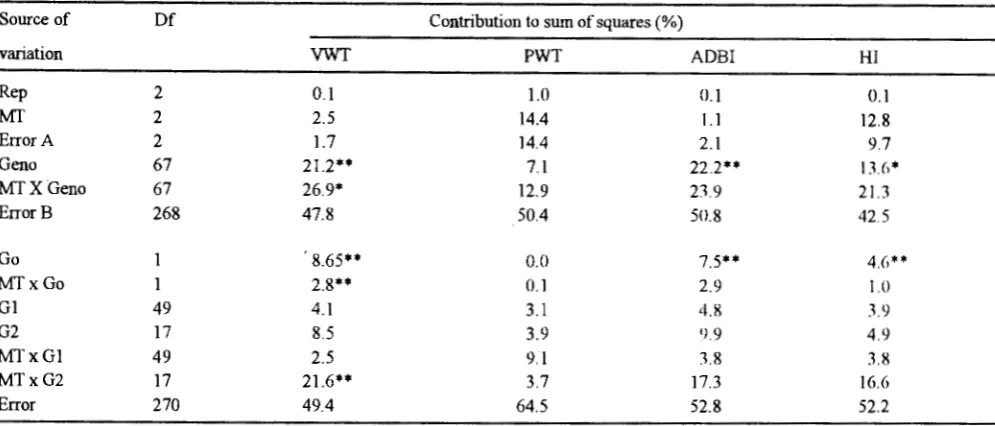
Analysis of variance for yield components for both Experiment I and Experiment II are presented in Table I. There is significant variation between genotypes in both Expt-1 and Expt-11 for vegetative weight, adjustable biomass and harvest index but no variation for pod
weight. Main treatment x genotype interaction was significant for vegetative weight in Expt-1 and vegetative adjustable biomass and harvest index in Expt II. This shows the possibility of selection of superior genotypes under diverse environments. Earlier Chapmanet al. (1993) reported the possibilities of selection of superior genotypes adapted under drought condition.
Table I. Analysis of variance and sum of squares of various crop parameters of 68 genotypes grown under irrigated and rainfed conditons. (Expt. I) - Rainy season, 1994, Vriddhachalam.
Source of Df Contribution to swn of squares (%)
variation VWT PWT ADBI HI
Rep 2 1.6 5.5 2.4 2.6
Mf 0.8 24.4 1.3 19.1
Error A 2 0.3 6.8 1.8 3.3
Geno 67 24.4** 10.9 23.3** 17.9**
MfXGeno 67 19.2* 11.1 1H.1 * 14.3*
ErrorB 268 53.7 41.3 53.2 42.8*
Go 7.1** 0.0 5.9** 3.2**
MfxGo 1.7** 0.4 2.2** 0.0
G1 49 12.6 8.5 12.4 12.0*
G2 17 4.7 2.4 5.1 2.6
MfxG1 49 11.1 9.9 11.2 9.7
MfxG2 17 6.3* 0.8 4.7 4.63
Error 270 54.1 48.1 52.0 46.1
Analysis of variance and sum of squares of various crop parameters of 18 genotypes grown under irrigated, water deficit and rainfed conditions. (Expt. II) - Rainy season, 1994, Vriddachalam.
Source of Df
variation
Rep 2
Mf 2
Error A 2
Geno 67
MTXGeno 67
ErrorB 268
Go MTxGo
Gl 49
G2 17
MTxGl 49
MTxG2 17
Error 270
VWT
0.1 2.5 1.7 21.2** 26.9* 47.8
'8.65** 2.8** 4.1 8.5 2.5 21.6** 49.4
Contribution to swn of squares (%) PWT
1.0 14.4 14.4 7.1 12.9 50.4 0.0 0.1 3.1 3.9 9.1 3.7 64.5
Indian J. Plant Physiol., Vol. 2, No.2, pp. 118-122 (ApriL-June, 1997)
ADBI HI
0.1 0.1
1.1 12.8
2.1 9.7
22.2** 13.6*
23.9 2U
50.8 42.5
7.5** 4.(•**
2.9 1.0
4.H
:u
'!.9 4.9
3.8 3.8
17.3 16.6
52.8 52.2
A ARJUNAN eta!.
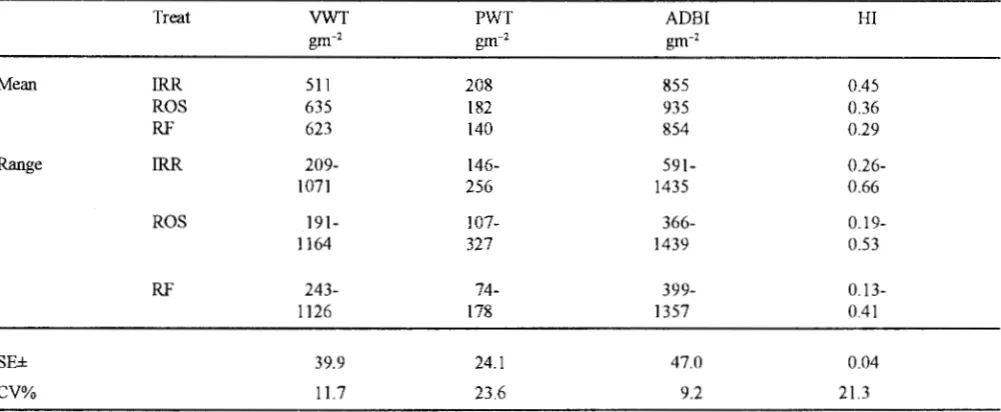
The mean and range values of yield parameters of genotypes for both Expt-1 and Expt-11 are given in Table II. Selection of best genotypes for varying environments were done based on the mean values of the genotypes. Earlier Redden and Wright (1993) used simple physiological model to analyse the yield variation in
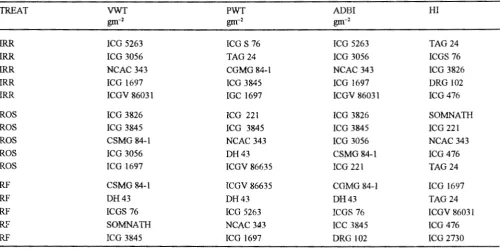
Phaseolus vulgans. The results of top five ranked
genotypes for individual treatment and for various yield parameters are given in Table -III. The results showed wide variation in vegetative weight in different treatments
in both the experiments (Table-III). Wright and Rredden (1996) also observed similar genotypic variation in water use efficiency in diverse Phaseolus vulgaris genotypes. The mean value of vegetative weight was higher in the ROS treatment (635 gm m2
-1) in Expt-II and culture ICG 5263 showed better performance under irrigated conditon in both Expt-1 and Expt-11 and ICG 3826 pertormed better under ROS treatment The genotypes CSMG 84-1 and DH 43 showed better performance for vegetative weight in rainfed conditon.
Table II. Mean and ranges yield parameters of 68 genotypes grown under irrigated and rain fed conditions. (Expt. I)-Rainy season, 1994, Vriddachalam.
Treat VWT PWT ADBI HI
gm-2 gm-z gm-2
Mean IRR 477 226 849 0.47
RF 534 144 772 0.33
Range IRR 209- 140- 591-
0.21-1444 308 1802 0.67
RF 243- 86- 399-
0.13-1126 299 1357 0.55
SE± 16.1 216 45.7 0.03
CV% 5.5 20.2 9.8 12.8
Mean and ranges yield parameters of 18 genotypes grown under irrigated, water deficit and rainfed conditions. (Expt. 2)- Rainy season, 1994, Vriddachalam.
Treat VWT PWT ADBI HI
gm-2 gm-2 gm-2
Mean IRR 511 208 855 0.45
ROS 635 182 935 0.36
RF 623 140 854 0.29
Range IRR 209- 146- 591-
0.26-1071 256 1435 0.66
ROS 191- 107- 366-
0.19-1164 327 1439 0.53
RF 243- 74- 399-
0.13-1126 178 1357 0.41
SE± 39.9 24.1 47.0 0.04
CV% 11.7 23.6 9.2 21.3
IRRIGATION EFFECT ON GROUNDNUT
Table III. Top five ranked genotypes for various yield parameters of68 genotypes grown under irrigated and rainfed conditions. (Expt- I}- Rainy season, 1994, Vriddachalam.
TREAT VWT PWT ADBI HI
gm-2 gm-2 gm-2
IRR ICG 3081 ICG 3096 iCG 3081 TG 17
IRR ICG 5263 LCHK l ICG 3158 TAG24
IRR ICG 3158 ICG 3704 ICG 5263 LCHK.l
IRR ICG 3056 ICG 3143 ICG 3056 ICG 3143
IRR NCAC 343 LCHK Ill ICG 3141 ICGS 76
RF CSMG84-1 ICG 2716 CGMG84-1 ICGV 87358
RF DH43 ICG 3089 ICG 2716 ICGV 86707
RF ICGS 76 ICGV 86707 DH43 ICG 3089
RF LCHK 111 ICGV 87358 ICGS 76 DRG 101
RF ICG 2716 ICGV 86607 LCK.H 111 ICG 4790
Top five ranked genotypes for various yield parameters of 18 genotypes grown under irrigated, water deficit and rainfed conditions. (Expt - 2) - Rainy season, 1994, Vriddachalam.
TREAT VWT PWT ADBI HI
gm-2 gm-2 gm-2
IRR ICG 5263 ICG S 76 ICG 5263 TAG24
IRR ICG 3056 TAG24 ICG 3056 ICGS 76
IRR NCAC 343 CGMG84-1 NCAC 343 ICG 3826
IRR ICG 1697 ICG 3845 ICG 1697 DRG 102
IRR ICGV 86031 IGC 1697 ICGV 86031 ICG 476
ROS ICG 3826 ICG 221 ICG 3826 SOMNATH
ROS ICG 3845 ICG 3845 ICG 3845 ICG 221
ROS CSMG84-1 NCAC 343 ICG 3056 NCAC 343
ROS ICG 3056 DH43 CSMG84-l ICG 476
ROS ICG 1697 ICGV 86635 ICG 221 TAG24
RF CSMG84-1 ICGV 86635 CGMG84-l ICG 1697
RF DH43 DH43 DH43 TAG24
RF ICGS 76 ICG 5263 ICGS 76 ICGV 86031
RF SOMNATH NCAC 343 ICC 3845 ICG 476
RF ICG 3845 ICG 1697 DRG 102 ICG 2730
Pod weight is the most important character for selection of superior genotypes under stress environment (Fussell et a!., 1991 ), which showed wide variation in rainfed (Expt-1) and ROS (Expt-III) treatments. Highest mean value was observed in the irrigated treatment (226 gm m2
-1} in Expt-1. The genotypes ICG 3096 (Expt- I) and
ICGS 76 (Expt-11) performed better under favourable
environment. The genotypes ICGS 2716 (Expt-1) and ICGV 86635 (Expt-11) performed better in rainfed condition. The genotypes ICG 221 showed better performance under simulated stress treatment under ROS. Earlier Chapman eta!. (1983) reported the development of pods and high HI are important characters for selection of water use efficiency when drought occurs at later stage
A ARJUNAN eta/.
of pod development. Adjustable biomass showed wide variation on ROS treatment, which is the deciding character for the partitioning efficiency of a particular genotype . The highest mean value (935 gm m2
) was
recorded in the ROS treatment. The genotype ICG 5263 under favourable environment and CSMG 84-l under rainfed treatment performed better. ~e genotypes ICG 3 826 showed superior performance under ROS treatment.
Harvest index showed wide variation under rainfed treatment. The highest harvest index (0.47) was recorded in the irrigated treatment (Expt-1). Chapman et al. (1993). emphasized the selection of cultivars with increased HI, under irrigated conditions may also increase yields following a drought during early reproductive development. In the present experiment TAG 24 showed better performance both in irrigated and rainfed treatments but under ROS treatment Somnath showed better performance.
For improvement of drought tolerance in groundnut, the traits contributing to the productivity under the drought situation are to be selected rather than yield alone (Ludlow and Muchow, 1990). Hence, in the present experiment, genotypes have been selected based not only on pod weight but also on the characters like HI, adjustable biomass and vegetative weight. Earlier Passioura ( 1977) selected water use efficient wheat cultivars utilizing the grain yield and harvest index parameters based on the yield and physiological traits. Thus the genotypes ICGS 76 and TAG 24 are the best ones for irrigated condition and ICG 221 for stress environment (ROS treatment) because of high pod weight and harvest index. Similarly Chapman et al. (1993) suggested that gain in yield under drought can be made by selection for increased harvest index. Moreover, the genotypes ICGV 86635, DH 43 and
122
ICG 2716 showed better performance under rainfed conditions based on pod weight and adjustable biomass. Hence, the above mentioned genotypes can be recommended for the specified situation in order to increase the yield potential in the varying environmental conditions.
ACKNOWLEDGEMENT
The authors acknowledge the financial assistance provided by the ACIAR-ICRISAT -ICAR-TNAU collaborators.
REFERENCES
Chapman, S.S , Ludlow, M.M., Blamey, F.P.C. and Fisher, K.S. ( 1993). Etled ofdrought during early reproductive development on growth of cultivars of groundnut (Arachis hypogaea L. Il
Biomass production, pod development and the yield. Field Crop. Res., 32:211-225.
Pussell, L.K., Bidinger, F.R. and Bieler, P. ( 1991 ). Crop physiology and breeding for drought tolerance, research and development.
Field Crop Res., 27 183-1'!9.
Ludlow, M.M. and Muchow, R.C. (1990). A critical evaluation of traits tor improving crop yield in water limited environments
Adv. Agron., 43: 107-153.
Passioura, J.B. (1977). Grain yield, harvest index and water use of wheat. J. Au st. In st. Agric. Sci., 43: 117-121.
Redden, R.J. and Wright, C; C. (1993). Use of a simple physiological model to ane~lyse yield variations in phaseolus vulgaris
genotypes. In Proc. Seventh Australian Agronomy conference, Adelaide: 88-91.
Wright, G.C. and Redden, R.J. ( 1996 ). Genotypic variation in water use et1iciency in divt:rsePhaseolus vulgaris genotypes. Aust. J. Agric. Res. (In press).