
IN VITRO ANTIBACTERIAL ACTIVITIES AND BRINE SHRIMP LETHALITY BIOASSAY OF ETHANOLIC EXTRACT FROM MORINGA OLEIFERA LAM. LEAVES
5
0
0
Full text
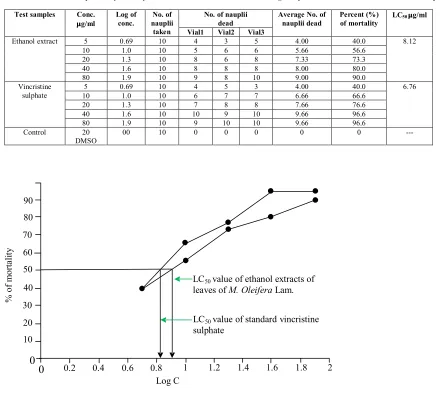
(2) Md. Abu Shuaib Rafshanjani et al. Int. Res. J. Pharm. 2014, 5 (11) Herbarium, Mirpur, Dhaka-1216, Bangladesh where a voucher specimen No. DACB32494 has been deposited. The leaves were washed, air dried for 3 days and then oven dried for 24 hours below the temperature 60oC followed by pulverization into coarse powder using a grinding machine. Plant material extraction The ground leaves (600 g) were subjected to 95 % ethanol (3 liters) extraction in cold condition in flat bottom glass container through occasional shaking for 7 days24,25. The extract was filtered and the solvent was evaporated to dryness in vacuum rotary evaporator at 40oC to 50oC to afford a semisolid mass (80 g) and used for further studies. Culture media Nutrient agar media (Difco laboratories) PH 7.2, nutrient broth media (Difco laboratories) pH 6.8 and artificial sea water (3.8 % sodium chloride solution) pH 8.4 were used for antibacterial screening, MIC determination and brine shrimp lethality bioassay respectively26,27. Antibacterial activity screening The antibacterial activity determination was performed by disc diffusion technique28. Test organisms were available in Microbiology Laboratory of Pharmacy Department, North South University, Bashundhara, Dhaka, Bangladesh. Pure cultures of these were collected from the Microbiological Laboratory of the Institution of Food and Nutrition Science and Department of Microbiology, University of Dhaka, Bangladesh. The sample of extracts were prepared by dissolving a definite amount of material in appropriate volume of solvent to give the desired concentration and applied on sterile disc (6 mm diameter, filter paper) followed by drying off in an aseptic hood. Thus, such discs contained 500 µg of crude extracts. The activities were compared with standard antibiotic, kanamycin 30 µg/disc. Blank disc impregnated with 10 µl of solvent ethanol followed by drying off was used as negative control. The test discs and standard disc were placed in petridishes seeded with particular bacteria and kept in a refrigerator at 4oC for 12-18 hours to allow maximum diffusion of test material in to the surrounding media. Then the petridishes were incubated overnight at 37oC for growth of bacteria and activities of the plant extracts were expressed by measuring the zone of inhibition in terms of mm. Determination of Minimum Inhibitory Concentrations Minimum inhibitory concentration (MIC) was determined by serial tube dilution technique29 against all the pathogenic bacteria. Inoculums were prepared in the sterile nutrient broth medium so that the suspension contains 106 cell/ml. The stock solution was prepared by dissolving 4 mg of the plant extract in 4 ml solvent (DMSO, dimethyl sulfoxide) to obtain concentration 1000 µg/ml and serially diluted to obtain concentrations 500, 250, 125, 62.5, 31.25, 15.62, 7.81, 3.90, 1.9 µg/ml consecutively. 10 µl of properly diluted inoculums were added to each of the nine test tubes. 1 ml of sample solution and 10 µl of inoculums were added to the control. test tube CS and CI whereas control test tube CM contained medium only. All the test tubes were incubated for 18 hours at 37oC and evaluated for growth of bacteria. Brine Shrimp Lethality Bioassay The in vitro lethality in a simple zoological organism such as the brine shrimp lethality, developed by Meyer et al30, was used as a simple tool to guide for cytotoxic activity. Brine shrimp eggs were collected from University of Dhaka, Bangladesh and placed in artificial sea water (3.8 % w/v NaCl in distilled water). The eggs were then incubated at 2428oC and hatched for 48 hours to provide large number of larvae called nauplii. The test samples were prepared by dissolving the ethanol leaves extracts in DMSO (not more than 50 µl in 5 ml solution) with sea water to obtain concentrations 5, 10, 20, 40, 80 µg/ml. A vial containing 50 µl DMSO diluted to 5 ml was used as a negative control and standard vincristine sulphate was used as a positive control26. The matured shrimp (10 nauplii) were applied to each of all experimental vials and control vial. The number of survivors usually swimming was counted with the aid of a magnifying lens for each of the vials at the end of 24 hours. From these data the (%) mortalities were calculated for each concentration of test and control solutions. By using Microsoft Excel the concentration- mortality data were analyzed statistically and LC50 values of the plant extracts were determined27. RESULTS The antibacterial activities of crude ethanol extract of Moringa oleifera Lam. leaves obtained by disc diffusion method are enlisted in Table 1. In comparison with standard antibiotic kanamycin 30 µg/disc; the leaves extract showed different zones of inhibition at a concentration of 500 µg/disc against four Gram positive and eight Gram negative bacteria. The extracts exhibited greater sensitivity to Gram negative bacteria with the zone of inhibition ranging from 19.3 to 26.3 mm. Highest zone of inhibition was found to be 26.3 mm against Escherichia coli followed by Shigella dysenteriae, Shigella boydii and Shigella sonnei with the zone of inhibition 25.2 mm, 22.3 mm and 22.1 mm respectively. However, comparatively less sensitivity was shown by Gram positive bacteria. Amongst twelve Sarcina lutea and Bacillus subtilis were two bacteria that had lowest activity with the zone of inhibition 10.1 mm and 11.2 mm. The results of Minimum Inhibitory Concentration (MIC) values of ethanol leaves extracts are also summarized in Table 1. The MIC values for Gram negative bacteria ranged from 62.5 to 125 µg/ml whereas that of Gram positive bacteria ranged from 125-250 µg/ml. In brine shrimp cytotoxicity assay, an approximate linear correlation was observed when logarithm of concentration versus percentage of mortality was plotted on a graph paper (Figure 1). Leaves extracts showed prominent cytotoxic activity in a dose dependent manner and median lethal concentration (LC50) value was found to be 8.12 µg/ml while for standard vincristine sulphate was found to be 6.76 µg/ml (Table 2).. Page 857.
(3) Md. Abu Shuaib Rafshanjani et al. Int. Res. J. Pharm. 2014, 5 (11) Table 1: In vitro antibacterial activities and MIC values of the crude ethanol extracts of Moringa oleifera Lam. leaves with standard kanamycin Tested organisms. Diameter of zone of inhibition (mm) Ethanol extract (500 µg/disc) Kanamycin (30 µg/disc). Gram (+ve) bacteria Bacillus subtilis Bacillus megaterium Sarcina lutea Staphylococcus aureus Gram (-ve) bacteria Escherichia coli Salmonella typhii Shigella shiga Shigella sonnei Shigella boydii Shigella dysenteriae Klebsiella species Pseudomonus aeruginosa. MIC values (µg/ml) Ethanol extract Kanamycin. 11.2 15.1 10.1 13.2. 29.4 19.3 17.2 28.2. 250 125 125 250. 31.25 31.25 62.50 62.50. 26.3 20.2 21.1 22.1 22.3 25.2 20.1 19.3. 29.1 28.2 25.2 25.1 24.1 28.4 24.2 22.1. 62.5 125 125 62.5 62.5 62.5 125 125. 15.62 31.25 62.50 15.62 31.25 15.62 62.50 15.62. Table 2: Results of brine shrimp lethality bioassay for ethanol extract of the leaves of Moringa oleifera Lam. and for standard vincristine sulphate Test samples. Conc. mg/ml. Log of conc.. Ethanol extract. 5 10 20 40 80 5 10 20 40 80 20 DMSO. 0.69 1.0 1.3 1.6 1.9 0.69 1.0 1.3 1.6 1.9 00. Vincristine sulphate. Control. No. of nauplii taken 10 10 10 10 10 10 10 10 10 10 10. No. of nauplii dead Vial1 Vial2 Vial3 4 3 5 5 6 6 8 6 8 8 8 8 9 8 10 4 5 3 6 7 7 7 8 8 10 9 10 9 10 10 0 0 0. Average No. of nauplii dead. Percent (%) of mortality. LC50 mg/ml. 4.00 5.66 7.33 8.00 9.00 4.00 6.66 7.66 9.66 9.66 0. 40.0 56.6 73.3 80.0 90.0 40.0 66.6 76.6 96.6 96.6 0. 8.12. 6.76. ---. 90 80. % of mortality. 70 60 50. LC50 value of ethanol extracts of leaves of M. Oleifera Lam.. 40 30. LC50 value of standard vincristine sulphate. 20 10. 0. 0. 0.2. 0.4. 0.6. 1 0.8 Log C. 1.2. 1.4. 1.6. 1.8. 2. Figure 1: Determination of LC50 values for crude ethanol extract of Moringa oleifera Lam. leaves and for standard vincristine sulphate from linear correlation between logarithms of concentrations versus percentage of mortalities. Page 858.
(4) Md. Abu Shuaib Rafshanjani et al. Int. Res. J. Pharm. 2014, 5 (11) DISCUSSION The results of the present study revealed that the leaves of the plant Moringa oleifera Lam. has got profound antibacterial and cytotoxic activity. The Gram negative bacteria are more sensitive to ethanol leaves extract than Gram positive bacteria. The leaves of Moringa oleifera Lam. have been known to contain a number of phytochemicals including flavonoids, saponins, tannins and other phenolic compounds having antimicrobial activities31,32. The mechanisms of action of these compounds have been proven to be via cell membranes perturbations. Compounds like pterygospermin, benzyl glucosinolate and benzyl isothiocynate have been isolated from Moringa oleifera Lam. leaves and these compounds have been reported to have antimicrobial properties against a wide range of bacteria which could partly explain the observed bacteriostatic and bactericidal activity33. Thus, the antibacterial activities observed in this experiment could be attributed to such compounds and the results are in good agreement with the previous reports on antibacterial activity of leaves of this plant34,35. Antibacterial potency of crude ethanol extracts of leaves of Moringa oleifera Lam. indicates that it is more effective against Gram negative bacteria than Gram positive one. However maximum inhibition was obtained with Escherichia coli, Shigella sonnei, Shigella boydii and Shigella dysenteriae at 62.5 µg/ml concentration. The brine shrimp lethality assay represents a fast, economical and easy bioassay for testing plant extracts bioactivity which in the majority cases correlates reasonably well with cytotoxicity and anti-tumor properties36. The degree of lethality shown by the ethanol extracts of leaves was found to be directly proportional to the concentration of the extracts. Maximum mortalities were happened at a concentration 80 µg/ml while least mortalities were at 5 µg/ml. Leaves extracts showed highest cytotoxic activity with LC50 value 8.12 µg/ml while standard vincristine sulphate showed LC50 value of 6.76 µg/ml. No mortality was observed for negative control group indicating that the results obtained are only due to the activity of the test leaves extracts. Previous reports suggest that leaves of this plant contain the phytochemical niaziminin, which is found to have molecular components that can prevent the development of cancer37. Additionally it is an important source of glucosinolate precursors of the isothiocynate group of chemopreventives that can inhibit carcinogenesis38. Niazimicin, a compound isolated from Moringa oleifera Lam. have also been reported to have potent anti-tumor promoting activity in two stage carcinogenesis in mouse skin using 7, 12-dimethylbenz (a) anthracene [DMBA] as an initiator and 12-O-tetradecanoyl-phorbol-13-acetate [TPA] as a tumor promoter39. Thus, significant cytotoxic effects of ethanol extracts of Moringa oleifera Lam. leaves exhibited by the present experiment indicates that it can be selected for further cell line assay, as many scientists have shown a correlation between cytotoxicity and activity against brine shrimp nauplii40. CONCLUSION The results of the antibacterial and cytotoxic activity of Moringa oleifera Lam. leaves has suggested further potentials of this plant in the area of pharmacology as safe antibacterial and anticancer agent. This extract can be regarded as a promising candidate for other researchers to done more work on Moringa oleifera Lam. including phytochemical and biological investigation.. ACKNOWLEDGEMENTS Authors are thankful to Mr. Md. Habibur Rahman, taxonomist, National Herbarium, Mirpur, Dhaka-1216, Bangladesh for identification of the plant and also to the Department of Pharmacy, North South University, Bashundhara R/A Plot 15, Block B, Dhaka-1229, Bangladesh for providing necessary facilities. REFERENCES 1. Kala CP. Current status of medicinal plants used by traditional Vaidyas in Uttaranchal state of India. Ethnobot Res Appl 2005; 3: 267-278. 2. Kumar S, Hassan SA, Dwivedi S, Kukreja AK, Sharma A, Singh AK et al, editors. Proceedings of the National Seminar on the Frontiers of Research and Development in Medicinal Plants. Lucknow: Central Institute of Medicinal and Aromatic Plants; 2000. 3. Kumbhare MR, Guleha V, Sivakumar T. Estimation of total phenolic content, cytotoxicity and in-vitro antioxidant activity of stem bark of Moringa oleifera. Asian Pacific J Trop Dis 2012; 144-150. http://dx.doi.org/10.1016/S2222-1808(12) 60033-4. 4. Eloff JN. Which extracts should be used for the screening and isolation of antimicrobial components from plants? J Ethnopharmacol 1998; 60(1): 1-8. http://dx.doi.org/10.1016/S0378-8741(97)00123-2 5. Kaur GJ and Arora DS. Antibacterial and phytochemical screening of Anethum graveolens, Foeniculum vulgare and Trachyspermum ammi. BMC Complement Alternate Medicine 2009; 9: 30. http://dx.doi. org/10.1186/1472-6882-9-30 6. Adedapo AA, Mogbojuri OM, Emikpe BO. Safety evaluation of the aqueous extracts of the leaves of Moringa oleifera. J Medicinal Plant Res 2009; 3(8): 585-591. 7. Sieradzki K, Wu SW, Tomasz A. Inactivation of the methicillin resistance gene mecA in vancomycin-resistant Staphylococcus aureus.Micro Drug Resist 1999; 5(4): 252-257. http://dx.doi.org/ 10.1089/mdr.1999.5.253 8. Jethinlalkhosh JP and Antony A. Antibacterial and cytotoxic activity of aqueous and methanolic extract of Terminalia arjuna. Int J Res Pharm Sci 2013; 4(1): 36-39. McLaughlin JL and Rogers LL. The use of biological assays to 9. evaluate botanicals. Drug Information J 1988; 32: 513-524. 10. Anderson JE, Goetz CM, McLaughlin JL, Suffness M. A blind comparison of simple bench-top bioassay and human tumor cell cytotoxicities as antitumor prescreens. Phytochem Analysis 1991; 2: 107-111. http://dx.doi.org/10.1002/pca.2800020303 11. Arcanjo DDR, Albuquerque ACM, Melo Neto B, Santana LCLR, Medeiros MGF, Cito AMGL. Bioactivity evaluation against Artemia salina Leach of medicinal plants used in Brazilian Northeastern folk medicine. Braz J Biol 2012; 72(3): 505-509. http://dx.doi.org/10.1590 /S1519-69842012000300013 12. Anwar F, Latif S, Ashraf M, Gilani AH. Moringa oleifera: A food plant with multiple medicinal uses. Phytother Res 2007; 21(1): 17-25. http://dx.doi.org/10.1002/ptr.2023 13. Ghani A. Medicinal Plants of Bangladesh with Chemical Constituents and Uses. 2nd ed. Dhaka: Asiatic Society of Bangladesh; 1998. p. 307308. 14. Sutar NG, Bonde CG, Patil VV, Narkhede SB, Patil AP, Kakad RT. Analgesic activity of seeds of Moringa oleifera Lam. Int J Green Pharm 2008; 2(2): 108-110. http://dx.doi.org/10.4103/09738258.41182 15. Hukkeri VI, Nagathan CV, Karadi RV, Patil BS. Antipyretic and wound healing activities of Moringa oleifera Lam. in rats. Ind J Pharm Sci 2006; 68(1): 124-126. http://dx.doi.org/10.4103/0250-474X.22985 16. Rao CV, Ojha SK. Analgesic effect of Moringa oleifera Lam. leaf extract on rats. 2nd world congress on Biotechnological Development on Herbal Medicine Lucknow. India: NBRI; 2003. p. 42. 17. Selvakumar D, Natarajan P. Hepatoprotective activity of Moringa oleifera Lam. leaves in carbon tetrachloride induced hepatotoxicity in Albino rats. Pharmacognosy Magazine 2008; 4(13): 97-98. 18. Pal SK, Mukharjee PK, Saha BP. Studies on the antiulcer activity of Moringa oleifera Lam. leaf extract on gastric ulcer models in rats. Phytother Res 1995; 9: 463-465. http://dx.doi.org/ 10.1002/ptr.2650090618 19. Faizi S, Siddiqui BS, Saleem R, Siddiqui S, Aftab K, Gilani AU. Fully acetylated carbamate and hypotensive thiocarbamate glycosides from Moringa oleifera. Phytochem 1995; 38(4): 957-963. http://dx.doi. org/10.1016/0031-9422(94)00729-D 20. Caceres A, Saravia A, Rizzo S, Zabala L, Leon ED, Nave F. Pharmacologic properties of Moringa oleifera, screening for antispasmodic, anti-inflammatory and diuretic activity. J Ethnopharmacol 1992; 36(3):233-237. http://dx.doi.org/10.1016/03788741(92)90049-W 21. Shukla S, Mathur R, Prakash AO. Antifertility profile of the aqueous extract of Moringa oleifera Lam. roots. J Ethnopharmacol 1988; 22(1): 51-62. http://dx.doi.org/10.1016/0378-8741(88)90230-9. Page 859.
(5) Md. Abu Shuaib Rafshanjani et al. Int. Res. J. Pharm. 2014, 5 (11) 22. Karadi RV, Palkar MB, Gaviraj EN, Gadge NB, Mannur VS, Alagawadi KR. Antiurolithiatic property of Moringa oleifera root bark. Pharm Biol 2008; 46(12): 861-865. http://dx.doi.org/10.1080 /13880200802367189 23. Mehta LK, Balaraman R, Amin AH, Bafna PA, Gulati OD. Effects of fruits of Moringa oleifera on the lipid profile of normal and hypercholesterolaemic rabbits. J Ethnopharmacol 2003; 86(2-3): 191195. http://dx.doi.org/10.1016/S0378-8741(03)00075-8 24. Trease EG, Evans WC. Textbook of Pharmacognosy. 14th ed. U.K: W.B. Saunders Company; 1997. p. 119. 25. Jeffery GH, Bassett J, Mendham J. Vogel’s Textbook of Quantitative Chemical Analysis. 5th ed. England: Longman Group UK Ltd; 2000. p.161. 26. Khan A, Rahman M, Islam MS. Antibacterial, antifungal and cytotoxic activities of amblyone isolated from Amorphophalus campanulatus. Ind J Pharmacol 2008; 40(1): 41-44. http://dx.doi.org/10.4103/02537613.40489 27. Parvin S, Kader MA, Rahman MA, Wahed MII, Haque ME. Antibacterial activities and brine shrimp lethality bioassay of the chloroform extract of stem bark of Crataeva nurvala Buch Ham. Int J Pharm Sci Res 2012; 3(3): 830-834. 28. Rios JL, Recio MC, Villar A. Screening methods for natural products with antimicrobial activity: A review of the literature. J Ethnopharmacol 1988; 23(2-3): 127-149. http://dx.doi.org/10.1016/ 0378-8741(88)90001-3 29. Roland R. Antibiotics: An Introduction. Switzerland: F Hoffmann La Roche and Co Basel; 1982. 30. Meyer BN, Ferrigni NR, Putnam JE, Jacobsen LB, Nicholas DE, McLaughlin JL. Brine Shrimp: A convenient general bioassay for active plants constituents. Planta Med 1982; 45(5): 31-34. http://dx.doi.org/10.1055/s-2007-971236 31. Sato Y, Shibata H, Arai T, Yamamoto A, Okimura Y, Arakaki N, Higuti T. Variation in synergistic activity by flavones and its related compounds on the increased susceptibility of various strains of methicillin-resistant Staphylococcus aureus to β-lactam antibiotics. Int J Antimicrob Agents 2004; 24(3): 226-233. http://dx.doi.org/ 10.1016/j.ijantimicag.2004.02.028. 32. Mboto CI, Eja ME, Adegoke AA, Iwatt GD, Asikong BE, Takon I, Udo SM, Akeh M. Phytochemical properties and antimicrobial activities of combined effect of the leaves of Garcinia kola, Veronina amygdalina and honey on some medically important microorganisms. Afr J Microbiol Res 2009; 3(9): 557-559. 33. Fahey JW. Moringa oleifera: A review of the medical evidence for its nutritional, therapeutic and prophylactic properties. Part1. Trees Life J 2005; 1(5). 34. Bhawasar GC, Guru LV, Chadda AK. Antibacterial activity of some indigenous medicinal plants. Med and Surv 1965; 5: 11-14. 35. Khatun S, Khan MMH, Ashraduzzaman M, Pervin F, Bari L, Absar N. Antibacterial activity and cytotoxicity of three lectins purified from drumstick (Moringa oleifera Lam.) leaves. J Bio-sci 2009; 17: 89-94. 36. Ara J, Sultana V, Ehteshamul Haque S, Qasim R, Ahmad VU. Cytotoxic activity of marine macroalgae on Artemia salina (brine shrimp). Phytotherapy Res 1999; 13: 304-307. http://dx.doi.org/ 10.1002/(SICI)1099-1573(199906)13:4<304::AID-PTR439>3.3.CO;20 37. Murakami A, Kitazono Y, Jiwajinda S, Koshimizu K, Ohigashi H. Niaziminin, a thiocarbamate from the leaves of Moringa oleifera, holds a strict structural requirement for inhibition of Tumor Promoter Induced Epstein Barr Virus Activation. Planta Med 1998; 64(4): 319323. http://dx.doi.org/10.1055/s-2006-957442 38. Daxebbichler ME, Spancer FG, Carlson DG, Rose GB, Brinker AM, Powell RG. Glucosinolate composition of seeds from 297 species of wild plants. Phytochem 1991; 30(8): 2623-2638. http://dx.doi.org/ 10.1016/0031-9422(91)85112-D 39. Guevara AP, Vargas C, Milagros UY. Anti-inflammatory and antitumor activities of seeds, Moringa oleifera L. (Moringaceae). Philipp J Sci 1996; 125(3): 175-184. 40. Martin Cordero G, Saenz MT, Ayuso MJ. Cytotoxic activity of Retama spaerocarpa. Fitotherapia XVI 1995; 66(6): 495-498. Cite this article as: Md. Abu Shuaib Rafshanjani, Shumaia Parvin, Md. Abdul Kader. In vitro antibacterial activities and brine shrimp lethality bioassay of ethanolic extract from Moringa oleifera Lam. Leaves. Int. Res. J. Pharm. 2014; 5(11):856-860 http://dx.doi.org/10.7897/2230-8407.0511175. Source of support: Nil, Conflict of interest: None Declared. Page 860.
(6)
Figure
Related documents
In vitro Activity of Colistin in Combination with Tigecycline against Carbapenem-Resistant Aci- netobacter baumannii Strains Isolated from Patients with Ventilator-
Dempster, S.Khan, and B.Jarra,”Analysis of infected blood cell images using morphological operators,”Image and vision computing,vol 20,no.2,pp.133-146,February 2002 [8] :This
One laboratory test of TNF-alpha serum concentrations in Syrian patients with breast and lung cancer can give us a strong evaluation for cancer patient outcomes (nutritional
Taking ad- vantage of the broad context of 2 375 European SMEs originating from 27 countries, this study employs linear regression analyses to investigate the relationships
Similar to other new carbapenems, these agents may be indicated for nosocomial bacterial infections due to Gram-positive and Gram-negative bacteria, especially
‘…as far as when I was studying I wasn’t shown, I didn’t know of any Black artists, any Black film makers, any Black designers apart from the obvious ones which was Chris
Predictors: (Constant), Rigidity of the Seq of Acts and Seq of Proj Being Exec In The Prog, Programme Size, Programme Context of the Environment in Which Programme is Being
