INTERNATIONAL RESEARCH JOURNAL OF PHARMACY
www.irjponline.com
ISSN 2230 – 8407
Research Article
AN EFFECTIVE MACHINE LEARNING ALGORITHM FOR TEXTURE BASED MEDICAL IMAGE RETRIEVAL SYSTEM
Yogapriya J 1*, Saravanabhavan C 1 and Ila Vennila 2
1Department of Computer Science and Engineering, Kongunadu College of Engineering and Technology, Trichy,
Tamil Nadu, India
2Department of Electrical and Electronics Engineering, PSG College of Technology, Coimbatore, Tamil Nadu, India *Corresponding Author Email: [email protected]
Article Received on: 13/11/17 Approved for publication: 30/11/17
DOI: 10.7897/2230-8407.0811241
ABSTRACT
In the present digital world, an image databases are increasing enormously across the world. An effective image retrieval approach is needed for utilizing this massive databases. An extensive research efforts have been conducted in the field of Content-Based Medical Image Retrieval(CBMIR) system. This paper analysed a novel evolutionary approach to extract texture features for CBMIR application .The selected texture features are Local Octal pattern(LOP)in which extracted features are formed as feature vector database. A machine learning algorithms are analysed for feature selection and classification problems. To reduce the high dimensional texture features, Grey Wolf Optimization(GWO) is used to select the best features. A classification algorithm is used as an Evaluation Criteria, for identifying the best subset of features. Fuzzy based Relevance Vector Machine(FRVM) based classification algorithm is applied to classify the subset of texture features of the images. Euclidean Distance(ED) is used as similarity measurement techniques, to identify the similarity between the query image and the classified image feature database.To evaluate the retrieval performance, an experiments have been conducted on medical image dataset. The Precision and Recall is used as a performance metrics to evaluate the CBMIR systems.
Keywords: Content Based Medical Image Retrieval (CBMIR), Texture Features, Feature Extraction, Selection, Classification, Grey Wolf Optimization(GWO), Fuzzy based Relevance Vector Machine(FRVM), Euclidean Distance (ED).
INTRODUCTION
Medical imaging plays a major role in healthcare systems to physicians for monitoring the treatment responses of patients diseases. Everyday thousands of human body anatomy images are scanned in the radiology department of each hospitals ,using different imaging modality devices, such as Computed Tomography (CT), Magnetic Resonance Imaging (MRI), Ultrasound (US), MammoGrams (MG), and Digital Radiography (DR) . All the images to be stored in a structured way and to be retrieved whenever images are needed by the physicians. Image retrieval is the process of searching the similar images from the database.Image retrieval using text analysis is a difficult task due to the enormous collection of images.
Content Based Medical Image Retrieval (CBMIR)1 system retrieves the needed images automatically from the medical image databases by extracting the visual content of the features2. The colour, shape and texture feature extraction methods are widely used for image retrieval3,4. The extracted visual image features can form as Feature Vector Database. The main task is to decide which features are best for specifying the contents of an image and which methodologies are best suited for extraction. In CBMIR, physicians look for visual characteristics of images in particular Region of Interest(ROI), for searching the surface to classify abnormality and resolve if a biopsy is needed. The distinct objects outside the image, such as medical tools, vaginal walls, and text
few years, massive development has been seen in the field of CBMIR5 for effective analysis of medical images, to help the physician for analysing the diagnosis and decision-making.
The main aim of this work is to build an efficient framework for CBMIR system by adapting the four phases of workflow such as Feature Extraction, Feature Selection, Feature Classification and Similarity Measurements.
MATERIALS AND METHODS Texture Feature Extraction
For medical images, only limited applications are using colour as feature extractor, such as dermatology, pathology, ophthalmology and nuclear cardiology6. Texture features are having the properties for capturing semantic features clearly in medical images and reflect the needed details from images as compared with all other visual features.
A texture feature extraction method, called Local Octal Patterns (LOP), is used in our CBMIR system11,12. LOP is utilized by analyzing the various existing texture feature extraction methods such as LBP, LDP, LTP and LTrP. LTrPs considers only horizontal and vertical pixels in four directions for derivative calculation. The performance of LTrP method can be improved by separating out the boundaries in more than four directions by using the horizontal, diagonal and vertical pixels for derivative calculations. This has motivated us to use an eight directional code, denoted as LOP for CBMIR.
The feature vectors are the histogram of the binary patterns. With P neighborhoods, there are 2P potential combinations of binary patterns, are extracted. Hence, the feature vector length is 2P, which will increase the computational complexity. If all of the patterns are considered for performing the classification, then it will take more time to retrieve the needed images. In order to reduce the computational cost, researchers have considered the uniform patterns13. The uniform pattern is considered, which shows the uniform appearance of patterns, that has limited discontinuities or transitions in the circular binary pattern representation. The most frequent „uniform‟ binary patterns are micro features such as edges, corners and spots and the remaining patterns are referred as non-uniform patterns, hence they can be considered as feature detectors that reflect the best matching patterns. If two transitions are exists between “0” and “1” then the patterns are uniform. For example, 11110111 and 11011111 are uniform patterns and it is identified that, nearly 90% of encoded labels are uniform patterns only.
The above problem is addressed by using a machine learning algorithms. The feature selection method which selects only the optimal uniform patterns with the consideration of irregular larger edges or shapes of patterns to extract the texture information. The classification algorithm is used as an Evaluation Criteria, for identifying the best subset of features. If maximum classification accuracy or minimum error rate, is reached, the process will stop and that will select the best subset of features for retrieval.
Machine Learning Algorithms
Machine learning is a field of computer science that gives computers the ability to learn without being explicitly programmed. Machine learning algorithms that make predictions on given set of samples. The most widely used machine learning algorithms are Supervised learning, Unsupervised Learning and Reinforcement Learning14.
Supervised Learning searches for patterns within the value labels assigned to data points. The sample algorithms are Decision Tree, Random Forest, K-Nearest Neighbor, Logistic Regression, Naïve Bayes, Support Vector Machine, Relevance Vector Machine and Ensemble Methods
Unsupervised Learning, which has no labels associated with
In Reinforcement Learning, the machine is trained to take specific decisions and trains itself continually using trial and error. It learns from past experience and tries to capture the best possible knowledge to take accurate decisions. Markov Decision Process is an example for this algorithm.
Unsupervised Machine Learning Algorithms for Feature Selection
Bio Inspired Meta Heuristic Algorithms (BMHA) are used to solve optimization problems by mimicking biological or physical phenomena , widely used in engineering applications because they: (i) Simple concepts and easy to apply; (ii) Gradient information is not required (iii) local optima can be bypassed; (iv) Different disciplines of problems can be addressed. The four steps for feature selection are subset generation, evaluation, stopping criterion and subset validation. There are three varieties of BMHA15:
Evolution- Based Methods: Inspired by the laws of natural evolution. The search process starts with a randomly generated population which is evolved over subsequent generations. Best individuals are always combined together to form the next generation of individuals. This allows the population to be optimized over the course of generations Genetic Algorithms (GA), Genetic Programming (GP), Biogeography-Based Optimizer (BBO), Evolution Strategy (ES), Probability-Based Incremental Learning (PBIL).
Physics-Based Methods: The most popular algorithms are Simulated Annealing (SA), Gravitational Local Search (GLSA), Big-Bang Big-Crunch (BBBC), Gravitational Search Algorithm (GSA), Charged System Search (CSS), Central Force Optimization (CFO), Artificial Chemical Reaction Optimization Algorithm (ACROA), Black Hole (BH) algorithm, Ray Optimization (RO) algorithm, Small-World Optimization Algorithm (SWOA), Galaxy-based Search Algorithm (GbSA), and Curved Space Optimization (CSO).
Swarm-Based Methods: Particle Swarm Optimization(PSO) ,Marriage in Honey Bees Optimization Algorithm (MBO) ,Artificial Fish-Swarm Algorithm (AFSA) ,Termite Algorithm , Ant Colony Optimization(ACO) Wasp Swarm Algorithm, Monkey Search, Wolf pack search algorithm, Bee Collecting Pollen Algorithm (BCPA) ,Cuckoo Search (CS), Dolphin Partner Optimization (DPO), Bat-inspired Algorithm (BA), Firefly Algorithm (FA), Hunting Search (HS), Bird Mating Optimizer (BMO) Krill Herd (KH) Fruit fly Optimization Algorithm (FOA) Dolphin Echolocation (DE) and Grey Wolf Optimization(GWO).
Ballerini16 proposed CBMIR for Skin Lesions by GA. The ranking quality17 of medical image retrieval is improved using GA as feature selection method. The experimental result shows that GA has provided fast suboptimal solutions but it is not able to find a global optimum solution within a timeframe.This way of approach is not always possible to take accurate selection of
Particle Swarm Optimization (PSO)20,21,22 is used as feature selection method for image retrieval.The experimental results shown that PSO has produced quality solutions with stable convergence features. However, the performance of PSO is affected by improper selection of parameters value that has caused the premature convergence, and trapped in local optimum solutions. When the velocity of particles are decreased in the search space ,it causes premature convergence. Hence, these kind of feature reduction problems to be addressed by the researchers.
Compared with above-mentioned BMHA techniques, Grey Wolf Optimization (GWO)23 is a new BMHA technique proposed recently by Mirjalili &Lewis.GWO is the simulated hunting behavior with random or the best search agent to chase the prey. GWO has great searching capacity and it is used in many real world problems such as optimal reactive power dispatch problem, compensator controller design ,smart grid ,nonconvex economic load dispatch problem and capacitated vehicle routing problems and medical diagonosis24.GWO mimics the social hierarchy and hunting behavior of grey wolves in nature.
Supervised Machine Learning Algorithm for Feature Classification:
CBMIR system was proposed25 using GLCM as texture feature, K means algorithm for classification and Euclidean Distance as the similarity measurements. The experimental results shown that classification perform poorly on overlapping regions, could not work on features with non-continuous values. Supervised Machine learning algorithms are used to classify the images.The most widely used machine learning algorithms are Support Vector Machine (SVM)26 and Relevance Vector
Machine(RVM)27.
SVM and RVM28,29 are used for mammogram image classification to know whether themicro calcifications was present or absent based on a small region of interest (ROI) surrounding that point. From the experimental results, it was proved that RVM performs better than SVM. The major drawbacks of SVM30 are the following: (1) SVM is unstable for the small-sized training set, (2) SVMs optimal hyper plane may be partial due to certain condition, (3) over fitting occurs when the number of feature dimensions is higher than the size of the training set, (4) SVM makes point predictions rather than generating predictive distributions, (5) SVM requires more support vectors to classify and (6) Kernel functions must satisfy Mercer conditions. All the training points are treated uniformly in RVM, as a matter of fact, in many real world applications, the influence of the training points are different. To assign fuzzy membership to each different training features for successful classification by using Fuzzy based Relevance Vector Machine (FRVM) algorithm31,32.
Similarity Measurements
Similarity measurement is to retrieve the similar images from the classified image feature vector databases. Several similarity
measurements are used as distance metrics33 such as Manhattan Distance (L1 metric), Euclidean Distance (L2 metric), Vector Cosine Angle Distance, Chord Distance, Pearson‟s Correlation Coefficient, Spearman Rank Coefficient and Earth Movers Distance34 has been proposed in the literature for measuring similarity between feature vectors.
An efficient retrieval system is based on choosing the similarity measure that selects the suitable classified reference samples of the same class between the query image and the database images. Zhu35 has made a research on similarity measurement for texture image retrieval and shown that an average Euclidean distance is best for effective similarity. A different distance measures for medical image retrieval is analyzed36 and known that Euclidean distance will produce good retrieval results.
PROPOSED SYSTEM
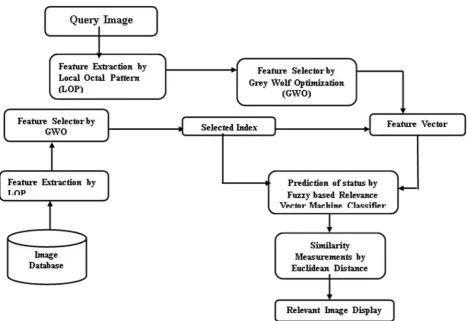
The proposed CBMIR system is represented in Figure 1. A texture feature extraction method, called Local Octal Patterns (LOP), is used in our CBMIR system. LOP is utilized by analyzing the various existing texture feature extraction methods such as LDP LTP and LTrP. LTrPs considers only horizontal and vertical pixels in four directions for derivative calculation. Thus, it is evident that the performance of LTrP method can be improved by segregating the boundaries in more than four directions by considering the horizontal, diagonal and vertical pixels for derivative calculation.
This observation has motivated us to use an eight directional code, denoted as LOP for CBMIR. Hence the proposed CBMIR uses second order derivative based LOP along with magnitude patterns for effective texture feature pattern extraction. The performance of the proposed LOP texture feature extractor is validated using LDP, LTP and LTrP. From this analysis, it has been concluded that LOP based CBMIR system is a well-defined texture feature extractor method which extracts the more detailed and complete pattern information of images using higher order derivatives of horizontal, vertical and diagonal directions along with the magnitude patterns. This effectively deal with the presence and variations of affected areas in the medical images such as tumors, swelling of inner organs etc.,
Figure 1. Overall Structure of the Proposed System
The main contribution of this proposed work is to reduce the high texture feature dimension by using Grey Wolf Optimization(GWO), which is used to select the best features among high dimensional texture features. The best subset of features are selected and evaluated using classification algorithm. Fuzzy based Relevance Vector Machine(FRVM) based classification algorithms are a capable method to classify texture features of the images. Euclidean Distance(ED) is used as similarity measurement techniques, to identify the similarity between the query image and the classified image feature database.
FEATURE EXTRACTION USING LOCAL OCTAL PATTERNS (LOP)
LOP is based on the ideas of LBP,LDP,LTP and LTrP . The LOP describes the spatial structure of the local texture image using the direction of the center gray pixel by segregating the boundaries in eight directions by considering the horizontal, diagonal and vertical pixels for derivative calculation. Hence the proposed CBMIR system uses second order derivative based LOP for effective texture feature pattern extraction.
The first order derivative at center pixel I (gct) along with 0o
,45o and 90o directions are mentioned as
1
0 ,45 90
(
ct) |
o oand oI
g
.Let gct represents the centerpixel in I,ghn,gdn and gvn denote the pixel values of
horizontal, diagonal and vertical neighborhoods of gct,
The centre pixel direction is calculated as follows:
This shows that the image is evaluated in eight directions such as 1,2,3,4,5,6,7, and 8 revolving around the centre pixel and therefore the image is transformed into eight directional values.
The second order derivative is evaluated as:
For each centre pixel, the 8 bit octal feature pattern would be extracted from the Equations 3 and 4. Following that, need to separate all octal patterns into eight directional parts. Finally, the octal feature patterns, for each directions, are transformed to seven binary
patterns. If the direction of centre pixel
I
1Direction(
g
ct)
is „1‟,thenLOP
2(
g
ct)
would be changed to seven binary patterns and defined in Equation 5.Once the 57th bit LOP pattern for each pixel (a,b) has been computed then the image is denoted by constructing a histogram as defined in Equation 8:
Where M1×M2 denotes the size of the input image.
FEATURE SELECTION ALGORITHM USING GREY WOLF OPTIMIZATION (GWO)
The objective of the feature selection method is to minimize the high dimensional features into low dimensional features i.e.,
N
M
,
where
}
sf
...
sf
,
sf
,
sf
{
}
f
,...
f
,
f
{
Min
1 2 N 1 2 3, MF fi
, N represents the set of all possible features,{ f ,f ,...f }
N 2
1 ,
and sf represents the set of selected features ,
}
sf
...
sf
,
sf
,
sf
{
1 2 3, M ,.This reduced features shouldmaximize the classifcation accuracy and reduce the error rate.In this section, GWO, a feature selection algorithm is explained.
The GWO is a new BMHA algorithm which mimics the social hierarchy and hunting technique of grey wolves in nature and is based on three main steps:encircling prey, hunting, and attacking prey. To model the leadership hierarchy of wolves in mathematical way, put the best solution as alpha, second solution as beta and third solution as delta,respectively.The remaining of the candidate solutions to be omega. Figure 2 represents the socially dominant hierarchy of grey wolves.
Figure 3 . Position Updating of Grey wolves
Guring the hunt,grey wolves encircle the prey. The following equations are proposed to simulate the encircling behavior of greywolves,mathematically:
where
A
andC
are coefficient vectors, 𝑡 indicates the current iteration,,X
preyis the position vector of the prey, andX
wolf is theFigure 4. Flowchart of GWO Algorithm
where
a
is linearly decreased from 2 to 0 for the entireiterations and
r
1andr
2 are random vectors in the interval of [0,1]. The hunt is regularly guided by alpha. Beta and delta also
take part in hunting rarely. To mimic the hunting behavior of grey wolves, first three best solutions such as alpha, beta, and
The update of positions for grey wolves is shown in Figure 3. The GWO algorithm is represented in Figure 4.
FEATURE CLASSIFICATION USING FUZZY BASED RELEVANCE VECTOR MACHINE
In this section, Relevance Vector Machine is explained for image classification.
Relevance Vector Machine
Relevance Vector Machine (RVM) is a machine learning classification technique,which is a statistical learning theory, and gaining popularity because, it is having attractive features and reflective empirical performance and,it is proved to be faster than Support Vector Machine (SVM), since it yields an optimum solution with few training samples .In RVM, there is no necessity for kernel function to satisfy the Mercer‟s condition.
The main goal of supervised learning is that functional mapping of the input and output data, which can be specified as a decision function
t
oy ox
( )
.This function is evaluated based on a set of input features, training set T, such that
(
1, ), (
1 2, ),..., (
2 N,
N)
T
ox t
ox t
ox t
,whereox
i is theinput vector and
oy
i is the corresponding outputs. The aim is to use this training data along with prior knowledge to make predictions of new values ofox
. The optimized inputs are Ddimensional real vectors
ox
D, and output could be a categorical manner. The decision function is a stable structure and having a set of parameters.RVM is a machine learning clasification techniques based on statistical learning theory and has an exploited probabilistic Bayesian learning framework. RVM generates predictions of the output based on the decision function which is the sum of the product of weights and kernel functions. The decision function of RVM is specified in Equation 18.
where N specifies the length of the data,
1,
2,...
N
Tare the model weights,
K
(
ox
,
ox
i)
is a kernel function.The likelihood of the complete training data set is defined as follows:
To overcome this over fitting and control the complexity of the learning function, Gaussian prior distribution over weight
is assigned as zero mean with variance 2 i 1j
:The hyper-parameter is
[
1,
2,...
N]
, which link independently with every weight (one per weight) in which sparsity isachieved that could strengthen the prior information. It is used to make the weight, to be focused around 0, and to very few nonzero terms in
oy
(
ox
;
)
. This nonzero weight are called relevance vectors (RVs).Once the prior distribution and likelihood function is defined, then the posterior over weight is defined based on Bayes rule as follows
The likelihood distribution over the training targets can be marginalized based on the weights, which is also a Gaussian distribution:
The values of the hyper parameters, α and σ2, are used to maximize the marginal likelihood which can be obtained by using an iterative re-estimation method with the approach of MacKay, which canbe used to maximize the objective function of (19) ,is defined as follows:
where
i is the ith posterior mean weight from (2.40) and themeasure
i is defined by
i 1
i
ii.With
iithe ith diagonal element of the posterior weight covariance from (22) computed with the current
and
values. During the estimation of iterative procedure, the hyper parametersnewiter i
leads to infinity also the relative weight becomes highly peak at zero. Hence the vector from the training set that associates with the remaining nonzero weights are calledFuzzy Based Relevance Vector Machine (FRVM) For Classification
evolution. FRVM is designed to overcome this training difficulty in which a fuzzy membership function (MF) is assigned to each training input point,such that different input points can make different impacts in learning process. A property of FRVMs is that, they simultaneously minimize the empirical classification error and maximize the geometric margin; hence they are also known as maximum margin classifiers. Figure 5 represents the Feature Classification using Fuzzy RVM.
Based on the different values of MFsn, there would be control over the transaction of the respective training points
)
t
,
ox
(
i i during the classification stage. In general, Asuitable value of MF grades the corresponding point
)
t
,
ox
(
i i less weighty in training. So RVM is the specialcase of FRVM if MF is positive then conclude that the optimized feature set would be properly classified otherwise it cannot be under the specific class and defined in Equation 24:
Figure 5 Feature Classification using Fuzzy RVM
The weight can be obtained by minimizing the following Equation (26)
with
oy
n
oy
(
ox
n;
)
.The first term represents the sum error of data and the second term represents the regularization term.Step 2:The Gaussian fuzzy membership
MFs
n is introduced into the likelihood and defined in Equation 27.Gaussian membership function (MFsn) is selected for fuzzy inference system in order to identify the grade of membership of the
center
ox
.
ox
*ij and variance
ijof predictive distribution of jth dimension term of ith input variable iox
and defined in Equation 28.where
ox
*ijis the RVs,
ij2 specifies the kernel width parameter and it is variant to both the feature of the input space
D and RVsand
i
1
,
2
,...,
n
,
j
1
,
2
,...,
D
. Step 3:Iteratively Reweighed Least Squares Algorithm for updating the weight
and hyper-parameters such as
2,
:The gradient and hessian matrix of (29) are given by,
The updating procedure for
newiter i
Step 4: The Defuzzification is performed for the overall output of the fuzzy model by aggregating the output.
From the above study,it is concluded that, it is a standard RVM if
MFs
i
1
.If it has different values ,then the trade-off of therespective training point
(
ox
i,
t
i)
in the system can becontrolled.When
MFs
i has smaller value then the corresponding training point is less important.SIMILARITY MEASUREMENTS
Euclidean Distance (ED) is used to find the similarity between the query image features and the categorized image features in the database and defined in Equation 30:
where,
F
Q[
i
]
is the ith
query image features and CFDB [i] is
the corresponding feature in the classified feature vector database and N refers to the total number of images in the database.
EXPERIMENTAL RESULTS AND DISCUSSIONS
This proposed CBMIR system is implemented in MATLAB with the medical image database of 1000 images which are gray level images of the human body anatomy such as Brain, Lung, Liver, and Kidney with resolution 512 ×512. Each dataset consists of 250 images of CT and MRI modalities.The images used in this research are collected from Fortis Malar Hospitals-Chennai,India Saravana Radiological Scan Centre,Salem,India and Namakkal Scans and Diagnostics,Namakkal,India and also few images acquired from Google search engine.
This proposed system is applicable to all four categories of medical images where proper training has been given to four databases, respectively. For analysis purpose, this proposed CBMIR system has taken 250 MRI images of normal/abnormal brain images and 250CT kidney images of different categories
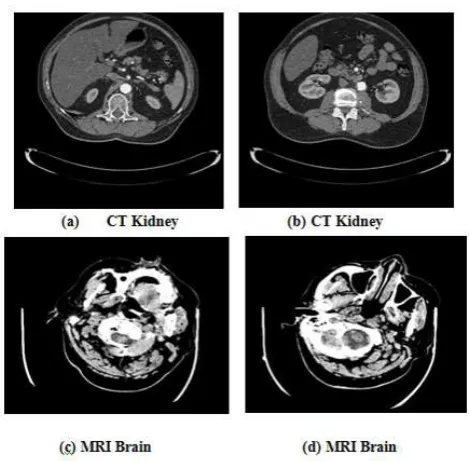
such as Normal kidneys, cortical cysts, medical renal diseases which are used for performance analysis.The motivation of building a CBMIR system is to identify the similar normal kidneys ,cortical cysts and medical renal diseases .The sample normal and abnormal kidney and brain images are represented in Figure 6.For analysis purpose, 100 normal and 80 abnormal images are taken for training. And, 35 normal and 35 abnormal images are taken for testing.
During the process of retrieval, a query image which contains the abnormalbrain or kidney image is given as an input, to retrieve the similar images from the old patients‟ database. The feature vectors of query image are computed online and the feature vectors of stored database images are computed offline. The feature selection and classification is performed on the training subsets and evaluated on the test ones. For each query, the system collects „n’database ( )images with the shortest image matching distance computed using Euclidean Distance. If the retrieved image fits into same category as that of the query image, then it is known that the system has suitably identified the expected image, otherwise, the system has failed to catch the expected image .
The measure of classification accuracy and error rate are used as evaluation criteria for each selected subset of features.The Sensitivity, Specificity, Accuracy and Error Rate are measured using confusion matrix which are described in Equations 33 to 36, respectively. A confusion matrix is a specific table layout where each column of the matrix represents the occurrences in a predicted feature class and each row represents the occurrences in an actual feature class.
Where
t_pos is the number of true positives that were correctly classified,
pos is the number of positive tuples.
t_neg is the number of true negatives.
neg is the number of negative tuples.
f_pos is the number of false positives.
f_neg is the number of false negatives.
The computation time for feature selection is calculated using MATLAB command such as tic and toc. The tic command starts a stopwatch timer and MATLAB executes the block of statements then toc stops the timer, displaying the time elapsed in seconds.
Results of Feature Extraction by LOP
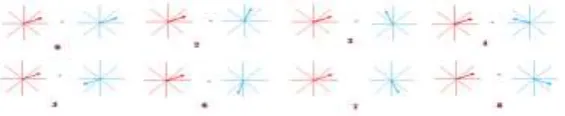
The possible local pattern transitions resulting in an LOP for direction “1” of the center pixel is represented in Figure 7. The LOP is coded to “0” when it is equal to the direction of center pixel, otherwise coded in the direction of neighbourhood pixel. Using the same analogy, LOPs are calculated for center pixels having directions 2, 3, 4,5,6 and 7.Figure 8 represents the sample example of the second-order LOP calculationresultant in direction “1” for a center pixel marked with red. When the
first-order derivative in horizontal, vertical and diagonal directions to the neighbourhood pixel “6,” then obtain direction “8” and magnitude “4.2.” It can be seen that the magnitude of the center pixel is “5.4,” which is higher than the magnitude of neighbourhood pixel. Hence, assign value “0” to the corresponding bit of the magnitude pattern. Similarly, the remaining bits of the LOP and the magnitude pattern for the other seven neighbours are computed resulting in the tetra pattern “8 3 7 8 0 4 6 0” and the magnitude binary pattern “00001100”.
After taking the octal pattern,it can be separated into seven binary patterns as follows. Referring to the generated LOP, the first pattern is “00000000” which is having 0 transitions.The second pattern is obtained by keeping “1” where the octal pattern value is “3” and “0” for other values i.e., “01000000”. Similarly, the other five binary patterns “00000100”, ”00000000”, ”00000010”, ”00100000”,10010000” are computed for octal pattern values “4”,”5”,”6”,”7”,and ”8” respectively. In the same way, octal patterns for center pixels having directions 2, 3,4,5,6 and 7 are computed. Thus, with eight octal patterns, 56 binary patterns are obtained. The 57th
Figure 7 Calculation of octal pattern bits for the center-pixel direction “1” using the direction of neighbors. Direction of (red) the center pixel and (cyan) its neighborhood pixels
Figure 9 Sample Results of Kidney Image Feature Extraction
Results of Optimized Feature Selection by GWO
The octal feature patterns for each direction are transformed to seven binary patterns along with one magnitude pattern.For eight direction, LOP produce 56 binary pattern along with one magnitude pattern. The feature vector length for LBP is 59, LTP is 2 X 59 (118), LDP is 4 X 59 (236),LtrP is 13 X 59 (767) and LOP is 57 X 59 (3363).To select the best features among the high dimensional featires,the search pocess is started randomly and Grey wolves diverge from each other for searching the prey and converge after find the best features. Each grey wolves evolve in the population of 20 to 30. After finding a prey,grey wolves encircle the prey and find the current best position andpass the current best solutions to the next generation. The procedure is then repeated for a fixed number of periods or until a minimum error is attained or the classification accuracy is high.The Size of population is 20 and 30 and the number of iterations are 50 and 100. The sample results of feature selection is shown in Figure 10 . The second order LOP based texture feature extraction performs well for medical images.The 57 binary patterns are reduced to 21 binary patterns using GWO.
Figure 10 Sample results of kidney image feature selection by GWO
Results of Classified Optimized Features and Similarity Measurements
There are four different combination of feature subsets are selected for classification. The feature vector formed for each subset features denoted by
i
x
which is then treated as an input pattern and is labeled asy
i
1
for a relevant case,and1
i
y
for a irrelevant case.Together(
,
)
i i
x
y
forms an input-output pair. These pairs are subsequently for training and testing of the FRVM classification.FRVM collects the training samples, decide the kernel function and select the relevant model parameters for good performance. Different training input points can make different impacts in the learning process.Radial Basis Function (RBF) is choosen as kernel function.The hyper parameter α could link independently with every weight in which sparsity is achieved that could strengthen the prior information.The training and testing of optimized features are performed for classification using FRVM. The fine tuning parameters of the FRVM classifier model are determined using 10 fold cross validation in the training set. Experiments are conducted with different kernel width ranges of 1,2.5,5 and 10.RBF kernel produced a generalization error of 3.72% with kernel width of 2.5 which in turn re-trained with all the samples in the training set to get a final decision function.The FRVM classification is performed efficiently and model selection and decision function is made, for example ,in the training set with generalization error rate of 5% with kernel width of 2.5.
Table 1 FRVM Classification Accuracy for four different subset features of FCKS – FPSO
Method Clasification Accuracy Pop_Size =20 Max_Iter =50 Pop_Size =20 Max_Iter =100 Pop_Size=30 Max_Iter=50 Pop_Size =30 Max_Iter =100
FPSO-FSVM Average 77% 77% 79% 80%
Best 84%/25 81%/32 83%/38 82%/39
FPSO-FRVM Average 78% 80% 81% 82%
Best 82%/32 84%/35 88%/42 84%/39
GWO-FRVM Average 90% 92% 94% 90%
Best 88%/31 96%/21 92%/27 92%/22
The accuracy of classification is analyzed with respect to four optimized feature subsets with the population size of 20 and 30
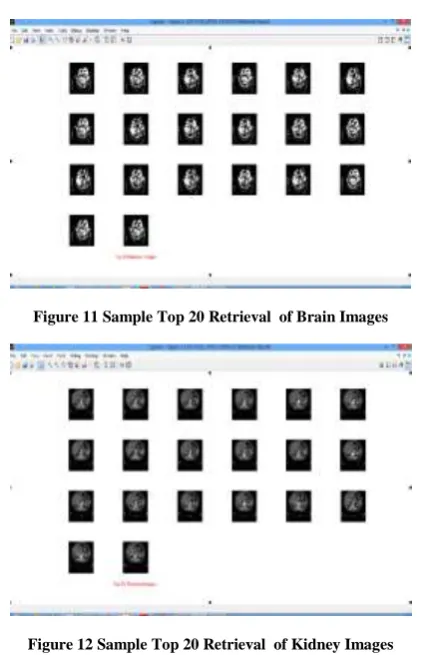
comparedagainst the training images of all the classes and theimage is assigned to the class which has the minimumdistance using ED. The Figures 11&12 represent the output of retrieved images of brain and kidney using LOP-GWO-FRVM. The experiments were carried out and the average precision for LOP-GWO-FRVM-ED based CBMIR has significantly increased from 89%, 91%, and 92 % to 96%, as compared with the LTP, the LDP, and the LTrP respectively. The recall has increased from 79%, 81%, 86% to 92% as compared with the LTP, and the LDP, the LTrP, respectively.
Figure 11 Sample Top 20 Retrieval of Brain Images
Figure 12 Sample Top 20 Retrieval of Kidney Images
CONCLUSION
This proposed CBMIR framework consists of four main stages which are feature extraction, feature selection, classification, and similarity measurements, respectively, for effective retrieval of images. A Local Octal Pattern (LOP), is used to extract the texture features of the medical images. An effective Grey Wolf Optimization (GWO) algorithm is used for feature selection, Fuzzy based Relevance Vector Machine (FRVM) classifier was used to perform the prediction based on the feature subset obtained in the second stage. GWO algorithm is very viable compared to the state-of-art meta-heuristic algorithms as well as conventional methods. Finally, Euclidean Distance(ED) is used to measure the similarity between query image and database images. The proposed method is compared against well-known feature selection methods including Fuzzy Based Particle Swarm Optimization (FPSO), on the two disease diagnosis problems. The experimental results shown that the proposed LOP-GWO-FRVM-ED method converges more quickly as compared with existing techniques, producing better solution ,produces less number(21 LOP Patterns) of selected features, and also has achieved 96% classification performance for retrieving an images. In future, we have planned to use fuzzy approach for tuning a GWO parameters and Big data analytics
methods for managing huge image database for effective retrieval of images.
REFERENCES
1. Bohren BF, Hadzikadic M, Hanley EN. Extracting knowledge from large medical databases: an automated approach. Computers and biomedical research. 1995 Jun 30;28(3):191-210.
2. Shyu CR, Brodley CE, Kak AC, Kosaka A, Aisen A, Broderick L. Local versus global features for content-based image retrieval. InContent-Based Access of Image and Video Libraries, 1998. Proceedings. IEEE Workshop on 1998 Jun 21 (pp. 30-34). IEEE.
3. Liu Y, Zhang D, Lu G, Ma WY. A survey of content-based image retrieval with high-level semantics. Pattern recognition. 2007 Jan 31;40(1):262-82.
4. Deselaers T, Keysers D, Ney H. Features for image retrieval: an experimental comparison. Information retrieval. 2008 Apr 1;11(2):77-107.
5. Akgül CB, Rubin DL, Napel S, Beaulieu CF, Greenspan H, Acar B. Content-based image retrieval in radiology: current status and future directions. Journal of Digital Imaging. 2011 Apr 1;24(2):208-22.
6. Dorileo EA, Frade MA, Roselino AM, Rangayyan RM, Azevedo-Marques PM. Color image processing and content-based image retrieval techniques for the analysis of dermatological lesions. In Engineering in Medicine and Biology Society, 2008. EMBS 2008. 30th Annual International Conference of the IEEE 2008 Aug 20 (pp. 1230-1233). IEEE..
7. Ojala T, Pietikäinen M, Harwood D. A comparative study of texture measures with classification based on featured distributions. Pattern recognition. 1996 Jan 1;29(1):51-9. 8. Zhang B, Gao Y, Zhao S, Liu J. Local derivative pattern
versus local binary pattern: face recognition with high-order local pattern descriptor. IEEE transactions on image processing. 2010 Feb;19(2):533-44.
9. Tan X, Triggs B. Enhanced local texture feature sets for face recognition under difficult lighting conditions. IEEE transactions on image processing. 2010 Jun;19(6):1635-50. 10.Murala S, Maheshwari RP, Balasubramanian R. Local tetra
patterns: a new feature descriptor for content-based image retrieval. IEEE Transactions on Image Processing. 2012 May;21(5):2874-86.
11.Nithya,J,Suchitra.S & Chitrakala,S. Local Octal Pattern: A Proficient Feature Extraction for Face Recognition.International Journal of Computer Science and Mobile Computing, 2014; (34):139-146.
12.Bhuvana, S, Radhakrishnan, R, Tamije Selvy, P, & Subhakala, S. An Efficient Hybrid Feature Descriptor For Content Based Image Retrieval. Journal of Theoretical & Applied Information Technology, 2014;66:145-157. 13.Guo Z, Zhang L, Zhang D. Rotation invariant texture
classification using LBP variance (LBPV) with global matching. Pattern recognition. 2010 Mar 31;43(3):706-19. 14.Chapter from the Book: Ayodele, TO. Types of machine
learning algorithms. In New advances in machine learning. InTech press; 2010. p:20-48
15.Mirjalili S, Lewis A. The whale optimization algorithm. Advances in Engineering Software. 2016 May 31;95:51-67. 16.Ballerini L, Li X, Fisher RB, Aldridge B, Rees J. Content-based image retrieval of skin lesions by evolutionary feature synthesis. InEuropean Conference on the Applications of Evolutionary Computation 2010 Apr 7 (pp. 312-319). Springer, Berlin, Heidelberg.
Australasian Joint Conference on Artificial Intelligence (pp. 580-589). Springer Berlin Heidelberg.
20.Kameyama K, Oka N, Toraichi K. Optimal parameter selection in image similarity evaluation algorithms using particle swarm optimization. InEvolutionary Computation, 2006. CEC 2006. IEEE Congress on 2006 Jul 16 (pp. 1079-1086). IEEE.
21.Ye Z, Xia B, Wang D, Zhou X. Weight optimization of image retrieval based on particle swarm optimization algorithm. InComputer Network and Multimedia Technology, 2009. CNMT 2009. International Symposium on 2009 Jan 18 (pp. 1-3). IEEE
22.Sasi KM, Kumaraswamy YS. Medical Image Retrieval System Using PSO for Feature Selection. InInternational Conference on Computational Techniques and Mobile Computing (ICCTMC'2012) 2012 (pp. 182-186).
23.Mirjalili S, Mirjalili SM, Lewis A. Grey wolf optimizer. Advances in Engineering Software. 2014 Mar 31;69:46-61. 24.Li Q, Chen H, Huang H, Zhao X, Cai Z, Tong C, Liu W,
Tian X. An enhanced grey wolf optimization based feature selection wrapped kernel extreme learning machine for medical diagnosis. Computational and mathematical methods in medicine. 2017 Jan 26;2017.
25.Ramamurthy B, Chandran KR. Content based medical image retrieval with texture content using gray level co-occurrence matrix and k-means clustering algorithms. Journal of Computer Science. 2012 Jul 1;8(7):1070. 26.Cortes C, Vapnik V. Support-vector networks. Machine
learning. 1995 Sep 1;20(3):273-97.
27.Tipping ME. Sparse Bayesian learning and the relevance vector machine. Journal of machine learning research. 2001;1(Jun):211-44.
Classification performance comparison between RVM and SVM. InAnti-counterfeiting, Security, Identification, 2007 IEEE International Workshop on 2007 Apr 16 (pp. 208-211). IEEE
31.Momot A, Momot M, Łęski J. The Fuzzy Relevance Vector Machine and its application to noise reduction in ECG signal. Journal of Medical Informatics & Technologies. 2005;9:99-105.
32.Jaganathan Y, Vennila I. A hybrid approach based medical image retrieval system using feature optimized classification similarity framework. Am J Appl Sci. 2013;10:549-62. 33.Chen CC, Chu HT. Similarity measurement between
images. InComputer Software and Applications Conference, 2005. COMPSAC 2005. 29th Annual International 2005 Jul 26 (Vol. 2, pp. 41-42). IEEE.
34.Papushoy A, Bors AG. Image retrieval based on query by saliency content. Digital Signal Processing. 2015 Jan 31;36:156-73
35.Zhu Z, Zhao C, Hou Y. Research on similarity measurement for texture image retrieval. PloS one. 2012 Sep 25;7(9):e45302.
36.Ayyachamy S, Manivannan VS. Distance measures for medical image retrieval. International Journal of Imaging Systems and Technology. 2013 Mar 1;23(1):9-21.
Cite this article as:
Yogapriya et al. An effective machine learning algorithm for texture based medical image retrieval system. Int. Res. J. Pharm. 2017;8(11):201-218 http://dx.doi.org/10.7897/2230-8407.0811241
Source of support: Nil, Conflict of interest: None Declared