
Bosn J Basic Med Sci 2013; 13 (3): 180-185Abstract
Th e aim of study was to evaluate endocrine changes in PCOS women during metformin treatment. One hundred women with PCOS, aged - years were included. A complete hormonal and metabolic pattern was recorded for each subject every months. Metformin treatment after and months signifi cantly reduced weight, BMI, waist circumference, insulin and HOMA-IR (p=.) with high diff erences of vari-ances within repeated measurements. Th ere was signifi cant reduction of PRL, testosterone and estradiol (p=.) with small diff erences within repeated measurements. Metformin did not have eff ect on TSH. However, results showed important reduction of CRP, LH, LH/FSH, androstendione, DHEA-S and progesterone (p=.) with moderate diff erences within measures. Metformin restored menstrual cyclicity in most participants. At baseline in study group was women with oligomenorrhoea, amenorrhoea or polymenorrhoea. After months of treatment, only PCOS women had irregular menstrual cycle (p=.). Hirsutism was also reduced. Intriguingly, during fi rst months of treatment in PCOS women pregnancies occurred (p=.), while during last months treatment were pregnancies (p=.), in total (). Multiple regression model revealed that the presence of anovulation in PCOS women was strongly associated with BMI, waist, FSH and age. Insulin resistance was signifi cantly predicted by BMI, cholesterol, progesterone and presence of hirsutism. Th e metformin therapy signifi cantly improved insulin resistance, imbalance of endocrine hormones, hirsutism and menstrual cyclicity in women with PCOS. Th e most important predictors for duration of metformin treatment in PCOS women were testosterone, progesterone, FSH, CRP and presence of
anovulation. © Association of Basic Medical Sciences of FBIH. All rights reserved
KEY WORDS: endocrine changes, PCOS, metformin treatment.
polycystic ovary syndrome during metformin treatment
Zelija Velija-Ašimi*Clinic for Endocrinology, Diabetes and Metabolism Diseases, University Clinical Centre of Sarajevo, Bolnička 25, 71 000 Sarajevo, Bosnia and Herzegovina
INTRODUCTION
Th e aetiology of the neuroendocrine irregularities in women with PCOS remains uncertain; though, latest studies have shown decreased sensitivity of the gonadotropin-releasing hormone (GnRH) pulse generator to inhibition by ovarian steroids, mostly progesterone []. Women with polycystic ovary syndrome (PCOS) need higher levels of progesterone to slow the frequency of GnRH pulse secretion, resulting in insufficient plasma follicle-stimulating hormone (FSH) synthesis and persistent plasma luteinizing hormone (LH) stimulation of ovarian androgens. In hyperandrogenemic girls certain to develop PCOS, increase in ovarian steroids may not be adequate to suppress the GnRH pulse generator, leading to a persistently rapid LH pulse frequency, reduced
FSH production, and insuffi cient follicular development []. PCOS is connected with nearly of women who suff er from infertility due to anovulation []. PCOS is often ac-companying to irregular gonadotropin levels, lower levels of insulin growth factor-binding protein- (IGF-BP), increased insulin resistance and increased ovarian -hydroxiprogester-one (-OHP) and androgen answers to GnRH-agonists []. The main disturbances in this syndrome are: . Abnor-mal morphology of the ovary, determined by more than small follicles per ovary measuring - mm in diameter with increased central stroma or an ovar-ian volume over ml on transvaginal ultrasound ex-amination of the ovaries [, , ]; . Abnormal steroido-genesis - hyperandrogenism []; . Oligo-anovulation []. Insulin resistance is a common piece of PCOS, and there is known association between high insulin con-centrations and anovulatory infertility []. Hyperinsu-linemia existed in about of obese PCOS women and in – of normal weight women with PCOS []. Management of PCOS depends on the symp-toms []. Therapy for PCOS becomes necessary in adults in order to induce ovulatory cycles and
fer-* Corresponding author: Zelija Velija-Ašimi, Clinic for Endocrinology, diabetes and metabolism diseases, University Clinical Centre of Sarajevo, Bolnička 25, 71 000 Sarajevo, Bosnia and Herzegovina
Phone: ++38733297299; Fax: ++38733297268 e-mail: [email protected]
Bosn J Basic Med Sci 2013; 13 (3): 181-185
tility, and to improve cosmetic appearance []. Metformin is an insulin sensitizing drug that has been recently presented for treating PCOS women []. Met-formin increases insulin sensitivity in the liver by reduc-ing gluconeogenic enzyme activities, inhibitreduc-ing hepatic uptake of lactate and alanine, increasing the conversion of pyruvate to alanine and inhibiting glucose output []. Clinical trials have shown that metformin can effectively reduce androgens, improve insulin sensitivity, and simplify weight loss in patients with PCOS []. However, a recent large randomized study of more than women reported no improvement in fertility with use of extended release met-formin in women with PCOS compared with clomiphene []. If pregnancy still escapes women with PCOS after initial pharmacologic treatments, gonadotropin therapy by itself or in conjunction with assisted reproductive therapy is consid-ered []. Th ere are claims that metformin use during preg-nancy reduces miscarriage rates and that neonatal and infant outcomes are equivalent to those of the general population, although widespread use of metformin in early pregnancy should be discouraged until more data are available []. Th e aim of this study was to evaluate clinical, hormonal and
metabolic changes in PCOS women during metformin treat-ment.
MATERIALS AND METHODS
Patients
A total of women with PCOS diagnosed last two years were interweaved for inclusion in the study. One hundred women with PCOS, aged - years were included. Af-ter -months of the metformin treatment, women were excluded because of non-compliance. There were eleven pregnancies and these patients excluded from the study, but not stopped with metformin during pregnancy. Th ere-fore, the number of women with PCOS available for fi nal statistical analysis after months of treatment was .
Procedures
The procedures used were in accordance with the guide-lines of the Helsinki Declaration on Human Experimen-tation and the Good Clinical Practice (CGP) guidelines. PCOS diagnosis was made in accordance with Rotterdam criteria. Patients to be included in the study were required not to have received any medication for PCOS, or for other conditions associated with insulin resistance, within the last months. Exclusion criteria were considered as: age less than or higher than years, presence of neoplastic, en-docrine, metabolic, hepatic and cardiovascular disorders or other concurrent medical illnesses. Biochemical, clinical, and ultrasounds data, performed at baseline, at -months
and -months follow-up were collected. Fasting serum glucose, basal insulin, HOMA-IR index, FSH, LH, PRL, TSH, total testosterone, DHEA-S, androstendione, CRP and lipid profi le were determined at follicular phase. Every months all parameters were re-evaluated. Homeostasis model analysis (HOMA) [fasting glucose (mmol/l) × fast-ing insulin (μU/ml)/.] was also calculated. Anthropo-metric measurements (height, weight, BMI and waist), Ferriman-Gallwey score and ultrasonography data were noted for each subject. Two months before starting met-formin treatment, into all patients were included lifestyle changes by diet and exercise. All patients have taken met-formin two or three times a day during meals (- mg/day) and followed during months. The treatment was well tolerated. Normal ovulatory status was defi ned by plasma progesterone assay (> nmol/l) performed seven days before the expected menses and by the presence of regular menstrual bleedings in three consecutive evaluations.
Statistical analysis
Th e normal distribution of continuous variables was evalu-ated by using the Kolmogorov-Smirnov test, and continu-ous data were expressed as mean ± standard deviation (SD). Variables without normal distribution were square root trans-formed to normalize distributions. Th e diff erence of repeated measures of continuous variables were analysed with the one-way analysis of variance (ANOVA) for repeated measures with Bonferroni test for the post-hoc analysis. Th e Friedman test was performed for testing diff erence of repeated mea-sures of categorical variables. Multiple regression analysis was performed to identify independent predictors. Th e results were expressed as odds ratios (ORs) with confidence intervals. Th e Statistics Package for Social Science (SPSS ) was used; p value <. was considered statistically signifi cant.
RESULTS
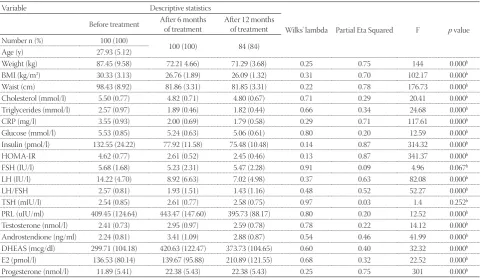
Bosn J Basic Med Sci 2013; 13 (3): 182-185to strong metformin’s effect on these variables. Level of fasting insulin and HOMA-IR index de-creased very significantly (p=.). Multiple regres-sion analysis sugests very strong effect of metformin on insulin and IR (.) with high differences within mea-sures at the same time (Wilks' lambda . and .). The data presented significant reduction of the lev-els of PRL, total testosterone and estradiol (p=.) but with not to strong metformin’s effect (Partial Eta
Squared ., . and .) and with small differenc-es within groups (Wilks' lambda ., . and .). Metformin did not have effect on TSH (p=., Partial Eta Squared .) and there was strong difference within groups (Wilks' lambda .). Similar effect was and on FSH (Partial Eta Squared .) with significant differ-ence within measures. Furthermore, results showed im-portant reduction of CRP, LH, LH/FSH, androstendione, DHEA-S and progesterone (p=.; Partial Eta Squared
Variable Descriptive statistics
Wilks' lambda Partial Eta Squared F p value Before treatment After 6 months
of treatment
After 12 months of treatment
Number n (%) 100 (100)
100 (100) 84 (84)
Age (y) 27.93 (5.12)
Weight (kg) 87.45 (9.58) 72.21 4.66) 71.29 (3.68) 0.25 0.75 144 0.000b
BMI (kg/m2) 30.33 (3.13) 26.76 (1.89) 26.09 (1.32) 0.31 0.70 102.17 0.000b
Waist (cm) 98.43 (8.92) 81.86 (3.31) 81.85 (3.31) 0.22 0.78 176.73 0.000b
Cholesterol (mmol/l) 5.50 (0.77) 4.82 (0.71) 4.80 (0.67) 0.71 0.29 20.41 0.000b
Triglycerides (mmol/l) 2.57 (0.97) 1.89 (0.46) 1.82 (0.44) 0.66 0.34 24.68 0.000b
CRP (mg/l) 3.55 (0.93) 2.00 (0.69) 1.79 (0.58) 0.29 0.71 117.61 0.000b
Glucose (mmol/l) 5.53 (0.85) 5.24 (0.63) 5.06 (0.61) 0.80 0.20 12.59 0.000b
Insulin (pmol/l) 132.55 (24.22) 77.92 (11.58) 75.48 (10.48) 0.14 0.87 314.32 0.000b
HOMA-IR 4.62 (0.77) 2.61 (0.52) 2.45 (0.46) 0.13 0.87 341.37 0.000b
FSH (IU/l) 5.68 (1.68) 5.23 (2.31) 5.47 (2.28) 0.91 0.09 4.96 0.067b
LH (IU/l) 14.22 (4.70) 8.92 (6.63) 7.02 (4.98) 0.37 0.63 82.08 0.000b
LH/FSH 2.57 (0.81) 1.93 (1.51) 1.43 (1.16) 0.48 0.52 52.27 0.000b
TSH (mIU/l) 2.54 (0.85) 2.61 (0.77) 2.58 (0.75) 0.97 0.03 1.4 0.252b
PRL (uIU/ml) 409.45 (124.64) 443.47 (147.60) 395.73 (88.17) 0.80 0.20 12.52 0.000b
Testosterone (nmol/l) 2.41 (0.73) 2.95 (0.97) 2.59 (0.78) 0.78 0.22 14.12 0.000b
Androstendione (ng/ml) 2.24 (0.81) 3.41 (1.09) 2.88 (0.87) 0.54 0.46 41.99 0.000b
DHEAS (mcg/dl) 299.71 (104.18) 420.63 (122.47) 373.73 (104.65) 0.60 0.40 32.32 0.000b
E2 (pmol/l) 136.53 (80.14) 139.67 (95.88) 210.89 (121.55) 0.68 0.32 22.52 0.000b
Progesterone (nmol/l) 11.89 (5.41) 22.38 (5.43) 22.38 (5.43) 0.25 0.75 301 0.000b
TABLE 1. Clinical and laboratory characteristics of the study population with test of variances for repeated measures
Legend: Data in descriptive statistics were expressed as means (SD) and n (%). b. Adjustment for multiple comparisons: Bonferroni.
Variable
Frequencies
Friedman test
(Chi-Square) p value
Wilcoxon test (p) 1/2 2/3 1/3 Before treatment After 6 months
of treatment
After 12 months of treatment
menstrual irregularity 69 (69) 45 (45) 17 (20) 78.15 0.000
0.000 0.000 0.000
hirsutism 63 (63) 53 (53) 44 (52) 12.61 0.002
0.086 0.003 0.004
PCO /
Echo-sonography 52 (52) 40 (40) 18 (21) 47.75 0.000
0.070 0.000 0.000
Anovulation 86 (86) 40 (40) 18 (21) 93.38 0.000
0.000 0.014 0.000
Pregnancy 0 (0) 9 (9) 11 (13) 38.10 0.000
0.000 0.317 0.000
Legend: Data in frequencies were expressed as n (%). Categorical variables were analysed by Friedman test with Wilcoxon test for the post-hoc analysis.
Bosn J Basic Med Sci 2013; 13 (3): 183-185
., ., ., ., . and .) with moderate differ-ences within groups (., ., ., ., . and .). Bonferroni test is used to adjust for multiple comparisons. Metformin restored menstrual cyclicity in most participants (Table ). At baseline in study group was women with oligomenorrhoea/amenorrhoea/polymenorrhoea, after months that number was and after months only PCOS women had irregular menstrual cycle (p=.) with signifi cant diff erences between all measures (p=.). Hirsutism FG score was also reduced during treatment
with differences between second and third (p=.) and first and third measure (p=.) and without dif-ferences between first and second measure (p=.). At beginning of the research, of PCOS patients had bilateral PCO. Ovarian morphology and vol-ume changed in of subjects after months and in of subjects after months of treatment. Ultrasonography showed no difference between first and second examination (.) but with significant dif-ference in frequency of PCO between second and third and between first and third examination (p=.) Eighty six of these subjects remained anovulatory despite treatment. After six months of treatment, this number be-came and at the end of months treatment this number reduced to (p=.). Lower diff erence was between sec-ond and third evaluation (p=.) than between fi rst and sec-ond (p=.) and between fi rst and third evaluation (p=.). Intriguingly, during fi rst months of metformin treatment in PCOS women () pregnancies occurred (p=.), while during last months of treatment happened preg-nancies (p=.), in total (). Between second and third evaluation there was no diff erence. Th ere was one re-duces miscarriage rate, due to stop of metformin treatment during pregnancy. Th ere was no congenital anomaly at birth and eleven infants developed well at one year follow-up. Multiple regression model was performed to evaluate the anovulation risk in PCOS women as a function of anthropo-metric, metabolic and hormonal values (Table ). Because of the high correlation between anovulation and progesterone (r =.), it was not included in the model. On the other side, due to very low correlations between anovulation and age, FSH, LH, TSH, PRL, androgens, CRP, triglycerides, they were not included in the model. Multicollinearity diagnosis for glucose, insulin and IR, excluded them from the model. Ad-justed R square of the model was . (p=.). It revealed that the presence of anovulation in PCOS women was associ-ated with BMI, waist, FSH and age as independent predictors. The most important factors for metformin treatment du-ration in PCOS women were testosterone and progester-one (p=.), presence of anovulation (p=.), FSH and CRP (Table .). Because of the high correlation between glucose, insulin and IR, they were excluded from the re-gression model. Remaining variables excluded from the model because of low correlation or multicollinearity diag-nosis. Adjusted r square of the model was . (p=.). Insulin resistance was significantly predicted by BMI, cholesterol, progesterone and presence of hirsutism (Table ). Because of the high correlation (r >.) be-tween glucose, insulin and IR, they were not included in the model. Due to very low correlations (r<.) between insulin and age, FSH, LH, TSH, PRL, androgens, CRP,
Variable Odds ratio (OR)* p value
age 0.143 0.001
BMI -0.365 0.000
waist -0.180 0.028
FSH -0.239 0.013
TABLE 3. Anovulation risk in PCOS women as a function of an-thropometric, metabolic and hormonal markers
Legend: *Multiple regression model ; Because of the high or low cor-relation and multicollinearity diagnosis, remaining variables were not included in the model. Adjusted r square of the model was 0.948 (p =0.000).
Variable Odds ratio (OR)* p value
CRP 0.297 0.000
FSH 0.376 0.003
testosterone -0.366 0.000
progesterone -0.427 0.000
anovulation -0.321 0.000
TABLE 4. The predictors of metformin treatment duration in PCOS women
Legend: *Multiple regression model; Remaining variables were not in-cluded in the model because of the high or low correlation and multicol-linearity diagnosis. Adjusted R square of the model was 0.939 (p=0.000).
Variable Odds ratio (OR)* p value
BMI 0.695 0.000
cholesterol 0.994 0.000
progesterone 1.275 0.000
hirsutism 0.358 0.001
TABLE 5. The predictors of insulin resistance in PCOS women
Legend: *Multiple regression model; Because of the high or low correlation remaining variables excluded from the model. Adjusted R square of the model as 0.772 (p=0.000).
Variable Odds ratio (OR)* p value
age 0.209 0.031
PRL 0.299 0.020
TABLE 6. Independent factors of pregnancy in PCOS women treated with metformin
Bosn J Basic Med Sci 2013; 13 (3): 184-185triglycerides, they were also not included in the mod-el. Adjusted R square of the model was . (p=.). Pregnancy depends on balance of all metabolic, endo-crine and anthropometric parameters (p=.). Ad-justed R square of the model was . (p=.). In the final model multicollinearity analysis showed only age and level of PRL as independent factors for pregnancy in women with PCOS treated with metformin (Table ).
DISCUSSION
The effect of metformin on endocrine, metabolic and anthropometric parameters in patients with PCOS has been described in several studies. Furthermore, to our knowledge, this is one of the rarely studies describ-ing all these parameters in the same time, and explordescrib-ing its relationship with duration of metformin treatment. A recent position statement from the Androgen Excess and PCOS Society recommended that women with PCOS, regardless of weight, to be screened for IGT or type DM by an oral glucose tolerance test at their initial presentation and every years thereafter. However, this statement noted that the use of metformin to treat or prevent the progression of IGT could be considered but should not be mandated at this point in time, as well-designed randomized controlled trials demonstrating effi cacy have yet to be conducted []. In the present research, metformin treatment after and months signifi cantly reduced weight, BMI and waist circum-ference (p=.). High waist value suggested visceral adipos-ity.
Hyperinsulinemia is an important parameter in deciding whether or not to initiate metformin therapy to PCOS wom-en with the expectation of prevwom-enting the onset of type dia-betes mellitus [].
Fasting insulin and IR in present research, signifi cantly de-creased during metformin treatment in PCOS women (p=.). Insulin resistance was signifi cantly predicted by BMI, waist, cholesterol, progesterone and presence of hirsut-ism.
In meta-analysis of Salpeter et al. [] women with PCOS ex-perienced a . decrease in BMI, a . mean decrease in fasting glucose, and an . improvement in IR as assessed by the HOMA. Fasting insulin decreased by ., although the diff erence did not reach signifi cance. In addition, HDL cho-lesterol increased by a mean of . whereas triglycerides de-creased by .. Th ese results were of similar magnitude to those of non-PCOS, except the measurement of fasting insu-lin, which in non-PCOS was improved by a mean of . []. Cardiovascular risk including markers of sub-c l i n i sub-c a l i n f l a m m a t i o n , a n d d y s l i p i d e m i a m a y also be improved by metformin therapy [].
Likewise, we also observed significantly reduction of CRP and lipids level by metformin therapy (p=.). Metformin plays significant role in improving ovula-tion inducovula-tion in women with PCOS through a reducing insulin levels and altering the effect of insulin on ovar-ian androgen biosynthesis, theca cell proliferation, and endometrial growth. Likewise, potentially through a di-rect effect, it inhibits ovarian gluconeogenesis and con-sequently reduces ovarian androgen production []. Metformin increased menstrual cyclicity, improved ovula-tion, and a reduction in circulating androgen levels in PCOS women [].
Present study described signifi cantly reduction of anovula-tory menstrual cycle, menstrual irregularity, hirsutism and PCO morphology in PCOS women treated with metfor-min (p=.). Th e presence of anovulation in PCOS wom-en was strongly associated with BMI, waist, FSH and age. Therefore, the data of this research presented sig-nificantly reduction of the levels of total testoster-one, DHEA-S, androstendione and PRL (p=.). Metformin modulates the reproductive axis, affect-ing the release of GnRH and LH. Tosca et al. [] concluded that, in rat pituitary cells, metformin de-creases gonadotropin secretion and MAPK/ phos-phorylation induced by GnRH and FSH release. In a prospective, controlled and randomized trial Billa et al. [] determined that the metformin administra-tion lowered LH activity in all PCOS women and in ovu-latory responders and also compromised PRL stimu-lated secretion in the latter cases. These findings have indicated an effect of metformin on pituitary activity. Present results described signifi cant decreasing of LH and LH/FSH level in PCOS women during metformin treatment. Palomba et al. concluded that in patients with PCOS, who are at high risk for ovarian hyperstimulation syndrome (OHSS) and who have been stimulated with gonadotropins for in-vitro fertilisation (IVF) cycles, metformin reduces the risk of OHSS by modulating the ovarian response to the stimulation []. Cycle cancellation rate under metformin result-ed with significant influence prresult-edisposresult-ed by in-teraction with BMI, age and basal FSH levels []. According to current study result metformin did not have
ef-fect on TSH.
Bosn J Basic Med Sci 2013; 13 (3): 185-185
CONCLUSIONS
The metformin therapy significantly improved insulin re-sistance, imbalance of endocrine hormones, hirsutism and menstrual cyclicity. Pregnancy depends on balance of the metabolic, endocrine and anthropometric parameters. The most important factors for duration of metformin treatment in PCOS women were testosterone, pro-gesterone, FSH, CRP and presence of anovulation. Further prospective studies are needed to explore relation-ship of endocrine changes and long-term metformin treat-ment of PCOS women.
DECLARATION OF INTEREST
Author declares that there is no confl ict of interest.
REFERENCES
[] Pastor CL, Griffin-Korf ML, Aloi JA, Evans WS, Marshall JC. Polycystic ovary syndrome: evidence for reduced sensitivity of the gonadotropin-releasing hormone pulse generator to inhi-bition by estradiol and progesterone. J Clin Endocrinol Metab. ;():-.
[] McCartney CR, Eagleson CA, Marshall JC. Regulation of gonado-tropin secretion: implications for polycystic ovary syndrome. Se-min Reprod Med. ; ():-.
[] Azziz R, Sanchez LA, Knochenhauer ES, Moran C, Lazenby J, Ste-phens KC, et al. Androgen excess in women: experience with over consecutive patients. J Clin Endocrinol Metab ; :– .
[] Carmina E, Orio F, Palomba S, Longo RA, Lombardi G, Lobo RA. Ovarian size and blood fl ow in women with polycystic ovary syn-drome and their correlations with endocrine parameters. Fertil Steril. ; ():-.
[] Rotterdam ESHRE/ASRM-Sponsored PCOS Consensus Work-shop Group. Revised consensus on diagnostic criteria and long-term health risks related to polycystic ovary syndrome. Fertil Steril. ; ():–.
[] Rotterdam ESHRE/ASRM-Sponsored PCOS consensus workshop group. Revised consensus on diagnostic criteria and long-term health risks related to polycystic ovary syndrome (PCOS). Hum Reprod. ;():-.
[] Balen AH, Laven JS, Tan SL, Dewailly D. Ultrasound assessment of the polycystic ovary: international consensus defi nitions. Hum Reprod Update ; :-.
[] Azziz R, Carmina E, Dewailly D, Diamanti-Kandarakis E, Esco-bar-Morreale HF, Futterweit W, Janssen OE, Legro RS, Norman RJ, Taylor AE, Witchel SF. Criteria for defi ning polycystic ovary syndrome as a predominantly hyperandrogenic syndrome: an androgen excess society guideline. J Clin Endocrinol Metab ; :-.
[] Azziz R, Woods KS, Reyna R, Key TJ, Knochenhauer ES, Yildiz BO. Th e prevalence and features of the polycystic ovary syndrome in an unselected population. J Clin Endocrinol Metab ; :-.
[] Norman RJ, Noakes M, Wu R, Davies MJ, Moran L, Wang JX. Im-proving reproductive performance in overweight/obese women with effective weight management. Hum Reprod Update ; :–.
[] Dunaif A, Segal K, Futterweit W, Dobrjansky A. Profound pe-ripheral resistance independent of obesity in polycystic ovary syn-drome. Diabetes ; :-.
[] Badawy A, Elnashar A. Treatment options for polycystic ovary syn-drome. Int J Womens Health. ; :-.
[] Geller D, Pacaud D, Gordon C, Misra M. Emerging Therapies: the use of insulin sensitizers in the treatment of adolescents with polycystic ovary syndrome (PCOS). Int J Pediatr Endocrinol. ; :.
[] Palomba S, Falbo A, Zullo F, Orio F Jr. Evidence-based and poten-tial benefi ts of metformin in the polycystic ovary syndrome: a com-prehensive review. Endocr Rev. ; ():-.
[] Fryer LG, Parbu-Patel A, Carling D. Th e Anti-diabetic drugs rosi-glitazone and metformin stimulate AMP-activated protein kinase through distinct signalling pathways. J Biol Chem Jul ; (): -.
[] La Marca A, Artensio AC, Stabile G, Volpe A. Metformin treat-ment of PCOS during adolescence and the reproductive period. Eur J Obstet Gynecol Reprod Biol ;():–.
[] Vanky E, Stridsklev S, Heimstad R, Romundstad P, Skogøy K, Kleggetveit O., et al. Metformin versus placebo from fi rst trimester to delivery in polycystic ovary syndrome: a randomized, controlled multicenter study. J Clin Endocrinol Metab. ; ():E-. [] McFarland C. Treating polycystic ovary syndrome and infertility.
MCN Am J Matern Child Nurs. ;():-.
[] Norman RJ. Editorial: Metformin--comparison with other thera-pies in ovulation induction in polycystic ovary syndrome. J Clin Endocrinol Metab. ; ():-.
[] Salley KE, Wickham EP, Cheang KI, Essah PA, Karjane NW, Nes-tler JE. Glucose intolerance in polycystic ovary syndrome--a posi-tion statement of the Androgen Excess Society. Clin Endocrinol Metab. ;():-.
[] Mathur R, Alexander CJ, Yano J, Trivax B, Azziz R. Use of met-formin in polycystic ovary syndrome. Am J Obstet Gynecol. ;():-.
[] Salpeter SR, Buckley NS, Kahn JA, Salpeter EE. Meta-analysis: met-formin treatment in persons at risk for diabetes mellitus. Am J Med ;:–.
[] Badawy A, Elnashar A. Treatment options for polycystic ovary syn-drome. Int J Womens Health ; :–.
[] Nestler JE. Metformin for the treatment of the polycystic ovary syndrome. N Engl J Med. ; :–.
[] Tosca L, Rame C, Chabrolle C, Tesseraud S, Dupont J. Metformin decreases IGF-induced cell proliferation and protein synthesis through AMP-activated protein kinase in cultured bovine granu-losa cells. Reproduction ;:–.
[] Billa E, Kapolla N, Nicopoulou SC, Koukkou E, Venaki E, Milin-gos S., et al. Metformin administration was associated with a modifi cation of LH, prolactin and insulin secretion dynamics in women with polycystic ovarian syndrome. Gynecol Endocrinol. ;():-.
[] Palomba S, Falbo A, Carrillo L, Villani MT, Orio F, Russo T., et al.; METformin in High Responder Italian Group. Metformin re-duces risk of ovarian hyperstimulation syndrome in patients with polycystic ovary syndrome during gonadotropin-stimulated in vi-tro fertilization cycles: a randomized, convi-trolled trial. Fertil Steril. ;():-
[] Palomba S, Falbo A, Russo T, Di Cello A, Morelli M, Orio F., et al. Metformin administration in patients with polycystic ovary syn-drome who receive gonadotropins for in vitro fertilization cycles: -year experience in a large infertile population. Gynecol Endocri-nol. ;():-.

![Bis[hydrotris(4 chloro 3,5 dimethylpyrazolyl)borato]nickel(II)](data:image/gif;base64,R0lGODlhAQABAIAAAP///wAAACH5BAEAAAAALAAAAAABAAEAAAICRAEAOw==)