ISSN: 2231-5381
http://www.ijettjournal.org
Page 25Design, Development And Performance
Evaluation Of Solar Dryer With Mirror Booster
For Red Chilli
(Capsicum Annum)
Biplab Paul1, S P Singh 2
1
Shri Ram Institutes of Sciences and Technology, Jabalpur, MP, India 2
School of Energy and Environmental Studies (SEES), Devi Ahilya Vishwa Vidyalaya (DAVV), Indore, MP, India.
Abstract— A laboratory scale forced convection mirror booster
based solar dryer was designed & developed for drying red chilli
(Capsicum annum) under the climatic condition (Composite Climate Zone) of Malwa region , Indore ( Latitude-22.44°N, Longitude-75.5°E) of Madhya Pradesh, India. The Solar dryer consists of a box type absorber & drying chamber enclosed with glass cover, fitted with one fan operated by a photovoltaic module. The north face of the dryer was kept insulated, and having door to load and unload material in trays. The experimental results show that reduction of drying time of chillies was nearly 83% in comparison to open sun drying. The average time required to dry 1.5 kg chillies from moisture content of 89.09% to 4.36% on wet basis was found to be 16 hours.
Keywords— Solar drying, red chilli (Capsicum annum), moisture content.
1. Introduction
Chillies are used mainly in food all over the world. India is the world’s largest producer, consumer and exporter of chillies. Total production of chillies is nearly 1 million tons per year. Dehydration of chilies is accomplished keeping various parameters in mind such as nutrient content, colour, texture etc. Traditionally agricultural products like chillies are open sun dried, and are spread on the ground, floors or on roofs of houses and stirred once or twice daily. The thickness of such a spread may vary from 10 to 15 cm. The chillies are heaped in the evening and covered with tarpaulin or gunny bags and are spread again the next day morning till they are completely dried up. It takes 10–15 days to dry up and lose 65–75% of weight during the drying. (P. A. Potdukhe et al., 2008). Drying rate is very slow and takes 7–15 days, depending on the weather conditions (Hossain, 2003). Considerable losses may occur during natural sun drying, due to over
drying and contamination by dust and insect infestation. This results in decreased product quality and fetch low market value (Tiris Cigdem et al.,1994).Looking to these drawbacks of open sun drying considerable scope of solar drying is available.
About 0.454 million tones of chillies can be dried using solar energy. The aperture area of solar dryers required for drying chilli is the estimated about 2774850 m2. The estimates for unit cost of solar drying are found to be Rs 4.23/kg for chili, itself speaks the potential of solar drying of chilli (Atul Kumar et al., 2004). For chillies maximum temperature in side the dryer permissible is 65°C with initial & final moisture content is 80% & 5%
respectively (V.K.Sharma et al., 1993). The
temperature of dryers should never exceed 70°C, otherwise the product tend to be dried will tend to cook rather than dry (H.Halak et al., 1995). Drying temperature above 65°C has to be avoided in order to prevent colour changes induced by high temperature. (Ramesh et al. 2001) suggested that the optimum temperature for drying of red chilli should be 60°C. Thus on the basis of literature survey one can use 60-65°C as a benchmark for chilli drying.
2. Mathematical Model
ISSN: 2231-5381
http://www.ijettjournal.org
Page 26 equilibrium moisture content at the drying air stateas reported by (El-Sebaii AA et al., 2002), and can be expressed as
(1) On integrating the equation
(2)
(3)
(4) Moisture ratio was simplified from ((M-Me)/(Mo-Me)) to (M/Mo) as it is reported by various researchers (Midilli et al., 2002) (Kingsly et al., 2007). This is because of the fact that the value of moisture content(M) and initial moisture(Mo) is comparatively higher than equilibrium moisture content (Me) and is treated as negligible (Goyal et al. 2007) (Doymaz et al., 2002). Also it happens because relative humidity of the drying air in the solar dryer fluctuates continuously as the drying process progresses (Doymaz 2004, 2005) (Midilli et al., 2003)
(5)
(6)
Where M is moisture content, Mo is initial moisture, Me is equilibrium moisture, MR is moisture ratio, and k and c are constant.
3. Materials and Methods
3.1Description of the solar dryer with mirror
booster
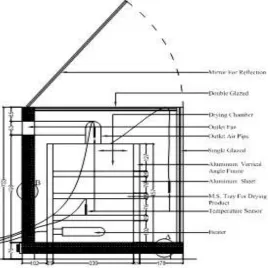
Most of the indirect solar drying system consists of the air collectors coupled to the drying chamber. Because the air collector and the drying chamber is separate made both cost as well as efficiency of the solar dryer is on stake. And hence effort has been made to design a single chamber unit which will act as collector cum drying chamber, which will not only reduce the cost but also increases efficiency of solar dryer. The drying unit was a box type structure made up of aluminum, which is kept in glass covered enclosure glazed from three sides i.e. south, east and west. The north wall was insulated
as it was not receiving any direct solar radiation; and losses will increase during the peak drying hours. An adjustable mirror is used on the top of the glass cover to enhance radiation in the drying chamber. Air circulation was facilitated by providing a gap from bottom of the drying chamber, and outlet air is thrown out from the upper part of drying chamber fitted with an air passage unit with 15W DC fan and 32W photovoltaic module to run the fan in order to analyze the effect of different flow rate of air. The detail of the dryer is shown in Figure 1.
Fig. 1 Mirror booster based solar dryer for drying chilli
3.2 Experimental procedure
ISSN: 2231-5381
http://www.ijettjournal.org
Page 27 were taken out of hot air oven & kept in decicatorbefore weighing it. Initial moisture content is then calculated is found 89.09% wet basis.
Experiments conducted from 20th May to 28th May 2010 in natural and forced flow mode respectively. Three different mass flow rates were set i.e. 0.456 m3/min, 0.285 m3/min & 0.002 m3/min (natural convection) by adjusting the fan speed and taking velocity of air from outlet of the drying chamber by anemometer. In case of natural convection velocity was measured without fan. Fresh 1.5 kg red chilli were taken & then equally distributed in three different trays i.e. 0.5 kg in each tray. In total 1.5 kg of red chilli were loaded to the drier for each set of experiments. The experiment starting and ending time was 9:00 AM and 5:00 which is 8 hrs duration in each day considering the solar radiation availability in a day. Sample of chilli was kept with initial weight in each tray & weight is checked after every two hrs in order to accesses the weight loss with an Electronic balance (accuracy ±.01 g). After each day of experiment i.e. after 5:00 PM the solar drier was covered with the insulating sheet. The insulating sheet was uncovered next morning at 9:00 AM from the drier. Experiment was continued till desired moisture level is achieved i.e. 5% in case of red chilli. The solar drier was fitted with Pt-100 sensor (upto 300C accuracy ±0.01C) which was used to measure the temperatures in trays at specified location and walls (east ,west, south), as well as outlet temperature of drying chamber were measured. Pt-100 sensor was connected to data logger (Model 2700, Keithley Instruments , Cleveland, Ohio, USA: accuracy ±0.1µV) which is attached to a computer ( Pentium- Core Duo Processor P41-0006 ) for continuous measurement of temperatures in the trays ,walls & outlet of drying chamber. These temperatures are recorded by data logger & can be retrieved by computer. A pyranometer (Model CMP-3, Kipp & Zonen BV, Rontgenweg, Holland: accuracy 7.69 µv/w/m2) was used to measure the solar radiation at the position of the drier & PV module. Relative humidity and temperature of the ambient air were measured with
a digital humidity/temperature meter
(accuracy±2.5% & ±0.01°C). The relative humidity
is measured at two location at the inlet (atmospheric) as well as outlet of the drying chamber and is measured at ½ Hrs interval during drying of red chilli. Velocity of drying air was measured with a vane type anemometer (Model AV6, 100 mmHd, Air Flow Instruments, England: Range : 0-30m/s, accuracy ±.01 m/s) at the outlet of the drier. After completion of drying, the dried chillies was collected, cooled in a shade to the ambient temperature and then sealed it in the plastic bag for storage.
4. Result and Discussion
4.1 Performance of drier
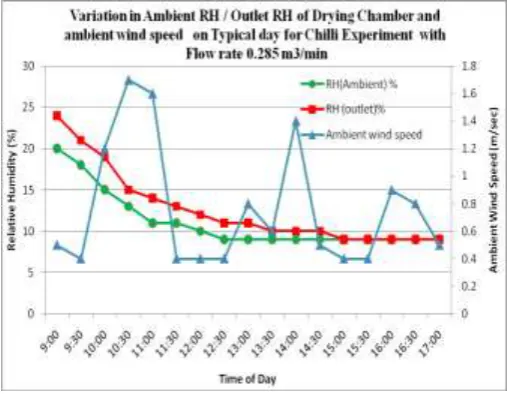
The parameters that affect the drying process were measured and variation of such parameters affecting the drying rate during the experimental period was critically analyzed and was displayed for a typical day in Figure2 and Figure3. It was found that solar radiation and ambient air temperature varied from 975.21 W/m2 to 73.34 W/m2 and 47.66°C to 31.90°C respectively. The average value of solar radiation and ambient air temperature was found to be 726.74 W/m2 and 41.1°C which were as per expected values during summer season. The maximum and minimum collector temperature was found to be 70.05° C to 38.74°C. Average tray temperature was found to be 58.2°C, 54.43°C and 54.43°C for top tray, centre tray and bottom tray respectively. This was found to be lower than the maximum allowable temperature for red chillies. Maximum and minimum temperature of outlet air from drying chamber was observed to be 107.41°C to 33.62°C, whereas the average outlet temperature was 74.43°C. Relative humidity at inlet and outlet of drying chamber was 54% to 8%, and 57% to 8%. The difference in average temperature of outlet of dryer and the ambient temperature was 33.20° C
higher than the ambient temperature and
ISSN: 2231-5381
http://www.ijettjournal.org
Page 28Fig. 2 Variations of solar radiation, ambient temperature and drying air temperature at the outlet of the drying chamber with time on 27th May 2010
during solar drying of red chilli
Fig. 3. Variations of RH%- ambient, RH%- Outlet of drying chamber and ambient wind velocity with time on 20th May 2010 during solar drying of red
chilli
4.2 Drying of Red chilli (Capsicum Annum)
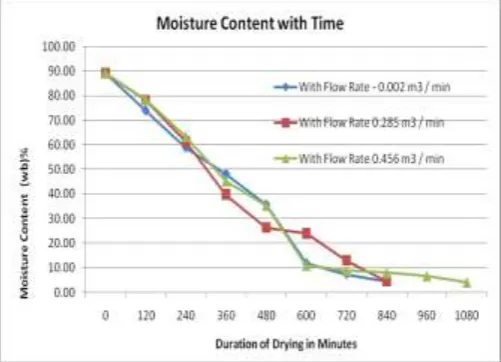
Red chilli was dried in the drying chamber during the experimental period; each tray was loaded with 0.5 kg of fresh red chilli i.e. top, bottom, and centre tray. Three different mass flow rates were considered during the drying period i.e. 0.456 m3/min, 0.285 m3/min and 0.002 m3/min (natural convection). The change in moisture content and moisture ratio with drying time for a typical
experimental run during solar drying for various mass flow rates were plotted as shown in Figure 4 and Figure 5. Moisture content of red chilli reached from 89.09% wet basis to 4.12% wet basis in 18 hrs or 1080 min for a mass flow rate of 0.456 m3/min, similarly moisture content reached to 4.55% wet basis in 14 hrs or 840 min for a mass flow rate of 0.285 m3/min and 4.53% wet basis in 14 hrs or 840 min for a mass flow rate of 0.002 m3/min (natural convection). It was observed that the drying time achieved using concentrator based solar dryer was comparable with Hossain et al., 2007, Mangaraj et al. 2001, Kaleemullah et al., 2005. The average temperature in the drying chamber was 55.27°C whereas drying air temperature was 50–55°C in case of Hossain et al., 2007 and was 55° C for Mangaraj et al., 2001 and 50° C, for Kaleemullah et al., 2005, respectively which was under permissible temperature limits for red chilli drying as reported by V.K.Sharma et al., 1993. Also the drying was much more efficient than traditional method of drying chillies as it required 10–15 days to dry up and loose 65–75% of weight during drying. P. A. Potdukhe et al., 2008.
It is clear from Figure 4 that drying was faster in case of medium and low mass flow rates of 0.285m3/min and 0.002m3/min which required 14 hrs to dry the product compared to mass flow rate of 0.456 m3/min which required 18 hrs to dry the product. In case of products with very high moisture content such as chillies the drying rate was faster and hence the air inside the drying chamber would become moist with rise in temperature, and needs to be replaced with fresh air in order to keep pace with higher drying rate. If the mass flow rate is high, it will replace the moist air with fresh air which also carries away the heat and hence with very high mass flow rate the drying rate decreases.
ISSN: 2231-5381
http://www.ijettjournal.org
Page 29Fig. 4 Comparison of solar drying of red chillies for different mass flow rates
Fig. 5. Moisture ratio to Duration of drying for solar drying of red chillies for different mass flow rates
5. Evolution of Drying Constants for drying of red chilli
The variation of moisture ratio with time for each mass flow rate was used for calculation of constants
c and k of the model using
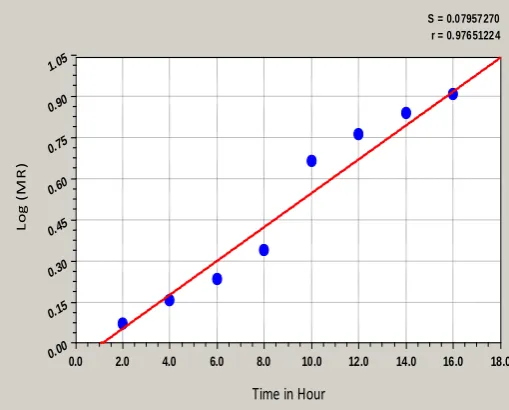
the linear regression. This has been done earlier using non-linear regression by Rapusas et al., 1995, and using exponential model by Sarsavadia et al., 1999. Curve was drawn between Log of MR and time in hour and is shown in Figure 6 to Figure 8. The coefficient of determination (R2) between the experimental and calculated moisture
ratios was also obtained. The c and k values thus obtained along with their (R2) values are tabulated below. The value of (R2) ranged from 0.99 to 0.96 indicating that the model fitted reasonably well with the experimental data for each mass flow rate i.e. 0.456 m3/min, 0.285 m3/min and 0.002 m3/min (Natural Convection) for drying of red chillies.
Following empirical relation was developed for all the mass flow rates.
For experiment red chilli using solar dryer with flow rate 0.002 m3/min (Natural Convection) Log(MR) = - k t + c (R2 = 0.97)
Values of c = -0.0697 k = 0.0616
For experiment red chilli using solar dryer with flow rate 0.285 m3 / min
Log(MR) = - k t + c (R2=0.99)
Values of c = -0.0864
k = 0.0622
For solar with flow rate 0.456 m3 / min Log(MR) = - k t + c (R2=0.96
Values of c = -0.0374
k = 0.0543
TABLE 1. ESTIMATED VALUES OF PARAMETERS USED FOR SOLAR DRYING OF RED CHILLIES ARE DISPLAYED -
S.No Mass
Flow rate (m3/min
)
Model Constants
k c R2
1 0.002 m3/min
0.0616 -0.0697 0.97
2 0.285 m3/min
0.0622 -0.0864 0.99
3 0.456 m3/min
0.0543 -0.0374 0.96
6. Quality of dried red chillies
ISSN: 2231-5381
http://www.ijettjournal.org
Page 30 phenolic compounds and ascorbic acid alsoprovided an unacceptable color for dried chilli
Manzocco et al., 2001, Sigge et al., 1999.
Ascorbic acid was degraded by higher temperatures and the degraded product (L-dehydro-ascorbic acid, DHAA) could participate in strecker degradation with amino acid, producing a browning pigment.
S = 0.07957270 r = 0.97651224
Time in Hour
L
o
g
(
M
R
)
0.0 2.0 4.0 6.0 8.0 10.0 12.0 14.0 16.0 18.0
0.00 0.15 0.30 0.45 0.60 0.75 0.90 1.05
Fig.6. Log (MR) as a function of Time for mass flow rate of 0.002 m3/min (Natural Convection)
S = 0.04400765 r = 0.99278104
Time in Hr
L
o
g
(M
R
)
0.0 2.0 4.0 6.0 8.0 10.0 12.0 14.0 16.0 18.0 20.0
0.00 0.15 0.30 0.45 0.60 0.75 0.90 1.05
Fig. 7. Log (MR) as a function of Time for mass flow rate of 0.285 m3/min
S = 0.09212729 r = 0.96053817
Time in Mr
L
o
g
(M
R
)
0.4 2.4 4.4 6.4 8.4 10.4 12.4 14.4 16.4 18.4 20.4
0.00 0.15 0.30 0.45 0.60 0.75 0.90
Fig. 8. Log (MR) as a function of Time for mass flow rate of 0.456 m3/min
Document BeMiller et., al 1996. Not only does the high temperature of drying air affect the loss of ascorbic acid, but a longer period of drying time can also introduce a significant loss of ascorbic acid. Looking to these effects of drying temperature and duration of drying both moisture content and ascorbic acid were taken as quality parameters for solar dried red chilli. Moisture content value was taken care of during the drying process and was maintained below 7% wet basis which was well under quality norms as per International as well as National standards are concerned. Ascorbic acid was minimum in case of sun drying i.e. 35.76 mg/ 100gm. and maximum when it was dried at 50⁰C i.e. 49.31mg/ 100gm as reported by Wiriya et., al 2009. Sample of dried chillies using solar dried was tested for ascorbic acid using Rangannna, 1986 method and it was found to be 49.5mg/100gm.
7. Conclusions
ISSN: 2231-5381
http://www.ijettjournal.org
Page 31 conventional sun drying. The drying rate constantachieved was 0.0543, 0.0622 and 0.0616 for mass flow rates of 0.456 m3/min, 0.285 m3/min and 0.002 m3/min (natural convection).
Nomenclature
M Moisture content on the wet basis, (%)
Mo Initial Moisture content on the wet basis, (%)
Me Equilibrium Moisture content on the wet basis, (%)
MR Moisture ratio
DR Drying Rate ( g of water / g of dry solid. min)
k Drying Rate Constant
c Constant
RH Relative Humidity (%)
G Solar radiation received by a horizontal surface, W/m2
Air flow rate, m3 / min
wb Wet basis
References
[1] Atul Kumar, Tara C. Kandpal 2004. Solar drying and CO2 emissions mitigation: potential for selected cash crops in India ,Solar Energy 78 (2005) 321–329
[2] Be Miller, J.N. and Whistler, R.L. (1996), Carbohydrate. In Fennema, O.R (Ed.), Food Chemistry. 3rd edn. pp.157. New York: Marcel Dekker, Inc.
[3] Doymaz, I., and M. Pala. 2002. The effects of dipping pretreatments on air-drying rates of the seedless grapes.Journal of Food Engineering, 52: 413– 417.
[4] Doymaz, I. 2004. Pretreatment effect on sun drying of mulberry fruits (Morus alba L.). Journal of Food Engineering, 65:205– 209. [5] Doymaz, I. 2005. Sun drying of figs: an experimental study. Journal
of Food Engineering, 71: 403– 407.
[6] Doymaz, I. 2007. The kinetics of forced convective air-drying of pumpkin slices. Journal of Food Engineering, 79: 243– 248
[7] El-Sebaii AA, Aboul-Enein S, Ramadan MRI, El-Gohary HG. Experimental investigation of an
[8] indirect type natural convection solar dryer. Energy Convers Manage 2002,43:2251-66.
[9] Goyal, R. K., A. R. P. Kingsly, M. R. Manikantan, and S. M. Ilyas.2007. Mathematical modeling of thin layer drying kinetics of plum in a tunnel dryer. Journal of Food Engineering, 79:176-– 180. [10] Halak H, Hilal J, Hilal F, Rahhal R, 1996, The staircase solar dryer:
Design and characteristics, Renewable Energy, 7 (2), 177-183. [11] Kaleemullah, S., Kailappan, R., 2005. Drying kinetics of red chillies
in arotary dryer. Biosystems Engineering 92 (1), 15–23.
[12] Kiranoudis C T , Maroulis Z B & Marious- Kouris D , 1992, Drying kinetics of Onion and green pepper, Drying Technology10(4), 995-1011
[13] Kingsly, A. R. P., and D. B. Singh. 2007. Drying kinetics of pomegranate arils. Journal of Food Engineering, 79: 741– 744. [14] Mangaraj, S., Singh, A., Samuel, D.V.K., Singhal, O.P., 2001.
Comparative performance evaluation of different drying methods for chillies.Journal of Food Science and Technology 38 (3), 296–299. [15] Manzocco, L., Calligaris, S., Mastrocola, D., Nicoli, M.C. and
Lerici, C.R. (2001), Review of non-enzymatic browning and antioxidant capacity in processed foods. Trends in Food Science and Technology 11: 340-346.
[16] M. A. Hossain, J. L. Woods , B. K. Bala, 2003 , Thin layer drying of Thai red chilli , ADC 333-335.
[17] M.A. Hossain, B.K. Bala, 2007, Drying of hot chilli using solar tunnel drier, Solar Energy 81 (2007) 85–92
[18] Midilli, A., and H. Kucuk. 2003. Mathematical modeling of thin layer drying of pistachio by using solar energy. Energy Conversion and Management, 44(7):1111– 1122.
[19] Midilli, A., H. Kucuk, and Z. Yapar. 2002. A new model for single-layer drying. Drying Technology, 20: 1503– 1513.
[20] P. A. Potdukhe , S. B. Thombre, 2008, Development of a new type of solar dryer: Its mathematical modeling and experimental evaluation, International Journal of Energy Research ; 32:765–782.
[21] Ranganna, S. (1986), Handbook of analysis and quality control for fruits and vegetable roducts pp. 171, 281 (2nd ed.). New Delhi: TataMcGraw-Hill Publishing.
[22] Ramesh, M.N.; Wolf, W.; Tevini, D., and Jung, G. 2001. Influence of processing parameters on the drying of spice paprika. Journal of Food Engineering. (49)63-72.
[23] Rapusas R S & Driscoll R H , 1995 , The thin layer drying characteristics of white onion slices. Drying Technology, 13 (8&9) 1905-31
[24] Sarsavadia P N, Shawhney R L, Pangavhane D R , Singh S P, 1999, Drying Behaviour of brined onion slices, Journal of Food Engineering 40 91999) 219-226
[25] Sigge, G.O., Hansmann, C.F. and Joubert, E. (1999), Optimizing the dehydration conditions of green bell peppers (Capsicum annuum L.): Quality criteria. Journal of Food Quality 22: 439-452.
[26] Sharma VK, Colangelo A, Spagna G, 1993, Experimental
performance of an indirect type solar fruit and vegetable dryer, Energy Conversion & Management, 34(4), 293-308.
[27] Singh R N , Patil K N , 2001, SPREI method for quick measurement of moisture content of biomas fuel, SESI Journal 14(10 pp 25-28 [28] Tiris Cigdem, Necdet Ozbalta, Mustafa Tiris, Ibrahim Dincer, 1994,
Performance of a solar dryer, Energy, 19 (9), 993-997.