The Importance Of Trust In Knowledge Sharing
Among Micro, Small, And Medium Enterprises
Adriana Madya Marampa, Pramono Hari Adi, Ade Irma Angreani, Woori Vivi Wulandari
Abstract: Trust is highly important in sharing knowledge within a business, particularly in micro, small and medium enterprises. MSMEs should be capable of building trust. This trust is built between employees and between owners and employees. In order to be able to share knowledge well, this trust needs to be supported by transformational leadership. The data was collected from 160 MSME employees in Purwokerto and Bandung. This research used SEM-PLS. The findings indicated that there was a significantly positive correlation between trust and knowledge sharing and found the significant influence of transformational leadership on knowledge sharing. The contribution of this research was that transformational leadership could increase the trust to share knowledge.
Index Terms: Trust, Transformational Leadership, Knowledge Sharing, SMES, Purwokerto and Bandung, Indonesia. —————————— ——————————
1.
INTRODUCTION
Micro, small and medium enterprises are among the businesses with great potentials and opportunity to grow within the economy in Indonesia. The role played by these micro, small and medium enterprises (MSMEs) in the national economy is relatively great. The number reaches 99.9 percent and its manpower absorption reaches 97 percent (liputan6.com). Micro, small and medium enterprises (MSMEs) were among the resilient economic actors in Indonesia in the face of monetary crisis which hit the country in 1998. This gives an evidence that MSME actors had better chance of surviving than major businesses and also a proof that MSMEs are highly important businesses to be developed in Indonesia. This research was conducted to employees of MSMEs in Purwokerto and Bandung. In this research, the issue is the lack of trust among employees of MSMEs to share knowledge. A MSME's development and growth cannot be separated from the employees working for them. Those employees working for MSMEs is basically not as many as those working for corporate companies. Employees need to build trust at work. The trust here is highly important element to own while working. The trust here is the one from leaders to employees and the one between employees themselves. A leader would be happy if she/he can have trustworthy employees. The trust between one worker and his/her partners in an organization would be helpful in knowledge sharing. Trust is an important element of a relationship and it can be built through partnership among organizations (H. W. Lee and Yu 2011). Trust is defined as a positive condition, confident even if it is subjective, expectation of one's behavior or something under a situation which involves risks for the party the trust is placed on (Panteli and Sockalingam 2005). Trust needs to be built between employees to allow them to work well. Trust also needs to be built at work to enable knowledge sharing.
This trust at work has been proven to have a significant and strong influence on various organizational phenomena, including work satisfaction, stress, organizational commitment, productivity, and, most relevantly knowledge sharing (Renzl 2006). Similarly, trust is considered as the important organizational factor which support knowledge sharing in an organization (McNeish, Jit, and Mann 2010). Le (2018) defined that the trust as a process of exchanging the information between individual and the organizations to create the innovative knowledge base for one to another. Simialarly, kowledge sharing is also process of sharing all types of knowledge including explicit and tacit knowledge through discussion, interations between employees and training workshops (Ibrahim and Heng 2015). Additionally, Gibbert dan Krause (2002) defined the knowledge sharing as desire of individuals in the organization to share with others knowledge that they acquire, innovate or create. Knowledge sharing in an organization, particularly micro, small and medium enterprises is different from that in a major business. Knowledge sharing in MSMEs is basically done informally and at a corporate business it is done formally. Knowledge sharing is hard to do, depending on individual willingness to share (Lam and Lambermont-Ford 2010) . Knowledge sharing is defined as ‗providing or receiving information on tasks, knowledge and feedback on products or procedures (Cummings, 2004: 352). In micro, small and medium enterprises, a leader plays a significant role in encouraging employees to share knowledge. Leaders can be a model to their employees on how they can share knowledge. Transformational leadership in some cases is an expansion of transactional leadership. Prior studies are highlighted the impotence of transactional leadership that emphasizes on transaction or exchange that happens between entrepreneurs, leaders, and followers (B. M. R. E. R. Bass 2006). However, transformational leadership is considered as the most effective leadership style and has a significant effect on the performance of followers (Le and Lei 2018). A transformational leader establishes supportive envirement in the organization which shapes the employees' attitude towards knowledge sharing by developing s set of skills, assumptions, values, and innovative capablities (Phong, Hui, and Son 2018). Knowledge sharing is defined in this research as an exchange of explicit and tacit knowledges which are relevant to the team‘s tasks (P. Lee et al. 2010).
______________________________
Adriana Madya Marampa: Universitas Jendral Sudirman/Universitas Kristen Indonesia Toraja,
Email: [email protected]
2.
LITERATURE
REVIEW
AND
DEVELOPMENT OF HYPOTHESIS
2.1. Trust
Trust is the willingness of a party to be vulnerable to an action from another party based on the expectation that this other party would take a certain important action from the trustor, regardless of the ability or confirmation of that other party (R. C. Mayer, Davis, and Schoorman 1995). The trust concept in management shows employees‘ confidence to the achievement of the organization‘s goal and leads the organization as well as the belief that the organization‘s actions would be useful for the employees (Renzl 2006; Ahmad & Ahmad 2019). Trust is a general intention of behavior to take a risk and the outcome is taking the risk, for example an employee can trust his/her manager and therefore is willing to admit his fault. Howeverm until he/she admits his/her fault, there is no risk taking (Roger C. Mayer and Gavin 2005). Trust can be seen as another process of important behavioral intervention, attitude, and good relationship being either supported or weakened. For example, an employee might want to communicate with leaders in public, yet without trust this communication might be limited (at best) or wrong (at worst) and avoidance of information which is personally risky. The dimensions of trust are prevention-based, calculus-based, relational and institutional trusts (Ahmad & Ahmad 2018; Warah 20101). Trust is an important element in human relationship (Warah 20101).
2.2. Definition of Knowledge Sharing
Kowledge sharing refers to all types of communication of knowledge including explicit and tacit knowledge through socialization, interaction, and training (Ibrahim and Heng 2015). Knowledge sharing is the heart of socialization, externalization, combination, and internalization (SECI) model frequently referred to as spiral model in the of knowledge creation theory (Curado and Vieira 2019). Knowledge sharing is one of employees‘ main contributions to strengthen organization‘s knowledge and can lead to high performance (Oyemomi et al. 2019). Knowledge sharing implies that each process of knowledge sharing consists of bringing (or contributing) knowledge and obtaining (or collecting knowledge) (Van Den Hooff and Ridder 2004). Knowledge sharing requires interaction between employees and this interaction depends on relationship involvement (H. W. Lee and Yu 2011). Knowledge sharing between employees is very important in case of achieving sustainable competitive advantage (Cabrera and Cabrera 2005). Knowledge sharing between co-workers is highly important for an organization. Relevant knowledge sharing has the potential to decrease costs, optimize processes and and its weakness is that it could put the organization in dange and even make the process ineffective (Rutten, Blaas - Franken, and Martin 2016). Knowlede sharing as a part of knowledge production occurs more in a form of discussion while working together to solve problems, define problems together discussing a knowledge sharing option to find a common solution (Bakker et al. 2006). Knowledge sharing refers to a process where team members share ideas related to tasks, information, improvement and suggestions with one another
(Eze et al. 2013). Trust is one of the main driving forces to improve KS (Smith 2006).
2.3 Transformational Leaders
Prior studies defined the transformational leaders that raise the desires of followers to achieve, self-development and promote the development of any group or organizations (Bernard M. Bass and Article 1990). Similarly, the transformational leaders serve as agents of transformational challenging with a strong vision for future (Nemanich and Vera 2009). However, Transformational leadership mostly emphasizes on the inspirational aspects of leader-follower relationship (Brown and Moshavi 2002) and behave charismatically to inspire their followers to identify themselves with them (realized their influence). They inspire followers for higher goals achievements, to do more than they originally (means inspirational motivation) (J. Liu, Siu, and Shi 2009). However, transformational leadership style in the organization can enhance supportive behavior among the employees and team members by creating innovative ideas and shared the knwladge (Eisenbeiss, van Knippenberg, and Boerner 2008). That‘s why, the transfromationa leadership is considered as one of the most effective leadership styles and has a positive effect on performance of the followers and organizations (Le and Lei 2018). Transformational leadership has direct and indirect results related to the work of followers and has practical implications for leadership development programs (Walumbwa, Hartnell, and Oke 2010). Transformational leadership involves followers and they inspire them to commit to a shared vision and goals for the organization. The behavior most frequently associated with transformational leadership includes the articulation of a convincing strong vision of the organization which helps to achieve the individuals and organization goals and encourage them by provide individual intellectual support (Wang et al. 2005). Similarly, Shiva and Suar (2010) highlighted that the transformational leaders can motivate their followers by inspiring them, offering and directing in the challenges, and creating space for individual‘s development. However, the transformational leadership is considered the most effective factor in creating and sharing effective knowledge at both individual and organizational levels (Bryant 2003).
H1: There is a significantly positive relationship between Trust and Knowledge Sharing.
shown a correlation between transformational leadership and knowledge sharing (Phong, Hui, and Son 2018). Coun, Peters, and Blomme's (2019) research findings show the significant relationship between transformational leaders and knowledge sharing.
H2: There is a significantly positive relationship between Leadership Transformational and knowledge sharing.
3. RESEARCH METHODOLOGY
This study based on the quantitative research. Quantitative research is a study which is based on quantitative data. Data were collected from the employees of MSMEs in Purwokerto and Bandung indonesia by distributing the 200 questionnaires randomly and only 160 Questionnaires were return. The sample was taken by using Startifed Random Sampling technique and analyzed by using SEM-PLS 3.08.
3.1. Analysis of Data
The data were analysed by using smart PLS in three stages, such as analysis of outer model, analysis of inner model, and hypothesis testing. The outer model is helps to ensure that the data is feasible to be used as a
measurement (means to test the validity and reliability). The analysis of outer model can be seen from several
indicators, such as construct validity, convergent validity, and the values of Cronbach Alpha. The Measurement Model was evaluated by seeing the result of indicator validity and construct reliability.
3.2. Construct Validity Testing
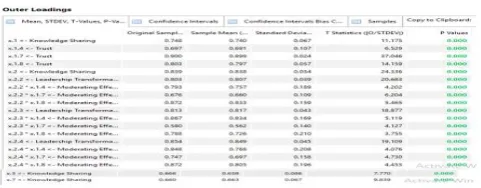
The indicator validity can be seen from the value of Loading Factor (LF) produced. As a rule of thumb, if the value of LF indicator ≥ 0.7, it is said to be valid. Nevertheless, in the development of a new model or indicator, the value of LF ranging between 0.5 – 0.6 is still accceptable (Yamin and Kurniawan, 2011:202). Meanwhile, Wijaya and Mustafa (2012:124) explain that the critical value of LF has varied criteria, yet several experts reccomend a minimum value of 0.4. LF testing can also be seen from the print out of Calculate PLS Bootstrapping command. Any indicator which has a value of T Statistic ≥ 1.96 (some rounding it to 2) is said to be valid. An indicator can also be said to be valid if it has a P Value ≤ 0.05. From Table 4.2. all indicators can be seen as having values of T Statistic ≥ 1.96 and P-Value < 0.05, hence all indicators which form the constructs are declared valid to be used to test the hypothesis in the structural measurement stage.
TABLE 1
Result of Construct Reliability Examination based on Convergent Validity
1. Construct Reliability Test
The evaluation of construct reliability value is analysied using Cronbach‘s Alpha and Composite Reliability values. Meanwhile, the analysis of inner model/model structural analysis is calculated to ensure that the structural model built is reliable and accurate. Similalry, the evaluation of inner model can be seen from the following indicators, such as determination coefficient (R2), predictive Relevance, doodness of Fit Index (GoF). However, the hypothesis is tested by evaluating by its probability and t- statistic. The p-value were considered at 5% is less than 0.05.
A. Analysis of Outer Model
The Outer Model specifies the relationship between dependent variable and independent variables and their indicators. Similarly, it also defined that in outer model how each indicator relates to its dependent and independent veriable. For this purpose, these tests applied to outer model such as:
1. Convergent Validity.
To analyze the convergent validity, the thrush hold value is >0.7. The AVE value indicates the convergent validity. An indicator is considered to have a good convergent validity if it has a AVE value greater than 0.5. The final value of AVE can be seen in table. It can be seen that the AVE value in the figureis above 0.5 for all variables.
2. Cronbach Alpha
A construct is declared reliable if the values of cronbach alpha are greater than 0.7. The result of cronbach alpha tests can be seen in table 2. From the tables 2, it can be seen that all variables have a composite reliability greater than 0.7. The reliability test is strengthened with Cronbach Alpha. The expected value is > 0.6 for all constructs. Average Variance Extracted (AVE). The expected AVE value is > 0.
TABLE 2
Composite Reliability and Average variance Extracted
Cronbach's Alpha rho_A Composite Reliability
Average Variance Extracted (AVE) Knowledge
Sharing 0.709 0.719 0.821 0.536
Leadership
Transformational 0.856 0.857 0.903 0.699 Moderating Effect
1 0.927 1.000 0.936 0.553
Trust 0.723 0.767 0.844 0.646
B. Inner Model Test
The inner model can be evaluated using three ways. These three ways are by seeing the R2, Q2 and GoF.
TABLE 3
R Square and R Square Adjusted
R Square R Square Adjusted
Knowledge Sharing 0.306 0.284
C. Goodness of Fit (GoF) Test
root value. From the result of GoF calculation above, a value of 0.403 is obtained, thus it can be concluded that the model has a great GoF and the greater the GoF value, the more better it describes the research sample.
The inner model can be tested by seeing the value of (predictive relevance). To calculate , the following
formula can be used.
= 1 – (1-0.284)
= 0.284
Finally, it can be done by finding the value of Goodness of Fit (GoF). Unlike the CB- SEM, the value of GoF in PLS-SEM should be found manually.
GoF = ...Tenenhaus (2004)
GoF =
GoF = 0.41
According to Tenenhau (2004), to validate the combined performance between measurement model (outer model) and structural model (inner model), a value range between 0 and 1 can be used with the following interpretations, 0- 0.25 being small GoF, 0.25-0.36 being moderate GoF, and above 0.36 being great GoF.
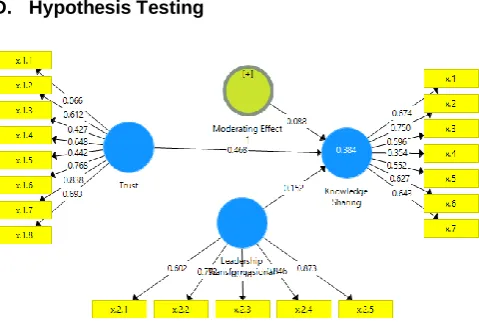
D. Hypothesis Testing
Figure 1: Hypothesis Testing
At the evaluation stage, the structural model would be analyzed by seeing the significance of correlation between constructs as shown by the t statistic value generated from out put of options Calculate PLS Bootstrapping. The extent of influence between constructs and interaction effect (moderation) is measured using path coefficient value. A path coefficient with T Statistic value ≥ 1.96 (or rounded to 2) or P Value ≤ 0.05 is stated as significant.
E. Structural model (inner model) evaluation
After testing the measurement model (outer model), the next step is to test the structural model (inner model) to figure out whether or not a hypothesis is accepted or rejected. This research will use a significance value of (α) 0.05 or 5%. The correlation between variables can be considered as significant if the P value is less than the predetermined significance value (P < 0.05)
4. RESULT ANALYSIS
Result analysis is done based on the result of structural model evaluation previously done, i.e. the significance value of correlation between variables to determine the hypothesis nil (Ho) is accepted or rejected. If the value of P is less than 0.05, Ho is rejected and the alternative hypothesis (Ha) is accepted, and if it is greater than 0.05, then Ho is accepted. The significance value of interaction or moderation effect is shown by t statistic 2.234 ≥ 1.96. Thus, it can be concluded that Leadership Transformational moderates the influence on knowledge sharing. Meanwhile, the extent of influence coefficient between the hypothesized constructs is shown by the path coefficient value. Partially, it can be concluded that:
1. Leadership Transformational has a significant influence on knowledge sharing since the t satistic is 2.438 ≤ 1.96 or P-Value 0.015 ≤ 0.05.
2. Trust has a significant influence on knowledge sharing since the t satistic is 2.098 ≥ 1.96 or P-value is 0.036 ≤ 0.05.
Table 4 Finding of the study
Variables Β Value
Sample Means
ST. DV
T-value
P-Value Findings LT->KS 0.276 0.278 0.113 2.438 0.015 Accepted LT->KS
(ME) 0.172 0.188 0.077 2.234 0.026 Accepted
Trust->KS 0.270 0.290 0.129 2.098 0.036 Accepted
5. CONCLUSION
1) Based on the result of data analysis above, it can be concluded that transformational leadership can have a significant influence on knowledge sharing since the t satistic is 2.438 ≤ 1.96 or P-Value is 0.015 ≤ 0.05. Thus, the hypothesis which states that leadership has a positive influence on knowledge sharing is acceptable. This is consistent with Bryant (2003) who suggests that there is a significant correlation between transformational leaders and knowledge sharing since it more effectively creates knowledge sharing at individual and group levels.
2) Based on the result of data analysis above, it can be concluded that trust has a significant influence on knowledge sharing since the t satistic is 2.098 ≥ 1.96 or P-Value is 0.036 ≤ 0.05.
3) Thus, the hypothesis which states that trust has a positive influence on knowledge sharing is acceptable. This is in line with Smith (2006) who states that trust is one of the main driving force to share knowledge.
6.
RESEARCH
LIMITATION
AND
IMPLICATION
REFERENCES
[1]. Ahmad, I., & Ahmad, S. (2019). The Mediation Effect of Strategic Planning on The Relationship Between Business Skills and Firm‘s Performance: Evidence from Medium Enterprises in Punjab, Pakistan. Opcion, 35(24), 746-778.
[2]. Ahmad, I., & Ahmad, S. (2018). Multiple Skills and Medium Enterprises‘ Performance in Punjab Pakistan: A Pilot Study. Journal of Social Sciences Research, 7(2010), 44-49. d
[3]. Bakker, Marloes et al. 2006. ―Is Trust Really Social Capital? Knowledge Sharing in Product Development Projects.‖ Learning Organization 13(6): 594–605.
[4]. Bass, Bernard M.Ronald E. Riggio. 2006. 53 Journal of Chemical Information and Modeling Transformational Leadership.
[5]. Bass, Bernard. 1981. ―Bass & Stogdill‘s Handbook of Leadership: Theory, Research and Managerial Application.‖
[6]. Bernard M. Bass, Bruce J. Avolio, and Article. 1990. ―Developing Leadership: 1992 and Beyond.‖ Strategy & Leadership 27(1): 20–25.
[7]. Brown, F. William, and Dan Moshavi. 2002. ―Herding Academic Cats: Faculty Reactions to Transformational and Contingent Reward Leadership by Department Chairs.‖ Journal of Leadership Studies 8(3): 79–93.
[8]. Bryant, Scott E. 2003. ―The Role of Transformational and Transactional Leadership in Creating, Sharing and Exploiting Organizational Knowledge.‖ Journal of Leadership & Organizational Studies 9(4): 32–44.
[9]. Burke, C. Shawn, Dana E. Sims, Elizabeth H. Lazzara, and Eduardo Salas. 2007. ―Trust in Leadership: A Multi-Level Review and Integration.‖ Leadership Quarterly 18(6): 606–32.
[10]. Cabrera, Elizabeth F., and Angel Cabrera. 2005. ―Fostering Knowledge Sharing through People Management Practices.‖ International Journal of Human Resource Management 16(5): 720–35. [11]. Cheng, Jao Hong, Chung Hsing Yeh, and Chia Wen
Tu. 2008. ―Trust and Knowledge Sharing in Green Supply Chains.‖ Supply Chain Management 13(4): 283–95.
[12]. Coun, Martine (M.J.H.), Pascale (C.P.) Peters, and Rob (R.J.) Blomme. 2019. ―‗Let‘s Share!‘ The Mediating Role of Employees‘ Self-Determination in the Relationship between Transformational and Shared Leadership and Perceived Knowledge Sharing among Peers.‖ European Management
Journal 37(4): 481–91.
http://dx.doi.org/10.1016/j.emj.2018.12.001.
[13]. Curado, Carla, and Sílvia Vieira. 2019. ―Trust, Knowledge Sharing and Organizational Commitment in SMEs.‖ Personnel Review.
[14]. Eisenbeiss, Silke A., Daan van Knippenberg, and Sabine Boerner. 2008. ―Transformational Leadership and Team Innovation: Integrating Team Climate Principles.‖ Journal of Applied Psychology 93(6): 1438–46.
[15]. Eze, Uchenna Cyril, Gerald Guan Gan Goh, Choon Yih Goh, and Tiong Ling Tan. 2013. ―Perspectives
of SMEs on Knowledge Sharing.‖ Vine 43(2): 210– 36.
[16]. Ibrahim, Suzilawati, and Low Hock Heng. 2015. ―The Roles of Learning in Stimulating Knowledge Sharing at SMEs.‖ Procedia - Social and Behavioral
Sciences 172: 230–37.
http://dx.doi.org/10.1016/j.sbspro.2015.01.359. [17]. Le, Phong Ba, and Hui Lei. 2018. ―The Mediating
Role of Trust in Stimulating the Relationship between Transformational Leadership and Knowledge Sharing Processes.‖ Journal of Knowledge Management 22(3): 521–37.
[18]. Lee, Hung Wen, and Ching Fang Yu. 2011. ―Effect of Organizational Relationship Style on the Level of Knowledge Sharing.‖ International Journal of Manpower 32(5): 677–86.
[19]. Lee, Pauline, Nicole Gillespie, Leon Mann, and Alexander Wearing. 2010. ―Leadership and Trust: Their Effect on Knowledge Sharing and Team Performance.‖ Management Learning 41(4): 473– 91.
[20]. Liu, Jiayan, Oi Ling Siu, and Kan Shi. 2009. ―Transformational Leadership and Employee Well-Being: The Mediating Role of Trust in the Leader and Self-Efficacy.‖ Applied Psychology 59(3): 454– 79.
[21]. Liu, Yuwen, and Richard S. DeFrank. 2013. ―Self-Interest and Knowledge-Sharing Intentions: The Impacts of Transformational Leadership Climate and HR Practices.‖ International Journal of Human Resource Management 24(6): 1151–64.
[22]. Lucas, Leyland M. 2005. ―The Impact of Trust and Reputation on the Transfer of Best Practices.‖ Journal of Knowledge Management 9(4): 87–101. [23]. Mayer, R. C., J. H. Davis, and F. D. Schoorman.
1995. ―An Integrative Model of Organizational Trust.‖ Academy of Management Review 20(3): 709–34.
[24]. Mayer, Roger C., and Mark B. Gavin. 2005. ―Trust in Management and Performance: Who Minds the Shop While the Employees Watch the Boss?‖ Academy of Management Journal 48(5): 874–88. [25]. McNeish, Joanne, Inder Jit, and Singh Mann. 2010.
―Knowledge Sharing and Trust in Organizations.‖ IUP Journal of Knowledge Management 8(1/2): 18– 38.
[26]. Nemanich, Louise A., and Dusya Vera. 2009. ―Transformational Leadership and Ambidexterity in the Context of an Acquisition.‖ Leadership Quarterly
20(1): 19–33.
http://dx.doi.org/10.1016/j.leaqua.2008.11.002. [27]. Oyemomi, Oluwafemi et al. 2019. ―How Cultural
Impact on Knowledge Sharing Contributes to Organizational Performance: Using the FsQCA Approach.‖ Journal of Business Research 94(February): 313–19.
[28]. Panteli, Niki, and Siva Sockalingam. 2005. ―Trust and Conflict within Virtual Inter-Organizational Alliances: A Framework for Facilitating Knowledge Sharing.‖ Decision Support Systems 39(4): 599– 617.
Employees‘ Behavior toward Knowledge Sharing.‖ Social Behavior and Personality 46(5): 705–20. [30]. Renzl, Birgit. 2006. ―Trust in Management and
Knowledge Sharing: The Mediating Effects of Fear and Knowledge Documentation.‖ Omega 36(2): 206–20.
[31]. Rutten, Werner, Joyce Blaas - Franken, and Harry Martin. 2016. ―The Impact of (Low) Trust on Knowledge Sharing.‖ Journal of Knowledge Management 20(2): 199–214.
[32]. Shiva, Mahalinga S.A., and Damodar Suar. 2010. 6 International Journal of Rural Management Leadership, Lmx, Commitment and Ngo Effectiveness: Transformational Leadership, Leader-Member Exchange, Organizational Commitment, Organizational Effectiveness and Programme Outcomes in Non-Governmental Organizations. [33]. Smith, Ian G. 2006. ―Article Information :‖
[34]. Usoro, Abel, Mark W. Sharratt, Eric Tsui, and Sandhya Shekhar. 2007. ―Trust as an Antecedent to Knowledge Sharing in Virtual Communities of Practice.‖ Knowledge Management Research and Practice 5(3): 199–212.
[35]. Van Den Hooff, Bart, and Jan A. Ridder. 2004. ―Knowledge Sharing in Context: The Influence of Organizational Commitment, Communication Climate and CMC Use on Knowledge Sharing.‖ Journal of Knowledge Management 8(6): 117–30. [36]. Walumbwa, Fred O., Chad A. Hartnell, and Adegoke
Oke. 2010. ―Servant Leadership, Procedural Justice Climate, Service Climate, Employee Attitudes, and Organizational Citizenship Behavior: A Cross-Level Investigation.‖ Journal of Applied Psychology 95(3): 517–29.
[37]. Wang, Hui et al. 2005. ―Leader-Member Exchange as a Mediator of the Relationship between Transformational Leadership and Followers‘ Performance and Organizational Citizenship Behavior.‖ Academy of Management Journal 48(3): 420–32.