Forbes, Marina, Fairlamb, Helen and Jonker, Leon (2017) Impact of patientheld
record on knowledge at 1year followup for glaucoma patients: singlecenter
randomized controlled trial. European Journal of Ophthalmology, 27 (5). pp. 542
547.
Downloaded from: http://insight.cumbria.ac.uk/id/eprint/2692/
Usage of any items from the University of Cumbria’s institutional repository ‘Insight’ must conform to the following fair usage guidelines.
Any item and its associated metadata held in the University of Cumbria’s institutional repository Insight (unless stated otherwise on the metadata record) may be copied, displayed or performed, and stored in line with the JISC fair dealing guidelines (available here) for educational and notforprofit activities
provided that
• the authors, title and full bibliographic details of the item are cited clearly when any part of the work is referred to verbally or in the written form
• a hyperlink/URL to the original Insight record of that item is included in any citations of the work • the content is not changed in any way
• all files required for usage of the item are kept together with the main item file. You may not
• sell any part of an item
• refer to any part of an item without citation
• amend any item or contextualise it in a way that will impugn the creator’s reputation • remove or alter the copyright statement on an item.
The full policy can be found here.
EJO
ISSN 1120-6721 ORIGINAL RESEARCH ARTICLEmated to be 64 million, increasing to 76 million in 2020 and
112 million in 2040 (1, 2). Glaucoma patients require lifelong review to monitor their condition and response to eye pres
-sure-lowering treatments. As the population ages, glaucoma will continue to present a significant burden for our current healthcare resources (3). One strategy for an improvement in patient outcomes is to increase patients’ knowledge and understanding of their disease, to in turn enhance treatment compliance and reduce disease-related morbidity.
There are various patient-held care records utilized in various UK healthcare services (4-6), but as yet such records have not been available for glaucoma patients. Previous re
-search recognizes that clients who receive emotional support and information at the initial diagnosis of glaucoma benefit by subsequently displaying good compliance and coopera
-tion with their care (7, 8). The NICE Guideline Development Group made recommendations for research into the clinical effectiveness of providing people with glaucoma with a glau
-coma personal record (GPR) and for this to be compared to standard treatment (9). Clinical teams may provide numerous
DOI: 10.5301/ejo.5000939
Impact of patient-held record on knowledge at 1-year
follow-up for glaucoma patients: single-center
randomized controlled trial
Marina Forbes1, Helen Fairlamb2, Leon Jonker31 Ophthalmology Department, Cumberland Infirmary, North Cumbria University Hospitals NHS Trust, Carlisle - UK 2 R&D Department, Cumberland Infirmary, North Cumbria University Hospitals NHS Trust, Carlisle - UK
3 Department of Medical and Sport Sciences, University of Cumbria, Carlisle - UK
Introduction
Glaucoma encapsulates a disparate group of eye diseases that are multifactorial and individual to each patient. The common factor is progressive optic nerve fiber loss, which leads to irreversible and disabling visual field defects if it is not diagnosed and treated early. In 2013, the worldwide number of people (age 40-80 years) with glaucoma was esti
-AbSTRACT
Purpose: To assess whether provision of a personalized patient-held eye health summary (glaucoma personal re
-cord) improves patients’ knowledge of glaucoma at 1-year follow-up. The National Institute for Clinical Excellence has recommended such an approach to ascertain if this may ultimately help slow disease progression.
Methods: Recruited patients, newly diagnosed with glaucoma conditions, were randomly allocated to receive standard clinical care or an additional glaucoma personal record, detailing the current state of each individual’s eye condition. Mann-Whitney U test was applied for comparison of knowledge scores between groups at 1-year follow-up, using a validated questionnaire. Multiple linear regression analysis was applied to detect any factors significantly associated with a difference in glaucoma knowledge.
Results: A total of 122 patients were recruited; 57 controls and 44 intervention patients were tested for their glaucoma knowledge, equating to 83% retention rate. Out of a maximum available 100% converted score, the median scores were 58% and 53% for the control and intervention arm, respectively (p = 0.85). Regression analy
-sis showed that age (p = 0.015) had a negative association and level of education (p = 0.002) had a positive as
-sociation with glaucoma knowledge.
Conclusions: The glaucoma personal record does not impact on a patient’s knowledge of glaucoma in either a positive or negative way. Other approaches to improve health literacy among glaucoma patients, particularly for patients who are elderly or have a limited educational background, must be considered to improve patients’ awareness and knowledge of their own condition.
Trial registration: International Standard Randomized Controlled Trial Number Registry: ISRCTN41306818.
Keywords: Health literacy Glaucoma, Glaucoma personal record, Knowledge, Patient
Accepted: January 12, 2017
Published online: February 1, 2017
Corresponding author: Marina Forbes
Clinical Nurse Specialist Ophthalmology North Cumbria University Hospitals NHS Trust
Cumberland Infirmary
Ophthalmology Department Carlisle, CA2 7HY, UK [email protected]
Author
personal
Forbes et al 543
resources to patients, depending on the individuals’ specific needs, yet there is potential to produce a standardized sum
-mary that can be tailored to record each individual’s current appearance of his or her own glaucoma status. This summary should have the potential to add value to patient care as it would be held by each individual, and be personalized to re
-flect his or her own condition.
Recent work by Waterman (10) identified the need for pa
-tients to be better informed about their glaucoma, to help them understand their condition and the health implications of poor medication adherence. To this effect, Spaeth and Pau
-lus (11) developed a colored glaucoma graph for diagnosed glaucoma patients and glaucoma suspects; it provides both patients and clinicians with visual information concerning current optic disc appearance. Its simple traffic light system was extended to other outcome measures, such as visual field scoring using the Hoddap Classification (12, 13) and in -traocular pressure measurement.
This study aims to fulfil the NICE requirement by assessing the clinical effectiveness of providing patients with ocular hy
-pertension (OHT), suspected glaucoma (SG), or chronic open-angle glaucoma (COAG) (henceforth collectively referred to as glaucoma) with an in-house-developed GPR, applying the earlier mentioned visually efficient graphs for clinical param
-eters, in comparison to current standard best practice. Here we focus on the primary objective of the trial, an evaluation of glaucoma patients’ knowledge at 1 year following receipt of a GPR compared to knowledge of patients who receive
standard clinical care.
Methods
Trial design and subjects
This prospective, single-center, parallel-group, random
-ized, controlled clinical trial recruited 122 adults, newly diag
-nosed with glaucoma (including OHT, SG, and/or COAG), from a nurse-led ophthalmology outpatient clinic at a medium-sized NHS Trust in the United Kingdom. National ethics approval, reference 12/YH/0471, and local institute approval were ob
-tained prior to commencing the trial. The study is registered with the International Standard Randomized Controlled Trial Number Registry, reference ISRCTN41306818. The degree of standard patient education and information provision within a specialist nurse clinic consists of patients being shown an en
-larged model of the eye and ocular anatomy posters, ocular coherence tomography sample scans, and images of healthy and damaged optic nerve heads. Furthermore, the nurse shows examples of normal visual field tests and those show
-ing glaucomatous loss, and patients are offered a generic Trust glaucoma information leaflet to take. The leaflet is based on widely available leaflets, from, e.g., Royal National Institute for the Blind, and covers the definition of glaucoma, its treatment, diagnostic tests, and further contacts. This is the standard clinical practice intervention for the control group, and also for those in the intervention arm, who received the additional GPR booklet with more personal clinical information and fur
-ther explanations on the impact of certain diagnostic readings. The main inclusion criteria were English-speaking adults with intact mental capacity who had just received a new
diagnosis of OHT, SG, or COAG or any combination of OHT, SG, COAG, or primary/secondary glaucoma. Patients fulfill
-ing the trial eligibility criteria were recruited and random
-ized at a baseline clinic visit, to avoid a priming effect.
Outcome measures
The trial methodology has been described in detail in a previous publication that outlines the protocol (14). In sum
-mary, the Health of Patients’ Eyes (HOPE) trial is designed to ascertain if a GPR will improve glaucoma patients’ knowledge of their condition at 1-year follow-up (primary outcome) and if it will alter clinical outcomes at long-term follow-up ap
-pointments at 2 and 3 years (secondary outcome). During the baseline visit and 1-year follow-up visit, clinical parameters were collated: optic disc damage (disc damage likelihood scale), visual field score, and eye pressure. The 25-item Na
-tional Eye Institute Visual Function Questionnaire (VFQ-25) was also administered to obtain a patient-reported outcome measure of quality of life related to glaucoma (15). Dur
-ing the 1-year follow-up visit, a knowledge assessment was conducted by the chief investigator. This questionnaire was devised and validated by Gray and colleagues (15). Depend
-ing on whether a participant is prescribed antihypertensive eyedrops or not, he or she can score a maximum of 17 or 12 points based on 10 or 6 questions, respectively. The ques
-tions relate to knowledge concerning the pathology of glau
-coma, its effect on vision, means to investigate glau-coma, and, for antihypertensive eyedrop users, the mode of action of the medication and instructions for use. The clinical pa
-rameters, and VFQ-25, are planned to be measured again at 2 and 3 years after the first baseline visit as part of the HOPE
glaucoma trial.
Intervention development and evaluation
The GPR was devised with the intention to produce an affordable yet functional 16-page A5 booklet containing per
-sonalized information concerning a patient’s glaucoma condi
-tion; the booklet used has been published previously (14). It was refined with advice from a small sample of glaucoma pa
-tients and input from the International Glaucoma Association. Traffic light systems are utilized to educate the patient on key clinical parameters: visual field loss, intraocular pressure, disc damage likelihood scale, and disc damage (with explanatory footnotes included). The patient’s glaucoma care plan is also summarized in the booklet (11). In addition to the methods described in Forbes and colleagues (14), feedback was sought on the intervention by the development of a 5-question sur
-vey, consisting of 4-point Likert answer options, which was posted to all participants randomized to receive the GPR after the year 1 follow-up appointment.
Analysis
Accounting for a 20% dropout rate, the study was de
-signed to have 90% power to detect a 12% difference in pa
-tient knowledge of glaucoma between the 2 arms. Differences in distribution (e.g., patient age, sex, level of education) were analyzed by applying 2-sided χ2 test or Mann-Whitney U test.
Author
personal
For assessing differences between the control and interven
-tion groups in terms of the level of knowledge demonstrated, 2-sided Mann-Whitney U test was applied. Multilinear regres
-sion was used to analyze which factors are significantly associ
-ated with either reduced or enhanced glaucoma knowledge. Due to the chronic nature of glaucoma, clinical outcome mea -sures cannot be compared between the 2 arms due to the
short duration of follow-up (12 months).
Results
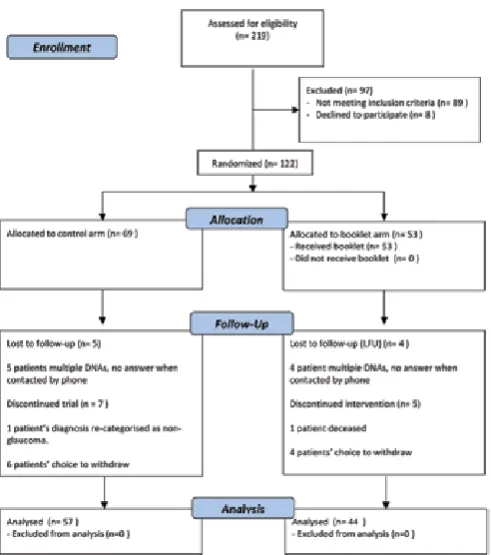
A total of 122 participants were recruited; distribution of patients into the 2 treatment arms was as follows: n = 69 for the control arm and n = 53 for the intervention arm. Patient eligibility, recruitment, and retention through the study are presented in a CONSORT flow diagram (Fig. 1). The 2 trial arms were compared in terms of participant demographics, use of prescribed antihypertensive eyedrops, and the initial diagnosis at presentation. Table 1 shows that there are no pronounced differences in average age, sex distribution, aver
-age educational level achieved, or type of diagnosis between the control arm and intervention (GPR) arm.
The primary outcome measure, patients’ knowledge of glaucoma, was quantified using a validated researcher- conducted survey at 12 months postrecruitment on average (16). Since the total available score is 12 for those not pre
-scribed antihypertensive drops and 17 for those pre-scribed eyedrops during the course of the study, the achieved scores were converted into a percentage score with a maximum of 100%. Table 1 and Figure 2 demonstrate that GPR provision
does not lead to a statistically significant difference in knowl
-edge when compared to scores achieved by the patients in
the control arm.
TABLE I - Characteristics of participants in the control and interven
-tion arms
Parameter Control
(n = 57) Booklet (n = 44)
Median age, y 65 65
Male/female 31/26 25/19
Median education level, ya 3: Vocational
training 3: Vocational training Use of prostaglandin analog
eyedrops, yes/no, % (n) 17 (10)/83 (47) 25 (11)/75 (33) Diagnosis, % (n)
Glaucoma suspect 26 (15) 18 (8) Open-angle glaucoma 26 (15) 27 (12) Ocular hypertension 25 (14) 34 (15)
Suspicious discs 2 (1) 5 (2)
Other 2 (1) 0 (0)
Multiple diagnoses 19 (11) 16 (7)
Visual field R, median -2.14 -2.37
Visual field L, median -2.31 -2.76
Eye pressure R, median 22.0 22.0
Eye pressure L, median 22.0 22.0
Q1, VFQ-25, median 75 63
Q2, VFQ-25, median 80 80
Q3, VFQ-25, median 75 88
Q10, VFQ-25, median 100 100
Median knowledge score for
validat-ed questionnaire, % (see also Fig. 2) 58 53
aOptions were 0, primary school; 1, O-level/GCSE; 2, A-level; 3, vocational
training; 4, college; 5, university.
Fig. 1 - CONSORT flow diagram: Health of Patients’ Eyes (HOPE) glaucoma. Summary of number of patients involved in different stages of the HOPE trial.
Fig. 2 - Glaucoma knowledge scoring. Box-and-whisker plot high
-lighting the minimum and maximum values (end of whiskers), 25th
and 75th percentile (edge of box), and median for knowledge scores.
Author
personal
Forbes et al 545
Since knowledge levels may be dependent on various factors, multiple linear regression was applied to determine which factors may contribute to reduced or enhanced knowl
-edge among patients. Table II shows that age is negatively associated with knowledge (i.e., older age is associated with less knowledge). Conversely, a higher level of education is as
-sociated with increased knowledge of glaucoma. No other variables were significantly associated with a change in glau
-coma health literacy.
A postal survey, sent only to participants in the booklet arm approximately 1 year after they first entered the trial and received the booklet at baseline visit, explored how the par
-ticipants perceived the GPR intervention. Five questions cov
-ered topics around the usefulness and impact of the GPR, or HOPE patient booklet, as it was called in the survey. Table III summarizes the results and shows that the feedback on the GPR was very positive. The response rate for this survey ele
-ment of the study was 57% (25/44 respondents). Participants were also invited to add free text comments. Twelve of the 15 patients providing such feedback gave positive feedback, e.g., “The feedback was helpful to my optician when check
-ing my eyes” and “The booklet was clear, concise, and easy to understand.”
Discussion
The HOPE glaucoma study constitutes the first effort to
-wards fulfilling NICE recommendations for research into the clinical effectiveness of providing people with COAG with a GPR
when compared with standard treatment (9). Three outcomes
are deduced from this trial: (1) the GPR used in its present for -mat and with current contents does not enhance a glaucoma
patient’s knowledge of glaucoma; (2) despite a lack of efficacy in terms of patients’ knowledge, the GPR is valued and recom
-mended by those who were allocated the booklet; (3) the key variables that significantly influence a patient’s likely (lack of) knowledge of glaucoma are age and level of education.
The content of the GPR was developed using validated tools published previously, and a balanced approach was taken to include visual information and text. Extended use of text was avoided to minimize the size of the booklet and to make the booklet as inclusive as possible for those patients who are less health literate. One could question whether too little in-depth information about glaucoma was included in the GPR, and if this therefore diminished the potential edu
-cational impact of the intervention. There is a possibility that the current standard education received by newly diagnosed glaucoma patients in a specialist nurse clinic is already ex
-tensive, and that this may therefore limit any impact that a the GPR may have on a patient’s knowledge of the condi
-tion. However, contrary to the one-off education received by patients when newly diagnosed with glaucoma, the GPR features in the follow-up visits, and therefore may have a more long-term positive impact not measured in the 1-year follow-up visit. Longer-term follow-up of the HOPE glaucoma trial patients at 2 and 3 years will further assess this in terms of clinical outcomes. The trial included the use of a control group, random allocation of the GPR, allocation concealment to minimize selection bias, and the use of validated question
-naires to capture knowledge outcome data. Upon analysis of the data, we can conclude that on average the patients in the 2 trial arms had similar baseline characteristics, with no marked differences detected in levels of education, age, sex, type of glaucoma, or degree of prescription of prostaglandin analogs. The sample size was such that the trial was ade
-quately powered to detect a small (12%) difference in knowl -edge between the 2 arms. Against these strengths, the trial TABLE III - Results of patient satisfaction survey concerning glau
-coma personal record
Questions and response options Participant response Median Mode Range
How would you rate the overall usefulness
of the personalized HOPE patient booklet?
(1 Not at all useful/2 not very useful/3 fairly useful/4 very useful)
4 4 3-4
Do you feel that the overall booklet was
fit for its purpose (appropriate number of pages, easy to read, logical layout)? (1 Not at all/2 a little/3 somewhat/4 very much so)
4 4 2-4
Did the personalized HOPE patient book
-let help you understand your glaucoma
condition better? (1 Not at all/2 a little/3
somewhat/4 very much so)
4 4 1-4
Did the personalized HOPE patient book
-let make you look for, or use, other
re-sources (leaflets, websites) to learn more about your glaucoma? (1 Not at all/2 a little/3 somewhat/4 very much so)
3 1 1-4
Would you recommend the personalized
HOPE glaucoma booklet to others? (1 Not at all/2 a little/3 somewhat/4 very much so)
4 4 2-4
HOPE = health of patients’ eyes.
TABLE II - Multiple linear regression for knowledge scoring
Variable Standardized
coefficient p value
Allocation (control or intervention) -0.058 0.77
Age -0.24 0.015a
Level of education 0.32 0.002a
Sex 0.002 0.99
Diagnosis, type of glaucoma -0.039 0.68
Use of eyedrops -0.057 0.55
Booklet returned or not -0.14 0.45 Q1, VFQ-25, baseline (general health) 0.083 0.44 Q2, VFQ-25, baseline (eye health) 0.072 0.50 Q3, VFQ-25, baseline (eye health concern) -0.023 0.82 Q10, VFQ-25, baseline (peripheral vision) -0.18 0.068
aStatistically significant at p<0.05
Author
personal
was conducted in one center only in a rural location, covering a highly homologous white British population. Furthermore, blinding of the assessor was not possible due to the trial de
-sign and this may introduce detection bias. The benefit of a single center meant that only one investigator delivered the invention and knowledge test, diminishing the risk of inter
-rater variability.
The results of our trial participant survey of those in receipt of a GPR indicate that overall the intervention is welcomed by glaucoma patients. However, despite partici
-pants’ opinion that the GPR helped them understand their glaucoma better, this did not translate into higher knowl
-edge scores compared to standard care patients. This may to some extent be explained because GPR patients did not go beyond reading the booklet, such as exploring the Internet for sources of information. Potential issues with the survey are that nonresponders may have a less positive opinion, or be less interested in the concept of a GPR, but this is not recorded. Even among the survey responders, 10% of the patients who received the GPR mentioned that they did not
recall receiving it. A small sample was canvassed in the
sur-vey and there is potential for an unquantified bias to be in
-troduced due to a response rate of only just over 50%. One factor that may mask the knowledge influence by the GPR is that both groups were still exposed to educational resourc
-es and materials pr-esented at diagnosis as part of standard clinical practice, as summarized in Methods. In terms of po
-tential for optimization of GPR delivery, this trial already of
-fered and delivered support and education to patients at the time of diagnosis, the most opportune moment (7). How
-ever, there may have been scope for reinforcement of the educational message; for example, 3 months after the base
-line visit, via a telephone conversation, or through closer col
-laboration with community opticians and other ophthalmic clinical staff. The core aim of this trial was to improve health literacy among glaucoma patients through the provision of printed (personal) health information, as suggested by NICE. Numerous different health literacy education options are available (17, 18). When compared to other types of edu
-cational interventions, the anticipated positive effect of GPR is not expected to be as high as one-to-one or group inter
-ventions (19), although the former is mostly likely the most
economical to deliver.
In this trial, GPR did not significantly improve glaucoma knowledge. A patient’s level of achieved education did cor
-relate positively with an increased level of knowledge on glaucoma, and this has been observed previously by others (19, 20). Since the trial arms were well-balanced in terms of average level of education achieved, this is unlikely to have confounded our results. The negative correlation of age with glaucoma knowledge pinpoints the need for more tailored health education in glaucoma management. In line with ob
-servations from other studies, a more intense support pro
-gram is required for elderly patients and those with a low socioeconomic status to optimize individuals’ adherence to glaucoma treatment (20, 21). More long-term follow-up of participants in this HOPE trial will determine if glaucoma knowledge—known to improve medical adherence (22)—or other factors identified here such as patient level of educa
-tion may impact on glaucoma progression.
Conclusion
The use of a GPR, in the format used in this trial, is not an effective additional source of information to enhance pa
-tients’ knowledge of glaucoma. The GPR does not impact on a patient’s knowledge of glaucoma in either a positive or nega
-tive way. Age-specific interventions and support programs, and educational support aimed at those glaucoma patients who are less health literate, need to be considered to opti
-mize their effectiveness.
Acknowledgment
The authors thank the International Glaucoma Association for awarding a research grant to conduct this study and members of the Ophthalmology and Research departments for their support throughout this project.
Disclosures
Financial support: This project was supported by a nurse research grant from the International Glaucoma Association.
Conflict of interest: None of the authors has conflict of interest with
this submission.
References
1. Quigley HA, Broman AT. The number of people with glaucoma worldwide in 2010 and 2020. Br J Ophthalmol. 2006;90(3):
262-267.
2. Tham Y-C, Li X, Wong TY, Quigley HA, Aung T, Cheng C-Y. Global prevalence of glaucoma and projections of glaucoma burden through 2040: a systematic review and meta-analysis. Ophthal
-mology. 2014;121(11):2081-2090.
3. Caley M, Sidhu K. Estimating the future healthcare costs of an aging population in the UK: expansion of morbidity and the need for preventative care. J Public Health (Oxf). 2011; 33(1):117-122.
4. Brunero S, Lamont S, Myrtle L, Fairbrother G. The Blue Card: a hand-held health record card for mental health consum
-ers with comorbid physical health risk. Australas Psychiatry. 2008;16(4):238-243.
5. Usha Kiran TS, Jayawickrama NS. Hand-held maternity records: are they an added burden? J Eval Clin Pract. 2002;8(3):349-352. 6. Robinson T. Empowering people to self manage COPD with
management plans and hand held records. Nurs Times. 2010; 106:12-14.
7. Lunnela J, Kääriäinen M, Kyngäs H. The views of compliant glaucoma patients on counselling and social support. Scand J Caring Sci. 2010;24(3):490-498.
8. Gray TA, Fenerty C, Harper R, et al. Individualised patient care as an adjunct to standard care for promoting adherence to ocular hypotensive therapy: an exploratory randomised con
-trolled trial. Eye (Lond). 2012;26(3):407-417.
9. National Institute for Health and Clinical Excellence (NICE). Glaucoma: Diagnosis and management of chronic open angle glaucoma and ocular hypertension. Available at: www.nice. org.uk/guidance/cg85.
10. Waterman H, Brunton L, Fenerty C, Mottershead J, Richardson C, Spencer F. Adherence to ocular hypotensive therapy: patient health education needs and views on group education. Patient Prefer Adherence. 2013;7:55-63
11. Spaeth GL, Paulus A. The colored glaucoma graph and its use in caring for patients with glaucoma: a new system of man
-agement presented in three parts. J Curr Glaucoma Pract. 2010;4:83-90.
Author
personal
Forbes et al 547 12. Hodapp E, Parrish RK, Anderson DR. Clinical decisions in glau
-coma. St. Louis: The CV Mosby Co 1993; 52-61.
13. Society EG. Terminology and Guidelines for Glaucoma. 4th Edi
-tion; Savona, Italy. Ed. Publicomm 2014.
14. Forbes M, Fairlamb H, Jonker L. The Health Of Patients; Eyes (HOPE) Glaucoma study. The effectiveness of a ‘glaucoma per
-sonal recordfor newly diagnosed glaucoma patients: study pro
-tocol for a randomised controlled trial. Trials. 2015;16:337. 15. Gray TA, Fenerty C, Harper R, et al. Preliminary survey of edu
-cational support for patients prescribed ocular hypotensive therapy. Eye (Lond). 2010;24(12):1777-1786.
16. Ozcelik F, Yiginer O, Arslan E, et al. Association between glyce
-mic control and the level of knowledge and disease awareness in type 2 diabetic patients. Pol Arch Med Wewn. 2010;120(10):
399-406.
17. Zhang NJ, Terry A, McHorney CA. Impact of health literacy on medication adherence: a systematic review and meta-analysis. Ann Pharmacother. 2014;48(6):741-751.
18. Coulter A, Ellins J. Effectiveness of strategies for informing, educating, and involving patients. BMJ. 2007;335(7609):
24-27.
19. Mullen PD, Green LW, Persinger GS. Clinical trials of patient education for chronic conditions: a comparative meta-analysis of intervention types. Prev Med. 1985;14(6):753-781.
20. Hoevenaars JG, Schouten JS, van den Borne B, Beckers HJ, Webers CA. Socioeconomic differences in glaucoma patients knowledge, need for information and expectations of treat
-ments. Acta Ophthalmol Scand. 2006;84(1):84-91.
21. Lacey J, Cate H, Broadway DC. Barriers to adherence with glau
-coma medications: a qualitative research study. Eye (Lond). 2009;23(4):924-932.
22. Olthoff CM, Schouten JS, van de Borne BW, Webers CA. Non
-compliance with ocular hypotensive treatment in patients with glaucoma or ocular hypertension an evidence-based review. Ophthalmology. 2005;112(6):953-961.